
Again, Pat Cisco has covered a handgun that is close to my heart. Thanks, as always. The 9mm Ruger P-89 is actually the first handgun that I went and bought myself back in the late eighties. To this day I love this bulky “Tank” of a gun.  I am so comfortable with it that I also bought a P-94 in .40 caliber and a P-90 in .45 caliber. I remember when I bought the P-90 it was a used gun and was listed for just over $300. I offered $300 cash out the door, and that is what I got it for. To me these models are just good solid guns. I’ve never had any issues with them in performing, and if all else fails I can use the big solid gun as a weight to knock an assailant in the head with. If you find one of these in the gun store, try it out, and if you like it then buy it. You can’t go wrong with it, IMHO. I’ve added a picture of the three guns mentioned with the P-89 (9mm) on top, the P90 (.45) middle, and the P-94 (.40) on the bottom.
- Ad California Legal Rifles & Pistols!WBT makes all popular rifles compliant for your restrictive state. Choose from a wide range of top brands made compliant for your state.
- Ad Elk Creek Company - Federally-Exempt No-Paperwork GunsPre-1899 Antique Cartridge Guns -- No FFL Required. Can be mailed to your doorstep with no Federal paperwork!
News From The American Redoubt:
Kristie Wolfe builds underground home & sets rural Washington hamlet. (Off-grid, of course!)
o o o
Eight takeaways from ‘Draining Oregon’: The big water giveaway
o o o
Joe Robertson Thrown In Solitary Confinement
o o o
Here is some news about a small company in Laramie, Wyoming: Vertical gardening is growing into the wave of the future
o o o
New program allows veterans to help each other heal in Montana wilderness
- Ad Elk Creek Company - Percussion Blackpowder Guns - No FFL Required.Elk Creek Company - Percussion Blackpowder Guns - Pre-1899 Guns - Knives - Bayonets - Magazines - The last bastion of privacy!
- Ad USA Berkey Water Filters - Start Drinking Purified Water Today!#1 Trusted Gravity Water Purification System! Start Drinking Purified Water now with a Berkey water filtration system. Find systems, replacement filters, parts and more here.
Economics and Investing:
GrubHub Loses MILLIONS After CEO Demands Trump Voters Resign – W.C.
o o o
Chinese Steadily Buying U.S. Entertainment Businesses – H.L.
o o o
India’s War on Cash and the Poor
o o o
o o o
SurvivalBlog and its editors are not paid investment counselors or advisers. Please see our Provisos page for details.
- Ad The SIEGE Belt in action is something to behold. Lightning-fast release. Whirling shield of solid stainless steel. 1000-year buckle. Salt-water amphibious. The world's toughest belts. Artisan-crafted in USA. SIEGE belts have saved many. Go anywhere!BIG SALE on SIEGE Stoves, Belts and Fire Starters! The world's best engineered bushcraft and survival fire starters, stoves and belts. Unmatched performance and versatility.
- Ad STRATEGIC RELOCATION REALTYFOR SALE: Self-sustaining Rural Property situated meticulously in serene locales distant from densely populated sanctuary cities. Remember…HISTORY Favors the PREPARED!
Odds ‘n Sods:
Video Tour: Ultimate Bug Out Vehicle
Here is another video with more rugged approach: Military Five Ton B.O.V.
o o o
A great 11-minute video: TOP TEN PREPPER “BUG IN” MISTAKES!
o o o
SurvivalBlog readers in the northeast who are looking for a 4WD vehicle should check out this auction in Pennsylvania, for a Humvee Ambulance. The long wheelbase ambulance variants only very rarely come up for auction!
o o o
France Plans to Implement Universal Biometric IDs – H.L.
o o o
The Far Left Is Planning The Biggest Political Protest In United States History For Inauguration Day
- Ad Click Here --> Civil Defense Manual"BE READY FOR ANYTHING—the Civil Defense Manual is the A to Z guide for Preparedness and Survival. Protect your area when CIVIL UNREST AND CHAOS OCCURS."
- Ad Survival RealtyFind your secure and sustainable home. The leading marketplace for rural, remote, and off-grid properties worldwide. Affordable ads. No commissions are charged!
Hugh’s Quote of the Day:
“There are decades when nothing happens, and there are weeks where decades happen.” – Vladimir Ilyich Lenin
- Ad Survival RealtyFind your secure and sustainable home. The leading marketplace for rural, remote, and off-grid properties worldwide. Affordable ads. No commissions are charged!
- Ad USA Berkey Water Filters - Start Drinking Purified Water Today!#1 Trusted Gravity Water Purification System! Start Drinking Purified Water now with a Berkey water filtration system. Find systems, replacement filters, parts and more here.
Notes for Monday – November 14, 2016
On November 14th, 1985, the Nevado del Ruiz Volcano erupted in Colombia, killing over 20,000 as nearby towns are buried in mud, ice, and lava. Scientists studying the volcano believed an eruption was imminent and had recommended an evacuation of the area, which was largely ignored, resulting in the high number of casualties.
- Ad SurvivalRealty.com: Sell Your Remote LandAdvertise your hard-to-sell remote land to eager buters. We specialize in rural, remote, and off-grid properties worldwide. Affordable ads. No commissions are charged!
Pat Cascio’s Product Review: Remington R51
Most readers probably believe that gun writers get specially picked firearms to test for their articles. I used to believe it myself, until I started writing about firearms. If I ever received a hand picked firearm from a gun maker, I sure didn’t know it. To the best of my knowledge, all my guns came off the shelves at the gun companies without being checked over or hand picked. As a matter of fact, I’ve had more than my share of lemons in the 25 years of writing about guns, and that is probably because I’ve tested so many different firearms. Some bad ones slipped through and got into my hands.
When testing firearms, I like to give the gun companies the benefit of a doubt. If I believe that I simply got a “bad” gun for testing, I’ll give the gun company a chance to correct it, and the gun gets sent back for repair or replacement. However, if I get another gun with problems I’ll report it as such in my article. I think that is fair enough. I don’t care which gun maker it is, some bad guns slip through. It may be a loose rear sight or a bad magazine came with the gun, loose grips, a heavy trigger pull, or whatever it might be; it does happen. A bad gun slips through, period!

A short story that I might have written about before. I purchased a brand new Taurus Model 85 .38 Spl snubby revolver at a gun shop. Again, this was a purchase and not a gun sent to me as a writer’s sample. I examined the gun at the shop, pulled the hammer back, dry fired it, and bought it. I took the gun out to shoot, and I could not pull the trigger in the double-action mode. I could cock the hammer and pull the trigger in single-action; however, in the double action mode the trigger couldn’t be pulled. The gun was sent back to Taurus, and in a couple of weeks it was returned repaired. Somehow one of the internal trigger parts didn’t get completely milled and the hammer couldn’t be pulled in the double-action mode! Like I said, a lemon slips through every now and then, and I don’t hold that against any gun maker.

Enter the Remington R51 semiauto handgun. The R51 is loosely based on the Remington Model 51. Don’t get confused here. The R51 is based on the old Remington Model 51 that came out around 1918 and was discontinued around 1927. It was a hot-selling gun in those days, too. It was based on the Pederson device, which in the case of the Model 51 allowed the breech block to slide rearward a little bit upon firing and the barrel was fixed in place. If interested, our readers can do the research on the Pederson device for complete information.
Remington came out with the R51 about two years ago, and it was a total disaster for them. I’m not talking about some “bad” guns slipping through to the consumer. I’m talking about guns that just didn’t work, period! Well, I guess some, but not many, guns did actually work most of the time. However, there were reports of the sights falling off the guns, guns that wouldn’t feed any type of ammo, guns that had a horrible trigger pull, and the list went on and on. Remington recalled the entire batch of guns with the intent of repairing them. Instead, Remington went back to the drawing board and completely went through the gun and improved it. Now, every now and then, when guns are recalled they are repaired or a part or two is replaced, but with the first batch of R51 pistols they just couldn’t be fixed. So, Remington engineers went and redesigned the gun. I applaud Remington for doing this. It’s not very often a gun maker will admit “oooops, we really messed up on this gun design…”

My local gun shop got in the newly reengineered R51, and I checked it out over and over again for a week. I worked a trade and took the gun home! Now, I really, really wanted to not like the R51. I checked it over closely, working the action, pulling the trigger, and dry firing it! I could only find a couple things I didn’t like, but overall I was rapidly falling in love with the gun. Remington calls the R51 a “sub-compact”. We can certainly agree to disagree on this point. It is a compact by my standards, not a sub-compact. A sub-compact is a gun I could carry in a cargo pants pocket. The R51 ain’t it!
The Remington R51 is at once a futuristic looking handgun as well as something that reminds me of guns from the early 20th century– retro! I like it, a lot. The R51 comes with two 7-rd magazines, and they both have stout springs. It takes a little of effort to fully load the mags. The black plastic follower has a raised “rib” in the front of it to get the 9mm rounds up into the chamber of the fixed barrel. (I have more on the barrel shortly.) The R51 weighs 20 ounces empty, and it has a frame that is made out of anodized aluminum, not polymer, as is the trend these days on semiauto handguns. The slide is forged steel and black in color to match the frame. The black checkered polymer grips are actually inserts. They fit nicely in the frame. They are not raised above the frame. There is a full-time ambi magazine release, not one that you switch from side-to-side. It is full-time and plenty big enough, not overly small, as found on many handguns.
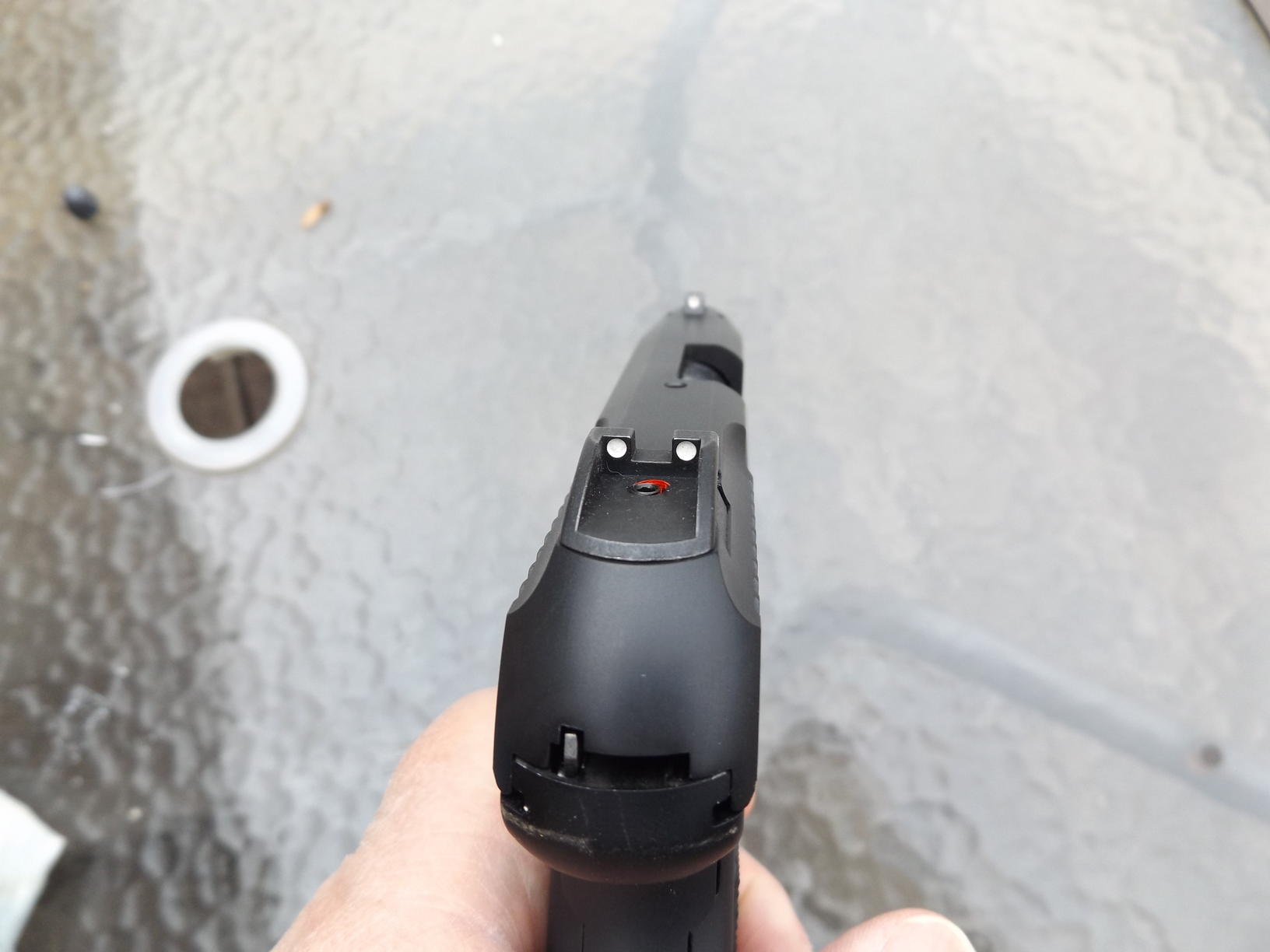
The R51 has a white, three-dot sight system, and it is very fast to pick up. However, the rear sight can cause a slight, ever so slight, problem. Remington made the rear sight very futuristic and slick. It rises from the rear of the slide and gets higher as it gets further forward on the rear of the slide. The two white dots are nestled in the front of the sight, so much so that if there is sunlight or any light off to the side of the rear sight it can slightly shadow one of the white dots. I tried to capture this event with my camera, but the camera pics just wouldn’t cooperate. While this really isn’t a problem, with one of the rear white dots being a little bit shadowed, when the light is off to the side of the rear sight, I still thought it was worth mentioning.
The polymer trigger, at first, seemed a little bit on the small side; however, it really isn’t. It works perfectly, and the trigger pull is very crisp, releasing at 5.5 lbs. There is a tiny bit of take up and then resistance, and then the trigger breaks cleanly. My second small complaint is the grip safety. It makes a “click-clack” noise when you depress it and release it. It is more annoying than anything. Unlike the grip safety on a 1911, this one is hinged on the bottom of the frame, instead of up towards the top of the frame. It doesn’t operate nearly as smoothly as that on a 1911. Still, it gets the job done, and it depresses with about a pound of pressure. After firing the gun during my testing, I noticed that the “click-clacking” sound wasn’t nearly as noticeable, and it seemed to smooth out a bit, too.
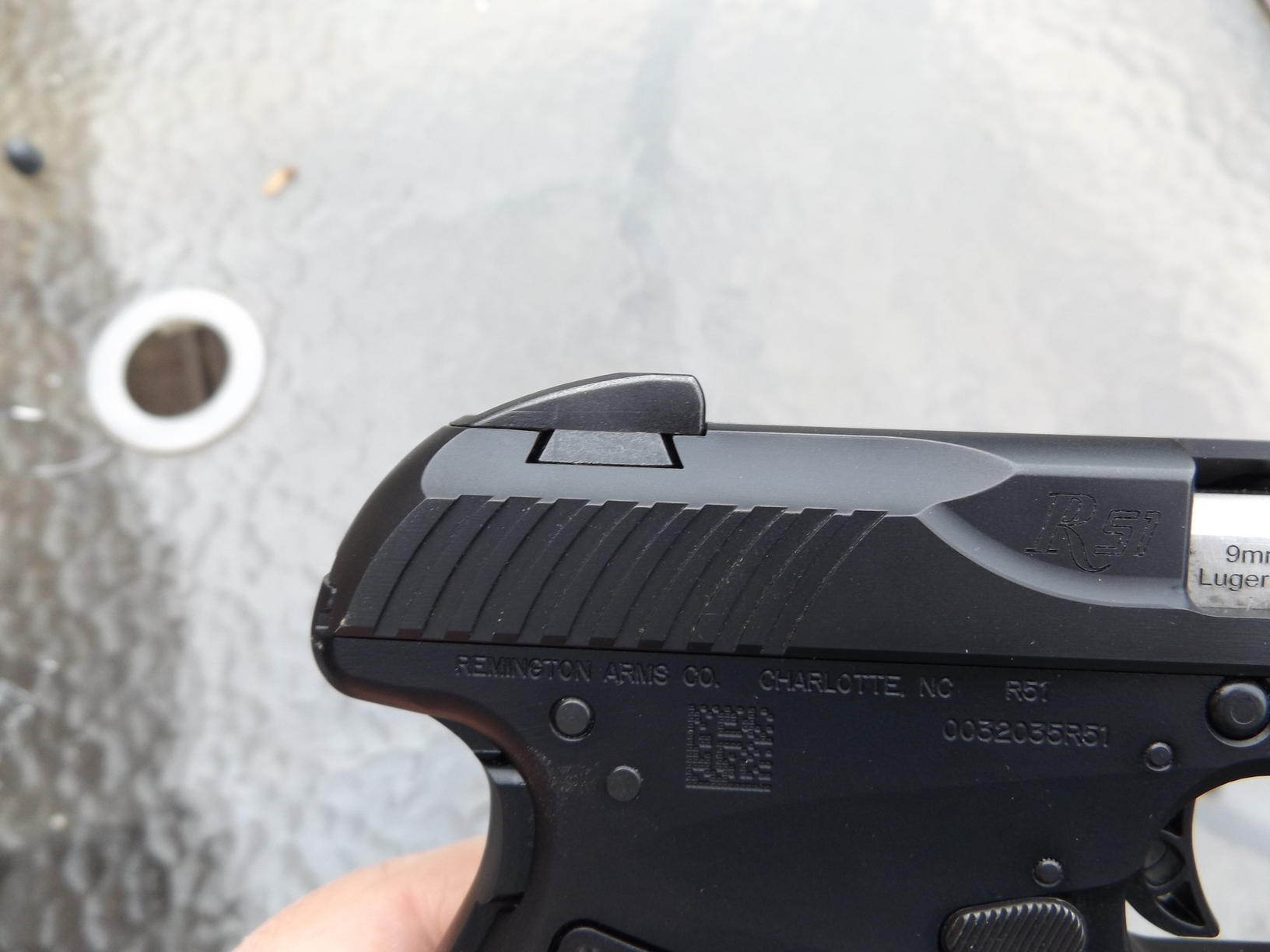
On the front of the grip frame is some nice checkering at about 20 lines per inch. This is a nice touch. The grip safety has no checkering. The trigger guard is big enough for my trigger finger to get in there, just the perfect size. There are angled slide serrations on the back side of the slide for a sure grip when chambering a round. The ejection port is large. There are no worries about an empty piece of brass getting caught up in it. The slide release dropped the slide with a simple push on it.
Remington advertises that there is 25% less recoil, because the slide sits extremely low in the hand compared to other designs. And, to be sure, the gun rides nice and low, with the slide only about a quarter inch above the web of the hand when properly gripping the gun. That’s nice! It does have a very low bore-to-axis in the hand. I’m not sure if there is 25% less recoil. It’s hard to measure that type of event, but I’m sure there is less recoil compared to similar 9mm handguns. I will say that the R51 does get you on-target very fast, and it points extremely well. I’m a huge advocate for the lost art of Point Shooting, and the R51 does point naturally. When you bring the gun up to eye level, you are on-target! For more information on Point Shooting, check out my DVD from Paladin Press. My video is entitled “Tactical Point Shooting”. While it was done more than 20 years back, the information is still up-to-date. The DVD has myself, Sheriff Jim Wilson, and the late John McSweeney demonstrating three different methods of Point Shooting.
Remington says the grip angle is 20 dgrees, and it feels like it. I don’t recall any gun that points more naturally than the R51 does for me. The gun feels absolutely fantastic in the hand. Everyone who handled it said the same thing. Great job, Remington!

Now, to the 3.4-inch “fixed” barrel that Remington advertises. Not so fast there, Remington. The barrel is “fixed” in place when the gun is assembled and fired. However, the barrel is not permanently fixed to the frame. When you disassemble the R51 for routine maintenance and cleaning, the barrel is removed from the slide/frame. The barrel is fixed to the frame via the slide stop/release when the gun is assembled. The barrel does NOT move back and forth or up and down upon firing. A fixed barrel gun is almost always more accurate than guns that have barrels that move during firing.
My one main complaint, and it is still a minor complaint, is the disassembly of the gun. It is more than a little bit tricky, to be sure. Instead of my trying to explain it, go to https://www.remington.com/handguns/remington-r51 and watch the four and a half minute video that shows how to disassemble and reassemble the R51. Don’t get discouraged. It really isn’t all that hard after you’ve done it a few times. Practice! BTW, the “threads” you see on the barrel, they are not for attaching a suppressor. They are there to aid you in disassembly of the R51.

The barrel of the R51 is marked 9mm Luger +P. I don’t recall seeing any 9mm handguns that were specifically marked for +P ammunition. While owner’s manuals will advise you can shoot +P ammo in many 9mm chambered handguns, they also advise that it shortens the life of the gun. However, this gun thrives on 9mm +P ammo, and I did test some +P+ ammo in the gun. I had not a single problem with this hotter ammo. I had but one malfunction, and that was in the first magazine where one round didn’t fully chamber. Again, this was in the first mag, and no other problems were observed.
For my testing, I had a great selection of 9mm ammo on hand. From Buffalo Bore Ammunition, I had their 147-gr JHP Subsonic Heavy load, 147-gr +P Outdoorsman Load, Hard Cast FN +P load, 115-gr Barnes TAC-XP all-copper hollow point +P+, 95-gr Barnes TAX-XP all-copper hollow point +P+, and their 124-gr FMJ FN +P+. From Black Hills Ammunition, I had their 115-gr JHP +P, 124-gr JHP +P, 115-FMJ, 115-gr EXP (Xtra Power) hollow point, and their 115-gr Barnes TAC-XP +P load.
The R51 just seems to run a little bit smoother with the +P and +P+ loads, compared to standard velocity loads. Go figure? The lone malfunction I had was with a FMJ load, and as mentioned it was the first magazine I fired through the gun. The round didn’t fully chamber. After that, I had no problems. As to accuracy, I tested the gun rested over a sleeping bag on the back of my pickup with the target at 15 yards. I had groups as small as two inches. They were with the Black Hills 124-gr JHP +P and the Buffalo Bore 124-gr FMJ FN +P+ loads. That is outstanding accuracy from a 3.4-inch barrel handgun, and I believe with more use and practice, I can get groups well below two inches. The gun showed a lot of potential. All the other loads didn’t exceed three inches. In all, I fired 300 rounds of ammo during my testing for this article and even more rounds after my testing that were not recorded.
I tried, I really tried to not like the R51, but the gun just grew on me. The more I shot it, the more I liked it. The more I handled it, the more I liked it. The few minor complaints, like the problem with the rear sight dot being shadowed and the grip safety making a little bit of noise plus the take-down procedure– those are very minor complaints to my way of thinking. The gun is super slick. There are, no sharp edges or corners. It is fast in the hand and very fast on follow-up shots, too. Full retail is $448 but can be found for under $400. This one is a keeper. Did I happen to mention how much I loved this gun? Yeah, I thought so.
– Senior Product Review Editor, Pat Cascio
Recipe of the Week: Glazed Corn Beef, by J.T.
Ingredients:
- 3½ to 4 lbs corned beef
- Water
- 2 Tbsp prepared mustard
- 1½ tsp horseradish
- 2 Tbsp red wine vinegar
- ¼ cup molasses
Directions:
- In a pot, cover corned beef with water.
- Cover and cook on low for 6 hours (making sure the water always covers the meat; add more water if necessary).
- Drain the cooked corned beef and place on a broiler pan or oven proof platter.
- Combine mustard, horseradish, wine vinegar, and molasses.
- Brush sauce on all sides of meat.
- Brown in 400° oven for about 20 minutes or until it begins to brown; brush with sauce several times while browning.
Makes 6 to 8 servings.
o o o
Do you have a favorite recipe that would be of interest to SurvivalBlog readers? Please send it via e-mail. Thanks!
Letter Re: Purchasing Power
HJL:
That was a great article series. I personally work to create things with my knowledge, skill, and labor that will ride with inflation. Since I do it myself, my labor goes into the thing that rides with inflation without being taxed. I’ll also note that insurance companies watch very carefully what they will have to pay to fix your car or your house and adjust rates accordingly. My income is a percentage of that premium. My income is therefore indexed. The other side of the coin is that when business activity drops by half, like it did in contracting in 2008, premiums drop by half and I have to give back compensation long since spent. Oh the joy! Any merchant type activity gets you indexed income with vigilance.
No plan is foolproof. So there is no perfect solution, but you have to figure out how to index and lawfully avoid the taxes. JWR’s Tools for Survival figures into this. When I build a project, probably 70% of the hardware comes from current inventory. I grimace when I replace the used items, as the prices have risen, but it represents a hedge. Also, in acquiring the tools, you are schooled to learn how to use them. Up goes the value of your property as you practice. Down goes the cost to live, assuming your project made it less expensive or more convenient at your property. Likewise, my stored fuel keeps me from anxiety along with having to run down to the gas station and pay any price when there is a fire in Alabama disabling the pipeline that serves Atlanta. For the record, I did go top off but only after judging that the price was reasonable. Up goes your confidence when you embrace the capabilities you command that are so essential to navigating this very difficult world. – RV
Economics and Investing:
Silver advances boost demand – DSV
o o o
Why President Trump Will Fumigate the Fed
o o o
Markets Are Changing, And People Are Going Crazy
o o o
Whistleblower Andrew Maguire – This Is What The Commercial Banksters Are Up To In The Gold Market
o o o
SurvivalBlog and its editors are not paid investment counselors or advisers. Please see our Provisos page for details.
Odds ‘n Sods:
Here is an oddity: Dr. David Powers, a USMC veteran, has compiled and published a collection of nonfiction extracts from my first novel, Patriots. He never asked for my input, so he misconstrued a couple of items. But overall, it seems to be the product of a man with an exacting mind. – JWR
o o o
Here is another video with some ideas that are applicable to Bug Out vehicles: Vanlife with no filter: couple records work/life on wheels
o o o
An interesting interview with an American serving alongside the Kurds: Interview With an American Peshmerga – W.C.
o o o
Several readers have written in to remind us that the election isn’t actually over yet. The Electoral Votes still have to be cast, on December 19th. History shows that Electoral Vote defections, while rare, do happen. However, never in the history of the United States has there been a mass defection resulting in a different president. – HJL
Jim’s Quote of the Day:
“Hillary Clinton did not hit a glass ceiling, she hit a ‘lead’ ceiling. America’s gun owners turned out to vote and made the Second Amendment great again.” – Second Amendment Foundation founder Alan Gottlieb
Notes for Sunday – November 13, 2016
Continental Army Brigadier General Richard Montgomery took Montreal, Canada without opposition on this day in 1775.
Robert Louis Stevenson, author of Treasure Island, Kidnapped, and Doctor Jekyll and Mr. Hyde, was also born in Scotland on November 13th, 1850.
o o o
Please continue to pray for President-Elect Trump and his transition team. There is now growing concern that he is “modifying” his positions and “seeking common ground”. Most troubling is that he is now planning on keeping Obamacare (and just “fixing” it), and that he has backed away from his stated goal of eliminating the EPA. Please pray that Mr. Trump keeps his campaign promises for LESS government! – JWR
The Drama is Not Over: It is Still Time to Pray and Take Action, by Sarah Latimer
Well, it has been an eventful month since I last wrote on SurvivalBlog. I decided to take my own advice and enjoy some of those Golden Moments of Silence, where I simply soaked in special moments, beauty, God’s Word, made memories with those I love, and deposited these inspirations in my soul. Since I last sat in front of my keyboard to address you, I have enjoyed fellowship with numerous friends and family, seen some spectacular sights, and experienced dramatic events, most of which were wonderful and beyond description. I have made some new “survivalist” friends and gained greater respect from some serious homesteaders who are venturing into new (and rather ancient) methods of doing things. It has been an amazing month, for the most part. However, there were some very serious moments that reminded me of the sinful world in which we live and were far from “golden”.
One cannot travel or talk with many people without being subjected to or hearing firsthand accounts of serious, violent crimes. This was my experience as well. I am thankful that all of my loved ones are safe and sound, but I was reminded what a very dangerous world we live in. I am thankful that we have the means to protect ourselves and law enforcement to lock away (at least for a time) violent offenders. I am thankful for Second Amendment rights, and I am even more thankful for God’s watchful hand and His Spirit to guide us when danger lurks.
Throughout the month’s festivities, part of me wondered if this was the last “hooray” before we began adjusting in an escalated departure of our American liberties and freedoms. I was trying to emotionally prepare for the possible consequences of having to live through the next four years under Hillary Rodham Clinton as President of the United States. Thankfully, we will not know what those four years would have brought to us. She promised gun control, womens’ right to kill their children up to the point of birth, punitive consequences for anyone who did not embrace and facilitate all sexual behavior, and so much more. She was no friend of our ally, Israel, but was a close friend of its sworn enemies. I am tired of hearing about Hillary. I am tired of the election, but the issues discussed during this campaign are far from resolved by the election and remain of great concern to all of us.
Our nation’s security, economy, employment, healthcare system, as well as international conflicts and our ability to diplomatically or militarily deal with these are among the more serious issues at hand. Individual liberty and property right issues are out of control. Church, synagogue, and religious non-profit organizations’ ability to operate and function separate from state control and scrutiny is being threatened. Of course, gun control laws are a problem that need to be resolved and many retracted, because the Second Amendment provides for the enforcement of all rights and liberties of the people against tyranny or a government that would threaten our basic rights and liberties. This is certainly not a comprehensive list of issues that need addressing; however, it is enough to remind us of the enormous burden being placed upon President-elect Trump and his executive staff as well as Congress.
The election is over, and I have stopped praying over the selection of the man/woman that is God’s will to lead our nation, state, district, and so forth in these various elections. It is easy to now think that any one of us can make no difference and that it is all on Trump’s shoulders and those in various lower offices to make the lives of Americans better (or worse). I am here to tell you, it is not up to Trump or anyone in political office! The majority of the choice rests with you and me! It’s not out of our hands.
What can you and I do? There are two extremely important things:
The first and most important one is to pray and listen to the God of Abraham, Isaac, and Jacob, recognizing that He is our ultimate ruler and has authority over all nations and people. He not only knows that past and present, He knows the future. He allows mankind to have choices, but He also has a plan that He will see accomplished.
“Therefore thou shalt love the Lord thy God, and keep his charge, and his statutes, and his judgments, and his commandments, alway. And know ye this day: for I speak not with your children which have not known, and which have not seen the chastisement of the Lord your God, his greatness, his mighty hand, and his stretched out arm, and his miracles, and his acts, which he did in the midst of Egypt unto Pharaoh the king of Egypt, and unto all his land; “ – Deut. 11:1-3
The Lord of hosts hath sworn, saying, Surely as I have thought, so shall it come to pass; and as I have purposed, so shall it stand:” Is. 14:24
He is our ultimate provider. It is in Him that we can choose to have an eternal citizenship through His Son, Jesus. While you and I cannot sign a bill or meet with a nation’s leader, we have connection with the eternal Sovereign and, through Him, we have authority, for no ruler has any authority and no man can do anything outside the permissive authority of God.
“Let every soul be subject unto the higher powers. For there is no power but of God: the powers that be are ordained of God.” Romans 13:1.
We need to be in tune with God’s Spirit to heed His voice when He gives us instruction for how to care for ourselves, our families, our communities, and/or our nation. We need to pray with prayers of petition on behalf of our nation and others, but we also need to pray prayers where we listen and ask for instruction and guidance. We need to pray His Word and take time to be still and listen. He speaks to those who draw near, and He gives instruction. This is evident all through the Bible. When in the spiritual (not yet physical) presence of the Most High God, to whom I have repented and strive to walk holy, I cannot help but find perfect peace, regardless of the chaotic world around me.
“Thou wilt keep him in perfect peace, whose mind is stayed on thee: because he trusteth in thee.” Is 26:3
The second thing you and I can do is to live right and take care of our business of living and preparation with integrity and honesty, compassion, and awareness, according to God’s instructions in His Word. He has given us excellent guidance in how to conduct ourselves and warns us to guard against and stay clear of the enemies of our mind, body, and soul. I want to emphasize the guarding against things of the mind and soul, because as believers we are not merely wrestling against things of a physical nature, though those are serious matters, of course.
Apathy toward God’s Word is an epidemic, in my opinion. The apostle Paul very plainly warns us of the danger of spiritual wickedness in Ephesians 6. It is not appropriate to blame Satan either. He has no power to force his will on someone who belongs to God. I despise that phrase “the devil made me do it.” We choose righteousness or evil, and we are blessed with or suffer the consequences. Yes, there are temptations put in front of us, but we have to make the choice. I’ve made plenty of mistakes myself, and the consequences I’ve suffered are of my own doing. I am thankful for a loving God who disciplines His children to teach them. I have learned and grown because of His discipline and am thankful for those lessons. I’m sure my life would have been much harder had I not learned those lessons. Here’s what Paul writes:
“Children, obey your parents in the Lord: for this is right. Honour thy father and mother; (which is the first commandment with promise;) that it may be well with thee, and thou mayest live long on the earth. And, ye fathers, provoke not your children to wrath: but bring them up in the nurture and admonition of the Lord.
Servants, be obedient to them that are your masters according to the flesh, with fear and trembling, in singleness of your heart, as unto Christ; not with eyeservice, as menpleasers; but as the servants of Christ, doing the will of God from the heart; with good will doing service, as to the Lord, and not to men: knowing that whatsoever good thing any man doeth, the same shall he receive of the Lord, whether he be bond or free. And, ye masters, do the same things unto them, forbearing threatening: knowing that your Master also is in heaven; neither is there respect of persons with him.
Finally, my brethren, be strong in the Lord, and in the power of his might. Put on the whole armour of God, that ye may be able to stand against the wiles of the devil. For we wrestle not against flesh and blood, but against principalities, against powers, against the rulers of the darkness of this world, against spiritual wickedness in high places. Wherefore take unto you the whole armour of God, that ye may be able to withstand in the evil day, and having done all, to stand. Stand therefore, having your loins girt about with truth, and having on the breastplate of righteousness; and your feet shod with the preparation of the gospel of peace; above all, taking the shield of faith, wherewith ye shall be able to quench all the fiery darts of the wicked. And take the helmet of salvation, and the sword of the Spirit, which is the word of God: praying always with all prayer and supplication in the Spirit, and watching thereunto with all perseverance and supplication for all saints” Ephesians 6:1-18
As we continue in faith, peace, love, and joy to go about life, we are a bright light that shines and reflects the strength of God and brings honor to Him in this dark world. Have hope but don’t let your hope be in President-elect Donald Trump or any man (or woman). Let your hope be in God. Then, you will not be disappointed!
I recently read a book, America’s Controversy with God’s Covenant that walks readers through the history of our nation and how it has been under a covenant of blessing with God, though this is changing. The authors– Perry Stone and Bill Cloud– wrote:
“First of all, we must acknowledge that time and space preclude us from listing and quoting even a small fraction of the material available which supports the argument that this nation was founded, settled and developed by people who believed in, prayed to and strove to faithfully serve the God of Israel. Consider that when over 15,000 quotes obtained from various papers, articles and books attributed to the Framers and Founders were evaluated, the results showed that 35% of these quotes were taken directly from or inspired by the Bible.”
“If they (the early colonists, such as William Bradford of Plymouth Plantation) perceived their efforts in Massachusetts to be part of a larger plan designed by the Great Architect, they also understood that success would require that their energies be spent on spiritual objectives so much, if not more so, as on building fences, homes and roads. If we may phrase it this way: they committed themselves to live according to the essential elements of the covenant demonstrated in the Scripture, ratified by the blood of Messiah– ‘Love the LORD your God with all your heart’ and ‘Love your neighbor as yourself.’ This would bring them prosperity.”
I want to encourage you, today, to walk with integrity, according to God’s Word and ways, which are consistent. Our God is not inconsistent. He does not have a Plan B or Plan C. He does not condone immorality. He blesses those who honor Him. Our nation has been blessed for centuries. We are teetering on the brink of destruction. Prayer, I believe, is not enough to save it. We must change our ways.
I do not know how well President-elect Trump will do to hold America together, confront our enemies, and face these many other challenges. However, I want to encourage all of us, especially my sisters in the LORD, to not be weak or fearful. We must keep our eyes on the LORD, for He is our strength, our redeemer, and our shield. Let us honor Him in all we do and say. Let us be part of keeping the blessing, if not for our nation then for our family and for ourselves.
May you find some “golden moments” of inspiration to deposit in your soul for the days ahead, and may God bless you!
Letter Re: Older Swiss Franc Note Invalidations
HJL,
Having experienced some disappointments with foreign currencies both in minor personal matters and in business (as well as some successes). Repeated mention of the Swiss Franc here on SurvivalBlog piqued my interest. When I first became involved in currency, I took a look through the souvenirs my family brought back over the years. I was happy to see a 10 SFr note there. My presumption was that surely this must be something! Disappointment followed shortly thereafter, when it turned out to be nothing more than a piece of colored paper by that time.
There is one fact regarding the Franc that may be worth drawing attention to that I have not found mention of on the site. Periodically, the Swiss National Bank invalidates a previous series of currency. As of 2016, they are in the process of issuing a new (9th) series of bank notes. When that is complete, one should expect the possibility that they will withdraw the previous (8th) series. If one reviews the Swiss National Bank website’s page on banknotes one can note the following:
- 9th Series: in process of being issued in 2016
- 8th Series: remains legal tender until further notice
- 7th Series: never issued
- 6th Series: recalled in 2000, may be exchanged at the Swiss National Bank until 2020 after which they have no value
- 5th to 1st Series are all withdrawn and have no legal tender status
Anyone holding Swiss Franc notes would first want to attend to any 6th series they have as soon as possible, then consider the 8th series. If previous patterns are repeated, then one would want to be prepared to exchange notes. Questions to be asked are:
- How long do you visualize holding them?
- Would banks and currency exchanges that deal in foreign currency accept 8th or 6th series in exchange for dollars?
- Would banks and currency exchanges that deal in foreign currency be willing to do a trade for new notes?
- Would there be a fee?
- Can any of them answer that question now and guarantee what they might promise?
- Do you want to count on what they say?
- Will you have the opportunity to carry them to Switzerland yourself (considering both limits on export of currency and safety)?
My old 10 SFr note was from the 5th series and still makes me feel the loss whenever I look at it (not often). In these matters, time can creep up on one too easily and leave one with pretty paper you may never want to look at! – Rob