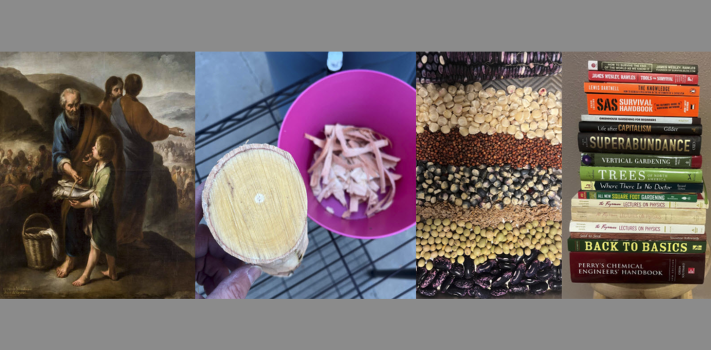
Loaves, Fishes, Tree Bark, Seeds, and Knowledge – Part 4, by The Chemical Engineer

(Continued from Part 3.) 2.5 – Options For Using Local Cambium Resources If we have prepared beforehand to harvest tree cambium and a Type 2 Emergency (T2E) happens, we will have three main choices to consider in my view. I encourage you to make this decision prayerfully and with your group’s best judgment. Every choice in a disaster is a set of trade-offs with no perfect solutions. If we actively try and help our neighbors early there is no doubt that this will reduce early suffering for some and could lead to ongoing beneficial cooperation. If more people are pulling …
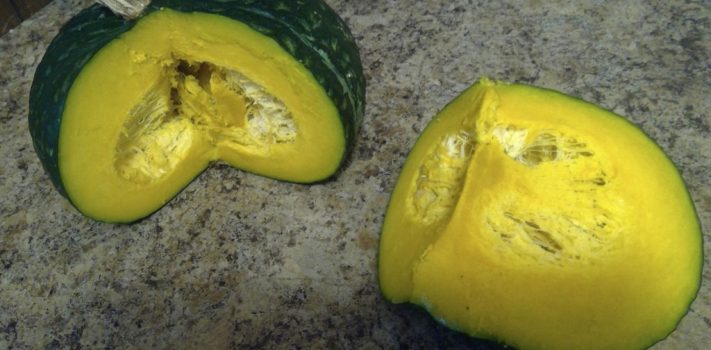

Growing Kabocha Squash, by Rookie Gardener

Until my retirement in the summer of 2021, I had never grown anything but weeds, which evidently, I’m pretty good at. However, growing anything else was hit and miss, mostly miss. During my working life my wife and I spent a lot of time in Asia. One of the commonly used vegetables often sliced thin, breaded, and deep fried on tempura platters is kabocha squash, also called Japanese pumpkin. Kabocha is a winter squash with a creamy texture. It’s used in many Asian cuisines. We could not bring home seeds but here we found that we could purchase them online …


A Three-Year Window or a Three-Month Window?

As an observer of contemporary politics, economics, and emerging threats, I have come to the conclusion that the last three years of Donald John Trump’s second term as President may provide a potential window of opportunity. If we were now living under a Harris-Walz Administration, we would surely be out of time to prepare. I have my doubts about Trump’s sincerity when he talks about scaling back the size and power of government. Alarmingly, the gains of the DOGE project were wiped out by the huge deficit spending included in the recent  “Big, Beautiful Bill”.  But I don’t consider DJT …


The “Come as You Are” Collapse–Have the Right Tools and Skills

Introductory Note From JWR: This article is an update and small expansion to a succinct post that I made back in February, 2008. When the Second World War broke out in September, 1939, the United States had nearly two full years to ramp up military training and production before decisively confronting the Axis powers. In the mid-1970s, looking at the recent experience of the 1973 Arab-Israeli War, the Pentagon’s strategic planners came to the realization that the next major war that the US military would wage would not be like the Second World War. There would not be the luxury …


The Time to Plan is Now, by Prepping Engineer

The single biggest reason for failure is failure to plan. “When you fail to plan, you plan to fail” Another way to think of this is: planning is being prepared. That is prepping in a nutshell! This is stated in many publications and articles about many subjects. I have experienced this more times than I can remember in my life. What I have noticed the most is the repetition of this error by both people and groups. Sometimes this seems to persist and someone else “helping” them out of the repeat failure to plan. It is a mistake the first …


Get Ready for Tariff War 2 or World War 3

This brief essay serves as a reminder, for the new year. As we enter 2025, both geopolitics and global economics are displaying some profound changes.  The Ukraine war, the fall of Assad’s government in Syria, and the ongoing civil wars in Burma (aka Myanmar), Yemen, Sudan, South Sudan, and Ethiopia all have the potential to spill over into wider conflicts. Ditto for potential invasions in Taiwan and South Korea. Meanwhile, the rise of the BRICS trade bloc, the out-of-control U.S. National Debt, global debt as a whole, and the run-up of precious metals prices are all evidence of deep-seated economic …


Fortifying Your Garden Soil, by Hollyberry

Perhaps the biggest boost you can give your garden is great soil. The seed/plant needs all the help it can get to grow and fruit. Soil will over time lose its nutrients and minerals so it is important to keep adding to it all year round. You can spend a lot of money on bags of fertilizer, worm castings and bone meal or you can get resourceful and do it cheaper or for free. The ideal PH for garden soil is 6.0 to 6.5. You can send in soil samples to various labs or the county cooperative extensions and receive …


Collards: Our Winter Staple, by A.F.

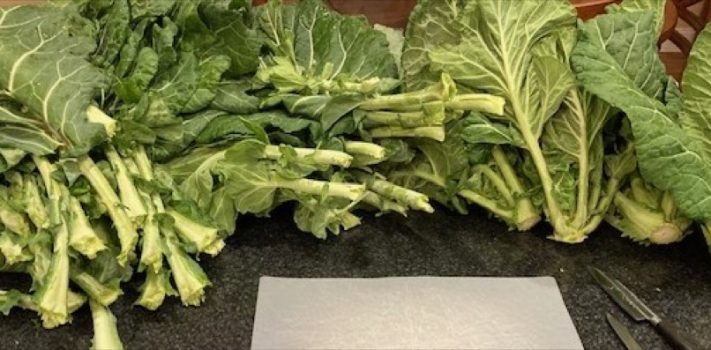
One of the aspects of living where we do I find most appealing is the long gardening season. It is possible to keep produce of one type or another growing in the garden year-round, (though this is not the same as saying we have harvestable vegetables for the full year). Kale is the most resilient thus far since a single fall planting can carry into the following June if there is not an early heat spell. Cabbage and broccoli are each suitable for both late winter and late summer plantings and typically yield well while requiring minimal effort. When life …


Thoughts on Retreats: History and Land – Part 5, by Single Farmer

Editor’s Introductory Note: This is the last part of a multi-part article series on retreats written by a Christian farmer who is praying and searching for a wife. Please prayerfully consider all of the topics that he discusses. (Continued from Part 4. This concludes the article.) Solutions: The Journey for Possible Future Retreat Owners It would be nice if there were other easy solutions out there. But for a family man the road of hard work done intelligently will often yield good results over many years. There are some who claim that you cannot save to afford land without a …


Thoughts on Retreats: History and Land – Part 4, by Single Farmer

Editor’s Introductory Note: This is part of a multi-part article series on retreats written by a Christian farmer who is praying and searching for a wife. Please prayerfully consider all of the topics that he discusses. — Economics of Land in the 21st Century Arable land is no longer free nor available at reduced cost. As you learned in Part 2, over a hundred million acres of land in our country were sold for some sweat, initiative, and a small filing fee during the main Homestead years from the 1860s to the 1930s. Even earlier, land was available for a …


Thoughts on Retreats: History and Land – Part 3, by Single Farmer

Editor’s Introductory Note: This is part of a multi-part article series on retreats written by a Christian farmer who is praying and searching for a wife. Please prayerfully consider all of the topics that he discusses. — Economics for Farmers The first lesson that I’d like to address in this installment is that our family is very conservative, economically. We chose to avoid all debt. Yes, it is a choice for most people. Debt is no longer passed down intergenerationally as it was previously in American history. As Christians, we are taught to avoid debt. In Proverbs, we are warned: …


Thoughts on Retreats: History and Land – Part 2, by Single Farmer

Editor’s Introductory Note: This is part of a multi-part article series on retreats written by a Christian farmer who is praying and searching for a wife. Please prayerfully consider all of the topics that he discusses. — The Land: Your Base of Operations Our farm can support the core food needs of hundreds of people. Farm productivity has been increasing much faster than the population. Over the space of two centuries, the number of people who are living on farms has decreased from almost universal to around two percent. Since the number of people who now live on farms is …


Thoughts on Retreats: History and Land – Part 1, by Single Farmer

Editor’s Introductory Note: This is part one of a multi-part article series on retreats written by a Christian farmer who is praying and searching for a wife. Please prayerfully consider all of the topics that he will discuss. — Preparedness Terminology History My family preparedness history goes back generations. Before the term “prepper” was used, people who were into preparedness were known as “survivalists” and even before then people were known as “retreaters.” Our survival library is very extensive covering preparedness-related subjects including original civil defense publications from the 1950s until today. I have spent many hours reading the articles …


The Final Countdown: Last-Minute Readiness Checks – Part 2, by Michael X.

(Continued from Part 1. This concludes the article.) Water List This is an item for the first three days. This is super important and needs to be one of the first items confirmed. Check locations and condition of water sources: Bottled Water/Stored water containers Well water (power dependent) Lake water – are there containers to carry and larger containers to store lake water? Is there a rainwater collection option available? Is the Berkey/Filtered water system ready? Can the tub be successfully filled with water from the system before the power goes out or the line pressure is gone? Can I …


The Final Countdown: Last-Minute Readiness Checks – Part 1, by Michael X.

Hypothetically, (of course), assume for a moment that the proverbial fan has been hit. Now you have three days….or two weeks….or two months…until the consequences of the event hit where you are. Good luck guessing how long it takes to hit you. Are you as ready as you can be? Are you sure? How do you know? How and when it hits you, whatever it may be, may be based on three key things: the type/cause of disaster, your proximity to the disaster or populated areas, and the stability of your systems (electricity, water, fuel, and human support systems). THE …