Writing Contest Prize Winners Announced — Round 123

We’ve announced the winners of Round 123 of the SurvivalBlog non-fiction writing contest, which ended yesterday.

Note to the top three prize winners: Please contact me and let me know your UPS and USPS address(es), for your prizes. Thanks. – JWR

The top three prize winners will each receive some great prize packages. The winners for Round 123 are…

First Prize Winner:

First Prize goes to Lodge Pole, for Raising, Hunting, and Harvesting Animals. It was posted Feburary 11-16, 2026. See: (See: Part 1, Part 2, Part 3, Part 4, Part 5, and Part 6.)  He will receive as prizes:

  1. A Gunsite Academy Three Day Course Certificate. This can be used for any of their one, two, or three-day course (a $1,095 value),
  2. A Peak Refuel “Wasatch Pack” variety of 60 servings of premium freeze-dried breakfasts and dinners in individual meal pouches — a whopping 21,970 calories, all made and packaged in the USA — courtesy of Ready Made Resources (a $350 value),
  3. American Gunsmithing Institute (AGI) is providing a $300 certificate good towards any of their DVD training courses. Their course catalog now includes their latest Survival Gunsmithing course.
  4. HSM Ammunition in Montana is providing a $350 gift certificate. The certificate can be used for any of their products.
Second Prize Winner:

Second Prize goes to Hobbit Farmer for Beyond Organic: Biological Systems Gardening. It was posted March 19-23, 2026. (See: Part 1, Part 2, Part 3, Part 4, and Part 5.)

He will receive:

  1. A SIRT STIC AR-15/M4 Laser Training Package, courtesy of Next Level Training, that has a combined retail value of $679
  2. Two 1,000-foot spools of full mil-spec U.S.-made 750 paracord (in-stock colors only) from TOUGHGRID.com (a $287 value).
  3. Preparedness author Jennifer Rader is providing a $200 purchase credit for any of her eight published food storage and medical preparedness books, including the Good Eats at the TEOTWAWKI Café series, the Armageddon Pharmacy series, and the Medicine Surrounds Us series.
  4. A transferable $150 FRN purchase credit from Elk Creek Company, toward the purchase of any pre-1899 antique gun. There is no paperwork required for delivery of pre-1899 guns into most states, making them the last bastion of gun purchasing privacy!
Third Prize Winner:

Third Prize goes to J.M., for Mobile Device Battery Management.  It was posted February 19-22, 2026. (See: Part 1, Part 2, Part 3, and Part 4.) He will receive:

  1. A Berkey Light water filter, courtesy of USA Berkey Filters (a $305 value),
  2. Two sets of The Civil Defense Manual, (in two volumes) — a $193 value — kindly donated by the author, Jack Lawson.
  3. A $200 credit from Military Surplus LLC that can be applied to purchase and/or shipping costs for any of their in-stock merchandise, including full mil-spec ammo cans, Rothco clothing and field gear, backpacks, optics, compact solar panels, first aid kits, and more.
  4. A transferable $150 FRN purchase credit from Elk Creek Company, toward the purchase of any pre-1899 antique gun.
Honorable Mention Prizes

The writers of the Round 123 Honorable Mention articles will each receive a transferable $100 FRN purchase credit from Elk Creek Company, toward the purchase of any pre-1899 antique gun, or any knife or bayonet.  There is no paperwork required for delivery of pre-1899 guns in most states, making them the last bastion of gun purchasing privacy!

There were six Honorable Mention prize-winning articles in Round 123. They are:

Get Busy Writing!

Round 124 begins today and runs for two months, so please get busy writing and e-mail us your entry. More than $984,000 worth of prizes have been awarded since we started running this contest. In 2023, we polled blog readers, asking for suggested article topics. Please refer to that poll if you haven’t yet chosen an article topic. Remember that there is a 1,500-word minimum, and that articles on practical “how-to” skills for survival have an advantage in the judging. Thanks, – JWR




Keeping God’s Appointed Times, by Avalanche Lily

Today is Passover (“Pasach”). So this is an appropriate day to discuss The Appointed Times.

The Bible teaches that God has specific Appointed Times (מועדים — transliterated Moedim), which are to be kept in perpetuity (“throughout your generations“), by His People.  Failure to observe the Appointed Times offends God.Continue reading“Keeping God’s Appointed Times, by Avalanche Lily”


SurvivalBlog Readers’ & Editors’ Snippets

Our weekly Snippets column is a collection of short items: responses to posted articles, practical self-sufficiency items, how-tos, lessons learned, tips and tricks, and news items — both from readers and from SurvivalBlog’s editors. Note that we may select some long e-mails for posting as separate letters.

It is time to contact your U.S. House and Senate members again, to encourage them to get both the Hearing Protection Act (HPA — de-regulating suppressors) and the SHORT Act (de-regulating SBRs and SBSes) into the pending budget reconciliation bill, and pass them! Please phone their offices several times.

o  o  o

#2 Son suggested this very practical piece: Do-It-Yourself Air Cleaners: Making Cleaner Air More Accessible.

o  o  o

SurvivalBlog Editor-At-Large Mike Williamson posted some cogent observations on Hardened Aircraft Shelters (HAS), over at Facebook.

o  o  o

Continue reading“SurvivalBlog Readers’ & Editors’ Snippets”


The Editors’ Quote Of The Day:

“When a man says he is building a house for himself and his posterity, he does not mean to be understood as saying that he has any thought of binding them, nor is it to be inferred that he is so foolish as to imagine that he has any right or power to bind them, to live in it.” – Lysander Spooner


Preparedness Notes for Tuesday — March 31, 2026

On March 31, 1917, the Danish West Indies were officially ceded to the US for $25 million and renamed the Virgin Islands. Pictured is St. Thomas Island.

March 31 is the birthday of the late economist Dr. Walter E. Williams, PhD., who was born in 1936. He passed away in 2020. His book American Contempt for Liberty is highly recommended.

Today we present an article that was too short to qualify as an entry for the SurvivalBlog non-fiction writing contest. More than $981,000 worth of prizes have been awarded since we started running this contest.  Round 123 ends today, so get busy writing and e-mail us your entry for Round 124. Remember that there is a 1,500-word minimum, and that articles on practical “how-to” skills for survival have an advantage in the judging. In 2023, we polled blog readers, asking for suggested article topics. Please refer to that poll if you haven’t yet chosen an article topic.


Monitoring Ship and Aircraft Traffic, by Ohio Galt

I have always been interested monitoring ships and air traffic around the world, especially since 9/11. On that day I was fishing for salmon out of the middle of Lake Michigan, a very clear day and I noticed every jet in the sky was turning into a different direction heading somewhere else. Turning on the Marine radio and started to hear the chatter of what was going on around the country, I finished my sandwich and headed the boat for the harbor.

Since then I have learned of several websites that show real-time movement of ships and airplane around the world. Almost any airplane that can fly above 10,000 feet or with a set number of miles of class A, B, or C airspace will have a transponder providing their position and identification. I’m not a pilot (although it is on my bucket list to get a pilot’s license) so I don’t know the exact rules on transponders but I wanted to point out the ability of the public to monitor planes in the sky. Think of this as Open Source Intelligence (OSINT.)Continue reading“Monitoring Ship and Aircraft Traffic, by Ohio Galt”


SurvivalBlog’s American Redoubt Media of the Week

This weekly column features media from around the American Redoubt region. (Idaho, Montana, eastern Oregon, eastern Washington, and Wyoming.) Much of the region is also more commonly known as the Inland Northwest. The high-resolution thumbnail below is click-expandable.

Redoubt News Links:

Send Your Media Links

Please send your links to media from the American Redoubt region to JWR. Any photos that are posted or re-posted must be uncopyrighted. You can do so either via e-mail or via our Contact form.


Preparedness Notes for Monday — March 30, 2026

On March 30, 240 BC, Halley’s Comet made its first recorded perihelion passage. (Photo courtesy of NASA, from the 1987 comet passage, photographed from Easter Island.)

March 30, 1856: The Russian Empire, the Ottoman Empire, Great Britain, France, and the Kingdom of Sardinia signed the Treaty of Paris. This ended the Crimean War.

Today’s feature article is by our Field Gear Editor, Tom Christianson.


Ballistol Multi-Purpose Lubricant, by Thomas Christianson

Ballistol is a gun cleaning oil. If my sources are correct, it is composed of white mineral oil, potassium oleate, ammonium oleate, benzyl alcohol, amyl alcohol, isobytyl alcohol, benzyl acetate, and anethole.

One key characteristic of Ballistol is that it emulsifies with water. This makes it an excellent cleaner for firearms that use black powder or corrosive primers. The best solvent for black powder and the salts left by corrosive primers is hot (almost boiling) water. Ballistol works well in conjunction with that hot water. Ballistol is also non-toxic, and can also be used on wood and leather as well as steel.

In my testing, Ballistol did not protect against corrosion as well as Breakfree CLP. As a result, I would recommend using Ballistol in conjunction with hot water for cleaning the bores of firearms utilizing black powder or corrosive primers. But I would recommend following that cleaning by using Breakfree CLP on those firearms as a lubricant and protectorant. (Note: with black powder firearms, the CLP should be used extremely sparingly inside of chambers and barrels. Oils can contaminate black powder, thus rendering it less effective. Often it is helpful to fire a non-corrosive percussion cap into a chamber prior to loading it in order to burn away any oil that might otherwise contaminate the powder).Continue reading“Ballistol Multi-Purpose Lubricant, by Thomas Christianson”


Recipe of the Week:

The following recipe for Granny’s Spring Greens Salad is from SurvivalBlog reader Granny M..

Ingredients
  • 8 to 10 cups (around about 1 pound) of mixed greens (mixture of any available lettuces, sprouts, watercress, mesclun, mache, baby arugula, dandelion greens, and/or pea shoots)
  • 2 tablespoons finely chopped chives
  • Kosher salt and freshly ground black pepper (to taste)
  • 2 to 3 tablespoons extra-virgin olive oil
  • 1/2 lemon, juiced
Directions
  1. Wash and blot dry your greens with a clean dish towel, and place them in a large bowl.
  2. Add the chopped chives.
  3. Season with salt and pepper to suit your taste.
  4. Drizzle over about 2 tablespoons of olive oil.
  5. Toss well, to coat the greens.
  6. Squeeze lemon juice over the greens and toss the greens again.
  7. Taste and adjust the seasonings, if need be.
SERVING

Serve immediately.

Do you have a well-tested recipe that would be of interest to SurvivalBlog readers? In this weekly recipe column, we place emphasis on recipes that use long-term storage foods, recipes for wild game, dutch oven recipes, slow cooker recipes, and any recipes that use home garden produce. If you have any favorite recipes, then please send them via e-mail. Thanks!


SurvivalBlog Graphic of the Week

Today’s graphic: A map showing the United States and Canada, with comparable latitude locales in Europe overlaid. (Graphic courtesy of Reddit.)

The thumbnail below is click-expandable.


Please send your graphics or graphics links to JWR. (Either via e-mail or via our Contact form.) Any graphics that you send must either be your own creation or uncopyrighted.


The Editors’ Quote Of The Day:

“Between income taxes and employment taxes, capital gains taxes, estate taxes, corporate taxes, property taxes, Social Security taxes, we’re being taxed to death.” – The Late Chuck Norris


Preparedness Notes for Sunday — March 29, 2026

On March 29, 845, a 5,000-strong army of Danish Vikings invaded Frankish lands and only retreated after besieging Paris and securing a ransom from the Frankish King Charles the Bald. This was part of a series of devastating raids begun by the Vikings that began in the 790s. The Vikings were led by a man named “Reginherus” or Ragnar, sometimes linked to the legendary saga figure Ragnar Lodbrok. The Vikings easily overcame defences set in place by Charlemagne and are known to have attacked the Abbey of Saint-Germain-des-Prés just outside the city. The Vikings returned home with a ransom of 7,000 French livres of gold and silver.

March 29, 1638: The first permanent white settlement in Delaware, Fort Christina (now Wilmington), was founded by Swedish Lutherans.

And on March 29, 2004, Bulgaria, Estonia, Latvia, Lithuania, Romania, Slovakia, and Slovenia joined NATO as full members.

Today feature piece is by JWR.

We stilll need entries for Round 123 and Round 124 of the SurvivalBlog non-fiction writing contest. More than $981,000 worth of prizes have been awarded since we started running this contest.  Round 123 ends on March 31st, so get busy writing and e-mail us your entry. Remember that there is a 1,500-word minimum, and that articles on practical “how-to” skills for survival have an advantage in the judging. In 2023, we polled blog readers, asking for suggested article topics. Please refer to that poll if you haven’t yet chosen an article topic.


Notes on Constructing a 12 VDC Fuel Transfer Pump


JWR’s Introductory Note: This is an update to a reply to a letter that I posted in SurvivalBlog back in February 2007.  Given the recent spike in gasoline and diesel prices, I thought it would be apropos to re-post it.

Every well-equipped retreat should have at least one “field expedient” 12 VDC fuel transfer pump. These pump rigs are popular with dirt bike, ATV, and snowmobile enthusiasts. They are very simple to construct. Here are the materials that you will need:

1 – An automobile or truck electric fuel pump. (The least expensive pumps come from automobile wrecking yards.)

2 – Roughly 15-foot lengths of heavy rubber hose–approved for use as fuel line–of the proper diameter for the fittings on the fuel pump.

2 – Stainless steel fuel line clamps. (Such as “Aero-Seal” brand, or similar, that are tightened with a screwdriver.)

15 to 20 ft. – 16 AWG (or heavier) gauge insulated two-conductor wire. (This will be the power cord for the pump.)

1 – “Cigarette Lighter” type male plug, available from any auto parts store, or via eBay. (Again, for the power cord for the pump.)

1 – Roll of black plastic electrician’s tape or better yet, some thermoplastic “heat shrink” tubing.

1 – Scrap of 3/8″ thick (or greater thickness) plywood, measuring roughly 16″ x 16″. (On which to mount the fuel pump.)

The construction method should be self-evident, based on the materials listed above. The pump is mounted in the center of the board. If you’d like, you can add an electrical switch to the power cord for convenience, but make sure that you get a high amperage switch that is rated for DC, and that you position the switch within a couple of feet of the dashboard plug so that the switch is inside your vehicle. That way, there is far less chance of generating a spark inside a gas vapor cloud.

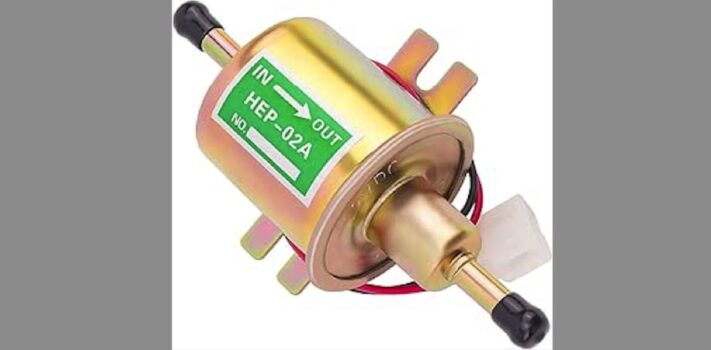
If your vehicle uses an electric fuel pump, then I suggest that you use an identical pump to the one used in your vehicle as the basis for your transfer pump project. (If your vehicle uses an electric fuel pump.) That way, you will have spares on hand, in the event that your vehicle’s fuel pump or any portion of your fuel system’s flexible fuel lines ever fail. If your vehicle uses a mechanical fuel pump or one that is submerged in your fuel tank, then just use a generic 12 VDC fuel pump like the one pictured above. These are widely available via eBay or a wide range of online vendors. Just do a web search on “low-pressure 12V fuel pump.”

By the way, you can also add an “in-line” fuel filter to your fuel transfer pump rig. Following a theme, it is best to use a filter cartridge that is identical to that used in your vehicle. (Always think: “Spares and redundancy, spares and redundancy”, like a mantra.)

The square scrap of plywood will keep the transfer pump out of the mud or snow. It also provides a handy place to mount some large hooks, so that you will have a neat way to coil up the power cord and the fuel transfer hoses, for storage. A 15-foot length of hose should be able to reach any vehicle fuel tank, or even down into an underground tank.

There are commercially-made equivalents to this field fuel pump rig, but they cost more, and they won’t provide you with a spare compatible fuel pump, for if or when your vehicle’s original pump goes Tango Uniform.

Important Provisos:

1.) All of the usual common-sense precautions for handling gasoline and gas cans apply:

  • Use only DOT-approved fuel containers.
  • No sparks.
  • No open flames.
  • Don’t turn on any radio transmitters.
  • Beware of static electricity build-up.

For more details, see this web page on fuel safety basics.

2.) Note that some later-model vehicles have “anti-siphoning” filler necks on their gas tanks. Check for this before you head for the boonies.

3.) Cover any exposed electrical connections with tape or heat shrink tubing, to avoid sparks or shorting.

4.) Transferring fuel with such a rig is best done as a two-man operation: One man inside the vehicle to keep an eye on your vehicle’s gas gauge and flip the switch (or pull the plug), and another man outside to handle the hoses and eyeball the filler necks,

Note: It is not just an expensive waste to spill gas on the ground. It is also toxic and a fire hazard!

By coincidence, soon after I wrote the first draft of my letter reply, I got an e-mail forwarded by Alfie Omega, a regular over at the outstanding Alpha Rubicon website. There, “Pike” has plans for building a very similar fuel transfer pump rig. (I surmise that he had seen the same type that I had.) A couple of nice touches with his design that mine lacked are that the mounting board has a carrying handle slot cut into it at the top-center, and there are hooks mounted all the way around the perimeter of the board, for hose and power cord stowage. But a couple of detractors: His photos show an on-off switch mounted to the board (which, as previously mentioned, could put it in proximity to gas vapors.) And I saw some exposed wiring terminals. If those terminals were touched by a metal object, they could cause a spark.

In conclusion: Plan ahead, design and build your “in-the-field pump” to last, and above all: be safe! –  JWR