
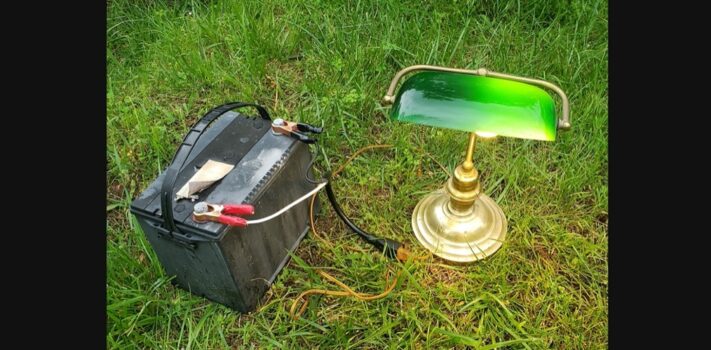


(Continued from Part 2. This concludes the article.)
Location Uses and Upgrades I Made
Kitchen Table – The table is under the beams which support the loft. With the table mostly being used as a work space and for playing games, a light hanging from above was needed. The lantern lights hanging upside down were enough for eating but more light would be preferable for other activities. As mentioned, the A-19 was the perfect solution. The shadowless light was as bright as the 120-volt lights they were replacing. For the test, the small riding-mower core battery was used to power the bulb. Using only 5 watts, if this light had its own dedicated 12-volt battery it would only have to be topped off once a week or so.
This A-19 setup worked so well I ordered a second one of these USB lights for my lighting preps before the test was completed, as well as a 6-pack of plain bulbs (6 for $22) for using in 120-volt lamps converted to 12-volt, and other similar uses.
Kitchen – Light is needed at many levels while cooking since we’re constantly changing the direction we’re looking: counter top, spice rack, top cupboards, lower cupboards, sink, and floor (three-second rule). The headlamp, shining light wherever I was looking, was the a practical solution during this test. Even on a low setting, it was sufficient.
A better solution for kitchen lighting would be one or two 12-volt A-19 lights with their own dedicated battery such as the one I used over the kitchen table.
The best post-SHTF long-term kitchen option for my particular kitchen would be to permanently jury rig the current circuit by switching it over to a DC line, then use just enough DC A-19 screw-in bulbs to see for cooking. My kitchen light circuit (4 bulbs) is a dedicated short-run line so this would be doable by using its own 12-volt vehicle battery.
Due to the potential dangers involved, I’ll leave out the details and leave it to the experienced electricians who are familiar with the peculiarities of DC wiring to figure it out for their use.
JWR Adds: To avoid potentially dangerous plug and outlet confusion in a house that has both DC and AC wiring, I recommend using Anderson Power Pole connectors on all of your 12 VDC device cords. Also note that many AC light switches are not rated to safely handle DC. Most traditional tubular-mount AC lamp switches will handle 12 VDC, but many modern AC wall-mount switches will not. And, of course you need fuses for DC — NOT AC circuit breakers!
Workshop – fortunately, the shop is used mostly in the daytime and the skylights really light the place up. The two 12-volt 16” LED strip lights I bought after the completion of the test provide more than adequate light for nighttime work.
Bathroom – Aside from showering, most of my bathroom use is during daylight hours when enough light is coming through the window to get things done. For all nighttime bathroom duties, only the dimmest light was needed and the battery-saving top light on the lantern worked well. One of the things that will take time when learning to use our post-SHTF lights will be where and how to position them. It sounds trivial and easily solved but it wasn’t that simple. In the bathroom, I finally found the best spot to hang it was above the window frame. I put a small finish nail there where it’s not noticeable.
Since the bathroom light is on for such a small amount of time each day, one of the lantern lights was the best choice. With a 4-hour battery duration time, the light would only have to be charged every few days or so, or could be quickly topped off daily to extend battery life.
Outdoor lights – During the test I decided that since they’re used so infrequently, deck lights wouldn’t be a necessity if the SHTF. My pocket flashlight was always handy for walking out to the shop, wellhouse, or vehicle, and the large rechargeable flashlight for all other things.
After the test, I discovered a good option with the motion detecting lights I bought in an attempt to keep Bambi & Co. away from the front flower gardens. They’re wall or post mounted and a small built-in solar panel keeps the battery charged. I have mine set so once activated, they’ll remain lit as long as the motion continues, then turn off after 30 seconds after the motion stops. Perhaps this would be a good option for outdoor lights when we’re stepping out onto the deck or porch. Another option keeps the lights on dim, then brighten once motion is detected. I’m not sure how long the rechargeable batteries last but motion-triggered lights might be worth having if the SHTF.
Reading Chair – The light which gets used the most is the one by my reading chair. Between checking my blogs before breakfast and working on reading, writing, research projects in the evening, for me a post-SHTF light for this area needs to be the best option available regardless of cost. After testing a lantern light, it was never under serious consideration. My reading light needed to be a warm light, I one that could run directly off its own dedicated 12-volt battery. I found what I was looking for in the form of a 14” tall goose-neck lamp, designed to be hard wired for RV use.
Light-duty extension cords, which some of us have way too many of, are good for various DC wiring purposes once the plugs are cut off each end. I wired the goose-neck lamp to one end, and for battery attachment, a pair of alligator clips to the other. I used zip ties to attach the lamp to the post of the floor lamp I currently use for reading.
At the brightest setting, the lamp only uses 4 watts. At a dimmer setting using fewer watts, the lamp provides more than enough light to read and work by. Even though the riding-mower core battery was never able to hold a charge over 10.9 volts, it was still providing enough light when I tested it discharged clear down to 10.0 volts. The lamp also has a USB port for powering or charging other electronics. The flexible goose neck allows the light to be turned in most directions and best of all, the light has a dimming switch. Depending on our post-SHTF battery-charging capabilities, we’ll probably have to get used to the idea of using just enough light to get the job done in order to conserve energy. Lights with dimming switches will be a big help.
As a side note, many electric items for RV applications work well for various stand-alone 12-volt projects. They typically come with just two bare wires on one end and can be connected with clamps to a battery or PPS, or connected with Anderson Power Poles. In your searches, be sure to include “RV,” such as “RV lights.”
General Concepts I Learned From This Preps Test
One thing learned during the test and in the months since then, is the vast number of different ways to jury rig lighting after the SHTF, as well as things we can DIY now before any mushroom clouds form on the horizon. There are so many they couldn’t be included here without turning in to a 10-part article. I’ll mentioned some of these in Part 4 of this post-SHTF lighting series on how to DIY a PPS.
DIY Portable Power Station – even for a beginning DIYer, if a prepper has a solar panel of some kind, a functional portable power station is easy enough to jury rig after the SHTF. A commercial PPS is on my recommended Top-10 list of prepping items, even if it’s a small 500-watt one. Even though I didn’t use mine in this test, it would have made things much easier. Not only does it have a built-in charge controller, it also different types of 12-volt and USB outlets for plugging in lights or other items, or charging batteries. But this test showed that while convenient, a PPS wasn’t a necessary item as far as lighting goes. But I include it on my top-10 list of recommended prepping items since it can make so many things so much easier in a grid-down world, and is more convenient than other options.
Duration of my current 12-volt vehicle/deep-cycle batteries – I’ll skip the math but I’m certain the seven batteries I have on hand at this writing would be more than adequate for lighting my homestead for 5+ years if the SHTF. If three worn-out core batteries could get me though this week-long test, it shouldn’t be a problem for preppers with two vehicles to repurpose one or more of those batteries to provide all the necessary electricity for lighting, and for charging that laptop to be able to access the SurvivalBlog archive stick, another item on my Top-10 list.
When the frenzied mobs are stripping the shelves at Walmart for Cap’n Crunch and pinto beans, it may pay to head to the automotive section to buy batteries and trickle chargers if you don’t have any solar panels.
Deep cycle battery – the 123 amp-hour deep-cycle battery I bought new (but didn’t use for this trial) at Walmart for $100 seven or so years ago (it’s still $100) would be an inexpensive prep to have on hand if it looks like we’re getting closer to big troubles. Any place that carries vehicle batteries will carry them. If all we have are our vehicle batteries and a solar panel to charge them, they’ll work well enough, they just won’t last as long or be able to power as many things as a deep-cycle battery. A deep-cycle battery will also be useful for other post-SHTF things besides lighting so they’re a good prepping investment. The deep-cycle battery I have powers the small pump for my solar water heater (Part 2) in the summer, and powers a RV water pump to run my household plumbing system when needed.
Lithium 12-volt battery – while writing this article I discovered the price of some 12-volt deep-cycle lithium batteries has come down to a more affordable level. When taking into account a lithium battery’s allowable depth of discharge and expected number of charge cycles, even though they’re more expensive, lithium batteries can work out to about the same price as a lead-acid or AGM battery. Since lithium batteries can be drawn down to a 20% charge, they also offer more flexibility as far as weather-related charging opportunities go. Since a non-lithium battery can only be discharged to 50% without damaging it, it can’t go as long between charges as a lithium battery. During longer periods of cloudy weather, a lithium battery can be discharged deeper while waiting for Mr. Sunshine to put in an appearance again.
Judicious Use – No matter what kind of rechargeable lights we have in our preps, we’ll have to be judicious on how we use them depending on what the expected near-future weather will be. Whether or not we can recharge batteries as frequently as we’d like should help us make some energy-saving decisions. One other thing to keep in mind is that the deeper we discharge our rechargeable lights and laptops, the shorter their lifespan will be. That’s especially true with 12-volt deep-cycle and vehicle batteries. In Teotwawkiville, when batteries will eventually be one more topic in the “remember-when” discussions, I’d prefer mine to last as many years as possible.
One change of habit we’ll all have to do to conserve battery power is to rethink how we use light. One simple example is instead of turning on a light to read, crochet, write etc, during the daytime we can move closer to a window and use free sunlight. In some situations we can also get accustomed to using less light than we always have. This includes things like general bathroom use, and sitting in the living room relaxing after a long day’s work, talking about the good old days when we still had cars, Piggly Wiggly, and Thin Mints.
Number of solar panels – If the only post-SHTF electricity I could produce was via vehicle batteries and solar panels, then I’d want to have a solar panel and charge controller for each of the multiple vehicle batteries I’d likely have on hand at that time. Based on how much electricity we’d want for lighting and other uses, the more the merrier when it comes to solar panels, batteries, and charge controllers. Solar panels are another thing on the list of preps to buy even if we don’t know how to use them. If we don’t understand enough about basic electricity, someone in our group will. Not having them for lack of knowledge is like not storing food because we don’t know how to cook. Buy the food, someone will know how to cook it! Ditto for a solar panel and charge controller.
Dedicated 12-volt battery placement – in my situation, I’d have at least three 12-volt batteries in the house, each dedicated to a specific location. When my vehicle batteries get worn out, even as core batteries which can only hold 10 volts, they’d work for the types of lighting I’ve mentioned in this article. The kitchen, kitchen table, and reading chair would each have their own dedicated battery. Other locations which require less light would use rechargeables.
Plastic battery boxes are available for $10 so we don’t have to worry about vehicle batteries coming into contact with carpets, etc.
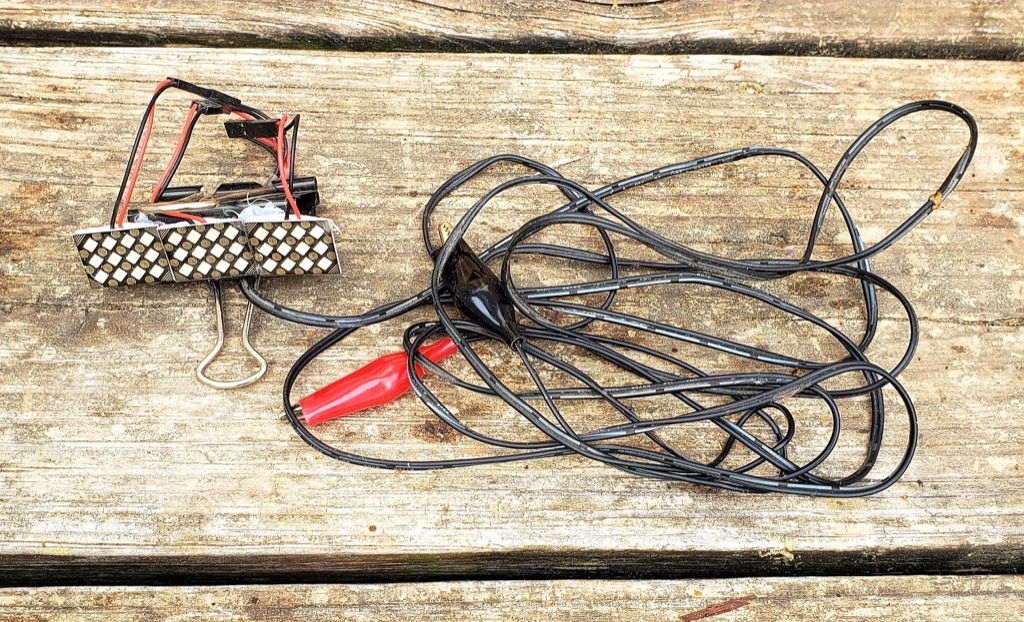 Permanently installed lights – In my situation, these would be most important in the kitchen and dining area. I mentioned converting some of the 120-volt loads over to 12-volt DC would make it possible to just switch the current A-19 bulbs over to 12-volt versions. Doing that would allow me to light my kitchen with no noticeable difference from how it is now. The 12-volt battery powering the lights would best be taken outside and topped off on a daily basis.
Warm Light – I think the most valuable lesson I learned from this preps test was about warm light vs white light. White light creates a harsh unfriendly environment which works well for dentist offices and workshops where a different kind of light is needed. For the home, IMO it’s absolutely necessary to have warm light to create a more pleasing, and more tolerable environment. The psychological stress of having white light in my home during the test was intense enough that I was online ordering warm-light bulbs the very first night. It’s one more prepping thing that’s hard to understand until you’ve lived through it, and the umpteenth reason to test our preps. Even after time, if it were the only thing available after the SHTF, I don’t think I’d ever get used to it. To heck with cigarettes, alcohol, and bullets for bartering, I’ll be stocking up on warm lights and lightbulbs!
For those wishing to delve into warm/white light further, research “Kelvins” to see how light is rated and what the best uses for each rating are. For those wanting to skip that, a good warm light range for the home is 3-4,000 Kelvins. This number is in the product description or on the package.
Where did I leave the light? One problem encountered with portable lights was trying to remember where I left it last. Now that I’m in my declining years, this phenomenon is not restricted solely to prep tests. To overcome losing lights, areas which don’t use a lot of light on a weekly basis would need to have their own dedicated portable light. In my situation this would include places like the bathroom and the area where I get the morning fire up and going. My bathroom light gets used less than 20 minutes per day and less than five minutes for seeing in the morning to get the woodstove going, so the weekly battery drawdown would be very minimal. With those kinds of numbers, and the ease of carrying small rechargeable lights outside to be recharged, they could all be collected once a week, and carried out to the solar charger to get topped off. It sounds like an excellent chore for one of the young members of the group.
Having a pocket flashlight will also help prevent us from moving lights from their assigned locations.
Conclusion
There were more things to discover in this test than I was expecting so this test proved to be very beneficial. I discovered there are so many permutations and possibilities on how to make lighting work if the SHTF and all we have is a solar panel and charge controller.
For whatever reason, I was late to the rechargeables party. Perhaps my tux was still at the cleaners, or perhaps because I remember all too well the shortcomings of the old nickle-cadmium batteries. Now whenever I make a purchase, if a rechargeable version is available I gladly pay a little more money to buy it. Over the life of the non-rechargeable device, when adding in the cost of AA and AAA batteries, a rechargeable one will be cheaper in the long run. Rechargeable batteries are also the only way to go in TEOTWAWKI, when disposable alkaline batteries are no longer available or are being used in low-power items such as remote temperature sensors and motion alarms. With a solar panel and an inexpensive charge controller we can keep our rechargeable devices running for years.
I hope I’ve inspired at least a few to carry out a realistic test of their SHTF lighting preps at least over a weekend. This would be whatever you have prepared: candles, oil lamps, or battery-powered. I also hope I’ve motivated a few more to spend a few bucks to buy a solar panel and charge controller. Even if you buy them to just tuck away in a closet between the bullets and beans,they’re a good what-if investment. Spend the money for a solar panel and charge controller combo, or $100 for some nicer ones, someone in your group will know how to use them for running your lights and charging your rechargeables. They’ll think you’re a genius with great foresight for having stored these in your preps. Just agree with them and smile. If they offer to let you have their dessert after dinner, take it.
Hopefully we’ll never have to use our preps and it’s just been a fun hobby, but if we do, we’ll want to light up our homesteads as well as they are now. This information also applies for those preppers wanting to be better prepared for the next hurricane or ice storm.
Test your preps! Then spend what little money it takes to provide your family with years of bright, smoke-free, carcinogen-free, healthy, rechargeable lighting.