Yesterday, I wrote about my experience where I needed night vision while being stalked on the mountain “alone”. I also wrote about the various generation technology advancements of night vision. Let’s proceed to outline the details of night vision technology and what it means.
Understanding Resolution and Signal-to-Noise Specifications
The two most important specifications for any night vision device are resolution and signal-to-noise ratio. In fact one of the main parameters for determining whether a night vision device can be exported is the multiple of these two specifications, also known as “Figure Of Merit”. If the NVD you are considering buying is subject to ITAR (International Traffic in Arms Regulations), it is a pretty good bet that you are looking at a high quality NVD. Conversely, if there is no restriction attached to the unit you are considering, it is probably a POS.
Resolution
Much like a television or computer screen, the more information that can be packed onto your night vision image tube, the clearer it will be. Measured in line pairs per millimeter (lp/mm), the higher the specified lp/mm the better. When you compare an average Gen1+ 25 lp/mm image tube to the typical resolution that you’ll find on a Gen3 tube, which is 64 lp/mm, it’s pretty obvious that a Gen3 tube is going to be better. No matter how you slice it, 150% better resolution means a better image.
Signal-to-Noise Ratio
However, a high resolution isn’t the only thing you should be looking for in your image tube. Though it’s a good start, keep in mind that the real function of a good night vision system is to perform well under incredibly low light conditions. This is where the signal-to-noise measure becomes important.
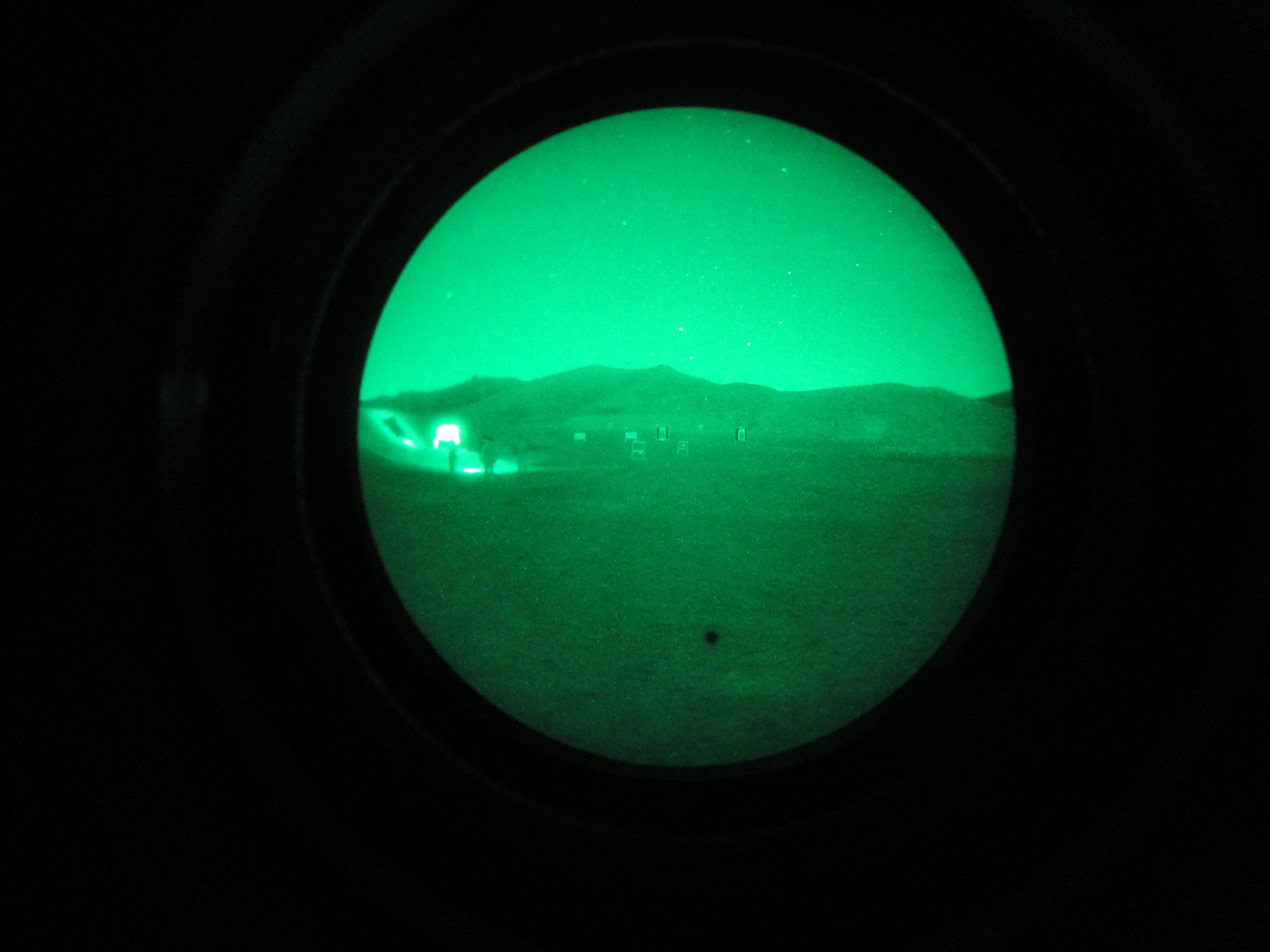
Signal-to-Noise provides a measure of the light signal that reaches your eye divided by the perceived noise that you actually see. For example, “noisy” tubes look like there’s a snowstorm going on inside the tube. Even a very bright tube that’s full of snow (noise) is going to produce lousy results. A good Gen3 tube will have a signal-to-noise ratio in the high 20s, while Gen1+ ratios are much lower, generally sitting in the single digits. My two best NVDs are a PVS-22, which has a photocathode response of 2200, a signal to noise ratio of 27, and it also provides 64 lp/mm resolution. I also have a Knights Armament PVS 30 with a photocathode response of 2300, signal to noise of 25, and also 64 pm/mm resolution.
Continue reading“Stalking the Night- Part 2, by Mark B.”