Modern civilization owes its existence in part to the early discovery that iron containing small amounts of carbon could be made much harder than other iron compounds. This substance, iron with between about 0.6 and 1.7 percent carbon and no other alloying elements, was the first predictably hardenable steel and can be referred to as “high carbon plain steel”. Such steels can be made as hard as a file and form the most basic group of tool steels, where tool steel is defined as steel that is able to cut softer steel. The range of these steels include the simple mixtures of iron and carbon we will discuss here as well as steels that exhibit very different behaviors from their older kin due to the addition of alloying elements such as chromium, cobalt, molybdenum, nickel, niobium, titanium, tungsten, vanadium, zirconium, and others that significantly change the properties of the steel.
Many manufactured products such as files, automotive leaf springs, and wood cutting saw blades are made from various alloys of high carbon steel. If you elect to use such scrap to make knives, chisels, gouges, or other cutting tools, first test harden a piece of the scrap steel to insure that it has enough carbon content to harden file hard when quenched. This testing will prevent an unwelcome surprise when you later unsuccessfully try to harden that particular steel.
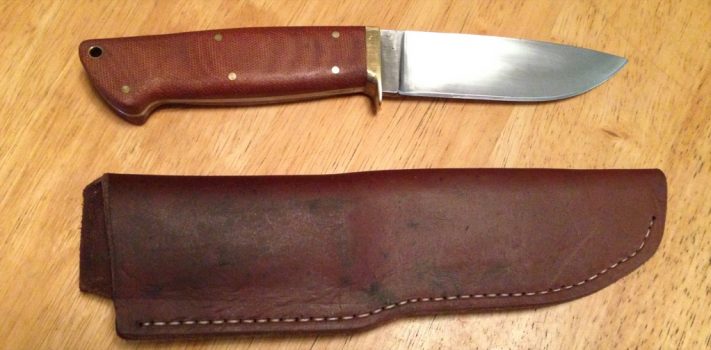
Many hardenable steels can be shaped and taken to the desired degree of hardness by using relatively simple processes. Cutting tools, springs, and high strength machinings can all be made from appropriate new or used steels using these processes to anneal, shape, harden, and temper such items. Fully hardened steel can be tempered using different times and temperatures to have the properties needed for fasteners, tools, springs, knives, and myriad other items. We will concentrate on applying this information to the making of a simple but very serviceable knife.
Implicit in this work is a source of high temperature heat such as an oxy-acetylene torch or a coal/charcoal forge. Indeed, blacksmiths were well known for recycling high carbon steel scrap into tools for their own and other’s use. These craftsmen had a practical understanding of the processes used to work high carbon steel. The need for high temperatures immediately mandates cautions such as proper clothing, fire protection, and ventilation before starting. All temperatures will be given in degrees Fahrenheit.
A little theory will help us understand how simple high carbon steel can be changed by the actions of heating and cooling it. Imagine a cube. On each of the eight corners of the cube is an iron atom. In addition, there is an iron atom in the center of the cube for a total of nine. This “unit cell” is the smallest grouping of iron atoms that forms the basis for the crystalline structure of iron. It is referred to as “body-centered cubic” structure, a cube with an iron atom in the center of its body.
Each unit cell shares its corner atoms with the unit cells that surround it. Body-centered cubic is the form iron has at temperatures ranging from below freezing up to approximately 1400 degrees F. It also is the form associated with the magnetic properties of iron. When steel is heated to the” critical temperature” of around 1400°, the heat makes the iron atoms more active. The iron atoms reorganize as the metal expands. The central atoms leave their positions and new locations are established at the center of all faces of each unit cell in the red-hot metal. This reorganization means each unit cell and all the surrounding unit cells now effectively have fourteen iron atoms each, one at each corner of the cube and one in the center of each face. These atoms are, of course, shared with all the adjoining cubic cells. The number of atoms has not changed, but the organization of the crystalline structure has. This form of iron is called “face-centered cubic” and is not magnetic.Continue reading“Simple Heat Treating for a High Carbon Steel Knife Blade – Part 1, by Steve A.”