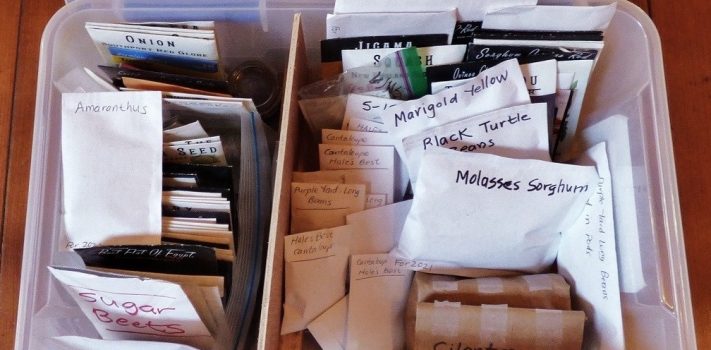
This is not a how-to article, but rather a few tips on what I do to save seeds each year. I’m hoping we all can share ideas in the comments section to help us all become more proficient seed savers.
My first experience at saving seeds happened when I was nine years old. I grew lots of sweet corn in my little garden and decided I better save some seed for the next year. I let it dry enough so I could remove the kernels from the cob then stored them in a green candy tin. A few months later when I opened the tin, there was nothing but a large multi-colored mass of various fungi and my seeds were a total loss. I’m surprised the lid hadn’t blown off. Hence I learned Rule Number One early: always let seeds dry sufficiently before storing. Fortunately, I’ve learned many other seed-saving tips since that time.
First, A Little Botanical Enlightenment
Botanically, fruit is a ripened ovary. Much of the produce we call vegetables is actually fruit. If it has seeds it’s a fruit, if not it’s a vegetable. Tomatoes, squash, pumpkins, peppers, okra, eggplant, etc., all have seeds making them a fruit. In some cases, the only part of the fruit we eat is the seeds such as peas, dry beans, and walnuts. Any produce coming from the vegetative parts of the plant are vegetables. Radishes, carrots, beets, and turnips are roots. Celery and rhubarb are leaf stalks while asparagus and potatoes (yes, potatoes) are stems. Sometimes fruit is fleshy like peaches, plums, pears, and pomegranates, and sometimes fruit is dry such as pecans, peanuts, and pearl millet. Sometimes it’s something in between.
The majority of the plants we see around us produce flowers and have covered seeds. Only a few of the higher plants have naked seeds (not covered by the ovary) such as conifers. If you see a “naked seed” from a flower-bearing plant, those are not the seeds even though we refer to them as such, but are actually a type of dry fruit. These include things such as sunflowers and most other daisy-type flowers, and umbelliferous plants such as celery, carrots, cumin, and cilantro.
A fun fact: what we call the strawberry “fruit” is technically not a fruit at all but a part of the flower base called the receptacle. Since seeds from flowering plants are never naked, each “seed” on the outside of a strawberry is actually an individual dry fruit called an achene. Apples are another exception. What you eat is a fleshy receptacle and when you get down to the core, that’s the actual fruit. When you cut an apple along its equator, you can see the distinct line separating the receptacle from the fruit.
For the sake of keeping things simple, I’m going to refer to dry fruits like marigolds, buckwheat, and cumin as “seeds” even though we’ve just learned that these are actually fruits.
Seed Collecting
There are many different ways to collect seed and each kind has certain requirements. Many seeds we separate out as we are preparing the fruit to eat such as squash, or while eating such as watermelon, so there isn’t any actual collecting involved. Other seeds require that we let the fruit ripen beyond prime eating stage, such as cucumbers. Cucumbers for eating and pickling are best when the seeds are underdeveloped and not yet large and hard. When harvesting cucumber seeds, we have to leave a few cukes on the vine until they turn from green to yellow to a dark yellow/brown. Only at that stage are the seeds mature enough to be viable.Continue reading“Seed Saving Tips – Part 1, by St. Funogas”