(Continued from Part 1. This concludes the article.)
Marlin got into the lever-action market in 1881, improving its initial offering with a stronger locking mechanism in 1888. These were top-ejecting actions like the Winchesters and came in the same calibers. In 1889 Marlin went to a solid-top design with side ejection. The Model 1894 was an improved version. It eventually fell out of favor but was reintroduced in .44 Magnum in 1969. Since then it has been offered in .218 Bee, .22 Magnum, .32 H&R Magnum, .357 Magnum, .38 Special, .41 Magnum, .44 Special and .45 Colt as well as .25-20, .32-20 and .44-40. Variants differ in barrel and magazine lengths and other details. I particularly like the ‘Cowboy’ series with octagonal barrels. Marlins made before the Remington buyout (some call it a sellout) can be pricey, especially when looking at special editions made in limited numbers.
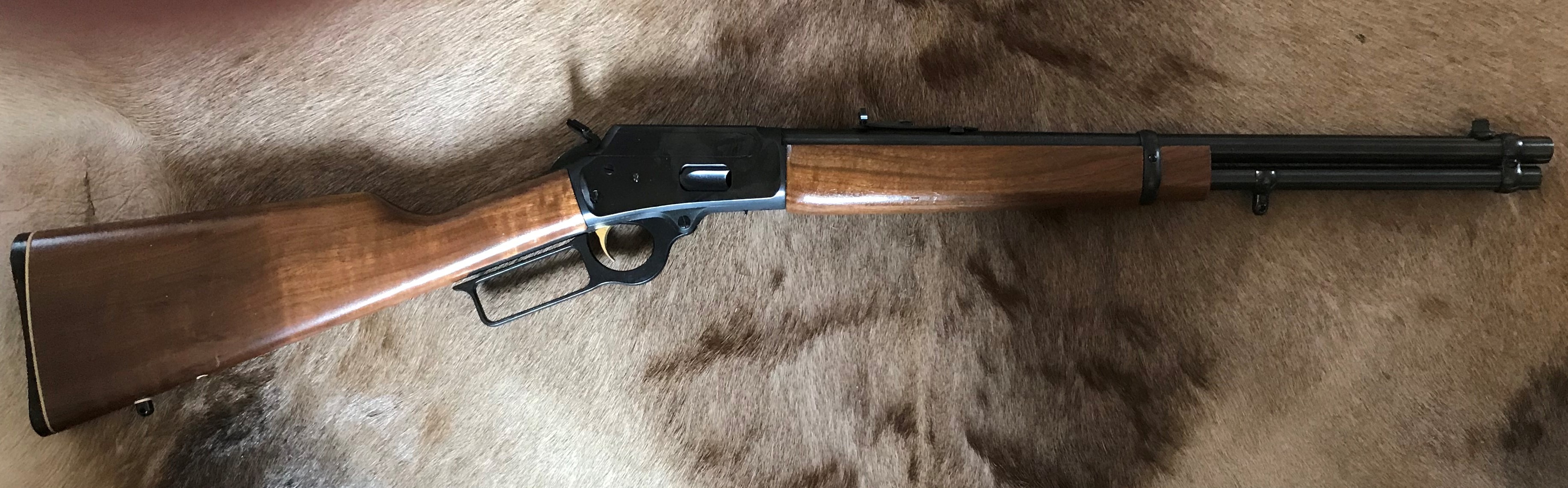
Figure 4:1894 Marlin .357 Carbine
Current-manufacture Henry Big Boys, as mentioned before, share only the iconic Henry name. On most of them, the magazine loads through a port on the bottom of the tube, like a .22. This is slower than guns with gates in the receiver, and Henry has responded with variations that do both. Barrels run from 16½-inches to 20-inches, and there are a variety of finishes from which to choose. Calibers include .45 Colt, .44 Mag/Special, .41 Magnum, .357 Mag/.38 Special, .30-30, and .327 Fed Mag, which also fires the .32 H&R. Not all versions are available in all calibers. Prices are competitive with Winchester and the Italian clones.
Calibers
As already noted, short-action lever actions are available in a wide range of calibers. Minus the rimfires and those for which companion rifles and revolvers are not available, and you have four vintage cartridges and three modern ones: the .32-20, 38-40, .44-40 Winchesters, and the .45 Colt, plus the .327 Federal, .357 and .44 Magnum. Any of these will, with careful shooting, drop deer-sized game.
In choosing among these, ammunition availability is probably the most important factor. What do you already own? What, if anything, can you still buy in quantity? What components are on your loading bench? Finding ammo to fit the gun of your dreams is probably going to be difficult at best, so dance with the one that brung you. Buy a carbine or rifle to match your favorite revolver, or a sidearm to match your long gun.
The old-timers, .32-20, .38-40, .44-40, and the .45 Colt, were all originally loaded with black powder. Guns designed around them were never intended for high-pressure smokeless ammunition. Later offerings like the 1892 Winchester, newly-manufactured 1894 Marlins, and the Ruger Blackhawk are much stronger. ‘Cowboy’ loads operate at pressures and velocities safe in all guns that are in good condition. Winchester and Remington once offered ‘high speed’ loads in .32-20 and .38-40. These were similar to what we now refer to as ‘+P’ and were labeled ‘for rifles only’. People who do not pay attention to warnings bulged barrels and blown-out cylinder walls.Continue reading“Alternatives to The Evil Black Rifle, Part 2, by Randy in S.C.”