(Continued from Part 1. This concludes the article.)
Stockpile Medical Supplies:
- Basic Household First Aid Kits: These are essential for treating the very minor/nuisance injuries one encounters in their daily lives. This is not as comprehensive as any prepper should have on hand, but its low cost is a starter towards having some medical supplies on hand. Many of the items could prevent worse problems, such as Neosporin preventing a life-threatening infection in a TEOTWAWKI situation. (These kits can be obtained at virtually any retailer for under $20.)
- More Comprehensive First Aid Kits: Useful for someone with slightly more advanced medical training than the non-medical lay person. These can be purchased online (from prepper or EMS websites, Amazon, or by assembling your own kit from a “shopping list”)
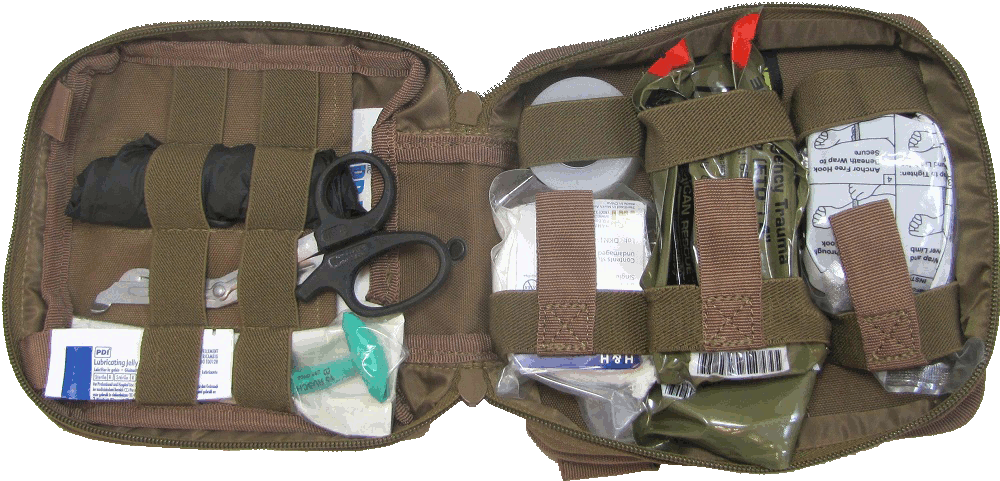
- IFAK (“Individual First Aid Kit”):
- Commonly used in military and tactical EMS applications. They are usually packaged in a MOLLE style pouch that can attach to a tactical bag.
- There are many variances, but all are designed to be used in an austere environment and provide life-saving, but often times not definitive, care.
- At a minimum, these kits need: tourniquets (at least 2), CPR mask, gloves, Kwik-Clot gauze, and chest decompression needles (at least 2).
- Every prepper (each member of the family/group) should own his/her own kit, keep it stocked, and know how to use it. My wife and I keep a kit in each vehicle, since we believe that most preparedness skills will be far more likely needed at an “everyday” emergency, than the possibility there will be a total breakdown of our medical system with care unavailable in a WTSHTF. Each member who carries their kit in a vehicle should also maintain a duplicate IFAK for their plate carrier/bug out bag (BOB) or remember to get the IFAK attached to their BOB if TEOTWAWKI occurs.
- Advanced/Specialized Medical Supplies:
- This can range from sutures for wound management, surgical instruments, diagnostic tests, casting/splinting supplies, to antibiotics, etc.
- Most of these purchases should depend on the level of training of someone in the preparedness group, or someone who you reasonably anticipate at your bugout location. (For instance, if your brother-in-law was likeminded and also happens to be a board-certified Emergency Physician, but lived 3 states away, you might want to stock up on more pre-positioned advanced medical supplies, if your in-laws’ plan was to bug out to your retreat in a TEOTWAWKI situation. He might even have access to antibiotics and other live-saving medication to add to the larder.)
- While I cannot legally advocate for anyone to practice medicine above his/her current scope of certification/licensure, I can also say that in a true WTSHTF situation there will be no licensing boards to restrain your actions. At that time, it may be an “every man for himself” world, and your family or friends’ lives may depend on your actions. So, by all means, read/attend seminars/watch YouTube videos on skills that may be useful in such a world. Just remember that you can do harm to a loved one if you do not know what you’re doing, so I would encourage you to learn, train, and continually practice.
- I highly suggest learning about wound management (including disinfection/ irrigation and debridement/ suturing) and having an abundance of supplies on hand to attend to such wounds. These will be frequently seen in a TEOTWAWKI scenario.
- CPR Equipment and an AED:
- CPR equipment (Ambu bag/mask, oral or nasal airway, or pocket CPR shield) is useful so that the rescuer is not exposed to body fluids on the patient they are rescuing.
- AED (automated external defibrillator): AED’s are now found in many public places and can also be purchased for private residences or small businesses. This is a worthwhile skill to have in the event that anyone around you experiences a cardiac arrest.
- An AED is not a cheap investment (they cost close to $1,000) but early defibrillation saves many more lives than just doing chest compressions, so the question might be, how much would you pay to have an AED in your hand if your loved one just collapsed with a cardiac arrest, and you have 4-6 minutes to save their life?
- The more remote you live from EMS services and/or the more that members of your family or preparedness group have a history of cardiac issues/risk factors, the more I would recommend emphasizing an AED purchase as part of your preps.
Continue reading“Family Medical Preps – Part 2, by Doctor Dan”