

“God granted men of principle to be our principal men.” – The late MG Victor Hugo, in a speech to The OSS Society
- Ad California Legal Rifles & Pistols!WBT makes all popular rifles compliant for your restrictive state. Choose from a wide range of top brands made compliant for your state.
- Ad USA Berkey Water Filters - Start Drinking Purified Water Today!#1 Trusted Gravity Water Purification System! Start Drinking Purified Water now with a Berkey water filtration system. Find systems, replacement filters, parts and more here.

Preparedness Notes for Tuesday — December 1, 2020
This is the birthday of novelist Rex Stout (1886–1975). Rex Stout was the brother of Ruth Stout, the gardener who wrote about no-till, year-round mulching, organic gardening in her book Gardening Without Work: For the Aging, the Busy, and the Indolent
—
Today, in addition to announcing the most recent writing contest winners, we’re presenting the latest precious metals column from Stephen Cochran of Gainesville Coins. He kindly sends us this, monthly.
- Ad SurvivalRealty.com: Sell Your Remote LandAdvertise your hard-to-sell remote land to eager buters. We specialize in rural, remote, and off-grid properties worldwide. Affordable ads. No commissions are charged!
- Ad Elk Creek Company - Percussion Blackpowder Guns - No FFL Required.Elk Creek Company - Percussion Blackpowder Guns - Pre-1899 Guns - Knives - Bayonets - Magazines - The last bastion of privacy!

Writing Contest Prize Winners Announced: Round 91
We’ve completed the judging for Round 91 of the SurvivalBlog non-fiction writing contest. The prize-winning authors are:
First Prize:
First prize is awarded to A.D.C. for: Kitting Out The Kalashnikov which ran in four parts: Part 1, Part 2, Part 3, and Part 4 — posted November 5-8, 2020.
He will receive:
- The photovoltaic power specialists at Quantum Harvest LLC are providing a store-wide 10% off coupon. Depending on the model chosen, this could be worth more than $2000.
- A Gunsite Academy Three Day Course Certificate. This can be used for any of their one, two, or three-day course (a $1,095 value),
- A course certificate from onPoint Tactical for the prize winner’s choice of three-day civilian courses, excluding those restricted for military or government teams. Three-day onPoint courses normally cost $795,
- DRD Tactical is providing a 5.56 NATO QD Billet upper. These have hammer forged, chrome-lined barrels and a hard case, to go with your own AR lower. It will allow any standard AR-type rifle to have a quick change barrel. This can be assembled in less than one minute without the use of any tools. It also provides a compact carry capability in a hard case or in 3-day pack (a $1,100 value),
- Two cases of Mountain House freeze-dried assorted entrees in #10 cans, courtesy of Ready Resources (a $350 value),
- A $250 gift certificate good for any product from Sunflower Ammo,
- American Gunsmithing Institute (AGI) is providing a $300 certificate good towards any of their DVD training courses.
Second Prize:
Second Prize is awarded to N.E for: Range Estimation and Windage with Mil Reticles Part 1 and Part 2, which ran on October 20th and 21st, 2020.
He will receive:
- A Front Sight Lifetime Diamond Membership, providing lifetime free training at any Front Sight Nevada course, with no limit on repeating classes. This prize is courtesy of a SurvivalBlog reader who prefers to be anonymous.
- A Glock form factor SIRT laser training pistol and a SIRT AR-15/M4 Laser Training Bolt, courtesy of Next Level Training, that have a combined retail value of $589,
- Two 1,000-foot spools of full mil-spec U.S.-made 750 paracord (in-stock colors only) from www.TOUGHGRID.com (a $240 value).
- Naturally Cozy is donating a “Prepper Pack” Menstrual Kit. This kit contains 18 pads and it comes vacuum-sealed for long term storage or slips easily into a bugout bag. The value of this kit is $220.
- An assortment of products along with a one-hour consultation on health and wellness from Pruitt’s Tree Resin (a $265 value).
Third Prize:
Third prize is awarded to E.P. for his article Making Dosa – Indian Fermented Bread. He will receive:
- Three sets each of made-in-USA regular and wide-mouth reusable canning lids. (This is a total of 300 lids and 600 gaskets.) This prize is courtesy of Harvest Guard (a $270 value)
- A Royal Berkey water filter, courtesy of Directive 21 (a $275 value),
- Two Super Survival Pack seed collections, a $150 value, courtesy of Seed for Security, LLC,
- A transferable $150 purchase credit from Elk Creek Company, toward the purchase of any pre-1899 antique gun. There is no paperwork required for delivery of pre-1899 guns into most states, making them the last bastion of firearms purchasing privacy!
Editor’s Choice Award:
We had a bit of a quandary when judging Round 91. Two of the best articles submitted in Round 91 came from a writer who had won one of our top three prizes just 11 months ago. That made him ineligible to win any of the top three prizes until Round 92 of the writing contest. So we decided to present a first-ever Editor’s Choice Award. That prize a transferable $400 purchase credit from Elk Creek Company, good toward the purchase of any of our pre-1899 antique guns. He in fact has already selected a S&W top-break .38 revolver, and it was just mailed to him late last week. Congrats to St. Funogas, the author of these two Editor’s Choice articles:
- How to Make Wooden Mason Jar Crates, which ran in two parts: Part 1 and Part 2, on October 24th and 25th, 2020, and,
- Seed Saving Tips, which and in three parts: Part 1, Part 2, and Part 3, on November 20th, 21st, and 22nd 2020.
Honorable Mention Prizes:
The Honorable Mention prize winners will each receive $30 Amazon.com gift cards. The five Honorable Mention prize-winning articles are:
-
- Lessons Learned from My First Bug Out Truck, by H.J. Part 1 and Part 2
- Prepping When Physically Disabled and Low Income, by Just A Dad
- Review: Leupold VX-Freedom 3-9X40 Scope, by The Novice
- Thoughts on an Amish Auction and Preparedness, by 3AD Scout
- Low-Tech Off-Grid Living, by Ani
Round 92 ends on January 31, so get busy writing and e-mail us your entry. Remember that there is a 1,500-word minimum, and that articles on practical “how-to” skills for survival have an advantage in the judging.
- Ad Survival RealtyFind your secure and sustainable home. The leading marketplace for rural, remote, and off-grid properties worldwide. Affordable ads. No commissions are charged!
- Ad Survival RealtyFind your secure and sustainable home. The leading marketplace for rural, remote, and off-grid properties worldwide. Affordable ads. No commissions are charged!
November 2020 in Precious Metals, by Steven Cochran
Welcome to SurvivalBlog’s Precious Metals Month in Review, where we take a look at “the month that was” in precious metals. Each month, we cover gold’s performance and the factors that affected gold prices.
What Did Gold Do in November?
There were many different factors steering gold prices in November, but the two major influences were also the most controversial: the COVID epidemic and the Presidential election.
Gold gained in early November, as COVID infections and deaths rose in the US and Europe. The possibility of a contested Presidential election was an even larger factor in the early November gold rally. Prices were further supported by continued dollar weakness. The gold price weakened as the Democrats failed to capture a majority in the Senate, breaking the “Blue Wave” that some had predicted.
The announcement in the middle of the month of three different COVID vaccines passing human clinical trials sent stocks shooting higher, and depressed safe-haven assets such as the dollar and gold. The last brick supporting gold prices fell when President Trump allowed the GSA to release transition funds to Joe Biden’s team.
Gold dropped more than $100 over the next two weeks, hitting a five and a half month low of $1,770 before the US open on November 30th. November was the worst month for gold in nearly four years.
In contrast, the Dow Jones Industrial Average had its best month since 1987, while the SP 500 and Nasdaq had their best months since April.
Factors Affecting Gold This Month
COVID SECOND WAVE AND VACCINES
COVID infections and deaths surged across the nation in November, once again straining hospitals to the breaking point. Pfizer announced on November 9th that its COVID vaccine had successfully passed human trials. The news sent the Dow 1,300 points higher at the opening bell. Gold fell by $67 at the open. December gold futures lost $98 on the day to settle at $1,854 an ounce. Spot gold closed at $1,863, down $86.
The next Monday, a second successful COVID vaccine was announced by Moderna. This time, the gold market had a muted reaction, leaking $20 lower on other news over the course of the week.
November 23rd saw a third COVID vaccine announced, this time by Astrazeneca and the University of Oxford in the UK. Gold investors, shaken by a new vaccine being announced three weeks in a row, headed out the door and into the stock market. By Black Friday, gold prices had fallen another $90 an ounce, breaking below the important $1,800 level.
The economy is expected to rapidly recover as vaccines roll out.Continue reading“November 2020 in Precious Metals, by Steven Cochran”
- Ad SIEGE belts: The essential go-anywhere GRAY MAN accessory. Solid 5.5-7 oz of persuasive power has saved many on their daily routines & travels. Revered "Thousand-Year Buckles" with stunning hand-crafted finishes. Complements CCW. Lear more..SIEGE STOVES: the ultimate high-performance portable survival stove. SIEGE BELTS: Use code "SBLOG" at checkout for $20 off any belt. Gifts that have saved lives. Be prepared!
- Ad STRATEGIC RELOCATION REALTYFOR SALE: Self-sustaining Rural Property situated meticulously in serene locales distant from densely populated sanctuary cities. Remember…HISTORY Favors the PREPARED!

SurvivalBlog’s News From The American Redoubt
This weekly column features news stories and event announcements from around the American Redoubt region. (Idaho, Montana, eastern Oregon, eastern Washington, and Wyoming.) Much of the region is also more commonly known as The Inland Northwest. We also mention companies of interest to preppers and survivalists that are located in the American Redoubt region. Today, we focus on some crowded rivers. (See the Montana section.)
Idaho
Authorities arrest fugitive in Coeur d’Alene, rescue two children missing since 2012
o o o
Boise virus order prompts ‘robocalls’ to jam phone lines, deter enforcement
o o o
In court over Idaho Capitol arrest, Ammon Bundy accuses government of ‘conspiring’
Continue reading“SurvivalBlog’s News From The American Redoubt”
- Ad Elk Creek Company - Federally-Exempt No-Paperwork GunsPre-1899 Antique Cartridge Guns -- No FFL Required. Can be mailed to your doorstep with no Federal paperwork!
- Ad USA Berkey Water Filters - Start Drinking Purified Water Today!#1 Trusted Gravity Water Purification System! Start Drinking Purified Water now with a Berkey water filtration system. Find systems, replacement filters, parts and more here.

The Editors’ Quote of the Day:
“A heart that’s full up like a landfill
A job that slowly kills you
Bruises that won’t heal
You look so tired, unhappy
Bring down the government
They don’t, they don’t speak for us
I’ll take a quiet life
A handshake of carbon monoxide
And no alarms and no surprises
No alarms and no surprises
No alarms and no surprises
Silent, silent
This is my final fit
My final bellyache with
No alarms and no surprises
No alarms and no surprises
No alarms and no surprises, please
Such a pretty house
And such a pretty garden
No alarms and no surprises
(Let me out of here)
No alarms and no surprises
(Let me out of here)
No alarms and no surprises, please
(Let me out of here)”
– Lyrics to the 1998 Radiohead song No Surprises. (Best covered in a retro style, by singer/clarinetist Chloe Feoranzo.)
- Ad Click Here --> Civil Defense ManualNOW BACK IN STOCK How to protect, you, your family, friends and neighborhood in coming times of civil unrest… and much more!

Preparedness Notes for Monday — November 30, 2020
Satirical novelist Jonathan Swift was born on November 30th, 1667.
—
Today we are featuring another review by our stalwart Field Gear Editor, Pat Cascio.
—
Shipments of Survival Retreats & Relocation are continuing. This is a book that I recently co-authored with my #1 Son, Jonathan Edwards Rawles. If strong interest continues, we will try to have one more printing run completed before Christmas.
The book is available through both Amazon and Jonathan’s SurvivalRealty.com site. The e-book is available at $9.99 as both a PDF and on Kindle.
Here are the current ordering links:
Main link: https://www.survivalrealty.com/survival-retreats-relocation/

Ruger American Compact .45 ACP , by Pat Cascio
I’m a big fan of the .45 ACP cartridge. The “official” FBI tests show that there isn’t a lick of difference between the 9mm, .40 S&W, and .45 ACP rounds – when loaded with high-performance JHP ammo, when it comes to stopping power. But I refuse to believe that those three rounds are all pretty much the same when it comes to stopping a deadly encounter. I do a lot of shooting, and I mean a lot of shooting for my articles, as well as for target practice, tactical shooting and just plain ol’ fun shooting. If there is one thing I’ve noticed when shooting different calibers of handguns, its that some calibers hit a whole lot harder than others. Whenever there are some targets of opportunity, like fist-sized rocks, I’ll focus on them. The 9mm will chip away at these rocks and eventually break them. The .40 S&W hits a lot harder and gets the job done faster. However, when we use a .45 ACP round on similar-sized rocks, it will break them – quite often with just one hit.
Now, this isn’t scientific testing, however, with the same aforementioned calibers, the 9mm when it hits a big rock, makes it move ever so slightly. The .40 S&W moves those rocks a bit more. However, when hit with a .45 ACP round – the rocks will move quite a bit. So, I’m not sure how this relates to real-world stopping power, or “knock-down” power, but it tells me that, the .45 ACP is hitting a lot harder than the other two rounds are.
The 9mm caliber, even with +P ammo is real easy gun to shoot for most people while the .40 S&W can be a handful with different ammo, and this is why many police departments, and the FBI and other Federal agencies have gone back to the 9mm, over the .40S&W. The .45 ACP isn’t all that hard to handle in the recoil department. Sure, it “kicks” a little more than the 9mm does, however, the felt “kick” is a lot less than the .40 S&W round does. Police qualification scores have gone way up, since many of them have gone back to the 9mm over the .40 S&W. Quite frankly, many in law enforcement simply aren’t “into” guns and don’t do a lot of shooting – so the hard-kicking .40 S&W round made it more difficult for them to qualify on the range – and it was even worse on the streets, when they had to deploy their firearms. Of course, then we have the fact that handguns can hold more 9mm rounds compared to .40 S&W or .45 ACP rounds – and that never hurts to have more ammo in your gun in a gunfight.
Not too long ago, I tested the Ruger American Compact 9mm pistol, their hot-selling LEO model. The “LEO” stands for Law Enforcement Only – model. And, I don’t believe this LEO gun is only sold to law enforcement, but it had some really nice features that the other American Compact 9mm didn’t have. My review article on the 9mm model is the SurvivalBlog archives. Shortly after testing and reporting on the 9mm American Compact, I received the new American Compact .45 ACP model with a gray Cerakote finish on the slide and a matching color frame – very handsome, indeed.
The 9mm version holds either 10 or 12 rounds – the LEO version came with three 12-round magazines, while the other models only come with a 10-round magazine. The new .45 ACP American Compact comes standard with three 7-round magazines, and these mags are Teflon coated, and make for easy insertion into the gun and even easier to load them to full capacity – an excellent design touch.Continue reading“Ruger American Compact .45 ACP , by Pat Cascio”
Recipe of the Week: Smothered Chicken
The following recipe for Smothered Chicken is from The New Butterick Cook Book, by Flora Rose, co-head of the School of Home Economics at Cornell University. It was published in 1924. A professional scan of that 724-page out-of-copyright book will be one of the many bonus items included in the next edition of the waterproof SurvivalBlog Archive USB stick. This special 15th Anniversary Edition USB stick should be available for sale in the third week of January, 2021. The 14th Edition sold out quickly, so place a reminder in your calendar, if you want one.
Ingredients
- 2 small chickens or 1 large chicken
- 2 or more tablespoons butter
- Salt and Pepper
- Flour
Directions
This is one of the most delicious ways of cooking chicken.
Take off the neck and split the chicken down the back, wiping it with a damp towel. Season inside and out with salt and pepper, and dredge on all sides with flour. Lay the chicken, with the inside down, in a small baking-tin and add very little water.
The pan should be very little larger than the chickens. Otherwise, the gravy will be too quickly-evaporated. Cook slowly for one hour, basting every ten minutes alter the first twenty minutes, or cook in a covered baking-pan.
Should the chicken be decidedly lacking in fat, add butter or butter substitute. There will be plenty of gravy in the pan with which to baste if the pan is small.
When done, place the chicken on a hot platter. Add enough water to make two cups gravy and thicken with two tablespoons of flour. Should the chicken be quite fat, remove all but two tablespoons of the oil from the pan before making the gravy. Season with salt and pepper, pour it over the chicken and serve at once. Any small birds can be dressed in this way with the most satisfactory results. The secret of success in this kind of roasting lies in very frequent basting and in not having too hot an oven.
—
Do you have a favorite recipe that would be of interest to SurvivalBlog readers? In this weekly recipe column, we place emphasis on recipes that use long term storage foods, recipes for wild game, dutch oven and slow cooker recipes, and any that use home garden produce. If you have any favorite recipes, then please send them via e-mail. Thanks!

Economics & Investing For Preppers
Here are the latest news items and commentary on current economics news, market trends, stocks, investing opportunities, and the precious metals markets. We also cover hedges, derivatives, and obscura. Most of these items are from the “tangibles heavy” contrarian perspective of SurvivalBlog’s Founder and Senior Editor, JWR. Today, we look at rural real estate. (See the Tangibles Investing section.)
Precious Metals:
Gold and silver both were pushed down last week, as was Bitcoin. But in the long term, we know the fate of the U.S. Dollar.
o o o
Record Silver Shortage in 2020?
o o o
A primer: Physical Gold vs. Gold Stocks: Which Perform Best In A Recession?
o o o
At Zero Hedge: JPMorgan Makes $1 Billion From Gold Trading After Paying $1 Billion Fine For Manipulating Gold Trading
Economy & Finance:
Several readers sent this piece at Bloomberg: Rich Americans Are Increasingly Looking for Second Passport
o o o
Next, at Wolf Street: Taxpayers Face $435 Billion in Student-Loan Losses, Already Baked in: Leaked Education-Department Study
o o o
Also at Wolf Street: Who Bought the Monstrous $4.2 Trillion Added to the Incredibly Spiking US National Debt in 12 Months? Everyone but China

The Editors’ Quote of the Day:
“[T]he people as ultimate sovereigns, retain the ultimate power – and even the duty – to overthrow any government that fails to respect their authority.” – Glenn Reynolds
Preparedness Notes for Sunday — November 29, 2020
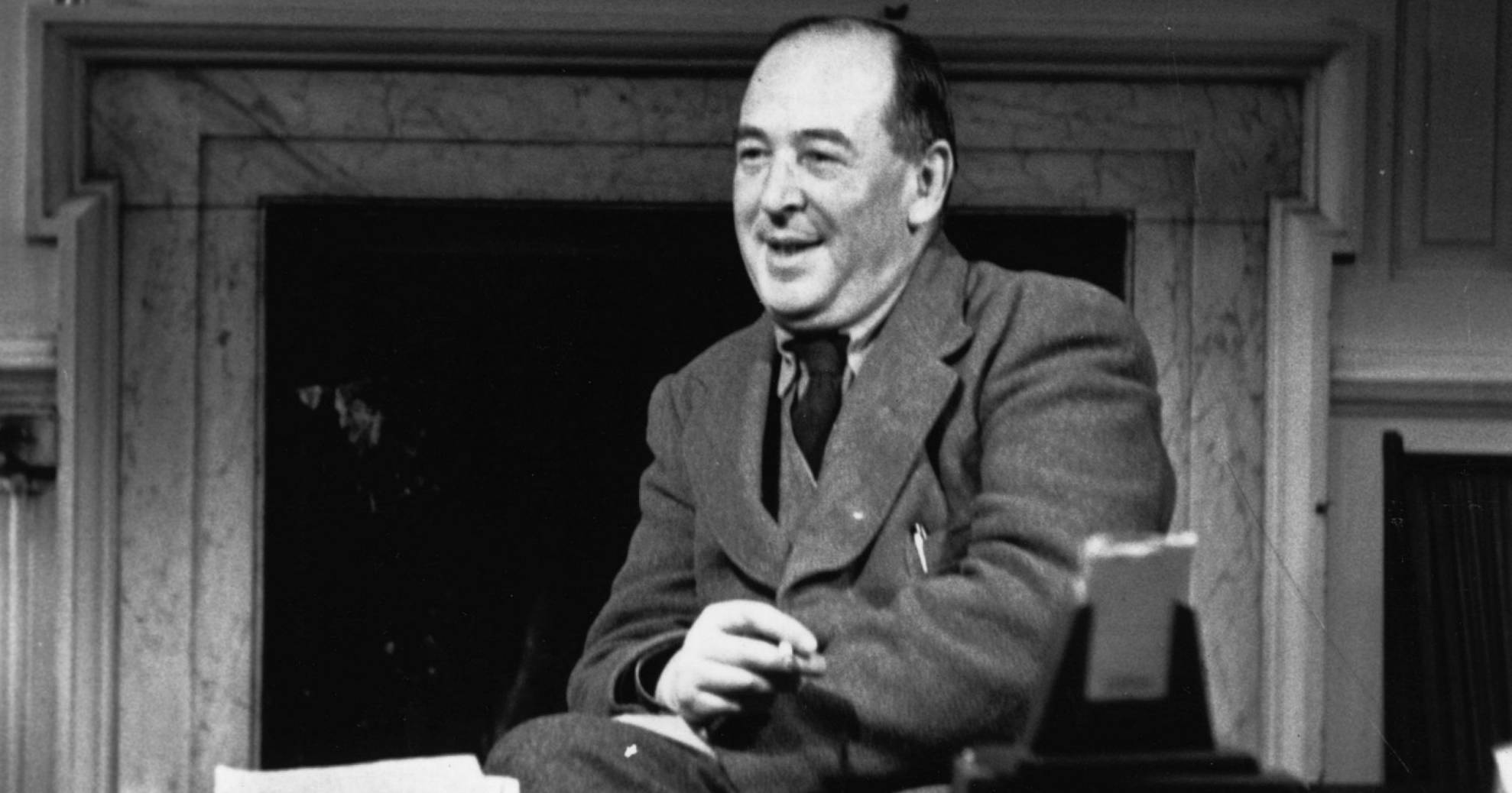
Today is the birthday of writer Clive Staples (“C.S.”) Lewis, who was born in 1898 and died 22 November 1963.
—
SurvivalBlog Writing Contest
Today we present the final entry for Round 91 of the SurvivalBlog non-fiction writing contest. The prizes for this round include:
First Prize:
- The photovoltaic power specialists at Quantum Harvest LLC are providing a store-wide 10% off coupon. Depending on the model chosen, this could be worth more than $2000.
- A Gunsite Academy Three Day Course Certificate. This can be used for any of their one, two, or three-day course (a $1,095 value),
- A course certificate from onPoint Tactical for the prize winner’s choice of three-day civilian courses, excluding those restricted for military or government teams. Three-day onPoint courses normally cost $795,
- DRD Tactical is providing a 5.56 NATO QD Billet upper. These have hammer forged, chrome-lined barrels and a hard case, to go with your own AR lower. It will allow any standard AR-type rifle to have a quick change barrel. This can be assembled in less than one minute without the use of any tools. It also provides a compact carry capability in a hard case or in 3-day pack (a $1,100 value),
- Two cases of Mountain House freeze-dried assorted entrees in #10 cans, courtesy of Ready Resources (a $350 value),
- A $250 gift certificate good for any product from Sunflower Ammo,
- American Gunsmithing Institute (AGI) is providing a $300 certificate good towards any of their DVD training courses.
Second Prize:
- A Front Sight Lifetime Diamond Membership, providing lifetime free training at any Front Sight Nevada course, with no limit on repeating classes. This prize is courtesy of a SurvivalBlog reader who prefers to be anonymous.
- A Glock form factor SIRT laser training pistol and a SIRT AR-15/M4 Laser Training Bolt, courtesy of Next Level Training, that have a combined retail value of $589,
- Two 1,000-foot spools of full mil-spec U.S.-made 750 paracord (in-stock colors only) from www.TOUGHGRID.com (a $240 value).
- Naturally Cozy is donating a “Prepper Pack” Menstrual Kit. This kit contains 18 pads and it comes vacuum-sealed for long term storage or slips easily into a bugout bag. The value of this kit is $220.
- An assortment of products along with a one-hour consultation on health and wellness from Pruitt’s Tree Resin (a $265 value).
Third Prize:
- Three sets each of made-in-USA regular and wide-mouth reusable canning lids. (This is a total of 300 lids and 600 gaskets.) This prize is courtesy of Harvest Guard (a $270 value)
- A Royal Berkey water filter, courtesy of Directive 21 (a $275 value),
- Two Super Survival Pack seed collections, a $150 value, courtesy of Seed for Security, LLC,
- A transferable $150 purchase credit from Elk Creek Company, toward the purchase of any pre-1899 antique gun. There is no paperwork required for delivery of pre-1899 guns into most states, making them the last bastion of firearms purchasing privacy!
Round 92 begins on Tuesday, so get busy writing and e-mail us your entry. Remember that there is a 1,500-word minimum, and that articles on practical “how-to” skills for survival have an advantage in the judging.

I Survived Running for Office, by W.W.
In light of the current political turmoil and contested election, some readers may be thinking of throwing their hat in the ring for elected office. I would like to share my experience of my candidacy for U.S. Congress for the 4th District of Pennsylvania in 2012. As you may recall this was the general election where Barack Obama was elected president and the Tea Party was quite active.
I’ve earned a Bachelor’s Degree in History and have always been interested in the political process. Back in the 1990s I served on the executive committee of the Political Action Committee (PAC) where I was employed. The committee was responsible for doling out funds to candidates who supposedly were pro-business. The company was located in Maryland, so you can take that last comment with a grain of salt. Turns out most of the money went to incumbents of the Democratic persuasion so that our lobbyists could gain access to said officeholders. After a couple of years, I was shuffled off of the committee, no doubt due to my negative voting record on allocating funds.
Fast forward to 2012. In 2001 I had moved from the Peoples’ Democratic Republic of Maryland to the Commonwealth of Pennsylvania. The current Congressman, Republican Todd Platts had announced he was not seeking reelection. He was instead seeking a judgeship on the York County Pennsylvania Court of Common Pleas. That is typical for career politicians. The primary election featured six Republicans and four Democrats seeking the nomination in their respective parties. Being relatively new to the area and not having any real contacts in the political arena, I knew the primary was a waste of time so I set my sights on the general election.
I had no illusion about winning, but I wanted an opportunity to present an alternative to Tweedle-Dee and Tweedle-Dum. An open seat seemed like the best opportunity. I went online to the Pennsylvania Government web site to scope out the details. I discovered that I could run as a third-party candidate by acquiring the signatures of 1,000 registered voters in the district. I sent for the forms.Continue reading“I Survived Running for Office, by W.W.”
JWR’s Meme Of The Week:
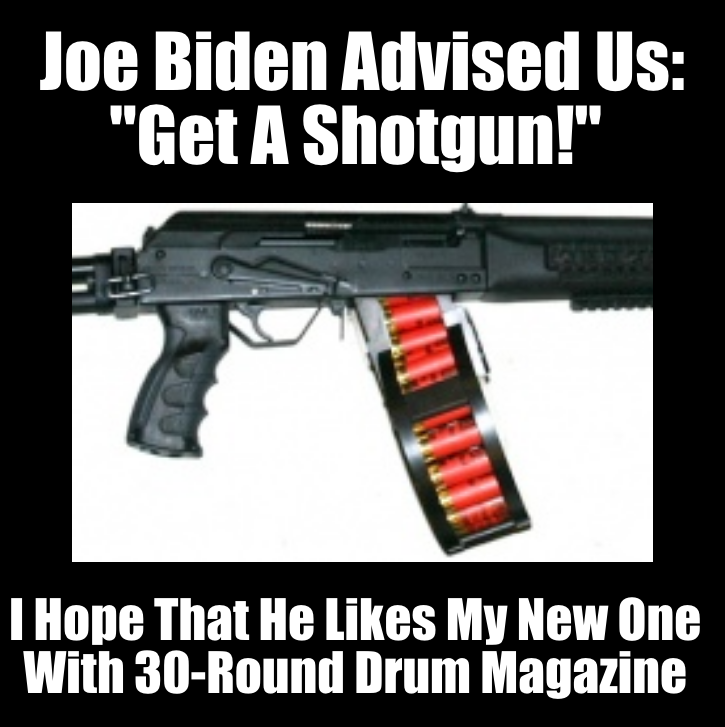
The latest meme created by JWR:
To share this, you can find it here:
Meme Text:
Joe Biden Advised Us: “Get a Shotgun”
I Hope That He Likes My New One With 30-Round Drum Magazine

The Editors’ Quote of the Day:
“Brethren, if a man be overtaken in a fault, ye which are spiritual, restore such an one in the spirit of meekness; considering thyself, lest thou also be tempted.
Bear ye one another’s burdens, and so fulfil the law of Christ.
For if a man think himself to be something, when he is nothing, he deceiveth himself.
But let every man prove his own work, and then shall he have rejoicing in himself alone, and not in another.
For every man shall bear his own burden.
Let him that is taught in the word communicate unto him that teacheth in all good things.
Be not deceived; God is not mocked: for whatsoever a man soweth, that shall he also reap.
For he that soweth to his flesh shall of the flesh reap corruption; but he that soweth to the Spirit shall of the Spirit reap life everlasting.
And let us not be weary in well doing: for in due season we shall reap, if we faint not.
As we have therefore opportunity, let us do good unto all men, especially unto them who are of the household of faith.
Ye see how large a letter I have written unto you with mine own hand.
As many as desire to make a fair shew in the flesh, they constrain you to be circumcised; only lest they should suffer persecution for the cross of Christ.
For neither they themselves who are circumcised keep the law; but desire to have you circumcised, that they may glory in your flesh.
But God forbid that I should glory, save in the cross of our Lord Jesus Christ, by whom the world is crucified unto me, and I unto the world.
For in Christ Jesus neither circumcision availeth any thing, nor uncircumcision, but a new creature.
And as many as walk according to this rule, peace be on them, and mercy, and upon the Israel of God.
From henceforth let no man trouble me: for I bear in my body the marks of the Lord Jesus.
Brethren, the grace of our Lord Jesus Christ be with your spirit. Amen.” – Galatians 6 (KJV)