Whatever your take on COVID 19, it has certainly sharpened our focus on contagious disease. As we spiral downwards as a society, it’s a good bet that other contagious disease will be visiting us more often. It is important to remember COVID 19 has not made other diseases fade away, even if the media attention on this virus makes it seem that way. Preppers often focus on bullets, beans and bandages – weapons, stored foods and trauma-related first aid supplies, but realistically disease is probably the main killer in any long-term scenario.
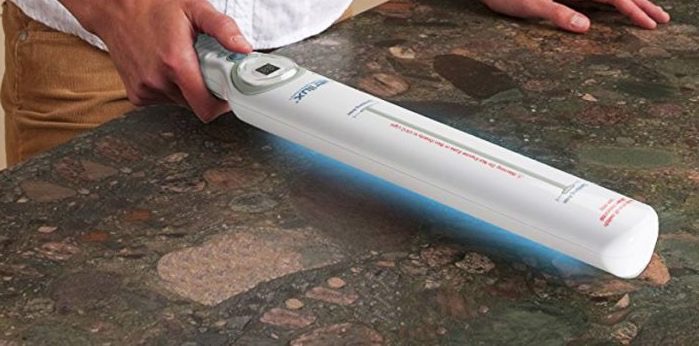
The purpose of this article then, is to get you briefed and up to speed on a type of disinfection called UVC light, that can help prevent contagious disease. “UVC” is an abbreviation for ultraviolet light in the C spectrum and it’s a powerful tool. UVC has a long history of use in disinfection, because it works well and is cost effective. I want you to be able to use it both safely and effectively. In this article I mention a number of UVC products and manufacturers. I have no financial interest in any of them, and they are only included as examples.
Here are some of the things that make UVC unique and useful-
1) It uses much less energy than many of methods of disinfection. Most methods of disinfection require energy to make heat, boil water or steam. UVC just requires enough energy to power a light bulb.
2) There are no chemicals to dry out, spill, or lose potency over time.
3) It can disinfect things that are challenging to disinfect by other means. Like air, paper, fragile or awkwardly shaped items. Air disinfection is of special interest to many as this seems to be the main method of COVID 19 transmission.
4) UVC is an excellent addition in a resource-scarce environment where water and other types of disinfectants are in short supply.
5) It is important to understand that UVC light disinfects, but technically does not sterilize. Complete sterilization, kills all microorganisms and requires high levels of steam, heat or toxic gas. UVC inactivates up to 99.9% of pathogens, but does not technically sterilize. UVC light works by messing with the genetic material of microorganisms, so they cannot reproduce. Once microorganism cannot reproduce, they cannot spread and are rendered harmless.
6) Smell. UVC treated air often has a distinctive smell. Some of the odor is caused by the UVC light interacting with dust in the air. This smell can be distinctive, but is harmless and generally dissipates quickly. The other cause of odor is ozone. When UVC encounters oxygen, it can create ozone. Cheaper, broad-spectrum bulbs create more ozone than do higher quality, narrow-spectrum bulbs. Ozone is a double-edged sword; it neutralizes all manner of microorganism, including ones that are in the shadow of the UVC rays, but it’s also harmful for people to breathe ozone gas.Continue reading“A Primer on UVC Light – Part 1, by Dr. David J.”