(Continued from Part1. This concludes the article.)
Area Disinfection
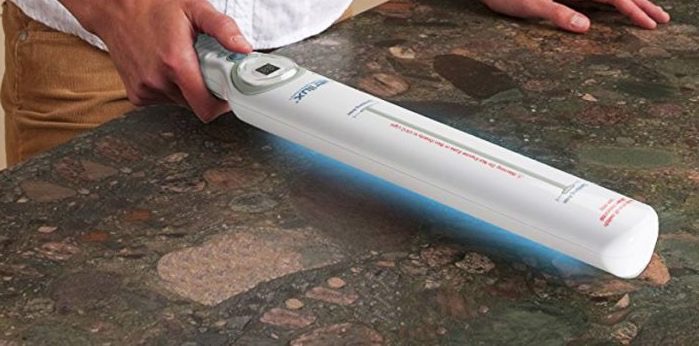
For area disinfection, an unshielded UVC light bulb is put on a lamp and controlled either by remote control or timer. Many are purpose-built, but it is certainly possible to buy a UVC bulb and place it on your own unshaded lamp and use a generic remote control or timer.
The UVC rays will neutralize microorganisms in the air and all surfaces that the light strikes. It can also be used to disinfect strategically placed masks, clothing and other items. In my opinion, the strength of area UVC light is to purify air of respiratory pathogens, any surfaces disinfected are a bonus. Area treatment with UVC often requires that the space be aired out for several minutes after treatment.
UVC for area disinfection has been used for some time for infection control in ambulances, emergency rooms, veterinary clinics and other health care facilities. It is particularly useful in hospital burn units. With the COVID 19 pandemic it has seen more widespread use in dental and medical offices as well as some correctional facilities. It must be used in an unoccupied space. I could see if being very useful in a home setting where one is caring for an ill family member. A bedroom could be disinfected while the patient is in the bathroom, and the bathroom disinfected when the patient returns to the bedroom. Any area where people congregate- offices, house of worship, daycare etc., could be disinfected when the area is cleared of people and animals.
The important question then is, how long does it take to disinfect a room? The answer, of course is, it depends. The air close to the lamp is disinfected quickly (seconds), the air further away takes longer. But how much longer?
I will try to keep it simple:
UVC light loses it strength according to the inverse square law (The same formula applies to dissipation of sound and to dissipation of nuclear radiation fallout.) It gets technical, but the strength of the UVC rays drops by the square of the distance from the source. The bottom line is the light strength drops quickly with distance. To be effective in a large space, in a reasonable amount of time, the bulb must have high wattage. To completely cover a larger room, a UVC light may need to be moved several times.
The intensity of UVC light is measured in millijoules (mj) or milliwatts (mw) per square centimeter. The dose of UVC is then measured by the intensity per second. Different pathogens are inactivated at different doses.
The virus on most people’s mind is the COVID19. According to the International Ultraviolet Association, COVID 19 is neutralized at between 10-20mj/cm2, a fairly low dose. They also say that 1000-3000 mj/cm2 to compensate for light blockage should really do it. There are other estimates available, but 1000-3000 mj/cm2, is a large dose. Any bacteria or virus that receives that dose is certainly harmless. MRSA is inactivated at about 50 mj/cm2 and C-diff is inactivated at about 100 mj/cm2. Here is a chart that shows dose to inactivate various pathogens, there are many others available:
So, this technical explanation doesn’t really answer the question. How long does it take to disinfect a room? Fortunately, there is a simple solution. Dosimetry cards. These are fairly inexpensive cards that change color with UVC dosage. Some are marked with the pathogen neutralized, others with the energy dosage. They can be taped up to parts of the room and checked after time intervals (1minute, 5 minutes, 10 minutes etc.) For the frugal, they can be cut in half or quarters. They can be purchased form CUREUV, American Ultraviolet and other manufacturers. They can also be used to evaluate other UVC devices, wands and ovens.Continue reading“A Primer on UVC Light – Part 2, by Dr. David J.”