Notes for Tuesday – March 29, 2016

This is the birthday of the gifted electronic and orchestral musician Vangelis (Evangelos Odysseas Papathanassiou).

o o o

Safecastle is running a timely sale on all Mountain House food in #10 cans and in pouches. Discount prices are as much as 46% off, shipping is included, and club members earn reward points on all purchases.

o o o

Don’t forget that Camping Survival’s Grand Opening is this Friday, April 1, 2016 at 9:00am. No foolin’! If you are in the area of Sanford, North Carolina, be sure to stop by and see them.

o o o

Today, we present another entry for Round 63 of the SurvivalBlog non-fiction writing contest. The nearly $12,000 worth of prizes for this round include:

First Prize:

  1. A Tactical Self-Contained 2-Series Solar Power Generator system from Always Empowered. This compact starter power system is packaged in a wheeled O.D. green EMP-shielded Pelican hard case (a $1,700 value),
  2. A Gunsite Academy Three Day Course Certificate that is good for any one, two, or three day course (a $1,195 value),
  3. A course certificate from onPoint Tactical for the prize winner’s choice of three-day civilian courses, excluding those restricted for military or government teams. Three day onPoint courses normally cost $795,
  4. DRD Tactical is providing a 5.56 NATO QD Billet upper with a hammer forged, chrome-lined barrel and a hard case to go with your own AR lower. It will allow any standard AR-type rifle to have a quick change barrel, which can be assembled in less than one minute without the use of any tools and a compact carry capability in a hard case or 3-day pack (an $1,100 value),
  5. Gun Mag Warehouse is providing 20 Magpul PMAG 30-rd Magazines (a value of $300) and a Gun Mag Warehouse T-Shirt; (an equivalent prize will be awarded for residents in states with magazine restrictions),
  6. Two cases of Mountain House freeze-dried assorted entrees in #10 cans, courtesy of Ready Made Resources (a $350 value),
  7. The Ark Institute is donating a non-GMO, non-hybrid vegetable seed package (enough for two families of four) plus seed storage materials, a CD-ROM of Geri Guidetti’s book “Build Your Ark! How to Prepare for Self Reliance in Uncertain Times”, and two bottles of Potassium Iodate (a $325 retail value),
  8. A $250 gift certificate good for any product from Sunflower Ammo,
  9. KellyKettleUSA.com is donating both an AquaBrick water filtration kit with a retail value of $250, and
  10. Two cases of meals, Ready to Eat (MREs), courtesy of CampingSurvival.com (a $180 value).

Second Prize:

  1. A Glock form factor SIRT laser training pistol and a SIRT AR-15/M4 Laser Training Bolt, courtesy of Next Level Training, which have a combined retail value of $589,
  2. A transferable certificate for a two-day Ultimate Bug Out Course from Florida Firearms Training (a $400 value),
  3. A Model 175 Series Solar Generator provided by Quantum Harvest LLC (a $439 value),
  4. A Trekker IV™ Four-Person Emergency Kit from Emergency Essentials (a $250 value),
  5. A $200 gift certificate good towards any books published by PrepperPress.com,
  6. A pre-selected assortment of military surplus gear from CJL Enterprize (a $300 value),
  7. RepackBox is providing a $300 gift certificate to their site, and
  8. Safecastle is providing a package of 10 LifeStraws (a $200 value)

Third Prize:

  1. A Royal Berkey water filter, courtesy of Directive 21 (a $275 value),
  2. A $245 gift certificate from custom knife-maker Jon Kelly Designs, of Eureka, Montana,
  3. A large handmade clothes drying rack, a washboard, and a Homesteading for Beginners DVD, all courtesy of The Homestead Store, with a combined value of $206,
  4. Expanded sets of both washable feminine pads and liners, donated by Naturally Cozy (a $185 retail value),
  5. Two Super Survival Pack seed collections, a $150 value, courtesy of Seed for Security, LLC,
  6. Mayflower Trading is donating a $200 gift certificate for homesteading appliances,
  7. Montie Gear is donating a Precision Rest (a $249 value), and
  8. Two 1,000-foot spools of full mil-spec U.S.-made 750 paracord (in-stock colors only) from www.TOUGHGRID.com (a $240 value).

Round 63 ends on March 31st, so get busy writing and e-mail us your entry. Remember that there is a 1,500-word minimum, and that articles on practical “how to” skills for survival have an advantage in the judging.


You Can Tune A Piano, But You Can’t Tuna Fish, by K.Y.

Consider the aftermath of a societal breakdown, not only in terms of survival but in the quality of life issues that make surviving worthwhile. Most likely, the arts and entertainment aspects of a post-breakdown world will be radically changed– no more television, movies, large-scale concerts, or computer-generated games. We will default to a simpler era, where folks made their own entertainment and personal interaction defined the process of a meaningful life.

And in a hard-scrabble existence– after the farming, hunting, homesteading, defending, procuring the basics of life-after-disaster– there will eventually need to be something more. There will need to be music, if only to salve the wounds of outrageous fortune. Where will it come from? It will come from the people, of course, as it always has but without the power boosts, long-range broadcasts, and mass communication that have been the hallmarks of the last centuries’ electronic age. We will be left with our own voices and the acoustic instruments to support them. There will still be guitars, strings, woodwinds, brass, and drums– the makings of bands and orchestras, massed voices in choirs, and soloists to be heard. And there will be pianos, literally millions of them in this country and worldwide– universally acknowledged to be the most useful instrument of all, for accompanying singers and other instruments, for composing and arranging music, and with the most glorious classical and popular repertoire conceivable. All this, in a package that you don’t need to plug in!

There was a time in America, from the the late 18th century to the pre- World War II era, when nearly every upper class and many middle class households featured a piano in the “drawing room”. These were not merely for decoration, although they were considered a status symbol; they were played and used, whether for little Emily’s piano lessons, chamber music and vocal recitals, or hymn-singing around the fireplace. The instruments ranged from the most humble spinet to magnificent, elaborately carved grands, depending on the wherewithal of the their owners. Before the era of phonographs, they were the conduit for popular and classical music for the common man, and arrangements of concertos and symphonies, the piano works of Bach, Chopin and Liszt, as well as the latest ragtime number or popular song could be found on their music racks.

There are still thousands upon thousands of pianos in the homes and institutions of this country, some in the neglected “clunker” status, but many more at least serviceable and others of concert-level quality. It is a wide range of both types and brand names. What is common to all is that they require tuning and maintenance, for they are the most complex mechanical instruments yet created, with hundreds of parts made of wood, felt, steel, and iron within their decorative cases. They are thus subject to atmospheric changes– variations in heat and humidity affecting the wood and metal– swelling, corrosion, and the stress of constant and repeated pounding of the keys and hammers, all taking their toll. A piano that is neglected will certainly become unpleasant to hear and will eventually become downright unplayable.

With the progression of the seasons, all acoustic pianos will go out of tune. Variation in humidity is the main cause. The wooden sound-board swells and shrinks, causing the steel strings to expand and contract at differing rates. The two-hundred-and-thirty-odd strings are stretched at tensions between 150 and 200 pounds each, with the iron plate and heavy wooden framing carrying a strain totaling from eighteen to twenty tons. Other delicate wooden parts and felt liners also absorb and evaporate moisture; they can warp and seize up or dry out and crack.

Repair and maintenance of a piano’s “action” is a subject best left to professionals, or amateurs who have intensely studied the labyrinthine innards of their own instruments and have access to specialized tools and replacement parts. Many of these parts– joints, pins, bushings, flanges, et cetera are tiny, vary by type and manufacturers brand of instrument, and require specialized tools to access, replace, or adjust them. Pliers and a screwdriver will simply not do. There is also a certain element of artistry to the piano technician’s craft– a feel for the subtleties of weight, tension, balance, and uniformity that requires years of experience. That, and sensitivity to vibration and the understanding of acoustics, overtones, and the equally-tempered scale, the “stretching of octaves ” in the bass and treble extremes, make it a rather esoteric and rarefied skill. However, the process of tuning itself and the more common and simple repairs are well within the reach of the amateur who is willing to study the craft a bit and acquire a few tools. Modern technology offers shortcuts to the tuning process, with battery-operated tuning devices, which with some practice can produce quite accurate, even beautiful, results. With a few simple tools and some knowledge, a piano tuner/technician might well have a valued vocation in a post-collapse scenario.

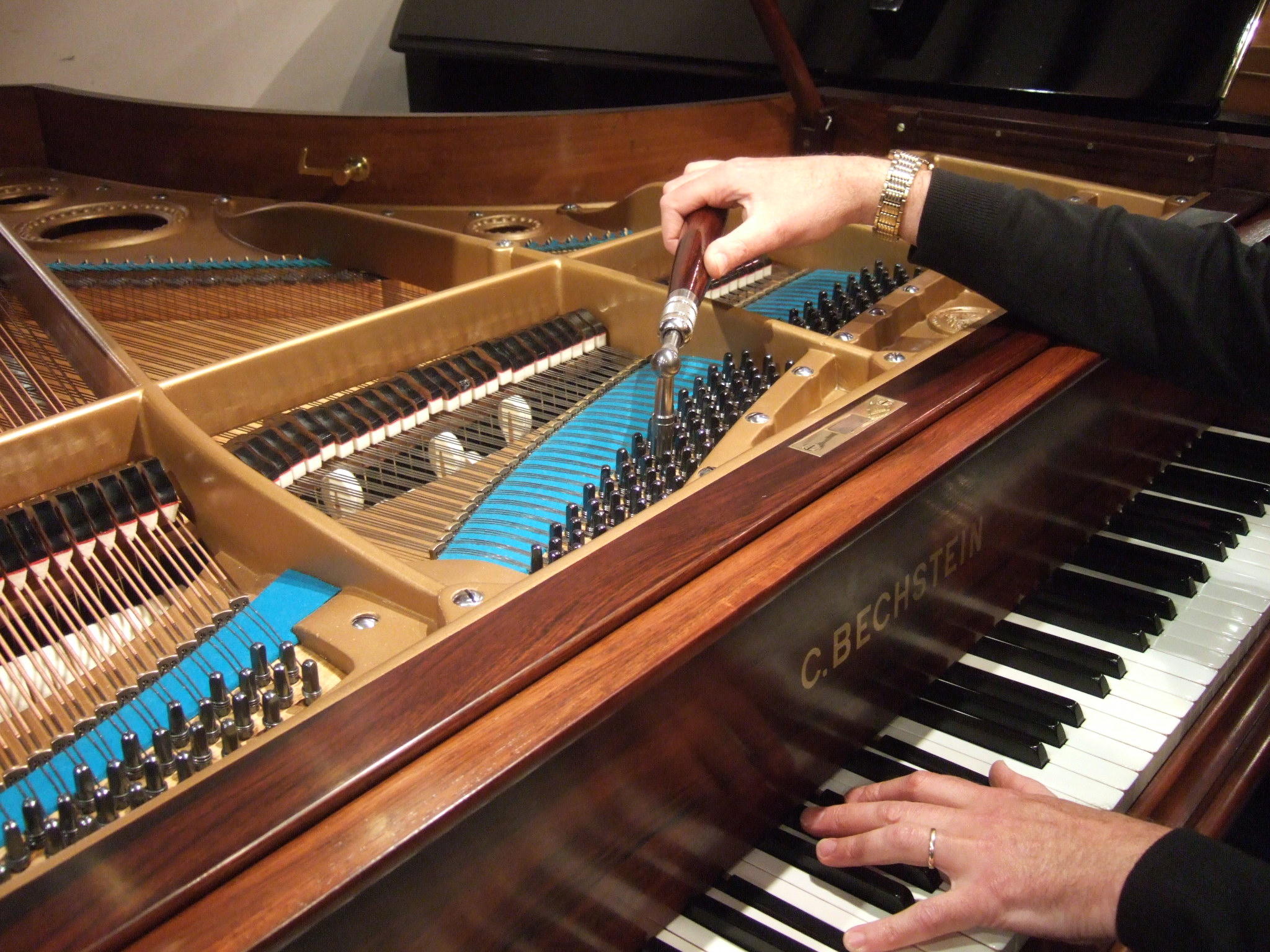
The basic process in tuning a piano is to first set the “temperament” or “scale” in the middle range of the piano by muting the outer two of the three-string sets of unison notes with a felt strip that is pushed between the outer strings, leaving the middle string to be adjusted with a tuning hammer (wrench). Setting the wrench on the appropriate tuning pin, slight movements are used to bring the note into synch with the dial on the electronic tuner. Care must be taken not to jerk the tuning hammer too much, as very slight movements will adjust the string; you will get a feel for the resistance pretty quickly and will learn to “set” the string by pulling it a little sharp and then relaxing it to the desired tone. After the scale has been set, the other notes are tuned in octaves from that temperament, alternating treble and bass octaves to balance the tension on the soundboard. Again, rubber mutes are used to dampen the outer strings of each note, and once the middle string is tuned, the mutes are removed sequentially to tune each outer string to the middle one (unison). This all should be done by ear, as tuning octaves and unisons is much easier than hearing other intervals. You will learn to hear when an octave or unison is correct when the conflicting vibrations all but disappear. The highest and lowest notes of the piano are the most difficult to hear by the human ear and also by the electronic tuner. They are generally tuned a little sharp in the highest octaves and a little flat in the lowest, to compensate for subjective misperceptions in hearing. The electronic device can be used to check accuracy at both ends of the keyboard. Finally, the felt strip in the middle octave is removed note by note, and those unisons are tuned. It must be warned that pianos that have not been tuned for a long period will need to have their overall pitch raised, a process of several gradual tunings to avoid breaking strings. The novice may take several hours to tune a piano, as it is a fairly tedious and exacting affair. Fluency comes with repetition, and the pro can do it in under an hour.

Those interested in this subject would first be advised to purchase a good text– the old classic William Brad White Piano Tuning and Allied Arts relies on the old tuning fork “by ear” process of interval ratios in setting the basic scale or “temperament”. There are several more modern tomes, one of the best of which is Piano Servicing, Tuning and Rebuilding: For the Professional, the Student and the Hobbyist by Arthur A. Reblitz. This book plus a small kit, consisting of a tuning hammer (wrench), set of rubber mutes, and felt Temperament strip, plus a good electronic tuning device (by Korg, for instance), will be sufficient to get started. There are numerous online tutorials, and even some free or near free tuning apps for the i-pad. And all the tool kits, books, and electronic tuners are available online. A basic setup for all these might be purchased for under a hundred dollars, total. Access to parts and more advanced tools and tuning devices can be found online as well, and such relatively simple repairs such as replacing a broken string or hammer are well within the skill set of a beginner. This is not to suggest that the casual tuner will replace the dedicated professional in the care of pianos, especially at the concert level where perfection in both the sound of a fine instrument and the sensitivity of the action to allow subtle nuances of expression and projection of power; these are luxuries we should savor now, as they may not survive in a clouded future. So we must prepare, adapt, and do the best we can. A field medic in that future will be as valuable as a surgeon in the present. Of course, a tuning fork and a “good ear” would be the default method in a “forever” grid-down situation, but the electronic tuner and a few batteries could last for years and be a source of income as well as artistic satisfaction for the essential balm of music in an injured world.



Letter Re: Prepaid Phones

HJL,

Yes, criminals use prepaid phones, but patriots do too. I have been using a monthly, no contract, prepaid phone for over 15 years. Why? Because I do not like contracts, hidden fees, data charges, et cetera. I use Virgin Mobile. For $35 a month, I get unlimited calls, messaging, and Internet. There are no hidden fees or surprise charges, and I do not have to surrender my personal information or SSN. I like having to NOT give up my personal information every chance I get. So, understand, it’s not just criminals who use these phones; it’s also the poor people with bad credit, people against tyrannical locked-in phone contracts, and people seeking a “private” phone. My phone is MY private business and not the government’s. So, when you hear “burner phone”, remember it is not just criminals who use them.


News From The American Redoubt:

The indictment count for the Malheur protests is now up to 26 defendants, and for the Bunkerville, Nevada protests now 19 defendants. (Some of those overlap, with the same folks getting charged for their involvement in both incidents.) The so-called “final indictee” of Malheur is said to be Jake Ryan, of Plains, Montana. (But some observers have voiced doubts about the eventual number of people who will be indicted for the Bunkerville protests, claiming that additional sealed indictments have been prepared.) The wording of the formerly-sealed Malheur indictments has numerous Federal conspiracy and other charges that if convicted and served consecutively, could put most of the defendants away for more than 100 years. The charges range from “conspiring to impede federal agents to possession of firearms and dangerous weapons in federal facilities, use and carry of a firearm in relation to a crime of violence, and depredation of government property.” It is noteworthy that Federal felony sentences rarely have the possibility of parole. As I’ve mentioned before, these indictments smack of politically-motivated selective prosecution. (In contrast, the threats and actual physical damage done by the “Occupy” protestors were much greater, but only one arsonist was charged with a felony and that was not a Federal charge.) Sadly, I believe that the Malheur and Bunkerville defendants will all get railroaded by the courts. Unless jury members stand up and do the right thing (through nullification), then lengthy sentences will be handed down, so their only hope will be an eventual presidential pardon. I predict that the eventual trials will be carefully stage-managed events, wherein the defendants will not be allowed to speak at length in their defense; they will be barred from making Constitutional arguments, and they will be barred from mentioning the right of jury nullification. I wouldn’t even be surprised to hear that they will not even be allowed to physically sit in the courtroom. – JWR

o o o

Readers in The American Redoubt who want rust-resistant and more subdued finishes for their guns should visit this web site: Liquid Transformations. This Spokane-based small company does excellent Cerakote finishes in an amazing variety of patterns. Their “Mothwing Spring Mimicry” pattern makes a gun blend in quite well in the woods. Supplement this finish with a few bits of taped-on ghillie thread garnish to break up the outline, and your rifle or shotgun will seem to disappear. It is noteworthy that Cerakote in an earth tone or in a camouflage pattern is particularly important for any of your stainless steel, Robar-coated, or nickel-plated guns that might ever see tactical use.

o o o

Wolf pack kills 19 elk in one night during ferocious hunting attack in Wyoming

o o o

Do you have any pictures, videos, or stories, from the Malheur National Wildlife Refuge Occupation? To dispute the government’s claim of damages, some patriots are coming together to acquire and present evidence to the contrary. If you have pictures of the Refuge before or during the occupation, you can email them, or if you have videos of the Refuge before or during the occupation you can email them to burnspix@committee.org.


Economics and Investing:

Items from Mr. Econocobas:

Peter Schiff- Two Down Two to Go.

Video: Stockman CNBC Interview: Dead Cat Bounce Over, Bury The Cat!

Items from Professor Preponomics:

US News

CCAGW Commends Chairman Hatch for Launching Investigation into Green Energy Grants (Citizens Against Government Waste) Excerpt: “A significant number of the recipients were either demonstrably financially unstable, and therefore too high-risk to receive taxpayer money, or already adequately well-funded by private capital and undeserving of taxpayer largesse.” This story is also being developed by the Wall Street Journal. The following report was posted to Market Watch: Senator Probes $25 Billion in Federal Green-Energy Grants

Rubio’s Failure: How Our Broken Economy Fuels Voter Rage (Mises) Excerpt: “None of this may seem to be connected to economics, but the connection is actually quite close. The economy has performed so poorly for so long that tens of millions of primary voters are very, very worried.”

Property Bubble Ghost Haunts Central Bankers Trying to Boost Prices (Bloomberg) Excerpt: “Here’s the dilemma: How do you cut rates to goose too-low inflation and support growth without lighting a fuse under real estate?”

International News

Cha-Ching: US, Cuba Ease Rules on Sending Cash (Washington Examiner) Excerpt: “Obama’s policy pronouncements went smoother than his public appearance did with Cuban President Raul Castro, who castigated the United States on human rights as he stood next to the president….”

Ex-Cuban Prisoner Says Cuban Economy Thwarted by Its Own Policies (Fox News) Excerpt: “The internet is now legal for Cubanos, it was legalized in June of 2013. The cost of internet access, even if the service is not really a great service, went from $6 an hour to $4.50 an hour, now it’s $2 an hour. The government of Cuba has now been opening up internet centers around the island….”

Flight Prices to Cuba Could Drop Almost 50% After US Travel Embargo is Fully Lifted (Forbes) Excerpt: “…a key update to the rule now permits individuals to embark upon personal trips self-determined to meet the criteria. No advance license required.”

Michelle Obama’s Floral Outfits Cost 23x Average Annual Salary in Cuba (Washington Free Beacon) Excerpt: “When the president and his family landed in Cuba Sunday, the first lady descended Air Force One wearing a sleeveless, rose-print dress made by designer Carolina Herrera. The dress is currently sold for $2,190….”

Personal Economics and Household Finance

Here’s How this Family of Three Lives Well on a Single Income (The Penny Hoarder) Excerpt: “Could a family still manage to live on one income in the 21st century? That was the question we had to answer….”

o o o

SurvivalBlog and its editors are not paid investment counselors or advisers. Please see our Provisos page for details.


Odds ‘n Sods:

Update on Video clears Texas man of assaulting cop—did police commit perjury?

JWR’s Comment: This video shows the importance of having both dashcam video cameras and home security video cameras. FYI, I bought pairs of Z-Edge Z3 Full HD dashcams for my vehicles. One faces forward and the other faces toward me and driver’s side window. These cameras come with 32 GB cards and continuously loop three hours of video and audio. The audio can be muted with one button press, for privacy. I also highly recommend getting LOREX webcam sets for your home. Make sure that one camera covers your porch and another covers your driveway, to capture both faces and license plate numbers! Also, be sure to carry free CFAPA press credentials whenever you are on the road.

o o o

Pope Francis Blames Weapons Manufacturers for Brussels Attack

JWR’s Comment: To be more precise in formulating his twisted logic, Pope Francis should have condemned the manufacturers of acetone, hydrogen peroxide, and roofing nails–the precursor chemicals and projectiles used to make the Triacetone Triperoxide (TATP) bombs used by the Islamist fanatics. The problem was not the tool or even the maker of the component parts. Rather, the real problem was with a zealous belief in a Religion of Hate, which the Pope refuses to acknowledge as such. Ironically, living safe in Vatican City behind thick castle-like walls and guarded by mercenaries armed with pistols and submachine guns, the Pope finds it easier to blame dual-use inanimate objects (and their manufacturers) for these terror bombings than to blame the real sinners with hatred in their hearts. Papa est stulto gloria.

o o o

Video: Finally! an accurate model. It’s complicated, noisy, dangerous, and does absolutely nothing. Sent in by SurvivalBlog reader P.W.

o o o

Sent in by RBS: Court ruling allows police to stop and question anyone within 100 miles of border

o o o

More insanity from the Jack-booted thugs: FBI employee charged with pointing a gun at woman’s head inside a restaurant – T.P.


Notes for Monday – March 28, 2016

This is the birthday of Marlin Perkins, of Carthage Missouri. He is remembered as the television host of Mutual of Omaha’s Wild Kingdom. He was born in 1905.

o o o

Today, we present another entry for Round 63 of the SurvivalBlog non-fiction writing contest. The nearly $12,000 worth of prizes for this round include:

First Prize:

  1. A Tactical Self-Contained 2-Series Solar Power Generator system from Always Empowered. This compact starter power system is packaged in a wheeled O.D. green EMP-shielded Pelican hard case (a $1,700 value),
  2. A Gunsite Academy Three Day Course Certificate that is good for any one, two, or three day course (a $1,195 value),
  3. A course certificate from onPoint Tactical for the prize winner’s choice of three-day civilian courses, excluding those restricted for military or government teams. Three day onPoint courses normally cost $795,
  4. DRD Tactical is providing a 5.56 NATO QD Billet upper with a hammer forged, chrome-lined barrel and a hard case to go with your own AR lower. It will allow any standard AR-type rifle to have a quick change barrel, which can be assembled in less than one minute without the use of any tools and a compact carry capability in a hard case or 3-day pack (an $1,100 value),
  5. Gun Mag Warehouse is providing 20 Magpul PMAG 30-rd Magazines (a value of $300) and a Gun Mag Warehouse T-Shirt; (an equivalent prize will be awarded for residents in states with magazine restrictions),
  6. Two cases of Mountain House freeze-dried assorted entrees in #10 cans, courtesy of Ready Made Resources (a $350 value),
  7. The Ark Institute is donating a non-GMO, non-hybrid vegetable seed package (enough for two families of four) plus seed storage materials, a CD-ROM of Geri Guidetti’s book “Build Your Ark! How to Prepare for Self Reliance in Uncertain Times”, and two bottles of Potassium Iodate (a $325 retail value),
  8. A $250 gift certificate good for any product from Sunflower Ammo,
  9. KellyKettleUSA.com is donating both an AquaBrick water filtration kit with a retail value of $250, and
  10. Two cases of meals, Ready to Eat (MREs), courtesy of CampingSurvival.com (a $180 value).

Second Prize:

  1. A Glock form factor SIRT laser training pistol and a SIRT AR-15/M4 Laser Training Bolt, courtesy of Next Level Training, which have a combined retail value of $589,
  2. A transferable certificate for a two-day Ultimate Bug Out Course from Florida Firearms Training (a $400 value),
  3. A Model 175 Series Solar Generator provided by Quantum Harvest LLC (a $439 value),
  4. A Trekker IV™ Four-Person Emergency Kit from Emergency Essentials (a $250 value),
  5. A $200 gift certificate good towards any books published by PrepperPress.com,
  6. A pre-selected assortment of military surplus gear from CJL Enterprize (a $300 value),
  7. RepackBox is providing a $300 gift certificate to their site, and
  8. Safecastle is providing a package of 10 LifeStraws (a $200 value)

Third Prize:

  1. A Royal Berkey water filter, courtesy of Directive 21 (a $275 value),
  2. A $245 gift certificate from custom knife-maker Jon Kelly Designs, of Eureka, Montana,
  3. A large handmade clothes drying rack, a washboard, and a Homesteading for Beginners DVD, all courtesy of The Homestead Store, with a combined value of $206,
  4. Expanded sets of both washable feminine pads and liners, donated by Naturally Cozy (a $185 retail value),
  5. Two Super Survival Pack seed collections, a $150 value, courtesy of Seed for Security, LLC,
  6. Mayflower Trading is donating a $200 gift certificate for homesteading appliances,
  7. Montie Gear is donating a Precision Rest (a $249 value), and
  8. Two 1,000-foot spools of full mil-spec U.S.-made 750 paracord (in-stock colors only) from www.TOUGHGRID.com (a $240 value).

Round 63 ends on March 31st, so get busy writing and e-mail us your entry. Remember that there is a 1,500-word minimum, and that articles on practical “how to” skills for survival have an advantage in the judging.


Esee-4, by Pat Cascio

My long-time friend and fellow gun writer, John Taffin, has been on a life-long search for what he calls the “Perfect Packin’ Pistol”, and it has been a long but fun search for him. I suspect that each and every one of us has also been on that search, even if we didn’t know it or want to admit it. There is that “one” handgun that we all are searching for– that one handgun that will fulfill every chore we’d need it for. I’m sure there is a Perfect Packin’ Pistol for each and every one of us, but the search continues.

When it comes to survival knives, or just an everyday knife, we all are probably on a search for the Perfect Packin’ Knife, and quite honestly I don’t know if such a thing really exists. I’ve been around knives all my life, and I’ve been testing and writing about knives since 1992. I’m also something of a knife designer, having designed at least a dozen knives and had many built by custom knife makers over the years. Additionally, several of my knife designs have been picked up by knife companies for mass production, including my latest design– the OC3, which was a joint effort by myself and custom knife maker, Brian Wagner, of Okuden Knives– that Columbia River Knife & Tool is producing. To be sure, this is a shameless plug for my OC3; forgive me!

100_6342

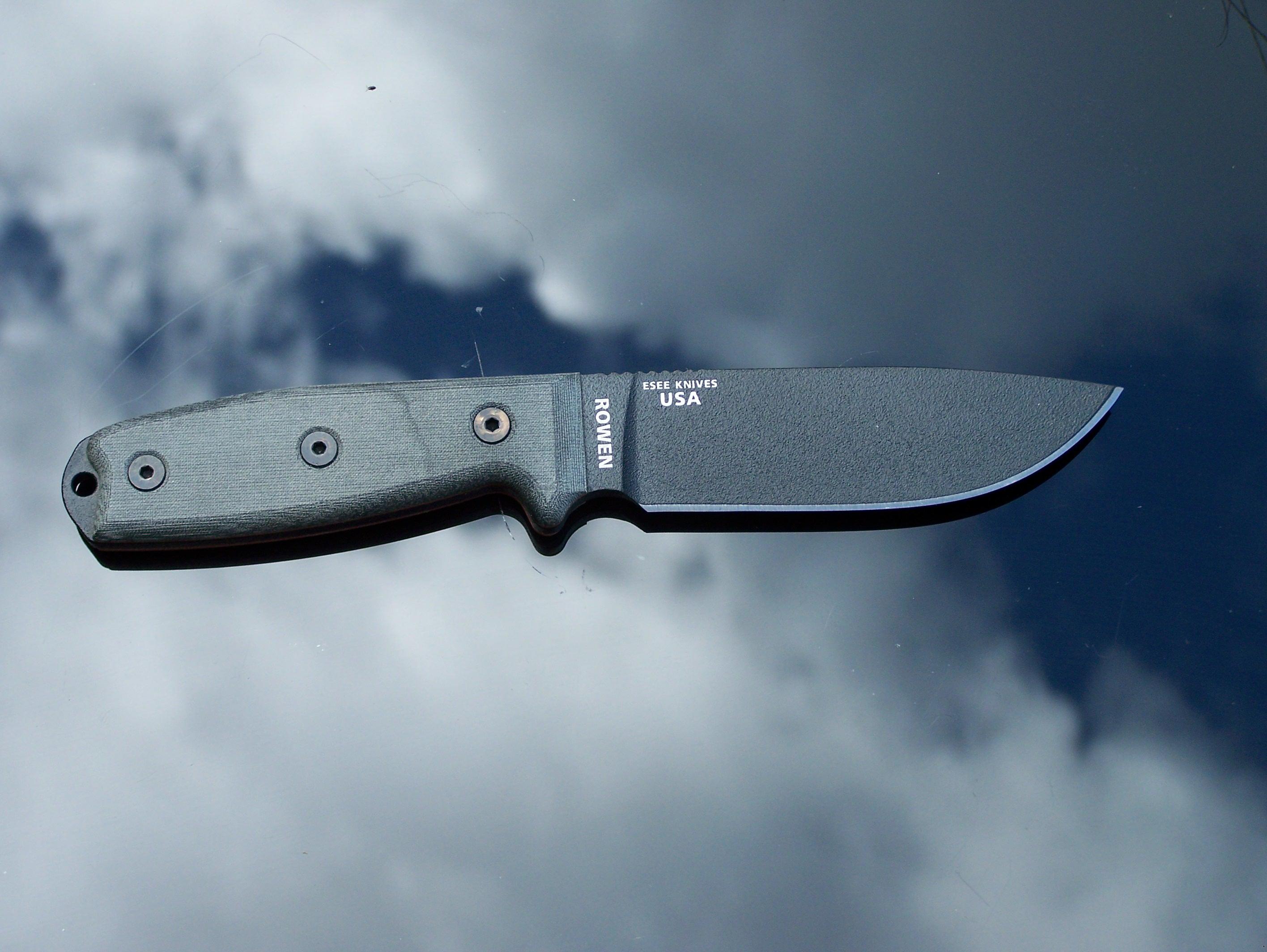
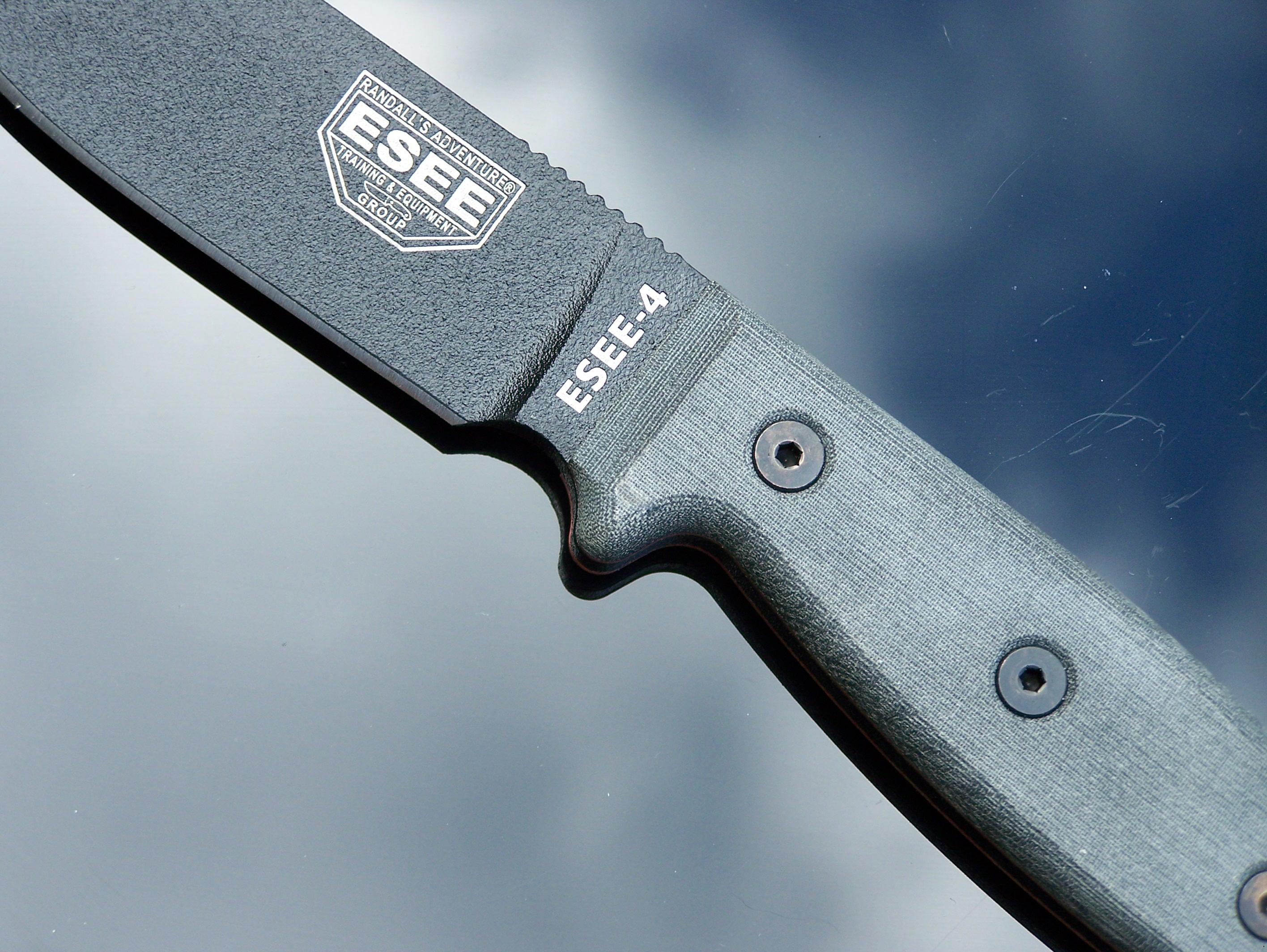
About six months ago, I was looking at some knives called “Esee Knives”, and I was favorably impressed by what I was reading about their line of knives. I have plenty of big, fixed blade knives, designed for various duties. However, their Esee-4 model caught my attention for some reason. A quick run down on the Esee-4 shows it has a blade of 4.1 inches, made out of 1095 carbon steel, with an overall length of nine inches. BTW, it is a fixed blade knife, too. The Rockwell on the blade is 55-57 for the carbon steel model, and they also manufacture a stainless steel version. The handle material is Micarta, and the blade is a hefty 3/16th inches thick with a black powder coating to help protect the carbon steel blade from the elements. A nice poly sheath (mine was tan colored) comes with the knife, and the knife weighs eight ounces. The blade is a drop point style, which is one of the most popular and useful blade styles in my humble opinion. There is a lanyard hole in the butt of the knife, too, and if you work around water a lanyard comes in handy, so you won’t lose your knife.

100_6343

The Esee-4 also comes in several different colors, including bright rescue orange as well as OD green. Sheath colors vary, so be advised with shopping around for one. Prices on this little knife are all over the place– anywhere from $90 on up to $130. So, shop around for the best deal you can find on the Internet. I liked the version I bought, with the black powder coated blade and the grayish/black Micarta handle scales.

The Esee line of knives comes from Randall’s Adventure Training & Equipment Group, and they have designed quite a few survival and all around knives over the years. They were being marketed under a different name, but for whatever reason they are now marketed under the “Esee” name.

100_6345

BTW, a word on the sheath, it is hard molded, and the knife stays put without any snaps or loops or anything like that. Plus, there is a belt clip that holds the knife on your belt or on a pack or combat vest, and this isn’t a cheap clip; it is heavy duty. There are no worries about it bending out of shape or breaking. There are also plenty of lashing holes around the sheath, if you desire to “tie” it to a combat vest.

The handle design on the Esee-4 is about perfect for my hand. Many other people said the same thing: that it just felt great, and the knife is hard to put down. There are also some shallow friction grooves CNC machined into the top of the blade, where it meets the handle for a sure thumb purchase on the Esee-4. It’s nice! On one side of the blade, at the juncture of the blade and the handle, is the word “Rowen”. I have no idea what that means, and I tried to get some info on it, all to no avail. I don’t know if that is the person who designed the Esee-4 or what. Strange!

100_6346

Now, to be sure, the Esee-4 wasn’t designed to be a “combat” knife of any sort. Instead, it is meant to be an everyday use knife, for all kinds of cutting chores. It will also easily double as a hunting knife, ideal for dressing out game as well as camp chores. It would work nicely as a survival knife. Just keep in mind the length of the blade. It isn’t designed for chopping down trees; it is designed for everyday use.

100_6348

While a folding knife is always clipped in one of my front pockets, sometimes I have two folders– one in each pocket– when testing folders for articles. No matter who makes them, they can only making a folder with a lock that is just “so” strong and no stronger, and a folder can and will fail under the right conditions. So, if you are one who abuses your knives everyday, a fixed blade might just be what you need. The Esee-4 will fill that need without worry of it failing you, like a folding knife might.

Over the course of carrying the Esee-4, it was used almost daily by me, my wife, or even friends, who are always asking “do you have a knife?” Like “duh”, you know I write about and test knives, so of course I have a knife! Kitchen chores were an easy task for the Esee-4, as were opening boxes from FedEx or UPS. I also used the Esee-4 to chop down the ever-present blackberry vines around my small homestead. The blackberry vines were no match for the super-sharp 1095 carbon steel blade.

100_6349

One of the nice things about 1095 carbon steel is that, it holds an edge a good long time, and it is extremely easy to re-sharpen or touch-up on a set of croc sticks. Plus, unlike some stainless steels used for knife blades, the 1095 won’t easily chip the fine edge on a knife. If you look at a lot of stainless steel knife blades – under magnification – you will see a lot of small and rather large chips in the blade’s edge.

100_6350

I was totally blown away by the Esee-4. It just might be the “Perfect Packin’ Knife” for a lot of folks,. And, if the Esee-4 isn’t quite right for you, check out many of the larger and even smaller fixed blade knives in the Esee line-up. I’m betting you’ll find something that will catch your attention. To be sure, shop around on the ‘net because, as I stated before, prices are all over the place on Esee Knives. Get the best deal you can. As for me, I’m in the market for another one or two Esee Knives for my knife collection.

– Senior Product Review Editor, Pat Cascio


The World Through Pink-Colored Glasses: Wikipedia’s Leftist Editorial Distortions

Wikipedia, launched in 2001, now has more than 39 million articles. It is now informally used by millions of students as a reference by students and journalists—usually as the starting point for researching nearly any topic. Wikipedia’s entries are given great weight by search engines, such as Google, placing their articles at the top of search rankings. In the 21st Century Internet age, one can safely say: All Roads Lead to Wikipedia.

Most SurvivalBlog readers have noticed that I refer to Wikipedia as LeftistAgendapedia. I do so for good reason, as a I will explain in this essay.

Because it has mostly attracted editors (called “Wikipedians”) from academia, Wikipedia soon developed a strong leftist and anti-Christian bias. Perhaps sometimes without even realizing it, the editors of Wikipedia have let their biases show in the way that articles have been written and cultivated over the years. Though some of Wikipedia’s leftward push has been overt, most of it is cleverly subtle and promulgated through the use of the online encyclopedia’s own editing rules, the use of sockpuppets (fake editor accounts), and through the manipulation of secret agenda-pushing cabals of editors. Those wishing to distort and censor Wikipedia have become experts at “Wikilawyering”. Typically they use Neutral Point of View (NPOV) arguments and other tactics to counter any wiki content that they dislike.

The Non-Notability Cudgel

Whenever a Wikipedian dislikes a new article they often flag it for deletion. Usually, the reason given is “lack of notability”. (They use the flag “nn”, which stands for “non-notable”.) Given the leftist view of the majority of Wikipedians, many articles about subjects of interest to Constitutionalists, conservatives, libertarians, and Christians become targeted in Articles for Deletion (AfD) campaigns. The debates in these campaigns are often heated, but their result (“by consensus”) almost always exhibits a leftist bias. The end result is that more articles on leftist topics survive. Many articles are summarily deleted, but some don’t go down without a fight in the AfD process.

It is not just individual Wikipedia articles that get deleted. Entire categories are deleted. Just try to find “Category: Climate change skeptics.” It no longer exists. Poof! Down the memory hole, conveniently gone.

The 30,000 Foot View

Until quite recently, I took a “hands off” attitude toward Wikipedia. For more than a decade, I watched with bemused detachment at the flame wars over various articles. The Wikipedia biography page about me was started in 2006. In April of 2008, the biography page was targeted for deletion.

Despite the strong sales for my books and despite the fact that I was frequently interviewed by mass media news outlets, including The New York Times, that biography page just barely survived the two-month AfD campaign.

Then, in 2010, the Wikipedia article about my nonfiction book How to Survive the End of the World as We Know It was similarly targeted for deletion.

This time, despite the fact that the book had already gone through multiple printings and was a bestseller for Penguin Books, the “consensus” of Wikipedia’s editors was that the book was “not notable” enough to have a page of its own, and the article was therefore truncated and merged into the James Wesley Rawles biography page. (The prevailing attitude was “Just because a book is a bestseller doesn’t make it notable.” That is Wikipedia’s twisted logic, and they have Wikilawyered rules to back that up.)

Rather than get involved personally, I asked my readers to chime in on these AfDs, when I heard about them. Noticing some errors of fact in my biography page that chronically went uncorrected, I finally created the James Wesley, Rawles account in April of 2015. After making just a few minor corrections, my reward was to have the biography page flagged with a Conflict of Interest (COI) tag. Henceforth, the first thing that people have seen when they bring up the James Rawles biography page is the warning: “A major contributor to this article appears to have a close connection with its subject. It may require cleanup to comply with Wikipedia’s content policies, particularly neutral point of view.” (So much for trying to do the right thing in the Wiki world.)

The Cabals

The root of the problem with Wikipedia– is the existence of secret cabals of agenda-pushing editors. These cabals are most apparent in the edit-warring campaigns on topics like gun control, homosexuality, pedophilia, and abortion.

The very existence of cabals is denied, and the phrase “There is No Cabal” (TINC) was used as far back as 1995 on Usenet. The TINC phrase is “…used as a pseudo-ironic statement, since presumably an insider or someone who knows “the cabal” would inevitably deny that there is a cabal.”

The cabals grow by a sly but simple method: A cabal member notices edits being made to an article of interest by someone who is obviously like-minded. He contacts that editor via their User “Talk” page and offers his e-mail address. Once they have established private contact, they immediately remove the comments to their respective Talk pages. They then conspire to maintain Watch Lists on articles of interest. They then take turns tendentiously editing articles, in attempt to wear down anyone with a different opinion or politics. These tag-teamed edit wars rage on month after month, often with attempts to edit, restrict, block, or cancel the accounts of other editors. Through Wikilawyering, they gradually bash many of their opponents into submission.

Wikipedia is now influenced by paid editors, in the employ of “reputation management” companies. The work of these paid editors brings the legitimacy of all of Wikipedia’s Bibliographies of Living Persons (BLPs) into question. Even worse than manipulative editing in Wikipedia are its outright lies and hoaxes that end up in print in magazines and newspapers with alarming regularity. Many of these hoaxes have gone on for years. For a good case in point, see: Wikipedia Seigenthaler biography incident

Wikipedia itself admits: “Mere hours after the death of French composer Maurice Jarre, Irish student Shane Fitzgerald added a phony quote to Jarre’s Wikipedia article. The quote said “One could say my life itself has been one long soundtrack. Music was my life, music brought me to life, and music is how I will be remembered long after I leave this life. When I die there will be a final waltz playing in my head, that only I can hear.” The quote was quickly copy/pasted by journalists and incorporated into numerous obituaries of Jarre published in newspapers around the world, including The Guardian and The Independent.”

The Cures

There are only two cures for Wikipedia’s now deeply entrenched bias. First, a larger number of Constitutionalists, conservatives, libertarians, and Christians need to get involved in watching Wikipedia and correcting errors. Second, the alternatives to Wikipedia (such as Conservapedia) should be promoted. Both of these will take lots of time and effort. However, failure to invest this time will result in Wikipedia’s leftist cabals continuing to predominate. If they continue to distort and censor Wikipedia unchallenged, then they will have won their part of The Culture War.

Oh, by the way: Don’t go looking in Wikipedia for an article on “The Culture War”. It was deleted. Nor should you bother with looking for the Wikipedia article on “Wikipedia Cabals”. It no longer exists. In fact the word “cabal” does not even appear in the “Criticism of Wikipedia” wiki page, and that entire criticism page has been nominated for deletion seven times. Still, it has somehow survived, now with a new and improved unblemished sheen. You see, all of the most incisive criticisms are quickly removed by sharp-eyed Wikipedians as soon as they appear. – JWR

Further Reading:


Recipe of the Week: Smoky Brisket

Ingredients:

  • 3 to 4 lbs. lean beef
  • 1 Tbsp smoke-flavored salt
  • 2 medium onions, sliced
  • 1 tsp celery seed
  • 1 Tbsp mustard seed
  • ½ tsp pepper
  • 1 (12 oz) bottle chili sauce

Directions:

  1. Sprinkle both sides of meat with smoke-flavored salt.
  2. Arrange onion slices in bottom of slow-cooking pot. Top with meat.
  3. Combine celery seed, mustard seed, pepper, and chili sauce. Pour over meat.
  4. Cover and cook on low for 10 to 12 hours, or until tender.

Makes 8 to 10 servings.

o o o

Useful Recipe and Cooking Links:

Do you have a favorite recipe that would be of interest to SurvivalBlog readers? Please send it via e-mail. Thanks!


Letter Re: Sharp Shooter 22LR Reloader

Dear Sir,

I have to throw my two cents in the ring on the 22LR reloader. Actually, there is a very good and available alternative. I love the 22LR. So, when the shortage of ammo hit, I searched for and found the near perfect solution! Voila’! It’s the .22 Hornet. This centerfire cartridge can be loaded for same velocities as 22 Long Rifle, 22 Magnum, or simply 22 Hornet +. It can be souped up just a little and come close to the .223!

The rifles are available in single shot or bolt action by several manufacturers.

So, in essence, the cartridge can be an excellent replacement for it. Lee sells a hand loader for less than $30. Then add a small lot of powder, primers, and bullets, and you have a small game, varmit, or a capable deer cartridge. Problem solved! – Okie Hillbilly


Economics and Investing:

Obama’s Final Budget Calls for $2.1 Trillion Tax Hike – B.B.

o o o

Items from Professor Preponomics:

US News

Low Oil Prices End 21st Century Gold Rush (USA Today) Excerpt: “Oil and gas companies worldwide have publicly announced plans to cut more than 319,000 jobs since late 2014…. Among them are large companies such as Baker Hughes, Halliburton and Weatherford International that supply services and equipment to drillers.”

Houston’s Energy Companies Majorly Downgraded by Moody’s (Houston Business Journal) Excerpt: “The negative outlook reflects the potential for a greater than expected deterioration in credit metrics if the demand for the company’s products remains subdued or due to an increase in shareholder distributions in the form of share repurchases….”

International News

New Guard Rises in Saudi Arabia as Oil Crises Forces Rethink (Bloomberg) Excerpt: “The economic and demographic challenges to the kingdom are too great, and they need to be resolved and confronted and addressed forcefully and quickly.”

Shell, Saudi Aramco Plan to Break Up Motiva Partnership (Wall Street Journal) Excerpt: “Ownership of biggest refinery in the US will shift to Saudi Arabia’s hands.” Note: The Wall Street Journal may require sign-in and/or an active subscription in order to access content.

Exclusive: After Motiva Split, Saudi Arabia Aims to Buy More US Refineries – Sources (Reuters) Excerpt: “Under the deal, Aramco would gain full control of the 603,000 barrel-per-day Port Arthur refinery. Shell will get two smaller Louisiana plants, which have a combined crude oil refining capacity of throughput 473,00 bpd last year, according to U.S. government data.”

Can the Oil Price Recovery be Maintained? (The Week) An interesting forecast. Excerpt: “He says prices may not hold at current highs in the short-term, but that they will not now go lower than $30 a barrel and will move up over the next year or so.”

Next Financial Crisis Could Overwhelm World’s Defenses, IMF Says (Bloomberg) Excerpt: “…a system-wide shock could overwhelm the world’s crisis resources, which include nations’ foreign-exchange reserves, central-bank swap lines, regional funds such as the euro area’s European Stability Mechanism, and the IMF itself….”

Personal Economics and Household Finance

4 Sad Facts about Americans’ Savings and What You Can Do To Fix It (Clark Howard) Excerpt: “Save more and spend less. If you’re a Clark Howard fan, then you’re probably familiar with this concept, even if you haven’t quite figured out how to make it work in your life. And that’s the case for a lot of Americans today, according to a new survey.”

o o o

SurvivalBlog and its editors are not paid investment counselors or advisers. Please see our Provisos page for details.


Odds ‘n Sods:

Glider pilot arrested, nearly shot down by DHS, for breaking no laws

o o o

The government continues to bleed critical information, possibly exposing your private information to the wild. Why The IRS’s Technology Nightmare Is Far From Over Sent in by PLC

o o o

Video clears Texas man of assaulting cop—did police commit perjury? Excerpt: “Without the video I would be in prison. There is no doubt about that.” – Sent in by T.P.

o o o

On the flip side of that coin, A young cop in Greenville, South Carolina fell “victim to his own department’s politically correct policy that requires officers to keep their guns holstered, except in the most dire of circumstances”, resulting in his being shot dead with a holstered firearm by a 17 year old punk he was chasing.

o o o

The thin veneer of civilization continues to crumble this election cycle: IT’S ON! Black Lives Matter Leader Issues a Violent Threat to White People if Trump Wins – D.B.