


On a January evening earlier this year, I walked around the corner from our kitchen towards the bathroom and smelled smoke. My wife had just returned home from a meeting and I had spent most of the afternoon juicing frozen plums saved from last fall. I ask my wife if there was a wood smoke smell outside when she came in expecting her to confirm that a neighbor either had a fire pit going or that there was a brush pile burning nearby. When she said that she had not noticed smoke while walking into the house, I stepped out to check for myself. Nothing outside smelled of smoke.
I came back in and returned to the short hallway where the whiff had been and smelled smoke again. Asking her to join me to sense if she also smelled smoke, I received confirmation when she agreed that there was a faint smell. In the immediate area there is a HVAC return duct on the ceiling and slightly ahead in the bathroom there is a supply register overhead. My next step was to grab the kitchen step stool and smell for smoke closer to the ceiling (we have nine-foot ceilings). There was no odor near the bathroom supply register but there was around the return grill.
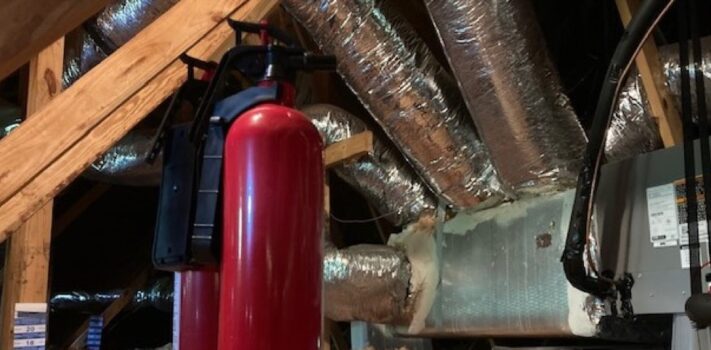
My next step was to pull down the attic access stairs and before my head reached the top step, the smoke smell intensified. Expecting the worst I called to my wife to begin collecting our pets and getting them kenneled then I proceeded into the attic. At this point the smell had distinguished itself into that of charred lumber. Our attic is excessively tall and open, with the central trusses having been designed to allow for a trio of fake dormers and a large platform for the furnace and HVAC trunks. I initially left the attic lights turned off hoping that in the darkness I could quickly spot flames or embers. After using a flash light to travel the central catwalk and not seeing fire, I turned the overhead lights on and expected to see smoke. Nothing, no smoke to be seen, only smelled. I reached over the furnace and pulled the central disconnect in hopes that with quietness I could hear something. Still no clue as to where the smell of smoke was coming from.
I left the attic, went outside again and entered the crawlspace. Our home now has gas logs, but when the original owners built it, they installed a wood burning fire place. Although I knew the chimney was a modern double pipe stainless steel tube and that there was not a foundation underneath our house, I wondered if there could be some penetration other than the natural gas and ducted fresh air intakes that could be siphoning smoke through the chimney pipe chase. The crawl space smelled stale which is expected since the block vents were closed to retain heat over winter, and all of the fiberglass insulation was still in place as well.
Returning inside, I helped catch the remaining highly spooked cat and decided to call the 24-hour service line for our furnace company. At the same time my wife suggested calling the fire department to which I agreed. All of the above had only taken six to eight minutes.
My wife dialed the non-emergency number for the local fire department and since it was well after seven, the recording informed her she needed to dial 911. The dispatcher was calm in collecting information as my wife relayed the situation until hearing that we were still in the house. Thus far we couldn’t find verification that there was an attic fire or otherwise so we knew there was not a reason to rush or evacuate, the dispatcher in no uncertain terms shouted at us to “get out!”.
After hanging up the call, my wife drove her SUV onto the front yard where we loaded the cats into the back seat. Within this short span, sirens from the nearest volunteer fire station could be heard and the first volunteers and truck were in our driveway less than five minutes after placing the call. Although we live in a rural setting, the primary VFD station is only two miles away, a satellite station is within five miles and the neighboring county has a substation within ten miles.
My wife drove her car over to the side of our front yard and joined my initial discussion with the fire fighters. As I wrapped up my description of the situation several of the volunteers entered our home and attic. Only about half of them (my best recollection is that seven men and women initially entered while the remaining volunteers waited outside) could smell the smoke in the attic and by this point none of us could detect smoke at the HVAC return. When no flames could be found we began exploring the attic in detail, reaching under the blown in insulation, sniffing and trying to locate the source of the charred smell.
After ten minutes of fruitless searching, I asked if they had a thermal imager on the fire truck. After exchanging a “oh yeah” look with each other, one of the gentlemen called down and asked another volunteer to get the thermal imaging camera (TIC) off the truck. Continuing to both physically search and scan the attic using the TIC, we spent over 45 minutes in the attic. The only thing we found was a gap between the bottom of the furnace body and the primary supply trunk line, which I will come back to.
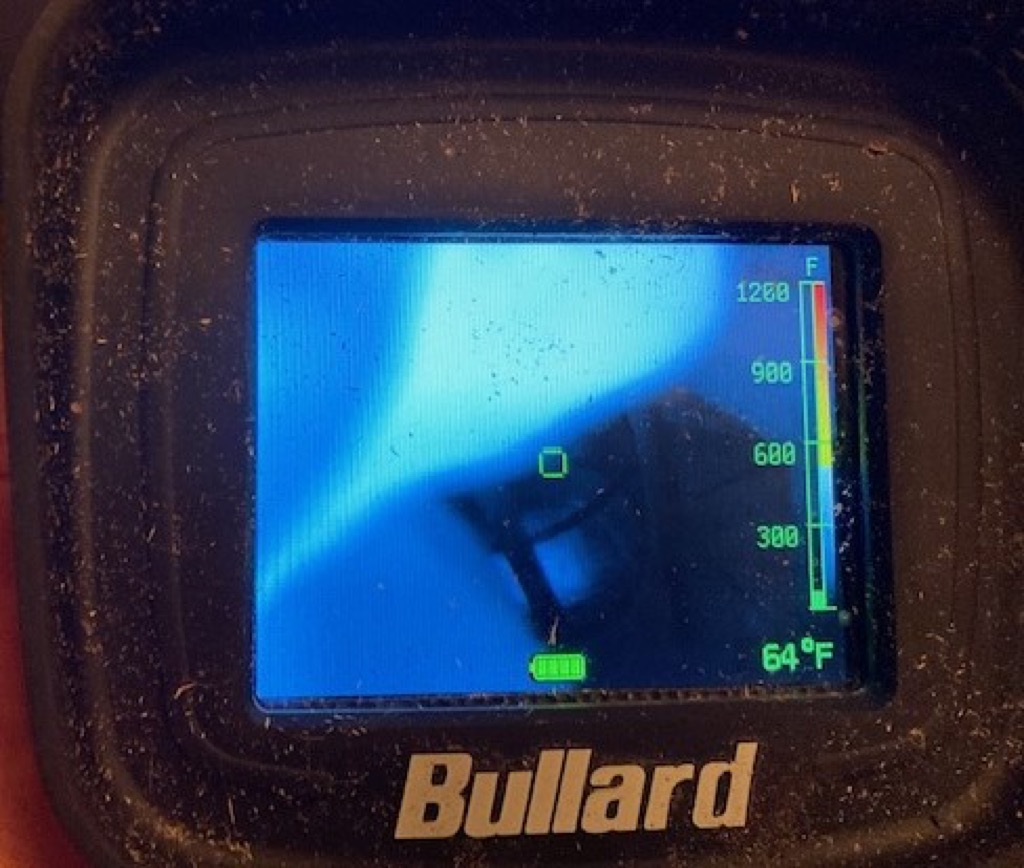 The fire fighters scanned all of the walls in our home, the wall to ceiling junctions and even joined me re-inspecting the entire crawlspace using the TIC. Nothing showed as hot. At one point one of the men who could smell the smoke questioned if the TIC was calibrated and working correctly. As a spot check, I opened the refrigerator then the freezer for them to scan. Both readings were accurate based on the thermometers we keep in the units. All told, a contingent from the volunteer fire department spent an hour and a half with me going through the house. Eventually they apologized for not being able to locate the source and said there was nothing else they could offer.
I asked the pair who seemed to be in charge what they would do in my situation where there had clearly been something that burnt but no trace could be found. One of them mentioned that to him the smell had more of a burnt electric smell so maybe keep the furnace turned off until it could be checked and the second suggested placing smoke detectors in the attic. By this point, it was almost nine pm out in the boondocks and I was hoping against hope that I had a spare smoke detector in my stash. I was fairly certain I had one left over from a multi pack purchased for a real estate job not too long ago, but all I could find were a pair of carbon monoxide detectors. My amazing, wonderful bride offered to drive two towns over to a late-night Walmart to buy us a smoke detector.
Around 10 o’clock she returned home with three battery powered smoke detectors, I spread them across the trusses then set a pair of fire extinguishers on the catwalk within reach of the attic stairs landing. As the final step my stressed mind could come up with, I also staged two more extinguishers next to my night stand for ready access.
That night made for one of the worst nights of my life. Each time I awoke (not that I slept much), I climbed into the attic. The smell hadn’t returned. On Friday morning the HVAC company returned my call and said they would “try” to get someone out to inspect the unit. Hearing this I asked what the point of paying for a guaranteed service contract was especially since they had just installed a complete replacement unit the week after Labor Day last fall. A technician arrived around noon, performed a very minimal inspection and told me he didn’t have the ability to re-align, support the trunk line and connect it to the sheet metal of the furnace unit. He said he could tape the seam and report the need for alignment to be taken care of at our six-month maintenance visit. As an aside, I as a licensed builder detest predominately service work oriented mechanical and plumbing companies. Their prices are typically highly inflated and the employees seem to spend more time trying to up-sale parts and services than actually working. They market availability and supply disappointment.
Anyhow, I requested the tech to check the natural gas burner assembly to see if he could find evidence that something had combusted within the chamber. While he agreed to “look” he let me know that anything that entered the chamber likely burnt to nothingness and that if I was concerned about dirty ductwork, his company offered duct cleaning as a service. Long story short, no evidence of burnt electronics nor charred conductor sheathing and there wasn’t any residue in the burner chamber as far as he could see.
Literally, there was no “smoking gun”. To this day we don’t know what caused the smoke in our home. I spent time online Friday morning trying to find a thermal camera in stock within a reasonable drive of our home, but couldn’t locate one. As a result, I ordered a no name imported camera because it would arrive days sooner than the $600 Milwaukee model that I actually wanted.
While my wife continued on with her normal schedule, I rearranged mine so I could spend the next week working from home. We got a slight whiff of smoke near the second HVAC return on Sunday morning but haven’t experienced the situation since. I accept that in all likelihood dust or some other detritus must have been in the new return ducts from the installation back in September and it/they finally worked their way into the burn chamber of the furnace on that Thursday night. What I can not reconcile however is why we smelled smoke at the returns both times when by the flow mechanics for any furnace, the supply registers were the only outlets for the smell if burning occurred in the furnace, not the returns.
I checked the attic as often as every two hours for the week before my thermal camera arrived. It goes without saying how grateful we are that our home is still sound and no fire appears to have existed outside of our furnace. Also, the overall experience gave us an unwanted but realistic opportunity to test our ability to evacuate. Here are some of the things we discovered.
When my wife came back from Walmart with the smoke detectors, I asked her to pack what she would need if flames broke out during the night and we had to truly bug out. We each collected three sets of work clothes and toiletries in addition to our pre-packed bug out bags. Next, we packed up our safe contents, added our important documents folder and photograph storage box. We made certain that we had the keys for our safety deposit box, vehicles and tractors and split our emergency cash between her purse and my computer bag.
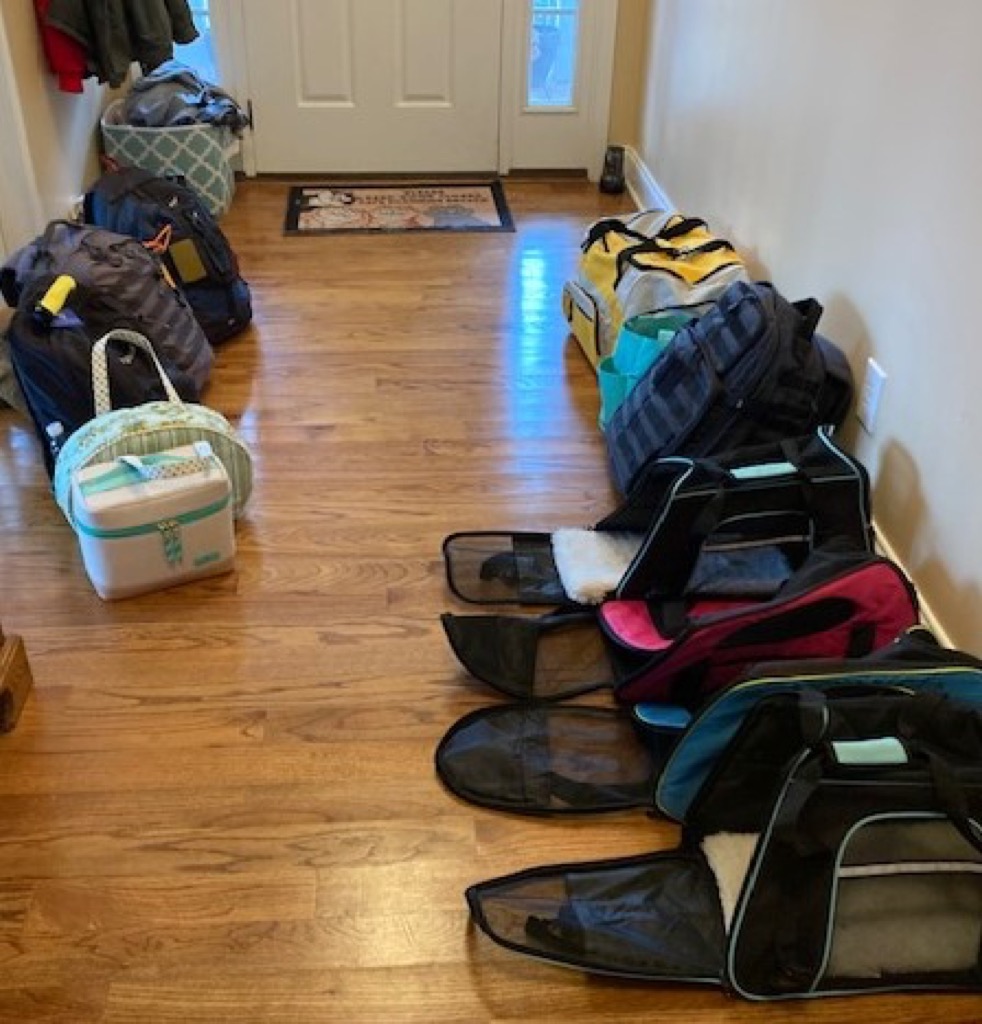 We placed these items along with the pet carriers in our home’s front entryway then backed her Ford Bronco up to the sidewalk in case we needed to load and scoot quickly. Our plan was to get the cats and prepared bags out of the house, even if it meant all I could do was toss the stuff onto the front lawn. Outside of our concealed carry pistols, I didn’t give consideration to any of our other firearms. On that night neither they nor any other material item mattered to me.
We found that our pets picked up on our stress and became skittish and difficult to kennel. One of the cats managed to roll itself across the room from inside his soft case carrier. We were not loud nor frantic as we waited for the fire department that evening, but the critters picked up on our stress and decided hiding was their new favorite game. This was completely out of character for all of them.
We were reminded that community matters. Two different sets of neighbors as well as our nearest family all invited us to spend the night at their homes before the fire department had gone. One set of friends offered us use of their Air B and B for as long as it would take for us to rebuild before finding out we didn’t have a fire.
I experienced that normalcy is slow to return after a shock. I can not imagine what those who experience loss endure. We only had the “rumor” of a fire yet my wife told me later that this was the first time in the 41 years we have know one another that she had seen me shaken.
We left our packed bags at the front door for a week, then moved them into the adjacent office where they stayed for two more weeks before I relaxed enough to “stand down”. With hindsight we realized that in our initial packing we forgot to grab our prescription medications and the sour dough starter we have been propagating for over 25 years. Perhaps a pair of trivial items, but we would have regretted not having them had the worst happened.
Lastly,as an aside, I have been questioning the wisdom of storing ammunition in our home. Currently about 40% is kept in my closet where as the balance is stored between the semi-detached garage and an outbuilding. I want to know: Is keeping ammo in the house a risk to safety if the home catches on fire?
JWR Adds: Generally, stored ammo is not a risk. Ammo in a house fire simply “cooks off”, making firecracker noises. The projected (“popped”) bullets do not travel more than a few feet. The only exception is a live round contained in the chamber of a gun, which can cook off with full force and full velocity. Reloading components (powder and primers) also present no threat to the safety of firefighters, other than making a house fire a bit more hot.
As a wrap up, I have added smoke detectors to my attic and plan to replace the battery models with hard-wired units because we all know the batteries in smoke detectors only die at night so we can all practice waking up to the “chirp”. I have purchased a thermal imaging camera and now routinely scan the attic and walls, even three months post event. I have inspected all six of the ABC fire extinguishers in my home and I did remove the two from the attic now that temperatures are seasonally rising.
I finally finished digging in and running the gravity supply water line from the 1,500 gallon irrigation tank that sits at the highest point on our land and am trying to decide how to terminate it for best use to fight a fire. And I’m grateful to our Lord for sparing us the actual fire, grateful to the local volunteer fire department members and thankful for a community that was reaching out before they knew what was happening. A final thank you to JWR for providing SurvivalBlog. It is an amazing resource.