
“Truth is treason in an empire of lies.” – George Orwell
- Ad SurvivalRealty.com: Sell Your Remote LandAdvertise your hard-to-sell remote land to eager buters. We specialize in rural, remote, and off-grid properties worldwide. Affordable ads. No commissions are charged!
- Ad Survival RealtyFind your secure and sustainable home. The leading marketplace for rural, remote, and off-grid properties worldwide. Affordable ads. No commissions are charged!
Notes for Sunday – January 01, 2017
John Cantius Garand (January 1, 1888 – February 16, 1974) was born in St. Rémi, Quebec. John Garand designed one of America’s best known battle rifles, the M1 Garand. General Patton praised Garand’s design, writing to Chief of Ordnance Lt. Gen. Levin H. Campbell, Jr., (January 26, 1945): “The M1 rifle is the most deadly rifle in the world.”
o o o
More bad news: Debbie Reynolds has passed away. She was an amazing dancer, singer, and stage performer.
- Ad Prepare for chaos with the essential SIEGE belt. Perfected for CCW with flexible, no-stretch, high-grip custom HD ballistic nylon and capabilities unmatched in any other belt. Go anywhere. Solid 5.5-7 oz of persuasion has saved many. Save $20!SIEGE STOVES: in a fuel crisis twigs are free and abundant. Ultra-compact high-performance portable survival stoves. Enter "SBLOG" at checkout for $20 off any belt. USA-made.
- Ad Elk Creek Company - Percussion Blackpowder Guns - No FFL Required.Elk Creek Company - Percussion Blackpowder Guns - Pre-1899 Guns - Knives - Bayonets - Magazines - The last bastion of privacy!
New Year’s Leadership-Part 1, by Sarah Latimer
Resolutions
It is the New Year, a time when most people reflect on the past year and determine what changes they want to make in themselves and their lives during the year ahead. When I think of a resolution, I think of a vow or serious commitment of resolve to see something through to completion. Usually, New Year’s resolutions are merely ideas or desires that people are willing to pursue with varying degrees of effort and commitment. According to Nielsen’s 2015 Report on Top New Year Resolutions, the top eight resolutions of those surveyed were:
- Stay fit and healthy,
- Lose weight,
- Enjoy life to the fullest,
- Spend less, save more,
- Spend more time with family and friends,
- Get organized,
- Learn something new/new hobby, and
- Travel more.
Actually, I don’t have a problem with any of those resolutions and could agree with all of those as good goals for myself, too. As preppers, being fit and healthy is important because we never know when we will be required to live without the power grid (cooking over fires, hand washing laundry and dishes, hauling water, cutting wood for heat) and producing our own food, protecting ourselves from thieves and raiders, and so forth. This level of work will require more physical activity and strength than the typical American applies today. Also, if doctors and/or medical facilities are not available, being healthy will prove valuable. Cutting out emotional, spur-of-the-moment purchases and non-necessities in order to save money that can be used to get out of debt or turned into precious metals or land is a great idea. It is amazing how much a person can spend over time when accumulating $10 and $12 items that seem cool when we’re at the store or browsing online but in a year or two will be called “junk” because they’re either broken, of no use, were never used, are rarely used, and are not remotely necessary. My mother wisely and frequently quoted, “A penny saved is a penny earned.” Pennies become quarters, and quarters become dollars; dollars become gold, silver, food, ammo, and even land. Being organized is good for preppers, too. In an emergency, we don’t want to have to go through six boxes looking for the wrench to turn off the water when there is broken water pipe nor do we want to hunt for the tourniquet or quick clotting gauze when we have a massive bleeding issue and no medical support available. It may be that you don’t know much about first aid or gardening or sewing or cooking from scratch over a fire stove, so maybe it is time to “learn something new”. If you live in the city, it might make sense to do some traveling into rural areas to look for places that you and your family could relocate and be happy away from the hordes of people who will be scrambling in chaos and violence if/when there is an crisis with limit supplies of food, electricity, and/or water. Of course, living life to its fullest and spending time with family and friends always makes sense. God and people should be our priority and give life value. So, I can see how all of these top New Year’s resolutions could benefit the person pursuing a preparedness. However, Time Magazine reports on the Top 10 Most Frequently Broken New Year’s Resolutions. Guess what? Take a look at their list that follows and see if any of it looks familiar:
- Lose Weight and Get Fit
- Quit Smoking
- Learn Something New
- Eat Healthier and Diet
- Get Out of Debt and Save Money
- Spend More Time with Family
- Travel to New Places
- Be Less Stressed
A lot of this list does look familiar, doesn’t it? Is it simply a lack of commitment that keeps us from accomplishing these good goals, or is it something else?
I propose that there may be several factors. One may in fact be that there is a slow commitment level to the stated “resolution”. We just truly are not resolved to doing whatever it takes to achieve that goal because we don’t see that the benefit is worth the invested effort. The objective isn’t important enough to us for us to change our ways and routine. We are creatures of habit, and we like our routines. Whatever is “normal” for us is what is comfortable and acceptable. Anything else is foreign, awkward, and uncomfortable at first, and a change requires determination and conscious effort. Some things, like giving up smoking or sugar, requires much more effort in the form of will power than others. For us to pursue something that requires a great deal of effort, we had better have at least a promise of a perceived return (benefit) equal to or greater than the investment; otherwise, we are likely to quit at the first sign of opposition or difficulty.
I don’t smoke, but I could benefit from all of the other discussed resolutions. I could lose a little weight and be more fit than I am. I enjoy traveling and spending time with friends and family. I could get some parts of my life more organized, and you know that I am always in pursuit of learning new things, including hobbies. However, I don’t see that these are likely to be what saves me in a catastrophic situation. Even though I stated that these resolutions could be beneficial for preppers, I don’t see any one of these things or even all of them combined as being the solution for a happy life, or even a secure, prepared life. Having achieved these things, a person will not be prepared for a catastrophic crisis. They will simply be more prepared than they were before, but they may be preparing in the wrong way since they don’t know what to prepare for.
Prepared for Catastrophe
As we enter the year 2017, we have cause for concern. The U.S.-Russian relations are critically strained; world economies are at the brink of collapse; nations around the globe are suffering from major natural disasters; and here at home we are functioning in an extremely fragile U.S. economy with a president who is spending his final days pulling off every sneaky deal he can muster on his way out of the door, which I hope gives him a good swift hit on the rear end as he leaves, if for no other reason than the fact that he took action against Israel. (On the topic of Obama’s betrayal of Israel, I wouldn’t want to be him when he stands before the Lion of Judah on judgment day.) I also pray that our nation will rectify this soon and stand strong with Israel, for the benefit of the U.S. more than Israel’s benefit. I believe the Bible and that God’s promise to Jacob (Israel) is ever-lasting when he says, “I will bless those who bless you and curse those who curse you.” As of this moment, the U.S. stands under God’s curse, and I only hope that God is holding back His hand of action because of Obama’s soon exit. I surely hope that Trump and Congress will turn this around and will stand firmly with Israel so that we can be the beneficiaries of God’s blessings.
Shifts
In my lifetime, there have been some major shifts in thinking. Some shifts in our culture that have changed in the past half century has to do with money, family, and home life among other issues.
In the 1950s, most U.S. citizens had some form of a savings account. They may not have had much in it, but most every employed person had one. Today, we read that most families do not have a savings account, and while some families do have investments, many families have very high debt. In fact, consumer credit card debt averages out to be in excess of $16,000 per household! This debt is in addition to mortgages, car loans, student loans, and other types of indebtedness. It is absolutely crazy how much Americans are spending beyond what we make. Furthermore, our definition of poverty is absurd in comparison to the rest of the world. Our poor are complaining that their television are too small, when the rest of the world’s poor is struggling to find adequate shelter, water, and food. Do we appreciate what we have? Do we think really need to have every luxury? I’ve lived in tiny, old apartments, and I’ve lived in large, elegant homes. I can’t say that my family relationships were any better in the larger homes. In fact, we may have been more distant, as we had more space and distractions that kept us apart. Be grateful for what you have and consider carefully what it is that you need versus what you just want. Those are two different things, and they should be treated differently. The wants should be postponed a bit to determine if they are beneficial and if their cost is worthy. Maybe there is another better use of that money.
When I was a child, there were a significant number of wives choosing to pursue careers outside of the home, but there were still a large number of women who valued home-making. They knew that their role in preparing and caring for their home (not as much the building as much as the community and function of those living together) was vital to their family and to the community and even to our nation, because they recognized that “family” was core to civilization. The idea of “every man (or woman) for himself” was considered a pitiful and weak way of living, but that’s where we find our current culture today. Even a single person needs relationships and a community. We thrive when we have others on which we can rely and trust. We need to be appreciated also. We, as humans, struggle physically and emotionally when we are in isolation. It’s just how we are programmed by our Creator.
- Ad Elk Creek Company - Federally-Exempt No-Paperwork GunsPre-1899 Antique Cartridge Guns -- No FFL Required. Can be mailed to your doorstep with no Federal paperwork!
- Ad Click Here --> Civil Defense ManualNOW BACK IN STOCK How to protect, you, your family, friends and neighborhood in coming times of civil unrest… and much more!
Letter Re: The Get-Home Cache, by The Feral Farmer
Hi Hugh –
With respect to the recent article about buried caches, burying an igloo-type cooler sounds like a great way to lose an entire cache of stuff. First, the suggested six inches of soil covering provides nowhere near enough protection from a vehicle over an otherwise unsupported area the size of a cooler lid. With no earth-arching over the flat lid, I suspect (but can’t prove) that it would fail if a heavy vehicle tire went directly over it. Second, and perhaps a more valid concern, is that if placed anywhere other than a hillside with great drainage, it will float out of the ground during heavy rain unless it weighs enough to remain negatively buoyant.
The net buoyancy of an object is equal to the weight of the water its volume displaces minus the object’s weight. Using the cooler linked in the article (a 48-quart Igloo), you can see its dimensions are 26.08in x 14.63in x 14.5in, or roughly 3.2 cubic feet. 3.2 cubic feet of water weighs approximately 200 pounds (varies with temperature). That means such a buried cooler would be positively buoyant (i.e., would want to float) if the cooler and its contents weigh anything less than 200 pounds. Now some amount of positive buoyancy is probably okay, as the weight of the dirt above would help prevent floating to some extent. But keep in mind that we are talking about a rain event and disturbed (previously dug-up) dirt is much more porous than undisturbed dirt and therefore will turn into mud much more readily, and mud isn’t going to provide much protection from floating. For better safety it would be prudent to ensure that the cache is negatively buoyant by doing the math and weighing it or by performing the swimming pool test described in the link below.
This issue was previously mentioned right here on SurvivalBlog – Matt R.
- Ad STRATEGIC RELOCATION REALTYFOR SALE: Self-sustaining Rural Property situated meticulously in serene locales distant from densely populated sanctuary cities. Remember…HISTORY Favors the PREPARED!
- Ad USA Berkey Water Filters - Start Drinking Purified Water Today!#1 Trusted Gravity Water Purification System! Start Drinking Purified Water now with a Berkey water filtration system. Find systems, replacement filters, parts and more here.
Economics and Investing:
Accounting Gimmicks Won’t Stop The U.S.A. Titanic From Sinking
o o o
Gold Prices: Bounce Before The Final Crash Or A Major Low?
o o o
Shale Spending Is Set To Soar. The worst of the oil price downturn appears to be over, with the most recent credit redetermination period showing that banks are finally loosening credit lines.
o o o
Criminal Witch Hunt in Dallas Pension Fiasco
o o o
SurvivalBlog and its editors are not paid investment counselors or advisers. Please see our Provisos page for details.
- Ad California Legal Rifles & Pistols!WBT makes all popular rifles compliant for your restrictive state. Choose from a wide range of top brands made compliant for your state.
- Ad Survival RealtyFind your secure and sustainable home. The leading marketplace for rural, remote, and off-grid properties worldwide. Affordable ads. No commissions are charged!
Odds ‘n Sods:
US Retaliates Against Russia For “Hacking The Election”: Expels 35 Diplomats, Unveils Sanctions
o o o
One of my buddies who is an expert on civilian drones just recommended this one: The Autel Robotics X-Star Premium Drone with 4K Camera, 1.2-Mile HD Live View. He said that it is ideal for video bloggers (vloggers) and for anyone who is seriously into making home/ranch/travel videos. – JWR
o o o
Headline: Soros: Trump is a “Would Be Dictator” Who Threatens the New World Order. JWR’s Comment: The psychological term for this is Projection. It is George Soros—the self-admitted former Nazi collaborater—who is the would-be dictator.
o o o
As Venezuelans starve, the generals grow fat – C.L.
o o o
A Recent Q+A podcast with Jay Nordlinger interviews AP’s Venezuela correspondent Hannah Dreier. She describes the apocalyptic scene there. – A.P.
- Ad USA Berkey Water Filters - Start Drinking Purified Water Today!#1 Trusted Gravity Water Purification System! Start Drinking Purified Water now with a Berkey water filtration system. Find systems, replacement filters, parts and more here.
Hugh’s Quote of the Day:
“And I, brethren, when I came to you, came not with excellency of speech or of wisdom, declaring unto you the testimony of God. For I determined not to know any thing among you, save Jesus Christ, and him crucified. And I was with you in weakness, and in fear, and in much trembling. And my speech and my preaching was not with enticing words of man’s wisdom, but in demonstration of the Spirit and of power: that your faith should not stand in the wisdom of men, but in the power of God.” – 1 Cor 2:1-5 (KJV)
Notes for Saturday – December 31, 2016
December 31st is the birthday of Dr. Cynthia Koelker, SurvivalBlog’s Medical Editor. It is also the birthday of Frederick Selous (born 1851, died 4 January 1917).
o o o
Mountain House is hiking most prices on their 30-year freeze-dried foods January 1 (as much as 10%). Safecastle is offering MH Sale discounts of as much as 48% through Dec. 31 (midnight Eastern time). Prices may never be this low again, so don’t miss this opportunity.
o o o
Today, we present another entry for Round 68 of the SurvivalBlog non-fiction writing contest. The nearly $15,000 worth of prizes for this round include:
First Prize:
- A $3000 gift certificate towards a Sol-Ark Solar Generator from Veteran owned Portable Solar LLC. The only EMP Hardened Solar Generator System available to the public.
- A Gunsite Academy Three Day Course Certificate that is good for any one, two, or three day course (a $1,195 value),
- A course certificate from onPoint Tactical for the prize winner’s choice of three-day civilian courses, excluding those restricted for military or government teams. Three day onPoint courses normally cost $795,
- DRD Tactical is providing a 5.56 NATO QD Billet upper with a hammer forged, chrome-lined barrel and a hard case to go with your own AR lower. It will allow any standard AR-type rifle to have a quick change barrel, which can be assembled in less than one minute without the use of any tools and a compact carry capability in a hard case or 3-day pack (an $1,100 value),
- Gun Mag Warehouse is providing 20 Magpul PMAG 30-rd Magazines (a value of $300) and a Gun Mag Warehouse T-Shirt; (an equivalent prize will be awarded for residents in states with magazine restrictions),
- Two cases of Mountain House freeze-dried assorted entrees in #10 cans, courtesy of Ready Made Resources (a $350 value),
- The Ark Institute is donating a non-GMO, non-hybrid vegetable seed package (enough for two families of four) plus seed storage materials, a CD-ROM of Geri Guidetti’s book “Build Your Ark! How to Prepare for Self Reliance in Uncertain Times”, and two bottles of Potassium Iodate (a $325 retail value),
- A $250 gift certificate good for any product from Sunflower Ammo,
- Two cases of Meals, Ready to Eat (MREs), courtesy of CampingSurvival.com (a $180 value).
Second Prize:
- A Tactical Self-Contained 2-Series Solar Power Generator system from Always Empowered. This compact starter power system is packaged in a wheeled O.D. green EMP-shielded Pelican hard case (a $2,400 value),
- A Glock form factor SIRT laser training pistol and a SIRT AR-15/M4 Laser Training Bolt, courtesy of Next Level Training, which have a combined retail value of $589,
- A gift certificate for any two or three-day class from Max Velocity Tactical (a $600 value),
- A transferable certificate for a two-day Ultimate Bug Out Course from Florida Firearms Training (a $400 value),
- A Trekker IV™ Four-Person Emergency Kit from Emergency Essentials (a $250 value),
- A $200 gift certificate good towards any books published by PrepperPress.com,
- A pre-selected assortment of military surplus gear from CJL Enterprize (a $300 value),
- An infrared sensor/imaging camouflage shelter from Snakebite Tactical in Eureka, Montana (A $350+ value),
- RepackBox is providing a $300 gift certificate to their site, and
- American Gunsmithing Institute (AGI) is providing a $300 certificate good towards any of their DVD training courses.
Third Prize:
- A Model 175 Series Solar Generator provided by Quantum Harvest LLC (a $439 value),
- A Royal Berkey water filter, courtesy of Directive 21 (a $275 value),
- A custom made Sage Grouse model utility/field knife from custom knife-maker Jon Kelly Designs, of Eureka, Montana,
- A large handmade clothes drying rack, a washboard, and a Homesteading for Beginners DVD, all courtesy of The Homestead Store, with a combined value of $206,
- Expanded sets of both washable feminine pads and liners, donated by Naturally Cozy (a $185 retail value),
- Two Super Survival Pack seed collections, a $150 value, courtesy of Seed for Security, LLC,
- Mayflower Trading is donating a $200 gift certificate for homesteading appliances,
- Montie Gear is donating a Y-Shot Slingshot and a $125 Montie gear Gift certificate.,
- Two 1,000-foot spools of full mil-spec U.S.-made 750 paracord (in-stock colors only) from www.TOUGHGRID.com (a $240 value), and
- Fifteen LifeStraws from SafeCastle (a $300 value).
- A $250 gift certificate to Tober’s Traditions, makers of all natural (organic if possible) personal care products, such as soap, tooth powder, deodorant, sunscreen, lotion, and more.
Round 68 ends on January 31st, so get busy writing and e-mail us your entry. Remember that there is a 1,500-word minimum, and that articles on practical “how to” skills for survival have an advantage in the judging.
Keeping Your Head, And Preventing Others From Losing Theirs, by G.F.
In a critical situation, would you rather make war or make peace? I think the idea of cooperating to live through a crisis is much better than a “kill or be killed” scenario. The main reason why we need to think on this topic is that if the unthinkable happens, we can more easily restore our society from scratch. Like the Founding Fathers, we will have a foundation to build on. A pile of dead people is not a good way to start.
Peace of mind is the key to happiness, and to have peace of mind you need resources. One of the most important of these is a solid survival plan. Resources and the land needed to support their production is true wealth, but respect for and preservation of life is priceless.
A major area that is often overlooked when considering the threat to our person is the sheer numbers of people who do not own land. In California, with a population of 39.4 million people, the percentage of non-owner occupied housing is 44%. That’s a lot of people who have no reason to prepare, and many will resort to taking by force from those who have a self-sufficient homestead. The numbers of people who are ready for a long-term event are few. Our society needs a huge paradigm shift towards building resiliency. From spare transformers for our grid to local police teaching appropriate use of firearms, community activism in emergency preparedness, and many other topics. In this uncertain age of terrorism, we cannot be too prepared.
So where do we begin? Obviously, personal preparedness must come first, before we can begin to strengthen our community. The poorest in this economy do not have the physical resources to move to a remote location, and a majority are disabled and in need of life extending treatments and medicine. These will be the first to pass on to the other side, needlessly. Do we want or need to deal with thousands of dead loved ones? The dignity of life must be preserved. Our American system, as flawed as it is, is the very best form of government on the planet, because it began with respect for human freedom, protection of life, liberty, and the constant desire to be happy. Whatever we do now to plan for the needs of our weakest will help to reduce the burden on our government when they are tasked with a reboot of our great system.
But I know you are thinking, why should I go beyond my personal needs or family’s needs? Shouldn’t the government provide for its citizens? Well, that might be too big of a task for our leaders who can’t even figure out how to have a fair and honest election in 2016. No, my friends, the job will most likely fall on all of us to make this society work in the event of a disaster. Our chance of success goes up exponentially if we get involved now with some sort of plan, even if we simply register as patriots with local police in the event they need men in a militia. That way, they might have an address book of trusted patriots to fall back on. However, I believe we can do much better than that.
All of the veterans who love this country will be a huge force to reckon with should a foreign nation plan to invade our borders, and with the recent election of Donald Trump as our president we might have an easier task of keeping enemies out of our country. It is clear that our borders are free-flowing inlets, ripe for breach by anyone with an evil intent to destroy our way of life and our principles of freedom. We even see the potential for destruction from within our own government with socialist and globalist policies that shave our sovereign rights into non-existence. The times are tough, but if we stick together we can save lady liberty for our children and grandchildren. The world needs a true ethical power to guide their destiny, and without all of us working together, the extinction of the human race is very likely. Is this enough reason to leave the comfort of your lazy chair and set up a community outreach or council meeting regarding emergency preparedness?
Developing a sharing mentality in society is key. Personal gain vs community gain is one of the primary issues for us to deal with correctly in any long-term, critical situation. If our goal is simply to have enough water, food, or ammunition to get our family through, what happens when those resources run dry? Can you reload bullets that you do not have? Can you drink water that no longer exists?
Wouldn’t it be better to have a network of local resources that you could count on? Let’s say for example that one neighbor has a gift of gardening; would it be wise to develop a cost or labor share? Maybe every neighbor on the block could contribute a bag of fertilizer, a Saturday pulling weeds, or a few hours a week on that shared backyard garden, or even a secure greenhouse to boost production? Maybe a neighbor on the block has an outdoor wood oven and a huge pile of firewood; could we begin to stock that pile and others for future cooking needs? Another neighbor might get a dollar a month from 30 people each contributing to the cost of chicken feed and watering of a coop, for enough eggs for everyone on the block. Another person who has solar panels might be able to secure a few extra deep freezers in their garage for community meat storage. Ideas like these will be the new currency when the ATM machine no longer spits out useless paper money.
Many preppers nationwide are building bunkers and buying rifles. Their thought process is that it’s too late to reprogram a society that wants everything easily or at the point of a gun, and there is a real need in many areas for a bunker or a safe room in your home. That is good insurance against foreign invasion, but we need to start building fallback plans into our local communities, so that we don’t have widespread violence and a loss of control. The scriptures teach that it is better to put others ahead of your own needs, and our current society is not even considering this, as if our political leaders are completely against this framework. Parasitic human culture and survival at any cost, putting ourselves first while others fend for themselves, will create a condition of constant strife and competition for scarce resources in a never-ending mass extinction. In a well-planned, survivalist society, the hierarchy must exist before the SHTF. We need to start setting up our resources now.
The ruling elites have defined who we are in society, and we have become very cynical towards each other. An industrial society of consumers will not work in a crisis. The people in power over these commodities, which we need to sustain life currently, have conditioned us to be self-centered consumers. The skills necessary for community survival are still ingrained in our culture but must be brought out and revitalized. We have been lead falsely to believe the government can take care of our needs. Social Security, banking, petroleum, Internet, commerce, electricity– all of these have lead to materialism of a dangerous kind, destroying our ability to thrive as individuals, families, and communities.
Think about this, huge populations where nobody except one or two neighbors actually goes out of their way to speak with each other, and we never talk about survival plans. There’s zero communication about working together or a group of families who might have to block off each end of the street to protect wives and children. Very few, if any, have a plan for self sustainability and none with a Ham radio shielded from damage by EMP. None know who has chickens or vegetable gardens and if there are seeds in storage or canned goods. How we would keep our food from spoiling in an extended loss of power, where drinking water would come from long term, and because many homes are on septic tanks, the groundwater, if any, is completely useless for consumption.
Our lifespan is dependent on technology; the threat is the loss of that technology. If the grid or the banking system were to fail, or any other sub-structure that the masses of people rely on, we all know what the result will be. People from the inner cities will drive out to the country as far as their gas tanks will carry them, and they’ll steal the resources they need until they run out of ammunition or they are killed. It’ll be a terrible time to be alive with mass extinction. The loss of many countless of otherwise beautiful human beings will be the result of a failure to plan ahead of time.
Our survival as a species relies on our ability to recognize the threat that we pose to ourselves, our over reliance on the capitalist system. The goal of this article is on where to begin and an answer to the question of how to get back in balance with the earth. How do we prepare as small villages of self sufficiency in advance of the potential failure of the system?
What should we do to develop strength in our infrastructure? Begin with recognizing different levels of threats to our survival. Some issues to consider:
- Personal Survival: Fresh sources of water, food storage, shelter from extremes of heat and cold, plants as medicines, proper weapons for personal safety and hunting, neighborhood cooperation, communications hardened from EMP for information updates, backup electrical power.
- Community Survival: Maps distributed to residents with the location of their personal emergency center of operations, food banks, and extra food production for the needs of others; seed banks; agreed rules for bartering goods, such as a list of suggested values (i.e. 2 chickens cooked = 10 lbs of flour); community shelters; cooperation in advance with local police and militia to include protection of community resources such as water tanks or sources, food banks, and alternate power sources; limits of government and a backup plan for peace and safety; setting aside acreage for people without soil of their own; emergency power distribution; and communications centers for officials to keep us updated.
A community must plan to be in balance before the SHTF. Reaching out to inner cities, the homeless, and other high risk groups is a starting point. Churches have volunteers and a good place for holding community meetings. Neighborhoods should be mapped into areas that each center will accommodate, because churches, senior centers, and foreign legion halls need to know what residents they can care for without being overburdened preparing for the needs of people unable to farm or grow their own food.
Setup city council hearings and workshops on emergency preparedness, maybe finding ways that community gardens can replace condemned buildings. Hold neighborhood meetings every month with a general plan for outreach and education. Can we task our government to re-purpose some of our tax money to a community solar panel for each city block that can be shared with local residents? Imagine that the worst has happened already. Do you want to see people shooting it out from behind barricaded doors as marauding bands of thieves and thugs search and destroy for their own personal survival? Or would thriving community gardens spread across multiple backyards be better? Some cities in England actually have entire public spaces filled with edible plants and fruit trees, so much so that people travel there as a vacation destination for a walking tour. Now that is smart.
The solution to the problem of survival begins with activism and also with your thoughts and prayers for our planet and our children, but along with prayer must also come actions. Start a local chapter on your city block, identify those most at risk, and get involved. Your family and your country is depending on you.
Letter Re: Secession
Thanks for the article. I enjoyed it, but I have a couple of questions: the Supreme Court rulings seem to pertain only to states wanting to leave an “indestructable Union” composed of “indestructable States”, but does that still leave open the possibility of one of the “indestructable States” wanting to separate and become another state and still be part of the United States? You mention Baja Arizona, and certainly there is discussion about a State of Jefferson. There’s also the intent/desire for Silicone Valley to split off and become their own state. I’m sure upstate NY would like to divorce themselves from the politics of NYC as well as Chicago driving the politics of Illinois. And how did West Virginia manage to separate from Virginia? It seems to me that West Virginia set the precedent for a state to split and remain in the “indestructable Union”, which kept the United States intact. So why not the possibility of a 51st and then a 52nd and a 53rd state, which would provide for a better representation of “We the People”? I’m not a lawyer but curious, especially since this election just showed how divided this country is. Thanks. -Andy
Economics and Investing:
Outlook 2017: What To Expect From Oil, Gold, USD And FX
o o o
Foreign Exchange Outlook (Scotiabank)
o o o
Investment Outlook 2017 (Credit Suisse)
o o o
Here’s where contrarian investors plan to make their money in 2017
o o o
SurvivalBlog and its editors are not paid investment counselors or advisers. Please see our Provisos page for details.
Odds ‘n Sods:
Spinners, Weavers, and Sheep Ranchers take note: The Annual Black Sheep Gathering is scheduled for June 23-25, 2017 at the Lane County Fairgrounds in Eugene, Oregon.
o o o
The Northwest Preparedness Expo is calendared for May 6, 2017, in Prosser, Washington
o o o
A Storm is Coming: Preppers Must Stay Vigilant in 2017
o o o
Signs of the times: Germany Considers Fining Facebook $522,000 Per Fake News Item
o o o
Star Parker: Obama Abandons Israel
Hugh’s Quote of the Day:
“And Pharaoh said unto Joseph, I have dreamed a dream, and there is none that can interpret it: and I have heard say of thee, that thou canst understand a dream to interpret it. And Joseph answered Pharaoh, saying, It is not in me: God shall give Pharaoh an answer of peace.” – Genesis 41:15-16 (KJV)
Notes for Friday – December 30, 2016
December 30, 1865 was the birthday of Rudyard Kipling. I should mention that his writings about Afghanistan have sparked a modern-day revival of interest in Kipling among British, Australian, and American officers and NCOs deployed to Afghanistan.
o o o
Today, we present another entry for Round 68 of the SurvivalBlog non-fiction writing contest. The nearly $15,000 worth of prizes for this round include:
First Prize:
- A $3000 gift certificate towards a Sol-Ark Solar Generator from Veteran owned Portable Solar LLC. The only EMP Hardened Solar Generator System available to the public.
- A Gunsite Academy Three Day Course Certificate that is good for any one, two, or three day course (a $1,195 value),
- A course certificate from onPoint Tactical for the prize winner’s choice of three-day civilian courses, excluding those restricted for military or government teams. Three day onPoint courses normally cost $795,
- DRD Tactical is providing a 5.56 NATO QD Billet upper with a hammer forged, chrome-lined barrel and a hard case to go with your own AR lower. It will allow any standard AR-type rifle to have a quick change barrel, which can be assembled in less than one minute without the use of any tools and a compact carry capability in a hard case or 3-day pack (an $1,100 value),
- Gun Mag Warehouse is providing 20 Magpul PMAG 30-rd Magazines (a value of $300) and a Gun Mag Warehouse T-Shirt; (an equivalent prize will be awarded for residents in states with magazine restrictions),
- Two cases of Mountain House freeze-dried assorted entrees in #10 cans, courtesy of Ready Made Resources (a $350 value),
- The Ark Institute is donating a non-GMO, non-hybrid vegetable seed package (enough for two families of four) plus seed storage materials, a CD-ROM of Geri Guidetti’s book “Build Your Ark! How to Prepare for Self Reliance in Uncertain Times”, and two bottles of Potassium Iodate (a $325 retail value),
- A $250 gift certificate good for any product from Sunflower Ammo,
- Two cases of Meals, Ready to Eat (MREs), courtesy of CampingSurvival.com (a $180 value).
Second Prize:
- A Tactical Self-Contained 2-Series Solar Power Generator system from Always Empowered. This compact starter power system is packaged in a wheeled O.D. green EMP-shielded Pelican hard case (a $2,400 value),
- A Glock form factor SIRT laser training pistol and a SIRT AR-15/M4 Laser Training Bolt, courtesy of Next Level Training, which have a combined retail value of $589,
- A gift certificate for any two or three-day class from Max Velocity Tactical (a $600 value),
- A transferable certificate for a two-day Ultimate Bug Out Course from Florida Firearms Training (a $400 value),
- A Trekker IV™ Four-Person Emergency Kit from Emergency Essentials (a $250 value),
- A $200 gift certificate good towards any books published by PrepperPress.com,
- A pre-selected assortment of military surplus gear from CJL Enterprize (a $300 value),
- An infrared sensor/imaging camouflage shelter from Snakebite Tactical in Eureka, Montana (A $350+ value),
- RepackBox is providing a $300 gift certificate to their site, and
- American Gunsmithing Institute (AGI) is providing a $300 certificate good towards any of their DVD training courses.
Third Prize:
- A Model 175 Series Solar Generator provided by Quantum Harvest LLC (a $439 value),
- A Royal Berkey water filter, courtesy of Directive 21 (a $275 value),
- A custom made Sage Grouse model utility/field knife from custom knife-maker Jon Kelly Designs, of Eureka, Montana,
- A large handmade clothes drying rack, a washboard, and a Homesteading for Beginners DVD, all courtesy of The Homestead Store, with a combined value of $206,
- Expanded sets of both washable feminine pads and liners, donated by Naturally Cozy (a $185 retail value),
- Two Super Survival Pack seed collections, a $150 value, courtesy of Seed for Security, LLC,
- Mayflower Trading is donating a $200 gift certificate for homesteading appliances,
- Montie Gear is donating a Y-Shot Slingshot and a $125 Montie gear Gift certificate.,
- Two 1,000-foot spools of full mil-spec U.S.-made 750 paracord (in-stock colors only) from www.TOUGHGRID.com (a $240 value), and
- Fifteen LifeStraws from SafeCastle (a $300 value).
- A $250 gift certificate to Tober’s Traditions, makers of all natural (organic if possible) personal care products, such as soap, tooth powder, deodorant, sunscreen, lotion, and more.
Round 68 ends on January 31st, so get busy writing and e-mail us your entry. Remember that there is a 1,500-word minimum, and that articles on practical “how to” skills for survival have an advantage in the judging.
Growing Pineapple, by G.J.
In post-Columbian Europe, imported or greenhouse pineapples were a symbol of wealth, often being used for decoration rather than being eaten. Now, imagine a world gone crazy, where even the canned pineapple is only a memory. For those of us who are well-stocked and even have a garden, the loss of trucking and worldwide shipping means a lot of fruits, especially tropical ones, will be simply a memory, kind of like how generations ago received oranges at Christmas as treats. Citrus fruits are not too much of a stretch in parts of the U.S., but pineapples will be rare. What is a fresh pineapple, something otherwise impossible to get, going to be worth?
Now imagine that you have a dozen (or more) of these things ripening every six months. Don’t forget the TEOTWAWKI value of fresh tropical fruit—what a precious commodity it could be. Pineapple has several health benefits beyond Vitamin C. It can help inflammation, regulate blood pressure, and ease arthritis. With a greenhouse or in a warm climate, you can grow your own pineapples. Pineapples take forever (up to two or three years) to fully mature, so get started now!
One of the ordinary benefits to growing your pineapples is that you can pick them at the peak of their freshness. They are usually picked about two weeks before you receive them in the grocery store and are often still in the green state they were picked in. Pineapples don’t ripen once they are picked, at least naturally. By contrast, the home grown pineapple you are picking is a golden pineapple taken directly off the stalk. Truly ripe pineapple has the sweetest, least tart flavor you can imagine.
Most people don’t even know how a pineapple grows, and they imagine pineapple trees or something outlandish. In reality, they are a plant about three feet high and wide that look like giant versions of the fruit’s green, leafy top. The fruit grows out of the top or from suckers on the side. This misunderstanding about pineapples leads to bad growing instructions that you basically cut the fleshy top of the fruit off and dunk it in water. This causes the flesh to rot and the leaves die. The actual method is slightly more complicated.
You’ll start with a standard grocery store pineapple; mine are Del Monte Gold, but don’t tell Del Monte that. The greener (unripe) the pineapple, the better, as you want to select one with healthy, dark green leaves. Remember, you’re growing pineapples, not buying it primarily to eat. Older and browner tops don’t grow very well. Stick your hand into the top of the pineapple, weaving your fingers into the leaves like you were grasping a handful of hair. Twist the top, don’t pull, in a circular motion around until it separates. With slight back pressure, it should come off in less than 360°.
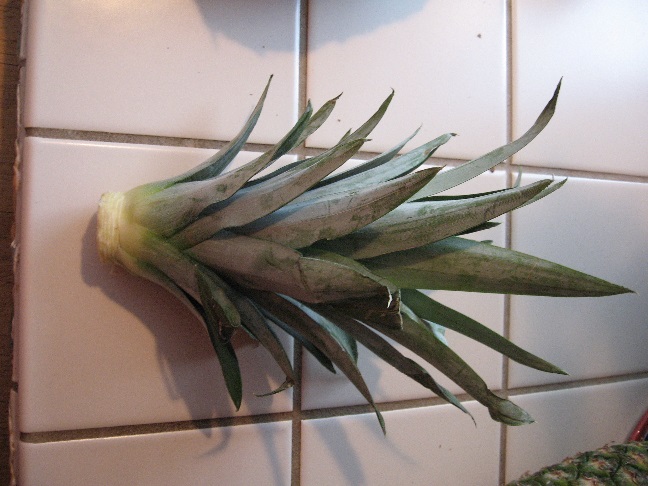
Now place the top on its side and cut about 3/8ths to half an inch off the very bottom of the top. A serrated knife will cut right through the leaves. Carefully prune off any leaves that are not firmly attached to the stem, but leave as many leaves as possible (a dozen are ideal, but more as well as just a few large leaves will work too). You will want not much more than half an inch of the ridged stem exposed. The bottom of the stem should have a ring of light brown dots along the perimeter. These will become the roots.
At this stage, you can choose to dry out the top for 1-2 days to ensure it takes up water. You can also choose to skip this step; I’ve tried both drying and skipping with good results. Place the exposed portion of the stem in the water until most if it is submerged; the less, the better, but this is an art, not a science. You want it to take up water but not be so deep that it begins to absorb water and rot. I personally use a jam jar (12oz) because the opening is often narrow enough to support the plant by the leaves. The easiest method is to just adjust the water level. Change the water weekly and add as necessary. Don’t be surprised if the water gets scummy, cloudy, or the stem itself looks a little brown. Ensure the plant gets good sunlight and is kept at room temperature.
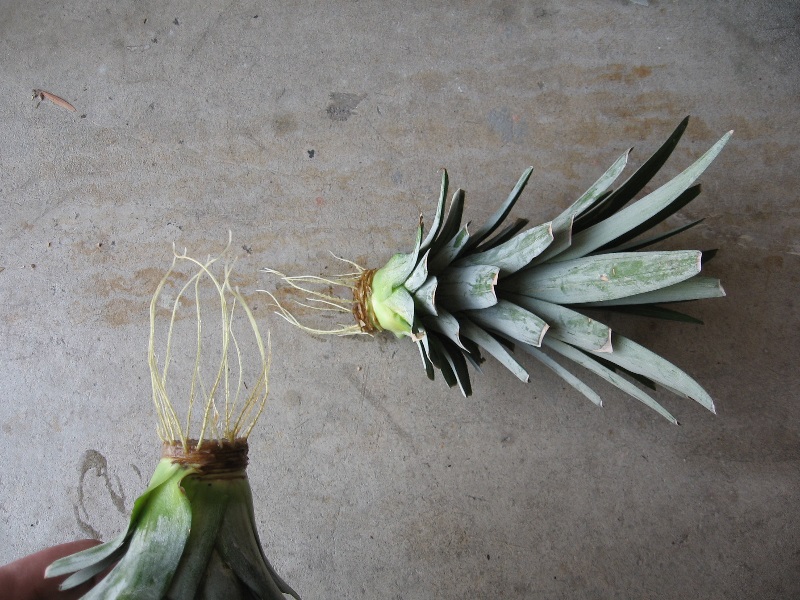
After a few weeks to a month, you will have long white roots growing from the bottom of the stem. I personally wait until the roots touch bottom before planting, but shorter roots are okay. Plant it in a medium sized pot using cactus soil and a gravel/pebble bottom if you can. You will want to wait about six months to a year (seriously!) for it to grow to the size of a houseplant before planting it in-ground. Alternatively, you can replant it to a much larger pot or leave it in a small pot, but if it does not have room to grow to bush size, it will be ornamental only.
Planting a pineapple in the ground is something strictly for frost-free zones. USDA Hardiness Zone 10 is the coldest you can grow it outside. In colder zones, it must come inside in winter or on cold nights. For my potted pineapples in the desert, the nights where the low 50s flirt with the high 40s are too chancy for me, and I take the pots inside. The English used to heat their pineapple greenhouses with a special stove. Those in the Redoubt must grow pineapples in pots or greenhouses, whereas coastal Californians south of San Francisco, anyone along the Gulf, or in Florida can grow them in-ground. The ground holds heat better than a pot.
Las Vegas? Phoenix? Forget it; it’s too cold in winter. Repeated exposure to low temperatures will kill the plant. Pineapples do okay in the heat, as long as they are well-watered and not blasted by direct sunlight all day. Watch that your garden or greenhouse doesn’t get too hot; two 80 degree days cooked my pineapples in a plastic greenhouse. If the leaves lighten up or brown slightly but otherwise appears healthy and growth continues, it should be fine.
Pineapples are rather like cactuses in many respects. In fact, they should be planted in sandy cactus soil, although well-drained, neutral or slightly acidic soil will do. They do not require frequent watering, but too little water will hinder proper fruit development. A light hosing once a week will do it in most temperate climates. Be sure to get some water inside the leaves as. Like many Bromeliads, the leaves are designed to conduct water to the plant itself.
You’ve waited two to three years and now you have this giant, spiky shrub in your yard. Don’t be afraid to prune the dead leaves; they will pull off with a gentle tug. The pineapple will flower and develop into a fruit by fusing the individual buds together. You’ve got a few months to go before it’s a ripe fruit. When it’s golden, twist it off or loosen it and cut with a sharp knife.
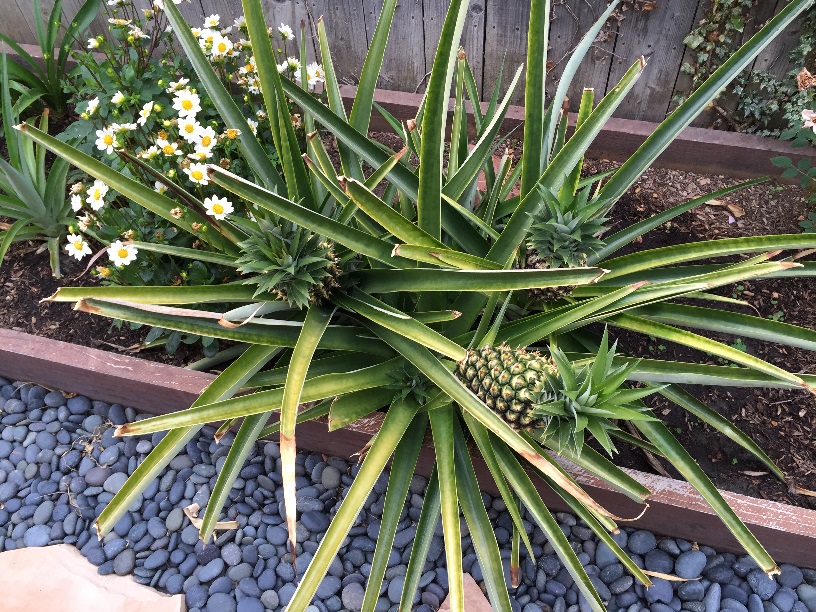
Your first fruit will probably be fairly small (though tasty); however, in less than a year, you will get suckers, known as ratoons, growing up from the side of the original plant. As the original plant withers, the ratoons, usually two to four, will grow into large, grocery store sized fruits. The ratoon suckers and fruit develop faster than the original plant did, sometimes as fast as six months. In optimal conditions, you can expect multiple “generations” of ratoons, producing fruit for several years.
Ripe pineapple rots quickly. When it’s about ripe, keep a close eye on it, and if in doubt, pick early and refrigerate. Eventually, the original plant will “give out” and wither or stop producing. I haven’t reached that point yet. Even this is not a problem, because the fruit can be used to create even more new plants. However, start rooting and planting early!
To slice the fruit, buy a stainless steel (not plastic) pineapple corer and slicer. Save yourself the time and trouble from cutting it into large chunks with a knife. Pineapple can be canned as cubes, slices, or rings. It does require a sugar syrup to be made to can the pineapple in. You can also dehydrate it, freeze dry it, or freeze the juice concentrate.
Warning: The leaf tips are sharply pointed and, depending on the variety, can be barbed. As the plants grow, the leaves become stiffer and more dangerous. You may want to put them up away from little kids and pets or cut off the sharp tips. This is especially helpful in greenhouses or the houseplant stage. Trimming will not hurt the plants as long as most of the leaves are intact.
Pineapples make excellent defensive shrubbery, just like cactus, which can be planted as companions to pineapple. If you are someplace where you can grow them outside in the ground, a dense hedge of pineapple plants will make a formidable barrier. Just imagine a looter, clad in shorts and a t-shirt walking, into the Pineapple Wall, because without night vision they look just like decorative shrubs. Even in pants, densely packed plants (say four deep) can make an uncomfortable obstacle. If a looter falls just right, he might lose an eye, but he will certainly be scratched and cut. Hidden foot snares can be added to guarantee anyone trying to make it through doesn’t do so successfully.