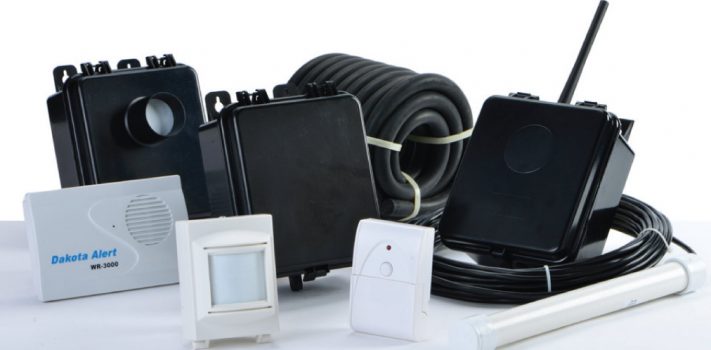
(Continued from Part 1. This installment concludes the article.)
—
MURS band Dakota Alert systems are very useful, but they often frustrate the user. Read up. It would be a huge loss if one could not operate their sensors correctly. And just like anything else, take one out of the Faraday cage and use it for awhile to gain experience with it. In a time of stress, getting a ‘false alarm’, could be nerve racking, when all hat it needs is batteries. In a pinch, but only in a pinch, would I connect directly to 12 VDC. With higher voltages they are more reliable in the rain, and cold. My first choice would be to add an ‘extra’ rechargeable AA battery, or two sets of 7-battery packs, wired in parallel to double the ‘run time’ when using rechargeable, or 6 regular alkalines, if the lithium type were not available. Just keep the voltage below 10 VDC, to be safe. The most stable source of power would be the 12 volt car battery with the universal voltage adapter set to 9 VDC. So as not to ‘waste’ a good car battery, use one with a bad cell that no longer can start a car. Once again, here is an inexpensive 10 watt PV panel that can be connected directly to that battery.
Especially if a PV panel is used, be sure to use a universal voltage adapter. And always confirm polarity with a volt meter before connecting.
Continue reading“Optimizing MURS Dakota Alert Sensors – Part 2, by Tunnel Rabbit”







 I poured the powder in each chamber and immediately seated a ball. I used a short starter to do the initial seating. A surprising amount of force was needed. I suspect the range lead I melted down included hard-cast commercial lead bullets. Once the widest part of the ball was past the chamber mouth, I pushed the ball in until it was flush, using a short dowel. The balls have to be flush in order to put the cylinder back in the gun. Again, I load only five of the six chambers.