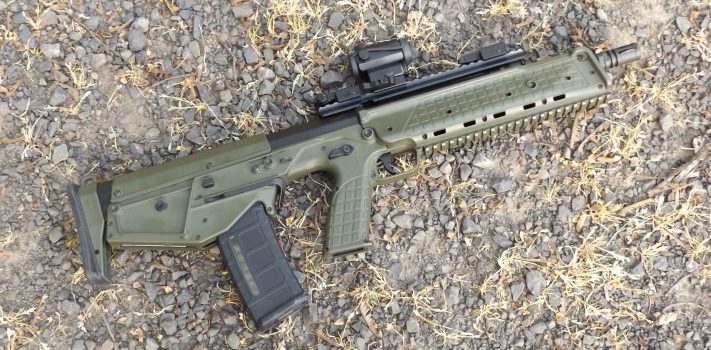
I’ve never been a huge fan of Bullpup rifle designs – I’ve shot a few over the years, but they just didn’t ring my chimes for some reason. That has all changed, since I bought a Kel-Tec RDB-17 – my local gun shop is always getting in something that catches my attention, and the RDB-17 really opened-up my eyes for some reason. I’ve played around with the civilian version of the IWI Tavor that is being used in Israel with great success, but it didn’t do anything for me – especially the price tag – it didn’t offer anything to me over an AR-style rifle.
I’ve owned more than a few different types of firearms from Kel-Tec over the years, some were great, some were just okay. One in particular is their SU-16, it is a pretty nice little rifle, that folds in half, and fires .223 Rem ammo and takes AR magazines, but they are not super durable – not something I’d willingly take into “war” of any sort – unless it was the only rifle I had – then I’d make do! It just seems a bit fragile for heavy use. I always thought it was perfect as a trunk or truck gun – for survival purposes of emergencies. Then we have the Kel-Tec Sub2000 – nice little folding guns with variants that shoot 9mm or .40S&W ammo – and take magazines from major gun makers. Again, nice guns, a lot of fun to shoot. But taking them into “war” – nope!!! Still, if that’s all you had, you go with it and pray for the best.
Kel-Tec was started by George Kellgren, and he is a firearms design genius. Not quite as good as John Moses Browning, but the guns that Kellgren has designed over the years – all of them – are really quite unique. And, one thing I like about the line-up at Kel-Tec is the simplicity of their guns – simple is better: Fewer parts, means less frequent breakdowns – I can’t make that any more clear. That is one of the reasons why Glock handguns are so popular, they are simple – very few parts to break, so they work all the time!
Continue reading“Kel-Tec RDB-17, by Pat Cascio”










 I poured the powder in each chamber and immediately seated a ball. I used a short starter to do the initial seating. A surprising amount of force was needed. I suspect the range lead I melted down included hard-cast commercial lead bullets. Once the widest part of the ball was past the chamber mouth, I pushed the ball in until it was flush, using a short dowel. The balls have to be flush in order to put the cylinder back in the gun. Again, I load only five of the six chambers.