SurvivalBlog presents another edition of The Survivalist’s Odds ‘n Sods— a collection of news bits and pieces that are relevant to the modern survivalist and prepper from “JWR”. Our goal is to educate our readers, to help them to recognize emerging threats and to be better prepared for both disasters and negative societal trends. You can’t mitigate a risk if you haven’t first identified a risk. Today, we look at the risk of solar superstorms.
New Studies Warn of Cataclysmic Solar Superstorms
Scientific American reports: New Studies Warn of Cataclysmic Solar Superstorms — New data suggest the New York Railroad Storm could have surpassed the intensity of the famous Carrington Event of 1859. Here’s how the article begins:
“A powerful disaster-inducing geomagnetic storm is an inevitability in the near future, likely causing blackouts, satellite failures, and more. Unlike other threats to our planet, such as supervolcanoes or asteroids, the time frame for a cataclysmic geomagnetic storm—caused by eruptions from our sun playing havoc with Earth’s magnetic field—is comparatively short. It could happen in the next decade—or in the next century. All we know is, based on previous events, our planet will almost definitely be hit relatively soon, probably within 100 years.
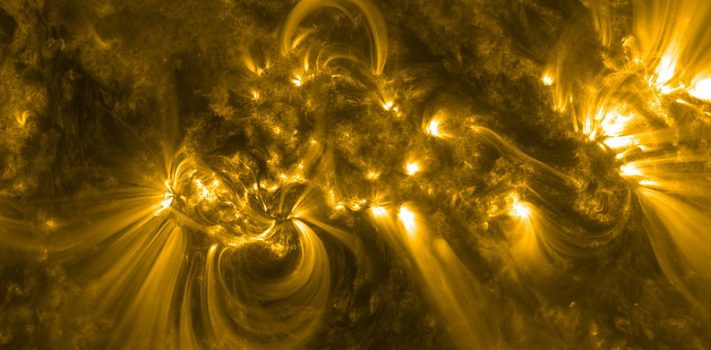
Geomagnetic storms are caused by sunspots, solar flares and coronal mass ejections, resulting in calamities to which our modern technological society is becoming ever more susceptible. Most experts regard the Carrington Event, a so-called superstorm that occurred in September 1859, as the most powerful geomagnetic storm on record. But new data suggest that a later storm in May 1921 may have equaled or even eclipsed the Carrington Event in intensity, causing at least three major fires in the U.S., Canada and Sweden—and highlighting the damaging effects these storms can have on Earth today.
In a paper published in the journal Space Weather, Jeffrey Love of the U.S. Geological Survey and his colleagues reexamined the intensity of the 1921 event, known as the New York Railroad Storm, in greater detail than ever before. Although different measures of intensity exist, geomagnetic storms are often rated on an index called disturbance storm time (Dst)—a way of gauging global magnetic activity by averaging out values for the strength of Earth’s magnetic field measured at multiple locations. Our planet’s baseline Dst level is about –20 nanoteslas (nT), with a “superstorm” condition defined as occurring when levels fall below –250 nT. Studies of the very limited magnetic data from the Carrington Event peg its intensity at anywhere from –850 to –1,050 nT. According to Love’s study, the 1921 storm, however, came in at about –907 nT. “The 1921 storm could have been more intense than the 1859 storm,” Love says. “Prior to our paper, [the 1921 storm] was understood to be intense, but how intense wasn’t really clear.”
Some Food Shortages Ahead?
SurvivalBlog’s Editor At Large Michael Z. Williamson spotted this news: India: Modi government’s onion export ban a ‘knee-jerk’ reaction. Mike’s Comment: Also, China has bought Smithfield and is reportedly shipping all processed pork carcasses overseas to replace those lost to disease epidemic. Combined with early flooding in the US this year, expect many food prices to rise this winter.Continue reading“The Survivalist’s Odds ‘n Sods:”