(Continued from Part 1. This concludes the article.)
My grandmother used open ceramic crocks to make sauerkraut. The problem is that they, like the Gartopf style ceramic crocks, are quite expensive compared to glass jars, so I bought several used crocks to try. It is hard to seal open crocks adequately to provide the anaerobic environment necessary to make sauerkraut without having to regularly skim off the spoilage that forms at the top of the crock. I tried using a piece of lexan sealed to the top of the crock with silicone glue, drilling a hole in the lexan to insert a wine-style airlock (similar to what I use for glass jars). That helped, but I found out that some of the used crocks I purchased were not fired properly and leaked liquid from the sides and bottom of the crock. If you decide to use a ceramic crock to make sauerkraut, then first test it to make sure that it doesn’t leak!
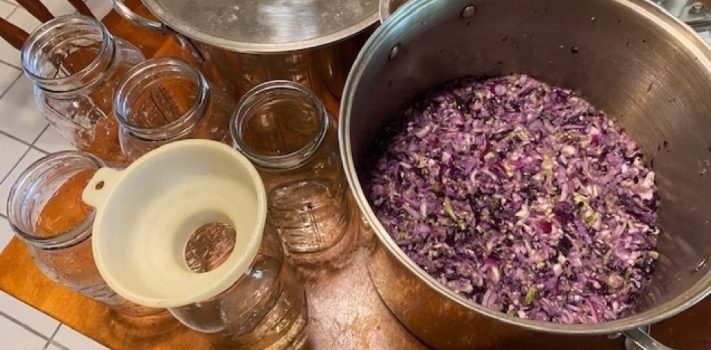
Use a funnel with a wide base so that spillage is minimal when filling the jars with a small ladle. As you fill each jar you need to periodically push the cabbage down with a tamper. The one shown below is a piece of 2-inch diameter poplar dowel that is 26 inches long. I added two handles to the top of the pounder but I don’t think they are really needed, unlike the heavy 4 x 4 pounder, where the handles are a necessity because of the weight and size of the 4 x 4. At this point, you are just pushing the cabbage down into the jar to remove the air pockets, not trying to mash the cabbage.Continue reading“Making Your Own Sauerkraut – Part 2, by E.P.”