
“No matter what I accomplish, it doesn’t seem like much compared to surviving Auschwitz.” ? Art Spiegelman, Maus, II: And Here My Troubles Began
- Ad USA Berkey Water Filters - Start Drinking Purified Water Today!#1 Trusted Gravity Water Purification System! Start Drinking Purified Water now with a Berkey water filtration system. Find systems, replacement filters, parts and more here.
- Ad STRATEGIC RELOCATION REALTYFOR SALE: Self-sustaining Rural Property situated meticulously in serene locales distant from densely populated sanctuary cities. Remember…HISTORY Favors the PREPARED!
Notes for Monday – April 27, 2015
On this day in 1789, the crew of the British ship Bounty mutinied, setting Captain William Bligh and 18 sailors adrift in a launch in the South Pacific.
- Ad California Legal Rifles & Pistols!WBT makes all popular rifles compliant for your restrictive state. Choose from a wide range of top brands made compliant for your state.
- Ad SurvivalRealty.com: Sell Your Remote LandAdvertise your hard-to-sell remote land to eager buters. We specialize in rural, remote, and off-grid properties worldwide. Affordable ads. No commissions are charged!
Scot’s Product Review: MagnetoSpeed V3 Ballistic Chronograph
One of the most basic needs for all living creatures is the ability to defend themselves. When there are bad times and problems in our society, it is essential to own and be able to use weapons for self-defense. The situation could be a regional disaster, like Hurricane Katrina, or it could be the worst of times, such as a Carrington or EMP event. In either case, there are wicked people who will take advantage of those who are weak. Even if you can avoid evil people, there are predators to be dispatched and game to be gathered for the table.
Having weapons is not enough. We must have skill with them. That means training and practice. Both require ammunition, and that stuff is expensive and sometimes hard to acquire. Being able to make our own by recycling cartridge cases saves money and also provides more detailed knowledge of how our weapons work, which is a component of being skilled. Reloading also allows us to tailor ammunition to specific purposes, from practice to self-defense and for hunting specific game animals or predators.
A key consideration in having ballistic success with our ammunition is how fast the bullet is going and how consistent the velocity is from round to round. That’s not something we can eyeball. While we can obtain some data for factory specs or from reloading manuals, the only way to know for sure what we are getting is the use of a ballistic chronograph– a device that can measure and record bullet speeds. While you can do okay without one, you will have far more data to work with as you tune your ammunition to your weapons if you have access to a chronograph.
At one time chronographs were rare and expensive, but thanks to modern electronics that has changed. In the early days of measuring bullet speeds, a number of approaches were used, such as a pendulum or a moving piece of paper. By knowing how far the pendulum swung when struck by the bullet or how much the paper traveled while the bullet was in flight, we could calculate its speed with reasonable accuracy. Today, however, chronographs use sensors that can detect the bullet as it passes over them. The timer starts as the bullet goes over the first sensor and then stops as it passes the second, and a computer determines the speed. Some add extra sensors to double check accuracy.
The most common form of sensor reacts to the shadow cast by the bullet as it passes over them. The bullet needs to pass directly over the sensors and its path should be parallel to them. There is often a diffuser placed over the sensors to provide even lighting. Sometimes, however, differing light conditions such as the lack of a good shadow or angled light that places the shadow offset to the sensor can cause problems and errant readings. Indoor lighting can be problematic for some sensors, particularly under lights that flicker, as most fluorescents do. The sensors usually need to be placed at a set distance in front of the shooting position. If the sensors are too close to the muzzle, blast can affect readings. The shade assembly typically forms a “target” area for the shooter to aim through to record results. There is the problem, however, of accidentally shooting parts of the unit, especially when testing weapons with a lot of sight offset, like the AR-15.
A newer and different form of sensor is found in the $399 MagnetoSpeed V3 Chronograph , which uses the disruption of magnetic fields by the bullet’s flight to measure speed. I was baffled a bit about how bullets made of non-magnetic materials could be read, but the physics work despite my inability to fully grasp them. The sensors are contained in what MagnetoSpeed aptly calls the “bayonet”, which attaches to the weapon’s barrel.
Putting the bayonet on a weapon the first couple of times is a bit fussy. It has to be positioned so it is parallel to the bullet’s flight and not in its path. It is recommended to have a .25 inch gap between the bottom of the bullet and the top of the bayonet, though air rifle pellets may need a narrower gap. In any case, you want to make sure the bullet does not hit the bayonet. However, unlike the down range sensors, once it is set up there is less chance of a brain fade and a hole in the sensor, since it stays fixed in relation to the bullet’s path. If you set it up right, there won’t be any problems when you get tired and lose a little concentration. Most of the time, we will place it at the bottom of the barrel, but it can be placed at any orientation to the bore.
You get a supply of spacers and shims to align the bayonet. What makes it fussy initially is that the shims compress as you tighten the assembly to the barrel. As you get used to how much they compress, it gets easier to pick the right one to start with. If you are smart, you will also take notes about which spacers are needed for which weapon so you won’t have to experiment the next time.
When you attach it to the barrel, you pull a mounting strap tight and then twist a knob to ratchet it tighter so it is securely mounted on the weapon.
A slight amount of barrel taper can be accommodated with the existing shims. If there is much, they sell a kit with special shims for $4.99 that allows you to correct for it.
MagnetoSpeed provides an alignment guide to help you get the gap between the bullet path and the bayonet correct. A cleaning rod will help too, as noted in the instructions. Just insert the rod in the barrel to show exactly what the bullet path will be and then use the alignment guide to be sure you have the right gap. The cleaning rod would need to be as close to bore diameter as possible, of course.
The V3 I am reviewing can fit on a barrel or suppressor up to two inches in diameter. There is a heat shield to be used with suppressors that can get very hot.
A new version is coming that will be available at a lower cost, but it only fits barrels up to one inch in diameter. It will have a fixed cord and won’t be able to tolerate as wide a range of muzzle devices.
The unit comes with your choice of a hard or soft case. The review unit I received had the sturdy, hard polymer case with neatly cut foam inserts for the unit and accessories. You get everything you need, including a battery and an SD storage card to hold your data, which can then be transferred to your computer. There are even two sets of cables to connect the display unit to the bayonet, and they are long enough to do the job. One is retractable, and they use a standard connector, so should you break or lose one it will be easy to replace it. The instructions are clear and easy to understand. Everything looked professional and well made. The only thing I would have wished for was a spare set of screws for the bayonet mount. I have a vivid vision of one of them popping out of my fingers and bouncing out in front of a bench at the range where I can’t get to it. You can order a spare set for $3, if you wish. http://www.magnetospeed.com/collections/v3-spare-parts/products/v3-screw-kit-pack.
The whole kit weighs only about 2.6 pounds, and the storage case is 10×13.5×3.5 inches in size. It is made in the U.S. with some foreign components. The bayonet adds about 8 ounces and 11 inches to the muzzle of the weapon. I discovered it is very magnetic when measuring it, so you might not want to get it close to your watch.
The instructions are quite clear and comprehensive, though I was horribly fuddled at how to turn it on until I realized that it turns on when you plug the cable into the top of the display unit. Sometimes the simpler it is, the harder I have to work!
I was a bit surprised that, as well as rifles, they recommend it for shotguns. I hadn’t thought much about this and would never try shooting a shot load through a sky screen style chronograph. However, since a shotgun pattern doesn’t begin to spread until it is downrange a few feet, all is well with the MagnetoSpeed as it is located at the muzzle. They do have some guidance in the instructions on fitting with shotguns.
It works well with revolvers that have enough space to mount it on the barrel, but semi-auto pistols are generally a problem. The strap that wraps around the barrel to hold on the bayonet will cause functioning issues with most self-loaders that have a reciprocating slide. MagnetoSpeed has developed a $25 rail mount that will work with many weapons that have rails for mounting lights or accessories, though they warn it will not work on all of them.
The small display unit takes either a standard 9 volt battery or two CR123A batteries. I like the option of battery choices and was especially happy that it will use a very common and widely available battery, though the CR123A’s will provide a longer run time.
To use it, you simply connect the display unit to the bayonet with either of the included cords. I preferred the retracting one, as it meant less wire to get tangled up. Delightfully, the connectors are common stereo microphone ones, so if you lose or break the cable, you can get a new one at Radio Shack. There are two connectors on the bayonet for the cord, so you can connect it to the back or bottom as your needs require.
There are a number of functions available from the display unit. Archiving a shot series allows you to save it to the included SD card, which can then be removed to transfer the data in the form of a spreadsheet file to a computer. You can continue to view any data that is on the card, though you can’t add more shots to a series that was archived. You can delete a shot or a whole series of shots. You can adjust sensitivity of the sensors, which might be necessary for use with smaller, lighter, or slower projectiles, particularly for air rifles.
It’s interesting, though not much use to me, that there is a rapid fire mode that MagnetoSpeed says can handle up to 1,100 rounds per minute. I have no automatic weapons and no access to any at the moment, so I didn’t get a chance to check this function.
I found the display easy enough to read, since it can be placed close to the shooter. The base is angled up, so the screen is at about a 30-degree angle towards the shooter. It can also sit so the screen is straight up if that is more convenient. There is a backlight that makes the screen much more visible in low light but at the cost of battery life. You can switch it on or off as needed.
You can be metric or English for velocity and have it display standard deviation or extreme spread on the home screen. Both statistics are kept when a shot series is archived.
MagnetoSpeed warns on their website that your group placement may change when you hang the bayonet on the muzzle; this was something I expected. They say that group sizes usually aren’t affected much. I found this generally true, though I spent most of my time working with an air rifle and an AR15 with relatively stiff barrels. I suspect that there could be changes in group size with many weapons. However, since I prefer to separate accuracy and velocity testing, the question of accuracy with the bayonet attached doesn’t matter to me.
I find it amazing that the unit can measure a bullet’s speed over the 5-inch distance between the two sensors on the bayonet.
I have some concerns about muzzle blast eroding the bayonet, but I haven’t seen any problems. A friend owns one with quite a few rounds through it, and his looks fine. There is a metal shield facing the muzzle to protect the unit.
For me, the biggest advantage of the MagnetoSpeed is that I can use it on indoor ranges. I have yet to find an indoor range that will allow me to setup a conventional chronograph in front of the bench, but I have had no issues using the V3. There have been no problems with the low light that is often used indoors or with flickering fluorescents. It is also delightfully easy to archive data, which is something I can’t do with the older unit I often borrow.
Overall, I am very impressed with the V3 and am scrounging for funds to buy one. My only complaint is not being able to use it with most semi-auto pistols or short barreled revolvers. My friend is pondering building a jig for his to hold the bayonet and align a 1911 properly, which would take care of most of my issues. Truthfully, however, most of my need for measuring velocity is for centerfire rifle ammunition to confirm what I am getting in real life. For that, the V3 is a blessing.
Work Sharp Update
We got a nice note from Holly Deffenbaugh at Work Sharp with a good explanation about how to avoid rounding the tip of a knife with their sharpening tool. I reviewed it originally last September and then updated it at the bottom of another review when I discovered that careless use can round blade tips. As with any sharpening tool, you need to use it correctly. Here is Holly’s note with some good pointers on using the Work Sharp properly.
“Hi Scot. Thanks for your update on the blog about the Work Sharp Knife and Tool Sharpener. Rounding off the tip of the knife can be a common problem, but as you said, with a careful finish through you will avoid this. Our suggestion to users is that you pull the blade back briskly while keeping your arm straight. Once you get to the tip, do NOT slow down. The faster the better. Also, don’t follow the curve of the knife, remain pulling straight or even at a downward angle. Keep the blade up against the guide at all times, but be sure that you are pushing with force against the belt. The belts are flexible and so they will give with your knife. If you push into the guide and belt with too much force, you can cause that rounding as well when coming off the belt with the tip.”
– SurvivalBlog Field Gear Editor, Scot Frank Eire
- Ad Click Here --> Civil Defense ManualNOW BACK IN STOCK How to protect, you, your family, friends and neighborhood in coming times of civil unrest… and much more!
- Ad Elk Creek Company - Percussion Blackpowder Guns - No FFL Required.Elk Creek Company - Percussion Blackpowder Guns - Pre-1899 Guns - Knives - Bayonets - Magazines - The last bastion of privacy!
Pat Cascio’s Product Review: CRKT Hunt ‘n Fisch Knife
I don’t know about you, but I’m sick and tired of hearing about people dying from cancer. We’ve all been touched by this deadly disease; we all know someone who has passed away after a fight with cancer. We keep hearing encouraging reports that “they” are close to finding a cure for cancer, but there are so many different types of cancer that I wonder if we’ll ever get a leg up on it. Still, we all continue to hope and pray.
Just last week, my oldest daughter lost one of her German Shepherds to cancer. It was a fast-moving cancer that two vets said was “common” in German Shepherds, yet I’ve never heard of it, and I’ve been around German Shepherds most of my adult life. The cancer my daughter’s German Shepherd had seemingly took his life in a matter of hours. My daughter was out of town on a business trip and had a dog sitter. The following day, the dog sitter had to go to work, so I checked on my daughter’s two German Shepherds around noon; they were both fine. When my daughter got home at 5:00pm and then came next door to our house for dinner, she asked if I had noticed anything different about Toby– her male who was also a trained service therapy dog. I said, “Nope.” He was fine at noon. After we ate, my daughter went back home and called us. She said Toby almost fell over. It appeared to me that he had a seizure. She rushed him to the vet, who diagnosed Toby with cancer. They told her to rush him to the emergency clinic 13 miles away. My daughter was going to spend the $2,500 on surgery, in hopes of saving Toby, but Toby died as they prepped him for surgery. That’s how fast that sort of cancer moved. The tumor had ruptured, and he literally bled to death within a couple of hours.
All of this brings us to the new Columbia River Knife and Tool Hunt ‘n Fisch small fixed blade hunting knife, designed by custom knife maker Larry Fischer. I didn’t know Larry, but I was touched by the story of his collaboration with CRKT on his design. Fischer was an avid outdoorsman who took a no-nonsense approach to everything he did. Larry loved to bow hunt and was on the National Board Of Directors for the Backcountry Hunters and Anglers Association as well as serving as past president of the Idaho Traditional Bowhunters. Sadly, Larry lost his battle with pancreatic cancer. It took his life in 14 months. If you know anything about this sort of cancer, the survival rate is extremely low. Yet, Fischer fought it as best he could. I also want to mention that 100% of the profits from the Hunt ‘n Fisch design goes to the Pancreatic Cancer Action Network in memory of Larry Fischer, www.pancan.org!

If you’ve followed my knife articles over the years, you know that I don’t particularly like small knives, whether fixed blade or folder. I’ve always found that, for the most part, I can usually do more chores with a larger knife than I can with a small knife, but that’s not always the case, and I’m the first to admit it. The Hunt ‘n Fisch has a blade length of only 2.99 inches, although it appears shorter than that for some reason. The blade steel is 8Cr13MoV– a high-tech stainless steel that holds a good edge and is easy to re-sharpen, too. Rockwell on the blade is 56-60, which is a bit hard, but as I mentioned it’s fairly easy to resharpen. The blade is a drop point design with a flat grind, too. The handle material is multi-colored G-10; it’s very eye catching. The overall length of the knife is 7.15-inches, but once again it looks smaller. The knife only weighs 3.6 oz, so it’s light weight. I like the file work on the top of the blade, which is very appealing though it has no served purpose other than to, well, look cool!
I liked the expertly made leather sheath that comes with the Hunt ‘n Fisch. The sheath is designed to slide onto the belt horizontally, and it is comfortable to carry. The handle is easy to access, and the sheath is molded to hold the knife securely, too.
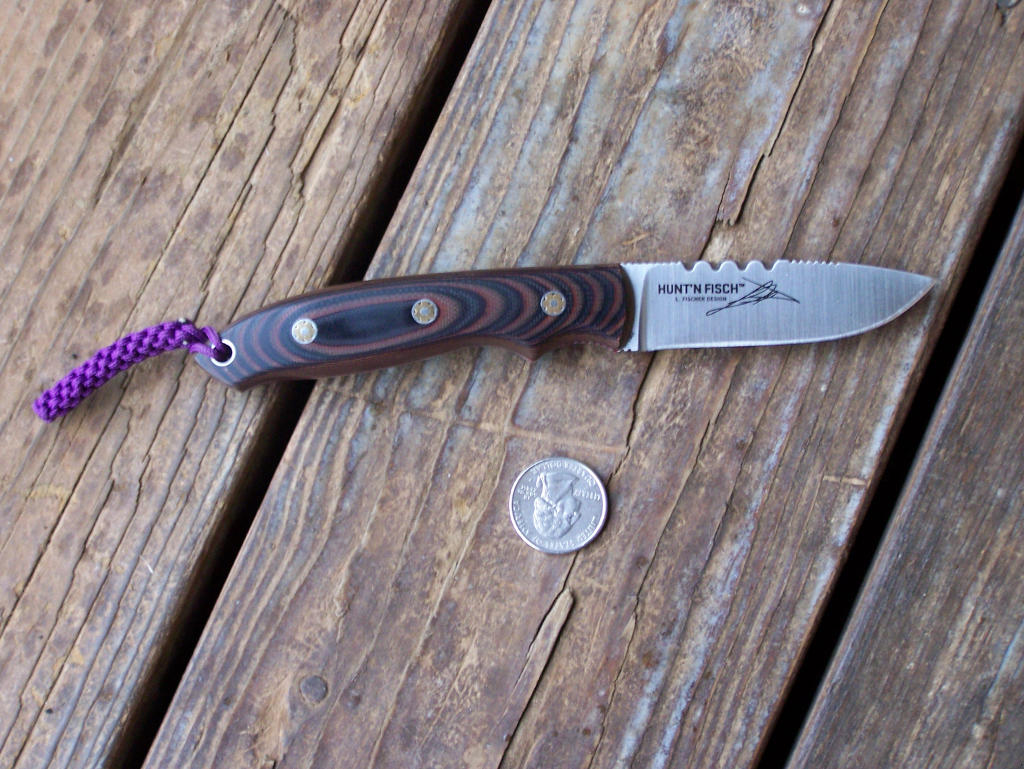
I tested the Hunt ‘n Fisch for more than a month and a half around my digs. Usually I test a knife for a couple weeks, but there was just “something” about this little fixed blade knife that had me addicted to it. I used it for all manner of chores in the kitchen, working on the pick-up truck and around the homestead, and for trimming blackberry vines, which is a never-ending chore in Western Oregon. Many folks don’t know that blackberries are not native to Oregon, but they sure gained a foothold once they were planted. While it’s nice to have all the free blackberries we want in late summer and early fall, it’s a chore keeping the wicked vines in check. They grow fast. To be sure, all over our area, you can have all the blackberries you care to pick. The vines have wicked thorns that seem to reach out and grab you, but the delightful blackberries are all natural and delicious. My wife loves making blackberry syrup for our pancakes. We always wear heavy, long-sleeve shirts and gloves when we pick blackberries, but we still get scratched from the wicked thorns. However, it’s worth it in the end. It’s free food for the picking!
I don’t see the Hunt ‘n Fisch as a survival-type knife per se. It’s just too small for many of the tasks you might need it for. However, if you hunt, this little knife would come in handy when you are dressing out big game. Unfortunately, this past hunting season, I didn’t get out there and get a deer tag. The deadline slipped away from me, but the Hunt ‘n Fisch would have made a dandy hunting knife to be sure. It is small enough that you can carry it on your belt every single day. You forget you have it there, until you need it. No matter what, a fixed blade knife is always going to be stronger than a folding knife. I don’t care what make a folder is or what type of locking mechanism it has, there is that possibility of the lock failing and the blade closing on your fingers, doing serious damage. That’s not so with a quality fixed blade knife!
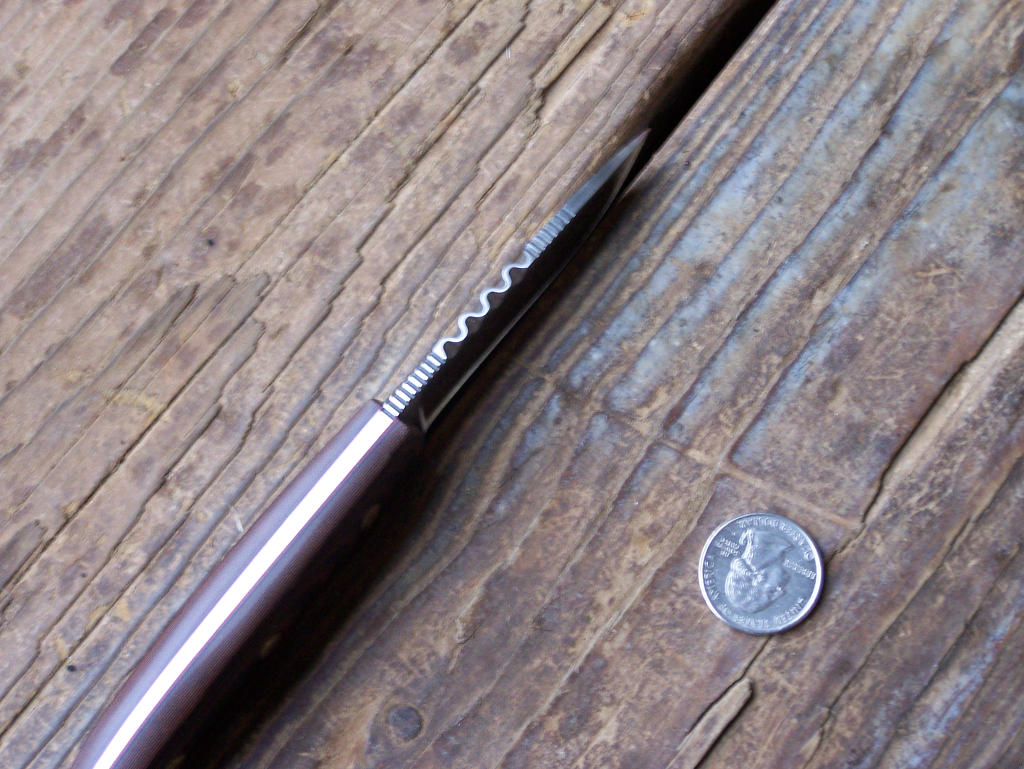
The Hunt ‘n Fisch comes with a lanyard on the butt of the knife; however, it was too short to be of any use, in my humble opinion. Of course, you can easily replace the lanyard with longer 550 paracord if you so desire. I also love the friction grooves on the bottom/front of the handle and along the top/front of the blade that makes for a sure grip even under all sorts of nasty weather and conditions.
To top it all off, the screws holding the G-10 handle scales on the Hunt ‘n Fisch are gold colored and embellished. This knife screams “custom” to my way of thinking.
I’ve saved the best for last, and that is suggested retail price. It’s $99.99, and if you shop around carefully you can usually find CRKT products discounted quite a bit. Now, here’s the bad news: the Hunt ‘n Fisch isn’t on the market as of this moment, however, CRKT expects to have a good supply in stock very shortly. I’d get my order in early. This is going to be a hot seller. We are talking custom quality at a factory price. What’s not to like here? Additionally, as I pointed out earlier, 100% of the profits from the sale of this knife goes to a worth cause– the fight against pancreatic cancer. You’ll be doing yourself a favor by getting one of these dandy little fixed blade knives. You’ll have a fantastic knife, and you’ll be helping in our fight against cancer. How can you lose?
– Senior Product Review Editor, Pat Cascio
- Ad Prepare for chaos with the essential SIEGE belt. Perfected for CCW with flexible, no-stretch, high-grip custom HD ballistic nylon and capabilities unmatched in any other belt. Go anywhere. Solid 5.5-7 oz of persuasion has saved many. Save $20!SIEGE STOVES: in a fuel crisis twigs are free and abundant. Ultra-compact high-performance portable survival stoves. Enter "SBLOG" at checkout for $20 off any belt. USA-made.
- Ad Survival RealtyFind your secure and sustainable home. The leading marketplace for rural, remote, and off-grid properties worldwide. Affordable ads. No commissions are charged!
Recipe of the Week: Chewy’s Augmented Mac ‘n Cheese, by D.D.
Carbs are easy to store, but mixing them with protein and flavors make mealtime more than another item on the daily task list. This recipe is named after our dog-shaped vacuum cleaner that went crazy when I prepared this and enjoyed the “accidental” dropping of ingredients on the floor.
Ingredients:
- 8oz ground beef
- 1/2 onion, chopped
- 1 foil packet of mushroom gravy mix
- 1/2 cup of milk
- 1 box of macaroni and cheese
Directions
- Boil the macaroni noodles in a pot of water until soft; lightly drain and transfer to a holding bowl.
- In the same pot, toss in the ground beef and onion, using the fat to cook it all down.
- When the meat is browned, add the cooked noodles back in and add the remaining ingredients (including the dry cheese packet).
- Simmer over low heat. Add water to achieve the consistency you desire.
- Eat with a happy tummy.
My advice is to get this recipe to the point where you like it before testing out SHTF adjustments, below:
- Use rehydrated onions
- Instead of milk and powdered mushroom gravy mix, use a can of mushroom soup
- Instead of ground beef, use a 10oz can of meat; this could be chicken, too
- Dish can also be cooked in a RoadPro RPSL-350 12 volt crock pot for off-grid use. (Yes, I tried this, and it took 2 hours total)
DD in Colorado
o o o
Do you have a favorite recipe that would be of interest to SurvivalBlogreaders? Please send it via e-mail. Thanks!
- Ad Elk Creek Company - Federally-Exempt No-Paperwork GunsPre-1899 Antique Cartridge Guns -- No FFL Required. Can be mailed to your doorstep with no Federal paperwork!
- Ad Survival RealtyFind your secure and sustainable home. The leading marketplace for rural, remote, and off-grid properties worldwide. Affordable ads. No commissions are charged!
Letter Re: Largest Bank’s War on Cash
I note that under Chase’s new rules, cash cannot be used to make a payment on a loan account. So payments on debt have to come through a deposit account. The Internal Revenue Service regards all deposits to deposit accounts as income. You have to offer proof that a given deposit is a transfer of funds from income previously recorded or proceeds from a loan to have the deposit excluded from income. Undocumented, it is known as phantom income to small business owners, as they are forced to pay tax on deposits they cannot prove to be from non-income sources. It is very important to keep good records.
Since debt can only be reduced by income and income is taxed, they are eliminating anyone’s ability TO avoid tax by engaging in cash transactions to earn money in order to pay off debt. They are making sure that the government can collect all the tax possible to pay interest on all those bonds they have bought. This is a necessary development that must precede dramatic increases in tax rates. As interest rates rise, taxes will have to go up to cover debt service and all those other obligations.
I know that I will have to pay tax on income in my journey to being debt free. It is important to use the rules to your favor using a combination of passive entities and active entities to achieve your goals. – R.V.
- Ad USA Berkey Water Filters - Start Drinking Purified Water Today!#1 Trusted Gravity Water Purification System! Start Drinking Purified Water now with a Berkey water filtration system. Find systems, replacement filters, parts and more here.
Odds ‘n Sods:
Battlefield America: The War on the American People – H.L.
o o o
Supreme Court: Police can’t hold suspects without probable cause, to wait for drug-sniffing dog. – RBS
o o o
Princeton study as a warning to Europe: US is no longer a democracy. – L.J. This is a German site, English translation available on Google.
o o o
Video: Can US agencies balance security and the Constitution?
o o o
Hugh’s Quote of the Day:
“Never shame your comrades by letting their death get you killed.” ? Rachel Bach, Fortune’s Pawn
Notes for Sunday – April 26, 2015
On April 26, 1986, the world’s worst nuclear accident occurred at the Chernobyl plant in the Soviet Union. An explosion and fire in the No. 4 reactor sent radioactivity into the atmosphere; at least 31 Soviets died immediately.
Street Combat – This Ain’t No Game! – Part 5a of 9, by Pat Cascio
[Street Combat – This Ain’t No Game is a SurvivalBlog exclusive.]
Chapter Three – GUNS & KNIVES
When we get into the topic of guns and knives, it holds a special place in my heart. I have carried a handgun since I was 18 years old and some sort of pocket knife even longer.
Deadly weapons don’t necessarily have to be used in the way they are generally intended for them to make an impact. Sometimes, the mere presence of one of these deadly implements is enough to stop an attack. The following is a true story. I know, I know; usually when someone starts out with the words “true story”, it’s not exactly true. Well, this one is!
CASE STUDY: Armed Robbery Admission
It was January 1975 at Chicago, Illinois Police Headquarters, which also houses various court rooms. I was present in one of these courts for a number of shoplifting arrests I had made while working temporary, plain clothes, store security detail.
While awaiting one of my court cases, I heard an elderly black man (probably in his late 60’s or early 70’s) explain to the judge the circumstances leading up to his arrest. The following is almost verbatim what this man said.
“Yore honors, I admits to going into that store. I admits that I had me this gun. I also admits that I wuz gonna rob that store. But, this here man (the elderly black man was pointing at a plain clothes police officer standing next to him) never told me he wuz no police man. He only pointed his gun at my head and said ‘Bye-bye mother f- – – er.'”
At this point the entire court room was laughing hysterically, including the judge. Court had to be recessed for 15 minutes while the court regained its composure.
LESSON LEARNED:
Never admit to attempting an armed robbery. The old gent above received a fairly stiff jail sentence. Silent hold-up alarms work, at least sometimes!
TECHNIQUE USED:
The plain clothes (tactical) officer didn’t need to fire his weapon. However, his judicious choice of words caused the elderly robber to cease and desists his actions IMMEDIATELY!
The elderly hold-up man wasn’t all that upset about being caught for his crime, but he sure enough was upset with the way the police officer identified himself as well as his carefully chosen challenge. Intimidation worked. Enough said?
Over the years, while working as a police officer, private investigator, or security officer, I had several occasions in which I drew my gun. There have also been occasions when I would have been justified (under the law) in firing.
CASE STUDY: Equalizing the Hefty Shoplifter
While working for one particular detective agency in Chicago, I was assigned to work a plain clothes store security detail for the two weeks leading up to Christmas. The store was Alden’s, a mail order outlet store. This was a fairly small outlet store with probably less than 5,000 square feet.
I worked with my partner, Dave Guritz, and four other security officers at this store, plus Alden’s had two off-duty Chicago Police Officers also working the store. That was plenty of security for a store so small in size, or so we thought.
The two Chicago Police Officer wore security guard uniforms and worked near the front door and cash registers. The rest of us either worked the floor or observed the store’s patrons from behind two-way mirrors in a specially built booth. We averaged 25 shoplifting arrests per day! Yes, you read that right; we had 25 shoplifting cases per day!
For some now forgotten reason everyone had gone to lunch and I was working alone. While observing a rather tall and heavily-built Puerto Rican “shopper” from behind the two-way mirror, it soon became obvious that this was no ordinary shoplifter. This fellow had on a long dress coat with “booster” pockets built into it. This is a sure sign of a professional shoplifter.
The two-way mirrors we worked behind were built onto a special platform that was raised several feet off the floor. I was looking down on this shoplifter when he carefully folded two men’s suits up and hid them inside his booster-pocketed coat.
I knew the character was big, but I had no idea just how big he was until I hurried down from my hiding place and met him at the front stairwell. He stood 6′ 7″ tall and weighed around 225lbs. I knew this was going to be trouble!
I identified myself as store security and had my badge in my left hand. I politely (really!) asked this pro to please turn around and accompany me back to the store’s security office.
I was told in no uncertain terms that he was “going to walk all over” me. He was big enough to do it, too. I looked hopelessly for help, but none was to be found. I drew my Smith & Wesson Model 39-2, 9mm pistol from my shoulder holster and placed in square in this monster’s face. He came along quietly.
LESSON LEARNED:
It’s simply amazing how much a person learns as they grow older. Such is my case. I should have followed this pro out the door and got a license plate number from his car. We could have called the police and caught him driving away or at home. My only excuse is that I was young, dumb, overly enthusiastic, and inexperienced.
I could have looked the other way when I saw the size of this guy and let him “walk”. No one would have been any wiser. The odds are that he would have returned later for some more “shopping” at a time when the rest of the store’s security staff had returned.
Under Illinois statute, I was justified in drawing my weapon. The “disparity in size” and his threat aimed at me (“I’m going to walk all over you”) gave me legal grounds to equalize the disparity in size. This guy was capable of carrying out his threat, even with my martial arts training. I don’t know if I would have been the victor in a fight.
TECHNIQUE USED:
The threat of deadly force and my clear intention of using it against this professional thief, turned his attention to doing the right thing. Many times, I’ve heard people say that they are only buying a handgun to scare someone away. They say they wouldn’t (or couldn’t?) ever shoot someone. This is a poor approach to self-protection. A seasoned professional criminal can detect if you’re serious in your threat. If they know you are only bluffing, they’ll take your gun away from you and use it on you.
I had every intention of using my 9mm (for self-defense,) against this monster of a thief, and he knew it! Oh, I wouldn’t have shot him for his shoplifting, even though it was a felony theft, but had he tried to “walk all over” me, as he claimed he would do and I believe he meant those words, he would have met my great equalizer– the 9mm!
CASE STUDY: The Young Bully
Knives have always held a special place in my life. I can still recall the very first knife I received. My grandfather got a hunting knife and hatchet set for me when I was about six or seven years old. I thought it was the best knife in the world. Today, you can probably buy the same knife for about $5. Nevertheless, I thought I had a real bear-killing knife.
Long before Spyderco came out with their easy one-handed opening knife, we were pretty limited to knives that were fixed blade or pocket knives that required two hands to open. That is until my cousin Tony devised a way to make a standard pocket a one-handed affair.
All the gang members in the area were carrying a certain type of pocket knife during the 60’s. It wasn’t anything special, but I do recall these knives had something akin to a clip point blade, which was about 3″ long. A “genuine” simulated bone handle accompanied the entire affair.
When the knife was closed, the back of the blade stuck out of the handle just enough so you could readily grasp it. You still couldn’t use one hand to open it though. This was easily corrected with a flat file and about 15 minutes of your time. About two-thirds of the way toward the front of the knife, the file was used to remove about a 1/3″ of the handle material. The file made a nice little, squared cut into the handle. It short order, you had a one-handed opening knife. With a little practice, you could flick the blade open almost as fast as you can with today’s one-handed openers.
Before I was old enough to carry a gun, I carried a pocket knife, similar to the one described above. I got pretty good at flicking it open.
Jack K was one of the slower kids in our 6th grade class. If I recall correctly, Jack K was probably about 15 or 16 years old and still in the 6th grade. Jack K was also a bully!
One evening my friend, Andy Silva, and I were in Knapps Pool Hall having a Coke or Pepsi. We weren’t old enough to shoot pool yet, but Jack K was always in the pool hall usually shooting pool with someone. This evening found Jack K sitting all alone at a table.
Jack K thought this was a good opportunity to shake Andy and me down for some money; maybe he needed it for a game of Eight Ball. Anyway, we both refused to give up what precious little pocket change we had with us. Jack K threatened to beat us up if we didn’t come across with the money, but we held firm.
After we finished our drinks, we went outside with Jack K right behind us. I had already gotten my neat little one-handed opening pocket knife, and it was in my hand yet unseen by Jack K because it was pretty dark outside. When Jack K grabbed me and told me what he was going to do to me, I let loose with the knife.
LESSON LEARNED:
First of all, we should NOT have been in the pool hall; we weren’t old enough, and there were usually some local “toughs” who occupied the place. Had we been a bit smarter, we would have gone to the bowling alley for our sodas instead of the attached pool hall.
As I’ve mentioned elsewhere in this book, no matter how big a person is (and Jack K was pretty big compared to me), if you can catch ’em by surprise you’ve got a fighting chance.
TECHNIQUE USED:
Plain and simple, I cut Jack K right across the top of his hand. He immediately let loose of me and told me what he was going to do to me later, but nothing ever happened.
I believe most people have a real fear of someone with a knife. I know this was true in my case, because of the times I faced knife-wielding attackers. However, I overcame my fears and fought back.
In the above incident, I caught Jack K by complete surprise, and the sight of his own blood was enough for him. The attempted theft of our money ended right then and there.
CASE STUDY: Shoot Out at Traffic Light
The early 1970’s still echoed the violence and demonstrations against the Vietnam War. I found myself working full-time for the Illinois National Guard. I enlisted in the Guard when I was 17 years old; my folks wouldn’t sign the necessary parental consent papers for my enlistment in the Regular Army. During my stint with the Guard, I saw my share of riots and demonstrations against the war. However, on this one particular evening the events had nothing to do with the Vietnam War or race riots.
I was working late one summer evening at the armory on Madison Street, on the west side of Chicago, which is a predominately black neighborhood. Our armory was located just a few short blocks from the (then) infamous black Panthers Headquarters.
It was approximately 7:00pm when I left the armory, and as is the case during the summer months in Chicago it was hot and humid. My car didn’t have an air conditioner, so I drove with the windows rolled all the way down.
While stopped at an intersection, waiting for the light to turn green, I noticed three black men standing in front of a tavern across the street from me. They hurled all sorts of racial remarks at me. I urged the light to change green, yet it didn’t! A shot rang out. I felt the bullet whiz past me. It struck the front passenger side door, shattering the rolled down window inside the door frame. My heart was pumping at this point. In all honesty, I didn’t know if I had been shot or not. I looked down at my uniform and saw no trace of blood.
I drew my Browning .32 acp auto, and without looking (or aiming) I emptied the magazine in the direction of my attackers. They took off running down the street. I ran the red light and headed home. It wasn’t until I arrived safely at home that I called the police and made a report. Nothing ever came of this incident to my knowledge.
LESSON LEARNED:
First of all, I should have left the armory at my usual time. The west side of Chicago was no place for a white man during the turbulent late 1960’s and early 1970’s. There had been a number of race riots in this area in the preceeding years (and months).
Secondly, I should have simply ran the red light. There were no other cars in front of me, and traffic was extremely light. Our battalion commander had instructed all of the full-time Guard employees about such matters and had given all of us some additional escape and evasion driving lessons.
Lastly, I should have looked where I was shooting. I was justified in returning gun fire to defend myself. While in uniform, we were authorized to carry concealed or openly.
TECHNIQUE USED:
This is an easy one. It was pure terror and sheer luck! I was driven by my youth and inexperience in these matters, as I was only 18 years old! Although I had been thoroughly trained in the use of all sorts of handguns (and long guns), I didn’t have the street sense to look where I was shooting. I simply drew my handgun and instinctively fired in the general direction of the threat. Luckily, no innocent bystanders were hit.
Thus far, I’ve only discussed the incidents that did not result in anyone getting shot. Lest anyone reading this believe that the mere presence of a gun will always work, you are sadly mistaken! If you purchase a firearm for self-defense or the defense of others, you’d better be prepared to use it. I made my mind up long ago that I would not hesitate using deadly force to save my own life or the lives of those in my charge. The following case illustrates this.
CASE STUDY: Shooting the Home Burglar
The fall of 1970 brought about a series of burglaries in our middle class neighborhood (in Chicago). Most of these burglaries took place during the evening hours, which is unusual. Contrary to popular belief, most burglaries take place during the day, when folks are at work or school.
I had abandoned my little Browning .32 acp by this time and laid claim to a neat little Smith & Wesson Model 36 Chief Special revolver. There’s a certain mentality in Chicago that exists to this day. It’s that most people who own handguns for self-defense carry (illegally) either a .38 Snubby or a totally under-powered .25 acp autoloader. I was caught up in the thinking of the day and had to have a little .38 for everyday carry to and from the National Guard Armory. I had two Colt Government Model .45’s at home; one of these should have been my carry gun in those days. Hind sight is wonderful, isn’t it?
I made a habit of keeping my revolver under the pillow on my bed when I came home from work. I couldn’t legally carry if I was out of uniform or off duty, but that’s another story.
My two oldest sisters were still in high school at the time. They were both on the volleyball team and asked me to drive them to a game (or maybe it was a practice) that evening.
I distinctly remember locking the front door as we left. As a matter our routine, someone was always coming or going, and the front door was usually left unlocked.
The roundtrip to the school and back only took about 10-12 minutes. When I returned home, I found ajar the front door, which I knew I had closed locked when I left. The only lights on in the house were in the living room. I left all the rest of the lights off and proceeded to creep up the stairs to my bedroom to retrieve my little .38 snubby from under my pillow. Like most people, I knew my house in the dark. There was no need to turn on any light switches to find my room, bed, and gun!
Just as I reached under my pillow and had my hand on my gun, someone shoved me and started to run down the steps to the main floor. I was right behind him. I fired two shots using point shooting techniques, and I heard the burglar scream out an obscenity. He ran out the back door, with me in hot pursuit. I never did catch him or fire any more shoots.
I called the Chicago Police. When they arrived, they discovered that there was one bullet hole in the wall along side the stairwell. Obviously, the other shot hit the burglar, and that’s why he cried out. The police made a search of the area and never found this creep. We did find that this character had broken out one of the panes of glass in the back door, reached in, and unlocked the door. Why he had opened the front door still remains a mystery. Perhaps, he opened it to look out to see if anyone was walking by.
LESSON LEARNED:
I should have gone next door to a neighbor’s house and called the police when I realized that someone had broken in. This would have been the smart thing to do. My excuse (and it’s a good one) is that I was only 18 years old (almost 19) at the time.
Secondly, after making the decision to retrieve a gun, I should have grabbed one of the guns my father kept downstairs in his room. It was foolish to insist upon following my own desire and taking the chance of getting attacked (which did happen) and going to my own room to get my own gun.
As an aside, I was an avid knife collector at the time. I had quite a collection of bayonets, Bowie knives, and hunting knives on the wall in my room. The burglar could have easily armed himself with one of those knives; instead of pushing me, he could have stabbed me in the back.
TECHNIQUE USED:
My cousins, Leroy Moe Laneve and Abner Leneve, taught me how to point shoot when I was 15 years old. I made my first visit down to Kentucky with my grandmother and purchased my very first gun during that trip. It was my country cousins– Moe and Abner– who really taught me how to shoot rifles and pistols. Abner was good enough to be an exhibition shooter for one of the ammo or firearms companies. Sadly, the day of the exhibition shooter was long gone by this time.
Moe was confined to a wheelchair because of an automobile accident that left him paralyzed from the waist down. Regardless, he could shoot the eye out of a crow at 75 yards without much trouble. Abner was a better shot and could toss rocks into the air and hit them (with a rifle or pistol), without aiming, nine times out of ten. Abner taught me how to point shoot, and I quickly applied this method to all my close quarters combat shooting. It wasn’t until 1990 that I met the legendary Col. Rex Applegate, who is recognized at the master of point shooting. Since that time, the good Colonel has taught me even more about close quarters combat shooting and the art of point shooting.
When I fired the double-tap at the burglar, who was running down the stairs, I used point shooting. It was too dark to see the sights, and there was no time to aim, even if I could see the sights. The distance involved was only about five feet.
The hole remains in the wall after all these years. My parents recently sold that house to a Chicago Police Officer!
Not all my encounters were deadly or potentially deadly. Like a lot of people, I still needed to be delivered from a little bit of a mean streak that I had. So much time has passed since this next incident took place, I think I’m safe to “fess-up” about it.
CASE STUDY: Who’s Boss in My House
Remember my friend, Andy Silva, who I mentioned earlier? Well, Andy was a bit bigger than me and about a year or so older. When you’re 10-13 years old, age and size make a difference. Remember, I was a skinny kid in those days, too.
I don’t recall the exact circumstances that led up to this case study, but I do recall that Andy and I were horsing around in my bedroom. I recall that my grandmother had told us to put an end to things, but Andy was persistent.
I was pinned on my bed and in pain. I don’t recall exactly what Andy was doing to me, but I believe he was applying a pressure point. (Andy was deeply involved in judo and karate in those days.) I remember telling him that I’d had enough and to stop, but he didn’t. I fought back and retrieved one of the many knives I had in my knife collection (on my desk).
LESSON LEARNED:
Never trust anyone (completely), not even your best friend. For some reason, Andy was determined to show me who the “boss” was that evening. I wasn’t about to submit to that, not in my own house and my own bed room.
TECHNIQUE USED:
It was very simple. I grabbed the first knife I could lay my hands on, which in this case was a Fairbairn-Sykes Commando Dagger. These babies have a point on them like a needle; they’re real sharp!
I stabbed Andy in the arm, and the “who was going to be ‘boss’ battle” was over immediately. Oh, don’t get me wrong, I didn’t stab Andy all that deeply, just enough to draw blood and let him know I wasn’t about to put up with his behavior that night.
Needless to say, Andy didn’t come around for quite some time after that. I do recall him saying something to the effect that I was crazy or something like that. I was making a reputation for myself.
Letter: Disinfecting Drinking Water
Hi,
Your articles have mentioned calcium hypochlorite. I went to the pool store today, and they had sodium dichloride.
Should I ask specifically for the first? I’m not sure if the girl behind the counter is going to know how to help me on this one. Thanks – D.
HJL Responds: We only recommend calcium hypochlorite, even though sodium dichloride is also used as a disinfecting agent. The pool shop should be able to order it for you. You are basically looking for a chlorine bleach solution to stabilize and disinfect your water. Liquid bleach has a very short shelf life, and the powdered calcium hypochlorite will get you that bleach solution with a harmless calcium sediment as a byproduct. When you mix a batch up, just let the sediment settle out. It is important to look at the label of the product that you are buying. Managing pool chemicals is a different process than disinfecting drinking water. You need to make sure that you are not getting any harmful additives in the product you purchase.
Economics and Investing:
o o o
What Will Happen to You When the Dollar Collapses?. – G.G
o o o
Deutsche Bank unit pleads guilty in U.S. Libor-rigging case. – G.G.
o o o
Odds ‘n Sods:
Nets Skip Wisconsin Police Raids Against Conservatives; Fox Exposes. – RBS
o o o
Constitution Revolution: How Does Washington Justify Its Unconstitutional Behavior?. – JBG
o o o
Declassified Report Shows Doubts About Value of N.S.A.’s Warrantless Spying . – JBG
o o o
New Way the U.S. Projects Power Around the Globe: Commandos . – T.P. A good read but requires a subscription.
o o o
Hugh’s Quote of the Day:
Then Jesus again spoke to them, saying, “I am the Light of the world; he who follows Me will not walk in the darkness, but will have the Light of life.” John 8:12 (KJV)