
“If people feel lost and alone and helpless and broken and hopeless today, what will it be like if the world really begins to come apart at the hinges?” ? Brandon Andress, And Then the End Will Come!: But Five Things You Need to Know in the Meantime
- Ad Civil Defense ManualClick Here --> The Civil Defense Manual... The A to Z of survival. Looks what's in it... https://civildefensemanual.com/whats-in-the-civil-defense-manual/
- Ad Survival RealtyFind your secure and sustainable home. The leading marketplace for rural, remote, and off-grid properties worldwide. Affordable ads. No commissions are charged!
Notes for Tuesday – June 02, 2015
Today, we present the first entry for Round 59 of the SurvivalBlog non-fiction writing contest. The $12,000+ worth of prizes for this round include:
First Prize:
- A Gunsite Academy Three Day Course Certificate, good for any one, two, or three course (a $1,195 value),
- A course certificate from onPoint Tactical. This certificate will be for the prize winner’s choice of three-day civilian courses. (Excluding those restricted for military or government teams.) Three day onPoint courses normally cost $795,
- DRD Tactical is providing a 5.56 NATO QD Billet upper with a hammer forged, chromlined barrel and a hard case to go with your own AR lower. It will allow any standard AR type rifle to have quick change barrel, which can be assembled in less than one minute without the use of any tools, and a compact carry capability in a hard case or 3-day pack (an $1,100 value),
- Gun Mag Warehouse is providing 20 Magpul pmags 30rd Magazines (a value of $300) and a Gun Mag Warehouse T-Shirt. (An equivalent prize will be awarded for residents in states with magazine restrictions.),
- Two cases of Mountain House freeze dried assorted entrees in #10 cans, courtesy of Ready Made Resources (a $350 value),
- A pre-selected assortment of military surplus gear from CJL Enterprize (a $300 value),
- A Model 120 Series Solar Generator provided by Quantum Harvest LLC (a $340 value),
- A $300 gift certificate from Freeze Dry Guy,
- A $250 gift certificate from Sunflower Ammo,
- KellyKettleUSA.com is donating both an AquaBrick water filtration kit and a Stainless Medium Scout Kelly Kettle Complete Kit with a combined retail value of $304,
- TexasgiBrass.com is providing a $300 gift certificate, and
- Two cases of meals, Ready to Eat (MREs), courtesy of CampingSurvival.com (a $180 value).
Second Prize:
- A Glock form factor SIRT laser training pistol and a SIRT AR-15/M4 Laser Training Bolt, courtesy of Next Level Training, which have a combined retail value of $589,
- A FloJak EarthStraw “Code Red” 100-foot well pump system (a $500 value), courtesy of FloJak.com,
- Acorn Supplies is donating a Deluxe Food Storage Survival Kit with a retail value of $350,
- The Ark Institute is donating a non-GMO, non-hybrid vegetable seed package–enough for two families of four, seed storage materials, a CD-ROM of Geri Guidetti’s book “Build Your Ark! How to Prepare for Self Reliance in Uncertain Times”, and two bottles of Potassium Iodate– a $325 retail value,
- A $250 gift card from Emergency Essentials,
- Twenty Five books, of the winners choice, of any books published by PrepperPress.com (a $270 value),
- TexasgiBrass.com is providing a $150 gift certificate, and
- RepackBox is providing a $300 gift certificate to their site.
Third Prize:
- A Royal Berkey water filter, courtesy of Directive 21 (a $275 value),
- A large handmade clothes drying rack, a washboard, and a Homesteading for Beginners DVD, all courtesy of The Homestead Store, with a combined value of $206,
- *Expanded sets of both washable feminine pads and liners, donated by Naturally Cozy (a $185 retail value),
- Two Super Survival Pack seed collections, a $150 value, courtesy of Seed for Security,
- Mayflower Trading is donating a $200 gift certificate for homesteading appliances,
- APEX Gun Parts is donating a $250 purchase credit,
- Montie Gear is donating a Y-Shot Slingshot and a Locking Rifle Rack (a $379 value), and
- Two 1,000-foot spools of full mil-spec U.S.-made 750 paracord (in-stock colors only) from www.TOUGHGRID.com (a $240 value).
Round 59 ends on July 31st, so get busy writing and e-mail us your entry. Remember that there is a 1,500-word minimum, and that articles on practical “how to” skills for survival have an advantage in the judging.
- Ad USA Berkey Water Filters - Start Drinking Purified Water Today!#1 Trusted Gravity Water Purification System! Start Drinking Purified Water now with a Berkey water filtration system. Find systems, replacement filters, parts and more here.
- Ad California Legal Rifles & Pistols!WBT makes all popular rifles compliant for your restrictive state. Choose from a wide range of top brands made compliant for your state.
Round 58 Non-Fiction Writing Contest Winners Announced!
First prize goes to Florida Mom for “Our Founding Fathers Were Right” which was posted on April 1st. She will receive the following prizes:
- A Gunsite Academy Three Day Course Certificate, good for any one, two, or three course (a $1,195 value),
- A course certificate from onPoint Tactical. This certificate will be for the prize winner’s choice of three-day civilian courses. (Excluding those restricted for military or government teams.) Three day onPoint courses normally cost $795,
- DRD Tactical is providing a 5.56 Nato QD Billet upper with a hammer forged, chromlined barrel and a hard case to go with your own AR lower. It will allow any standard AR type rifle to have quick change barrel, which can be assembled in less than one minute without the use of any tools, and a compact carry capability in a hard case or 3-day pack (an $1,100 value),
- Gun Mag Warehouse is providing 20 Magpul pmags 30rd Magazines (a value of $300) and a Gun Mag Warehouse T-Shirt. (An equivalent prize will be awarded for residents in states with magazine restrictions.),
- Two cases of Mountain House freeze dried assorted entrees in #10 cans, courtesy of Ready Made Resources (a $350 value),
- A pre-selected assortment of military surplus gear from CJL Enterprize (a $300 value),
- A Model 120 Series Solar Generator provided by Quantum Harvest LLC (a $340 value),
- A $300 gift certificate from Freeze Dry Guy,
- A $250 gift certificate from Sunflower Ammo,
- KellyKettleUSA.com is donating both an AquaBrick water filtration kit and a Stainless Medium Scout Kelly Kettle Complete Kit with a combined retail value of $304,
- TexasgiBrass.com is providing a $300 gift certificate, and
- Two cases of meals, Ready to Eat (MREs), courtesy of CampingSurvival.com (a $180 value).
Second prize goes to R.H. for “ ‘Internet’ Without Infrastructure – Part 1”, “Part 2”, “Part 3”, “Part 4”, and “Part 5” which were posted on April 21st, 22nd, 23rd, 24th and 25th. He will receive the following prizes:
- A Glock form factor SIRT laser training pistol and a SIRT AR-15/M4 Laser Training Bolt, courtesy of Next Level Training, which have a combined retail value of $589,
- A FloJak EarthStraw “Code Red” 100-foot well pump system (a $500 value), courtesy of FloJak.com,
- Acorn Supplies is donating a Deluxe Food Storage Survival Kit with a retail value of $350,
- The Ark Institute is donating a non-GMO, non-hybrid vegetable seed package–enough for two families of four, seed storage materials, a CD-ROM of Geri Guidetti’s book “Build Your Ark! How to Prepare for Self Reliance in Uncertain Times”, and two bottles of Potassium Iodate– a $325 retail value,
- A $250 gift card from Emergency Essentials,
- Twenty Five books, of the winners choice, of any books published by PrepperPress.com (a $270 value),
- TexasgiBrass.com is providing a $150 gift certificate, and
- RepackBox is providing a $300 gift certificate to their site.
Third prize goes to C.P. for “An Emergency Hand Pump For A Well” which was posted on May 9th (With pictures on May 29th). He will receive the following prizes:
- A Royal Berkey water filter, courtesy of Directive 21 (a $275 value),
- A large handmade clothes drying rack, a washboard, and a Homesteading for Beginners DVD, all courtesy of The Homestead Store, with a combined value of $206,
- *Expanded sets of both washable feminine pads and liners, donated by Naturally Cozy (a $185 retail value),
- Two Super Survival Pack seed collections, a $150 value, courtesy of Seed for Security,
- Mayflower Trading is donating a $200 gift certificate for homesteading appliances,
- APEX Gun Parts is donating a $250 purchase credit,
- Montie Gear is donating a Y-Shot Slingshot and a Locking Rifle Rack (a $379 value), and
- Two 1,000-foot spools of full mil-spec U.S.-made 750 paracord (in-stock colors only) from www.TOUGHGRID.com (a $240 value).
Honorable Mention prizes ($30 Amazon.com gift certificates via e-mail) have been awarded to the writers of these fine articles:
- “An Introduction to Gangs – Part 1”, “Part 2”, and “Part 3”, by T.N.
- “A Guide to Assembling an Off-Grid Carpentry Tool Box”, by B.F.
- “God’s Natural Provision- Part 1” and “Part 2”, by Dr. Z
- “Watchman Fatigue – Part 1” and “Part 2”, by J.P.
- “Planning Who Shares Your Parachute – Part 1” and “Part 2”, by L.M.
Note to all Prize winners: Let us know your current e-mail address. We will also need the UPS and USPS addresses for each of the top three prize winners.
Round 58 ended on May 31st, but Round 59 has started, so get busy writing and e-mail us your entry. Remember that there is a 1,500-word minimum, and that articles on practical “how to” skills for survival have an advantage in the judging. Those articles that we received for Round 58 but that did not get published in time will be automatically entered in Round 59.
- Ad USA Berkey Water Filters - Start Drinking Purified Water Today!#1 Trusted Gravity Water Purification System! Start Drinking Purified Water now with a Berkey water filtration system. Find systems, replacement filters, parts and more here.
- Ad Trekker Water Station 1Gal Per MinuteCall us if you have Questions 800-627-3809
Getting Started With Aquaponics – Part 1, by F.B.
Aquaponics is a practical skill to learn for prepping now, while the ability to obtain all the pieces and parts exists. The technology of aquaponics combines raising fish with gardening vegetables only in water. (There is no soil used at all). This usually takes a dedicated room that is water resistant, a reliable continuous (read redundant) source of electricity, food safe tanks of various sizes (any material from plastic to glass), and a good source of water. With the drought in California, which is the part of our nation that supplies a major proportion of the vegetables we find in our stores, reaching epic proportions and potentially hitting historic norms (California is a desert historically), it may be very important to be able to supply your family with vegetables. Based on my experience with my system, I think I can grow anything I can get to sprout. Sprouting various vegetables out of the soil is a challenge all by itself that I won’t discuss here. Water usage in Aquaponics is very low at around 3 percent of a regular garden operation. California should convert to all Aquaponic farms immediately.
Most set ups are small scale, though very large scale, industrial aquaponics businesses have sprung up across the country. For the purposes of this article, I will discuss family-sized operations. My little system is capable of raising 500 pounds of Tilapia (fish) per year as the harvested biomass equivalent of 4000 heads of lettuce a year. This is WAAAY more than my family of six can eat. We have fresh salads daily, fresh fish on demand (literally fresh fillets), tomatoes off the vine in January, peppers, eggplant, peas, cabbages, and spices all year round here in very snowy country. Seeds are available everywhere. Tilapia MAY be available locally from someone like me (I sell them to smaller guys), but ordering them on the web will mean a big airfare, unless you live near a Tilapia farm. (Don’t mix other species with your Tilapia. Do not add snails, gold fish (particularly), or anything else, please.)
My Aquaponics Greenhouse
My garden is established in a 40’X16’ underground greenhouse design, known as a pit greenhouse. The floor of the greenhouse is eight feet below grade and is done in poured concrete with drains every eight feet along the center of the floor for drainage. The walls are eight-inch, reinforced concrete, which is mostly insulated (as we live in a cool climate to -30 in the winter) by dirt which moderates both hot summer temps and cold winter temps. Essentially the structure is a basement with a greenhouse ceiling. Having two inches of polystyrene on the upper four feet of the outer wall moderates winter freezing considerably, also reducing condensation from the very humid environment within on the cooler surfaces. The green house slanted roof above is made of two layer Lexan™ specifically made for green house applications. We used redwood beams wrapped in mylar (reflective) for the roof span. Even with the two layer roof, condensation all through the cool months cause it to rain every day in the greenhouse. This necessitates using all plastic, aluminum, glass, stainless, weather-proof wood and other material for fixtures, cabinets, and tanks, as well as outdoor rated electrical equipment. Big exhaust fans during the warmer month(s) automatically start when the temperature hits the 80 degree mark and shut off at 70. In the summer we extend a 40 percent shade cloth over the structure to reduce heat gain and excessive sunlight on the plants. Even tomatoes will grow under 60 percent full sun. Growing tomatoes is the pinnacle of success with aquaponics, so they are something to shoot for about a year from starting your system. New systems will not successfully grow them.
Any aquaponics set up may be scaled to suit the size area you have available for the operation. There are many different kinds of aquaponics systems, and I will talk only about my set up. It took me a year from inception of the idea to get it all built and working to the first crop. Again, each building situation will be different. Warm climates versus cold climates obviously have different requirements for maintaining year round operation (keeping things warm but not too warm and so forth). Alternative energy sources are obviously quite applicable for this technology if you can guarantee 24/7 water circulation to your operation. Our heating bill for the whole severe winter this year was 250 dollars worth of propane. It never got below 65 degrees all winter. There are some operations that utilize hot water from nearby oil wells for heat during the winter. Others use solar water systems, while others use solar electricity. I have 4000 watts of solar panels, grid tie in, and propane generator redundant backup, plus the ability to plug in a small gasoline generator if I have to. Again, 24/7 power is a requirement for aquaponics. If you don’t have this ability, you need to consider non-circulating hydroponics. A researcher/PhD at the University of Hawaii called Kratky has a video that explains that technique in detail. Greenhouse design is outside the scope of this discussion.
If you have had aquarium fish before successfully, you should be able to master the skills necessary to raise Tilapia in an aquaponic setting. (My wife and I used to own and operate a pet shop.) Tilapia fillets are sold in grocery stores all over the country and are almost all farm raised in ponds from warm areas. Some states prohibit their presence due to their ability to rapidly populate warm waters. Water under 58 degrees will render Tilapia sterile and unable to breed, so northern states have no such limitation. Tilapia are mouth brooders, and females will protect eggs and fingerlings IN their mouth when danger appears. They are hard NOT to breed, and over-population is sometimes a problem.
The Cooperation of Fish and Plants
The object is, of course, for the fish food to be processed by the fish, the fish then poop, and the poop converts via bacteria eventually into nitrate, which the plants consider fertilizer. Tilapia and plants living together need compromised water conditions. Tilapia are prolific breeders, if fed well and kept in proper water conditions. For aquaponics purposes, your water should have a pH of 6.4-7.0 and never be any higher than 7.2 because plants start to starve (unable to take nutrition from the water). Plus higher pH’s tend to make what ammonia is present in the water (from fish respiration and food/fecal decay) to be more toxic coming out of solution over pH of 7.0. Water temperature is also a compromise. Tilapia do better at 80 to 85 degrees. They grow very fast at that temperature. Plants don’t like it over 75 degrees, so that is where my system is set.
The size of your system will determine how many fish and how many plants you can grow. My system has eight fish tanks, consisting of two 125-gallon breeder glass tanks, two 40-gallon refuge tanks, and four 110-gallons plastic tubs for feeding out/growing the fish. That’s a total of 770 gallons of fish elbow room. There are three 70-gallon plastic settling/filter tanks, called clarifiers, that remove any large floating debris/fecal matter/uneaten food from the fish tanks and two anaerobic mineralizing tanks (40 gallons each) that catch small particles and then let them slowly turn into trace minerals under low oxygen conditions. Water from the mineralizing tanks flows into a small heavily aerated tank that drives off any CO2 from the water and adds O2 to the system. From there, the water flows to the plant raft tanks. My total tank capacity is roughly 2000 gallons. You can keep as much as one pound of fish for every two gallon of water in the system, but that is a maximum. Your milage will vary. More population means VERY close monitoring of conditions. With that many fish/that much feeding, things could go bad very quickly. You have to be meticulous about your water quality.
The water actually is on sort of a race track as it circles about. In my system, two 1” pumps push water from the last plant tanks (lowest part of the system) up to the fish tanks (highest part of the system). From there, water just runs down hill to the clarifiers (first filter tanks), from the clarifiers to the mineralizers (second filter tanks), then to the degassing tanks, then back to the plant raft tanks. When I drain water from the system, an automatic float lets in reversed osmosis (RO) water, which prevents an increase of total dissolved solids into the system. This necessitated a 1000 gallon a day RO filter, which wasn’t free unfortunately. You have to add your own salts to the water for pH buffering (the tendency of the water to be stabile at a certain pH level because of hardness). This is better than having hard water in the system and increasing its hardness due to evaporation and replacement. The only way to deal with that is to do regular (weekly) partial water changes (read work). The RO does a lot of that for you, though it doesn’t reduce overall water use. It just makes it so you don’t have to change water as much manually, which results in the loss of trace minerals you work hard to accumulate for the plants.
- Ad Click Here --> Civil Defense ManualNOW BACK IN STOCK How to protect, you, your family, friends and neighborhood in coming times of civil unrest… and much more!
- Ad Don't wait - get the ultimate US-made ultra-high performance US-made SIEGE Stoves and stunning hand-crafted SIEGE belts for Christmas. For stocking-stuffers see our amazing fire-starters. Gifts that can save lives. Big Sale!Every bespoke SIEGE buckle goes through an hours-long artisanal process resulting in a belt unlike anything else, with blazing fast performance and looks and comfort to match.
Three Letters Re: The Noose is Tightening
HJL,
I recommend that readers strive to make deposits and withdrawals via an ATM. There is no opportunity to be interrogated by a teller.
I’ve also found that a deposit of a larger value seems to clear faster (i.e. funds available in my account) if I perform the deposit via an ATM. – P.S.
o o o
HJL,
I checked with a friend of mine that works in a small community bank in NJ. She was not aware of the most intrusive questions at all. Income and employer of both to make a deposit plus the other questions they do not do. At times, identification is required for split check (receive some cash back) deposits, but as we have heard Chase Bank is making people show i.d. and be an account holder for cash deposits. They just want to track and record all about us. – D.S.
o o o
Dear HJL,
I have worked in the banking industry for over 26 years and have never heard of such requirements. First, the bank would already have much of the information on file since he already had an account. My question would be, “Did he try and cash the two checks first, then deposit them as cash?” If so, I could see it could happen. If the teller cashed the checks in the system and they totaled over the $10,000 amount then a currency transaction report would have showed up on the teller’s computer. However, at that time the teller should have bypassed the CTR requirement since no money actually was given. This would be the only possible reason for asking these types of questions.
I would be very interested in what bank did this. Also, if this is true, I would have immediately closed my account out and moved it to another institution. – L.F.
HJL Adds: It could also be a local bank policy. I have seen some truly bizarre behavior from local banks where they attempt to blame government or corporate policy for local policy. It is also possible to have a teller issue, either nefarious or ignorant in nature. In either case, if the questions were truly posed the way the letter was presented, it’s probably time to move banks. I’ve made such moves for much simpler reasons. I would like to believe that a smaller credit union or similar institution is better, but I’ve had my share of issues there as well.
- Ad LifeSaver 20K JerryCan Water PurifierThe best water jerrycan you can buy on the market! Mention Survivalblog for a Free Filter ($130 Value)
- Ad STRATEGIC RELOCATION REALTYFOR SALE: Self-sustaining Rural Property situated meticulously in serene locales distant from densely populated sanctuary cities. Remember…HISTORY Favors the PREPARED!
News From The American Redoubt:
Idaho company faces $15K in OSHA fines after employee killed by bear – RBS
o o o
Garden Valley Idaho School Dist. buys rifles, will warn visitors building is ‘armed’ – RBS
o o o
Washington fast food workers fired for trading burgers for weed
o o o
73-year-old BASE jumper dies after setting parachute on fire
- Ad Ready Made Resources, Trijicon Hunter Mk2$2000 off MSRP, Brand New in the case
- Add Your Link Here
Economics and Investing:
GERMAN GOLD BUYING: A Chart You Have To See
o o o
Margin Debt Breaks Out: Hits New Record 50% Higher Than Last Bubble Peak
o o o
Items from Mr. Econocobas:
Peter Schiff- The Fed Considers a More Seasoned Approach – While Peter and others may not view the Fed in an insidious or conspiratorial way, I consider that to be a bit wishfully naïve. As I have heard JWR say in an interview, if you look at legislation it always seems to favor the bankers.
Consumer Comfort in U.S. Slumps on Views of Buying Climate
Financial Insanity Grips The World – This is a good read. It’s not for the faint of heart.
Video: Peter Schiff – Fed Destroyed the Economy-QE 4 Guaranteed
Odds ‘n Sods:
The Simple Off-Grid Guide To Making Paper. – D.S.
o o o
I wonder how long before this shows up in North America or Europe? China unveils world’s first facial recognition ATM. – B.B.
o o o
Is it time for civil disobedience of kludgeocratic bureaucracy?. – JBG
o o o
Global Warming Agenda driven “study” attempts to paint Christians as anti-science fools: New study reaffirms the link between conservative religious faith and climate change doubt. – T.P.
o o o
House Democrat Backed By Insurance Companies Pushes Mandatory Gun Insurance
Hugh’s Quote of the Day:
“We’d stared into the face of Death, and Death blinked first. You’d think that would make us feel brave and invincible. It didn’t.” ? Rick Yancey, The 5th Wave
Notes for Monday – June 01, 2015
Ready Made Resources is still having their sale on Mountain House Products. There are some good deals to be had here, so if you need to restock, now is the time.
Scot’s Product Review: Armasight Night Vision Accessories
I recently reviewed the $549 Russian-made Armasight Spark Core night vision device and promised to do an update on some of the accessories that can be used with it. If you recall, I liked the monocular unit (which was $90 less when I bought it) and felt it offered a lot of bang for the buck, enough so that I purchased it on my own and then reviewed it. I still like it, but I am very concerned about not being able to get a response from Armasight on several questions. I contacted them both as a purchaser looking for product support and as a SurvivalBlog writer looking for information. I received no reply from emails or phone calls. They also neglected to answer a request to borrow some of the accessories for a review. Even if they don’t want to make anything available, courtesy should mandate a reply. For those reasons, I have doubts about recommending the product, but I want to review some accessories for it in case readers want to take a chance.
The first is the $145 Armasight Quick Release Picatinny Mount Adapter #26. One of the primary reasons I chose this unit was for the weapons mount. It is very useful as a handheld monocular, but like the far more expensive PVS-14 used by the U.S. military it offered the possibility of using it behind a red dot sight at night. This was the only unit I could find on the market in this form in this price range, and the fact that it promised better performance than most Gen I units also appealed to me.
Thankfully, I got the mount for $20 less than the current price, but I was still disappointed at the cost. It is a specialized item, which does drive up the price, but I have purchased other items that were probably harder to make that cost a lot less. Still, if you price mounts for a PVS-14, you will likely pay even more.
When the mount arrived, I was reasonably impressed with the quality. It is not up to what one might get from LaRue Tactical or some of the other American companies, but the finish is acceptable and it seems sturdy. It appears to be an aluminum alloy with a matte anodized finish that has worn off at the contact points, which is not a surprise. It weighs 3.25 ounces and has two adjustable quick release locking levers– one to latch the mount to a Picatinny rail on a rifle, and the other to the 3/8 inch dovetail rail on the Spark. This rail, by the way, works with the tip-off mounts used on .22 rifles. I haven’t figured out a way to take advantage of that, but there might be some use for it I haven’t thought of yet.
When I put it on an AR though, I began to get frustrated. I had hoped to just be able to add it to the AR when needed and remove it when not. Regular readers may have noticed I like backup iron sights (BUIS) on rifles, and the mount absolutely will not go on over the Troy BUIS I use. I have to move the Spark farther forward than I want to keep the rear sight on and that means the Aimpoint M4S my AR wears has to move forward too. Oops, now I just ran out of rail, since my carbine doesn’t have an extended rail.
I thought about the option of spending more money and buying the GG&G Cantilever mount, to move the Aimpoint far enough forward so the Spark can clear the BUIS, but thankfully I realized before doing it that it still doesn’t leave enough space for the Aimpoint on the rail. The only solution is to spend a bunch of bucks and buy a handguard with a full length rail. So much for the idea of getting it to work the way I wanted it to on my AR at no further cost. It always amazes me how projects keep on growing.
The next problem is that the mount does not line the Spark up with the Aimpoint using the Aimpoint factory QRP2 mount. The effect is somewhat like not lining your eyes up with a telescope; part of the view is occluded and in the dark, and that is a real problem. Your field of view is already narrowed by the night vision device and then further narrowed by the Aimpoint. Narrowing it more, by not lining it up with the sight, is a bad thing.
The mount places the Spark slightly lower than the Aimpoint, which is in a co-witness mount, meaning that the red dot is in the same plane of sight as the iron sights. The Spark needs to move up or the Aimpoint needs to move down. Moving the Aimpoint down means the front sight will be in the way of the red dot, which is not a good plan.
Moving the Spark up could probably be accomplished by removing the mount on the Spark and shimming it up a few millimeters; that’s what I was trying to get advice from Armasight about. I’m a bit hesitant to start pulling the thing apart. There is a warranty to consider, and I don’t want to wreck expensive gear. I had hoped that Armasight had an Aimpoint solution or would tell me it was safe to pull off the mount and shim it. I had no such luck, as they won’t answer my messages.
One thing I did discover was that increasing the space between the sight and the Spark helps by allowing me to see around the Aimpoint, which increases situational awareness. My first thought was that it would be best to have the Spark as close as possible to the Aimpoint, but that turned out to be wrong. There was still the problem of occlusion from the Spark not being centered on Aimpoint, though.
I have looked for a number of ways to raise the Spark other than to remove the mount and shim it, but I have not come up with a good answer. It I do, I will report back. In the meantime, it can be used, and it is better than the naked eye. However, it is not what it could be. I have tried holding the Spark in line with the Aimpoint, and it is much better than with the mount. That’s not, however, a usable method in the field.
I have read reviews on Amazon that people are having good luck using it with Eotechs. I have never used them, as I prefer the battery life on the Aimpoint. I also took a class from an instructor with many Eotech failure stories. I wouldn’t mind trying one, but I trust my instructor and have limited funds to spend, so I stick with Aimpoint. I would, however, be delighted to review one if offered.
I did not get a chance to shoot with it as the range I used to use at night is no longer available. I had to settle for dry fire drills, and they simply aren’t the same. One concern I have is muzzle flash and how the Spark will handle it. When I find another location to use at night, I will report on it.
The mount, in short, has been a disappointment. I can use it, but not up to its full potential unless I figure out a way to raise it a bit and add a full length rail to my AR.
Armasight IR810 Detachable Infrared Illuminator
Infrared light really boosts most night vision equipment, and I assumed that having more on tap would be a good idea. The Spark surprised me with how well it sees into shadows and on nights without moonlight, but extra light in the form of infrared will add clarity and definition to what you see when it is really dark. The Spark has a built-in illuminator, which works well indoors, but it only goes about 10-15 yards outside depending on the subject. Items with high infrared reflectivity would show farther away.
As I looked for a supplemental illuminator, I knew I wanted one that could attach directly to the Spark, which has three rails that can be used to mount it on a helmet, weapon, or attach accessories to the Spark. It was natural to check out the Armasight illuminators that, at the time I bought mine, included two Armasight recommended for the Spark– the $115 ($90 when I bought mine) Armasight IR810 Detachable Infrared Illuminator and the $199 Armasight IR810W Detachable Wide Angle Adjustable X-Long Range Infrared Illuminator. Neither product is currently listed on the Armasight web page, apparently having been replaced with newer products that I’ll touch on later. They can still be found, however, so it would be worth describing them.
Thanks to budget, I bought the less expensive one, which was a mistake due to the fact the beam, even though adjustable, was narrower than the field of view for the Spark. While it still gives you good light where it shines, it doesn’t cover everything you can see, and that erodes situational awareness, which is always a struggle in the dark.
Making the wrong choice was my fault, however. Both products have a zoomable lens, and I should have paid closer attention to this. The IR810 zooms from 2 to 12 degrees, while the IR810W zooms from 2 to 30 degrees. The field of view of the Spark is 30 degrees, and that should have given me pause before I clicked the spend money button.
Both units are from Ukraine, which means using illuminators and night vision from warring countries. One of the reasons I decided to buy this gear when I did was a fear that it might become unavailable due to the conflict; I have seen the prices climb substantially in the weeks since I ordered mine, and I would not be surprised if that is an effect of the war.
You use a single CR123A battery in either light. I was unable to determine if it could handle a rechargeable 123. Those normally produce 3.7 volts as opposed to the 3 volts from a primary cell, so there are often issues when using the rechargeables. The Spark instructions warn against any battery that exceeds 3.2 volts, so I am stuck using primary batteries in it as well. I have been trying to transition to rechargeable batteries for all of my equipment using solar chargers, so this is a point of concern.
I think the light easily met the promise of reaching 300 meters, and I suspect it goes farther when set to the tightest beam. How far you can see depends on how well the subject reflects light, of course. There is also the fact that the Spark is 1x, so it does not magnify what you see unless you can afford one of the supplemental lenses for it.
The light appears very sturdy and came with an adapter to convert the 3/8 inch dovetail on the Spark to a Picatinny rail, which is what the mount for the light requires. I have seen references that it is not always packaged with the adapter, so caveat emptor. I didn’t see any claims that it is waterproof, but there is an O-ring on the battery cap. I would most fear water intrusion through the lens, which must rotate in or out as it zooms.
There are four power settings on a rotary dial on the battery cap that serves as an on-off switch. A really nice touch would have been interconnecting it with the power switch on the Spark so you would only have one switch to contend with in the dark, but that would have run up the cost.
Both the light and mount appear made of a sturdy aluminum alloy anodized with a black finish. Together they weight 4.7 ounces, and the light is five inches long with the lens zoomed out and 1.5 inches tall in the mount. The light is 1.1 inches in diameter at its largest point.
The light emits 810nm infrared, which means if you shine it on something at night, you won’t be able to see the reflected light with your naked eye. If, however, you are looking back at the light, you can see a bright red glow, if you are looking directly at it and on axis with the lens. If someone else is using the light and you have night vision, it is as if they were waving a bonfire around, even at long distances. Always remember that you can see a light source farther that the person with the light can see you. This is, of course a major drawback when you have to use illumination.
One of the other questions I was unable to get answered by Armasight was whether higher frequency infrared light sources would work with the Spark. I wanted to know if I could use 850nm lights with it. I didn’t get an answer, alas. The higher frequency lights produce a bit less visible light, which makes it a little more difficult for an observer without night vision to spot the light source. I do note now that both of the lights Armasight recommends for the Spark on their website are 850nm, which indicates they should work. I wish I had known.
I don’t know the real costs of things like infrared light sources, but when I compare this to some of the very nice conventional flashlights on the market, I have to wonder about the price. There are lower cost infrared lights from other countries, but I don’t like to deal with one of them.
Armed with my current knowledge, I would be shopping for an 850nm light that has at least a 30 degree wide beam. It should have multiple power settings, as too much light will wash out your view. Something that would be very nice would be a tape switch that could be placed in a convenient spot to allow you to turn the light on or off with just a press. It would also use rechargeable batteries. Armasight has a new light that meets those specs, but it comes from China, and I am looking for other alternatives.
Armasight Transfer Adapter/Swing Arm to PVS7/PVS14 Headset/Helmet #37 JRH Enterprises PVS-14 Night Vison Helmet Mount Kit
These two products work together, so I will cover them at the same time. As useful as the Spark is as a monocular or weapon sight, I also wanted to try it on a head mount. There are times one wants to move about and have their hands free. There is a $99 harness, but I was more interested in seeing how it might work on a helmet. JRH enterprises was kind enough to loan me two of the $225 helmet mount kits for the PVS-14 night vision unit, and I then purchased the $99 Armasight #37 adapter for the PVS-14 mount.
I will describe the PVS-14 mount a bit before getting to the Armasight adapter. I was extremely impressed with these units, which are the same ones used by the military. They came out of packaging with National Stock Numbers just as if they were to be issued to soldiers and were made by Norotos, a small company that specializes in this sort of equipment for military and governmental organizations. There is a mounting plate that can be screwed to the helmet or held on with a strap, which was not part of the kits I got. You could probably adapt the plate to most any helmet with the strap and some jury rigging.
Once you get the plate on, there is an arm that snaps onto it. The arm allows the user to either flip the night vision unit up and out of the way or down to use. There are additional adjustments to help line it up with your eye. The arm can be used with a variety of night vision devices, having a standardized socket that an arm appropriate to the device in question plugs into. The device itself then mounts on the arm.
I found these mounts to be extremely sturdy and well made with all controls working smoothly. They were as good quality as I expect to find all military equipment.
Not surprisingly, since the Spark is Russian, it won’t work with the standard arm one would use the US PVS-14. Armasight makes the #37 adapter mentioned above, however, to remedy this and thankfully to allow the owner to use standard U.S. mounts.
At first, I thought it was all made of some sort of polymer, but when I scraped on it some parts revealed silver underneath, indicating metal while others were indeed polymer as scraping revealed more black. The metal appeared to be aluminum, and the entire thing was finished in a nicely textured black crinkle finish, which was finer on the polymer parts. They seemed to have chosen metal for the parts that need to endure more stress.
I found it difficult to get into one of the mounts from JRH but persevered in pushing, and it did go in. It got easier as time went on. I was unable, unfortunately, to get it into the second one at all. I suspect tolerance stacking. The Armasight is on the far end in one direction, and the Norotos mounts are on the other, which is not unexpected when dealing with parts from different countries; however, it is still frustrating. I will probably have to take a file to it to get it to go into the second mount if that turns out to be a need.
In use, you click the arm onto the helmet mount and then latch the Spark onto the arm. You flip it up when not using it and down to see through it. You have to decide which eye to put it in front of. Most users place it in front of the non-dominant as it gets in the way when trying to shoot if in front of the dominant eye. Additionally, looking into the glowing green screen doesn’t help night vision, although it doesn’t hurt it as much as lighting things up with a regular flashlight, since green light is less damaging than white light. Being left-eye dominant, I swung it over to the right eye.
Despite the adjustments available on the Norotos mounting arm, I had a bit of trouble getting it to line up with my eye, which made it difficult to use. There were also problems with the glasses I am cursed with needing. Finally, I am strongly left-eye dominant, and my brain really doesn’t like have to switch to the right eye.
Since I chose to use a strap to hold the mount onto the helmet, I was able to shift the mount over a bit to get it to line up better with my eye. If I had bolted it to the helmet, though, I am not sure what I would have to do. It would be great if either the mounting arm or the adapter had a bit of left to right adjustment available.
There isn’t much to do with glasses other than accept the hassle, but the eye dominance is something that I think will take work and practice to get over, which brings us to the learning curve issue with night vision. Do not pop any night vision on and expect to own the night. That would be a huge mistake. It is very different from normal vision and the only way to get used to it is practice. The limited field of view is a big problem as is the conversion of the image from color to a green scale. Things just look wrong and you have to work at seeing. As an example, sometimes objects that appear dark to the naked eye are bright in night vision. A dark shirt, for example, washed in a detergent with brighteners may glow.
When using it helmet mounted, I found I had to move slowly and carefully and take pauses to reorient. You have to do a lot of head swiveling. Blinking my dominant eye a lot helped, too.
Depth perception is also affected, since the image is a monocular one presented on an electronic tube. I have wanted to try driving with it but haven’t had a chance yet. I suspect it will be tricky. It amazes me that pilots, particularly helicopters ones, can fly with them, since depth perception is so critical for things like landing.
I did try it with a handgun, but remember that you have to focus the Spark for the distance to the object being observed. That means other things are out of focus, including a handgun at arm’s length.
As a recap, the place where the Spark helps me is looking into shadows. On a bright moonlit night, if you give your eyes a chance to adapt, you can see quite well, probably better than you can through the Spark since you have full use of your field of vision and depth perception. Deep shadows are a different matter, as is a moonless or overcast night. The Spark can help you see better in those circumstances. Adding infrared illumination helps even more, and being able to mount it to my head or a weapon is a real boon.
I’m glad I have the Spark, but I remain concerned with my inability to get a response from Armasight. That makes me very cautious about recommending it. I will say that, if you can afford the $3,000 or more it takes to get into Gen III, that’s the route you should take, as those units are far batter, but it you have limited means more like me, the Spark and its accessories are worth a cautious look.
– SurvivalBlog Field Gear Editor, Scot Frank Eire
Ruger Mini-14, .300 AAC Blackout Tactical Rifle, by Pat Cascio
I still remember the very first Ruger Mini-14 I owned. It was in .223– the only caliber available at that time. It was 1983, and I really didn’t get a chance to shoot the little Mini-14 until a vacation from Chicago back to Oregon to my brother-in-law’s ranch a few months later. Some unforeseen circumstances found my wife and I stuck in the Chicago, IL area from 1982-1984. My stepfather and mother made the trip with us to Oregon, and my stepfather brought along his Universal M-1 Carbine. We had a lot of fun shooting, but my stepfather was blown away by the Mini-14 and the fast .223 round it was shooting. We would both fire at the same time into a hill about 200-yards away, and the rounds from my Mini-14 were hitting the hill a good second faster than the .30 M1 Caliber Carbine rounds were. You could hear the “thud” when the rounds hit the hillside.
Since 1983, I’ve owned quite a few Ruger Mini-14s, as well as the Mini-30 that fires the 7.62X39 round, and for some reason I’ve always had a difficult time holding onto a Mini-14. To be sure, some of the early Mini-14s were okay guns, but they were not the most accurate, in my humble opinion. That has changed a long time ago! When I went to work for the late Col. Rex Applegate, in 1990, I was afforded the opportunity to meet a lot of people in the firearms field. One I didn’t meet but talked to a number of times was Bill Ruger himself. He and Applegate were best friends, and they spoke on the phone weekly, if not more often. Not many gun writers could pick-up their phone and talk directly to Bill Ruger. So it was quite an honor for me, a fellow just starting out as a gun writer, to have that privilege.
I don’t believe Bill Ruger ever got the full recognition he so richly deserved as a firearms designer. Ruger probably designed more firearms than John Moses Browning did, and Bill Ruger wasn’t one to just copy someone else’s designs; he come up with fresh ideas and built his firearms tank-tough, to be sure.
When the Mini-30 first came out, I snapped one up. However, back then, there wasn’t much in the way of 7.62X39 ammo to be had. Additionally, the gun only came with a 5-rd detachable magazine, and everyone wanted 20 or 30 rd magazines. Some aftermarket magazine makers came out with higher capacity magazines, but none were very reliable. The Mini-30 languished for a lot of years. The gun was superb in all respects, and many people don’t realize that the 7.62X39 round is very accurate in the right guns. The AK-47 doesn’t allow you to squeeze the accuracy out of this round. It was my friend and famous gun writer, the late Chuck Karwan, who told me how accurate the 7.62X39 round was, and then he demonstrated it to me in a bolt action rifle he had. I don’t recall what brand or make it was.
Now, Ruger has come out with a new Mini-14, and this time it is in .300 AAC Blackout. To be honest, I didn’t have any first-hand experience with this round. Sure, I’d read about it quite a bit and was tempted to get an upper for an AR-15 in .300 Blackout, as it is commonly referred to, but I never did. I was content with the .223/5.56 round that most ARs fire. About a month ago, Ruger sent me a press release on the new Mini-14 in .300 Blackout, and for some reason it intrigued me to no end. A Mini-14 that can fire a more potent and .30 caliber bullet, using the same magazines that are used in a Mini-14 that fires .223 rounds. I had to have one. Well, it was two weeks before my sample arrived– a long two weeks. What we are looking at with the .300 AAC Blackout round is basically a .223 shell casing that is trimmed down and necked up to take a .30 caliber bullet. It works!

A quick look at the .300 Blackout in the Mini-14 is in order. The gun comes with a black polymer stock with a nice recoil pad on it. It’s not that the recoil pad is needed; the gun doesn’t “kick” that much. The rear sight is adjustable for elevation and windage; the barrel is slightly over 16-inches in length; and needless to say, it is chambered in .300 Blackout. Instead of coming with a 5-rd magazine, like other Mini-14 do, this gun comes with two twenty-round magazines. In the press release, Ruger stated that the mags would be marked as .300 AAC Blackout; however, mine weren’t. The reasoning behind this is that you won’t load any .223/5.56 rounds into this magazine and then mistakenly load the mag into the rifle. It will more than likely chamber the round, and it might even fire it, but it’s a dangerous situation. I marked my two mags with a silver Magic Marker, writing .300 Blackout on both sides, and I purchased some aftermarket 30-rd magazines and did the same thing. The finish on the new Blackout is subdued black. It looks nice and very tactical in appearance. The front blade sight is protected by “wings” on either side of it. Looking through the rear sight, the front sight is nice and crisp for a good sight picture. The gun only weighs 6.75 lbs and has an overall length of 36.25 inches. It handles fast in the hand.
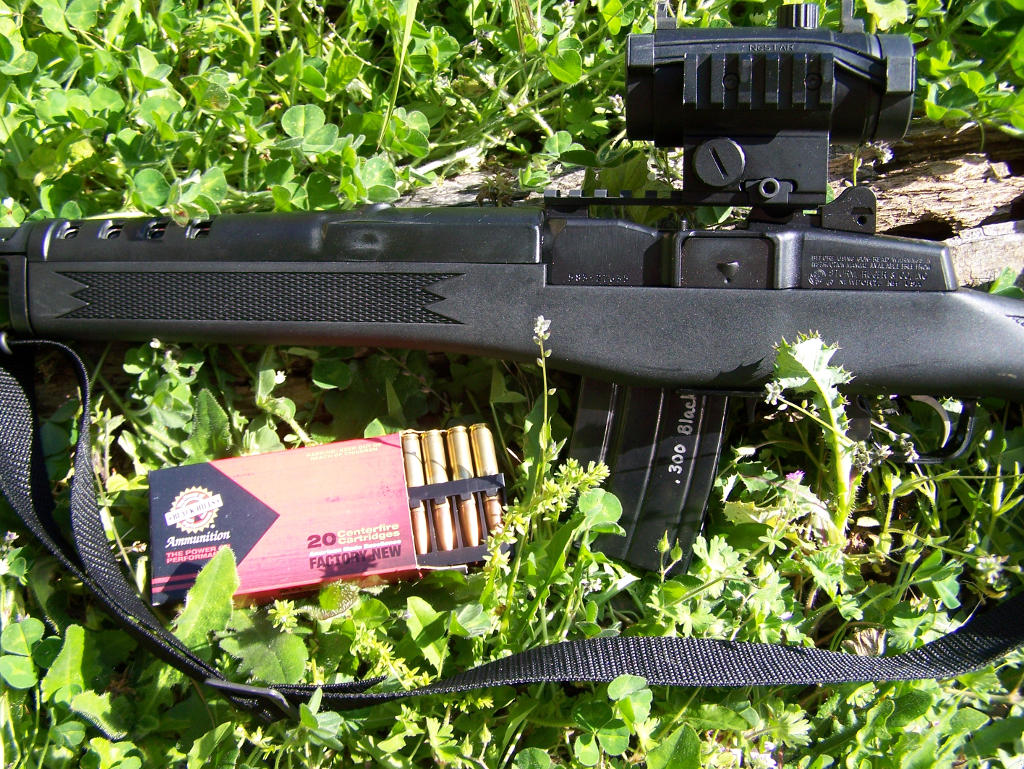
By my count, there are at least 16 ammo companies that are making .300 AAC Blackout ammo. However, none was to be found in my neck of the woods. NONE! I called on long-time friend, Jeff Hoffman, who owns and operates Black Hills Ammunition www.black-hills.com with his lovely wife, Kristi. Jeff was able to help me out. Black Hills Ammunition is producing the .300 Whisper round that is almost identical to the .300 AAC Blackout round. The .300 Whisper was developed by J.D. Jones many years ago as a wildcat round that is extremely popular. However, what Advanced Armament Corporation did (they are the AAC in the .300 AAC Blackout nomenclature name) was to ever so slightly change their round and then call it something different. Now, Jeff Hoffman informed me that you can safely fire .300 Whisper in any rifle chambered in .300 AAC Blackout. However, there are reports of some .300 Whisper chambered firearms that won’t safely fire the .300 AAC Blackout round. So be advised, and don’t try to fire .300 AAC Blackout in a gun chambered in .300 Whisper. Jeff Hoffman knows what he’s talking about, and I take anything he has to say about ammunition as gospel.
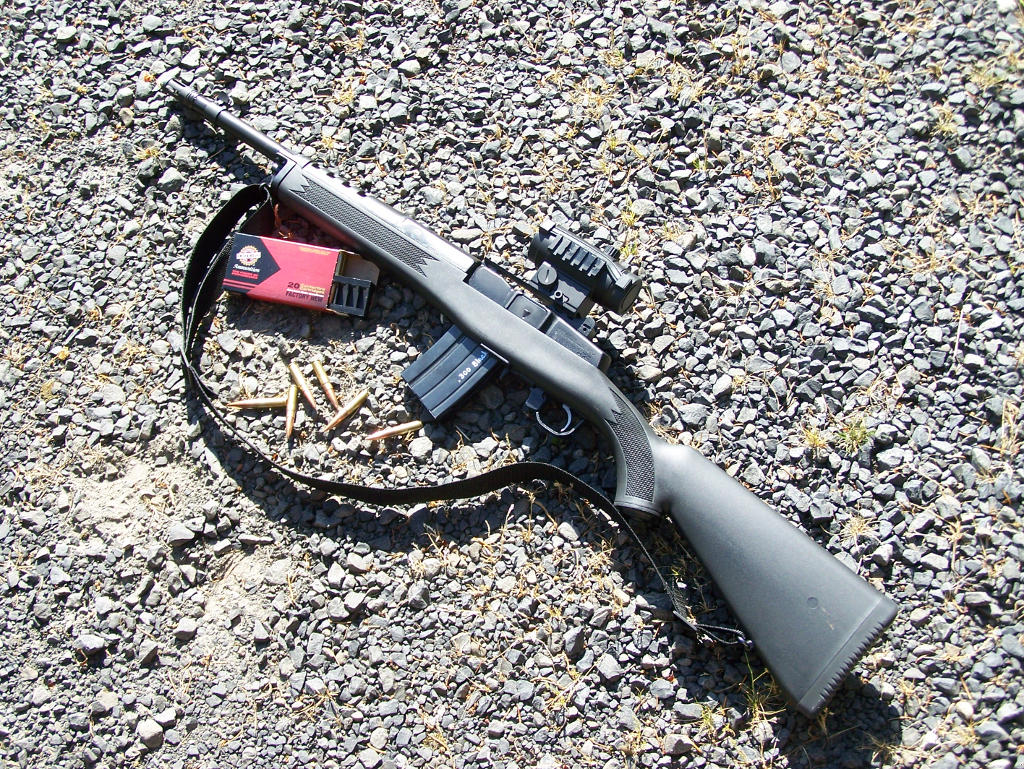
The .300 AAC Blackout round was designed to be fired from rifles in one of two ways. The lighter rounds, that come in around 110-125 grains in weight, are supersonic rounds. The heavier 200+-grain rounds are meant to be fired in the same firearms with a sound suppressor on it. Yes, you can fire the heavier rounds in any .300 AAC Blackout chambered semi-auto; however, without the sound suppressor attached, the action won’t function, and you’ll have a single shot rifle. The idea behind the sub-sonic rounds is specifically for firearms with sound suppressors on ’em for taking out enemy sentries; at least that’s one function of the round. The Ruger Mini-14 .300 Blackout has a birdcage flash suppressor on it that can be removed and a sound suppressor installed. I refuse to jump through the red tape to obtain a sound suppressor! So, my testing was limited to supersonic rounds.
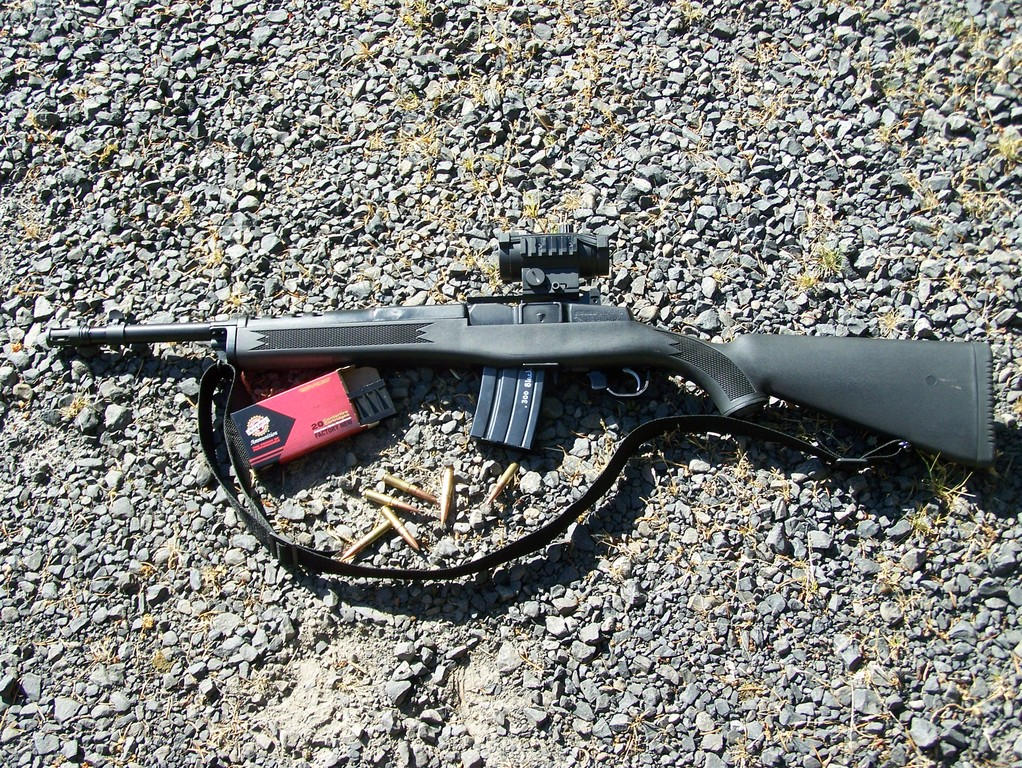
Right off the bat, I noticed that this new Mini was dead-on zeroed from the box, for a 300-yard zero. Nice! The ammo from Black Hills is their 125-gr OTM (Open Tip Match) round, again in .300 Whisper. Just for fun and to test function, I managed to “kill” quite a few large rocks downrange at my usual shooting spot. To be sure, the .300 Whisper blew those large rock into little pieces; a .223 round wouldn’t have done the same. The recoil is worth noting. This round recoils slightly more than a .223 does and less than a 7.62X39 does, and it was the brainchild of Advanced Armament Corporation to have a round that closely resembled the AK-47 round 7.62X39 that could be fed from existing .223 magazines without any alterations. They succeeded! Using the factory Ruger magazines and the 30-rd aftermarket mags I bought, there were zero feeding problems.
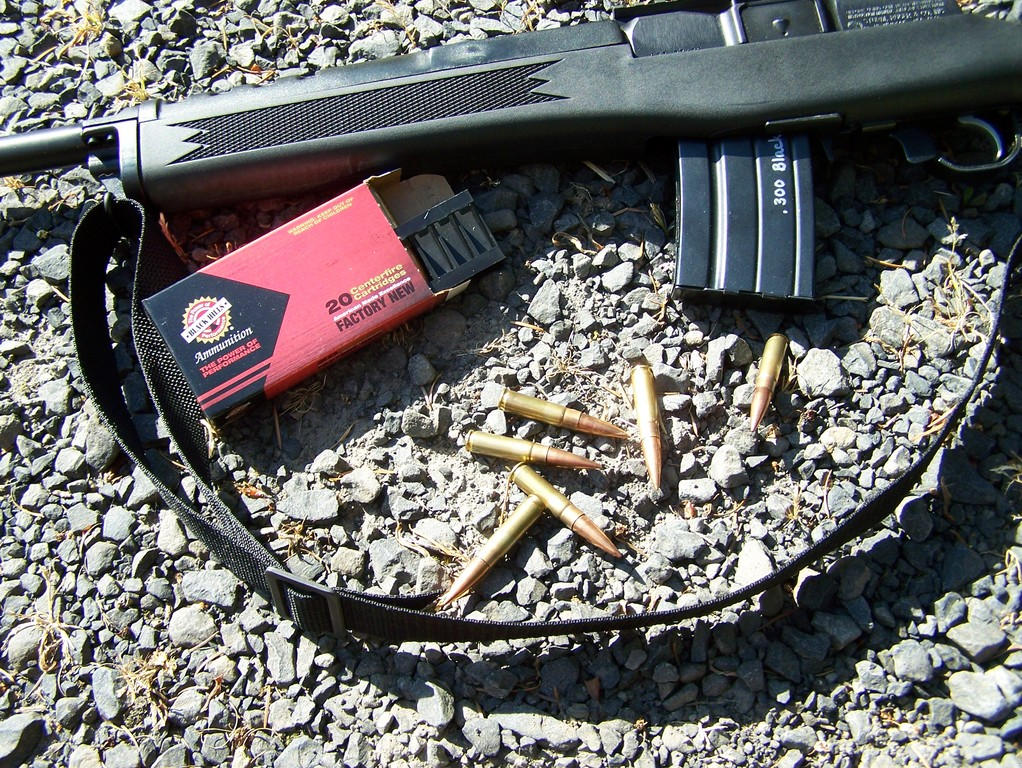
Ruger includes scope rings, as well as a flat-top Picatinny rail for those wanting to install some sort of red dot sight on this rifle. I installed an inexpensive, real inexpensive, red dot sight, and it failed me. After every shot, the red dot sight would turn off. I replaced it with another identical red dot sight, and it wasn’t much better – maybe I could get 2 or 3 rounds fired, before it would shut down. And, I do NOT attribute this to the recoil of the gun/caliber – it is the cheap scopes. However, when I could get the red dot to stay on, I was getting 2-inche groups at 100-yard with this little rifle – I was more than a little impressed, to say the least. I’m searching my office, for a Nikon 3-9X40 scope I have here……some place – so I can really wring the most accuracy out of this new Mini and the .300 Whisper rounds, I still have on-hand, from Black Hills Ammunition.
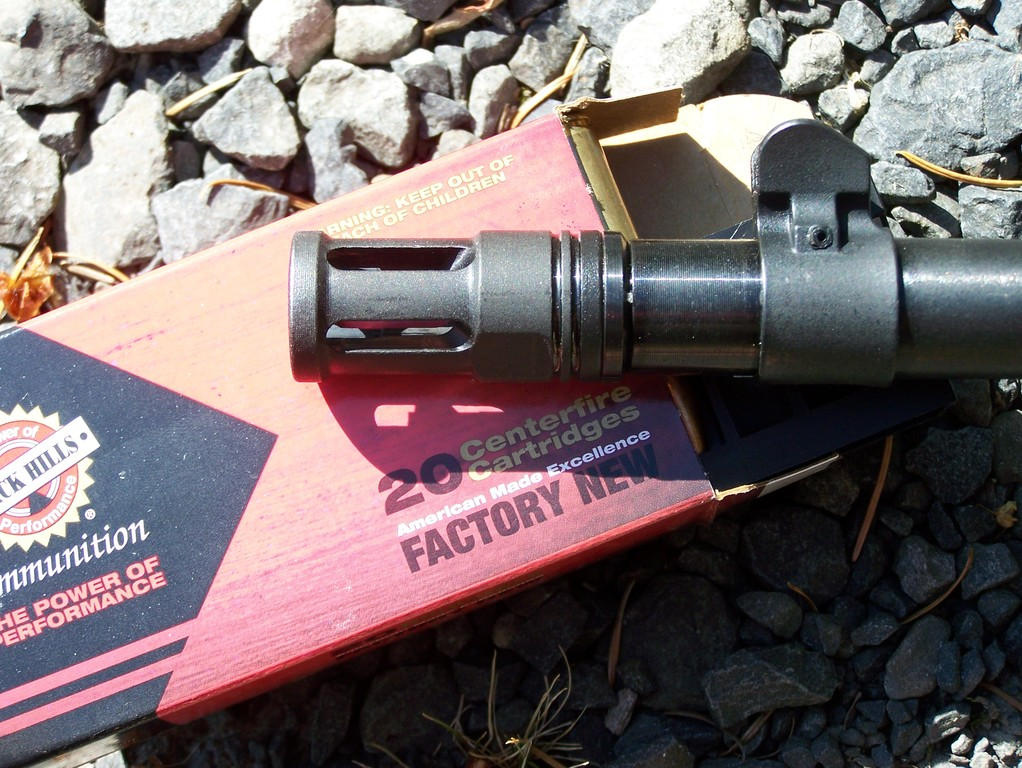
These days, it takes a LOT to impress me, when it comes to knives and firearms – so many are just the same ol’ thing, just dressed up differently. Well, I thought the same of this Mini-14 in .300 AAC Blackout – before I got it. Yeah, there was “something” that drew me to this gun, when I got the press release from Ruger – still don’t know what that “something” was, though. I’m impressed with this new Mini-14 in .300 Blackout!
Near the end of my testing, my local gun shop happened to get in one box of Hornady .300 Whisper “Zombie Max” ammo in 110-gr with a green tip, of course, designed for killing the living dead. This lighter-weight round shot a little bit lower at 100-yards than the 125-gr OTM Black Hills .300 Whisper round did, as you would expect; to be expected, lighter bullets tend to fall faster than heavier ones do. I was getting 3-inch groups, but with more of this ammo I can probably tighten up the groups a bit. Overall, the Black Hills .300 Whisper OTM is the round of choice for my target shooting needs.
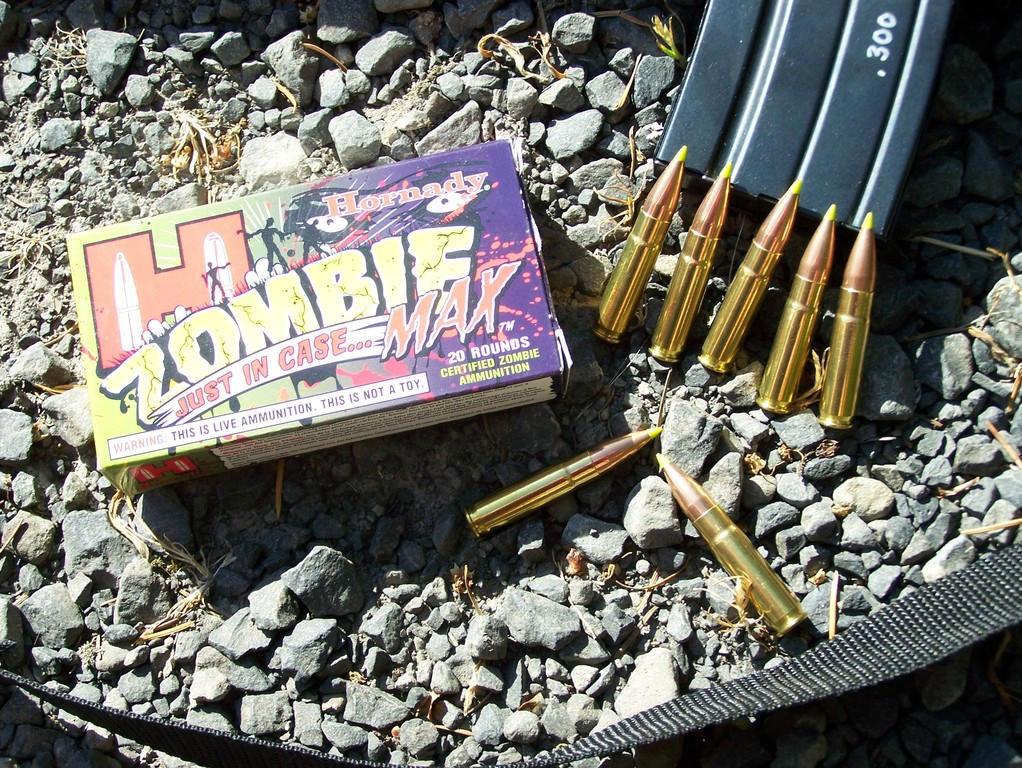
Still, after shooting this .300 Blackout Mini-14 for several weeks, I’ve yet to run across any actual .300 AAC Blackout ammo in my area. All shooting has been done with .300 Whisper, with the compliments of Black Hills Ammunition. I’m hoping the .300 Blackout round shoots just as nicely and as accurate as the .300 Whisper round does. In the meantime, I’m in the process of requesting some more .300 Whisper ammo from Jeff Hoffman. The problem with this Mini-14 in this caliber is that it is way too much fun to shoot. Since I got this gun sample, I have forsaken my AK-47s and my AR-15s. Sorry guys, but I’ll take you out shooting again soon, I promise!
There’s still “something” about this gun/caliber combo that intrigues me to no end, besides the fun factor. I’m seriously thinking about getting a 5-rd magazine and taking this gun out deer hunting this Fall. All the deer I’ve shot in the past were all shot at well under 150 yards, and out of those most were 100 yards or under. With the proper hunting bullet installed, the .300 AAC Blackout will get the job done. Through my research on this round, I’ve come to the conclusion that this round was designed to take out enemy troops out to 450 yards, which is the same as the .223 round will do, however, the .300 Blackout will do it faster. A heavier bullet will get the job done, and the 125-gr fodder should do it. Of course, if your shooting skills are up to it, you can take out the enemy far beyond 450 yards. Just remember your ballistic tables and bullet drop at longer distances.
All that’s left to do is for me to get my hands on some .300 AAC Blackout ammo, or lacking that, a good supply of .300 Whisper ammo. For any semiauto center-fire rifles meant for self defense or going into a SHTF scenario, I demand no less than 1,000-rds for each gun in that caliber. So, I have my work cut out for me, because .300 Blackout ammo isn’t cheap. I’ve checked online and the same is true for .300 Whisper ammo. However, I’ll start building up my .300 Blackout/Whisper ammo supply just as soon as I’m done with a little more fun shooting with this sample. Then I’ll have to raise the funds to purchase this sample, because it is NOT going back to Ruger. It has found a new home. So, if you’re in the market for something with a little more “umph” than the .223, and you don’t really like an AK (for some reason) take a close look at the new Mini-14 in .300 AAC Blackout. Full-bolt retail is slightly over $1,000. However, checking gun broker, I’m seeing them for sale for slightly more than $700. That’s a bargain in my book for such an outstanding shooter in a hard-hitting caliber. I got mine; you get yours!
– Senior Product Review Editor, Pat Cascio
Recipe of the Week: Salmon ‘Souffle’, by JVB
My uncle likes his little luxuries, even when we’re eating LTS food. Here’s one of his favorites.
Ingredients:
- 1 14-oz can salmon
- 1 can condensed mushroom soup
- 1/2 cup powdered cheese
- 6 Tbsp powdered eggs
- 1 cup water
- 1/4 tsp pepper (optional)
- 1/2 tsp onion powder (optional)
Directions:
- Drain and flake salmon in casserole dish.
- Add mushroom soup; mix with spoon.
- Alternate powdered cheese along with half the water while mixing.
- Alternate powdered eggs, along with the rest of the water while mixing.
- Add spices, mix.
- Cover and bake at 350F until firm, approx 30-40 minutes.
Makes about four servings.
o o o
Do you have a favorite recipe that would be of interest to SurvivalBlog readers? Please send it via e-mail. Thanks!
Letter: The Noose is Tightening
HJL,
Report from Maryland: I went to the bank today to make a deposit (two medical insurance reimbursement checks). I was informed that I had to show my drivers license or passport to make a deposit. (Up until now ID had to be provided only for withdrawals.)
Then, the teller told me I needed to provide personal information:
- name of employer,
- annual salary,
- citizenship of another country or dual citizenship,
- foreign bank account holdings, and
- because it is a joint account, I was told to provide the same for my spouse.
I’ll let you and others imagine my response.
I asked the teller if she worked for TSA. “No,” she said, “but these are new government requirements based on a new law.” I told her I had been a customer of that bank for 35 years and asked why now do they need to know everything about me? – M.B.
Economics and Investing:
How Long Can OPEC Maintain Its Current Strategy?
o o o
Here’s a sad statistic from a Georgia think tank—Georgia Public Policy foundation:
Cost of government: Federal regulation and intervention cost American consumers and businesses an estimated $1.88 trillion in 2014 in lost economic productivity and higher prices, according to “Ten Thousand Commandments,” by the Competitive Enterprise Institute. If U.S. federal regulation was a country, it would be the world’s 10th largest economy, ranking behind Russia and ahead of India. Given that our total national economy is somewhere in the $18 trillion range (GDP was listed as $16.7 trillion in 2013), government regulation adds 10% to the cost of all goods and services produced in the country. You can read the article “Ten Thousand Commandments” at Cost Of Government Regulation And Intervention – D.R.
o o o
Video: US Economy Worse Than Originally Thought, US Government Readies For A National Crisis – Episode 679. – J.C.
o o o
FATCA New Currency Law Could Be Devastating for Anyone Holding U.S. Dollars