
The Cycle Express, by W.N.

Food? Check. Water? Check. Tools and other supplies? Check. Do you have the entire rest of the list? Check. You are prepared and ready for an economic collapse, a catastrophic natural disaster, a terrorist attack, martial law, and a host of other scenarios. In fact, you have even convinced your family and friends to get prepared and they have totally bought in. Then that day arrives, and the power is out. The banks are closed. Water and gasoline are being hoarded. There is no phone, no tv and no Internet. On the radio, there are only official broadcasts, but these don’t tell you much, and can you even trust them? You also notice that you haven’t seen your postman lately. That is because he is at home taking care of his own family, and so are the UPS and Fedex guys. It is then that you think, “I prepared and I had my loved ones prepare, but they are across town, in another city, or across the country.” You suddenly realize that you have no way of communicating with them. You wonder, “Are they okay? Are they sick? Are they even still alive?”

Now is the time to solve this often overlooked emotional and psychological land mine. Now is the time to put the structure in place for “The Cycle Express”.

First, here is a quick history lesson. During the civil war, there was a need to communicate with the western part of the United States in the most efficient way possible. Horses were the most accessible means of rapid transit available at the time; thus, the Pony Express was born. Over 200 riders were able to cover 250 miles a day each with the mission to deliver messages back and forth across the country.

Well, I daresay most of us don’t own a horse. Also, it may be that putting together a network of cowboys to traverse the width of North America is a bit ambitious. However, many Americans do own a bike, and for those of us with loved ones scattered 20, 40, 60, or even 2000 miles away, now is the time to assign outposts, waypoints, and riders or cyclists to relay messages.

This is a fairly simple task, but if it isn’t done ahead of time, before TEOTWAWKI, it becomes exponentially more difficult.

This is how to do it:

  1. Make two lists of people. The first list is those people in your immediate circle (those family, friends, and acquaintances who you trust and who live within a one day bike ride from you). A typical distance for an average person to bike in a full day is 60 miles (or possibly 80-100 miles for cyclists). Keeping in mind that if this person is the full 60 mile distance away, an overnight stay would be needed, so it is best if the round trip is 60 miles rather than just a one-way trip. If you want to be on the safe side, keep the total distance to 20 or 40 miles. The second list of people is the people that you want to be able to communicate with.
  2. Next mark on a map (or if you have to, draw one) where both the people on your first list and the people on your second list are located.
  3. Next, find the person on the first list who lives the closest to you who also owns a bicycle and is in good physical health. Determine a meeting location, and set a day of the week and time that you will meet this person at this location once communication services go down. (This will be called waypoint “a”.)
  4. After enlisting your first cyclist, go back to the map and find the next person on your list who lives within a one-day bike ride of the first person you selected. Then make sure that they also have a meeting place and time predetermined. To clarify, each cyclist should only be responsible for two waypoints—one where they receive the information going one direction and the other being where they deliver that same information. NOTE: After seeing the locations of your inner circle on a map (List 1) and those people you want to be sure to communicate with (List 2), you will want to enlist people in your circle who will be able to create waypoints in the direction of your desired end location. For example: If you live in Atlanta, GA and you have many people in your circle who are in the northern part of the city, but the people on your List 2 are 120 miles south of the city then ideally you want to enlist people who will come aboard your Cycle Express that live in the southern part of the city and will complete your network and be able to get a message to your most important recipients (on List 2).
  5. Continue enlisting individuals and creating waypoints, until you reach your ultimate desired location. Obviously, the further away the people on List 2 are, the more difficult the task. For those readers with a List 2 that is 20 to 200 miles away, this should be a somewhat simple system to organize. If you are like me, and your parents literally live on the opposite coast of the United States, the task is much, much, more difficult.

However, it is not impossible! If people in the 1800s could orchestrate a system to get messages across the U.S., then so can we. The key is to have the system in place NOW. Once communications go down it will be much more difficult to put the Cycle Express into place. If you find that when making your waypoints on your map, and enlisting your trusted people from your List 1, that you still can’t get to the people on List 2, you will then want to ask the person at your furthest waypoint who they trust and who might be on their List 1 that can help reach the geographical goal of your List 2. The Cycle Express is already a realized network, albeit just with my personal List 1 and List 2, and as mentioned, I am trying to establish a network to get from coast to coast, and I am not there yet.

Imagine a scenario where one of your loved ones lives 80 miles away and there is no more gasoline to be found. You get word through the Cycle Express that they were injured and that the wound is infected. They have a fever and there are no meds left. Meanwhile, you have a stockpile of antibiotics. Your friendly Cycle Express peddler can make sure to pass the medications along in time to reach your loved one.

This brings me to the issue of payment. Unless you are fortunate enough to have an entirely closed network of trusted friends and family in all of your waypoints between List 1 and List 2, it might be necessary to get a friend of a friend on board. Chances are that they will want to know what is in it for them, but in the coming new world as we will know it we will need ways of working and contributing to society in order to support our families. Being a cyclist in the Cycle Express could be a great line of work, and it could be one that will be much needed and respected. It not only brings a means of bartering, but it also will be a grassroots way to get a most valuable commodity—information.

As a believer in the Lord Jesus, I believe:

“According as his divine power hath given unto us all things that pertain unto life and godliness, through the knowledge of him that hath called us to glory and virtue: Whereby are given unto us exceeding great and precious promises: that by these ye might be partakers of the divine nature, having escaped the corruption that is in the world through lust.” (2 Peter 1:3-4)

He has given us everything we need for life, and that will hold true, regardless of what happens in this temporal world. He is calling us to participate in His divine nature, and one aspect of His nature is that of creativeness. He is our Creator, and being made in His likeness He invites us to co-labor with Him in being creative in solving challenges. He called Joseph to prepare for famine and gave him the knowledge, ability, and position to make a difference and succeed. All through scripture He prepared prophets and kings and priests to carry out His work on the Earth. Now is our time. He is calling us. Answer His call. The Cycle Express is just one tiny task that I can do to help solve a potential problem when the communication age comes to a screeching halt. I hope you will join me. May the God of all grace make your paths straight!

Letter Re: A Problem Today That is Only Going to Get Worse After TSHTF

I have a special appreciation for the letter written and posted on July 25th by S. C. S. C. has mirrored my sentiments exactly. I have had several friends say to me, “When the SHTF I know where I am going, I am coming to YOUR house.” My reply, as I laugh hysterically, “You might want to rethink that one, cause you might get shot!” They do not realize just how serious prepping is. When I began prepping in earnest (I prepped somewhat half-heartedly for more than 20 years), I was very excited about it. I wanted to tell everyone I knew about my epiphany, my new-found knowledge, and my plan to save myself and my family from disasters and hard times.

Today, my feeling on OpSec is completely different than before. I regret ever having said anything at all to anyone about being a prepper. Additionally, I feel mounting pressure to move far from my current location. Partially to get away from those that know that I prep, and also to choose a better location with fewer people. This is a double-edged sword in that it also puts me in a position of being far from those who do currently give me support in my prepping endeavors. In other words, I would have to make new friends fast, and I know it. So I am merely validating how many people likely feel about their friends and neighbors in relation to prepping. It is a slippery slope. The Christian thing to do is to help those in need, but when you do that you may be risking yours and your family’s lives in the process. Also, when we give up those extravagant vacations, Saturday night movies, new clothes, and the like, in order to assign that income to our perceived long-term survival needs, do we really owe that to anyone else? My thought is that if you give to those in need, they will be back for more, and before long you have nothing to eat and nothing to give. What happens then? My family has and is doing without now so that they might be fed later. – PJP

JWR responds: As I’ve mentioned a few times in SurvivalBlog, I recommend that you make arrangements in advance to make charitable donations of food through your local church. Just brief your church elders, and get their solemn assurances that your name will never be mentioned.

This method has several advantages: First, it maintains your anonymity. Second, it keeps your charity food stocks separate from your home larder (which reduces the chances of your home being identified by miscreants). Thirdly, it encourages a godly, humble attitude. This is in accord with Matthew 6:3, which states:

“But when thou doest alms, let not thy left hand know what thy right hand doeth”


Odds ‘n Sods:

11th Circuit: Law Barring Doctors From Asking About Guns Is Constitutional – JBG

o o o

Police State “Ministry of Truth” Hits Spain; Man Fined for Calling Police “Slackers” on Facebook – P.S.

o o o

Ministry of Education Worsens Actions against Christian Schools in Israel – C.S.

o o o

Rochester General Hospital in NY Newborn Policy Includes Medical Kidnapping – C.W.

o o o

From the nanny state of Australia: The letter that was sent to panicked parents at a primary school after a 10-year-old boy brought in a GUN for show and tell – A.S.


Hugh’s Quote of the Day:

“Wherefore it shall come to pass, if ye hearken to these judgments, and keep, and do them, that the Lord thy God shall keep unto thee the covenant and the mercy which he sware unto thy fathers: And he will love thee, and bless thee, and multiply thee: he will also bless the fruit of thy womb, and the fruit of thy land, thy corn, and thy wine, and thine oil, the increase of thy kine, and the flocks of thy sheep, in the land which he sware unto thy fathers to give thee.” Deuteronomy 7:12-13 (KJV)


Notes for Friday – July 31, 2015

31 July is the 94th birthday of Army Air Corps veteran David Thatcher, one of just two living Doolittle Raiders. He lives in Missoula, Montana.

31 July is also the birthday of free market economist Milton Freidman (born 1912, died November 16, 2006).

o o o

More moving sales from Camping Survival: Canned Cheese, DAK Ham and Red Feather Butter.

o o o

Today, we present another entry for Round 59 of the SurvivalBlog non-fiction writing contest. The $12,000+ worth of prizes for this round include:

First Prize:

  1. A Gunsite Academy Three Day Course Certificate, good for any one, two, or three day course (a $1,195 value),
  2. A course certificate from onPoint Tactical. This certificate will be for the prize winner’s choice of three-day civilian courses. (Excluding those restricted for military or government teams.) Three day onPoint courses normally cost $795,
  3. DRD Tactical is providing a 5.56 NATO QD Billet upper with a hammer forged, chromlined barrel and a hard case to go with your own AR lower. It will allow any standard AR type rifle to have quick change barrel, which can be assembled in less than one minute without the use of any tools, and a compact carry capability in a hard case or 3-day pack (an $1,100 value),
  4. Gun Mag Warehouse is providing 20 Magpul pmags 30rd Magazines (a value of $300) and a Gun Mag Warehouse T-Shirt. (An equivalent prize will be awarded for residents in states with magazine restrictions.),
  5. Two cases of Mountain House freeze dried assorted entrees in #10 cans, courtesy of Ready Made Resources (a $350 value),
  6. A pre-selected assortment of military surplus gear from CJL Enterprize (a $300 value),
  7. A Model 120 Series Solar Generator provided by Quantum Harvest LLC (a $340 value),
  8. A $300 gift certificate from Freeze Dry Guy,
  9. A $250 gift certificate from Sunflower Ammo,
  10. KellyKettleUSA.com is donating both an AquaBrick water filtration kit and a Stainless Medium Scout Kelly Kettle Complete Kit with a combined retail value of $304,
  11. TexasgiBrass.com is providing a $300 gift certificate, and
  12. Two cases of meals, Ready to Eat (MREs), courtesy of CampingSurvival.com (a $180 value).

Second Prize:

  1. A Glock form factor SIRT laser training pistol and a SIRT AR-15/M4 Laser Training Bolt, courtesy of Next Level Training, which have a combined retail value of $589,
  2. A FloJak EarthStraw “Code Red” 100-foot well pump system (a $500 value), courtesy of FloJak.com,
  3. The Ark Institute is donating a non-GMO, non-hybrid vegetable seed package–enough for two families of four, seed storage materials, a CD-ROM of Geri Guidetti’s book “Build Your Ark! How to Prepare for Self Reliance in Uncertain Times”, and two bottles of Potassium Iodate– a $325 retail value,
  4. A $250 gift card from Emergency Essentials,
  5. Twenty Five books, of the winners choice, of any books published by PrepperPress.com (a $270 value),
  6. TexasgiBrass.com is providing a $150 gift certificate, and
  7. RepackBox is providing a $300 gift certificate to their site.

Third Prize:

  1. A Royal Berkey water filter, courtesy of Directive 21 (a $275 value),
  2. A large handmade clothes drying rack, a washboard, and a Homesteading for Beginners DVD, all courtesy of The Homestead Store, with a combined value of $206,
  3. Expanded sets of both washable feminine pads and liners, donated by Naturally Cozy (a $185 retail value),
  4. Two Super Survival Pack seed collections, a $150 value, courtesy of Seed for Security, LLC,
  5. Mayflower Trading is donating a $200 gift certificate for homesteading appliances,
  6. APEX Gun Parts is donating a $250 purchase credit,
  7. Montie Gear is donating a Precision Rest (a $249 value), and
  8. Two 1,000-foot spools of full mil-spec U.S.-made 750 paracord (in-stock colors only) from www.TOUGHGRID.com (a $240 value).

Round 59 ends on July 31st, so get busy writing and e-mail us your entry. Remember that there is a 1,500-word minimum, and that articles on practical “how to” skills for survival have an advantage in the judging.


The Importance and Art of Fire-Making, by N.P.

Obviously, being able to make a fire in a SHTF scenario is of utmost importance. In addition to providing warmth and cooking capabilities, fire also provides a psychological boost.

As an avid outdoorsman, who is originally from Canada, I’ve got a lot of experience and training, but I’m by no means claiming to be an expert. I just want to share some of my findings that may prove useful to others. I have several stories about the importance of fire-making. Here’s an example:

I was in the Boreal Forest in Canada and noticed a large billboard containing the writing “Nature Trail” and a map of the trail, which went in a 1-mile circle. I thought I’d love to learn more about plants so decided to take the trail.

I had two bags of groceries in my truck, along with my camping gear. It was only a mile, so I figured I’d be only gone 30 minutes. Well, the end never came. It started getting dark, so I started jogging in hope to reach the end quicker. As darkness fell, I soon realized that I was lost.

The temperature was getting cold, but that didn’t stop the mosquitoes; there were ungodly swarms of them eating me alive. All I had to make a fire was a dead Bic lighter. Thank God someone once showed me a trick with a Bic! If it’s dead and you hold down the valve and then make the spark, a very tiny flame will result. With that I was barely able to start a fire, which helped keep the mosquitoes away and warm me up. I heated up a bunch of large rocks, put my jacket over my face and arms to keep the mosquitoes away, and covered my body with the rocks to keep warm. They were still warm to the touch when I woke up in the morning.

When I finally found my way out, I asked the locals about that nature trail. They said, “Oh sorry; that isn’t finished yet. You were on trapper trails that go for a hundred miles north!”

Anyhow, that’s one example of the importance of knowing how to start a fire. Fire-making is almost an art. It’s a near impossible art when the wood is wet. Even when you think that you’ll be able to start a fire because you stacked good wood correctly, it’s not guaranteed, depending on wind, oxygen availability, the wood, and other variables.

This is what happened to me the other day. I put a large pile of tinder down and then stacked some thicker pieces on top; I figured this will be easy. It wasn’t, and is the reason I’m writing this article. I landed up using a poor man’s fire starter. Previously, in the winter (for my wood stove), I went to the dollar store and bought a bunch of those pre-formed paper coin wrappers, some cotton balls, and petroleum jelly. You dip a cotton ball in the jelly, and stuff it in the paper tube, until it’s filled. These beauties work awesome. The one I used in the aforementioned fire burnt for fifteen minutes! With that fire, I had to stoke it with tinder several times before I was able to get some logs to burn; it had rained a day prior and the wood was waterlogged, even though it appeared dry.

When I go camping though, I prefer the small plastic pouches that have a fire starter chemical in them, because the cotton ball starters are a little messy.

The absolute best wood to use in starting a fire is dried out pine needles, you know, the brown ones. The first internal combustion engine was powered by turpentine and ethanol alcohol, which is made from pine. It’s no wonder; it burns like gasoline! I had a fire recently that was easy to get started, because I had a few pine boughs that had been drying for months. It ignited like gasoline, and putting larger branches on top, it was a no brainer. I believe we could get off of our reliance on oil by harvesting the oil in pine leaves instead.

Another ideal fuel starter is birch bark. However, you need to be careful not to kill the tree by taking the bark off. Only take the bark that is already peeling off. It naturally repels water. If hiking and you spot some, put some in your pocket in case you need a fire starter.

Dry grass is the easiest to light (pine needles take more heat to get started).

If your kindling is wet, use a pocket knife to cut off the outside layer and make shavings on the stick. (Don’t cut the shaving all the way; but leave the shaving hanging on the branch.) According to this article, if you find wood oozing with sap, you can use that too, although I’ve never had the occasion to try that. My recent experience with starting a fire with wet wood resulted in the fire initially raging successfully but then dying out later.

Softwoods (i.e. fir, apple, and witch hazel) burn quickly and give off good heat and lighting. They make sparks when they burn. They are ideal for starting a fire and cooking rapidly. The wood is quickly burned up, leaving only ashes.

Hardwoods (i.e. birch, hickory, ash, maple, and oak) burn slowly and evenly, giving off heat and also result in coals that can be used to cook over.

The trick to fire-building is to build the fire beginning with tinder and steadily adding twigs, sticks, and branches, but really, fire-making is an art form, even with years of experience. I still have trouble occasionally. Not enough space or too much space between the sticks or logs can put the fire out. With too much smoke, the same thing happens. Too much moisture, well, causes it too. The environmental conditions make a huge difference. I’ve tried tepee style fires, log home type stacking, and just plain randomness. Basing my decision on the conditions is what I’ve settled with. Every time I start a fire I usually have a unique configuration. However, proper construction beforehand has proven reliable too. Strategic blowing of air onto the fire to help fuel it is mandatory in wet conditions. Also, in a wet environment, once the fire is burning robustly, keeping it fueled in a robust burning condition will ensure that your fire is not extinguished, unless you’re under a torrential down pour, in which case you should give your fire shelter.

I was in Boy Scouts (even did winter camping in Canada), and they teach you for winter conditions to build a “Reflector” out of logs to reflect the heat from your fire into your shelter. Well, I tried that when winter camping for nine days in -30+ degrees Fahrenheit in Canada. We made a lean-to with a fire in front and a reflector (wall of logs) behind the fire. It didn’t work; we froze. What saved us was my partner had a great idea to instead build a teepee out of a canvas tarp. Tepees are awesome! You build a fire on the floor in the center, and the little hole at the top of the tee-pee sucks out the smoke. Though better off, we were still cold, which was resolved when we made a stove out of metal pails that we found at a garbage dump. After we built that, it was toasty warm in the tepee. However, it required constant firewood chopping all day to stay warm. It was a full-time job to chop enough wood. I’ve heard that to have enough wood, multiply by five the amount you think you need. Respecting nature, I always try to find dead fall wood, which there usually is in abundance, except sometimes you may need to travel a distance.

Just for fun, I’ll share another experience where fire was my best friend. I was in the Canadian forest in minus 30 degree temperatures once again. My truck wouldn’t start, and there was no one around for 100 miles. The battery was so cold that it couldn’t crank the engine. So what did I do? I built a fire under the truck by the battery. I managed the size of the flames so that it wouldn’t start the truck on fire! I didn’t think it would work, because I had no tarps to keep out the wind, but it did, thank God! That time I had a fully-functioning BIC lighter!

Although the subject is not about tools to start a fire, here’s a good video exactly on that subject.

As far as tools go, there’s nothing like the good old reliable Zippo Lighter! My friend from Iowa taught me a great trick regarding Zippo’s. There is nothing worse than needing a lighter; it’s fully fueled, but the flint runs out! His trick, which is amazingly simple, is to put a spare flint or two beneath the felt cover flap, sitting on top of the cotton. It’s awesome. You’ll always have a spare flint that way.


Letter Re: Raising Meat Rabbits

HJL,

This is just a note to let you know that three years ago, based on information obtained on SurvivalBlog, my daughter stopped using commercial pellets to feed her pedigreed silver fox rabbits. I gave her an article about all the things you can eat from your yard. Two hours later, she had found most of them in our yard and decided to feed her rabbits that way. Since then, she harvests clover, wild strawberry, dandelion, mulberry, sorel, wild violet, and much more from about six yards in the neighborhood that use no chemicals. She supplements in winter with bales of alfalfa and BOSS, so the rabbits are fed 100% natural food, about 80% locally grown. Her rabbitry is small, with one litter at a time, and no more than two dozen total mouths to feed. – M.E.


Economics and Investing:

Rental Apocalypse: US homeownership collapses to 48 year low while rental rates continue to climb.

o o o

Central banks will disagree; Keynesian economists probably disagree; Too-Big-To-Fail banks don’t care …

o o o

Items from Mr. Econocobas:

2nd Quarter GDP Misses Expectations

Alan Greenspan: This is ‘Extremely Dangerous’ – While what he is saying is true, Greenspan has no room to lecture anyone, considering his abysmal track record at inflating debt and destroying an economy.

US Economy Grew At 2.3% In Q2, Below Expectations, “Winter” Quarters Revised Higher On Double Seasonal Adjustments – Venturing further down the “Ministry of Truth” era.

Total Collapse: Greece Reverts To Barter Economy For First Time Since Nazi Occupation


Odds ‘n Sods:

War drums beating: China, Russia to hold military drills in Sea of Japan – G.P.

o o o

Violent Street Gangs Launch Shocking Contest: “Kill 100 People In 100 Days” – B.B.

o o o

Michigan Officer Shells Out $35,000 For Open Carry Stop – D.S.

o o o

Dem Congressman: With Sanctions Relief, Iran Can Just Buy a Nuke from North Korea – B.B.

o o o

US military’s smart rifle can be HACKED to change weapon’s target and disable its scope – JBG


Notes for Thursday – July 30, 2015

Today we remember the birthday of author Reginald Bretnor. He was born Alfred Reginald Kahn on July 30, 1911, in Vladivostok. He died on July 22, 1992 in Medford, Oregon. In addition to penning many witty science fiction novels and short stories in his characteristic style, he also wrote nonfiction articles for Mel Tappan’s P.S. Letter

o o o

Camping Survival is continuing their moving sale, hoping not to have to move these heavy items. Now is an excellent time to stock up.

o o o

Today, we present another entry for Round 59 of the SurvivalBlog non-fiction writing contest. The $12,000+ worth of prizes for this round include:

First Prize:

  1. A Gunsite Academy Three Day Course Certificate, good for any one, two, or three day course (a $1,195 value),
  2. A course certificate from onPoint Tactical. This certificate will be for the prize winner’s choice of three-day civilian courses. (Excluding those restricted for military or government teams.) Three day onPoint courses normally cost $795,
  3. DRD Tactical is providing a 5.56 NATO QD Billet upper with a hammer forged, chromlined barrel and a hard case to go with your own AR lower. It will allow any standard AR type rifle to have quick change barrel, which can be assembled in less than one minute without the use of any tools, and a compact carry capability in a hard case or 3-day pack (an $1,100 value),
  4. Gun Mag Warehouse is providing 20 Magpul pmags 30rd Magazines (a value of $300) and a Gun Mag Warehouse T-Shirt. (An equivalent prize will be awarded for residents in states with magazine restrictions.),
  5. Two cases of Mountain House freeze dried assorted entrees in #10 cans, courtesy of Ready Made Resources (a $350 value),
  6. A pre-selected assortment of military surplus gear from CJL Enterprize (a $300 value),
  7. A Model 120 Series Solar Generator provided by Quantum Harvest LLC (a $340 value),
  8. A $300 gift certificate from Freeze Dry Guy,
  9. A $250 gift certificate from Sunflower Ammo,
  10. KellyKettleUSA.com is donating both an AquaBrick water filtration kit and a Stainless Medium Scout Kelly Kettle Complete Kit with a combined retail value of $304,
  11. TexasgiBrass.com is providing a $300 gift certificate, and
  12. Two cases of meals, Ready to Eat (MREs), courtesy of CampingSurvival.com (a $180 value).

Second Prize:

  1. A Glock form factor SIRT laser training pistol and a SIRT AR-15/M4 Laser Training Bolt, courtesy of Next Level Training, which have a combined retail value of $589,
  2. A FloJak EarthStraw “Code Red” 100-foot well pump system (a $500 value), courtesy of FloJak.com,
  3. The Ark Institute is donating a non-GMO, non-hybrid vegetable seed package–enough for two families of four, seed storage materials, a CD-ROM of Geri Guidetti’s book “Build Your Ark! How to Prepare for Self Reliance in Uncertain Times”, and two bottles of Potassium Iodate– a $325 retail value,
  4. A $250 gift card from Emergency Essentials,
  5. Twenty Five books, of the winners choice, of any books published by PrepperPress.com (a $270 value),
  6. TexasgiBrass.com is providing a $150 gift certificate, and
  7. RepackBox is providing a $300 gift certificate to their site.

Third Prize:

  1. A Royal Berkey water filter, courtesy of Directive 21 (a $275 value),
  2. A large handmade clothes drying rack, a washboard, and a Homesteading for Beginners DVD, all courtesy of The Homestead Store, with a combined value of $206,
  3. Expanded sets of both washable feminine pads and liners, donated by Naturally Cozy (a $185 retail value),
  4. Two Super Survival Pack seed collections, a $150 value, courtesy of Seed for Security, LLC,
  5. Mayflower Trading is donating a $200 gift certificate for homesteading appliances,
  6. APEX Gun Parts is donating a $250 purchase credit,
  7. Montie Gear is donating a Precision Rest (a $249 value), and
  8. Two 1,000-foot spools of full mil-spec U.S.-made 750 paracord (in-stock colors only) from www.TOUGHGRID.com (a $240 value).

Round 59 ends on July 31st, so get busy writing and e-mail us your entry. Remember that there is a 1,500-word minimum, and that articles on practical “how to” skills for survival have an advantage in the judging.


Raising Meat Rabbits: Mistakes and Successes, by JEE

We currently live on one acre. So finding a protein source that is easy to house, is inexpensive, has a fairly good turn-over rate, and doesn’t require a lot of land, was hard at first. We actually stumbled upon it by accident. We were given two Rex rabbits with a cage shortly after moving into our new house. Three months later, we had babies, lots of them. However, not ever having butchered anything before and not really wanting to, as they were such small animals, we re-homed them. However, it got me thinking and researching. It turns out that there are a lot of different types of rabbits out there, including meat rabbits!

We built two very large cages with an enclosed area for sleeping and having their babies. They are massive cages that are extremely hard to move and were even harder to keep clean. We learned early on that rabbits will poop in their sleeping area if it is too large. We were able to obtain a male and female New Zealand and were even able to get a pretty decent kit that year. That was all it took; we were hooked! Over the last four years, we’ve made lots of mistakes, and we’ve had lots of successes.

Mistakes

  1. Meat rabbits need lots of room.

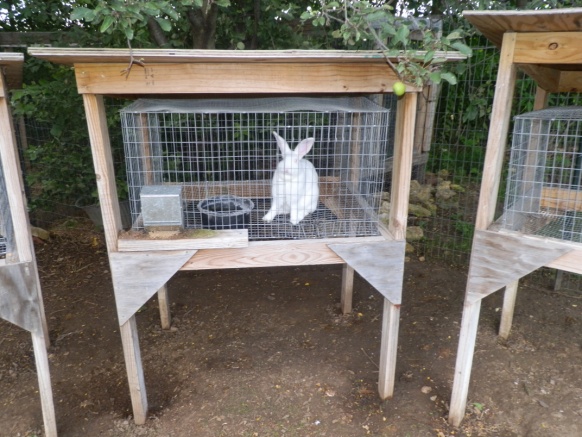
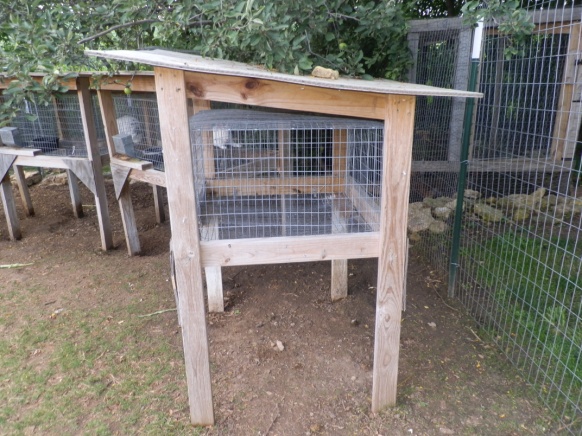
    Domesticated rabbits do not need a lot of room to survive and thrive. Our original cages were massive structures that were hard to clean and even harder to move. They are 83” x 48”. Part of the original cages we completely enclosed as a nest box, then we covered the top and three sides with wood. It was not a good idea. We discovered that the rabbits would poo in the enclosed area, and it turned into a stinky nasty mess that we had to constantly clean. Also, wood and rabbits don’t mix; they chewed it constantly. One doe even chewed her way out once. We also used chicken wire, but again it was not a good idea. It’s okay for the older rabbits, as their feet are bigger, but it was still not ideal. The openings are too big for the babies’ feet and they can easily break a foot or toe. Through lots of research and good DIY websites, we decided to use ½ “ x 1” 14-gauge welded galvanized wire mesh. It is so much nicer for their feet and still big enough to let the poo fall right through! We still have our original cages, as they cost quite a bit to make, but we use them as “brooders”. We took the nesting areas out, so now it is all opened up and we also removed most of the chicken wire. When the does have their kits, we move them to those cages so the babies have enough room to grow. Our current cages are 36” x 30”, and they are perfect for our rabbits. We even moved the cages into our chicken run. This not only frees up land on our property for gardening and fruit trees, but it also keeps the area under the rabbits cleaner. The chickens scratch at the food and poo they drop, which eliminates all the flies we used to have.

  2. rabbit1

  3. Meat rabbits will eat lots of carrots.

    Meat rabbits have lots of dietary needs, like all other animals, and carrots in abundance are actually not all that good for a rabbit. Carrots have a lot of sugar, so they should only be given in small amounts. We mainly feed our rabbits commercial feed because we have young kids that we homeschool, so I don’t have a lot of extra time to make sure our rabbits are getting the right amounts of everything they need. However, we do supplement their pellets with things we grow in the garden, like lettuce, kale, and yes an occasional carrot. There are many books out there on how to feed rabbits without resorting to pellets, but for us, for now, it’s easier to go with the pellets.

  4. rabbit2

  5. Rabbits are not compatible with all other animals.

    The second year we had meat rabbits, we got a dog, a beautiful black lab. That summer we couldn’t get our does to take care of their babies. They would have large kits, but within a day or two the babies would die. I finally called a friend who also raised rabbits and he told me it was our dog. The rabbits felt threatened by the dog and would abandon their nest to save themselves over their babies. It’s a natural instinct. So we re-homed the dog and had four good kits before winter set in.

  6. Meat rabbits breed well, like rabbits.

    That’s not entirely true. Sometimes the doe is unwilling to let the buck “do his thing”. Other times, your buck may be too old. Sometimes the doe will abort her pregnancy, and you won’t even know it until the 30 days is past and you have an empty nesting box. We have gone through some “dry” times in the four years we’ve had meat rabbits. We just had one this spring. I was sure all had gone well, but 30 days later we had NO baby rabbits. So we tried again. This time we got two. We’re hopeful this next go around is more “fruitful”.

  7. Bigger doesn’t always mean better.

    Most meat rabbits are about the same size. However, there is one breed out there that is much bigger; it’s the Flemish Giant. As the name suggests, it is a giant rabbit. That sounds great, right? However, it takes an enormous amount of rabbit feed to satisfy their hunger. So, unless you are willing to put out the money for feed or are able to grow your own, stick with the regular sized ones. Also, it is best to have your buck slightly smaller than your does for the following reasons: 1) so you don’t have babies that are too large for the mom to birth and take care of, and 2) so your buck doesn’t hurt your does while breeding.

  8. Rabbits are great for kids to raise.

    If you have older kids, this is true. However, if you have young kids, it is easy for them to get attached to those adorable babies. When you butcher a rabbit, they are not fully grown, nor have they been around for a long time. The first year we butchered, we did our best to keep our kids away from the babies. (That’s not an easy task.) Also, the day of butchering we had to keep them inside. It was a hard day for them, but they got through it. They are older now and are able to handle and understand much better why we butcher and that it’s necessary. However, we still don’t let them handle the babies.

  9. Rabbits need lots of warmth and shelter.

    Rabbits adapt fairly easily to any climate. However, if you live in an area where your summers are extremely hot, you will need ways to keep your rabbits cool. They are very cold-hardy animals, but they do not tolerate extreme heat well. Even here in the Midwest, we’ve had some hot summers, and I’ve had to put out a box fan or a bottle of frozen water to help them keep cool. Putting your rabbit cages in a shady spot is ideal. Put them somewhere where they can get the morning sun but from about 10 a.m. on that they are shaded. It’s nice for them to have that sun in the morning though, especially in the winter. In the winter, we wrap plastic around three sides of our rabbit’s cages– the north, south, and west sides. This keeps the extremely cold winter winds and snow out of their cages, but the front (east side), and bottom of the cages are still open. This allows plenty of air to circulate through the cage to ensure happy, healthy rabbits. If your rabbits are accustomed to being outside, I would not recommend moving them indoors during the winter, as this extreme temperature change can actually kill them. On nights when it is very windy and snowy, or the temperature drops extremely low, we throw some straw in their cages. This not only allows them some added protection from the elements, but also gives them something to munch on to keep their blood pumping.

  10. Having a good ratio.

    When we first started out, we had one doe and one buck. We quickly figured out this would not be enough. One doe can be bred about every 10-12 weeks; that would give you four kits per year, however I would not recommend this, as it is very hard on your does. We currently have one buck and three does, and this works great for us. I breed my does twice a year, once in the early spring and once in the late summer. A doe can have anywhere from 1 to 12 babies, and most meat rabbits only have 6-8 teats, so a kit of 8 to 9 is ideal. We figure an average of 6 babies per kit, with each doe having two kits per year that gives us approximately 24 rabbits to butcher each year. This works for us, but for a collapse scenario, you may want to consider having some backups. Ideally, having at least two bucks and five or six does is what we are striving for, as sometimes things don’t always work out as you planned. For example, last summer our buck decided he was just too old to do his job, so we were stuck with finding a new buck. It’s not an easy task to find a buck that is of breedable age. Most rabbits for sale are between eight and ten weeks old, so we had to either buy a young one and wait till he was old enough, or continue searching. Through word of mouth we were able to eventually find one that was old enough to use right away. It was a good lesson for us.

  11. Supplies

    Rabbits don’t need a lot of supplies, but what they do need must be good. With our first set of rabbits, we used whatever we had lying around the house. That worked for a few weeks, but anything made of plastic they will chew to bits in no time. Anything that isn’t heavy they will knock over while they are jumping around. We found that for feeding, the metal hopper feeders are the best. We do have some plastic bowls that hook to the side of the cage that we use during those last few weeks the babies are really putting on the weight. It’s easier than having to refill the hopper three times a day. Also for watering, ideally using the nipple system is the best way to go. If you search for DIY ideas, it is the best, however, we haven’t had the time or the funds to invest in such a thing, so we use black rubber bowls. They are thick and heavy enough that the rabbits can’t knock them over, and in the winter when the water freezes, the ice pops right out.

Successes

  1. Meat in the freezer

    Once we finally started working the kinks out of our system, we ended up with 30+ rabbits in the freezer! We cooked those suckers every way you can think of. We decided the next year to not have whole rabbits in the freezer (because I’m really bad at frying rabbit). So we pressure can or grind the rabbit meat. It’s easier to store ground rabbit in the freezer, because it takes up a lot less space than a whole one, and the canned meat is so quick and easy to use! One of our favorite things to do with the ground rabbit is to make pizza. Cook it up with some Italian seasoning and add to your favorite homemade crust! It’s also a great way to introduce people to rabbit meat. We have also made rabbit sausage patties; it’s great for our son, who has food allergies. In the winter, having canned rabbit is so wonderful, especially with a large family. Just pop open a can of pre-cooked rabbit meat and you can make great stews, chili, casseroles, et cetera. Wherever you would use chicken meat, use your canned rabbit. We love rabbit chili in the winter, and you can use either the ground or canned meat.

  2. Poo

    Rabbit poo is AMAZING! We discovered it is one of the few poos that can be put directly on your plants. We have been using their poo since we got rabbits. Even if you don’t use them for meat or are unable to get them to breed for a time, they are still useful because of their waste. Our soil has gone from normal to amazing in the few years we’ve had rabbits.

  3. Use for excess garden produce

    Our garden produces more produce than we can eat, especially the stuff you can’t save, like kale, lettuce, beet greens, carrots and their tops, even rhubarb (red stalks only!). Also things like cucumbers, bell peppers, eggplant (purple fruit only), squash and zucchini, and even tomatoes (red fruit only) are edible. There are also many fruits, tree and shrub leaves, twigs, flowers, and herbs that are safe for rabbits to eat.

  4. Companionship

    While we don’t let our kids play with or hold the babies, the does and bucks will be around for many years and trying to breed a rabbit that trusts you and is comfortable with you touching it is much easier than a rabbit that is scared of you or very skittish around humans. Whenever I am outside, which is a lot because of the kids, I talk to my rabbits or pet their noses. I will give them “treats” of garden produce or herbs. They are so used to me and the kids that when I have to move them to breed them or relocate them to clean a cage or to check on their babies, they don’t get nervous or try to bite and scratch me. We find great joy in watching our rabbits be rabbits or see them run to the front of the cage when we come near.

  5. Be a blessing to others

    Having rabbits has allowed us to help others start their journey to rabbit breeding. It can be quite hard to find a good breeder that isn’t selling to show or 4-H quality buyers, and who doesn’t want an arm and a leg for their rabbits. Most of the time, when we need a new rabbit or want to introduce new blood, we have to drive quite a ways to get it. We have also been able to bless others with meat or poo. If you have even just a few rabbits, the poo can easily pile up. Be generous with your gardening friends. Maybe they’ll reward you with excess produce for your rabbits.

When we decided to get into rabbit breeding and butchering, we had very little knowledge and even less know-how. We also had no one to turn to when problems arose. Everything we know we learned by trial and error, the Internet, and books. Raising rabbits is a very rewarding adventure, but it’s not one to take lightly and not something you can easily accomplish in a collapse scenario. If rabbit meat is something you plan to rely on, start now!


Letter Re: West Nile Virus

Hi Hugh,

I recently heard from two people (one who stayed in Florida, the other in Texas) that restaurants were hanging zip-loc bags with water in them around their outside dining areas. Apparently, that repels mosquitoes and flies. Although no one could provide an explanation as to why it worked, I have a theory that may explain it. When sunlight passes through water droplets in the air (when it’s raining) the light bends as it passes through the surface of the water droplet. The different wavelengths of light bend at different angles. A second bending occurs when the light exits the droplet on the other side. This causes the rainbow that we see when it is raining somewhere and the sun is also shining. (You can replicate this on a sunny day by spraying a fine mist out of your garden hose.) Even though insects may not be the most intelligent species on the planet, it’s quite likely they also see the rainbows and associate them with dangerous projectiles (rain) and take cover. Insects likely have eyes that are more sensitive to light than ours and can detect rainbows emanating from the bags of water. They think it’s raining and therefore avoid the area. This is definitely worth a try and may aid in keeping mosquitoes at bay. – P.B. in Maine

Hugh Responds: I have not heard anything about that method of mosquito repellent, but I am highly skeptical. Around 1900, it was already known that “germs” were spread through common points of contact, such as telephone handsets. Several companies marketed “Hygienic Telephone Discs”, which were simply disposable paper discs that one placed over the mouthpiece of the phone to protect the user from picking up germs or spreading germs to the phone handset. To be especially effective, you could soak the paper in an antiseptic as well. However, the uneducated person did not understand how the paper disc protected the user from the germs, so it became quite common to find these paper discs hanging on the telephone lines outside of homes. The owners reasoned that if the discs protected you from picking up germs from the phone, why even bother letting the germs inside the home through the telephone lines in the first place? I suspect, in a similar vein, the sealed bags of water are related to the instructions of not leaving open stagnant bodies of water around for mosquitoes to breed in rather than any repellent ability that they may have.

In the meantime, my wife suggests the following recipe for making 8 oz of mosquito repellent from essential oils:

  • 2 oz. of rose geranium essential oil,
  • 12 drops of peppermint essential oil,
  • 8 drops of lavender essential oil,
  • 6 drops of clove essential oil,
  • 2 drops of sage leaf essential oil,
  • 2 drops of eucalyptus essential oil, plus
  • Enough base oil to bring the volume to 8 oz. The base oil can be olive oil, almond oil, coconut oil, or (for an especially light option) sesame oil.

My wife prefers the heavier oils as she has dry skin and the lighter oils are quickly absorbed. I prefer the lighter sesame base oil. An application seems to last about two to three hours, depending on how quickly your skin absorbs the oils. We place the repellent in an 8 oz spray bottle and shake before each use. Spray it on exposed skin and then rub it in so that it has an even application. So far, it seems to be as effective as the DEET products, though the application doesn’t last as long. The aroma is not too feminine or masculine and is rather pleasant, so even children don’t fight it. We also use it on our dog, though only on areas of her body where she can’t lick (on her collar or back of neck) and it deters not only mosquitos but other pests as well, such as fleas and ticks. You can mix just peppermint and lavender oils in coconut oil for use on dog’s paws, between toes and on torso, as it is safe for their ingestion and will aid in warding off fleas, ticks, and other bugs in those areas of their body also.