Notes for Saturday – August 08, 2015

8 August is the birthday of Terry Nation (8 August 1930 – 9 March 1997), who was a Welsh television writer and novelist. Nation wrote two series, Survivors and Blake’s 7, in the 1970s. Survivors was re-made a few years ago.

o o o

Today, we present another entry for Round 60 of the SurvivalBlog non-fiction writing contest. The $10,000 worth of prizes for this round include:

First Prize:

  1. A Gunsite Academy Three Day Course Certificate, good for any one, two, or three day course (a $1,195 value),
  2. A course certificate from onPoint Tactical. This certificate will be for the prize winner’s choice of three-day civilian courses. (Excluding those restricted for military or government teams.) Three day onPoint courses normally cost $795,
  3. DRD Tactical is providing a 5.56 NATO QD Billet upper with a hammer forged, chromlined barrel and a hard case to go with your own AR lower. It will allow any standard AR type rifle to have quick change barrel, which can be assembled in less than one minute without the use of any tools, and a compact carry capability in a hard case or 3-day pack (an $1,100 value),
  4. Gun Mag Warehouse is providing 20 Magpul pmags 30rd Magazines (a value of $300) and a Gun Mag Warehouse T-Shirt. (An equivalent prize will be awarded for residents in states with magazine restrictions.),
  5. Two cases of Mountain House freeze dried assorted entrees in #10 cans, courtesy of Ready Made Resources (a $350 value),
  6. A Model 120 Series Solar Generator provided by Quantum Harvest LLC (a $340 value),
  7. A $250 gift certificate from Sunflower Ammo,
  8. KellyKettleUSA.com is donating both an AquaBrick water filtration kit and a Stainless Medium Scout Kelly Kettle Complete Kit with a combined retail value of $304,
  9. TexasgiBrass.com is providing a $300 gift certificate, and
  10. Two cases of meals, Ready to Eat (MREs), courtesy of CampingSurvival.com (a $180 value).

Second Prize:

  1. A Glock form factor SIRT laser training pistol and a SIRT AR-15/M4 Laser Training Bolt, courtesy of Next Level Training, which have a combined retail value of $589,
  2. A FloJak EarthStraw “Code Red” 100-foot well pump system (a $500 value), courtesy of FloJak.com,
  3. The Ark Institute is donating a non-GMO, non-hybrid vegetable seed package–enough for two families of four, seed storage materials, a CD-ROM of Geri Guidetti’s book “Build Your Ark! How to Prepare for Self Reliance in Uncertain Times”, and two bottles of Potassium Iodate– a $325 retail value,
  4. A $300 gift certificate from Freeze Dry Guy,
  5. A $250 gift card from Emergency Essentials,
  6. Twenty Five books, of the winners choice, of any books published by PrepperPress.com (a $270 value),
  7. A pre-selected assortment of military surplus gear from CJL Enterprize (a $300 value),
  8. TexasgiBrass.com is providing a $150 gift certificate,
  9. RepackBox is providing a $300 gift certificate to their site, and
  10. Safecastle is providing a package of 10 Lifestraws (a $200 value).

Third Prize:

  1. A Royal Berkey water filter, courtesy of Directive 21 (a $275 value),
  2. A large handmade clothes drying rack, a washboard, and a Homesteading for Beginners DVD, all courtesy of The Homestead Store, with a combined value of $206,
  3. Expanded sets of both washable feminine pads and liners, donated by Naturally Cozy (a $185 retail value),
  4. Two Super Survival Pack seed collections, a $150 value, courtesy of Seed for Security, LLC,
  5. Mayflower Trading is donating a $200 gift certificate for homesteading appliances,
  6. APEX Gun Parts is donating a $250 purchase credit,
  7. Montie Gear is donating a Precision Rest (a $249 value), and
  8. Two 1,000-foot spools of full mil-spec U.S.-made 750 paracord (in-stock colors only) from www.TOUGHGRID.com (a $240 value).

Round 60 ends on September 30th, so get busy writing and e-mail us your entry. Remember that there is a 1,500-word minimum, and that articles on practical “how to” skills for survival have an advantage in the judging.


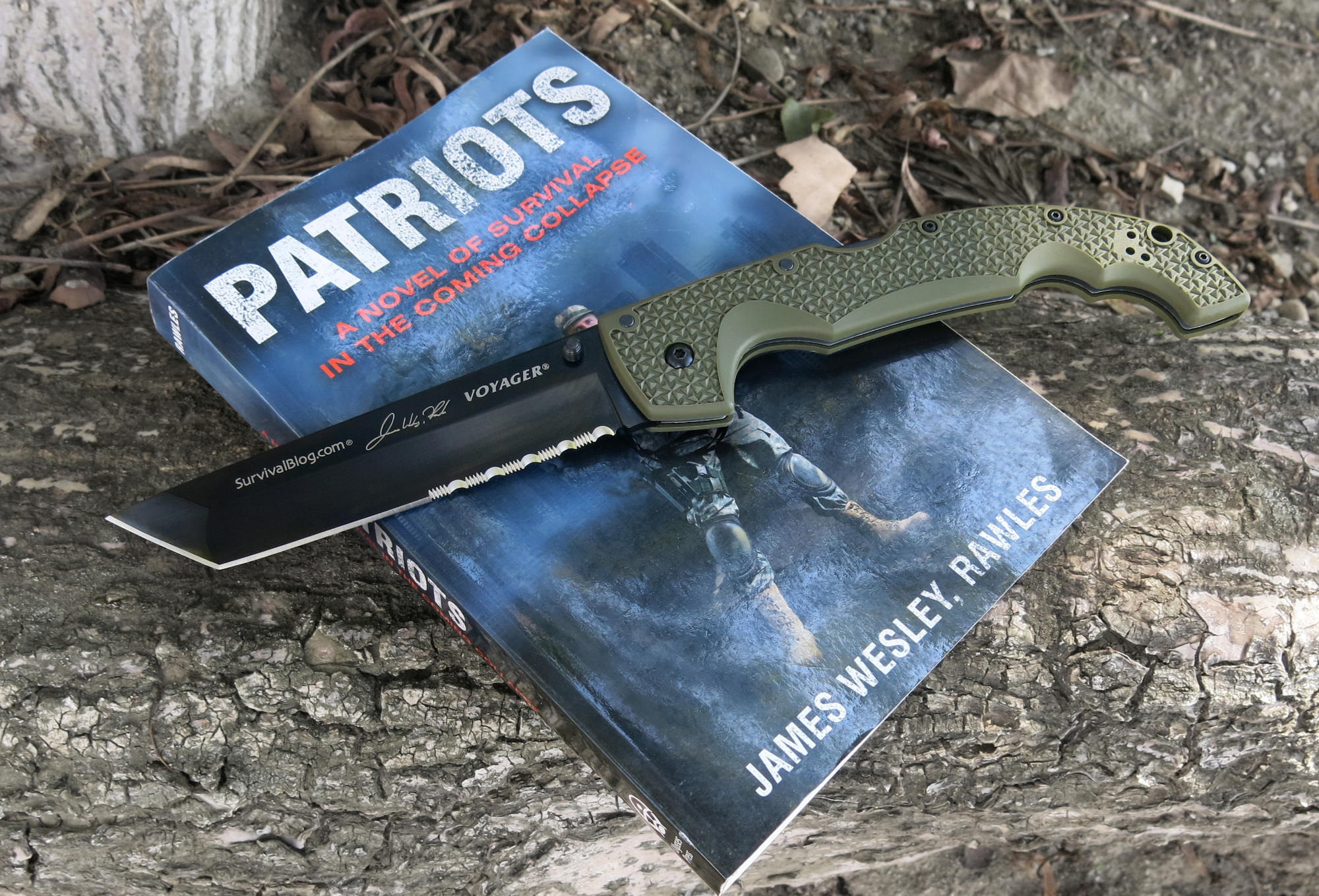
Announcing the SurvivalBlog Limited Edition XL Voyager Knife!

I’m pleased to announce that after more than a year of development, Cold Steel has released the Limited Edition Rawles Voyager Extra Large (XL) folding knife. This knife was specially made to my own specifications. It features the new Carpenter CTS XHP steel for superior edge holding and corrosion resistance, a half-serrated tanto blade for practical versatility, a black diamond-like coating for low reflectivity, and an olive green Griv-Ex grip that won’t slip and that blends in to natural environments. Each knife comes with a right-hand pocket clip installed and a spare pocket clip for left-handers. It has an ambidextrous thumb stud for fast opening, and a time-proven Tri-Ad lock to keep it securely open, even in the most vigorous use.

voyager1

This is a massive folding knife. It has a 5.5″ blade and a 12.25″ overall length, with the blade open. The blade is a hefty 4 millimeters thick. But just beware that because of its large size that it is not legal for carry in all jurisdictions, so consult your state and local laws before ordering.

Carpenter CTS XHP steel is a fairly new steel alloy that combines the corrosion resistance of 440C stainless with the great edge holding of D2 Tool steel. Think of this new steel alloy as “the best of both worlds.” Like all other Cold Steel knives, it comes from the factory razor sharp and the knife has a lifetime warranty.

100% of Cold Steel President Lynn Thompson’s profits and 100% of my own profits are going to Christian charities. (My share has been assigned to Anchor of Hope Charities, which supports a well-established mission school in rural Zambia.)

Because this is a limited edition knife, they are expected to sell out in just a few months, and these won’t even make it to most Cold Steel dealers. So don’t wait to buy one in stores. Because this is one of Cold Steel’s first product offerings in the desirable Carpenter CTS XHP steel alloy, they are bound to be quite popular. Once they’ve sold out there will be no more of this model produced, so order yours today! – JWR


Our Experience Growing and Storing Our Own Food- Part 3, by Tennessean

Farming Equipment

Farming equipment is useful in various functions of gardening, particularly when growing a large garden for a family’s self-sustenance.

Mechanical Seeders

Two months ago we were on a UT field trip visit to a farm several counties northeast of us. I was extremely impressed with “Farmer Bob”. He demonstrated a Jang Clean Seeder. it actually worked! Two other push hand seeders we have tried have been about as useless as a screen door in a submarine. This gizmo is NOT inexpensive, but it does the job. We bought a fertilizer attachment, a row marker attachment, a rough soil furrow opener, and oddles of the seed rollers. One varies the seed distance by varying the gears on the front wheel and seeder roller and by the number of holes in the plastic seeder rollers. One may buy blank rollers and drill your own holes to suit. Johnny’s Seeds sells these.

Why is this important? Okay, consider doing this without a mechanical seeder. First, you go down the row with a Warren hoe and make a furrow. Then you make a second pass dropping the seed into the furrow. Then, you make a third pass with the hoe to cover the seed, and then a fourth pass to side dress the row with fertilizer. Why not save time and effort and do all this in one pass?

Cultivation

Farmer Bob uses a BCS walk-behind tractor, which can be found at BCSTractors.com. They sell one diesel engine model. Okay, the thing about this gizmo is that the PTO shaft coming out at the rear is the complete attachment point for things like a PTO-powered rototiller. Why is this important? Well, after you struggle putting a 3-point hitch Category 1 PTO implement on a tractor, you will appreciate the ease with which one may change implements on a BCS tractor.

We have a Kubota B7510 24 hp diesel Category 1 tractor, turning plow, disc harrow, drag harrow, a 48” wide PTO 3 pt hitch KingKutterII rototiller, a five foot bush hog, a rear 3pt hitch grader adjustable angle grader blade for perfecting the terraces, a rock and root rake, a “potato plow” (aka a middle buster), a subsoiler, and 3 pt PTO post hole digger. I suggest killing all vegetation first with Round Up and waiting a week or two before tearing up new soil. We DO use Round Up, or actually its generic equivalent with added detergent, to kill weeds, but we would never grow GMO cultivars.

Here is my take on cultivation with a tractor: Forget the turning plow and disc harrow. Tear up the sod and soil with a subsoiler, which is a chisel plow 2” wide that goes down 16” into the soil. This is far better than a turning plow that only goes down 6-8”, as it brings up nutrients in the subsoil and allows water to penetrate deeply into the soil. In our case (with rocks in the soil) the subsoiler tends not to shatter the rocks into a zillion pieces parts, as does a turning plow. After picking up the rocks, use a PTO 3 pt hitch rototiller to turn the clods into a nice seed bed. For broadcast seeds (e.g. winter cover crops, turnips, and the like) a drag harrow will get the small seeds mixed up into the ground.

Saving the Harvest

There are many way of storing various types of food grown in the garden. I’ll share with you how we save our harvest.

Dehydrating Foods

We have four Excalibur dehydrators. Dried food is placed in canning jars and the air is pumped out with a “Pump ‘N Seal” gizmo. We then put a one square-inch piece of aluminum foil duct tape on top of the seal valve. Otherwise, you may discover that mice will chew up the small seal valve thinking thereby they can get to the food.

There are three advantages of dehydrating:

  1. It takes up far less shelf space,
  2. The shelf life is much longer, and
  3. If the jars freeze, no damage is done.

We are especially fond of dehydrated tomatoes and peppers. These go in the root cellar. Dried peas, wheat, dry beans, and corn are stored in Mylar bags with oxygen absorbers added before sealing. (I shop www.beprepared.com for both bags and oxygen absorbers.) The Mylar bags are stored in a 5-gallon plastic bucket with a Gamma Seal lid, which I purchase from sportsmansguide.com.

Canning Foods

Safe canning is an exercise in applied microbiology. If (and only If) the pH of the food is below 4.5 is it safe to use a boiling water bath canner, as Clostridium botulini (an obligate anerobic primitive bacteria) can only grow (and produce the deadly toxin) if the pH is above 4.5. These bacteria form spores that are not killed in a boiling water bath canner. A considerably higher temperature is required, and this is only possible with a pressure canner. As an aside, let me point out that boiling any canned food in an OPEN pot for fifteen minutes will denature (inactivate) the protein toxin produced by this bacteria. A caution here: many new tomato cultivars are low acid, and the pH resulting may well be above 5.0. So, buy thyself some pH paper at an aquarium store to be sure. This is one reason we add Fruit Fresh to tomatoes to be canned. Both the citric acid and the Vitamin C lower the pH.

We have three All American pressure canners, which are made in Wisconsin and have a metal to metal seal. We also have a huge stash of canning jars and lids. We can tomatoes, apples, pears, peaches, soups, green beans, jams, and jellies. We add Fruit Fresh to the tomatoes, apples, jams, and jellies to increase the Vitamin C content. The Ball torque wrench for exactly tightening the bands on the lids prior to canning is a must. Consider the Tattler reusable canning seals. It is important to keep the pressure as steady as possible with a pressure canner; otherwise, the lids may not seal. It is also important to let the pressure canner cool down all by itself. Therefore, do not hurry things up by placing a fan to blow air on the canner, or you are liable to have seal failures. Many county agents provide a service to check the gauge on a pressure canner. Buy at least one spare gauge. DO NOT use a “steam” canner, which is patently unsafe. In a boiling water bath canner, the water must cover the tops of the jars.

It is CRITICAL to exactly follow the directions in the Ball Blue Book for canning anything. In March of 2015, several folks at a church supper in Ohio were permanently injured eating potato salad from improperly canned potatoes. Just like in reloading ammunition, the failure to exactly follow the directions can lead to death. Let me note in passing that NO food bank will take home-canned foods, and these are very unlikely to be confiscated to give to other folks.

Canning Pasta Sauce and Soups with Tomatoes

Here is the way to do it. Get thyself a Ninja blender. Cut up the tomatoes and removing the clear liquid and the seeds (diverticulitis issues). Place what remains in the Ninja blender with oregano and basil leaves. Liquify this completely. Okay, there will be very small bits of tomato skin there. Who cares? After all, you know what was (and was not) sprayed on the tomatoes. Sauté diced onions, peppers, and garlic in a stock pot (that has a copper layer on the bottom of the pot); add the blended tomatoes. Can this as “stewed tomatoes” per the Ball Blue Book recipe. Add ½ can of Fruit Fresh to each 18 pints of mix.

The Importance of a Root Cellar

We’ve a root cellar with about 118 cubic feet total gross space. It has its own 12 VDC power system with PV panels, a marine battery, and LED lighting. We store dehydrated tomatoes and onions, potatoes, seeds, apples, cabbage, and so forth in it. It is sufficiently insulated so that in the dead of winter the interior temperature is above freezing. The cellar is contained by ½ of an old diesel tank whose exterior was coated with Rust Oleum paint and then a rubberized roofing compound. it’s totally mouse and water proof. So far, it’s been bear proof with its extremely sturdy door. Yes, we have a lot of black bears around us.

Equipment for Shelling Vegetables

Corn. We have an old timey manual crank cast iron corn sheller. I’ve just bought another. I’m a big believer in spares for critical tools. Try shelling dry field dent corn by hand for several hours, and you will understand the need for this device.

Peas. One very real advantage of field peas is their fragile pod when dried. A small motorized dry field pea pod sheller is available at www.peasheller.com. This is made in Moultrie Georgia.

Homemade Dryer for Corn/Peas/Beans/Peanuts. I designed and constructed a bulk corn/pea/bean dryer from plywood, a 20” box fan, and four 100-watt light bulbs to heat the incoming air. We first dry the shucked corn on the cob. Shelling damp corn does not work. Once dry, we shell and then dry the kernels in the same dryer. Unless well dried, a toxic fungus grows on the shelled corn. This dryer is also used to dry field pea pods prior to mechanical shelling. This is made with two boxes 14” high and large enough to accommodate the fan. The lower box contains the 20” box fan and the four 100 watt light bulbs placed above the fan. With the fan on medium these warm up the ambient air about 10 degrees F. The second box just sits on top of the first box. At Home Depot I bought eight ¼ steel rods and inserted these into the bottom edge of the upper box, horizontally, to provide a strong open support for the aluminum screen wire that sits on top of these eight rods. Such an apparatus will be critical for drying peanuts. Peanuts are very susceptible to the fungus that produces aflatoxin.

Permaculture

Consider fruit trees. Please know that many soils are deficient in boron, so sprinkle one ounce of borax every 20 square feet around each tree the first year you see blossoms. Please note that more is NOT better, and only add this micronutrient to fruit trees, as it is toxic to most other plants. In our area, cedar apple rust is a major issue along with fire blight. The former is a basidiomycete fungus that has as alternate hosts apple leaves and eastern red cedar trees. Fire blight is a bacterial disease that is somewhat controllable by spraying the antibiotic streptomycin on the leaves. It’s far better to choose cultivars that are resistant to these two microbes. We will now only buy the Liberty and Freedom apple cultivars. We also have four sets of M-111 semi-dwarfing apple rootstock plants growing. It turns out the choice of rootstock can confer a lot of disease resistance to the grafted apple tree. Thus, we will be able to produce our own semi-dwarf grafted trees that may become a valuable home business. Consider the new “Green Jade” hybrid (European & Asian) pear cultivar with a lot of disease resistance. Consider hazelnut trees as a windbreak. Consider Osage orange trees as a fence to keep out both two-legged and four-legged herbivores. Look up this on wikipedia. It’s totally vicious LONG thorns that can actually puncture a tractor tire. Consider the new “Reliance” disease-resistant grape vine cultivar developed at the University of Arkansas. We have had great success with the “Ontario” grape vine cultivar. So far, it has been the most vigorous grape vine we’ve grown.

We grow asparagus from seeds. Sure, it takes longer to get a plant large enough to be harvested, but the cost of the seeds is quite small compared to the cost of really good (as opposed to mostly rotten) asparagus “crowns.” I find that the local rabbits have no interest in asparagus spears, and I see almost no insect problems. I’ve read that good practice is to cut and burn all the dead foliage in winter to kill any over wintering asparagus leaf beetles. I place a commercial tomato cage over each plant to keep the stalks from getting bent over by winds. Alternatively, one could grow these on the west side of a fence, as I did decades ago.

Operational Security

None of our veggie garden or fruit orchard is visible from any public road. Our plot is at the end of a one-way gravel road. We have a VERY sturdy gate at our boundary. The plot is visible from only two houses. Along the two property lines with trees we encourage the growth of greenbriar vines, blackberry vines, and multiflora rose bush vines. From the barn attic window we can observe the entire garden plot without being observed. If need be, we will rotate guard duty in the barn attic. We will have infrared game cameras hidden, pointing toward the garden to record any visitors with a date and time stamp. Only a few close neighbors know of our farm.


Letter Re: A Year’s Supply of Food on a Budget by J. H.

HJL

I’d throw in that the rice and beans need to be stored in a ratio of 10 lbs. of rice to 6 lbs. of beans. Together, in that proportion, they provide the essential proteins according to smart people with credentials to whom I am related. Fats and oils are important as PW asserts. Check out Piteba Nut and Seed Oil Expeller Oil press. It is important that you not just buy it and put it on the shelf. There are expendable parts, and the instructions include direction to a video to figure it out. Also, I understand it takes a good acre of sunflowers to provide a year’s worth of oil. I would be pleased to hear about another easily grown seed that provides good cooking oil that does not stand out like a flag and ruin OPSEC.

To PW’s point about variety, I include spices that would potentially help preserve (cloves) food or mask (cayenne pepper) food that has met the “get it hot enough and it is still good rule” from college. – RV


Economics and Investing:

The spot prices of silver and gold recently dipped to $14.70 USD and $1,006 USD, respectively. This short-term aberration in long-term market trends can be attributed to both the sag in oil prices and to near panic shifts by European investors into the United States equities following news of the Greek bailout and a possible Euro collapse. I recommend that anyone who sees the need to diversify their portfolio do so NOW. If you wait until October, you may miss the boat. Physical silver is the logical choice. If you already have your beans and bullets squared away, then I highly recommend buying some pre-1965 US circulated silver coins, immediately. – JWR

o o o

Gold, Golf, & Silver … are Similar

o o o

1 out of 3 American workers support the rest of the country: Those not in the labor force surges to another record at 93,770,000.

o o o

How Microsoft Lost the Browser Wars and the Comex is Losing the Precious Metals Trade


Hugh’s Quote of the Day:

“Beware that thou forget not the Lord thy God, in not keeping his commandments, and his judgments, and his statutes, which I command thee this day…” Deuteronomy 8:11 (KJV)


Notes for Friday – August 07, 2015

7 August 1933 is the birthday of Jerry Pournelle. He, along with Larry Niven, authored the survivalist classic Lucifer’s Hammer.

o o o

Today, we present another entry for Round 60 of the SurvivalBlog non-fiction writing contest. The $10,000 worth of prizes for this round include:

First Prize:

  1. A Gunsite Academy Three Day Course Certificate, good for any one, two, or three day course (a $1,195 value),
  2. A course certificate from onPoint Tactical. This certificate will be for the prize winner’s choice of three-day civilian courses. (Excluding those restricted for military or government teams.) Three day onPoint courses normally cost $795,
  3. DRD Tactical is providing a 5.56 NATO QD Billet upper with a hammer forged, chromlined barrel and a hard case to go with your own AR lower. It will allow any standard AR type rifle to have quick change barrel, which can be assembled in less than one minute without the use of any tools, and a compact carry capability in a hard case or 3-day pack (an $1,100 value),
  4. Gun Mag Warehouse is providing 20 Magpul pmags 30rd Magazines (a value of $300) and a Gun Mag Warehouse T-Shirt. (An equivalent prize will be awarded for residents in states with magazine restrictions.),
  5. Two cases of Mountain House freeze dried assorted entrees in #10 cans, courtesy of Ready Made Resources (a $350 value),
  6. A Model 120 Series Solar Generator provided by Quantum Harvest LLC (a $340 value),
  7. A $250 gift certificate from Sunflower Ammo,
  8. KellyKettleUSA.com is donating both an AquaBrick water filtration kit and a Stainless Medium Scout Kelly Kettle Complete Kit with a combined retail value of $304,
  9. TexasgiBrass.com is providing a $300 gift certificate, and
  10. Two cases of meals, Ready to Eat (MREs), courtesy of CampingSurvival.com (a $180 value).

Second Prize:

  1. A Glock form factor SIRT laser training pistol and a SIRT AR-15/M4 Laser Training Bolt, courtesy of Next Level Training, which have a combined retail value of $589,
  2. A FloJak EarthStraw “Code Red” 100-foot well pump system (a $500 value), courtesy of FloJak.com,
  3. The Ark Institute is donating a non-GMO, non-hybrid vegetable seed package–enough for two families of four, seed storage materials, a CD-ROM of Geri Guidetti’s book “Build Your Ark! How to Prepare for Self Reliance in Uncertain Times”, and two bottles of Potassium Iodate– a $325 retail value,
  4. A $300 gift certificate from Freeze Dry Guy,
  5. A $250 gift card from Emergency Essentials,
  6. Twenty Five books, of the winners choice, of any books published by PrepperPress.com (a $270 value),
  7. A pre-selected assortment of military surplus gear from CJL Enterprize (a $300 value),
  8. TexasgiBrass.com is providing a $150 gift certificate,
  9. RepackBox is providing a $300 gift certificate to their site, and
  10. Safecastle is providing a package of 10 Lifestraws (a $200 value).

Third Prize:

  1. A Royal Berkey water filter, courtesy of Directive 21 (a $275 value),
  2. A large handmade clothes drying rack, a washboard, and a Homesteading for Beginners DVD, all courtesy of The Homestead Store, with a combined value of $206,
  3. Expanded sets of both washable feminine pads and liners, donated by Naturally Cozy (a $185 retail value),
  4. Two Super Survival Pack seed collections, a $150 value, courtesy of Seed for Security, LLC,
  5. Mayflower Trading is donating a $200 gift certificate for homesteading appliances,
  6. APEX Gun Parts is donating a $250 purchase credit,
  7. Montie Gear is donating a Precision Rest (a $249 value), and
  8. Two 1,000-foot spools of full mil-spec U.S.-made 750 paracord (in-stock colors only) from www.TOUGHGRID.com (a $240 value).

Round 60 ends on September 30th, so get busy writing and e-mail us your entry. Remember that there is a 1,500-word minimum, and that articles on practical “how to” skills for survival have an advantage in the judging.


Our Experience Growing and Storing Our Own Food- Part 2, by Tennessean

Seed (continued)

Winter Squash

One needs to give these cultivars a LOT of room, planting on a grid 8’ by 8’ is about right. This year we are growing two winter squash cultivars that keep a long time in a root cellar. Anna Swartz is a C. maxima and Waltham Butternut is a C. moschata and will not cross pollinate (this is why you must have Suzanne Ashworth’s book!), so we will be saving the seed from these. Insects pollinate the cucumber family, and we’ve oodles of all sorts of pollinator insects in East Tennessee, and they fly for many thousands of feet looking for blossoms. On each “hill”, dig an 18” wide, 12” deep hole, and mix two gallons of composted manure, ¼ cup lime, and ¼ cup enhanced triple 15. Plant four seeds at the corners of the “hill.” Water with a drip irrigation system.

Potatoes

We’ve settled on Yukon Gold potatoes. 95% of our seed potatoes that are saved in mesh bags on hooks in our root cellar survived over the fall and winter months. You really, really need a root cellar. Buy the recommended book and get to work. Grow potatoes on a plot where you have grown legumes the year before and you will probably get a decent crop without any added fertilizer.

Tomatoes

Prepare the hole for the tomato seeding about like that recommended for the winter squash. It is best to have a single row of tomato plants spaced about 2’ apart in an area that gets good air circulation to reduce transfer of the early blight fungus from plant to plant. You may need to fence in the tomatoes with 2’ chicken wire to keep Bugs Bunny out and hang old CD’s around the tomatoes. The bright reflection scares most birds away and vastly reduces losses due to bird pecks.

Tomatoes are either determinant or indeterminate. The latter keep growing vines until disease or drought kills the vines. The former are mostly hybrids; the latter are mostly heirlooms. We’ve tried a great many cultivars. In our area early blight (a fungus disease) is our major issue. Clemson University research showed that planting tropical nightshade family plants (e.g., tomatoes, eggplant, peppers) in the center of 5’ wide red plastic mulch speeds time to harvest. Since the fungal spores that infect the tomato leaves come from the soil, the red mulch and 3’ wide weed cloth on both sides of a tomato row reduce infection. Removing the lower leaves that seem damaged by the fungi also helps. We recommend burning all tomato vines at the end of the season. One heirloom cultivar that is somewhat resistant to the fungi is the Black Plum (from the Crimean region and indeterminate) that produces the most excellent pasta sauce you will ever eat. Our Black Plum vines in mid July are 7‘ long and have to be corralled with T posts tied to tomato cages. Researchers are working very hard to develop tomato cultivars resistant to early blight. We are trying one of these– Mountain Magic– this year.

The conical tomato cages sold at Home Depot, Lowe’s, and most gardening stores are as useless as a screen door in a submarine. Why? The conical shape virtually guarantees that if your tomato plant reaches a decent size, the cage will fall over. It is the idiotic geometry that is the problem. Sure, they will nest nicely. So what?

What is there to do? Go this winter to Home Depot or Lowe’s or wherever and get thyself a roll of reinforcement wire used for concrete work. This comes in tall rolls and is rusty. Forget about and ignore the rust. Get a pair of wire nippers (electrical tools to cut rather heavy gauge wire) and also a pair of smallish Vise Grip pliers. On sunny days this winter cut the roll of wire into sections about four to six feet wide. This will yield a cylindrical cage of about the right diameter.

Using the vise grip, grab the horizontal sections of wire at what will become the bottom, and cut these out. Cut out enough rows so that you will have only vertical wires at the bottom at least 12 inches and preferably 15 inches long, if your soil will permit. These are stuck into the soil with the tomato plant in the center.

My neighbor does this. I’ve yet to see a single cage fall over, and I’ve been watching over the last four years. He stores these off season on a tarp, covered by another tarp, secured against the wind.

Onions

The seed only lasts a year or so. It’s very hard to keep them all winter, though we try. We suggest Egyptian Walking onions. Read about these on Wikipedia. Thomas Jefferson grew these in his Monticello garden. Around here they are called “winter onions” because people leave them in the ground all winter and dig them up as needed. In colder climates, bales of straw on top of the raised bed will keep them happy. IF one has sufficient rain in April to June then in July the flower stalk does not make flowers but oodles of bulblets, which are planted (only halfway) in the soil and kept watered until the fall rains. Over the winter the in-ground bulbs will divide. In midsummer, as they go dormant, I divide up the bulbs and replant. I strongly suggest growing these on a 3” by 3” grid in an easily weeded raised bed. One may also (as I am about to do) put the bulblets in small pots in starting mix and keep watered. I note in passing that we have found that bok choi interplanted with these onions is pretty much ignored by leaf beetles. We wish to test this with other members of the cabbage family.

Peanuts

If your soil and climate allow for peanut cultivation, consider peanuts for their quite high fat (and caloric) content as opposed to other legumes, like field peas. A caution about peanuts: very quickly dry the peanuts as they are still attached to the plant. A fungus that produces a toxic carcinogen (aflatoxin) very readily grows on damp peanuts. After the peanuts are mostly dry, detach them from the plant and dry until they’re a constant weight. A homemade bulk dryer as described below will be invaluable. Weigh four cups of peanuts in the shell before drying the peanuts in the shell and at intervals during the drying process. When the weight approaches a constant value, your peanuts will be as dry as you can get them. I suggest immediately shelling the peanuts and roasting them. Then put them in glass canning jars, with a band and lid, and pump out most of the air with a Pump ‘N Seal. Hold back enough shelled peanuts from roasting for next year’s seed. Beware: rabbits love peanut leaves, and mice will travel from adjacent counties to eat your peanuts while they are drying. Squirrels have been known to dig peanuts right out of the ground and eat them.

Garlic:

In October, separate out individual cloves of garlic and plant them a couple of inches below the surface. Remove the flower heads in May to direct all the food storage to the bulbs. In mid summer, after the garlic tops die down, carefully remove from the dirt and braid the garlic into braids and hang in a cool, dark, moderate humidity space. Territorial Seeds has an astounding number of different garlic varieties. The main difference is the “soft neck” versus the “hard neck” distinction.

Oregano

In our area, this is a perennial. Now I strongly suggest that you grow oregano in a raised bed far, far, away from any other veggie plots, as the small seeds will wind blow and next spring you will have ‘volunteer” oregano growing in any nearby veggie bed. You’ll likely have lots of it.

Perennial Leeks

We are propagating perennial leeks, both by seed and by division of the cloves as they begin to sprout come fall. We do this in raised beds.

Rotation

It is important for several plant families not to plant veggies from the same family in the same plot until three years have passed. This is especially true for the nightshade, cabbage, and cucurbit families. Keep a detailed record of what veggies were grown in what plot each year for rotation planning. Corn and legumes do not seem to need as much rotation as other families. Yes, we’ve grown all these veggies, as well as peppers, sweet potatoes, cabbages, broccoli, cauliflower, Brussel sprouts, cucumbers, eggplant, and others.

Cover Crops

Unless you are very fortunate, your soil will not have nearly enough organic matter (aka humus) in it. There are beneficial fungi that form (sometimes critical as in the lady slipper orchids) symbiotic relationships with plant roots. These need a soil with substantial organic matter to prosper. Humus, with its negative charges, also acts as a cation exchanger to hold on to the important cations (more below). Sowing a crop of annual winter rye in the fall will:

  1. Add humus to the soil,
  2. Come spring, will inhibit the germination of many weeds, and
  3. Will sequester nitrogen thru the winter.

Every chemist knows that all nitrate and ammonium salts are soluble. One may mix rye with hairy vetch to add nitrogen. For a summer cover crop, try a hybrid that comes from sudan grass and sorghum. It is best to bush hog the crop at the flowering stage, as it will become “weedy” if the seeds are allowed to mature. Another great summer cover crop (if your climate permits it) is Iron and Clay field peas. Thomas Jefferson grew these, they take a long time to make flowers and make very long vines. Diakon radish (aka Tillage Radish) is an interesting cover crop, because the roots go deep and it winter kills for ease of spring planting. A very useful cover crop is Austrian Winter Peas sown in the fall. In our area they survive the winter and fix some 160 pounds of nitrogen per acre. If one allows them to mature, the green peas in their pods taste (at least to me) exactly like English peas. Of course, all non-food vegetable matter is returned to the soil via a compost pile, except of course the pieces the chickens like to eat. You do plan to have chickens, right?

For all cover crops, bush hog these before roto-tilling them into the soil; otherwise, you will waste time and energy unwinding vines and stems from your rototiller. Yes, we have tried all these cover crops.

Fertilizer

We augment commercial 15-15-15 with a micronutrient mix and magnesium sulfate (aka Epson Salts) from your drugstore to add to the commercial NPK fertilizer. See www.foodforall.com for this micronutrient mix. For legumes, we mix ½ 15-15-15 with ½ 0-20-20 and for corn we mix ½ 15-15-15 and ½ 46-0-0 (urea). We stockpile LOTS of triple 15, 46-0-0, Epsom salts, and bags of micronutrient mix. Since some of our soil has a lot of clay we add gypsum (calcium sulfate) to the soil to loosen the clay. William McKibben’s book is a must read on balancing soil nutrients. His book is based on the massive research done by Dr. William A. Albrecht at the University of Missouri on balancing the cations in the soil (e.g., Ca, Mg, K, and the micronutrients). I’m now reading the second of his books with his collected papers. Albrecht showed that having the correct mix of major and micro nutrients was critical to growing food that led to healthy animals. Cows and pigs could tell the difference between food grown with the correct mix of macro and micro nutrients and food grown on plain soil! Albrecht showed over and over again that the main benefit of adding lime (calcium carbonate) to the soil was the addition of enough calcium for great plant growth, not raising the pH per se. Dr. Albrecht suggests that exchangeable cations in the soil should be about 70% calcium, 20% magnesium, with 5-10% potassium. The remainder is mostly bound hydrogen ions.


Letter Re: Calcium Hypochlorite

I recently bought a 1 lb. bag of DryTec calcium hypchlorite through Amazon. When I repackaged it for long-term storage I noticed there was very little chlorine odor. I made a 1/2 gal. per directions for stock. I poured the stock directly on the tail of a non-colorfast shirt (bright red that already had white spots from a sodium hyphochlorite spill) and left it for hours; it didn’t even lighten the color. I don’t know any other way to test the amount of available chlorine that I have on hand, but I am deeply concerned that a lot of people who think they have excellent water purification stored for the future are going to get sick due to the failure of the calcium hypochlorite. – K.M.

HJL Responds: Thanks for that feedback. That is an excellent reason for testing and sampling your long-term preps while you have the ability to replace the defective items. Once your ability to replace the items is gone, the need for constant sampling is certainly lessened, but until then you should be regularly testing your ability to “make do”. You will often hear of “Grid-down” challenges, where families will simply turn the power off for the weekend and live as if something had actually happened. You will be amazed at how often well-laid plans don’t quite work out the way you had envisioned. The peace of mind brought about by expending a couple hundred dollars every year on things you consume is well worth it.


Notes for Thursday – August 06, 2015

On August 6, 1945, the United States of America dropped the first Atomic bomb on Japan. The bomb, though small by today’s standards, possessed more power than 20,000 tons of TNT, a destructive force equal to the load of 2,000 B-29s and more than 2,000 times the blast power of what was previously the world’s most devastating bomb. While the effect of the bomb on the outcome of the war is still debated today, one thing is sure–Pandora’s box had been opened. Even today, the fear of a single nuclear bomb in the hands of an unstable government sends chills down the spine. To date, the U.S.A. is the only country to have ever used nuclear bombs in a military attack on another country.

o o o

Today, we present another entry for Round 60 of the SurvivalBlog non-fiction writing contest. The $10,000 worth of prizes for this round include:

First Prize:

  1. A Gunsite Academy Three Day Course Certificate, good for any one, two, or three day course (a $1,195 value),
  2. A course certificate from onPoint Tactical. This certificate will be for the prize winner’s choice of three-day civilian courses. (Excluding those restricted for military or government teams.) Three day onPoint courses normally cost $795,
  3. DRD Tactical is providing a 5.56 NATO QD Billet upper with a hammer forged, chromlined barrel and a hard case to go with your own AR lower. It will allow any standard AR type rifle to have quick change barrel, which can be assembled in less than one minute without the use of any tools, and a compact carry capability in a hard case or 3-day pack (an $1,100 value),
  4. Gun Mag Warehouse is providing 20 Magpul pmags 30rd Magazines (a value of $300) and a Gun Mag Warehouse T-Shirt. (An equivalent prize will be awarded for residents in states with magazine restrictions.),
  5. Two cases of Mountain House freeze dried assorted entrees in #10 cans, courtesy of Ready Made Resources (a $350 value),
  6. A Model 120 Series Solar Generator provided by Quantum Harvest LLC (a $340 value),
  7. A $250 gift certificate from Sunflower Ammo,
  8. KellyKettleUSA.com is donating both an AquaBrick water filtration kit and a Stainless Medium Scout Kelly Kettle Complete Kit with a combined retail value of $304,
  9. TexasgiBrass.com is providing a $300 gift certificate, and
  10. Two cases of meals, Ready to Eat (MREs), courtesy of CampingSurvival.com (a $180 value).

Second Prize:

  1. A Glock form factor SIRT laser training pistol and a SIRT AR-15/M4 Laser Training Bolt, courtesy of Next Level Training, which have a combined retail value of $589,
  2. A FloJak EarthStraw “Code Red” 100-foot well pump system (a $500 value), courtesy of FloJak.com,
  3. The Ark Institute is donating a non-GMO, non-hybrid vegetable seed package–enough for two families of four, seed storage materials, a CD-ROM of Geri Guidetti’s book “Build Your Ark! How to Prepare for Self Reliance in Uncertain Times”, and two bottles of Potassium Iodate– a $325 retail value,
  4. A $300 gift certificate from Freeze Dry Guy,
  5. A $250 gift card from Emergency Essentials,
  6. Twenty Five books, of the winners choice, of any books published by PrepperPress.com (a $270 value),
  7. A pre-selected assortment of military surplus gear from CJL Enterprize (a $300 value),
  8. TexasgiBrass.com is providing a $150 gift certificate,
  9. RepackBox is providing a $300 gift certificate to their site, and
  10. Safecastle is providing a package of 10 Lifestraws (a $200 value).

Third Prize:

  1. A Royal Berkey water filter, courtesy of Directive 21 (a $275 value),
  2. A large handmade clothes drying rack, a washboard, and a Homesteading for Beginners DVD, all courtesy of The Homestead Store, with a combined value of $206,
  3. Expanded sets of both washable feminine pads and liners, donated by Naturally Cozy (a $185 retail value),
  4. Two Super Survival Pack seed collections, a $150 value, courtesy of Seed for Security, LLC,
  5. Mayflower Trading is donating a $200 gift certificate for homesteading appliances,
  6. APEX Gun Parts is donating a $250 purchase credit,
  7. Montie Gear is donating a Precision Rest (a $249 value), and
  8. Two 1,000-foot spools of full mil-spec U.S.-made 750 paracord (in-stock colors only) from www.TOUGHGRID.com (a $240 value).

Round 60 ends on September 30th, so get busy writing and e-mail us your entry. Remember that there is a 1,500-word minimum, and that articles on practical “how to” skills for survival have an advantage in the judging.


Our Experience Growing and Storing Our Own Food- Part 1, by Tennessean

A recent post commented on how it is next to impossible to grow one’s own food. It’s very hard work, has a difficult and long learning curve, but it can be done. This essay explains how to efficiently grow and store your own food. You can learn from our mistakes. Both my sets of grandparents farmed with a team of mules. We know a couple in a county north of us who farm using with a team of mules; they are able to feed themselves, the mules, and also customers at a farmer’s market.

About Me

I’m 73 years old and retired. I grew up in West Tennessee. Both my wife and I have a PhD in biophysical chemistry and have worked in academia and in the pharmaceutical business. Our scientific background in biochemistry is extensive. Now for my experience in farming, I grew up on a Farmall A tractor. My dad worked for the USDA, in the Soil Conservation Service. He used almost all of his vacation time building up the farm. At various times we had horses, turkeys, goats, chickens, pigs, and always cattle. We, at one time or another, grew soybeans, corn, cotton, and always hay. We had a sizable veggie garden. My mom did not work, and she put up much produce each summer. We always had two large freezers full of meat and veggies.

For the last six years, we’ve farmed on a 2.65 acre minifarm and sold veggies at local farmer’s markets. This essay is based on our farming experience and biochemical knowledge.

Getting the Basics

I’ve found repeatedly that city folk who have never grown or raised any amount of their own food do not really understand very much about agriculture. The anecdotes in Barbara Kingsolver’s wonderful book, Animal, Vegetable, Miracle, demonstrate this all too well. I’d figure that maybe 3% of Americans would recognize an asparagus plant in July.

One may grow enough food for one year for one person in 8000 square feet of good, correctly fertilized, full sun, away from trees, soil. As Ragnar Benson correctly points out in his recent book, Survival End Game, mechanization is essential. Every task that can be mechanized should be. One needs to use efficient irrigation systems that do not require dragging a hose around a half acre. Sprinkler irrigation is to be avoided, especially for those of the cucurbit family, as it will lead to powderey mildew. Carol Deppe’s suggestion to first focus on high calorie content crops that are easily stored is great advice.

Essential Gardening Books

I consider these to be absolutely essential books:

The Resilient Gardener by Carol Deppe. Read this first.

Seed to Seed Suzanne Ashworth. This is the Bible on saving your own seed, which is an essential skill.

Root Cellaring by Mike and Nancy Bubel (You need a root cellar to benefit from this.)

How to Dry Foods by Deanna DeLong

The Art of Balancing Soil Nutrients William McKibben (There’s more on this subject later in the article.)

Diet for a Small Planet by Frances Moore Lappe. (This is essential to learn how to correctly combine a legume and a grain to give the optimal mix of the eight essential amino acids we humans need to consume. As a general rule a mix of 80% grain and 20% legume, by dry weight, works well.)

More-With-Less Doris Janzen Longacre, Herald Press, Scottsdale PA (If you only have one cookbook for hard times, this is IT! The Mennonite Central Committee of Akron PA commissioned this book. It has a great chapter on making soap with a novel idea I’ve not seen elsewhere about how to best “cure” the soap.)

Land

First, learn about soils. See who grows what in your area. Go to your local Natural Conservation Resources Service office and County Extension office and learn about soil types. Beware of areas that have lots of rocks in the soil. Before you buy any farmland, get a hand auger and sample the soil in a number of locations to a depth of 18”. You need to know the amount of rocks and the thickness of the topsoil. We’ve spent a great many hours picking up rocks from our veggie plots. Oh, did I mention about full sun and trees? Veggies do best in full sun, which means they need to be at least 50’ away from any trees. Trees suck water out of the soil at a fast rate and water will diffuse from your veggie plot to the trees. However, if you have a tree windbreak to the west and north, it will help.

Seed

The second thing to consider is your seed. With few exceptions we use non-hybrid seed. Each year we save a LOT of seed, enough to share with our neighbors when The Crunch comes. Each year we grow a different mix of legumes, so that we will have a large variety of legume seed available. The seeds are stored in the root cellar. (There is more about this below.) We also save seed potatoes in the root cellar. We store seeds in glass mason jars with the air pumped out and in the cool dark root cellar. Insects will not be able to grow if the partial pressure of oxygen is too low. Researchers in Iowa have ascertained that the major factor in seed life is the moisture content. We gently dry legume, winter squash, and similar seeds in an Excalibur dehydrator at 90F.

Suggested Seed Cultivars and How to Grow Them

Here are some suggested seed dealers with extensive listings:

  • Southern Exposure Seed,
  • Seed Savers Exchange,
  • Territorial Seeds,
  • Seven Springs Farm, and
  • Totally Tomatoes.

Prices do, however, vary a lot, so do comparison pricing.

Seedlings

For plants to be started as seedlings (e.g., tomato, eggplant, peppers, cucurbits, and cabbage family) the good folks at the University of Tennessee Agriculture Institute strongly advised us to start all our own seedlings in sterile starting soil, and not to buy them. Do you have a small greenhouse in which to start seedlings? We do. Now, Sweetie Pie is a serious experimentalist and has found that adding a ***AMAZON.amazon.com/Grow-More-7508-Hawaiian-1-5-Pound/dp/B00CJJ0ZT6/ref=sr_1_1?s=lawn-garden&ie=UTF8&qid=1438818297&sr=1-1&keywords=soluble+phosphate+solution***soluble phosphate solution to the seedlings on planting them really jump starts them.

Beans

First, only grow pole beans. Why is this so important?

  1. It is far easier to spray pythetrins for insect control (approved for organic growers) on the north side of the pole bean row as the larvae feed on the underside of the bean leaves. A backpack sprayer is essential.
  2. The yield is larger and spread over time. (This is important!!!)
  3. Many of the pods of bush shelly beans will rot with ground contact.

Now many years of trying different bean cultivars have shown us that different bean cultivars are attacked by Mexican bean beetles at vastly different rates. One year we grew four different bush bean cultivars, all next to each other, all fertilized identically. One cultivar–the coco rubio– drew the bean beetles like a supermagnet and stripped the leaves clean in several days. Guess what? We will not grow this cultivar ever again. Italian canillini bush beans were also a supermagnet for the Mexican bean beetles, and only a meager harvest was obtained. So we choose from our own field trials cultivars that have the best yield and are least attractive to the bean beetles.

As an aside here… we have two species of weeds that are supermagnets for Japanese beetles. We are in the process of identifying these two species. These, usually very destructive pests, leave every other leaf on the farm alone and focus on just these two weeds. Thus, these weeds serve as a “sacrifice crop.” Chinese cabbage works as a great sacrifice crop next to any plants of the cabbage family. The beetles prefer these leaves to the other leaves.

We grow pole beans on 60” high Red Brand horse fence because horse fence has twice the vertical wires of other fences. At chest height we have a run of 1” PVC pipe with two hose outlets every twenty feet for easy watering of veggies between the pole bean fences. We connect the run of PVC pipe with a hose to yard faucets. The system is easy to drain come late fall. With more vertical wires, one has better separation of the vines for more sunlight and carbon dioxide assimilation. Run the pole bean fence west to east to shade the weeds on the north side of the fence. Plant the bean seeds on the south side of the fence. You will have to help the vines find the fence wires, several times a week for a couple of weeks. Place 2’ high chicken wire around the pole bean fence else Bugs Bunny will chomp the vine 3” off the ground for the sweet sap. Keep the bottom of the fence about 6” or so off the ground for easier weeding. It is important to inoculate your bean seed with the bacteria that fixes nitrogen in the root nodules. Different legume species prefer different strains of the root nodule bacteria. Pull up some of your dying bean vines and examine the density of the root nodules. Dr. Albrecht (more below) showed that 1/16 of an ounce per acre of molybdenum was enough to supply the nodule bacteria with this essential micronutrient that is a cofactor for the enzyme that splits the triple bonded nitrogen molecule. No molybdenum, no root nodules, and no nitrogen from the air gets turned into proteins in the beans. Plant seed 1” deep and 5 to 6 inches apart. Water with a soaker hose or drip irrigation system. Do NOT cultivate when dew is on the leaves else you will efficiently transfer soil pathogens to the leaves.

After trying a great many pole green bean cultivars we find that the Rattlesnake pole green beans are the best. Two shelly pole bean cultivars which are less attacked by the Mexican bean beetle and have good yields are Turkey Craw (16 lbs dry beans per 100 feet of row) and Good Mother Stallard. We are growing this cultivar for the first time, and this is an amazing cultivar. Sweetie Pie told me I was going to pick these beans as the leaves are so big and thick she could not locate the beans under them!

Field Peas

For those living in the south, field peas are the legume of choice. Southern field peas make the most edible seed of any legume. My family in the 1930s called them “lifesavers” for a reason. Rabbits seem to leave these legumes alone in contrast to the damage they will do to any sort of bean plant. Our dry pea yield data per 100 feet of row are: Whipporwill (will climb a fence a la pole beans) 19 pounds and Brown Crowder; 24 pounds. Plant seed only after the soil is warm 1” deep and 8-10 inches apart. I suggest growing the Whipporwill field peas on a fence with soaker hose irrigation.

Corn

As Carol Deppe correctly points out, field corn is the grain of choice for a number of reasons. We like the heirloom Bloody Butcher dent field corn for two important reasons: it has the best and most prop roots of any corn I’ve ever seen. This reduces wind damage. Secondly the ears are 5 to 6 feet above the ground and too high for the (expletive deleted) raccoons to reach. Around here both coyotes and raccoons will devastate any sweet corn, so we do not bother with it. Plant seeds 1” deep and 8-9 inches apart, only after the soil is warm. Side dress with 23-7-7 enhanced fertilizer. Your corn leaves should be VERY green if they are getting enough nitrogen. Note that corn is wind pollinated and a corn patch best have at least six adjacent rows. One may always tell a newbie veggie gardener as they will have only one row of corn. Our yield per 100 feet of row is around 40 pounds dry shelled corn. Please note that corn is sold by the bushel, NOT by the protein content. Commercial hybrid corn cultivars are selected to have the most bushels per acre. In doing this, the protein content of the dry corn is considerably less than old heirloom corn with lower bushels per acre.

Now it is critical to note that the niacin in corn is unavailable unless the corn is heated with alkali. In MesoAmerica, folks made tortillas with corn meal and wood ash. One may make hominy by slowly boiling corn with alkali. In Little House on the Prairie, hominy was made by putting wood ashes into a small cotton bag and boiling until the skins came off. Both methods make niacin available. Pellagra results from niacin deficiency. In one of Joe Nobody’s novels a community living off mostly corn suffered badly from pellagra.