Sun Tzu and The Art of Prepping, by B.F.

Around 2,500 years ago, a Chinese general named Sun Tzu wrote a treatise called “The
Art of War
.” I first read it when I was in Officer’s Candidate School back in the 1970s. There are a number of translations and interpretations of the book available today. It is claimed that Marco Polo brought back a copy from his travels in the Thirteenth Century. I have also read where writers say that Von Clausewitz used Sun Tzu’s principles when he wrote “On War” and that (probably closer to the truth) Napoleon had a copy that had been first translated into French in 1782. I own a half dozen or so different versions of “The Art of War”, and find the most readable one to be a version edited by James Clavell, the author of Shogun, King Rat and other books of Asian historical fiction. Clavell’s book is available through Amazon and other outlets. I have used lessons from the book in the business world, and have provided copies of it to many of the managers who work for me. There is a local used book sale held annually by a non-profit here in town, and I usually pick up a couple of copies to have on hand (along with “Love and Profit, the Art of Caring Leadership” by James Autry) to giveaway.

JWR has used quotes from Sun Tzu in a couple of his novels in the Patriots series, and it seems to me that his protagonists also use Sun Tzu’s tactics at various points in the novel.

The lessons in The Art of War are still relevant today, and were used heavily during the first Gulf War. They were not used as well during subsequent action in Southwest Asia, nor were they followed earlier during the Viet Nam War and Korean War. If they had been, things would likely have been much different.

The Art of War does indeed focus on warfare and fighting, and depending on what sort of TEOTWAWKI scenario you are preparing for, is probably something you should read concerning tactics and battle.

The question in this article is not what Sun Tzu can tell us about warfare,it is what can we learn from Sun Tzu’s principles when we look at them through the eyes of preppers?

Probably my favorite quote, and the one I use most often, is from the beginning of the book. When one of my managers comes in to talk about what they should do when one of their folks does something wrong, I use the lesson about who is responsible when a mistake is made.

You can read the book for yourself for more details, but basically, the King of Wu “auditioned” Sun Tzu before hiring him as a general. The king gave Sun Tzu his harem of 180 concubines and told him to train them to drill like soldiers with pikes. He appointed two of the concubines as leaders, trained the women, and commanded the group to face right. When he did this, they all giggled and none carried out the command.

Sun Tzu then said “If the command is not understood, it is the General’s(in this case Sun Tzu himself) fault.” He then repeated his instruction and ensured they were understood. Then when he gave the command the second time,the concubines again giggled and were unable to carry out the command. This time, he said “If the command is clear, and it is not understood, then it is the fault of the officers,” whereupon he had the two concubines that were leaders executed.

The next time he gave the command to face right, the group did it perfectly.

What I talk to my managers about is that they should not just jump to the conclusion that the employee making the mistake is wrong. They need to be sure that the job is understood and that the associate had been trained. If this is something new, they also need to satisfy themselves that “the right way” is in fact correct and is something that can be done by the employee. Finally,they need to talk to the associate, ensure they understand how to do something right. By providing the focus and looking at it from the employee’s point of view, they can get their attention almost as well as chopping off someone’s head.

How does this lesson apply to prepping? In a couple of ways, first, if you are the one making the mistake, then you need to be sure you are not too hard on yourself. Was what you tried to do right? Was it within your skill set or capability? Same thing if you are working within a prepping group. They are there because they want to be and want to do things right. If you are working on a group training for a patrol, are the procedures and goals clear? Are you building tactical and technical proficiency or are you teaching something new?Is the training you are trying to carry out really within the capabilities of the group, or is it more something that you would need a team of Navy Seals to accomplish?

If it is within the capabilities of the group, then work through it. Ensure that whoever messed up knows it, and knows what they should do. Just don’t get personal about it that is the fastest way to alienate an important member of your team.

This doesn’t just apply to tactical exercises. Purchasing the wrong stores,trouble with preparing supplies for long term storage or rotating supplies, all of these areas and more are places that mistakes can be made and instructions not followed, and they are all areas where it is important to understand why a mistake was made before placing blame. They are also all “teachable moments.”

Sun Tzu organizes his writing around five factors. They are:

  • The Moral Law — this causes the people to be in complete accord with their ruler, so that they will follow him regardless of their lives, undismayed by any danger.
  • Heaven — by this, Sun Tzu means the environmental conditions that you operate under.
  • Earth — which refers to physical terrain
  • The Commander — which reflects the virtues of wisdom, sincerity, benevolence, courage and strictness.
  • Method and Discipline — to me, this which to me this focuses on organization. Originally it referred to marshaling the army, organizing the rank structure and controlling expenditures.

How do these fit in with preparedness?

Moral Law is what drives us to be prepared. We believe in self-sufficiency and self-reliance. While we don’t have a “ruler” as preppers, we do have an accord. To become as ready as we can be in case of disaster or TEOTWAWKI. While prepping may or may not be the most important thing in our life, it is something that matters to us, and that drives us.

Heaven – environmental conditions. If you have a retreat or if you are planning to “bug in” what weather and climate conditions do you need to prepare for. Is water available if the grid is down? Can you put in a well or draw from a nearby river, stream or pond? How cold will it get in winter and how hot in summer? Can you heat it when it is cold, do you have shade for the hot season if air conditioning is nothing more than a memory?

Earth – Physical Terrain. In extremes of weather, will wind blow down trees on your shelter? Is your property subject to flooding or to heavy water flow in the case of unseasonable rains? If you have a basement, will it remain dry and will your stores remain safe? In case of loss of civil order, can your property be defended? Is it far enough away from heavily traveled routes that a “Golden Horde” will have a hard time finding it?

The Commander – Let’s call this the attributes of wisdom, sincerity,benevolence, courage and others that you will need to survive. While we don’t necessarily have a commander, we do need a fast definitive way to make critical decisions. These attributes need to exist not just in the leader, but in the followers too. We are all human, we all make mistakes. By having smart,dedicated people to share your post-apocalyptic world or even short term crisis with, you will be better off.

Method and Discipline. While we don’t promote the idea of cutting people’s heads off for giggling, we need to be sure we have identified the right way to do things and have the self-discipline to do things right.

Other ideas from the book also apply to preparedness.

All warfare is based on deception. To me, this means if you are prepared,keep it to yourself. While it is tempting to show pictures of stocks and supplies on Facebook, if you do so, you have just let hundreds or thousands of people know about it. Likewise talking about your preps to your friends. Unless they are like minded, most will roll their eyes and think of you as some sort of kook, that is until a crisis hits, then they may all show up on your doorstep. Think about spreading your stores around your house or retreat. False walls and other deceptions can be used to hide most of your stockpile, leaving only a small amount visible to the casual observer.

Though we have heard of stupid haste on war, cleverness has never been seen associated with long delays. Gather and assess information and then act. Or to quote General George Patton, “A good plan violently executed now is better than a perfect plan executed next week.” Keep abreast of current events, monitor the news and what is going on, but when you think it is time to bug out(if that is your plan) don’t hesitate, do it.

If you know the enemy and you know yourself, then you need not fear the result of a hundred battles. Know what you need to do to survive. Practice it,live it if possible. Don’t leave your get home bag at home, keep it in the trunk of your car. I frequently read a Facebook page where people post photos of their “bug out bags”. Now they have the right idea, but most of what they show in the photos are brand new items, many still in the packaging, that they have never even used. The time to learn how to use a wire saw or a firestarter is not when you are in the middle of a survival situation. Know yourself and know how to use the tools you have provided for yourself.

There is a lot more in the book that makes it a worthwhile addition to your library, I hope I have provided enough information to interest you in acquiring a copy or two and reading through it. Just be sure to keep a pen or highlighter handy when you do, as I am sure you will find a lot that resonates with you.


Economics and Investing:

Just like clockwork, Spot Silver is emerging from the regular summer doldrums. It is noteworthy that the physical market is now very far removed from the spot and futures markets. There is a huge shortage of silver coins and small bars, and dealers are commanding huge premiums above spot. With spot silver now around $15.60 per ounce, you will be lucky to find even generic one-ounce rounds selling for less than $22 each, and U.S. Mint American Eagles are a couple of dollars more.

o o o

Record ATM Fees Rise Toward $5

o o o

Jim Willie: Checkmate! In an interview with Rick Wiles, in his characteristically blunt style, Jim Willie discusses Glencore and asserts that the Fed is creating$1 Trillion per month in hidden Quantitative Easing (QE) via oil market naked bond short reverse repos and related derivatives! (To see an explanation of this scheme n greater detail, read a piece that Willie wrote forMarket Oracle, back in late August: REPO Window Hidden$Trillion QE Monthly Volume.)

Items from The Economics Team:

The year-to-date layoff total of 493,431 is actually 2% more than all of 2014’s

Deutsche Bank says S&P Should Trade at Half It’s Value without the Benefit of QE (Zero Hedge)

Wage Apocalypse: Typical Male Earned Less in 2014 than in 1973 (MyBudget360)

World’s Biggest Currency Trader Says Weak Jobs Means Weak Dollar (Bloomberg Business)

Dave Ramsey on Zero-Based Budgeting


Odds ‘n Sods:

A consulting client in Georgia recently asked me about carry methods for his new Rawles XL Voyager folding knife. Since this knife is quite large (7.3″ long when folded and just over 12″ when locked open), it can be challenging for everyday front pocket carry, using the included pocket clip. And, given the long blade length, pocket carry is not always legal in all jurisdictions. I told him: To get a kydex belt sheath made in your choice of colors and set up for either horizontal or vertical carry, talk to Matt Mann of Trident Concealment. Or if you prefer leather, then Wicek Leather makes a great pancake style sheath. One other option is a Desmond suspended pack strap/neck sheath. (In my experience, for wear under a shirt, some people who wear an undershirt will find these comfortable to wear between layers, but without an undershirt, they are fairly uncomfortable.) And if you live in a locale with no restrictions on concealed knife carry, then a horizontal cell phone pouch or an eyeglasses case might do the trick.(BTW, test-fitting a knife in various pouches at a shopping mall cell phone kiosk can be quite a conversation starter!) And regardless of your choice of carry method, check your state and local laws before ordering! Oh, and if you order a custom sheath, make sure that you specify that you need it for a Tanto-style XL Voyager, since the Vaquero XL Voyager profile is substantially different.- JWR

o o o

Richard H. flagged this: The plinker went to war: The IDF’s Ruger 10/22 JWR’s Comment: Keep in mind that these are not being used as primary battle rifles. They are used in Intifada riot situations, to reduce the risk of killing the guys who are throwing the rocks and Molotovs. (It is very difficult to just deliberately wound with a 5.56.) Keep in mind that.22LR is NOT an appropriate to use as a WTSHTF defensive rifle!

o o o

Daniel Pipes: 50 Years of Dangerous Immigration Legislation. Here is a sobering quote from the article: “Put in numerical terms, according to the Pew Research Center, the United States was 84 percent white, 11 percent black, 4 percent Hispanic, and 1 percent Asian in 1965; today, it is 62 percent white, 12 percent black, 18 percent Hispanic and 6 percent Asian, and 2 percent other. The center projects that in 2065, the population will be 46 percent white, 13 percent black, 24 percent Hispanics, 14 percent Asian, and 3 percent other.” JWR’s Comment: This demographic shift is profound–not because of skin color, which is in an of itselfmeaningless–but rather because it indicates a corresponding shift in America’s religious makeup. There are now fewer Christians and Jews, as a percentage of the overall population, and the demographic shift is expected to continue. And it is notable that a lot of the cited “other” category will be Muslims of Middle Eastern origin.


Notes for Tuesday – October 6, 2015

Folks in the Carolinas are still suffering from the effects of Hurricane Joaquin, which brought a record-breaking 15 inches of rain in 24-hours in several locales. This being called a “1,000-year rain event.” With the flooding, there are now curfews with “no firearms allowed” in effect in some South Carolina cities. Please keep the Carolinians in your prayers! (Thanks to Reader J.B.G. for the link.)

o o o

October 6th is the birthday of adventurer Thor Heyerdahl. (Born 1914, died April 18, 2002.)

Today is also the birthday of science fiction author David Brin. (born, 1950.) He wrote The Postman, a novel which was very loosely the foundation of a movie of the same name, produced by Kevin Costner.

o o o

Today, we present another entry for Round 61 of the SurvivalBlog non-fiction writing contest. The nearly $12,000 worth of prizes for this round include:

First Prize:

  1. A Tactical Self-Contained 2-Series Solar Power Generator system from Always Empowered. This compact starter power system is packaged in a wheeled O.D. green EMP-shielded Pelican hard case–a $1,700 value.
  2. A Gunsite Academy Three Day Course Certificate, good for any one, two, or three day course (a $1,195 value),
  3. A course certificate from onPoint Tactical. This certificate will be for the prize winner’s choice of three-day civilian courses. (Excluding those restricted for military or government teams.) Three day onPoint courses normally cost $795,
  4. DRD Tactical is providing a 5.56 NATO QD Billet upper with a hammer forged, chrome-lined barrel and a hard case to go with your own AR lower. It will allow any standard AR type rifle to have quick change barrel, which can be assembled in less than one minute without the use of any tools, and a compact carry capability in a hard case or 3-day pack (an $1,100 value),
  5. Gun Mag Warehouse is providing 20 MagPul PMAG 30rd Magazines (a value of $300) and a Gun Mag Warehouse T-Shirt. (An equivalent prize will be awarded for residents in states with magazine restrictions.),
  6. Two cases of Mountain House freeze dried assorted entrees in #10 cans, courtesy of Ready Made Resources (a $350 value),
  7. The Ark Institute is donating a non-GMO, non-hybrid vegetable seed package–enough for two families of four, seed storage materials, a CD-ROM of Geri Guidetti’s book “Build Your Ark! How to Prepare for Self Reliance in Uncertain Times”, and two bottles of Potassium Iodate– a $325 retail value,
  8. A $250 gift certificate from Sunflower Ammo,
  9. KellyKettleUSA.com is donating both an AquaBrick water filtration kit and a Stainless Medium Scout Kelly Kettle Complete Kit with a combined retail value of $304, and
  10. Two cases of meals, Ready to Eat (MREs), courtesy of CampingSurvival.com (a $180 value).

Second Prize:

  1. A Glock form factor SIRT laser training pistol and a SIRT AR-15/M4 Laser Training Bolt, courtesy of Next Level Training, which have a combined retail value of $589,
  2. A FloJak EarthStraw “Code Red” 100-foot well pump system (a $500 value), courtesy of FloJak.com,
  3. A transferable certificate for a two-day Ultimate Bug Out Course from Florida Firearms Training. (A $400 value.)
  4. A Model 120 Series Solar Generator provided by Quantum Harvest LLC (a $340 value),
  5. A $300 gift certificate from Freeze Dry Guy,
  6. A $250 gift card from Emergency Essentials,
  7. Twenty Five books, of the winners choice, of any books published by PrepperPress.com (a $270 value),
  8. A pre-selected assortment of military surplus gear from CJL Enterprize (a $300 value),
  9. RepackBox isproviding a $300 gift certificate to their site,
  10. DisasterStuff.com is kindly donating one of their Berkey-compatible 5-gallon bucket filter systems, complete with four black Berkey filter elements (a $245 value), and
  11. Safecastle is providing a package of 10 Lifestraws (a $200 value).

Third Prize:

  1. A Royal Berkey water filter, courtesy of Directive 21 (a $275 value),
  2. A $245 gift certificate from custom knifemaker Jon Kelly Designs, of Eureka, Montana.
  3. A large handmade clothes drying rack, a washboard, and a Homesteading for Beginners DVD, all courtesy of The Homestead Store, with a combined value of $206,
  4. Expanded sets of both washable feminine pads and liners, donated by Naturally Cozy (a $185 retail value),
  5. Two Super Survival Pack seed collections, a $150 value, courtesy of Seed for Security, LLC,
  6. Mayflower Trading is donating a $200 gift certificate for homesteading appliances,
  7. APEX Gun Parts is donating a $250 purchase credit,
  8. Montie Gear is donating a Precision Rest (a $249 value), and
  9. Two 1,000-foot spools of full mil-spec U.S.-made 750 paracord (in-stock colors only) from www.TOUGHGRID.com (a $240 value).

Round 61 ends on November 31st, so get busy writing and e-mail us your entry. Remember that there is a 1,500-word minimum, and that articles on practical “how to” skills for survival have an advantage in the judging.


A Budget Disaster Response Kit, by R.S.

Opinions regarding civilian possession and use of firearms within our nation vary widely. Many citizens (including most preppers) consider them to be a vital component of personal security while others view them as a scourge upon our country producing thousands of deaths every year. However, among those in the latter camp (at least among my acquaintances) I have noticed a number who have begun to view firearms as a necessary evil in the face of increasing lawlessness and savagery. They still do not like the idea of possessing firearms but have become convinced they must do so as a form of insurance against the escalating threats to their families.

With family members and friends like this in mind I set out to create the “Disaster Response Kit”, a firearm-based package to suit their needs. I had several criteria in mind: obviously, it must be sufficient for personal and home defense needs. I strongly believe that no single firearm can adequately fulfill this role: while a handgun occupies a vital place as a concealable firearm when it is necessary to leave home, it is woefully under-powered to defend a home against multiple attackers and/or long guns.

However, this kit must also satisfy other requirements. It must be compact and inconspicuous: those who are uncomfortable with firearms do not want a bulky and obvious gun cabinet or, worse still, a gun safe if it can be avoided. It must be secure to prevent access by children or others who are not competent to handle firearms. Finally, it must be affordable: in most cases individuals interested in a kit of this nature (or their spouse) are not eager to spend a great deal of money on something they view as insurance and, frankly, would prefer not to have at all.

With these guidelines in mind I started with two firearms: a short barreled home defense shotgun and a full size semi-automatic handgun. The shotgun I selected is a used Western Field (essentially a Mossberg 500) 12 gauge pump action shotgun with a 30 inch hunting barrel that I purchased for $175. As I have a small machine shop. It proved to be relatively easy to remove the barrel, chuck it in my lathe, cut the barrel down to 18.5”, trim and re-blue the ends, and then drill, tap, and install a new bead sight. Even with the addition of an inexpensive butt-stock shell carrier for 5 additional shotgun rounds my total cost was $185 and about 45 minutes of my time.

The handgun I selected is a Ruger P89 semi-automatic in 9mm with two15-round magazines and an inexpensive nylon holster. In a previous article I extolled the virtues of the Ruger P-series handguns as a high quality and highly reliable handgun for a very modest price: I recently traded for aw ell-used SIG-Sauer P226 (I would not have come up with the money to purchase even a used P226) and have found it to be an excellent firearm. However, I would characterize the P series handguns including the P89 included in the kitas “80% of a SIG for 40% of the price”: the P89 and magazines cost $250.Add sales tax and a simple holster for both the gun and a spare magazine and the total price was $285.

The third essential component of an effective firearm defense is a quality flashlight. I have found the Mag-Lite XL50 to be a high quality flashlight for a modest price, but the light included in the kit was a particularly good value since I was able to purchase it on clearance for $12.50. Add fresh lithium batteries (since this kit may be stored away for years before it is needed) and the total price for a quality flashlight with long-lasting batteries is $25. While it might be preferable to have a light mounted on one or both firearms, the uniformly cylindrical shape of the XL50 makes it entirely feasible to hold against the forearm of the shotgun or use with an FBI style hold with the handgun to provide light with either firearm.

ResponseKit

Included in the kit is a supply of ammunition for each firearm: 50 rounds of00 buckshot, ten rounds of rifled slugs, 100 rounds of 9mm hollow point, and100 rounds of 9 mm full metal jacket add another $100 to the cost of the kit. I also included a $7 “gun sock” (a sock impregnated with silicone to protect the metal surfaces) with enough cut from the end to contain the shotgun barrel when removed from the shotgun frame and the remainder (with the open end sewed closed) to cover the metal parts of the shotgun frame. Add ziploc bags for the ammunition and the kit components should be suitable for storage for years, if necessary.

Finally, I selected a Cabela’s tactical gun case to store everything. While this sturdy case including four latches, rubber gasket around the edges, and compatibility with one or more padlocks is a good value at the regular price of$100, I was able to purchase the case on sale for $75. Including sales tax and a sturdy padlock the enclosure has a total cost of $90. Using a pair of scissors I removed the foam rubber “bumps” in the appropriate locations to house the shotgun frame, shotgun barrel, handgun/holster, and flashlight and then removed a section of the foam rubber entirely in one spot to hold the ammunition.

If you have been keeping score you will note that the total price for this kit is less than $700 and a couple hours of my time. While most people do not have the capacity to cut down a shotgun hunting barrel to home defense length,a new or used home defense shotgun would not add greatly to the cost of this kit: substituting a new Mossberg 500 or Remington 870 short barrel shotgun would add less than $200 in cost. This complete, compact, secure, and effective personal defense kit may easily be assembled for an investment of less than $900.

I do not intend this kit for my own use: I prefer to have a variety of firearms in secure but quickly accessible locations for maximum availability in the event of an emergency. However, a similar kit may well be useful to me for other applications. For example, a similar kit stored at another location would provide a back-up in the event my primary firearms were stolen or lost in afire. In that case, I would likely prefer to substitute a carbine length rifle with a folding stock, such as an AK-47, Ruger Mini-14, or my personal favorite:a Kel Tec SU-16C. (An AR style rifle with a collapsing stock might also be a possibility.) For any of these, I would carry a half-dozen 20 or 30 round magazines instead of the shotgun and shells. Alternatively, I might make use of a similar “survival” kit with the folding stock carbine along with a .22caliber handgun/red dot sight to hunt small game or a “bug-out” kit consisting of two cases: one containing a shotgun/.22 handgun and the other containing a carbine/full-size handgun (perhaps with a 9mm sub-compact handgun with pocket and/or ankle holster for deep concealment). As you can see, there are many variations to this approach.

Even with this kit locked and stowed in a closet it could be deployed very quickly if necessary. By pre-loading the handgun magazines with 12 rounds of hollow point in one and 12 rounds of full metal jacket in the other (I prefer not to fully load magazines for long-term storage as the magazine springs maybe damaged) the case could be accessed, unlocked, opened, and the handgun removed/loaded in about 30 seconds. Assembling the shotgun, loading the shotgun magazine, and racking the first round could be completed in another 60 to 70seconds. While I prefer much quicker access to a loaded firearm in the event of an emergency, most situations may be effectively addressed with an access time of less than two minutes.

While I would highly recommend that anyone obtaining a “disaster response kit” take the time to learn how to use and maintain both firearms along with regular practice using both (which I would eagerly facilitate for my family members and friends), this kit would also be valuable as nothing more than an insurance policy to be stored away in a discreet location in the hope that it will never be needed. In the event danger appears it would be far better to have a kit of this nature available despite minimal (or no) familiarity with the firearms: at the least, it would be available for me to teach them when the need is obvious rather than scrambling for something among the empty shelves of picked-over gun stores in a time of crisis. Hopefully they can be persuaded to become proficient long before the crisis arrives if the means are readily at hand.


News From The American Redoubt:

Man fends off grizzly by shoving arm down its throat. (Thanks to “Keeper” for the link to this amazing news story.)

o o o

Montana Governor Bullock signs anti-police militarization bill

o o o

Wildfire smoke pollution unprecedented in 2015

o o o

New plan offers hope in saving imperiled Wyoming toad

o o o

Things are at least a bit more common sense in Eastern Oregon: College shooting highlights school safety issues. Here is a quote: “Blue Mountain Community College’s official policy bans weapons on campus, but students with a concealed carry permit are exempt from that ban if they file a copy of their permit with the college’s Human Resources department.”


Economics and Investing:

Vegas Casinos Fight to Buy Their Own Electricity

o o o

Ron Paul predicts a monumental crash in interview on Russia Today:
Bubbles are all over the place. (Video.)

Items from The Economics Team:

7 Ways to Sample Living with Less (Becoming Minimalist)

Investors Brace for Market Fall (Reuters)

U.S. Currency Laundered by Mexican Drug Cartles through the Middle East (Breitbart)

The System Designed to Prevent Financial Crisis is Likely to Fail (MarketWatch)

Asian Markets Fall as Fears Deepen Over China Slowdown (The Guardian)

A reminder: In an economically interconnected world, there is no “containment”!


Odds ‘n Sods:

The 5th National Preppers and Survivalists (NPS) Expo is scheduled for October 10-11, 2015 in Louisville, Kentucky at the Louisville Convention Center.

o o o

The latest Thoughts From Frank and Fern: A Group of Your Own

o o o

Pat Condell: Goodbye to the First Amendment

o o o

‘It’s not the guns’: Donald Trump says arming teachers and students would have stopped Oregon school killer as he defends Second Amendment rights

o o o

Patrice Lewis: The Stupidity of Gun-Free Zones


Hugh’s Quote of the Day:

“Every man has a property in his own person. This nobody has any right to but himself. The labor of his body and the work of his hands are properly his.” – John Locke


Notes for Monday – October 5, 2015

October 5, 1703 was the birthday of Jonathan Edwards. He was a prolific Calvinist theological writer. Many of his writings were later collected in the multi-volume book The Rational Biblical Theology of Jonathan Edwards, edited by John Gerstner. Edwards died March 22, 1758.

o o o

We are pleased to announce that we are adding one more new prize for the SurvivalBlog non-fiction writing contest, starting with Round 61, which is in progress. DisasterStuff.com is kindly donating one of their Berkey-compatible 5-gallon bucket filter systems, complete with four black Berkey filter elements. This is a $245 value. It will be part of the Second Prize package.


Pat Cascio’s Product Review: Ruger’s Precision Rifle

When I worked full-time for the Illinois National Guard I was on their rifle and pistol team. At the time I was only 18 years old – but I was an Expert (military earned) shot with a long gun. We were issued match-grade M14s and all matches were shot with open sights – and our team used to beat the pants off of other shooters, with scoped rifles. I was a “novice” or so they rated me as such, and I handily bet every shooter I was placed against. I can’t attribute my shooting skills to the military training. I was trained by two country cousins, Moe and Abner – their real names – down in Kentucky when I was only 15 years old,. And it was their training stayed with me. Moe was confined to a wheelchair after an auto accident, and Abner, had just recently returned from Vietnam, where he was a military police officer. Shooting came easy to Abner, and he taught me not only aimed shooting, he also taught me point shooting.

There aren’t a lot of tricks or secrets when it comes to long-range shooting with a rifle. You have to have a good sight picture, and proper trigger control, and control your breathing. And, of course, it helps when you have a good rifle and ammo, too. I think it might be a toss-up, as to which is the most important skill to master – trigger control or sight picture. I believe,in my case, trigger control was the hardest to learn and master. I’ve shot some long-range matches in my neck of the woods–if you can call 200-yards “long range”–and handily beat those who invited me. They haven’t invited me back fora rematch, either. I’m not a spring chicken any longer, as a matter of fact, I collect Social Security these days. However, I believe my shooting skills have improved over the years, instead of degrading.

If a rifle (or handgun) isn’t accurate, I’m not the least bit interested in them. Most rifles off the rack, are okay shooters, and will get the job done hunting deer in the field. I’ve personally never shot a deer beyond 150 yards,and most were taken at 100 yards or less. That is not much of a challenge.However, I’ve seen many slob hunters out there, taking 500+ yard shots at deer and elk, and they didn’t even come close to hitting them. They had no idea where their bullets even went, and had no idea the drop or trajectory of the ammo they were using. Most deer hunters sight their rifles in at 1″ high at100-yards and call it good – and it doesn’t matter what caliber they are using- they sight their guns in the same – hitting 1″ high at 100-yards. Guess that is good enough, if you aren’t shooting at game more than a couple hundred yards away. However, I like to know where my shots are going to hit – at any range.

DSC00139

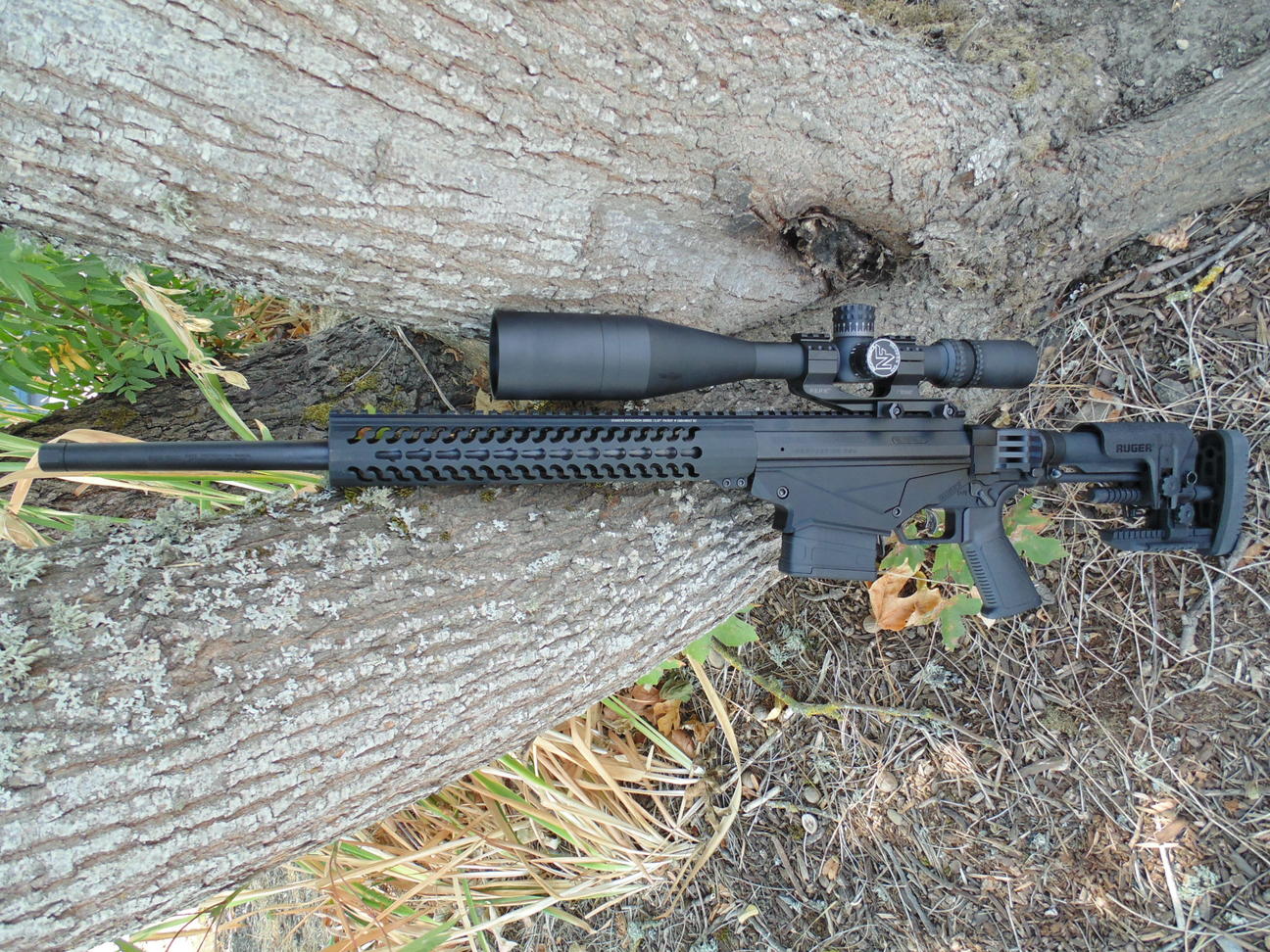
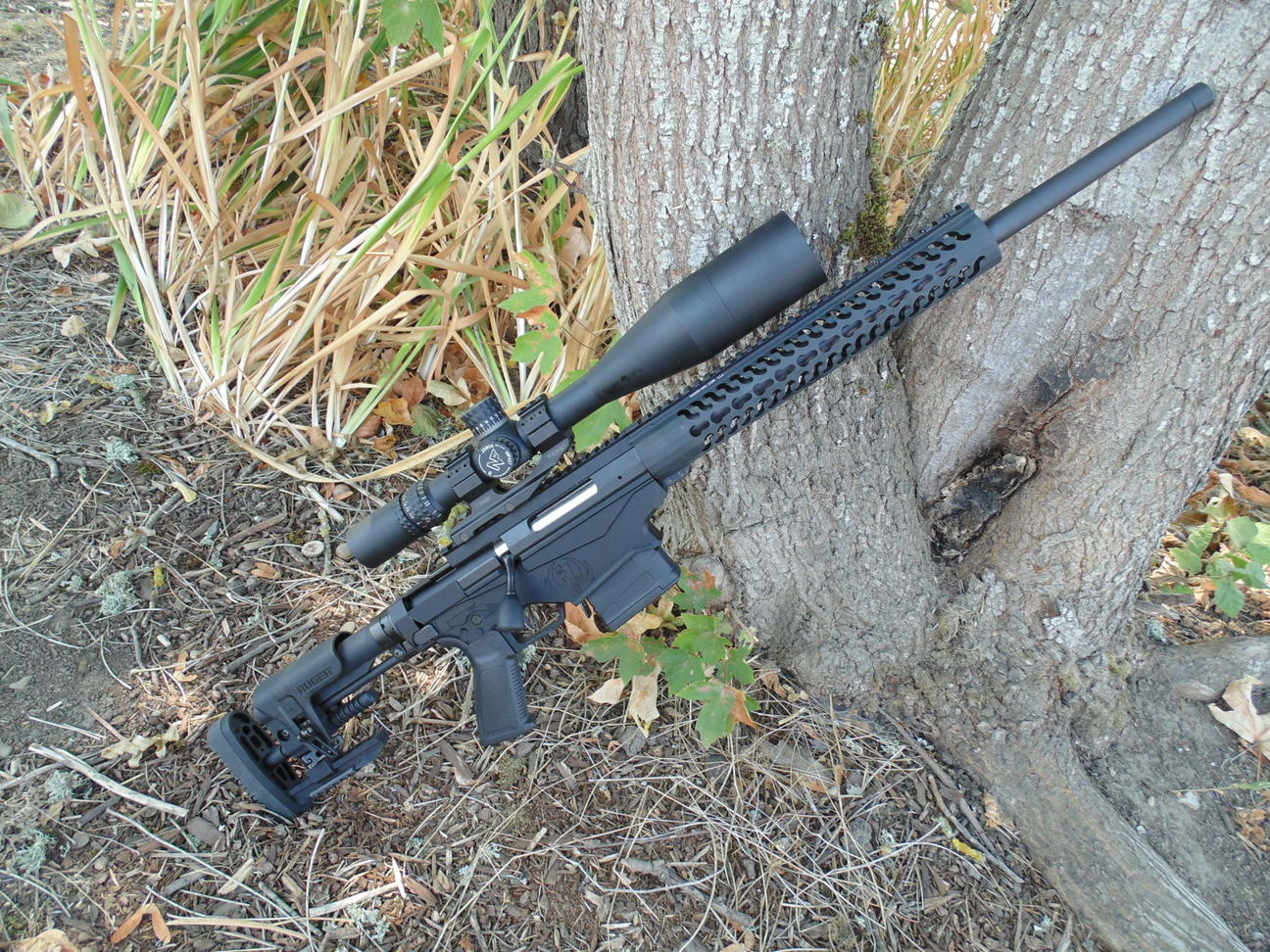
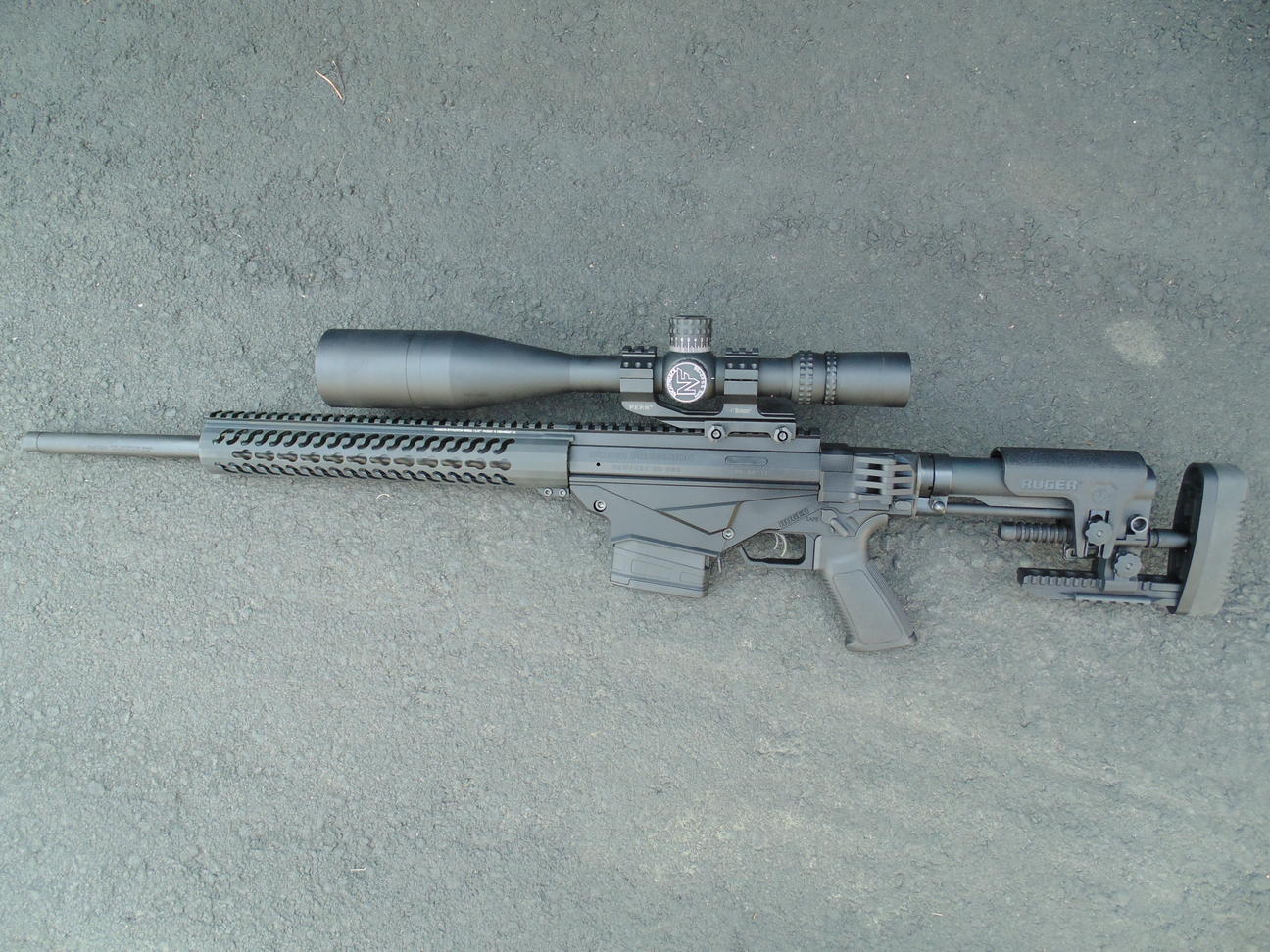
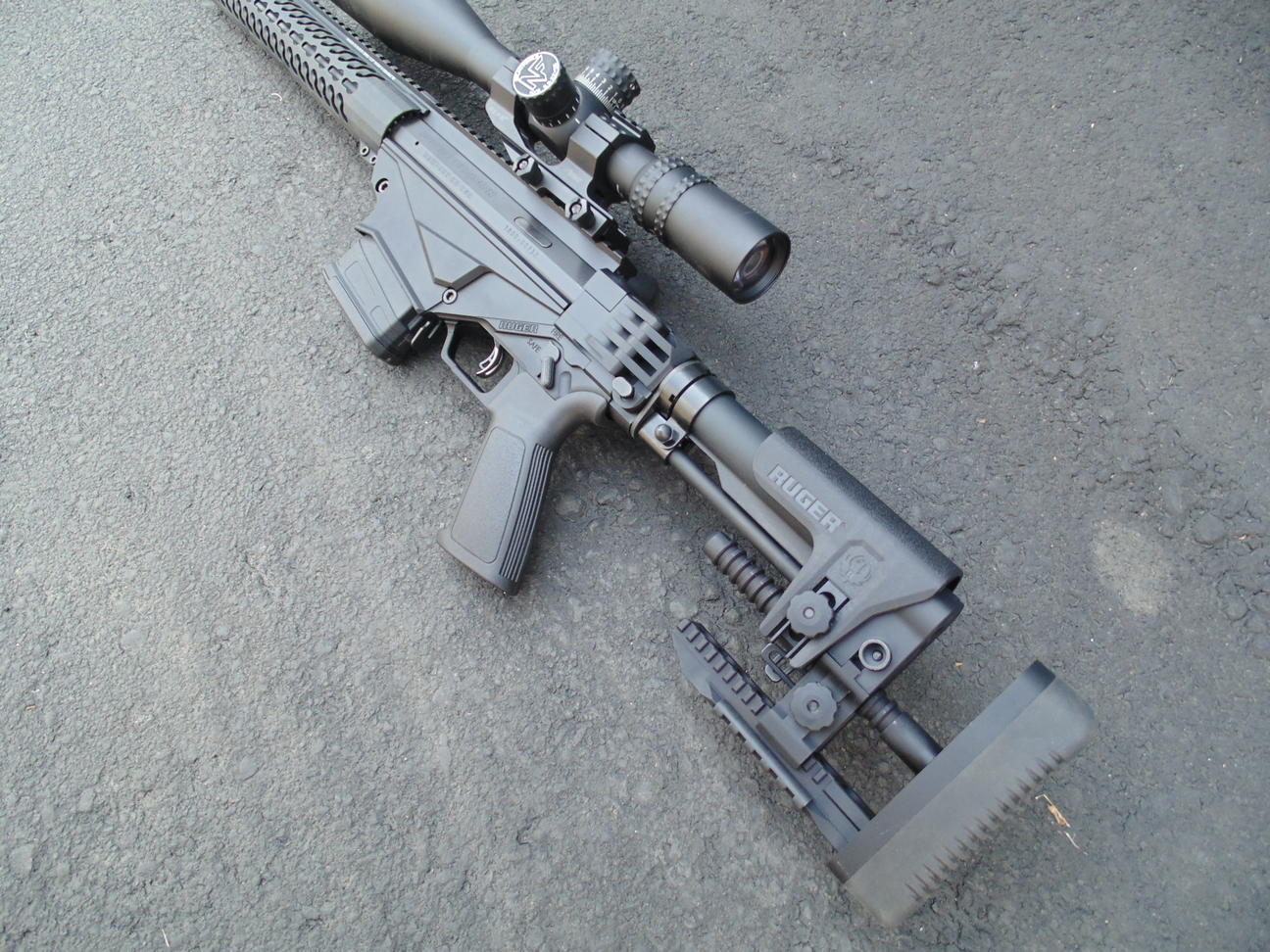
The Ruger Sturm, Ruger & Co., Inc. Precision Rifle was recently released, and I’m here to tell you, it is one of the hottest sellers on the market these days. Ruger is doing all they can to keep up with demand.the Ruger Precision Rifle is available in three calibers, .243 Winchester, 6.5Creedmoor and .308 Winchester, and I understand that, the 6.5 Creedmoor is currently the hottest seller. I readily admit that, I have never fired any rifle chamber in 6.5 Creedmoor, but I understand it is an outstanding round that many long-range shooters use in competition.

I requested a sample from Ruger, and it shipped right away. The gun has so many features, I don’t even know where to begin, and I won’t cover them all,you can read more on the Ruger web site. I’ll start with what I usually save for last, and that is the retail price. Full retail is $1,399.00 any model. Now, don’t get too upset over this, until you read more about this rifle. First of all, this rifle was not designed to be a “hunting” rifle, although it can sure be used as one–with a 5-round magazine–since many states restrict you to5 rounds in the magazine. And, here’s where the Precision Rifle shines, it comes with two MagPul 10-round mags, however, because of the clever design,this rifle will also function with SR-25, DPMS and some modified M-14 magazines- which means you can probably find a 5-round mag for hunting if you wish to use this rifle for big game hunting.

DSC00140

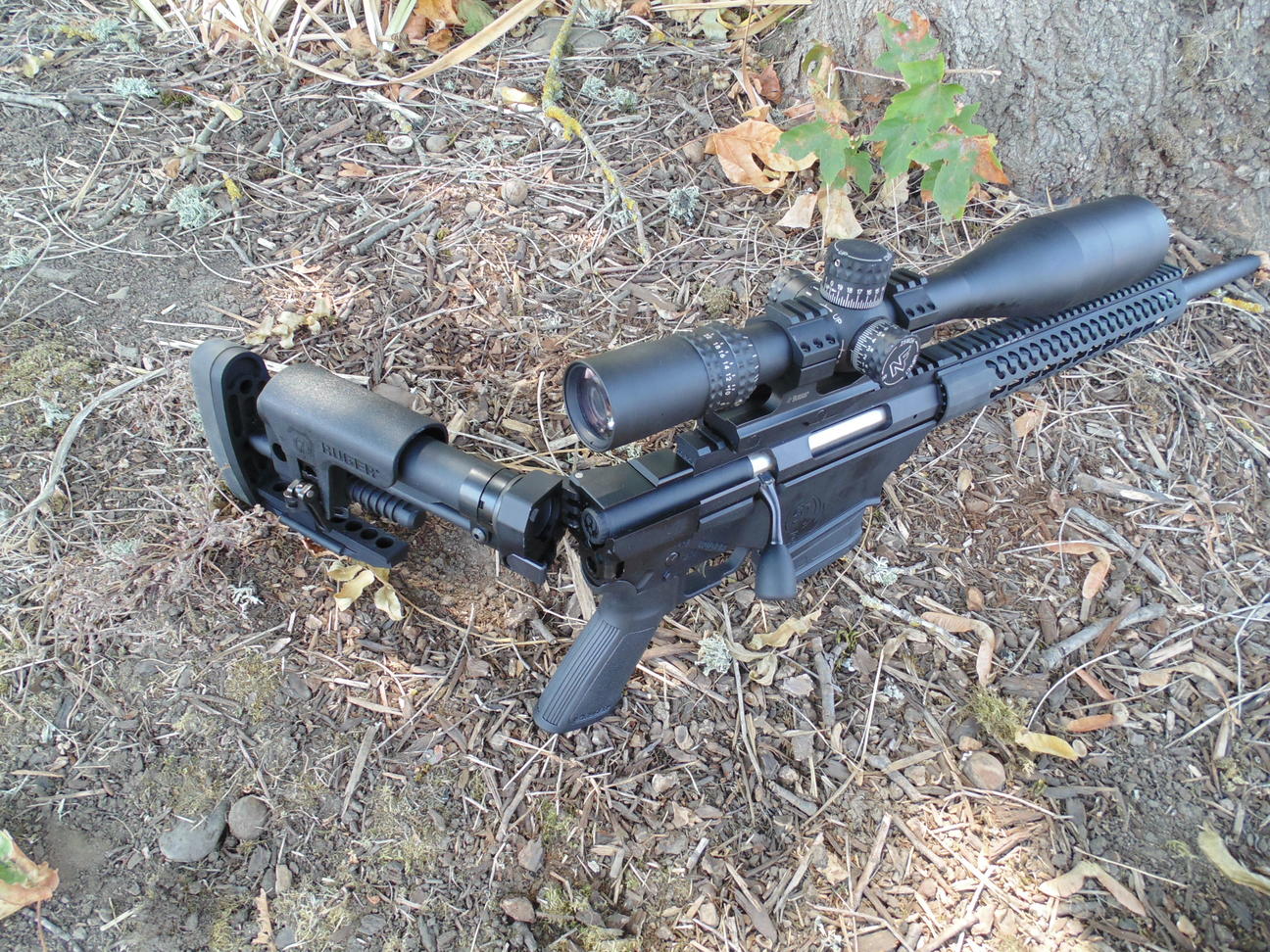
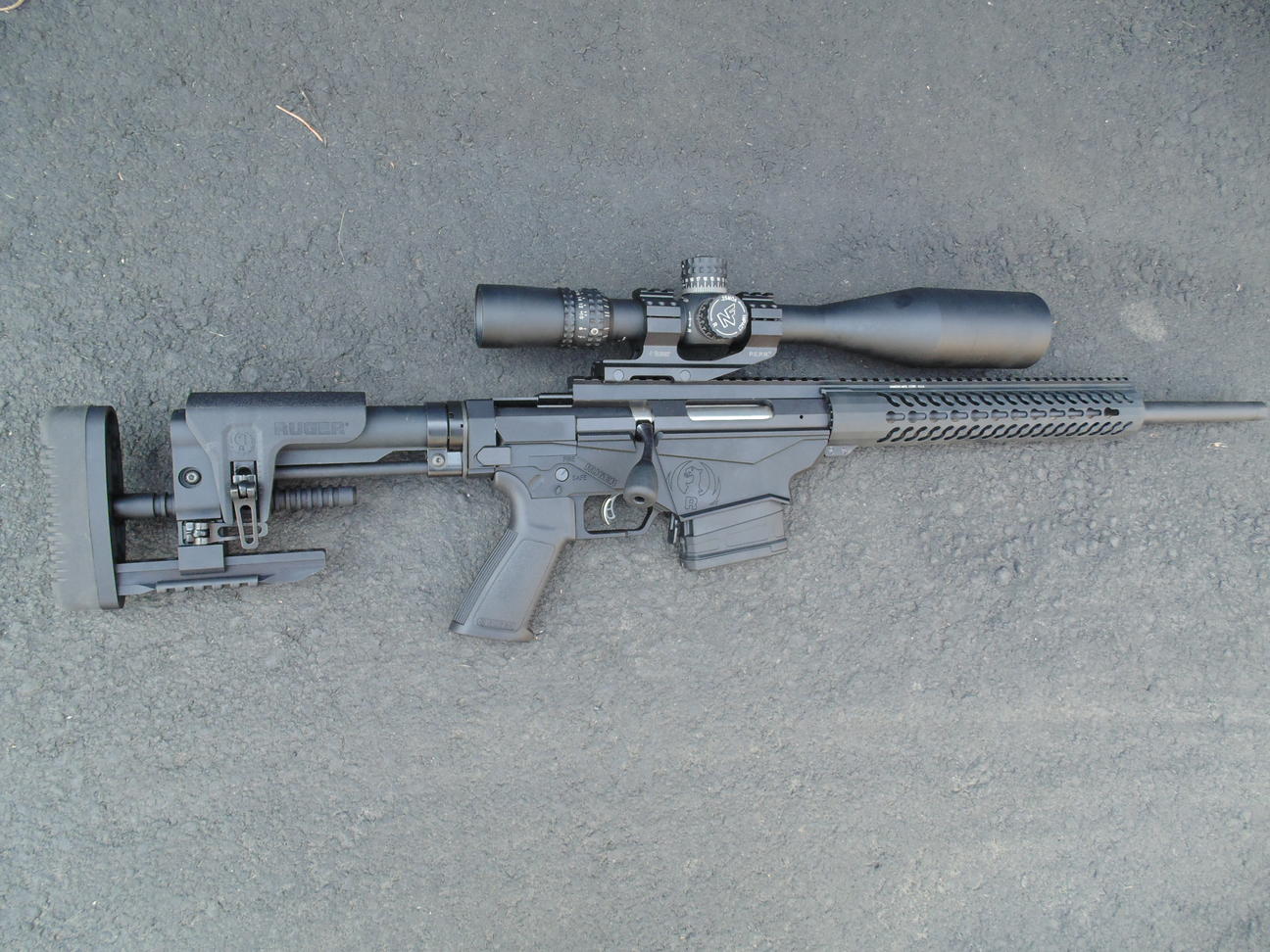
The Ruger Precision Rifle, is, without a doubt designed for long-range target/competition shooting. And as such, it is priced far less than anything else in it’s class. If you’ll take a close look at several of the pictures attached with this article, the complicated-looking stock, just smacks of one designed for long-range shooting, and it would be one heck of a sniper’s rifle for our military, or or any military. I thought that the stock was complicated,however, once you get it adjusted for length of pull and height – you don’t have to adjust it again. Oh sure, perhaps tweak the adjustments, as needed,based on your clothing – but it really isn’t all that complicated as I first thought it was. Additionally, the stock folds to the left side of the receiver.

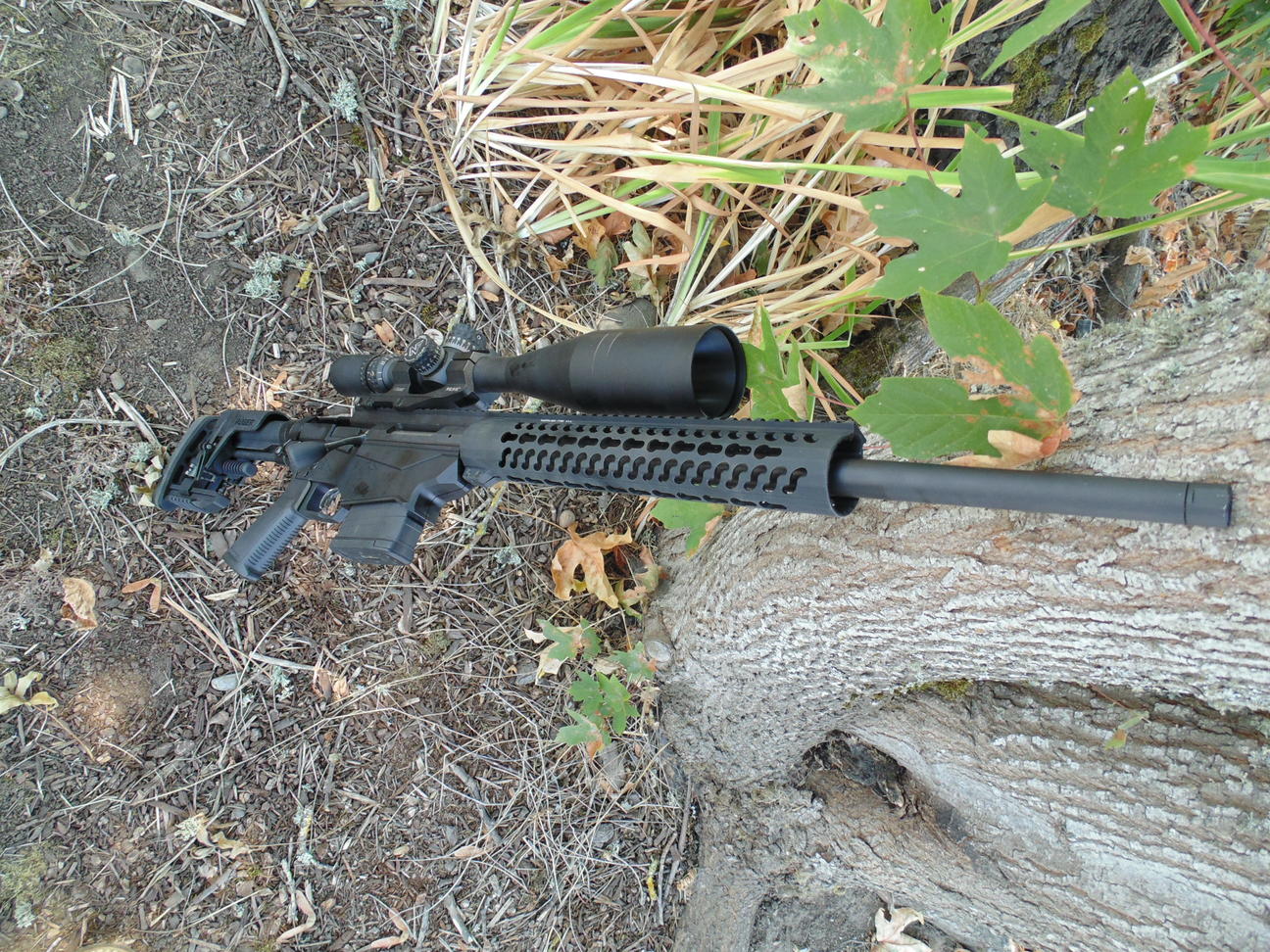
We have a medium contour barrel that is .75″ at the threaded muzzle. The muzzle actually has a cap protector on it, and if you elect, you can add a flash suppressor or even a registered sound suppressor attached to the 5/8″-24threads. The barrel is also easily replaced by a trained gunsmith, with an AR wrench and proper head space gauges. The barrel is also cold hammer forged 4140chrome moly steel. The handguard is the popular KeyMod, that is rapidly becoming the standard on ARs these days – easy to attach accessories to it. The rifle’s bolt has three locking lugs, and a 70-degree throw – pretty short for fast follow-up shots. The bolt operates very smoothly, too. I should also mention that, the barrel is free-floated, giving you every ounce of accuracy you can wring out the gun.

DSC00142

At first glance, the Ruger Precision Rifle, looks all the world like a big-bore AR-15 style of rifle, until you notice the bolt on the right side.There is also a pistol grip, and the safety control is in the same spot, where you’d find it on an AR-15 style rifle – so if you are familiar with the AR-15,the Ruger Precision Rifle will be familiar to you. I also liked the over-sized bolt handle, easy to find and operate, even with gloves on. Nice touch, Ruger!

The upper receiver has Picatinny Rails, for easy mounting of a scope and anyWeaver rings easily attach. In-hand, the rifle just feels, for all the world,like a slightly large AR-15, and that’s a good thing, if you’re already an AR owner/shooter. Ruger also added their Marksman Adjustable Trigger, and it can be set from 2.25-lbs to 5.0-lbs. My sample was right at 3.25-lbs and I left it there. The Hex wrench for adjusting trigger pull is stored in the bolt shroud,as is a bolt disassembly tool.DSC00145

The .308 Win sample has a 20-inch barrel and weighs in at 9.70-lbs without a scope, Overall length varies, depending on where you adjust your butt stock,but it can be from 38.25-inches to 41.75-inches. With the stock folded to the side, it is 30.60 inches in length. Length of pull can be adjust from12.00-inches to 15.50-inches, so it should fit most shooters of all sizes.

There are other features, that I don’t want to bore our readers with, so please check out the Ruger web site for complete information and instructions.

I was anxious to get this Ruger Precision Rifle, out to the range, and see what it could do. I mounted a (borrowed) Night Force 5.5-20X56mm scope on it,and it was more than I needed. Unfortunately, we had several heat waves in my part of Oregon this past summer, and most of the spots I used for long-range shooting were closed so I had to limit my shooting to only 100-yards – sad! I only had two types of ammunition on-hand for testing, both from Black Hills Ammunition – one was their168-gr Match Hollow Point, and their other their slightly heavier 175-gr MatchHollow Point.

DSC00146

I shot the rifle over the hood of my pick-up truck, using a rolled-up sleeping bag for a rest. Not the best way to get the most accuracy from any type of firearm, especially when testing a rifle designed for long-range hooting. I’m sure with a bipod and going prone, I could have gotten a bit more accuracy out of the Ruger. The gun, in .308 Win weights in at 9.70-lbs and the weight helped me stabilize the rifle a bit more. It did take me a while to get the buttstock adjusted to fit me just perfect, and perfectly it didfit…I made sure I had it adjusted to my liking, before I even fired the first shot.

With a target down range, at 100 yards, I easily had all shots under one inch – without trying all that hard. The Black Hills .308 Winchester Match Grade ammo, is outstanding, and I can’t recommend it highly enough. The rifle liked the 168-gr Win Match Hollow Point ammo just a touch better than the175-gr version. However, on a different day, I might have had different results. Due to the extreme fire danger in our area, I was only able to get out shooting one time – ONE TIME! And, as of this writing, in the middle of September, all the logging roads are still closed to any foot or vehicle traffic – no long range shooting!

DSC00147

The Ruger Precision Rifle and the Black Hills 168-gr Match Hollow Point ammo, gave me some groups that were almost one hole “groups” – one group was slightly under 3/4″ and all the rest, were easily under an inch, and I know that this rifle and ammo combination can do much better than that. I can easily see this gun and ammo shooting under half an inch with a bipod, and going prone.

If you’re looking to get into long-range high-powered rifle competition, you
don’t have to spend many thousands of dollars, to get an outstanding rifle.
With a full-retail price of $1,399 for the Ruger – and you can usually find
Ruger’s discounted from retail-price, you can afford to get a great rifle –
just add a really good scope and you’re good to go. The rifle would also be an
outstanding sniper’s rifle – and I would love to see the US military – all
branches – take a close look at this rifle. It’s a lot less expensive than any
other sniper rifle the military is currently using, and the accuracy is there,
with the right ammo. As I stated at the start of this article, I’m only
interested in accurate rifles and handguns, and the Ruger Precision Rifle
didn’t let me down in this respect.

DSC00148

Right now, the Ruger is in short supply, however, I understand that Ruger is adding more machinery, so they can turn out more rifles to meet the great demand. Ruger not only hit a home run, they hit it out of the ballpark on this Precision Rifle, and the price is totally unbelievable for so much gun, with so many features, and with more accuracy than you can probably squeeze out of the gun. But it will be fun trying to your hand at it. Now, as is the usual “problem” I have: this rifle isn’t going back to Ruger, and I have to find a way to raise the funds to purchase it. Life is tough!

– Senior Product Review Editor, Pat Cascio


Letter: Getting Practical and Tactical With Baofeng Hand-Helds, by Wrangler

Dear SurvivalBlog Readers:

Imagine for a moment that you are a licensed ham, operating in a tactical situation, observing your target. It is pitch black outside, and suddenly a team member calls you on the radio. Your radio goes “beep” and the screen lights up so brightly that you can be seen for half a mile. That is not a good situation!

One very popular hand-held radio available in the U.S. is the Chinese-made Baofeng UV-5R handheld dual-band transceiver. They cover two bands: 136-174MHz and 400-519.995 MHz. These hand-helds are mass-produced, so they are often bargain
priced at less than $35. There is also an iSaddle upgrade version of the UV-5R with a larger battery pack (3,800 MaH), available for under $40.

These radios are basic, and have their drawbacks. The default programming settings do not have tactical use in mind. But there are adjustments you can make to your programming to correct the aforementioned issues along with several other recommendations to make your radio a more “Tactical” hand-held VHF transceiver.

1. Reduce the transmit power level. There is no reason to be transmitting your signals any farther than you need to.

– You can lower the transmit power level by pressing the “#” key until you see a “L” in the display. Absence of the “L” indicates High power. (Note: 8 watt units have L, M, H, settings)

2. Replace that 16 inch aftermarket flex antenna with either the stock antenna or better yet, purchase a soft “stubby” antenna. True, that longer antenna will get you better
performance, but, catching your antenna on something and breaking it off just rendered your radio totally useless. The shorter one will work just fine in a tactical situation.

3. Turn off the “BEEP” tone.

– Press “MENU”, “8”, “MENU”, then press the “UP Arrow” until the display says ”OFF”, Press “MENU”, then “EXIT”.

4. Turn off “VOICE”.

– Press “MENU”, “14”, “MENU”, then press the “UP Arrow”until the display says ”OFF”, Press “MENU”, then “EXIT”.

5. Turn off the display backlight.

– Press “MENU”, “29”, “MENU”, then press the “UP Arrow”until the display says ”OFF”, Press “MENU”, then “EXIT”.

– Press “MENU”, “30”, “MENU”, then press the “UP Arrow”until the display says ”OFF”, Press “MENU”, then “EXIT”.

– Press “MENU”, “31”, “MENU”, then press the “UP Arrow”until the display says ”OFF”, Press “MENU”, then “EXIT”.

6. Purchase a sturdy aftermarket speaker/microphone. (The ones supplied with radio Baofeng are inferior and will fail after very little use.)

7. Don’t rely on the factory-supplied belt clip to keep your radio on your person. (In rigorous field use, that will surely mean either a broken clip or a lost radio.) Instead, use a sturdy aftermarket case.

For more information: I am a big fan of the MIKLOR.COM web site for information on Baofeng radios. There, you can find almost everything you ever wanted to know about these radios, from programming to troubleshooting.

Closing Note: The aforementioned programming changes can also be made by “offboard” by using either the Baofeng programming software or the CHIRP programming software.


Recipe of the Week: Minestrone Soup, by C.S.

This is my favorite Minestrone soup.

Ingredients:

¼ cup cooking oil (I use peanut oil or olive oil)

1 clove garlic, minced or (1/8 tsp. powder)

1-1/3 cup onion coarsely chopped

1-½ cup celery with leaves, coarsely chopped

½ can (6 oz.) tomato paste

1 Tbs. parsley

1 cup carrots, sliced fresh or frozen

4-¾ cup cabbage, shredded

4 cans diced tomatoes (28oz. cans)

1 can red kidney beans, drained, rinsed (black beans also work well)

1 ½ cup frozen peas

1 ½ cup green beans

1 tsp. sugar

Dash of hot sauce (optional)

11 cups of water

2 cups spaghetti, uncooked, broken (I like to use Angel Hair Spaghetti,
because it cooks faster)

Directions:

  1. Heat oil in 4-quart saucepan. Add garlic, onion and celery and sauté for
    about 5 minutes.
  2. Add all of the remaining ingredients except for the spaghetti. Stir
    well.
  3. Bring to a boil, reduce the heat and simmer for about 45 minutes or until
    vegetables are tender.
  4. Add uncooked broken spaghetti and simmer until spaghetti is tender.

I love to garnish this soup with grated parmesan cheese.

o o o

Useful Recipe and Cooking Links:

Homemade Turkey Soup Recipe

Jamie Oliver: Slow-Cooked Venison & Juniper Stew

o o o

Do you have a favorite recipe that would be of interest to SurvivalBlog
readers? (Our list of recipes in the blog queue is running
short!)
Please send it via e-mail. Thanks!