
“Do not wait for a national audience. Speak on any scale open to you, large or small—to your friends, your associates, your professional organizations, or any legitimate public forum. You can never tell when your words will reach the right mind at the right time. You will see no immediate results—but it is of such activities that public opinion is made.” – Ayn Rand
- Ad STRATEGIC RELOCATION REALTYFOR SALE: Self-sustaining Rural Property situated meticulously in serene locales distant from densely populated sanctuary cities. Remember…HISTORY Favors the PREPARED!
- Ad Elk Creek Company - Federally-Exempt No-Paperwork GunsPre-1899 Antique Cartridge Guns -- No FFL Required. Can be mailed to your doorstep with no Federal paperwork!
Notes for Monday – June 27, 2016
June 27th is the birthday of economist Dr. Ravi Batra. (Born 1943.)
This is also the birthday of movie director J.J. Abrams (of Star Trek fame.)
On this day in 1957, Hurricane Audrey made landfall, killing more than 400 people.
o o o
Safecastle’s big Mountain House long term storage foods sale ends on June 30th, so get your order in soon!
o o o
Today, we present another product review by Pat Cascio, our Senior Field Gear Editor:
- Ad Elk Creek Company - Percussion Blackpowder Guns - No FFL Required.Elk Creek Company - Percussion Blackpowder Guns - Pre-1899 Guns - Knives - Bayonets - Magazines - The last bastion of privacy!
- Ad Survival RealtyFind your secure and sustainable home. The leading marketplace for rural, remote, and off-grid properties worldwide. Affordable ads. No commissions are charged!
Pat Cascio’s Product Review: Springfield Armory XDs 9mm
We covered the Springfield Armory XDs 45 pistol when it first came out, and I believe SurvivalBlog was the first in the media to cover this outstanding little pistol. We have many contacts in the firearms and cutlery fields and quite often get a first look at new products. The little XDs 45ACP was, and is, an outstanding concealed carry handgun. However, there were some teething problems with the first batch, and Springfield Armory was quick to take care of this minor problem. Several of our readers who lived neaby were also having a different sort of problem with their guns, and so I had them come for a visit. It was a simple “fix”. It wasn’t the gun; it was a limp-wristing problem, which is common with polymer-framed pistols. You have to hold them tight!
However, aside from the minor problem that resulted in the recall of the .45ACP version, I discovered another problem of sorts– the XDs .45ACP wouldn’t always eject a loaded FMJ round. It was an easy fix, which I passed along to Springfield. The top of the barrel’s chamber wasn’t contoured, and the FMJ rounds were hitting it and falling back in the gun. There was no such problem with JHP loaded ammo. One thing you can count on, at Springfield Armory, is that if there is a problem with any of their guns they jump right on it and correct it without hiding the problem or denying it, like some other gun makers do.
Springfield Armory saw the demand and had numerous requests for the XDs in 9mm, and they are producing guns in the guns in this caliber. To my way of thinking, maybe they should have come out with the XDs in 9mm first. Everyone was jumping on the itty-bitty .380 ACP guns for concealed carry. The market is still awash with them. However, savvy gun carriers wanted more power in a sub-compact gun, and the entire gun industry is now making very small, easily concealable handguns in 9mm.

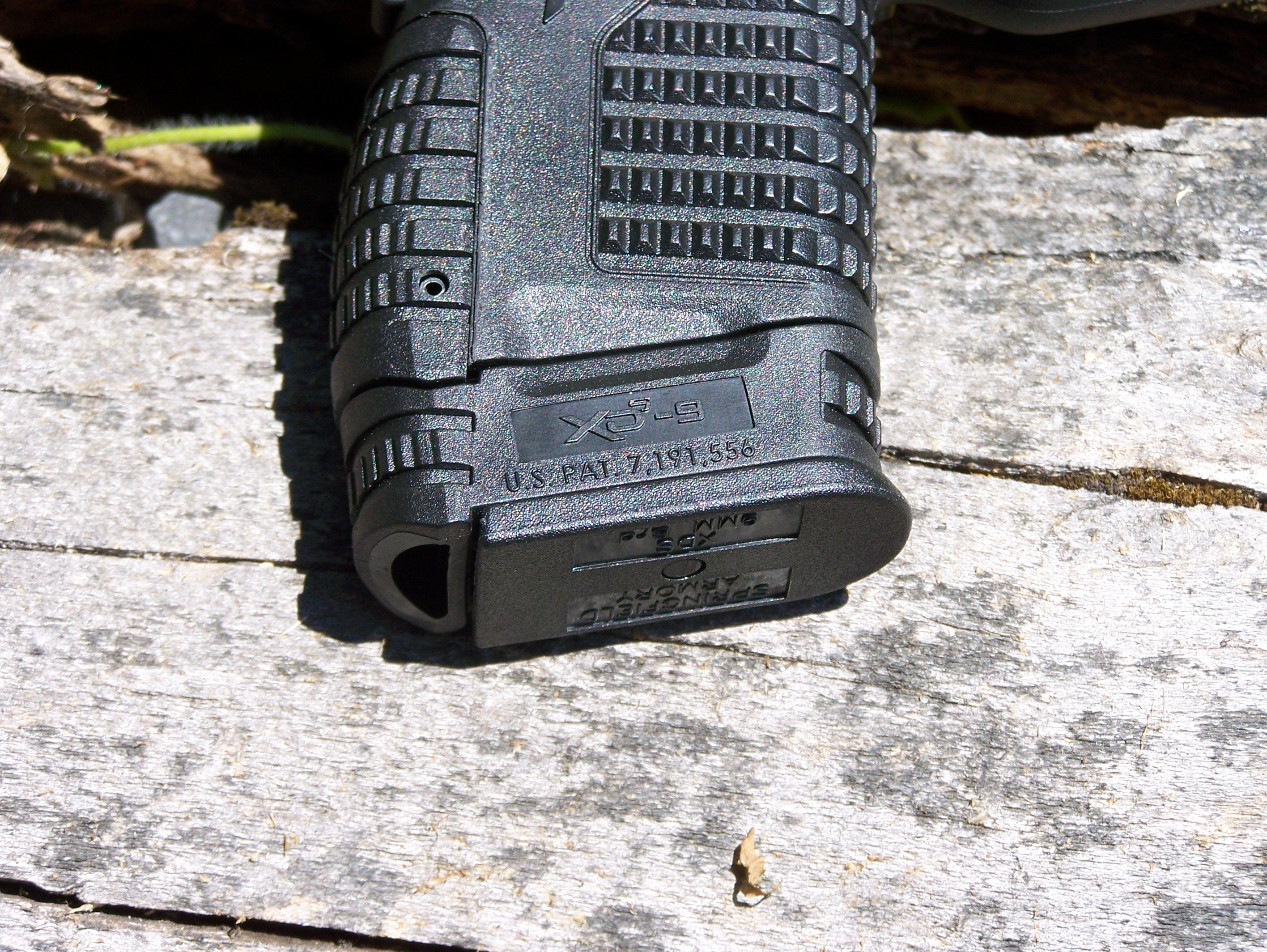
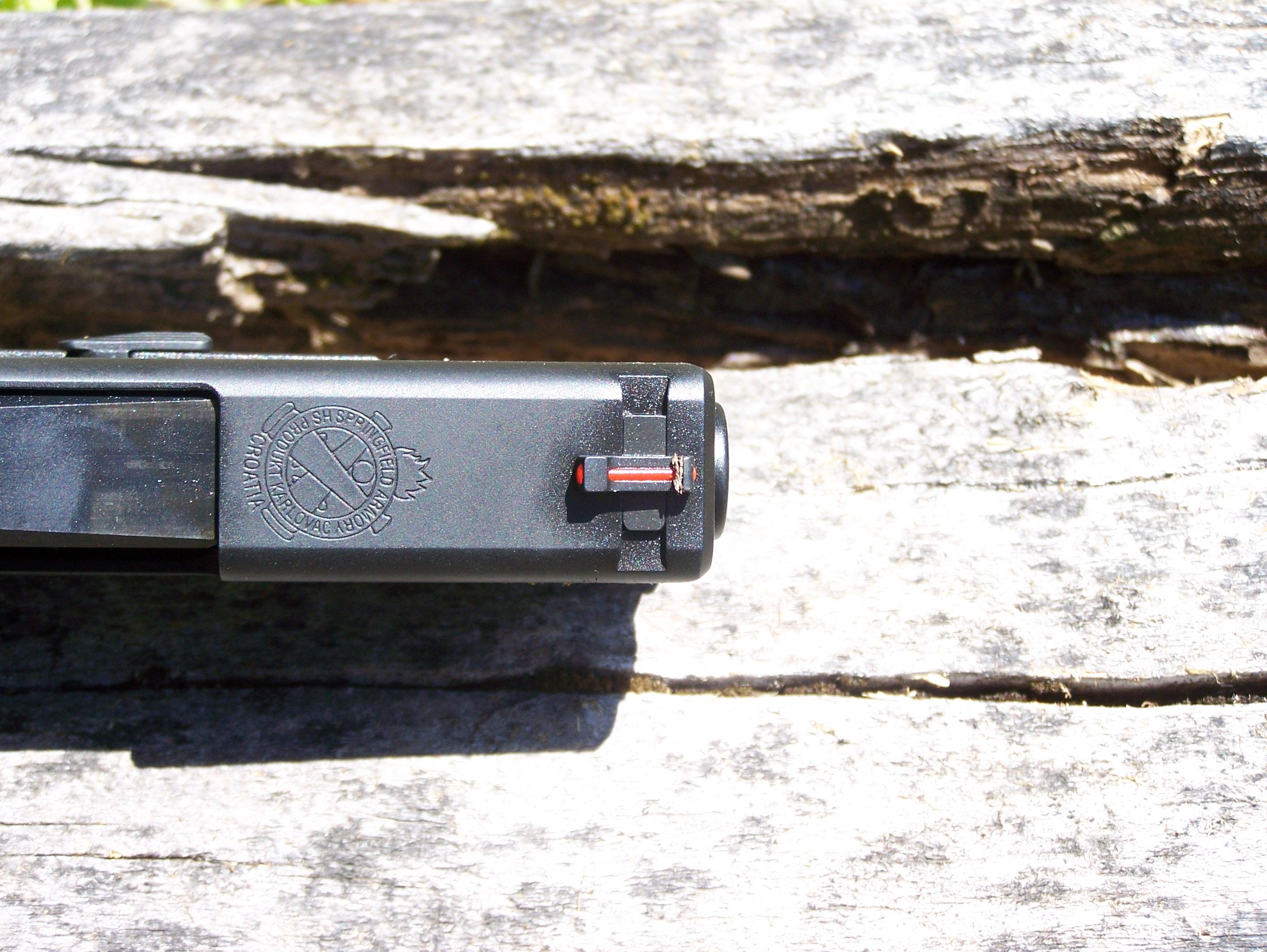
A quick look at the XDs in 9mm is in order, and it isn’t much different than the .45ACP version. We have a dual recoil spring system with a full-length guide rod. There’s a red fiber optic front sight that is very fast to pick-up and a steel rear sight with two white dots. The gun has a polymer frame and can be had with an all-steel (blackened) slide or one in stainless steel. Weighing in at a mere 23 ounces, the gun is a light weight. Each gun comes with two magazines– one that holds seven rounds and an extended 8-round mag with the Mid-Mag X-Tension. There is also a grip safety on the XD line-up, a la the 1911; you can’t fire the gun or chamber a round if you don’t have a firm grip on the gun! Then we have all the other goodies– a holster, dual mag pouch, cleaning rod, and a very sturdy carrying case. You can check out full specs on the Springfield website.

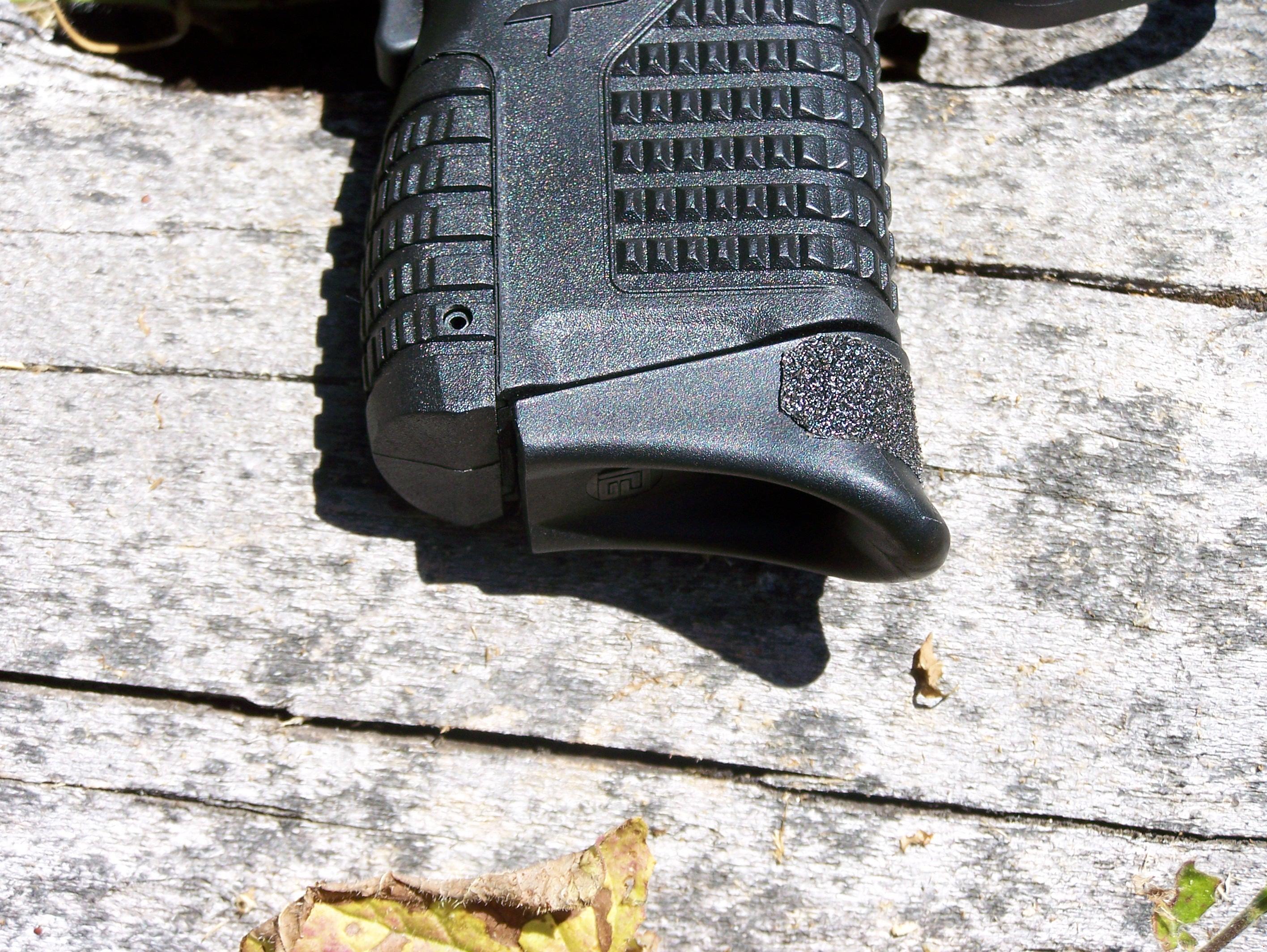
I mentioned to the powers-that-be at Springfield Armory that they should include the pinky catcher mag floor plate that is made by Pearce Grip with each gun. This allows the user to choose which floor plate they want to install on their guns. The flat one that comes with the gun just doesn’t do it for me. It leaves my pinky finger dangling. However, with the Pearce Grip extended mag floor plate, the pinky finger has a place to go and it gives the gun an entirely different and more secure purchase when holding and firing it. EVERYONE who shot my XDs 9mm (and 45 ACP) samples picked the pinky catcher extension over the factory-supply mag floor plate. For ten bucks, it is well worth it to install the Pearce Grip extended floor plate on the gun, in my humble opinion. As you’ll see in the pics accompanying this article, I have two XDs samples– one with the all-steel slide, and one with the stainless steel slide. After my wife shot my sample, she “confiscated” it. This happens more often than you might believe. So, I had to order another XDs sample for myself and went with the stainless steel slide. She wanted it, but that was a no-go. She already made her choice when she confiscated the one with the all-steel black slide!
It should also be noted that the XDs is now available in .40 S&W, too. However, I just find the .40 S&W round in sub-compact pistols a bit too violent for my tastes. I keep my XDs 9mm loaded with +P+ 9mm ammo, and it will surely get the job done if I had to use it for self defense. I’m content with the 9mm version and the .45 ACP version.
As I have stated numerous times, as a gun writer, I don’t recommend the .380 ACP as a first line of defense. However, I do realize that there are times when something in .380 ACP might be all one can carry. I carry a little .380 ACP every single day in an ankle holster. However, it is my backup to whatever my main gun is. Yes, I know that the .380 ACP can get the job done but not as fast as a larger caliber can when it comes to stopping an attack. So, the XDs 9mm is one great choice if you want a subcompact gun for everyday carry. Springfield has wisely stayed out of the itty-bitty .380 ACP handgun market . It is already covered!
I had an outstanding selection of 9mm ammo to run through the XDs 9mm for this article. The nice folks at Black Hills Ammunition and Buffalo Bore Ammunition keep me supplied in their outstanding ammo for my articles. Even during the long 2+ year ammo drought, they did their best to meet me requests, and they are great companies to do business with, too.
From Black Hills, I had the following 9mm ammo: 115 Gr JHP +P, 124-gr JHP +P, 115-gr FMJ, 115-gr EXP HP, 124-gr JHP and 115-gr Barnes all-copper hollow point TAC XP +P load. From Buffalo Bore: I had their 147-gr Hard Cast Outdoorsman +P load, 115-gr Barnes all-copper hollow point TAC XP +P+ and the same load in a lighter 95-gr load, 124-gr FMJ-FN Penetrator +P+ and their 124-gr JHP +P+ load.
Now, as I’ve mentioned before, no gun maker recommends that you fire +P+ rounds through their handguns; it will void the warranty, and it also increase wear and tear on the guns, so be advised. To be sure, there is nothing wrong in the least with non +P loads in 9mm. They get the job done each and every day. However, when I’m carrying a 9mm handgun for self defense, I prefer +P or +P+ JHP loads. There are many handguns, especially sub-compact 9mms, that won’t function with +P or +P+ loads, so you MUST test your gun to make sure these hotter loads will function properly!

I had zero malfunctions with any of the above loads, standard pressure, FMJ, JHP, Barnes, +P and +P+. Quite honestly, I didn’t know if the little XDs was going to work with the hotter +P+ loads. However, with the dual-recoil spring set-up, the gun is strong and handled all those loads with aplomb. I’ve had full-sized, duty 9mm handguns that refused to function with hot +P+ loads, so this is a testament to the design of the XDs and to the man behind it– Dave Williams, who operates the Custom Shop at Springfield Armory. I know that Dave is always going to Croatia, where the XD line-up of handguns is made, making minor changes/improvements, so he has his hand on the pulse of the XD line-up all of the time. It was Williams who said I could fire all the +P .45ACP through my XDs sample that I cared to fire through it when I got it. A couple boxes were more than enough per shooting session, to be sure. How many other gun makers will tell you to shoot all the +P ammo you want through their guns?

My shooting for accuracy was done over the hood of my pickup truck, and the target was only 15 yards away. That is more than fair for the little 3.3-inch barrel gun to handle. Remember, this is a sub-compact gun. However, I did some shooting out to 25 yards, too. At 15-yards, I could easily keep most of my groups under two inches, which is outstanding. Out to 25 yards, I did not test all the ammo at that distance, but I was getting sub 4-inch groups if I did my part. Was there a winner in the accuracy department? You betcha! The Black Hills 124-gr JHP took home the honors. However, all the rest of the ammo tested was hot on the heels of this load.
I was more than a little impressed with the Buffalo Bore 95-gr Barnes all-copper hollow point, TAC-XP +P+ load. The recoil was very manageable for a +P+ load, and it will sure get the job done for you. You might really want to think hard about this light-recoiling load in this sub-compact 9mm for self defense. Plus, Buffalo Bore loads most of their self-defense ammo with a flash retardant powder, so if you are forced to shoot in low-light conditions, you won’t be blinded by the flash when you touch off a round! Nice!
The XDs in .45 ACP carries 5+1 rounds, while the same gun in 9mm carries 7+1 or 8+1. That’s enough difference in capacity to give the 9mm version a close look if you ask me, and many people can’t handle the recoil of the much bigger .45 ACP round but have no problems with a small gun in 9mm.

My wife is very particular about how a gun feels in her hand. If it doesn’t feel “just right”, she’s not interested in it, no matter how well she can shoot it. I’ve seen it happen time and time again. She will shoot a particular gun extremely well, but she doesn’t like the way it feels in her hand. I think many of us are like this, even if we don’t know it. Everyone who shot my XDs 9mm samples loved the way they felt in their hand, with the Pearce extended floor plate pinky catcher on it, as opposed to the flat floor plate that comes on the 7-rd mag. I also found that my accuracy was a bit better with the pinky catcher on the mag!
Prices for the XDs line-up, at least in my neck of the woods, is well under $500, and that’s quite a bargain for so much when it comes to such a sub-compact handgun that gives outstanding accuracy and is ready to go out of the box, with a holster, spare mag, and mag pouch. But buy a couple more spare mags, too.
– Senior Product Review Editor, Pat Cascio
- Ad USA Berkey Water Filters - Start Drinking Purified Water Today!#1 Trusted Gravity Water Purification System! Start Drinking Purified Water now with a Berkey water filtration system. Find systems, replacement filters, parts and more here.
- Ad Prepare for chaos with the essential SIEGE belt. Perfected for CCW with flexible, no-stretch, high-grip custom HD ballistic nylon and capabilities unmatched in any other belt. Go anywhere. Solid 5.5-7 oz of persuasion has saved many. Save $20!SIEGE STOVES: in a fuel crisis twigs are free and abundant. Ultra-compact high-performance portable survival stoves. Enter "SBLOG" at checkout for $20 off any belt. USA-made.
Recipe of the Week: K.M.’s Hot Milk Sponge Cake
Reader K.M. sent a quick and simple recipe recommendation that is great for families with both laying hens and a home dairy cow. She notes: “We are folks who often ask ourselves: ‘What are we going to do with all these eggs and this extra warm milk?’ Here is one answer.”
Hot Milk Sponge Cake
Ingredients:
1 Cup All-purpose flour
1 Teaspoon baking powder
2 Eggs
1 Cup of sugar
1/2 Cup milk
2 Tablespoons of butter (or margarine)
Directions:
Combine flour and baking powder. Then, in a bowl mix the two eggs with a hand or electric mixer set to high speed for about 4 minutes or until it is thick. Gradually add sugar; beat at medium speed for 4 to 5 minutes or until it is light and fluffy. Add flour mixture; beat at low speed just until combined. In a saucepan, heat and stir the milk and butter until the butter melts; add to the batter–beating just until combined.
Pour batter into a greased 9x9x2-inch baking pan. Bake in a 350F oven for 20 to 25 minutes or until a test toothpick comes out clean. Serve warm or cool. Makes 9 servings. A powdered sugar frosting drizzle makes a great topping. (Serve with a big glass of milk, of course!)
o o o
Useful Recipe and Cooking Links:
Egg and Dairy Recipes at Food.com
Do you have a favorite recipe that would be of interest to SurvivalBlog readers? Please send it via e-mail.
Thanks!
- Ad USA Berkey Water Filters - Start Drinking Purified Water Today!#1 Trusted Gravity Water Purification System! Start Drinking Purified Water now with a Berkey water filtration system. Find systems, replacement filters, parts and more here.
- Ad California Legal Rifles & Pistols!WBT makes all popular rifles compliant for your restrictive state. Choose from a wide range of top brands made compliant for your state.
Letter: Pre-1965 90% Silver Coins are the Best Defense Against Counterfeits
Dear Editor:
Those buying silver and gold coins and bars need to be aware. I work in the industry at a well known coin shop in the mid-west. Time after time…week after week customers try to sell us fake items that they purchased from eBay, pawn shops, Craigslist, and elsewhere. It has become a bigger issue over the the last year and especially so in the last few months.
When purchasing coins and bullion from customers we use our scales to make sure items are of proper weight, we use our calipers to check diameters, and we have the benefit of having an “x ray” machine to scan metal composition. The fakes are becoming more common place. I could spend hours describing the types of fakes that have come into our shop just over the last month. I could spend hours explaining how we have worked with local authorities and even the the FBI on counterfeit stings on fake Morgan dollars and Seated Liberty dollars.
The Schumer has hit the fan on fakes. JWR has long recommended 90% silver (junk) coins and he is dead right. Those coins are now the only ones that I recommend to my new customers who are looking to buy!
Junk silver isn’t made anymore…the last year minted was 1964 and that pertains to U.S. dimes, quarters and most halves. These coins can not be properly counterfeited. The fakes I have seen are horrible, made out of lead, they don’t feel or look correct, and more importantly they don’t pass the “sound” test.
The “sound” test is simple…drop a silver coin on a glass surface or hard floor and it makes a nice “ting” sound, but the fakes go “clunk” or “thud”.
In recent months we have seen fake 1-oz gold bars, 1-oz gold coins, 1-oz silver, 10-oz silver bars, and so forth. Two small shops in our region have been fooled and are now out $20,000 and $5,000 on fakes that they bought without doing their due diligence.
90% silver [pre-1965] U.S. coins are the only safe way to go from here on out, folks. They are becoming harder to find and there is a reason for that. Stay safe and prepared, –
The Silver Bull
- Ad SurvivalRealty.com: Sell Your Remote LandAdvertise your hard-to-sell remote land to eager buters. We specialize in rural, remote, and off-grid properties worldwide. Affordable ads. No commissions are charged!
- Ad Click Here --> Civil Defense ManualNOW BACK IN STOCK How to protect, you, your family, friends and neighborhood in coming times of civil unrest… and much more!
Letter Re: Tracking Dogs
Dear Editor:
I have some experience with dogs that were specially-trained to track living humans, and with cadaver dogs. I agree with the previous Tracking Dog posts regarding restrictive points of terrain and/or infrastructure. In any escape route, there are always certain areas of heightened vulnerability, which an experienced team of searchers will not disregard.
The Texas Rangers at one time (reportedly) enjoyed an annual manhunt in the Texas Panhandle. They would seek volunteers from vetted and trusty inmates whose reward at the end of the day, would be the day’s freedom and a good meal. The inmate would be given a head start before Rangers, handlers, and dogs from a local state penitentiary would sally forth in pursuit. The Rangers and dog handlers were usually on horses and I don’t think they ever ‘lost’ a trustee. Before this practice fell in disrepute, the trustee manhunts provided great training with the captured inmate returned to the general population unable to remain at large, certainly sending a message to the inmate population.
I will always remember one real-world dog-assisted manhunt: A deputy sheriff had been murdered during a vehicle stop. Good police practice led to the department knowing whom the deputy was stopping. The assailant departed the crime scene in his personal vehicle. The sheriff of a nearby county almost ran me over on that awful day. I noticed his tight grip on the steering wheel and purposeful intent as he sped toward the county where I also owned a ranch. I called the sheriff of that county and reached a tearful dispatcher. When she could talk, I advised I was en route and asked if the sheriff had deployed airborne assets. “No” she responded, but she said that the dog team has been called from the state penitentiary. “Tell him I’ll get a helicopter in the air”, I advised.
I called a local owner/operator of a helicopter service and quickly arranged for him to meet me at the airport. Upon arrival, the pilot (who also hunted cattle predators from helicopter), was brandishing a shotgun. “What’s that for?”, I asked. “We might find him”, was the response. I urged him to put the shotgun back into his pickup truck. “But what if we find him?”, the pilot insisted, far too eagerly. By then I was removing 7.62×51 main battle rifle with telescopic sight from my vehicle. “We’ll not get close enough for him to shoot at us in the ride”, I responded.
Once airborne, we followed the search via hand-held police radio. The assailant’s vehicle was discovered abandoned in a dry riverbed and the dogs were searching the adjacent river area. Not wanting the down blast from the blades to interfere with any possible scent, I kept the helicopter well away and above the immediate search area. It was summer and very hot. Before long, I noticed one of the dogs leaving the pack and heading toward a small pond. Too hot I thought, the dogs are played out. A moment after that dog hit the water, it looked like an alligator with a gar. Such splashing and carrying on I had never before seen. The murderer had concealed himself in the water in a bed of reeds and rushes. He and that dog were enjoying a close encounter of the personal kind.
The pilot asked if we should land and pull the dog off. “Why?”, I asked, since I knew the handlers would arrive momentarily. I could see the Rangers on horses headed that way. “Let’s just watch. He’s not getting away,” I told the excited pilot. The rest of the dogs arrived not long thereafter and these dogs were trackers and biters. How he lived I’ll never know but the man eventually traded a confession to the murder of the deputy sheriff in exchange for his life. (Texas has capital punishment.)
The prison dog team prompted immediate capture of a dangerous individual, and in just hours rather than in days or weeks. I’m convinced that someone has to be extremely fortunate to escape dozens of well trained and motivated scent dogs, especially on foot. The murderer’s vehicle was abandoned because he correctly intuited that its description and license plate number had been forwarded to every lawman in the sparsely settled region. And, with few major highways leaving the area, those would be obvious checkpoints. Having a partner with a vehicle or successfully stealing a vehicle would have offered better chance at escape but less than a half-day had elapsed from the time of the murder to the capture. The assailant was hard pressed from the beginning and had increasingly dwindling options.
Regards, – Panhandle Rancher
- Ad Survival RealtyFind your secure and sustainable home. The leading marketplace for rural, remote, and off-grid properties worldwide. Affordable ads. No commissions are charged!
Economics and Investing:
Over at Zero Hedge: Will Brexit Give the U.S. Negative Interest Rates?
o o o
Over at The Daily Bell: Brexit Vote Is Great News for Britain, but Difficult Times Ahead
o o o
Gold Summer Doldrums Risk
o o o
UK’s departure makes EU disintegration ‘irreversible’: Soros
15 Euro Stocks That Lost Over 10% to 25% After Brexit Shock
o o o
SurvivalBlog and its editors are not paid investment counselors or advisers. Please see our Provisos page for details.
Odds ‘n Sods:
Mainstream magazine The Atlantic posits: Is Middle America Due for a Huge Earthquake? (Thanks to Peter S. for the link.)
o o o
Bad news from Hawaii: All registered gun owners are being added to the centralized “Rap Back” Federal crime database.
o o o
Truly pragmatic training: Tam (one of our favorite gun bloggers) describes learning practical pistol shooting with kids in tow.
o o o
Oregon standoff: Case of possible misconduct by FBI in LaVoy Finicum shooting now before grand jury
Jim’s Quote of the Day:
“In omnibus negotiis prius quam aggrediare, adhibenda est præparatio diligens.” (In all matters, before beginning, a diligent preparation should be made.) – Cicero, De Officiis (“On Duties”) (44 B.C.)
Notes for Sunday – June 26, 2016
June 26th is the birthday of Marine Corps Lt. General Chesty Puller (born 1898, died October 11, 1971). Perhaps America’s finest-ever maverick officer, Puller was part of what I call the Even Greater Generation. – JWR
Using Canning Jars For All Food Stores and More – Part 2, by Sarah Latimer
What We Store In Jars
- Dry, bulk goods. This category of items includes grains, dried pasta, dried potato flakes, dry beans, and rice for long-term storage. We buy these in 40- and 50-pound bags from the Mormon storehouse, Costco, and online vendors and then repackage them into the half gallon jars, which are then vacuum sealed, using our FoodSaver Jar Sealer connected to an electric vacuum pump system that Hugh installed into my kitchen. It takes less than a minute to put the lid on, vacuum seal a jar, and put the ring on. All I have to do at that point is label the jar and place it in storage. I can easily open the jar without damaging the flat lid by using the dull side of a butter knife laid flat along the jar’s screw-top thread and slide the knife along the threads upward toward the top of the jar until it lifts the lid and breaks the vacuum seal. Then, it’s just 30 to 45 seconds to once again put the contents back into a vacuum seal, using the same process, after I’ve retrieved whatever portion I need from the jar. I haven’t heard of an easier way to do this, especially repeatedly without heating the contents and potentially damaging the nutritional value and flavor of the contents. For the times when electricity might not be available, we have an easy hand-pumped vacuum option. However, it takes a bit more time and certainly more effort, so we are trying to get the bulk of our needs put away while the grid is available. The spring-loaded hand pump will work after TEOTWAWKI.
- Wet, canned goods. These are the things that are traditionally canned in a canner for short- and long-term storage. I appreciate my All American canner and wouldn’t be without it, as I use it often during the garden harvest for canning things like tomato sauce and tomato meat sauce, which are stored in quart jars, as those are just about the perfect size for a meal for our family. However, most of our vegetables, and even some of the tomato sauce is freeze dried rather than canned, because we prefer the firmer texture in our vegetables and want to have flexibility of extracting only a small amount of tomato sauce for some recipes without having to open and use (or refrigerate and soon use) a whole quart at a time. Additionally, while the wet canned foods will last for years, the freeze-dried items will last for decades. In the long haul, if the grid goes down and our solar system is not able to keep up to power the freeze dryer and the dehydrator, we’ll resort to wet canning everything. Until then, we will limit the wet canning, because it creates heavy jars and boxes, and once those jars are opened the contents more quickly go bad, even with refrigeration, when compared to freeze-dried goods.
- Freeze-dried meals, meats, refried beans, vegetables, eggs, fruit, herbs, and dairy. Other than the dry, bulk goods, this is where the majority of our jars are used. For these, we use quart jars, as they are the perfect size for meals and for most ingredients in both short-term and long-term storage. I often make double meals and freeze dry one. When the beef is processed, a significant amount of the meat is cooked and prepared and freeze dried in quart jars. This is true of other meat we process, too. Vegetables are freeze dried and stored individually or in combination in quart jars as are many herbs. I find that freeze-dried herbs retain more of their flavor than dehydrated ones, so whenever the freeze dryer is available, I opt to use it for my herbs rather than the dehydrator, and I grow the vast majority of my large and continually expanding herb and tea flavoring pantry. Fruit does beautifully in the freeze dryer, especially berries, and they look lovely in the jars. I enjoy popping some freeze-dried berries in my mouth for a burst of sweet flavor when I get the inkling for candy. They’re better tasting and better for you! Freeze-dried blueberries or mixed berries are so easy to use; just pull a couple of tablespoons out of the jars to add to pancake or muffin batter or to add to hot cereals. Yum! Again, there is no giant can to open and worry about resealing. It’s just a pretty little quart jar in my pantry that was pulled out of the larger storage larder. Dried milk, buttermilk, sour cream, freeze-dried cheeses, and more can be stored easily in the jars and used by the spoonful or handful, as freeze-dried shredded cheeses also make for a yummy snack right out of the jar. I can put more than two dozen freeze-dried raw eggs in a quart jar. It just takes about 1 1/2 tablespoons of the Ova Easy egg crystals and 1 1/2 tablespoons of water to equal an egg in recipes or for making an omelet. Furthermore, homemade breakfast burrito filler is a breeze in a quart glass jar. I just scramble a half dozen raw eggs and cook them, adding some crumbled cooked sausage, and sauteed onion and peppers. This goes into a freeze dryer tray with some shredded cheddar cheese on top. Then, a tray’s worth goes loosely into a quart jar, which is vacuum sealed. When traveling (or presumably when TSHTF), all I have to do is add a cup of boiling/hot water to the jar, put the lid back on, and roll it around a little for about three or four minutes. I can open it up and scoop out about one-third of the contents into a tortilla and roll it up for a nice, hot ready-to-go breakfast. The jar serves two or three, and there is only a jar to clean up afterward, too! On trips, the tortillas don’t even have to be refrigerated. I can take the jar in our vehicle with a thermos of hot water and not even have to stop to start a fire to heat water. We can truly have a hot breakfast while on the go. This is something that seems to me could be very handy, too, for those hunting or fishing trips, when you just don’t want to have to haul pots and pans (or share a lot of aroma for long), but you can fit a quart jar, package of tortillas, and a wide-mouth Thermos in your four wheeler or fishing boat. (Just be careful not to break that jar!) So many dried dairy products are stored in plastic, but plastic is not the best material for long-term storage. There are numerous reports of health concerns associated with plastic, so I feel much safer using glass for long-term food storage and, therefore, immediately transfer any purchased items that come in plastic to my glass jars.
- Cereal Blends and Mixes. We crack and grind grains to make our own hot cereals, but I like the germ, bran, and vitamins to stay active and viable, so we either produce only a small amount at a time and vacuum seal it in a quart jar or freeze it. I will also sometimes grind flours and make mixes, like biscuit mix or pancake mix and store these in jars.
- Jams, Jellies, Sauces, Extracts, and Syrups. Quart jars are excellent for making homemade vanilla extract with fresh Madagascar vanilla beans and vodka. They are also good for canning jellies, jams, and syrups, as well as pasta sauces or barbecue sauce using the wet canning method.
- Dried/dehydrated Meats, Herbs, Fruit, and Spices. We store our meat jerky in vacuum-sealed jars. These jars can be opened and a jerky stick removed anytime it is needed. Herbs, fruit, and spices that are dehydrated are stored in quart jars also.
- Teas and tea flavorings. Tea bags as well as tea flavorings are stored in quart size tea jars. By vacuum sealing the jars, we seal in the flavors and keep them lasting a long, long time!
- Sugars/sweeteners (including brown and powdered sugar, molasses, and honey). Brown sugar particularly benefits from being kept in a glass jar. It no longer dries out, as it is kept under a vacuum, which keeps its moisture inside the jar. Other sweeteners are stored in glass quart jars and protected against insects and theft, as is necessary. Powdered sugar is usually kept in half gallon jars though, because it is so light and is often required in large quantity for frostings. Powdered sugar does not get moisture in it, but it can get compacted when vacuum sealed. (It just requires a little stirring to break it loose when you first open the jar.) Vacuum sealing fine powder contents can be a bit tricky, but it is quite possible. The vacuum is opened slowly into the jar and then increased gradually to full capacity. It still barely takes a minute to seal a jar. Molasses and honey do not require vacuum sealing. I do seal the sugars and extracts made for long-term storage, to keep them from attracting (or hatching) bugs, though they naturally last a long time.
- Green coffee beans. Hugh buys green coffee beans in large quantities and then stores it in half-gallon jars. Green coffee can be stored for a very long time within a vacuum-sealed coffee jar and then brought out to be roasted the night before you want to use them. Then, you just grind and brew your coffee.
- Dog biscuits and treats. Quart size jars stashed in key locations around the house means I can reward good behavior close by and quickly.
- Lotions, ointments, salves. I make a variety of these, and glass is the best storage for them.
- Hair clips, clasps, and claws. It is handy to have all of these hair components in one place, and the quart size jar is a good collector. Furthermore, because of its height and clear glass, the jar can be used to help you find your jewelry or whatever you were hunting inside.
- Medicinal herb infusions for soap and lotion making. I make many of our lotions, salves, and soaps and have realized that glass is perfect for making tinctures and infusions as well as storing these healthful ingredients. Glass doesn’t absorb the flavors or aromas of its contents, so even though many of the infusions are very strong, the jars can be used again and again, just as if they were brand new.
Letter Re: Radical Islam
Dear James and Hugh,
I was just reading the article mentioned on June 18th in SurvivalBlog regarding BHO’s refusal to mention ‘radical Islam’. There are very few things that I agree with regarding the BHO’s thought process, but I tend to agree that our problem is not with ‘radical Islam’. As Scott Ott suggests, a better term would be ‘Literal Islam’. These people wreaking terror all over the world are taking their book of faith seriously or ‘literally’. Such a shame that more of us that claim to be followers of Christ don’t take His book as seriously. If we did from the foundation of this country by our Founding Fathers, we would have no problem with our government as people like the BHO could never be placed in that position.
‘We’ as a nation elected and then re-elected Barack Hussein Obama (BHO), even though he stated “we are not a Christian nation”, much to our shame. We are now reaping the reward for falling away from Christ. I am expecting that we as a nation will elect ‘The B*tch’ (I am being as polite as I can be) as our next president, at which point [the key elements of] JWR’s novels will come to fruition. It amazes me how blind most of us are. – MtH
JWR Replies: The most fundamental issue that needs to be addressed is that western societies have been in denial that Islam is both a religion and a monolithic political system that is surely bent on world domination. Unless or until we come to grips with the fact that Islam itself is the Arabic word for “submission”, and that the phrase “radical Islam” is redundant, then we are doomed. Islam is fundamentally antithetical to western ideals and there can be no placating the Islamists in finding “common ground.” The nascent Global Islamic Caliphate simply and devilishly wants the whole enchilada and will settle for nothing less. I recommend that SurvivalBlog readers take a half hour to listen to the recent podcast interview of Ann Barnhart. This fascinating interview is a real eye-opener.
Letter: My Take on the U.S. Economy and Politics, and Their Implications for Prepping
HJL:
I’m a both CPCU and CIC chartered senior insurance agent. I have observed that in a normal [business] year there is all sorts of business formation in the first three months. I know because they ask for insurance quotes for the pro-forma or just come in and buy insurance, to to kick off operations. That activity has declined over the last three years to the point where it just did not happen this year.
In the lead up to Mr. Obama’s election, business activity oriented to expansion practically stopped. No one wanted to rent a building. Very few bought equipment. No one wanted insurance for a new business. Lots of people thought you were stupid if you bought a building.
The business activity poll in my office this week tells me someone taken to be pro-business is going to be elected in spite of the political polls calling it neck and neck. Those political elites seem to put their own “rice bowl” ahead of the health and success of the entire country.
I am making a list of talking heads who I have listened to for advice and news reporters who are talking down “the presumptive nominee.” I don’t exactly love that presumptive nominee but I see the disaster in the alternative. The choice to me is about opting for “New York rude” versus a criminal. Think about that. Rude versus criminal. A parlor rose can hardly stand the rigors of an election process. You have to be tough and he is. We need tough to get us out of this mess.
My fellow readers need to pay attention to the early trend and take advantage of opportunities at the same time you are stocking up on .308 ammunition and establishing redundancy in the locker. He cannot fix it all at once. – R.V.
Economics and Investing:
“Sound as a Pound?” There is now plenty of conjecture about the prospects for UK’s Pound Sterling. Will the Pound’s post-Brexit plunge in the exchange markets continue? (As of Friday evening, it had crashed to 1985 levels.) Or will there be a Pound Rebound–making the Pound a “Buy”? (Some say that the divorce from the EU might eventually put the Pound in the same category as the Swiss Franc.) In the short term the weak Pound will mean strong exports from the UK. The shares prices of England’s car makers and woolens makers are likely to gallop. Tourism in the UK is also likely to boom, as American and Continental tourists swoop in for shopping sprees with Pounds that they’ve bought on the cheap. I predict that the tailors of Saville Row are going to build long waiting lists! But in the long term, a strong Pound would be negative for both manufacturing and tourism, but positive for their domestic consumers. As an aside, I do hold some Swiss Francs as a minor hedge. I might consider parlaying part of that into GB Pounds in a few days, if it looks like a bottom has been reached. But regardless, I’m still solidly in the Physical Silver camp! – JWR
o o o
Over at Dr. Housing Bubble: The Mass Exodus of the Middle Class From California
o o o
After Brexit, will the EU crumble?
o o o
In a piece posted at Gold-Eagle, John Rubino asks: Will The European Union Just Dissolve?
o o o
The Brexit fallout — the bloodbath starts with these stocks
SurvivalBlog and its editors are not paid investment counselors or advisers. Please see our Provisos page for details.
Odds ‘n Sods:
Reader T.Z. flagged this: The price of LEDs is falling so fast it’s profitable to farm in a New Jersey nightclub. JWR Adds: We have a couple of 600-watt fan-cooled special plant growth spectrum Growpanel LED units here at the Rawles Ranch that we purchased from Ready Made Resources. These lights do a fantastic job of extending our vegetable growing season. They can be used indoors, or inside a greenhouse. Just one caveat: The light that these throw is very intense and has an odd purplish-pink tinge, so they can be quite distracting if operated in a bedroom or living room.
o o o
Bad News from a California pro-gun PAC: California Magazine and Ammunition Ban to Be Decided By Voters in November. Sadly, given the liberal media bias there, it is expected that the initiative will pass into law. (Thanks to regular content contributor D.B. for the link.)
o o o
Federal Court: The Fourth Amendment Does Not Protect Your Home Computer. (A hat tip to reader RLH for the link to the Slashdot article.)
o o o
Max Velocity has announced his upcoming course schedule for July and August. “Max” is a British Army Para Regiment veteran, and his courses are highly recommended.
o o o
“‘EU is failing, EU is dying’: Nigel Farage speech following Brexit vote”>Video: ‘EU is failing, EU is dying’: Nigel Farage speech following Brexit vote
o o o
Anthony Wile: Brexit Is Part of Internet Reformation Building Around the World