Odds ‘n Sods:

The apple doesn’t fall far from the tree: Chelsea Clinton: Now that Scalia’s Gone We Can Enact Gun Control (VIDEO). The left is coming after your guns. This is not a conspiracy. They’re actually saying it. – DMS

o o o

Harriet Tubman, Enemy of the State – In an interesting twist of fate, the U.S. Government has now determined that a person who was considered seditious will be on the new $20 bill. I’m wondering if her portrait will include the gun.

o o o

ISIS suspect reveals plans to open up route from Syria to U.S. through Mexico – These are the guys from Minnesota who were arrested for trying to join the Islamic State. – B.B.

o o o

Sorry to Have to Tell You This, But the World Just Came to an End – Warning: This is a disturbing story on the darker side of virtual reality.

o o o

CDC secret warning on surge of illegal kids: ‘Plan on many having TB’ – Make sure your biological preps are up to speed, and it may be time to start some basic decontamination procedures after rubbing shoulders with the public, if you aren’t already doing this. – B.B.


Hugh’s Quote of the Day:

“Jesus therefore, knowing all things that should come upon him, went forth, and said unto them, Whom seek ye? They answered him, Jesus of Nazareth. Jesus saith unto them, I am he. And Judas also, which betrayed him, stood with them. As soon then as he had said unto them, I am he, they went backward, and fell to the ground.” – John 18:4-6 (KJV)


Notes for Saturday – April 23, 2016

Today, we present another entry for Round 64 of the SurvivalBlog non-fiction writing contest. The nearly $12,000 worth of prizes for this round include:

First Prize:

  1. A Tactical Self-Contained 2-Series Solar Power Generator system from Always Empowered. This compact starter power system is packaged in a wheeled O.D. green EMP-shielded Pelican hard case (a $1,700 value),
  2. A Gunsite Academy Three Day Course Certificate that is good for any one, two, or three day course (a $1,195 value),
  3. A course certificate from onPoint Tactical for the prize winner’s choice of three-day civilian courses, excluding those restricted for military or government teams. Three day onPoint courses normally cost $795,
  4. DRD Tactical is providing a 5.56 NATO QD Billet upper with a hammer forged, chrome-lined barrel and a hard case to go with your own AR lower. It will allow any standard AR-type rifle to have a quick change barrel, which can be assembled in less than one minute without the use of any tools and a compact carry capability in a hard case or 3-day pack (an $1,100 value),
  5. Gun Mag Warehouse is providing 20 Magpul PMAG 30-rd Magazines (a value of $300) and a Gun Mag Warehouse T-Shirt; (an equivalent prize will be awarded for residents in states with magazine restrictions),
  6. Two cases of Mountain House freeze-dried assorted entrees in #10 cans, courtesy of Ready Made Resources (a $350 value),
  7. The Ark Institute is donating a non-GMO, non-hybrid vegetable seed package (enough for two families of four) plus seed storage materials, a CD-ROM of Geri Guidetti’s book “Build Your Ark! How to Prepare for Self Reliance in Uncertain Times”, and two bottles of Potassium Iodate (a $325 retail value),
  8. A $250 gift certificate good for any product from Sunflower Ammo,
  9. KellyKettleUSA.com is donating an AquaBrick water filtration kit with a retail value of $250, and
  10. Two cases of meals, Ready to Eat (MREs), courtesy of CampingSurvival.com (a $180 value).

Second Prize:

  1. A Glock form factor SIRT laser training pistol and a SIRT AR-15/M4 Laser Training Bolt, courtesy of Next Level Training, which have a combined retail value of $589,
  2. A transferable certificate for a two-day Ultimate Bug Out Course from Florida Firearms Training (a $400 value),
  3. A Model 175 Series Solar Generator provided by Quantum Harvest LLC (a $439 value),
  4. A Trekker IV™ Four-Person Emergency Kit from Emergency Essentials (a $250 value),
  5. A $200 gift certificate good towards any books published by PrepperPress.com,
  6. A pre-selected assortment of military surplus gear from CJL Enterprize (a $300 value),
  7. RepackBox is providing a $300 gift certificate to their site, and
  8. Safecastle is providing a package of 10 LifeStraws (a $200 value)
  9. American Gunsmithing Institute (AGI) is providing a $300 certificate good towards any of their DVD training courses.

Third Prize:

  1. A Royal Berkey water filter, courtesy of Directive 21 (a $275 value),
  2. A $245 gift certificate from custom knife-maker Jon Kelly Designs, of Eureka, Montana,
  3. A large handmade clothes drying rack, a washboard, and a Homesteading for Beginners DVD, all courtesy of The Homestead Store, with a combined value of $206,
  4. Expanded sets of both washable feminine pads and liners, donated by Naturally Cozy (a $185 retail value),
  5. Two Super Survival Pack seed collections, a $150 value, courtesy of Seed for Security, LLC,
  6. Mayflower Trading is donating a $200 gift certificate for homesteading appliances,
  7. Montie Gear is donating a Precision Rest (a $249 value), and
  8. Two 1,000-foot spools of full mil-spec U.S.-made 750 paracord (in-stock colors only) from www.TOUGHGRID.com (a $240 value).

Round 64 ends on May 31st, so get busy writing and e-mail us your entry. Remember that there is a 1,500-word minimum, and that articles on practical “how to” skills for survival have an advantage in the judging.


Our Solar System Experience, by F. in TX

Back in 2014, my wife and I installed a 9 KW solar system. The system is an off-grid with battery backup. After about 18 months of use we do like the system, despite the cost and complexity of installation.

I spent about a year doing research on which type of system best met our needs and settled on a grid tied system with battery backup, since it would give us the ability to use grid or off-grid power. With most grid tied-only systems, you will be outta luck once SHTF; grid-tied-only systems shut down as a safety precaution. The off grid capability is really valuable. One lesson we learned the hard way with anything grid-tied is to investigate which type of insurance your power company requires and how much (if any) tariff will be charged. Our homeowner’s insurance does not offer the liability protection required by our utility, so we had to search for a new policy. Also, the utlility charges a $40 monthly tariff. These two requirements by the utility make grid tied solar not very practical for small systems, in my opinion. In the end, we only switch the system off grid when the sun is shining and are on grid power otherwise. It was purchased primarily as a backup SHTF power system, so we are only moderately disappointed. I have no doubt that if I had fully researched the utility’s requirements ahead of time, I could have saved some money! Try your best to get everything in writing so you’ll have the documentation, should it become necessary. When you generate your own power and try to sell it back to the utility, they treat you as a competitor rather than like a customer, in my opinion. YMMV!

Another consideration before purchasing is where you will put the system (ground or roof mounted). We chose a ground-mounted system. I have more on this at the end.

After SHTF, I assume we will have more than just the two of us living on our farm, so we need a large system. With potentially three additional families living with us at least temporarily, we knew we would need a lot of capacity. We started thinking about critical loads: water wells, fan, air conditioner, space heater, et cetera. Our system is sized accordingly. One thing we found out quickly is that when we are running in off-grid mode, cloudy days reduce our power output substantially and the batteries provide us with a fairly large power reserve. We have two water wells (2 HP and 3/4 HP), so knowing how to determine current draw from motors is important. From my research, I found that motors can draw up to four times their running wattage at startup. Our 2HP well takes about all the power we can produce just to start. Running wattage for the 2 HP well is about 2,900 watts. The 3/4 HP well is around 1,300 running watts. (We have a Simple Pump alongside the 3/4 HP well as a backup.) One device, which can lower your startup current draw significantly, is a Soft Start unit. Schneider Electric makes several types, but I don’t own one. If you have or are considering a well, look into a larger pressure tank (or tanks) in order to give yourself a reserve water supply on cloudy days.

My brain “thinks” better in watts than amps, and I determined that what we needed was a system that could supply 8-10KW. Solar panels are usually rated in watts of power output, but when building your system you need to utilize Amps and volts, A/C and DC power. It can get complicated.

Here is a helpful chart for a simple off grid setup: Sunlight (Photons)==> Solar Panel (absorbs photons, emits electrons) ==>Charge controller (collects power from panels and converts it to the required voltage your system can handle) ==> Inverter/Batteries (Inverter provides 120 or 240 volts as needed; batteries are charged automatically) ==> Load (refrigerator, pump, et cetera)

Once I determined how much power I needed, I had to find a supplier. The one I settled on was Wholesale Solar from a web search and got some quotes on systems I could afford. Our final system price was around $4 per watt. You might need something totally off-grid and much simpler. Wholesale Solar provided me with a wiring diagram along with the matching components. You can probably find some youtube videos of how to match your components. My wife and I did the “grunt” work ourselves to save money and had a contractor recommended by Wholesale Solar to hook everything up. We set posts, trenched for conduit to the house, attached the panels to the racks ourselves, and probably saved $1500 or more. If you aren’t able to set posts in concrete and run wire, et cetera, find someone to do it for you. The component hookup was too complicated for me, so having someone who does it for a living was great. Not knowing what you’re doing can get you or a utility lineman killed.

Our system utilizes 36 Astroenergy 260 Watt panels, two Midnite Solar Charge controllers, and two Outback Radian Inverters. Charge controllers keep your batteries charged and run your inverter. The charge controllers must be sized correctly with your solar output and battery bank. Sometimes both units run at once, while other times only one is required. They run in a master/slave orientation. Our system is 48 volts with lead-acid batteries. After SHTF, you’ll need to figure out how to distill your own water to maintain the batteries. Maintenance free batteries are available but cost more and have a lower storage capacity. The batteries are six volts each and wired in series (6×8=48). Cleanliness around the batteries is a must. Also, you can assume that they will be emitting hydrogen gas, so avoid smoking, open flames, or sparks to avoid igniting the hydrogen. The inverters seem to run in a master/slave orientation. Both are required to start the 2HP well, but after startup, only one appears to be running.

Some odds and ends

We are located at roughly 32 degrees latitude, so 32 degrees south facing is the recommended panel tilt angle. After a lot of thought, I installed our panels at a 22 degree angle. This reduced angle will have less wind resistance in the winter when we can have 40+ MPH north winds, and it gives us a little more power in the summer. In hindsight, I wish we could have added a few panels facing due west to take advantage of late evening sunlight. I have no experience with roof mounting a system. That sounded like a bad option due primarily to the number of roof penetrations required and the fact that our house has too many tall trees around it. If you decide to go with a roof mount system and your roof develops a leak, who’s going to fix it? You can bet that anywhere you penetrate your shingles or metal, your warranty against leaks would be voided. As far as components go, you might as well get the best you can afford because after SHTF, there probably won’t be a lot of spare parts for these systems. One thing you’ll have to get used to is a gradual decline in power output of your solar panels over the expected lifetime of the panels. Each manufacturer should specify how much power (wattage) will be reduced over the expected lifespan of the panels. You’ll need to size your system for not only the possibility of greater future power demands but lower future power output. I have noted a very slight output drop from this time last year. Generally speaking, cold sunny days produce a lot more power than hot sunny days. Even on cloudy days we can generate at least 1 KW. Higher ambient temperatures will yield higher battery storage capacity but will shorten battery life. Our system’s efficiency is greatly reduced in August when temperatures over 100 degrees cause the inverter and charge controller fans to run full speed. I have had to add a ventilation fan to the inverter shed to help keep it cool in the summer. Whenever possible I tried to oversize the components (wire and inverters, for example) of the system to give us the ability to add on in the future if necessary. This is not a maintenance free system. I check water levels in each battery cell at least monthly and more often in the summer.

If we were to run all of our critical loads simultaneously, they would quickly overwhelm the system. So when the time comes, we will have to choose which loads to use.

Here is what I have found some of our loads to be:

  • Stove– each burner, 2KW, all four burners = 8KW
  • 2HP well– startup, 9KW, running, 2.7KW
  • 3/4 HP well– startup, 6KW, running, 1.3KW
  • Skilsaw– startup, appx 3.5KW, running 1.5KW
  • Minisplit A/C– 400Watt-1.0KW
  • Space heater– 700Watt-1.3KW
  • 24 cu ft refrigerator– startup ?, running watts, 200
  • Washing machine– 300 Watts-1.0 KW, depending on cycle.

With a finite amount of power, we had to choose which appliances we could do without. We chose the water heater and the oven. We can work around these two appliances with difficulty. Modern LED lighting and a very reliable DeWalt CFL flashlight will give us night lights.

Finally, speaking of OPSEC, I couldn’t think of too many ways of disguising our system. It’s sitting in the only place that made sense for maximum power generation. I know there are flexible panels available that could be mounted in various places, but they seemed to be pretty expensive.


Economics and Investing:

Many Middle-Class Americans Are Living Paycheck to Paycheck – RBS

o o o

Why Are Bankrupt Oil Companies Still Pumping?

o o o

Items from Professor Preponomics:

A Brief Commentary by Professor Preponomics

Property rights are not only enumerated within and protected by the Constitution, they are essential to economic liberty. I hope you will follow the subject of civil forfeiture with attention and interest, and proactively (and with all due respect and civility) communicate with your county and municipal authorities, state legislatures, and members of Congress. Write editorials and post them to your local papers. Vigorously encourage the protection of property rights. The need to bridge budget shortfalls should be managed with responsible and grounded financial stewardship and never justify the discretionary taking of property based on accusation without benefits and protections of due process.

US News

Inside Panama Papers: Multiple Clinton Connections (McClatchy DC) Excerpt: “…she and her husband have multiple connections with people who have used the besieged law firm Mossack Fonseca to establish offshore entities.”

Obama Just Gave Cops the OK to Simply Take Your Stuff (New York Post) Excerpt: “Attempting to get back their money or property often forces owners into a legal labyrinth designed to favor law enforcement.”

Alaska’s House OKs 12-Word Civil Forfeiture Bill (NewsMiner) Excerpt: “Common law civil in rem forfeiture is prohibited except by court order.”

“Policing for Profit” Reforms Defeated in Tennessee (News Channel 5) Excerpt: “In the end, the law enforcement lobby proved to be too strong, with police dismissing concerns about innocent victims…”

International News

Brazil’s Nightmare: No End in Sight (The Washington Post) Excerpt: “Political turmoil saps confidence, which weakens the economy and deepens political discontent.”

“It’s Pure Chaos Now; There is No Way Back” – Venezuela Morgues are Overflowing (Zero Hedge) Excerpt: “Sadly, while we have been warning for years about Venezuela’s inevitable, economic devastation, we said it was only a matter of time before the chaos spreads to broader society and leads to total collapse.” Warning: Commentary following the article may contain bad language and/or inappropriate avatar images.

Personal Economics and Household Finance

How to Save Money Every Month (Dave Ramsey) Excerpt: “We’ve got three tips to help you save on those household expenses—both the regular and unexpected varieties…”

o o o

SurvivalBlog and its editors are not paid investment counselors or advisers. Please see our Provisos page for details.


Odds ‘n Sods:

Another reason to get your kids out of the corrupt marxist indoctrination system we regularly waste private and public dollars on: Professor Struggling to Write Recommendation for Pro-Gun Student. – W.C.

o o o

More evidence that Hillary is not only woefully criminal in her endeavors but that there are others willing to do her dirty work. State Department Office Removed Benghazi Files After Congressional Subpoena – B.B.

o o o

Mark Dice, again showing why our founding fathers set the original governing mechanism up as a Federal Republic rather than a democracy: Americans Sign Petition to Ban Cash – DSV

o o o

Greater Seattle now warning about lead in the water: Customers should run water before drinking it. There are apparently about 2000 homes that have lead-based connections to the water system, but they have not released which ones yet. – P.S.

o o o

Regardless Of The Law, I Can’t Allow A Man To Enter A Bathroom With My Wife Or Daughter – Submitted by D.V.


Notes for Friday – April 22, 2016

Today is also the birthday of the late Charles Rankin Bond, Jr., born in Dallas on April 22, 1915, who was one of the last of the AVG Flying Tiger pilots.

o o o

Today, we present another entry for Round 64 of the SurvivalBlog non-fiction writing contest. The nearly $12,000 worth of prizes for this round include:

First Prize:

  1. A Tactical Self-Contained 2-Series Solar Power Generator system from Always Empowered. This compact starter power system is packaged in a wheeled O.D. green EMP-shielded Pelican hard case (a $1,700 value),
  2. A Gunsite Academy Three Day Course Certificate that is good for any one, two, or three day course (a $1,195 value),
  3. A course certificate from onPoint Tactical for the prize winner’s choice of three-day civilian courses, excluding those restricted for military or government teams. Three day onPoint courses normally cost $795,
  4. DRD Tactical is providing a 5.56 NATO QD Billet upper with a hammer forged, chrome-lined barrel and a hard case to go with your own AR lower. It will allow any standard AR-type rifle to have a quick change barrel, which can be assembled in less than one minute without the use of any tools and a compact carry capability in a hard case or 3-day pack (an $1,100 value),
  5. Gun Mag Warehouse is providing 20 Magpul PMAG 30-rd Magazines (a value of $300) and a Gun Mag Warehouse T-Shirt; (an equivalent prize will be awarded for residents in states with magazine restrictions),
  6. Two cases of Mountain House freeze-dried assorted entrees in #10 cans, courtesy of Ready Made Resources (a $350 value),
  7. The Ark Institute is donating a non-GMO, non-hybrid vegetable seed package (enough for two families of four) plus seed storage materials, a CD-ROM of Geri Guidetti’s book “Build Your Ark! How to Prepare for Self Reliance in Uncertain Times”, and two bottles of Potassium Iodate (a $325 retail value),
  8. A $250 gift certificate good for any product from Sunflower Ammo,
  9. KellyKettleUSA.com is donating an AquaBrick water filtration kit with a retail value of $250, and
  10. Two cases of meals, Ready to Eat (MREs), courtesy of CampingSurvival.com (a $180 value).

Second Prize:

  1. A Glock form factor SIRT laser training pistol and a SIRT AR-15/M4 Laser Training Bolt, courtesy of Next Level Training, which have a combined retail value of $589,
  2. A transferable certificate for a two-day Ultimate Bug Out Course from Florida Firearms Training (a $400 value),
  3. A Model 175 Series Solar Generator provided by Quantum Harvest LLC (a $439 value),
  4. A Trekker IV™ Four-Person Emergency Kit from Emergency Essentials (a $250 value),
  5. A $200 gift certificate good towards any books published by PrepperPress.com,
  6. A pre-selected assortment of military surplus gear from CJL Enterprize (a $300 value),
  7. RepackBox is providing a $300 gift certificate to their site, and
  8. Safecastle is providing a package of 10 LifeStraws (a $200 value)
  9. American Gunsmithing Institute (AGI) is providing a $300 certificate good towards any of their DVD training courses.

Third Prize:

  1. A Royal Berkey water filter, courtesy of Directive 21 (a $275 value),
  2. A $245 gift certificate from custom knife-maker Jon Kelly Designs, of Eureka, Montana,
  3. A large handmade clothes drying rack, a washboard, and a Homesteading for Beginners DVD, all courtesy of The Homestead Store, with a combined value of $206,
  4. Expanded sets of both washable feminine pads and liners, donated by Naturally Cozy (a $185 retail value),
  5. Two Super Survival Pack seed collections, a $150 value, courtesy of Seed for Security, LLC,
  6. Mayflower Trading is donating a $200 gift certificate for homesteading appliances,
  7. Montie Gear is donating a Precision Rest (a $249 value), and
  8. Two 1,000-foot spools of full mil-spec U.S.-made 750 paracord (in-stock colors only) from www.TOUGHGRID.com (a $240 value).

Round 64 ends on May 31st, so get busy writing and e-mail us your entry. Remember that there is a 1,500-word minimum, and that articles on practical “how to” skills for survival have an advantage in the judging.


Project Management for Preppers- Part 2, by B.F.

Let’s focus on techniques you can use.

Project management is sometimes compared to a three legged stool. The legs are Time, Cost, and Quality. All three need to be kept in balance so that the stool doesn’t fall over. Another way of saying this is that you can have a project good, fast, or cheap; pick any two.

There are a lot of tools available for your use, when you want to design a project. Many are computer based, some are free, and some are expensive. Projects and project management has been around for quite a while, even before we had computers everywhere. While computer based tools can be great to use, you don’t have to have a computer to use these techniques.

If you do want to download some of the free PM tools for your computer, remember the old adage– if you are not paying for the product, you are the product. Not necessarily a bad thing, this is attributed to various people about free Internet services, but it goes back to work done by Richard Serra in the early 1970s referring to the economics of free television. I wouldn’t be surprised if someone didn’t use the concept to describe Roman circuses back in the BC era.

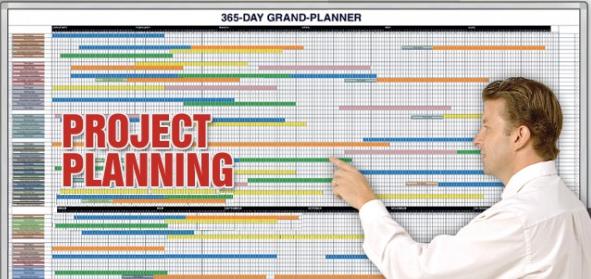
Something you probably do today is make a list of work to be done. Often you arrange this in the order the tasks need to be started in and you may even write down (or have an idea in your head) about how long each task will take. In the project management world, this is called a work plan or schedule.

Work plans can include many different levels of detail and can be viewed at those levels or rolled up to a higher level. A high level work plan for building a shed might have just a few tasks, such as:

  • Prepare site
  • Acquire materials
  • Dig and pour foundation and slab
  • Erect shed
  • Run electricity
  • Paint and insulate
  • Move in

Each of these tasks can be broken down further into sub-tasks. Erect shed can be broken down into tasks such as:

  • Build and erect stud walls
  • Sheath walls
  • Place and attach roof trusses
  • Sheath roof
  • Hang windows and doors
  • Attach siding
  • Shingle roof

Each of those sub-tasks can be broken down further as needed. After you get to the lowest level of task you need, arrange the tasks in the sequence they need to happen and figure out how long each task will take. At this stage, you want to track mainly the amount of effort. Later you will figure out the duration of the task based on the availability of people and other resources to help with the work.

Scheduling the work is the next part. Some of the work to be done on the shed depends on other work being done first, some of the work does not. You can have overlapping or parallel tasks on the work plan where there is no dependency. For example while you cannot erect the walls until the foundation is set and cured, you could build the stud walls and have them waiting to be erected, if you have the resources available. Likewise with acquiring material, this is a task that has to be done before the particular materials are needed, but it can be done almost any time before they are needed.

The amount of time between when you can start a task and when the task needs to be done so a dependent task can be started next is considered the duration of the task. The amount of time it actually takes to do the work is the task effort. The difference between the effort and the duration is referred to a slack or float time. Think of it this way; if you can’t build and erect the walls of a shed until after the foundation is poured and cured, then there is a dependency between completing the foundation and building the walls. So let’s say it takes five days to pour the foundation and let it cure. While you can’t build the walls yet, you can go ahead and cut the lumber to size. If cutting the lumber takes one day, and you can do it any time after you start on the foundation, then the lumber cutting task has four days of slack (five days of work for the foundation minus one day of work cutting the lumber). That slack is time your carpentry crew (if you had separate crews) could be doing something else.

The sequence of tasks that has no slack time is called the critical path. This is the set of tasks where a delay in completion of any of them extends the duration of the project. For example, if your foundation work is delayed by two days due to rain, then the project completion date moves ahead by two days.

You can try to make up delays on the critical path either by changing scope or design or by allocating or acquiring additional resources; for example, you may want to make up for the delay in digging the foundation by hand by renting a back hoe. This can get you back on track for on time project completion. However, it does so at added cost. (Remember the three legged stool.)

A resource list is another tool that can come in handy for preppers. Sticking with the shed example, you may have based your construction time estimates on how long it would take your best carpenter to do the job. If that person is only available for part of the time you need him or her, then you will need to slot in a less experienced person (resource) and understand how much longer the carpentry tasks will take with that resource. Again, this can be used to understand impacts to cost and schedule.

More tools include the risk and issue log. A risk is something that might happen to impact the project; an issue is something that did happen and impacted the project. This impact could be to schedule, cost, or quality.

  • List out potential risks, such as weather delays, et cetera.
  • Next to the risk, list strategies that can help eliminate or reduce the risk. (This is called mitigation.)
  • If a risk does not come to be, then cancel the risk and note why.
  • If a risk occurs, then it becomes an issue. You need to track the impact of the issue and document how you resolved (or failed to resolve) the issue.

A risk to building the foundation might be freezing weather impacting the strength of the concrete as it cures. Mitigation might be to add lime or another curing agent to the mix, which will add to the cost. Another mitigation for the risk might be to wait until warmer weather, which does not directly add cost but can impact the scheduled completion date.

Risk and issue logs not only help you manage the current project, they are an excellent source to use when planning your next project.

Another tool I want to mention is the RACI (sometimes called ARCI) chart. This is a grid that lists tasks or activities down the side and has at its top columns indicating people. At the intersection of the row and the column, you would indicate who is Responsible, Accountable, Consulted or Informed. Let’s say you had a family member coming to live with you and you had been storing miscellaneous stuff in the spare bedroom. The person who is accountable for cleaning out the room is you. The person who is responsible for cleaning out the room is your thirteen year old son, the people who are consulted before anything is thrown away is the owner of the item in question, and the person who is informed is the relative who will be moving in to the room.

The parking lot is probably one of the most useful tools out there. As you are dealing with stakeholders and trying to move forward to a particular result, frequently a conversation will pop up that is valuable information but may not be directly related to the discussion under way. In order to move forward and accomplish the goals for the meeting, you document the item on a parking lot so it doesn’t get lost, but then move forward with the topic at hand. This allows people to understand they have been heard and their discussion will be noted and acted upon, while reducing the risk of losing time by chasing something down a bunny hole.

Other PM tools that you can consider using should the project warrant are:

  • Status reports – Periodic reports usually provided to stakeholders and the project team to keep everyone on the same page about the project and schedule
  • Project status meetings – Usually with the project sponsor to bring him or her up to date on progress and to discuss issues the sponsor needs to help resolve
  • Team meetings – Standing meetings held on a regular schedule (weekly, et cetera) with the people who are actually doing the work on the project. May include decision makers as necessary, if that is the only way you can get decisions made
  • Budget – updated regularly (weekly or monthly) to track the project spending and ensure that you are still on track for cost or resource use

The important thing about using these tools is the purpose they serve, not the form they take. For instance, the team meeting might just be updating the family about progress on the shed Friday night at supper. The sponsor meeting might go something like “Hon, I don’t think this paint looks the way you thought it would. Can you come look?” Rather than include a bunch of images or attachments with this article, I would suggest you do some google searches and just browse around a bit to get some examples. I did include a few links to get you started.

Remember, you can build them with paper and pencil as well as with a computer.



Letter Re: Half-Dollars as an Investment

Hi Hugh, I was just reading James’ blog on saving nickels again. I have about a year or more’s worth of coins I’ve been saving. My late wife had rolled $10 worth of halves which I’ve saved. Would it be wise to hold onto them?

How about Canadian silver coins? Aren’t they mostly silver?

HJL’s Comment: The base metal content of half dollars made from 1971 to 2014 is 91.67% copper and 8.33% nickel with a current value of less than six cents. Unless you are able to procure coins of high silver content, they are most likely not worth what you pay for them and cannot be considered a store of value. Coinflation is an excellent site to determine the melt value of coins based upon their base metal percentage. They also list the coinage of Mexico and Canada (among others) and the same rules apply.


Economics and Investing:

Fed Issues An Ominous Warning To JPMorgan Chase And Leaders Flock To Secret Meetings – Submitted by JFJ

o o o

Sanctions Lifted, Now Iran Wants To Get Paid

o o o

Items from Professor Preponomics:

US News

How of Representatives Files Amicus Brief in Support of Judicial Watch Taxpayer Lawsuit to Prevent DC Government from Illegally Spending Taxpayer Money (Judicial Watch) Excerpt: “Regardless of whether it is sound policy for the District of Columbia to have budget autonomy, [the defendants] cannot ignore the law. Yet, they do.”

Privatizing the US Postal Service (Cato) Excerpt: “…with the rise of electronic communications, mail volume has plunged, and the 600,000-worker USPS has been losing billions of dollars a year.”

Treasury Official Dismisses Bank Fears about Liquidity Crisis (Washington Examiner) Excerpt: “…the rules have hampered big banks’ ability to act as brokers and dealers in the bond market, and that requirements for banks to hold certain amounts of liquid assets means that those same assets won’t be available for sale in a stressed environment when they’re needed.”

International News

A Bunch of Hedge Fund Managers Got Together in a Room and Talked about How Long China Has (Business Insider) Excerpt: “In 12 months there will be a currency crisis of around 15%,” she said. “There will be a banking crisis two years later.”

Funny Numbers Show Money Leaving China (Bloomberg) Excerpt: “… questions linger over exactly how much money is leaving China and why. The true picture may not be as rosy as the headline numbers suggest.”

IMF Members Urge “Growth-Friendly” Spending, New Lending Tools (Reuters) Excerpt: “…calmer markets since February had reduced the stress level at the IMF and World Bank spring meetings here, but the outlook was still fraught with downside risks from weak demand….”

Greece Back in the Firing Line as IMF Reconsiders Bailout Deal (The Independent) Excerpt: “The IMF wants Greece’s European partners to grant Athens substantial debt relief, contrary to Greek Finance Minister Euclid Tsakalotos and German Finance Minister Wolfgang Schaeuble, who told Reuters on Tuesday that he saw no need for debt restructuring.”

Personal Economics and Household Finance

41 Foods You Should Make Yourself (Frugal Living) Excerpt: “Want to enjoy fresher foods and a smaller grocery bill? Then, start making more of the foods that you eat. Many of the recipes that follow take just minutes to make.

o o o

SurvivalBlog and its editors are not paid investment counselors or advisers. Please see our Provisos page for details.


Odds ‘n Sods:

This is an interesting concept and it is certainly aesthetically pleasing. I’m not sure I agree with the contents though. Cylindrical Japanese survival kit – J.N.

o o o

You already knew this, but it was probably government grant money they spent: Why living around nature could make you live longer. – W.A.

o o o

Sheriff: Without Secure Border Every County Will Be ‘A Border County’ – Sent in by B.B.

o o o

This has long been a fear, but now there is some hard evidence that it is a reality: Residual drugs in water supply – P.S.

o o o

Way back in the day high schools taught marksmanship. Glad to see one school bringing this tradition back. High school gun range – DMS


Hugh’s Quote of the Day:

“Debt is cancer, it is killing our economy and killing the dreams of many Americans. There may be little you can do about the total national debt but you can control your own debt. Do so now!” – Jack Spirko


Notes for Thursday – April 21, 2016

April 21st is Aggie Muster Day, for all Texas A&M Corps of Cadets graduates. Aggie Muster celebrations/meetings are held as far away as Japan, Germany, and Afghanistan. I should mention that Jim’s grandfather (a U.S. Army Cavalry LTC) was an Aggie–something mentioned so often that everyone in his family felt like de facto Aggies, too. Other than the officers that matriculate though West Point, the four institutions that seem to have the greatest ongoing esprit de corps for graduates are Texas A&M, The Citadel, Norwich University, and VMI. Jim felt almost obliged to include an Aggie character in his novels Survivors and Founders, even though his connection to Texas A&M is two generations removed.

o o o

SurvivalBlog welcomes a new advertiser to its family today: The Wisconsin Trigger Company has some awesome high performance trigger upgrades for your “black” rifles.

o o o

Hazarid Decontamination System has just gone on sale. You can pick this handy kit up at Ready Made Resources and be ready for that “accident” while saving $100.

o o o

Today, we present another entry for Round 64 of the SurvivalBlog non-fiction writing contest. The nearly $12,000 worth of prizes for this round include:

First Prize:

  1. A Tactical Self-Contained 2-Series Solar Power Generator system from Always Empowered. This compact starter power system is packaged in a wheeled O.D. green EMP-shielded Pelican hard case (a $1,700 value),
  2. A Gunsite Academy Three Day Course Certificate that is good for any one, two, or three day course (a $1,195 value),
  3. A course certificate from onPoint Tactical for the prize winner’s choice of three-day civilian courses, excluding those restricted for military or government teams. Three day onPoint courses normally cost $795,
  4. DRD Tactical is providing a 5.56 NATO QD Billet upper with a hammer forged, chrome-lined barrel and a hard case to go with your own AR lower. It will allow any standard AR-type rifle to have a quick change barrel, which can be assembled in less than one minute without the use of any tools and a compact carry capability in a hard case or 3-day pack (an $1,100 value),
  5. Gun Mag Warehouse is providing 20 Magpul PMAG 30-rd Magazines (a value of $300) and a Gun Mag Warehouse T-Shirt; (an equivalent prize will be awarded for residents in states with magazine restrictions),
  6. Two cases of Mountain House freeze-dried assorted entrees in #10 cans, courtesy of Ready Made Resources (a $350 value),
  7. The Ark Institute is donating a non-GMO, non-hybrid vegetable seed package (enough for two families of four) plus seed storage materials, a CD-ROM of Geri Guidetti’s book “Build Your Ark! How to Prepare for Self Reliance in Uncertain Times”, and two bottles of Potassium Iodate (a $325 retail value),
  8. A $250 gift certificate good for any product from Sunflower Ammo,
  9. KellyKettleUSA.com is donating an AquaBrick water filtration kit with a retail value of $250, and
  10. Two cases of meals, Ready to Eat (MREs), courtesy of CampingSurvival.com (a $180 value).

Second Prize:

  1. A Glock form factor SIRT laser training pistol and a SIRT AR-15/M4 Laser Training Bolt, courtesy of Next Level Training, which have a combined retail value of $589,
  2. A transferable certificate for a two-day Ultimate Bug Out Course from Florida Firearms Training (a $400 value),
  3. A Model 175 Series Solar Generator provided by Quantum Harvest LLC (a $439 value),
  4. A Trekker IV™ Four-Person Emergency Kit from Emergency Essentials (a $250 value),
  5. A $200 gift certificate good towards any books published by PrepperPress.com,
  6. A pre-selected assortment of military surplus gear from CJL Enterprize (a $300 value),
  7. RepackBox is providing a $300 gift certificate to their site, and
  8. Safecastle is providing a package of 10 LifeStraws (a $200 value)
  9. American Gunsmithing Institute (AGI) is providing a $300 certificate good towards any of their DVD training courses.

Third Prize:

  1. A Royal Berkey water filter, courtesy of Directive 21 (a $275 value),
  2. A $245 gift certificate from custom knife-maker Jon Kelly Designs, of Eureka, Montana,
  3. A large handmade clothes drying rack, a washboard, and a Homesteading for Beginners DVD, all courtesy of The Homestead Store, with a combined value of $206,
  4. Expanded sets of both washable feminine pads and liners, donated by Naturally Cozy (a $185 retail value),
  5. Two Super Survival Pack seed collections, a $150 value, courtesy of Seed for Security, LLC,
  6. Mayflower Trading is donating a $200 gift certificate for homesteading appliances,
  7. Montie Gear is donating a Precision Rest (a $249 value), and
  8. Two 1,000-foot spools of full mil-spec U.S.-made 750 paracord (in-stock colors only) from www.TOUGHGRID.com (a $240 value).

Round 64 ends on May 31st, so get busy writing and e-mail us your entry. Remember that there is a 1,500-word minimum, and that articles on practical “how to” skills for survival have an advantage in the judging.