JWR’s Recommendations of the Week:

Books:

What to Expect When You’re Expecting

The Instant Pot Electric Pressure Cooker Cookbook: Easy Recipes for Fast & Healthy Meals

Movies:

God’s Not Dead

Galaxy Quest

Music:

Lau: Lightweights & Gentlemen

Leo Kottke: Six And Twelve String Guitar

Instructional Videos:

DIY How to add Paracord to your MFT Battlelink Stock

Podcasts:

Radio Free Redoubt: Episode 17-06: Do Not Oppress the Sojourner – and – HUNTED: Analysis and Review. (Also available via iTunes.)

The Survival Podcast: Episode-799- Greenhouse Thoughts, Construction, Usage and Considerations

Blogs:

Total Survivalist Blog

Brushbeater

Gear:

Rothco Flyers Helmet Shoulder Bag, Olive Drab (These are great for organizing and transporting sets of web gear for your defensive guns.)

Flambeau Outdoors 7-Tray Hip Roof Tackle Box. (Not just for fishing, these are perfect for storing spare gun parts.)

AlienTACS CQC Transformer Wide Padded Quick Adjust 2-Point 1-1/4″ Sling


Notes for Tuesday – February 21, 2017

February 21st is the birthday of Zimbabwe’s President For Life, Comrade Robert Mugabe (born 1924). Despite the 2011 revelations of the apparent murder of at least 640 political opponents, Mugabe was elected again in 2013 to a five year term in office. Mugabe and his ZANU-PF henchmen must be driven out office and sent to prison, where they belong!

February 21st is also the birthday of Group Captain Douglas Bader (born 1910, died 5 September 1982). He was a Royal Air Force (RAF) fighter ace during the Second World War. He lost his legs in a pre-war flying accident, but that didn’t stop him from re-entering the RAF when war broke out. He was credited with 20 aerial victories, four shared victories, six probables, one shared probable, and 11 enemy aircraft damaged. Bader was eventually shot down and became a POW in Germany. Since the Luftwaffe ran its own POW camps, he became a celebrity with his captors. The Germans would lock up his hollow metal prosthetic legs each night to prevent him from escaping. Bader’s autobiography Reach for the Sky is a must for those studying aviation in World War II.

o o o

Today, we present another entry for Round 69 of the SurvivalBlog non-fiction writing contest. The nearly $15,000 worth of prizes for this round include:

First Prize:

  1. A $3000 gift certificate towards a Sol-Ark Solar Generator from Veteran owned Portable Solar LLC. The only EMP Hardened Solar Generator System available to the public.
  2. A Gunsite Academy Three Day Course Certificate that is good for any one, two, or three day course (a $1,195 value),
  3. A course certificate from onPoint Tactical for the prize winner’s choice of three-day civilian courses, excluding those restricted for military or government teams. Three day onPoint courses normally cost $795,
  4. DRD Tactical is providing a 5.56 NATO QD Billet upper with a hammer forged, chrome-lined barrel and a hard case to go with your own AR lower. It will allow any standard AR-type rifle to have a quick change barrel, which can be assembled in less than one minute without the use of any tools and a compact carry capability in a hard case or 3-day pack (an $1,100 value),
  5. An infrared sensor/imaging camouflage shelter from Snakebite Tactical in Eureka, Montana (A $350+ value),
  6. Gun Mag Warehouse is providing 20 Magpul PMAG 30-rd Magazines (a value of $300) and a Gun Mag Warehouse T-Shirt; (an equivalent prize will be awarded for residents in states with magazine restrictions),
  7. Two cases of Mountain House freeze-dried assorted entrees in #10 cans, courtesy of Ready Made Resources (a $350 value),
  8. A $250 gift certificate good for any product from Sunflower Ammo,
  9. Two cases of Meals, Ready to Eat (MREs), courtesy of CampingSurvival.com (a $180 value).

Second Prize:

  1. A Tactical Self-Contained 2-Series Solar Power Generator system from Always Empowered. This compact starter power system is packaged in a wheeled O.D. green EMP-shielded Pelican hard case (a $2,400 value),
  2. A Glock form factor SIRT laser training pistol and a SIRT AR-15/M4 Laser Training Bolt, courtesy of Next Level Training, which have a combined retail value of $589,
  3. A gift certificate for any two or three-day class from Max Velocity Tactical (a $600 value),
  4. A transferable certificate for a two-day Ultimate Bug Out Course from Florida Firearms Training (a $400 value),
  5. A Trekker IV™ Four-Person Emergency Kit from Emergency Essentials (a $250 value),
  6. A $200 gift certificate good towards any books published by PrepperPress.com,
  7. A pre-selected assortment of military surplus gear from CJL Enterprize (a $300 value),
  8. A selection of canned meats containing a 10 pack of 28oz cans of Premium Beef and a 5 pack of 28oz cans of Premium Pork from Wertz’s Farm Market (a $300 value),
  9. RepackBox is providing a $300 gift certificate to their site, and
  10. American Gunsmithing Institute (AGI) is providing a $300 certificate good towards any of their DVD training courses.

Third Prize:

  1. A Model 175 Series Solar Generator provided by Quantum Harvest LLC (a $439 value),
  2. A Royal Berkey water filter, courtesy of Directive 21 (a $275 value),
  3. A custom made Sage Grouse model utility/field knife from custom knife-maker Jon Kelly Designs, of Eureka, Montana,
  4. A large handmade clothes drying rack, a washboard, and a Homesteading for Beginners DVD, all courtesy of The Homestead Store, with a combined value of $206,
  5. Expanded sets of both washable feminine pads and liners, donated by Naturally Cozy (a $185 retail value),
  6. Two Super Survival Pack seed collections, a $150 value, courtesy of Seed for Security, LLC,
  7. Mayflower Trading is donating a $200 gift certificate for homesteading appliances,
  8. Montie Gear is donating a Y-Shot Slingshot and a $125 Montie gear Gift certificate.,
  9. Two 1,000-foot spools of full mil-spec U.S.-made 750 paracord (in-stock colors only) from www.TOUGHGRID.com (a $240 value), and
  10. Fifteen LifeStraws from SafeCastle (a $300 value).
  11. A $250 gift certificate to Tober’s Traditions, makers of all natural (organic if possible) personal care products, such as soap, tooth powder, deodorant, sunscreen, lotion, and more.

Round 69 ends on March 31st, so get busy writing and e-mail us your entry. Remember that there is a 1,500-word minimum, and that articles on practical “how to” skills for survival have an advantage in the judging.


Donkeys as Pack Animals for Survival and Recreation- Part 1, by B.W.

Moving unobtrusively over land with pack animals whether for recreation or in an emergency situation is both enjoyable and possibly a lifesaving endeavor. This article concerns my experience with donkeys as a veterinarian and as someone who has prepared as much as possible over the years for whatever circumstances may arise in the world we live in. I hope this information will persuade you to look into pack animals, such as donkeys, in your preparedness planning if your circumstances will allow.

My wife and I have owned and ridden horses for the majority of our lives but got out of the horse business about eight years ago primarily due to a downsizing in pasture acreage. We have had donkeys now for the past four years. I did not consider myself “expert ” enough to write an article on donkeys, but after reading a few discussions about donkeys on other survival blogs, I realized that the public has many misconceptions about them. To most they are cute but rather stubborn lawn ornaments, but as I have learned they are actually very hardworking affectionate pack animals with tons of personality.

Donkeys have been working animals for man for over 5000 years. They are by far the most used and abused working animal in the world with over 41 million worldwide. The vast majority of these are in third world countries, where the availability of mechanized implements are limited primarily due to economics. The conditions existing in these countries now are similar to those that would exist in the United States after a total grid breakdown, economic collapse, or other nationwide debilitating natural disaster. Donkeys in these third world countries today are hard working survival animals that allow these people to do jobs and provide for their families when otherwise they would be unable to do so. However, due to limited resources and social mores that don’t allow for the promotion of the human animal bond, these animals live shortened lives with the average being 12-15 years in these countries while donkeys are fully capable of living twice that long if treated well. The Donkey Sanctuary is a U.K.-based donkey welfare group that is active worldwide showing people how to make inexpensive pads for packing donkeys and inexpensive harnesses for other donkeys that haul carts and wagons. By teaching these people that it is not only good for the animal when they care for its welfare but also good for them economically since the animals can work better and longer, they are showing them that a positive human-animal bond is a win-win situation for both man and animal.

The reasons I got into donkeys were multi-fold, but primarily I wanted a smaller, easy to keep, low impact animal for extended back packing trips that I could house in a relatively small area. I felt they would allow my wife and I to travel further with more supplies by reducing our number of resupply points and allow us to travel with lighter packs on our backs. Donkeys would allow us to carry our more valuable, delicate items, such as firearms, ammo, optics, GPS devices, and other small items in our packs while they could carry food, bedding, and other large items in their panniers. These possibilities would make them ideal for either recreational or emergency travel uses. Whether we were traveling on the trails nearby or trying to escape our local nuclear plant in the case of an EMP with grid shutdown and non-functioning vehicles, donkeys would lighten our load and allow us to carry more of our essentials.

Very early in my thought process about whether to get back into riding horses or walking with pack animals to meet the needs of moving myself and material over difficult terrain, I considered several ideas. First, when I had horses, I would sometimes go on overnighters in the mountainous woods of Pennsylvania with my supplies: this was always a great time, but because the horse was carrying me, it greatly reduced the amount of supplies I could carry. I always wondered where those cowboys in the movies used to keep that big coffee pot, cast iron skillet, side of bacon, et cetera on their horses when all I could see was a small bedroll. Another issue I had was that taking the horse off of an established trail or logging road in mountainous woods was not an easy thing to do. I still always felt that I would still be able to travel much faster over distance riding a horse. However, once when we were on a continuing education trip out west one year, I picked up the book Empire of the Summer Moon by S.C. Gwynne. The book was about the Comanche Indian Nation and the war against them by the U.S. Cavalry during the late 1800’s. The book went into the logistics of moving men and material over long distances using horses with riders, donkeys, and mules with packs and wagons, and infantry walking. The interesting idea that I noted was that the mounted riders only outpaced the walking people and animals for two or three days and then their pace was the same. This bolstered my view that in a situation where my wife and I were moving ourselves with the maximum amount of supplies over long and difficult terrain, we would be most efficient on foot with a small group of pack animals. Donkeys, for their size, can carry a larger load for a longer time than any other pack animal. Donkeys can easily carry 20-25% of their bodyweight in their packs for 10-12 miles per day for extended periods of time and higher weights over short distances. Our donkeys, except for one, are in the 350-400 lb. range, which means that they can carry 80-100 lbs. We do have a smaller donkey, Chili Pepper, who is half mini and weighs a little under 300 lbs. She can’t carry quite as much, but she makes up in spirit what she lacks in size. Donkeys come in many sizes, from minis that weigh as little as 100 lbs. to the mammoth donkey that weighs over 1000 lbs. Our donkeys are small standards, but there are large standards who weigh in the 600-800 lb. range, which is in the small horse size. We chose our donkeys because we felt the smaller size had many more advantages in our situation.

Donkeys are extremely hardy animals that can survive on much less than a horse or pony of similar size. A horse will not do nearly as well on the types of forage that a donkey can live on. It is unclear exactly why donkeys are so much more efficient than horses at thriving on substandard forage, but one reason put forth is the fact that while both species grind their feed by a circular motion of their jaws using their molars as grindstones, the jaws of the donkey make a much larger circle than those of the horse. In addition, it has been suggested that the differences in the donkey’s intestinal microflora make it digestively more efficient than the horse. The bottom line is that a horse requires 2-2.5% of their bodyweight of a higher quality forage on a dry matter basis to thrive while a donkey can live on 1.5% of its body weight in a lower quality forage.

While donkeys, in a pinch, can live on straw– a very low quality forage, I have found that mine do best on first cutting grass hay, which tends to have more stems and seed heads present. First cutting hay is usually less expensive than second cutting hay, which has more broad leaves and is more often fed to horses. Our three donkeys live on 3/4 acre of land in our backyard. We have their space divided into two sections during the warm months. One section is a grassy area; the other area, which is more wooded, contains their barn. Their barn is about 10 feet wide by 32 feet long and is about 10 feet tall. This has proven to be ample space for the donkeys and for the storage of about 60 bales of hay. The donkeys have taken out all of the underbrush in the wooded area but are pretty good at not bothering the larger trees, especially evergreens, if they are provided an equine mineral block. We turn them out on the grassy area for thrre or four hours every day or two during the growing season depending on the amount of grass available. This lets them have the taste of green vegetation, but because of their small area we feed them year round. They each eat an average of 1/4 bale of hay daily and 1/2 lb. of 12% pelleted horse feed daily. Where we live in Pennsylvania, a bale of grass hay runs about $2.75 a bale and a 50 lb. bag of pelleted ration runs $10 dollars, so each donkey costs about $300 a year to keep. If these three donkeys were one horse, the ground would be turned to mush and completely devoid of vegetation in their small area, but because of their small feet the donkeys still have vegetation. These Sicilian donkeys we have were originally desert dwellers, so they do like to roll on bare ground. These are the type of donkeys that lived in the Middle East during the time of Jesus and have the large cross on their back. Because of this need, they do tend to paw out a few bare rolling areas in their pasture that are six to eight feet in diameter that they use on a regular basis.

Another item of concern, especially in a small area such as we have, is manure management. Fortunately, donkeys tend to concentrate their manure in several piles around their living area rather than going in many different places. Where they have these manure piles they will not eat the grass, even though it grows prolifically. I rake my barn area daily and pile it up. Once a week in the winter and more often in the summer, I sprinkle hydrated lime on my barn pile and the various pasture piles. The lime helps degrade the manure, stops insects in their tracks, balances the pH, and controls intestinal parasites. When the smaller piles degrade, I just go over them with a riding lawnmower and puree them over the ground to add organic matter to the soil. A couple of times a year, I move my barn pile to a composting area to make room for more. If you cover it with black plastic in the spring after a season of composting and just after the weeds and grass have sprouted, you can put it in your garden after all of the vegetation in the manure has died.


Letter Re: Total Solar Eclipse 2017

Captain Rawles,

You are correct in publishing that Greenville, SC will be in the sweet spot for viewing the total solar eclipse. In fact, schools in the state are already making adjustments to their schedules, either delaying the start of school or dismissing early the day of the event. Your insight into possible traffic conditions highlighted for me the fact that I-26 from Asheville, NC to Charleston, SC should be in the direct path of totality. I’m running scenarios through my head about regular commuters to the three urban hubs in South Carolina and the eclipse watchers. Perhaps I’ll take a vacation day and stay home. – G.O.


News From The American Redoubt:

Idaho: Dozens of dead owls showing up along I-84: ‘It’s like they fell from the sky’

o o o

A 51st state, called Liberty, would have political clout and an ag-based economy

o o o

An acquaintance who lives near Sandpoint, Idaho is selling an amazingly versatile Bug Out vehicle, based on a U.S. Army 5-Ton M934A1 6×6 multi-fuel truck with an expanding shop van on the back. It even has a snowplow blade. It has been painted charcoal gray.

Description of the truck:

  • Extended Cab-Seats (2)
  • 2 Upgraded Air Ride Seats
  • Cab Entry to Expandable Box
  • Expanded Range Dual Fuel Tanks
  • 10’ width detachable snowplow blade
  • 18,000 lb Waterproof 24VDC Forward Facing Winch
  • Roof Hatch (with Ladder)
  • 2 Forward Facing LED Light Bars
  • Engine Block Heater
  • Roof Mount Tire, Crane and Winch
  • Upgraded Batteries
  • Hitch for Standard Trailers
  • Cummins Diesel Engine (Multi-fuel)
  • Allison Automatic 5-speed Transmission
  • 50? Tires and Includes a Mounted Spare.
  • Rockwell Axles.
  • Rockwell High/low Range Transfer Case.
  • 4-Person Cab with In-cab Heating.
  • Rear Box Expands from 7’ X 17’ to 14’ X 17’, (230 sq. ft. of interior space)
  • Equipped with Full Electrical Panel with Lights and Electrical Outlets.

Some photos can be seen at this web page. The asking price is $65,000 (negotiable). It can be seen near Naples, Idaho, Idaho on Highway 95. Contact: Kevin or Missy at Bee Safe Security, at: (208) 267-0000.

o o o

The web editors of AmericanRedoubt.com put together this great little promotional film that extols the virtues of The American Redoubt: Flee The City!

o o o

The BBC Reports: US preacher’s warning to Islamic militants: ‘The women of Montana are armed’


Economics and Investing:

Why Your Gold IRA Might Depend On The IMF! (Part 1)

o o o

Biggest Gasoline Glut In 27 Years Could Crash Oil Markets. Falling demand and consistent refinery runs have caused gasoline inventories to reach unexpected levels, significantly increasing downward pressure on crude.

o o o

Trump to Fill at Least Three Fed Positions: What Will the Trump Fed Look Like?

o o o

Why the “Experts” Can’t Agree About Fed Rate Hikes

o o o

SurvivalBlog and its editors are not paid investment counselors or advisers. Please see our Provisos page for details.


Odds ‘n Sods:

From the isle of chestless men: English cops refuse to carry guns. “…one in eight officers would not be prepared to carry a gun under any circumstances, despite the threat of a Paris-style attack in Britain.” Britain’s leaders have, over three generations, destroyed the English gun culture. This is the predictable and pitiable result. I wonder, will there ever again be an England. – J.N.

o o o

Study: Venezuelans lost 19 lbs. on average over past year due to lack of food – G.P.

o o o

9 Ammo Storage Tips Every Gun Owner Should Know – DSV

o o o

Phony Baloney: The 9 Fakest Fake-News Checkers – DSV

o o o

The CIA Vs. The Presidency: This Is Not The First Time


Hugh’s Quote of the Day:

“The times call for courage. The times call for hard work. But if the demands are high, it is because the stakes are even higher. They are nothing less than the future of human liberty, which means the future of civilization.” – Henry Hazlitt


Kahr CT40, by Pat Cascio

I’ve been a huge fan of Kahr , since I laid my hands on the first one I ever spotted in a gun shop. The double-action only trigger pull on their handguns is second to none; it is butter smooth. Some have described the trigger pull as the Rolls Royce of DAO triggers, and I’m not about to argue the point either. The one “problem” I have with any of the Kahr handguns I get in for testing and for writing an article on is that I simply can’t return the samples; I end up purchasing them eventually, because I like their guns so much.

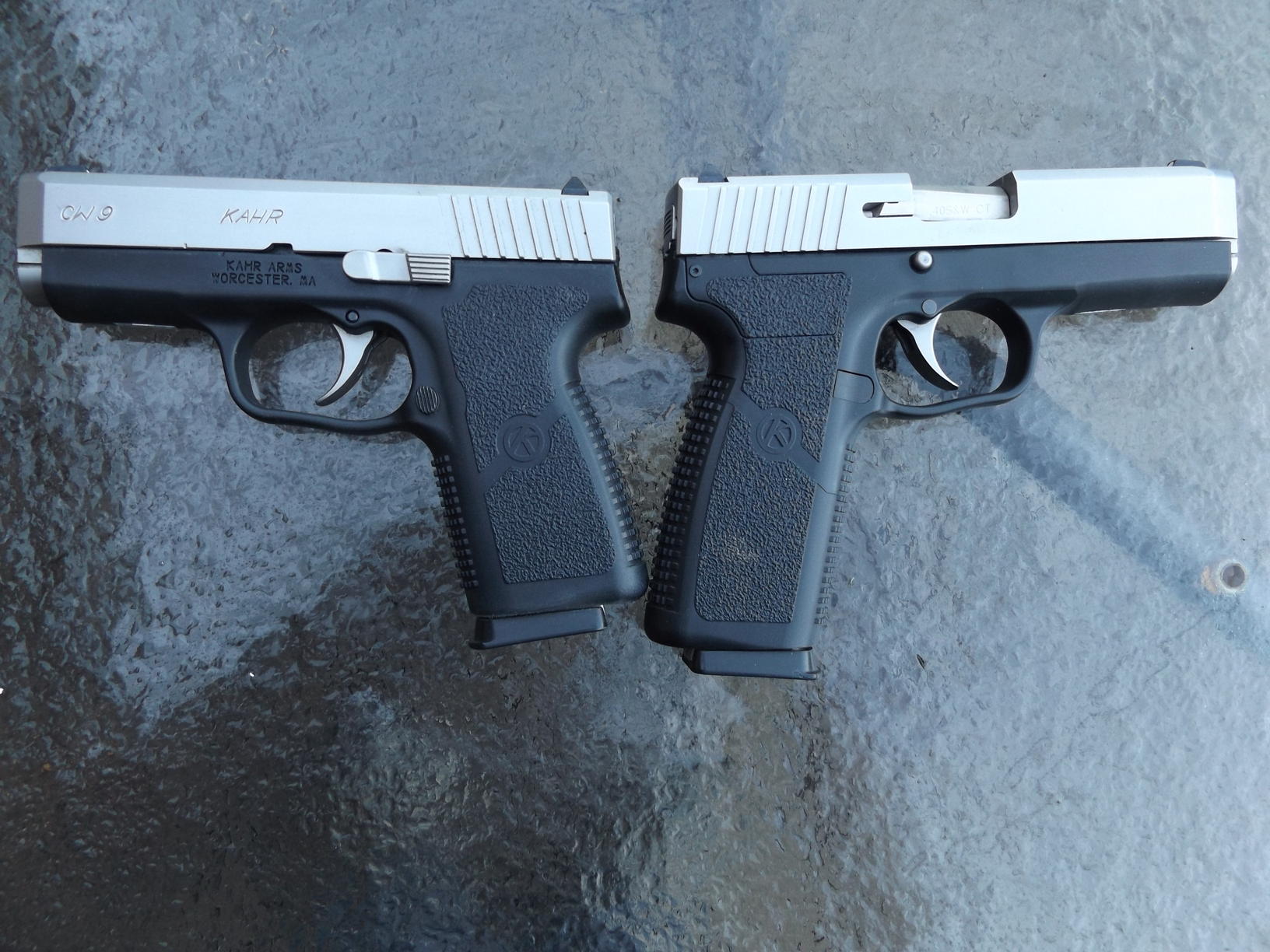
My youngest daughter gave me a Kahr CW45 about three or fours years ago as a Christmas present. I also purchased a second one from the local gun shop, because I loved the way the gun felt and operated. A couple of years ago, my wife and two daughters gave me a Kahr CW9 for Christmas; it was another winner. The only problem I had with it was that it did require slightly more than 200 rounds through it before it operated 100% of the time. Then again, Kahr recommends you fire at least 200 rounds through their guns to insure they operate 100% of the time. This particular gun really needed that break-in period for some reason; most of the Kahrs I’ve had worked 100% right out of the box.
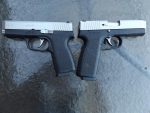
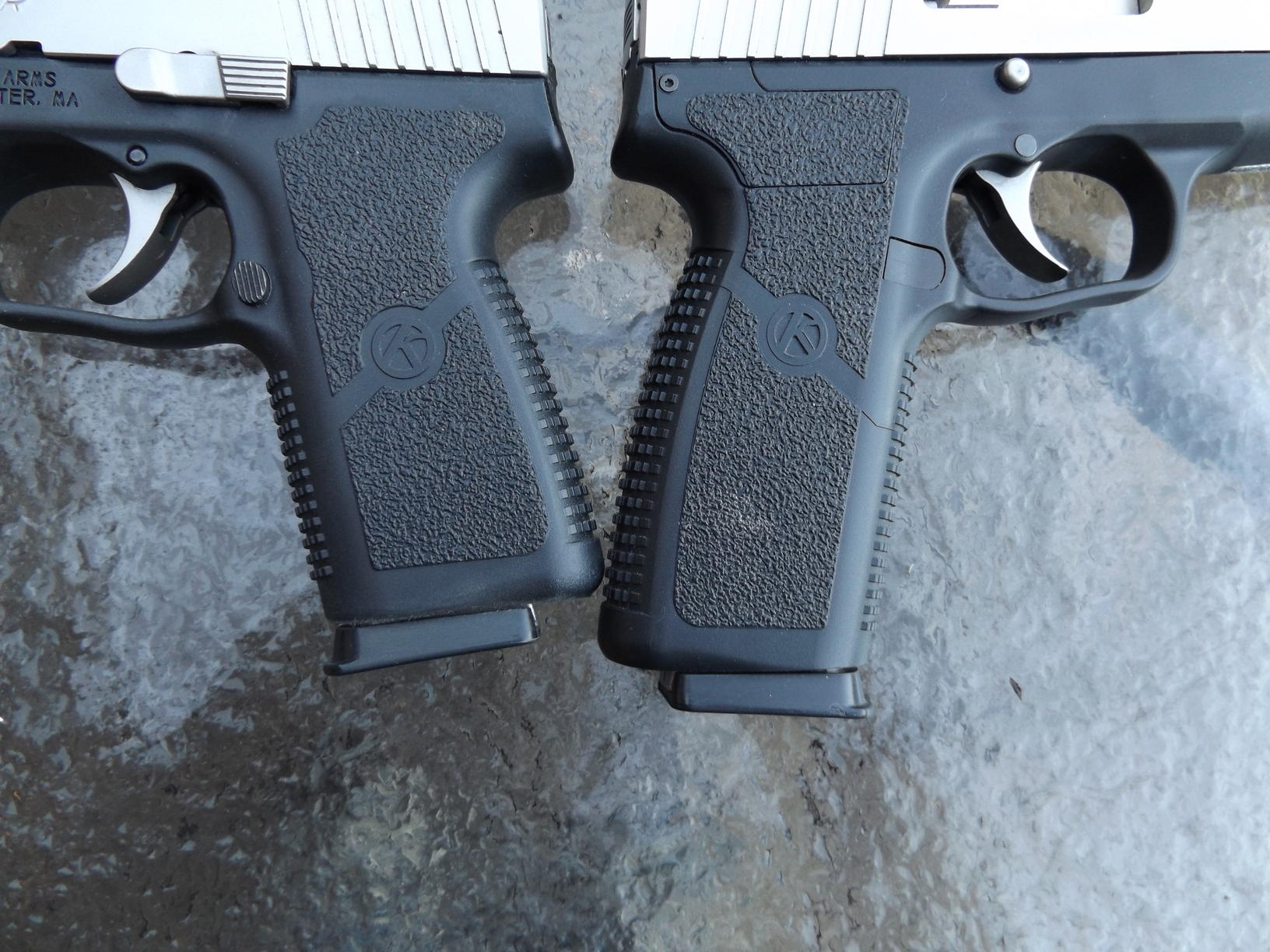
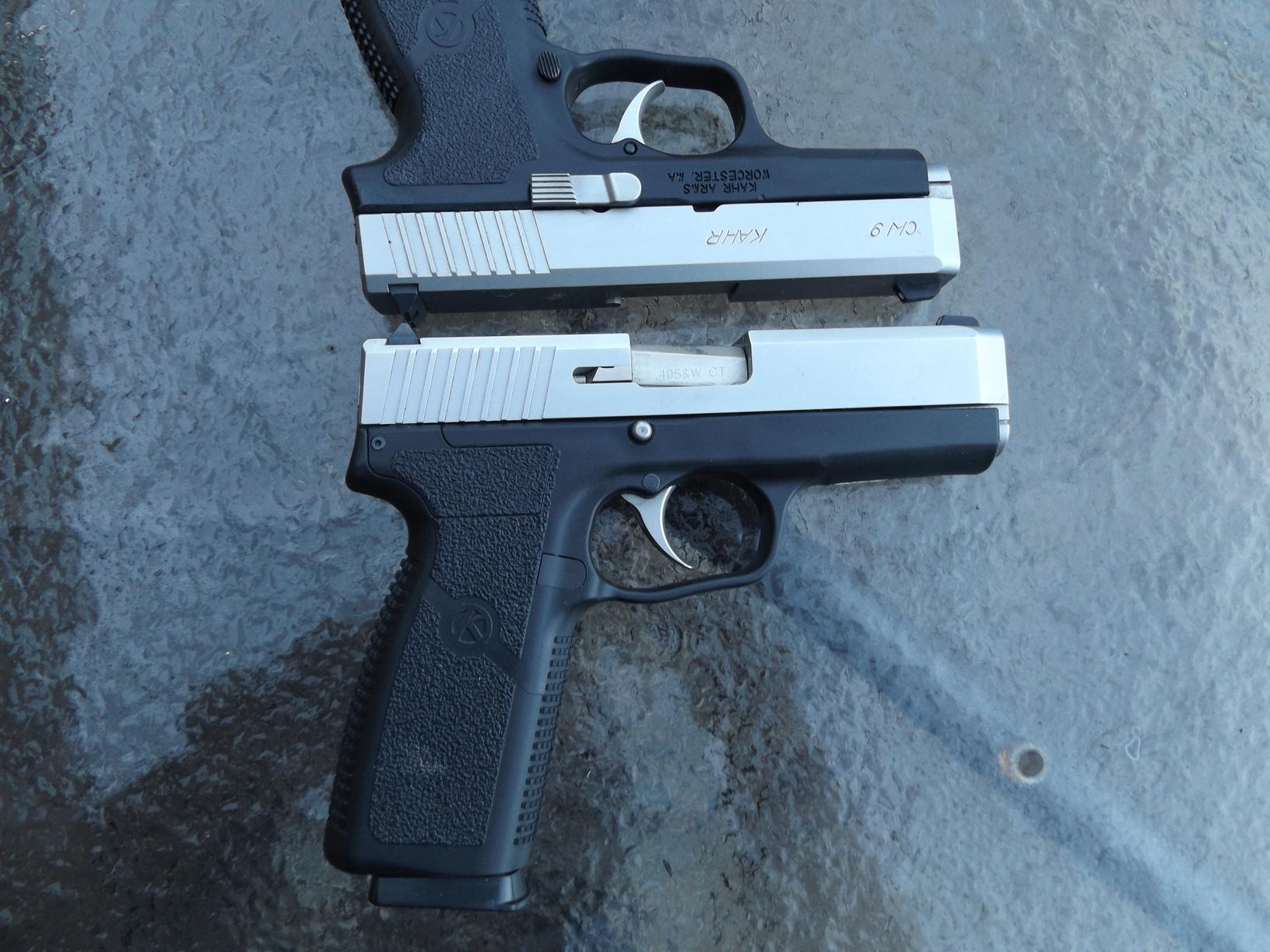
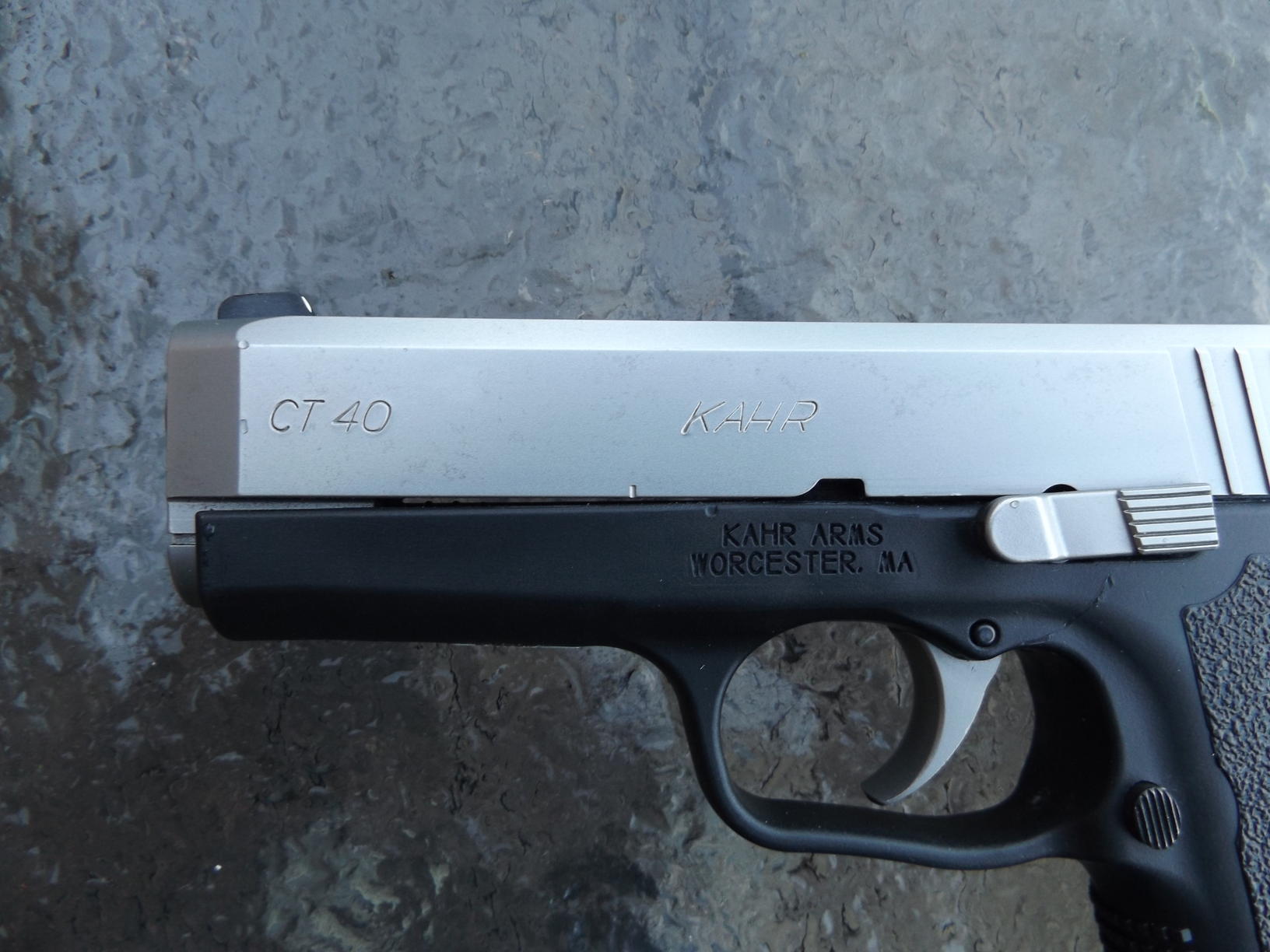
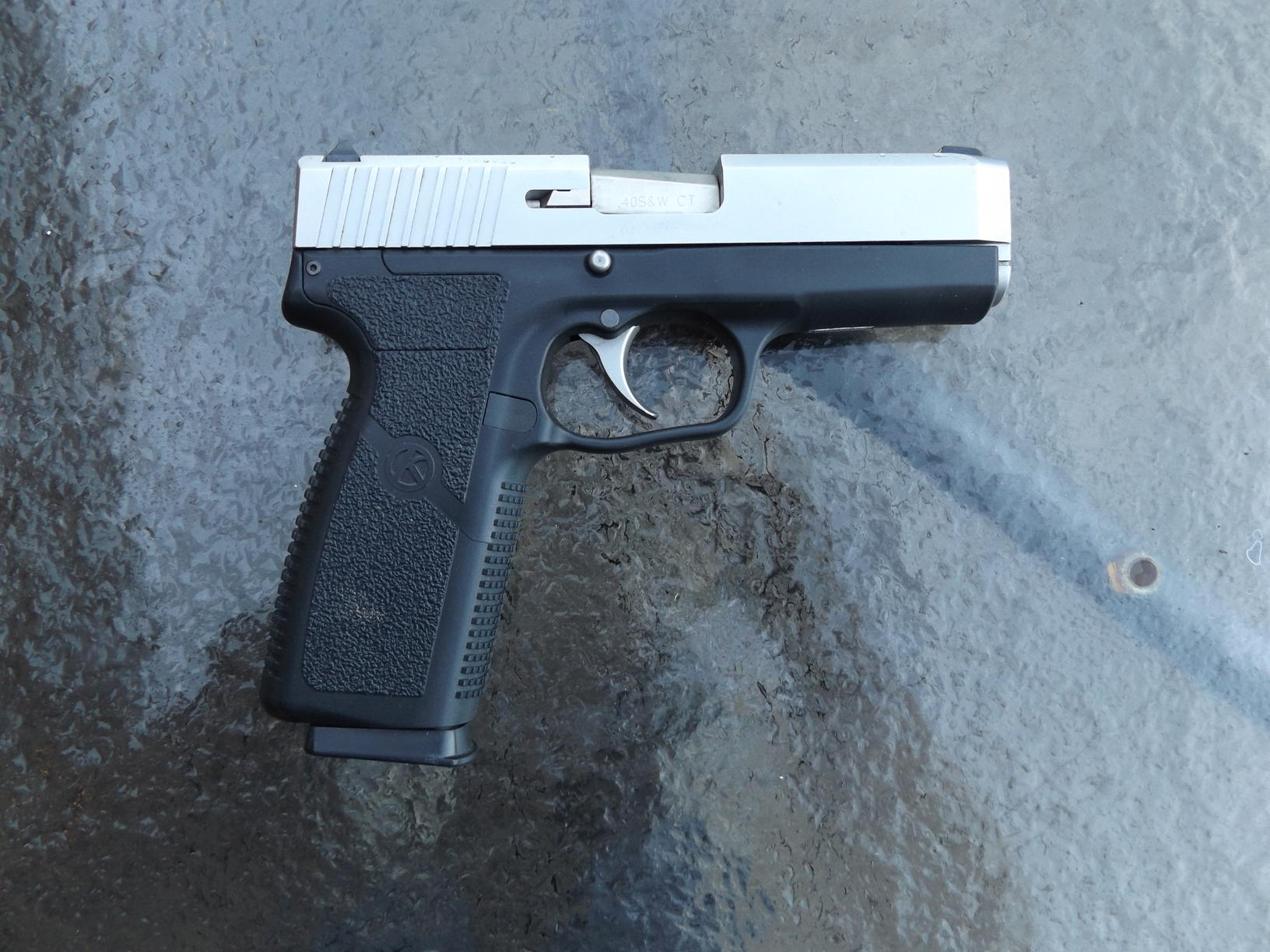
This brings us to the Kahr CT40, which is a fairly new model in the Kahr stable. I ran across this one, which is used but as-new, at the local gun shop I haunt. The asking price was just too low for me to pass it up; I’m so weak. The CT40 is chambered in .40 S&W, and this model holds 7+1 rounds. The grip is ever so slightly longer than that of the CW9 series of pistols. I’ve found that the CW9 and my CW45 are just right, when it comes to fitting my hand and providing great concealment. To be sure, Kahr handguns are designed to be some of the best pistols that are easy to operate and conceal.

The CT40 has a 4” long barrel with a length of 6.5” and a height of 5.12”, and it is only 0.94” wide. It is slim. The gun weighs in at only 21.8 ounces and has a stainless steel slide and black, textured polymer frame. The sights are the bar/dot, with white dot on the front sight and bar on the rear sight, which is very fast to pick up. The gun only comes with one magazine, but spares are readily available, and you should always carry a spare magazine with any autoloading pistol.
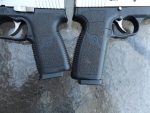
In the past, I tested the Kahr CM40, and I got one from Kahr for an article. I also purchased another one. These are outstanding concealed carry pistols, and I carried one or the other in an ankle holster for quite some time. They are much smaller than the CT40, with a shorter barrel and being shorter in the grip area. Then again, they only hold 5+1 rounds. The one “bad” thing with these little guns was that they were punishing to shoot, and if you didn’t have a firm grip on the guns there would be feeding problems. However, if you had a firm grasp when firing, the guns worked perfectly.

The CT40 is quite a bit bigger than the CM40 was. It’s longer front to back and top to bottom. I was looking forward to giving it a good workout and considered carrying it on a daily basis with a spare 7-rd mag. Here’s where things got a little “complicated”, in my humble opinion. The CT40 is, as mentioned, longer and taller, and it hurts when it comes to concealed carry; the gun is just a little bit bigger than I wanted to conceal. Oh sure, I’ve carried much larger handguns concealed without any problems, and there were no problems carrying the CT40 concealed either. However, Kahr is known for small, concealable handguns, and in my humble opinion this one is kind of like the proverbial red-headed step-child. It just doesn’t work for me as a small handgun, even though it is small, and it isn’t quite big enough to fill the roll of a full-sized handgun either.
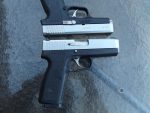
I certainly understand where Kahr is coming from with the CT40; those who want to carry more ammo in the handguns wanted something like this. However, to my thinking, I’d rather carry a round or two less and go with the Kahr P40, CM40, or CW40. I don’t mind giving up a round or two for a lot better concealed carry handguns, especially when I’m carrying at least one spare magazine for the gun. Maybe it’s just me, but we’ll see.

From Buffalo Bore Ammunition, I had their 140-gr Barnes TAC-XP all-copper hollow point standard pressure ammo and the same in 125-gr, but both are really stout loads. I also had their 155-gr and 180 gr JHP +P loads, which are very hot loads. From Black Hills Ammunition, I had their 155-gr JHP load, 180-gr JHP load, and their 140-gr Barnes TAC-XP all-copper hollow point load. So, I had a fair selection of ammo to run through this CT40.

The good news is that I had zero malfunctions with any of the ammo tested, and in all I fired 300 rounds through the CT40. There’s more good news. The recoil was easily handled because of the much longer grip area, compared to the CM40, CW40, or P40. I didn’t really expect the recoil control to be all that much more manageable, but it was. I was totally surprised that with the slightly longer gripping area the gun was very easy to shoot, all things considered. The 155-gr and 180-g JHP +P loads from Buffalo Bore were a bit snappy to say the least, and I wouldn’t shoot a steady diet of this hotter ammo through the Kahr CT40. However, all the other loads aren’t bad at all in the CT40.
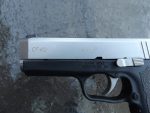
Accuracy testing was conducted at only 15 yards, resting the gun over the hood of my pickup on top of a rolled up sleeping bag. I was getting groups all around three inches, if I did my part, and that is outstanding accuracy from a “small” handgun in a hot-stepping caliber like the .40 S&W. The Black Hills 140-gr Barnes TAC-XP all-copper hollow point gave me some groups a little bit below 3”, and that’s nothing to complain about, so it was the accuracy winner.

I carried the CT40 for several weeks and changed holsters. Both were leather holsters from Blackhawk Products , made in Italy and outstanding concealed use holsters, plus a great buy. So, I was giving the CT40 a fair shake when it came to concealing it. However, for whatever reason, this gun didn’t resonate with me. I’d rather carry my CW45 or my CW9 instead of the CT40. There wasn’t anything wrong with the gun; it functioned 100% of the time, and I loved the DAO trigger pull. However, there was just “something” about the gun that didn’t appeal to me. It’s the first Kahr ever like this.

I ended up selling the gun back to my local gun shop, and there it has sat for several months now. The guys at the gun shop tell me what I already knew. When a customer would ask to handle the gun, they all said it was too long and that they wanted something shorter in the butt region of the gun for better concealed carry. So, it wasn’t just me with this complaint. I’m thinking that, for once, Kahr didn’t hit a home run with the CT40, but they still got onto third base, and that’s not bad.
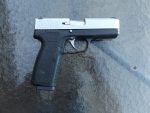
When I think about Kahr handguns, I think of guns that are easy to conceal– not too big and not too small– but “just right”, as Goldilocks once said. That extra round in the 7-rd magazine just makes the gun a little bit longer than should be for someone who wants a concealed carry gun. I’m sure it will appeal to a lot of shooters, but when a gun sits on the shelf at my local gun shop for more than a few weeks, there is a problem, and the CT40 still sits there. Again, there’s nothing wrong with the gun; it performed great and was easy to control, even with the hottest .40 S&W loads I fed it. But this one just wasn’t ringing my chimes.

– Senior Product Review Editor, Pat Cascio



Book Review: Krav Maga Tactical Survival, by D.R.

Published by Tuttle Publishing
ISBN: 978-0-8048-4765-0
5 parts, 224 pages with index

Between active shooters, the rise in violent crime, and the outbreak of “undocumented shoppers”, many Americans are taking an interest in learning how to protect themselves and their loved ones. This takes many forms, as some people devote their time and money to storing up resources and equipment, others to training with armed and unarmed combatives, and some to both. Any serious practitioner in unarmed combatives will likely have heard of the discipline of Krav Maga. Since Imi Lichtenfeld started training the Israeli military in “contact combat” in 1944, Krav Maga has become increasingly popular among the international community. With instructors all over the world spreading the word of reality-based self-defense, it’s not hard to imagine why that is the case. One such instructor is Gershon ben Keren, a 5th degree black belt in Krav Maga and the head instructor at Krav Maga Yashir in Boston, MA. In addition to providing training to civilians, law enforcement officers, and military personnel, he has also written a few books on the subject of unarmed combat.

In his latest book, Krav Maga – Tactical Survival, ben Keren goes in-depth on the subject, covering not only specific techniques but also important physical and psychological concepts that would be useful for self-defense and martial art practitioners of all levels. Every technique in the book is explained step-by-step and accompanied by pictures of the technique being preformed at actual speed, making it easy to understand and emulate the techniques in your own training. He also provides in-depth instruction on how to preform individual strikes, such as the hammerfist, palm strike, or elbow for those who are new to training or are unfamiliar with such combatives.

In addition to striking, the book also covers self-defense scenarios, armed assaults, unarmed assaults, and throws/pick-ups. Beyond combatives, one of the most important concepts taught in the book is how and when to de-escalate a situation before it erupts into a violent confrontation. Having to de-escalate or avoid a fight is the most likely situation a person will encounter, and it doesn’t take years of training to learn how to do it.

With his Master’s degree in Psychology, he gives insight into the way people perceive conflict. He writes: “When this happens, their mamilian or limbic system takes over; this part of the brain understands social interaction through displays of dominance/posturing and submission, just like a dog or wolf.”

I highly recommend this book to self-defense and martial arts practitioners, as well as those who have an interest in beginning to train. Keep in mind that no instructional book will be an adequate replacement for training with a good instructor, but Krav Maga – Tactical Survival should provide an excellent auxiliary resource for you during your training.


Recipe of the Week: Old Bay Crab Cakes, by MCA

Ingredients:

  • 2 slices white bread, crusts removed and crumbled
  • 2 tablespoons mayonnaise
  • 2 teaspoons OldBay seasoning
  • 2 teaspoons parsley flakes
  • 1/2 teaspoon prepared yellow mustard
  • 1 egg, beaten
  • 1 pound lump crab meat

Directions:

  1. Mix bread, mayonnaise, OldBay, parsley, mustard, and egg in large bowl until well blended.
  2. Gently stir in crab meat.
  3. Shape into 4 patties.
  4. Broil 10 minutes without turning, or fry until golden brown on both sides.
  5. Sprinkle with additional OldBay, if you like OldBay.

o o o

Useful Recipe and Cooking Links:

Do you have a favorite recipe that would be of interest to SurvivalBlog readers? Please send it via e-mail. Thanks!


Letter Re: License Plate Reader & OPSEC

Hugh,

That was a good article and timely. Recently I took pictures of a couple cars to sell on the Internet. I covered the license plates with duct tape for the photos for OPSEC. I pulled the tape off after I was done, and two days later I noticed a very nice dirt film obscuring the letters exactly where the tape was. So just a 3 cent piece of tape placed on different letters or numbers and then removed will collect road film and make your plate unreadable and easy to explain or rub off if you’re pulled over. – B.C.