Odds ‘n Sods:

We’ve covered this subject fairly extensively in the pages of SurvivalBlog, but reader G.G. sent in a link to PeakProsperity for another article on the subject: Prepping With A Reluctant Partner

o o o

More documents released showing the Obama administrations animosity and behavior towards those presumed to be “enemies” using the IRS as the weapon of choice: New Obama IRS Scandal Documents – D.S.

o o o

I agree with the author here: Tennessee is absolutely terrifying: In your state which animal is most likely to kill you – T.Z.

o o o

Rucksack Rob informed us of this little jewel: NOS Surplus Swedish Surgical Sets – It’s a decent price and shipping to the USA is reasonable.

o o o

Reader T.J. keeps us updated on several boat projects. The latest from Quidnon was A Houseboat that Sails. For those who like the idea of bugging out via boat, this looks promising.


Hugh’s Quote of the Day:

“I beseech you therefore, brethren, by the mercies of God, that ye present your bodies a living sacrifice, holy, acceptable unto God, which is your reasonable service. And be not conformed to this world: but be ye transformed by the renewing of your mind, that ye may prove what is that good, and acceptable, and perfect, will of God.” Romans 12:1-2 (KJV)


Notes for Saturday – April 08, 2017

April 8th is the birthday of the late Ian Smith, Prime Minister of Rhodesia, (born 1919, died November 20, 2007).

o o o

SafeCastle is offering a free membership to their site for SurvivalBlog readers. You get extra savings on top of already discounted prices along with several other benefits. Use code: EFREEMEM


Product Review: Flamethrower from FlamethrowerPlans.com, by Mike Williamson

Flamethrowers are primarily a tool and, accordingly, are not regulated under federal law as a weapon. As they do not fire a projectile from a fixed cartridge, they are not restricted under BATFE regulations.

The FlamethrowerPlans.com flamethrower will be recognized by some as kitbashed from various industrial components. This, however, does not make it any less effective. You can buy the plans (as the site indicates), components, or a finished unit. I opted for the finished unit. The package is surprisingly compact considering the contents. There is the fuel tank, projector, hose, and pressure hardware. The instructions are very clear and simple. Also included is a modified propane torch as an igniter. All that is required is to charge the CO2 tank, fill it with fuel, and attach a propane bottle.

Safety is obviously paramount with something that projects burning fuel. The instructions recommend a wet test with water first, to verify function safely. We did this, and we measured a range of right at 50 feet and a firing time of right at one minute. This is a shorter distance than historical military models but with a longer burn time.

Fuel can be kerosene, diesel or gasoline, and thickeners can be added to increase range and effectiveness. Diesel or kerosene are recommended both for safety, due to a higher flash point than gasoline and because they will offer a bit more range. Thickened with left over motor oil and such, the mix approximates the Russian napalm from WWII. I’ve tested it successfully with motor oil and vegetable oil. It’s important to agitate the mix for good blending. I had the best results with about 3:1 fuel to thickener.

A ratio of 3:1 diesel to gasoline gives more range and a hotter flame without undue risk. I have not tested a thickened gasoline mix, but it can be made by using grated soap (not detergent). The best is Ivory soap that is oven dried, grated, and then blended and agitated with the fuel.

CO2 is available at many sporting good shops that handle Airsoft or paintball, for about $5 locally. If you have access to nitrogen, it will offer a bit more pressure and range.

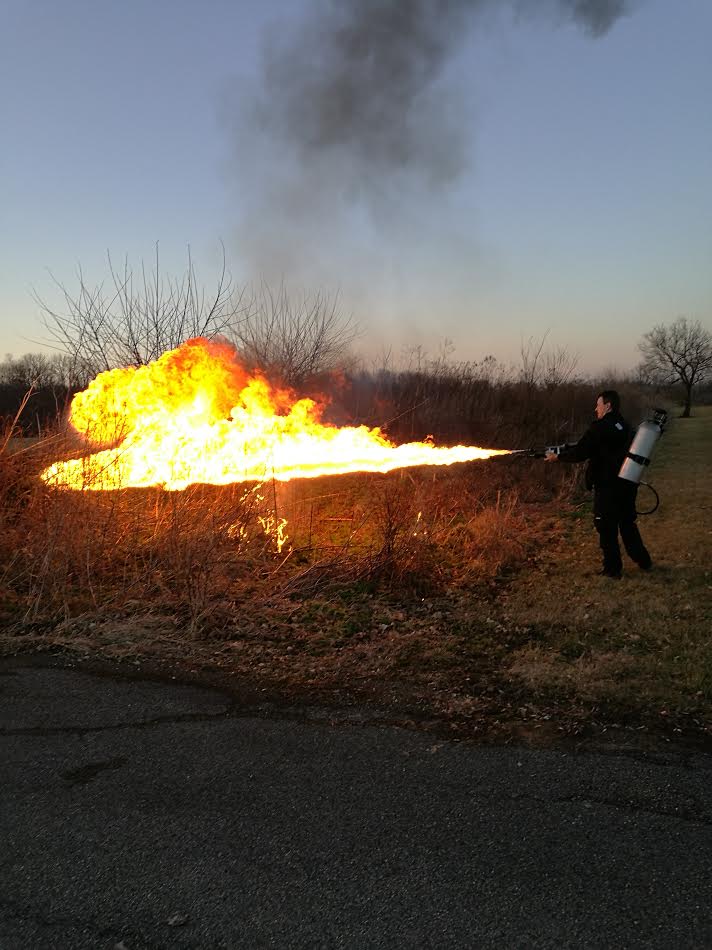
Once charged live, we tested it by burning off brush around a drainage pond. There is actual recoil, or more accurately thrust, from firing this. The operator remains relatively cool, but the flame emits radiant heat to the sides that is palpable at quite some distance.

The pond was about 50 feet by 20 feet in size and was surrounded by heavy greenery and weeds. It took less than two minutes (two charges) of both working and playing about to clear a five foot swath all the way around.

I then tested it on one of my property’s abandoned animal runs, which was about 20′ square. It was full of trash, trees, weeds, and brush. One tank and about 60 seconds cleared it down to ash and stalks, making it much easier to finish clearing with shears and loppers.

We kept a fire extinguisher handy, and I strongly recommend doing so for safety. It wasn’t needed, but if it becomes so it would be critical. As fun as it is to operate, this is not a toy.

For brush removal around a position to clear a field of fire, it would be much faster than hand tools, assuming the fuel is available. For igniting debris, even when wet and cold, it is hard to beat. Caution: Do not inhale fumes from burning debris if it might contain toxic chemicals, or if it contains toxic plant matter, such as poison ivy.

For a defensive weapon, it would be hindered by the prep and loading time as well as the limited burn time and range. However, for protecting an emplaced position, it would work very well to deny large swaths of ground to any attackers, for firing existing burn piles for cover or concealment, and for direct distraction and concealment behind a huge ball of flame and smoke. It could be used to corral attackers into a chosen area of effect. It would not instantly stop a vehicle, but any unhardened vehicle would be rendered inoperable in seconds. In extremis, it would be instantly incapacitating and lethal within its range, causing traumatic, contaminated burns. In enclosed spaces, such as bunkers, sheds, or entryways, it consumes most of the oxygen, leaving any occupants with a lungful of smoke and carbon monoxide. I caution that this would have to be during a siege or mass attack when law and order has broken down. Any use as a weapon with existing legal infrastructure would probably constitute pre-meditation, would definitely attract unfavorable government and media attention, and least of all but certainly an EPA bill for cleanup. But if it was to hand when your life was threatened, it’s a trump card of psychological magnitude and terror.

We found occasional ignition issues with pure diesel, the fuel blowing right across the igniter without catching. Releasing the trigger and re-firing usually corrected this at once, and the projected fuel then lit from the second shot. With mixed fuel and oil, there were no ignition problems at all.

There are improvements that could be made. The igniter would benefit from a fabricated attachment rather than hose clamps. While the pressure bottle was secure enough, a clamp assembly would be sturdier than relying on the fittings. However, I’ve had no trouble with reliability.

Photo links below show the short range and effectiveness of straight diesel.

I rate it excellent for brush removal. It’s unexcelled for fun, if you like controlled fire. As a weapon, it’s limited in utility but devastatingly psychologically effective.

There are other models out there, but I have found this to be the most cost effective, range effective, and capacity effective model. To the best of my research, flamethrowers are unrestricted in 48 states, prohibited in Maryland, and require fire marshall approval to use in California, which given the risk of brush fires isn’t entirely unreasonable in this case.

Note: I purchased my own model and use it on my property for brush removal. I was not compensated in any way for this review.


  • SurvivalBlog Resources: Retreat Security

    Introductory Note: The following is another in a series of articles by JWR that will link to some of the thousands of archived SurvivalBlog articles and letters, grouped topically.

    Today, we address the broad issue of retreat security measures.

    In my estimation, many preppers have a tendency to over-buy on their gun budget and under-buy on their night vision and intrusion detection budget. I would much rather own just a few guns and have a full complement of other key retreat security gear. After all, humans can’t see well at night with un-aided eyes, and we can’t be vigilant 24 hours a day. Many of the following articles address such gaps in retreat security planning, gear, and training. And some of your most important “gear” might be very low tech or even “no tech”—such as trip flares, bells, and well-trained guard dogs.

    Thee following are just a sampling of the articles and letters on retreat security that have been posted over the past 11 years:

    Closing Note: You can use our recently improved Search box at the top of the blog’s right hand column to find even more articles. (The ones that I’ve linked to are just a sampling.) The new Search tool is much more useful that the old one. When searching, use quote marks around terms that need to appear together, for example: “photovoltaic panel”. You can also use the word “and” in search phrases to combine multiple search terms, such as “seismic and detection”. – JWR


    Two Letters Re: My Family Preparedness Plan, by R.S.

    Hugh,

    As the article observes, silver will be more useful in small denominations. My question is: How will sellers recognize that “junk silver” has more than face value, and how will that value be determined? – RJB

    HJL’s Comment: Junk silver has the advantage of being widely recognizable, and the smallish value as well as the wear and tear that it already has makes it harder to counterfeit. It certainly has a distinctive look to it and is easy to evaluate. It will not take long for that value to be recognized and established. As to what that value is? Whatever it takes for the seller to part with the silver and whatever the buyer is willing to spend. It’s only worth what you can sell it for.

    o o o

    HJL,

    I was raised without electricity or running water pretty far out of any town. I will go back to that way of life and plan on living a simple, cautious life. It isn’t difficult if you have patience and appreciate the simple life. – puzltock

    HJL’s Comment: Having already experienced that lifestyle, you have an advantage, but it may not be as simple as most think. My family always had a large garden (~100′ x 100′) while I was being raised, but when I made the decision to have my own garden I discovered that a lot of wisdom had not been passed on to me (or I just simply didn’t listen; children have than tendency.) Having my first garden was certainly not as easy as sticking a seed in the ground and watching it grow. It probably took me three or four years before I began to see a reasonable return on my labors in the garden. Most living skills are like that. While you can alleviate most issues like this by simply having a small garden that you practice with and enlarging it when the time is right (or whatever skill it is), there are some living skills that only get practiced when creature comforts are not available.


    Economics and Investing:

    Illinois Revenue Freefall: Fiscal Year-to-Date -8.1% and Worsening. Sadly, my state of Connecticut seems to be going down the same path! Now they are talking about a HUGE tax on our hospitals! – H.L.

    o o o

    Time To Hedge State Reserve Funds With Gold. Excerpt: “Financially prudent individuals set aside surplus funds to protect against unforeseen expenditures. This way, when faced with loss of income, house repairs, car trouble, or anything else, they will have a buffer against unanticipated downturns.” – H.L.

    o o o

    Stores Are Closing at a Record Pace as Amazon Chews Up Retailers. Sad. Soon everything will have to be purchased online or over the phone. ?- DSV

    o o o

    QE Infinity And The Two Biggest Risks To World Markets

    o o o

    SurvivalBlog and its editors are not paid investment counselors or advisers. Please see our Provisos page for details.


    Odds ‘n Sods:

    SurvivalBlog reader T.N. joined in the conversation of EMP and our nation’s difficult-to-replace power transformers with this impressive news item from 2015 about one of the huge transformers being delivered to southern Utah: Huge transformer to arrive in Monticello Monday. This certainly puts the problem in perspective!

    o o o

    Showing once again the futility and pointlessness of gun control laws: Neighbor used homemade air gun to kill Lehigh County mom -Will we outlaw plumbing supplies next? – T.P.

    o o o

    Map showing why Europe will be extinct These maps show how fragmented Europe is and why the European Union is destined for extinction. – G.P.

    o o o

    More on the private property issue we have been talking about on SurvivalBlog: Law School Professors Reject Property Rights. – B.B.

    o o o

    The Vast, Secretive Face Database That Could Instantly ID You In A Crowd – B.B.


    Notes for Friday – April 07, 2017

    April 7th is the birthday of Colonel Bob Denard (born 1929, died October 13, 2007). He had an amazing life as a mercenary, including four attempted coups in the Comoros.

    o o o

    Today, we present another entry for Round 70 of the SurvivalBlog non-fiction writing contest. The nearly $15,000 worth of prizes for this round include:

    First Prize:

    1. A $3000 gift certificate towards a Sol-Ark Solar Generator from Veteran owned Portable Solar LLC. The only EMP Hardened Solar Generator System available to the public.
    2. A Gunsite Academy Three Day Course Certificate that is good for any one, two, or three day course (a $1,195 value),
    3. A course certificate from onPoint Tactical for the prize winner’s choice of three-day civilian courses, excluding those restricted for military or government teams. Three day onPoint courses normally cost $795,
    4. DRD Tactical is providing a 5.56 NATO QD Billet upper with a hammer forged, chrome-lined barrel and a hard case to go with your own AR lower. It will allow any standard AR-type rifle to have a quick change barrel, which can be assembled in less than one minute without the use of any tools and a compact carry capability in a hard case or 3-day pack (an $1,100 value),
    5. An infrared sensor/imaging camouflage shelter from Snakebite Tactical in Eureka, Montana (A $350+ value),
    6. Two cases of Mountain House freeze-dried assorted entrees in #10 cans, courtesy of Ready Made Resources (a $350 value),
    7. A $250 gift certificate good for any product from Sunflower Ammo,
    8. Two cases of Meals, Ready to Eat (MREs), courtesy of CampingSurvival.com (a $180 value).

    Second Prize:

    1. A Model 175 Series Solar Generator provided by Quantum Harvest LLC (a $439 value),
    2. A Glock form factor SIRT laser training pistol and a SIRT AR-15/M4 Laser Training Bolt, courtesy of Next Level Training, which have a combined retail value of $589,
    3. A gift certificate for any two or three-day class from Max Velocity Tactical (a $600 value),
    4. A transferable certificate for a two-day Ultimate Bug Out Course from Florida Firearms Training (a $400 value),
    5. A Trekker IV™ Four-Person Emergency Kit from Emergency Essentials (a $250 value),
    6. A $200 gift certificate good towards any books published by PrepperPress.com,
    7. A pre-selected assortment of military surplus gear from CJL Enterprize (a $300 value),
    8. RepackBox is providing a $300 gift certificate to their site, and
    9. American Gunsmithing Institute (AGI) is providing a $300 certificate good towards any of their DVD training courses.

    Third Prize:

    1. A Royal Berkey water filter, courtesy of Directive 21 (a $275 value),
    2. A custom made Sage Grouse model utility/field knife from custom knife-maker Jon Kelly Designs, of Eureka, Montana,
    3. A large handmade clothes drying rack, a washboard, and a Homesteading for Beginners DVD, all courtesy of The Homestead Store, with a combined value of $206,
    4. Expanded sets of both washable feminine pads and liners, donated by Naturally Cozy (a $185 retail value),
    5. Two Super Survival Pack seed collections, a $150 value, courtesy of Seed for Security, LLC,
    6. Mayflower Trading is donating a $200 gift certificate for homesteading appliances,
    7. Montie Gear is donating a Y-Shot Slingshot and a $125 Montie gear Gift certificate.,
    8. Two 1,000-foot spools of full mil-spec U.S.-made 750 paracord (in-stock colors only) from www.TOUGHGRID.com (a $240 value), and
    9. Fifteen LifeStraws from SafeCastle (a $300 value).
    10. A $250 gift certificate to Tober’s Traditions, makers of all natural (organic if possible) personal care products, such as soap, tooth powder, deodorant, sunscreen, lotion, and more.

    Round 70 ends on May 31st, so get busy writing and e-mail us your entry. Remember that there is a 1,500-word minimum, and that articles on practical “how to” skills for survival have an advantage in the judging.


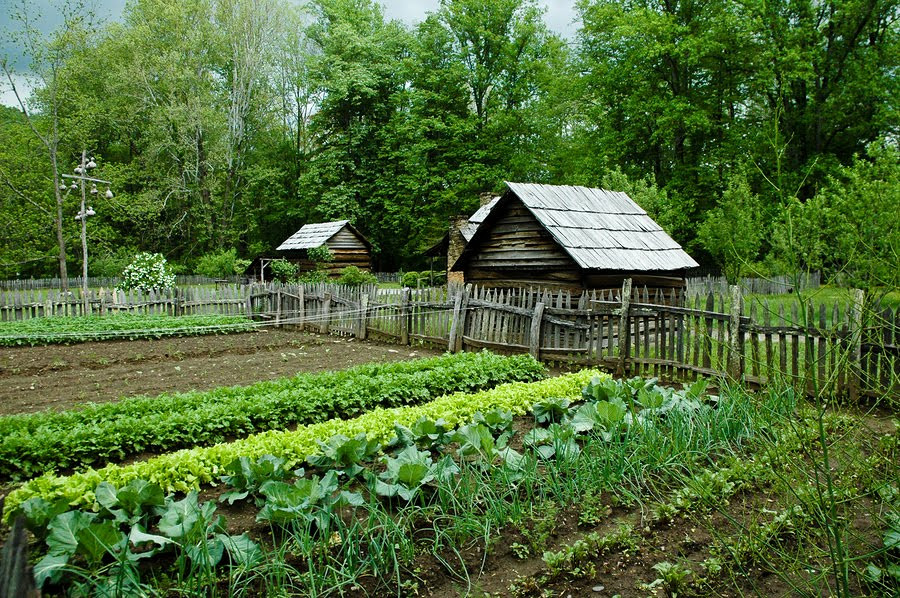
    The Human-Powered Veggie Garden- Part 2, by J.A.

    Deep Digging and Rock Removal

    The second round of digging is the hardest work of the whole project. The process is much like the first round, except the goal is to be able to bury the whole head of your shovel in loose soil when you are done. This time, if you hit a rock in the process of achieving that, it has to go. As you back up, some of the rocks will expose an edge you can get under with the shovel. This is where buying good tools, and sharpening your shovel is really going to pay off. Use the shovel to poke under an exposed edge of a stone to create leverage and pry it out. You may have to go slightly off track or attack from a different angle, but if you stick with it for a few seconds, you will find a way to easily pry most of them out. In the instance where you hit a rock that extends far back under the ground you are still standing on and have yet to dig, skip it and remove it while digging another row that exposes enough of it for you to extract it easily. Stay hydrated. Keep your eye on the prize, because when this is done you will be left with the beginning of a great garden bed that only improves with time.

    Make Rows and Beds and Smooth the Paths

    At this point in the project, if the amendments you used included any non-composted manures or fibrous organic matter, like grasses or leaves, I would let it sit for at least two weeks. If you amended the soil with “well-rotted” compost, you can begin the next step immediately. Depending on how large it is and how your garden is configured, you will need to dig some paths and create more than one bed for the plants. The idea is to not have to step on the beds, thereby eliminating a lot of potential damage to roots. When you avoid stepping on the beds, they stay loose and well-drained, allowing maximum root penetration and oxygen delivery. Dig your paths according to how easily you can reach into the bed to tend to the plants. To dig the path, simply use a transfer shovel to move soil from the intended path up and onto the beds that you will be forming. Dig it down about 6-8” below the tops of the beds you are making. Even out the beds and smooth the paths. Finally, rake the tops of the beds with a ***stone rake to remove rocks and loosen up a seedbed. The beds are now ready to be planted.

    Spacing of Plants

    The spacing of your plants is critical in the philosophy behind a garden like this. I mentioned earlier about the highly intensive gardening practices used and recommended as part of conventional wisdom. Growing as many plants as possible in a given space is fine for modern society, when we can be reliably sure that we can run irrigation in our gardens on-demand. This works fine when we have chemical fertilizer and literal tons of compost and soil amendments available at multiple retailers in every community. The point here is that if gardening is to work in a survival situation, you may be forced to largely rely upon the rain that falls for your watering.

    Spacing becomes an issue because when a canopy of leaves forms, the plants generally stop getting bigger and hit their peak of water consumption. Plants that are spaced closely will be small when this happens. This means they have shallow root systems with small footprints. They don’t penetrate deeply, and if a drought hits, they will need constant supervision to survive until the next rain. Although you can most definitely recover a plant that wilts in the sun from lack of water if you address it quickly, the stress this places on the plant will set it back days and possibly weeks. Plants that are allowed room to grow large before a canopy forms will have deep roots and large, sturdy stems. They can better survive both harsh weather and longer periods without water than plants that are spaced close together.

    Every plant has different requirements, so my general rule of thumb for spacing is whatever the seed packet says, I at least double it. The first year of this garden, I grew sweet corn. I did two 10 foot square beds and put four rows of corn in each bed with individual plants spaced 12 inches apart within the rows. These plants had plenty of room to grow and were over six feet tall before any of their leaves touched. They ended up topping out over eight feet, with some plants growing lateral branches and secondary sets of ears. Conventional wisdom might say this is wrong, but if you offset the rows, there is still enough wind protection, and I didn’t have any fall over in that particular year. The second year, I grew peppers in that bed. I did a total of 12 plants in both beds, arranged in four corners, plus two in the middle arrangement. There were bell peppers in one bed and habanero peppers in the other. I was pushing the spacing way out this time, trying to see how it would affect the yield. When I grow habaneros in a raised bed, I might get a dozen or so ripe peppers from a healthy plant. These plants each had over 75 ripe peppers, with the best three having more than 100. Give your plants room to grow. Their odds of surviving long enough to produce go up when they get bigger faster. The payoff in yield will be worth the weeding.

    Weeding

    Remember the sharp hoe? This is the primary weeding tool, and if you take it with you on your daily patrol of the garden you should never have to dig a weed by hand. If you see a green shoot that is in a position you didn’t plant a seed, use the corner of your hoe to lift it up out of the soil. That’s it. If will almost definitely shrivel and die as soon as the sun hits its now exposed tiny roots. If one happens to slip by you for a couple days, the sharpened bevel of the hoe will easily chop it off just below the soil surface, cutting off the energy supply of the root below. That will die just as easily as the ones you pluck out. The key here is discipline. You can weed once a week if you choose to, but your plants will grow more slowly and the weeding will be more difficult every time. You don’t want to skip a week. Just weed every time you visit the garden. Be diligent about not letting any plant that you don’t want growing in your garden steal vital nutrients from your vegetables. Weeds die very easily when they are young. Once your plants get big and form a canopy, this chore diminishes, but if you are disciplined it never gets hard in the first place.

    Here’s a note on “weeds”. A lot of the plants that we typically don’t want growing in our gardens, like wild spinach, dandelions, wood sorrel, and sheep sorrel to name a few, are not only edible but nutritious and delicious. I grow some of each in my garden every year. In a survival situation, simply turning over sod and letting the “weeds” grow could provide you with a lot of food in the form of leafy greens that grow very quickly. The seeds are already in the ground, waiting for the conditions to germinate. Turn the soil over, and they will grow. You would still need something to eat while the garden grows.

    Watering

    Watering is pretty simple if you space your plants properly and live in a place with consistent rain. Where I live, rains tend to be concentrated in spring. We also have frequent afternoon thunderstorms in summer months, making the amount of watering I do for my double-dug gardens nearly zero. Even on a hot, dry day, if you go down an inch or so into the soil, you will find plenty of usable moisture. As long as the grass isn’t getting crispy, a garden like this with properly spaced plants will not require much watering input on your part. If you do water and you chose a sunny, well-drained location, it’s pretty hard to overdo it if you are watering by hand. I prefer to water in the morning rather than the evening, so that I am not soaking the roots with cold water before hours of darkness. Soil temperature makes a big difference in how quickly things like germination and early growth take place; therefore, I try to water when the sun is coming up so the plants get warmed immediately. There are innumerable strategies for storing and moving water in a grid-down scenario, and they have been covered on this blog in great detail. Your individual strategy will vary from mine, but I plan on running a hose to my garden to gravity feed from an artisanal well.

    Maintenance

    The ongoing, year to year maintenance of this type of garden is much simpler and less time consuming than the initial start-up. Your thoroughness and diligence in removing large stones and digging in deep the first time through will be rewarded with deep, loose soil that roots can penetrate easily in search of the space they need to make large, resilient plants. When you are finished growing for the year, remove all the above-ground vegetation. I don’t put much thought into whether or not I get the roots out. If you leave them in the ground, they will rot down and add both nutrition and organic matter to the soil for next year. If you remove them from the garden, they will presumably become part of a compost pile and the end result will be nearly the same. After the vegetation is removed, you can be finished and come back when the ground thaws, plant cover crops, or spread amendments that might take some time to break down. These would include un-rotted manure and fall foliage– two that I have used in the past. When you are ready to start again the following spring, you simply spread any amendments you want in the soil for the season and make one pass with the shovel to incorporate the amendments and prepare the soil for planting. It will be easy work this time, since the soil is loose and previously worked. Dig your paths to form the beds, and you are ready for another growing season.

    Satisfaction

    At this point it would be natural to conclude that this is a ton of unnecessary labor for what you might assume to be similar results to a rototilled garden. This is partially correct in that the labor is currently unnecessary. There are easier ways to garden, and there is currently an abundance of relatively inexpensive, high quality tools, seeds, fuel, and soil amendments. It is also partially incorrect, because if this method is followed and worked with discipline, the results end up far superior. For me personally, gardening was originally inspired by a combination of nutritional reasons and the desire to prepare for harder times by learning a valuable skill. This style of gardening satisfies both requirements for me, while training and instilling confidence in me for the type of gardening that would be required during an extended crisis. This practice will give you a good gauge based on how many hours per week you put into your garden for the yield you get. You can multiply this out to plan for how much land you could personally cultivate as a full-time endeavor. This will give you a good estimate as to whether you currently have enough manpower to grow as many calories as you are planning to need. This information can be used to adjust food storage plans now.

    I hope you will find this to be an informative guide on how you can hand-dig a garden that can easily adjust from the current bounty to times of crisis, and that it can be accomplished with a small budget and dedicated work. I’m not recommending you sell your tractor or rototiller, but this is a good way to expand your survival skillset in the comfort of modern luxury with enjoyable and rewarding results.


    Letter Re: My Family Preparedness Plan, by R.S.

    Hugh,

    The best books I have read concerning an EMP are Lights Out by Ted Koppel and Collapse You’re On Your Own by Kay Mahoney. One is fiction, and one nonfiction tells us all we need to know about a terrible event. The first book examines the reality of our delicate electronic infrastructure and how easily it can be shut down. The second book tells the story of the aftermath of an EMP on regular, small town folks, like us, and how we might handle the calamity. I like my electricity and the comforts it provides to me and my family, but I also know our grid is vulnerable in many ways. So, get prepared for no electricity and enjoy the today. – T.M.

    o o o

    Hugh,

    I interviewed Dr. Peter Vincent Pry on my radio show. Dr. Pry is the head of The Commission to Assess EMP. He stated that when it came to testing motor vehicles, they were mandated to “hold back” on the strength of the pulse the vehicles were subjected to, for budgetary reasons. They were further told to do this so the test vehicles would suffer minimal damage, thus making them easy to repair and sell. Therefore, according the Dr. Pry , we really don’t know the consequences/damage a strong pulse will do to modern motor vehicles. The tests of a weak pulse on modern motor vehicles did minimal damage but still allowed them to run. Assuming that they will run when exposed to a strong pulse is wishful thinking. The full report of the commission is a free download at my web site www.thelibertyman.com. I also recommend reading Dr. Pry’s book: Apocalypse Unknown: The Struggle To Protect America From An Electromagnetic Pulse Catastrophe. He’s authored several other books, but I believe this one would give the best overall view on the matter.

    The 90% level of fatalities in one year is based on several things not mentioned in what I’ve read thus far in your article.

    1. Prescription medications: The percentage of Americans that take these medications daily to stay alive? One-third of all Americans would be a conservative number. Almost all scrips are for a 30-day supply, which means the average person has a 15-day supply.
    2. The very large, very expensive (million dollar plus) transformers that control the three national power grids in the lower 48 require a full year from the order being made to delivery being made in normal times. No, there is no inventory of replacement transformers in the USA. Granted, hard-working, clever, power company technicians may be able to do work-arounds in limited geographical areas. Those areas would be truly blessed and quickly find themselves overwhelmed with refugees.
    3. In general terms, the following is a true statement: Everything you need to repair what’s broken is also broken.
    4. It will take 2 to 3 days for all municipal water supplies to be exhausted. Waste water systems will go down immediately. Hint: Municipal waste water systems use gravity to get the waste water to pump stations (run be electricity) to pump the waste to the treatment plant. When that stinky brown water starts bubbling up through your basement floor drain, it’s past time to jam rags into the drain pipe. (That’s better done before the fact.)

    I’m a big fan of SurvivalBlog and interviewed Mr. Rawles a number of times in the 1998-1999 time frame when I was on WGNU 920 AM in St. Louis. I’m now with Republic Broadcasting Network in TX and do a daily show 0800 to 1000 hours Monday through Friday. – John Moore


    Economics and Investing:

    From Hubert Moolman: Gold and Silver Boom or Bust – A bit heavy on the charts but interesting nonetheless.

    o o o

    OPEC’s No.2 Goes Rogue: Plans 600,000 Bpd Oil Output Increase. Despite talks of an OPEC extension, Iraq, which is OPEC’s second-biggest exporter, has plans to boost crude production to 5 million bpd by the end of the year.

    o o o

    I listened to a sermon one time about the phases that many organizations go through. There is the time of passion in which men and women of great passion do extraordinary things and the organization grows like crazy. They eventually reach a stage where the people in charge sit back on their heels and enjoy the ride that their predecessors created, but eventually, the organization slides to the point where you often hear the phrase “I remember the good ol’ days,” and the organization lives in its past glory days with nothing of real value to add to the current time. It is a hollow organization at that point. Wait, did I just describe our government’s management of America? The Hollowed Out System – link sent in by reader H.L.

    o o o

    Trump’s Tax Overhaul Keeps Congress Waiting as Questions Pile Up

    o o o

    SurvivalBlog and its editors are not paid investment counselors or advisers. Please see our Provisos page for details.


    Odds ‘n Sods:

    Over at SHTFPlan.com: These Two South Carolina Lawmakers Are Planning to Create Survivalist Communities Across the Country

    o o o

    Nathan, over at The Price of Liberty blog recommended this fascinating article at Gun Culture 2.0: The Problem with Averages in Understanding Guns, Violence, and Crime (Take 2)

    o o o

    I was doing some web wandering and found this interesting company in Tempe, Arizona: Prepper’s Discount – JWR

    o o o

    If this report is anywhere even close to true, we are very near the bottom of the slippery slope: Judge Openly LAUGHS At Bundy Ranch Defendants Rights – link sent in by T.R.

    o o o

    This easy-to-set-up emergency water collection system can save your life – DSV


    Hugh’s Quote of the Day:

    “Collective wisdom, alas, is no adequate substitute for the intelligence of individuals. Individuals who opposed received opinions have been the source of all progress, both moral and intellectual. They have been unpopular, as was natural.” – Bertrand Russell