Homebuilders Could Be Losers in Early Test of Trump Trade Policy. “A long-simmering trade dispute between the U.S. and Canada over lumber is heating up, increasing the cost of building houses and causing American businesses to hunt for supplies in other countries.”
o o o
SurvivalBlog and its editors are not paid investment counselors or advisers. Please see our Provisos page for details.
Find your secure and sustainable home. The leading marketplace for rural, remote, and off-grid properties worldwide. Affordable ads. No commissions are charged!
Max Velocity Tactical (MVT) has several training events scheduled for May and June near Midvale, Idaho and in Romney, West Virginia. This is top notch training. Be sure to check it out!
Bose headphones spy on listeners – lawsuit. “Bose Corp spies on its wireless headphone customers by using an app that tracks the music, podcasts and other audio they listen to, and violates their privacy rights by selling the information without permission, a lawsuit charged.” – DSV
o o o
The Most Controversial DNA Test You’ve Never Heard Of. “A vote on whether to approve a proposal that would allow familial DNA searching in certain criminal cases has been delayed by New York state’s Forensic Science Committee.” – D.W.
Click Here --> The Civil Defense Manual... The A to Z of survival. Looks what's in it... https://civildefensemanual.com/whats-in-the-civil-defense-manual/
“No matter how disastrously some policy has turned out, anyone who criticizes it can expect to hear: “But what would you replace it with?” When you put out a fire, what do you replace it with?” – Thomas Sowell
FOR SALE: Self-sustaining Rural Property situated meticulously in serene locales distant from densely populated sanctuary cities. Remember…HISTORY Favors the PREPARED!
April 19th is the original Patriot Day which marks the multiple anniversary of the battles of Lexington and Concord, known as “The Shot Heard ‘Round the World”. This first battle, leading to our nation’s independence, was the then-dictator’s (United Kingdom King George III’s) failed attempt at “gun control”– an act being carried out in too many parts of our USA right now. This first gun control of the colonies was a failure, because of the will and determination of a small part of the population (about 3% actually fought for our independence actively, with many others supporting) to stand up to an oppressive, controlling government (England). Without the sacrifice by those few Patriots, we could very well still be “British subjects” rather than independent citizens. Note that due to corporate and government bureaucracy, the celebration has generally been moved to the third Monday in April to facility a postal/banking holiday.
It also marks the anniversary of the Warsaw Ghetto uprising against the Nazis in 1943, the BATF’s costly raid on the Branch Davidian Church in Waco, the gun turret explosion on the USS Iowa in 1989, the capture of the Boston Marathon bomber in 2013, and very sadly also the Oklahoma City bombing in 1995.
April 19th is also the birthday of novelist Ralph Peters. Coincidentally, Ralph and JWR both have the same literary agent, Robert Gottlieb.
A $3000 gift certificate towards a Sol-Ark Solar Generator from Veteran owned Portable Solar LLC. The only EMP Hardened Solar Generator System available to the public.
A Gunsite Academy Three Day Course Certificate that is good for any one, two, or three day course (a $1,195 value),
A course certificate from onPoint Tactical for the prize winner’s choice of three-day civilian courses, excluding those restricted for military or government teams. Three day onPoint courses normally cost $795,
DRD Tactical is providing a 5.56 NATO QD Billet upper with a hammer forged, chrome-lined barrel and a hard case to go with your own AR lower. It will allow any standard AR-type rifle to have a quick change barrel, which can be assembled in less than one minute without the use of any tools and a compact carry capability in a hard case or 3-day pack (an $1,100 value),
An infrared sensor/imaging camouflage shelter from Snakebite Tactical in Eureka, Montana (A $350+ value),
A custom made Sage Grouse model utility/field knife from custom knife-maker Jon Kelly Designs, of Eureka, Montana,
A large handmade clothes drying rack, a washboard, and a Homesteading for Beginners DVD, all courtesy of The Homestead Store, with a combined value of $206,
Expanded sets of both washable feminine pads and liners, donated by Naturally Cozy (a $185 retail value),
Round 70 ends on May 31st, so get busy writing and e-mail us your entry. Remember that there is a 1,500-word minimum, and that articles on practical “how to” skills for survival have an advantage in the judging.
#1 Trusted Gravity Water Purification System! Start Drinking Purified Water now with a Berkey water filtration system. Find systems, replacement filters, parts and more here.
With spring finally here, many a homesteader is turning their thoughts to this year’s vegetable garden. Whether their garden is large or small, experienced gardeners know the successful garden begins well before the seed is planted. Many gardeners diagram on paper where they want to plant what vegetable, how many rows of each, and calculate how many bedding plants or how much seed they will need. Then, it’s off to the seed catalogs or local nursery to stock up.
For many of us who have been raising gardens for a long time, there’s nothing quite like planting seeds in grow boxes to raise our own bedding plants or planting seeds directly into the ground. I confess, I go to the garden everyday to see if the seeds I planted have sprouted. I walk to the end of the row, and even after all these years I still get a thrill when I see a perfect row of tiny plants breaking through the soil. When that happens, I know I’ve been successful at least up to that point.
Being successful as a gardener brings many rewards; you learn and develop a practical skill, provide food for yourself and family, lower grocery bills with home-grown produce, enjoy the freshest of food, and hopefully grow enough to dry, can, or freeze the extra for later non-season use. Yes, the benefits are many, but the disappointments can be there as well. Here, where I live in Tennessee, summers can be extremely hot and dry. In some years, I will not cut my grass for three or four weeks at a time, because we’ve received so little rain. No rain means all the hard work I’ve put into my garden to that point is completely wasted. Nothing, and I mean nothing, is more disappointing than watching your plants wither and die because of no rain.
Mother nature does the best job of watering; it’s far superior to anything I can do with a garden hose and a few hundred gallons of city (read chemicals added) water. But during periods of drought, especially when your plants are setting fruit, regular amounts of water are vital. Enter a rainwater harvesting system. Yes, you still have some work to do to actually water your garden, but with harvesting rainwater your plants will get the best water possible. You’ll also save money on your water bill, and depending on where your garden is located you may be able to significantly reduce the number of hoses you have to buy, maintain, and use to stretch from your home faucet to your garden. Perhaps the best reason of all is that by harvesting rainwater you will never be completely dependent on your municipality’s electric-driven water pumps to obtain water. If we are ever faced with a TEOTWAWKI situation, raising your own food will take on an extremely critical role in your personal long-term survival. With no city water available, your rainwater harvesting system will take on added importance, providing you and your family with precious drinking water as well as water for your garden.
I built my own version of such a rainwater harvesting system several years ago and have used it with great success ever since. It was very easy to build, requires virtually no maintenance, and is 100% efficient in capturing and storing rainwater. I already had four 55-gallon metal barrels I’d picked up a few years ago, but I wanted an additional four barrels to store more water. After making a few neighborhood inquiries, I found the four additional barrels I needed. Eight barrels gave me a total storage capacity of 440 gallons.
Figure 1
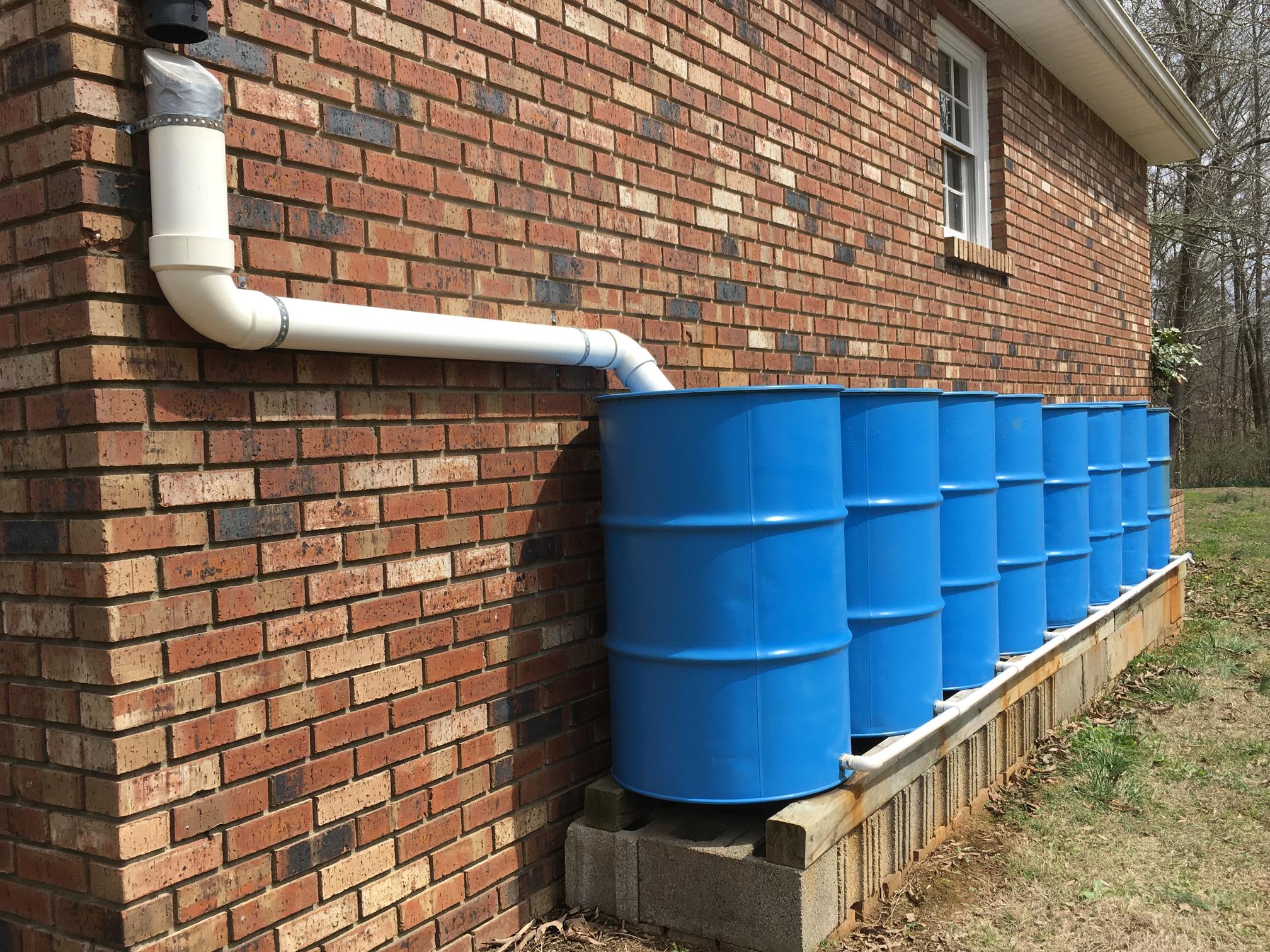
It wasn’t hard in determining where my harvesting system was to be located. My 6,200 square foot garden space is behind a 20′ x 32′ garage. I wanted to capture the rainwater runoff from the garden-facing roof of the garage, so I figured it would be easy enough to set the rain barrels side by side along the garage wall. (Figure 1.) Water is heavy, weighing in at 8.34 pounds per gallon. A full 55-gallon drum is going to weigh nearly 460 pounds; that’s a lot of weight, and a proper foundation is critical for a trouble-free system.
After determining where the barrels would be located, I began leveling the ground with a hoe and a four foot level. Because the ground was on a slight slant, and because I’m basically lazy and didn’t want to do a lot of digging, I used some old brick on a part of the slope to help level the ground. Next, I set twelve standard 8” x 16” concrete blocks end to end directly along the garage wall on the ground or bricks making sure they were reasonably level. That completed the back side of my foundation. Then, I measured 24” out from the wall (the width of a 55-gallon barrel) and put a second row of concrete blocks to finish the foundation. Knowing that each barrel would weigh 460 pounds when full, I decided to lay 4” x 4” posts on the concrete blocks to help more evenly distribute the overall weight. Then, I set the first barrel in place.
Figure 2
I located the first barrel a few feet away from the downspout, since I wanted to route the water directly into the top of this barrel. I cut the downspout off about 24” above this barrel and ran a short piece of 4” PVC pipe from the downspout to a hole I cut into the lid of the barrel. (Figure 2.) I secured the piping with metal straps screwed into the garage wall. One PVC elbow on each end of the 4” PVC pipe directed the water from the downspout through the pipe and into the first barrel. I wanted to be able to filter out any small twigs, leaves, and other debris, so I cut a slant to the PVC collector and covered it with screen wire. The screen easily filters out what I don’t want in the barrels but lets the water pass through. I cut the PVC collector at a slant so any debris caught by the screen is simply washed off by the flow of water. When the barrels are completely full of water, I cover the PVC collector (a small plastic bag works great) to shed off any more water, letting it simply fall on the splash guard on the ground below. When I want more water, I take the plastic bag off and collect all the water I need.
Figure 3
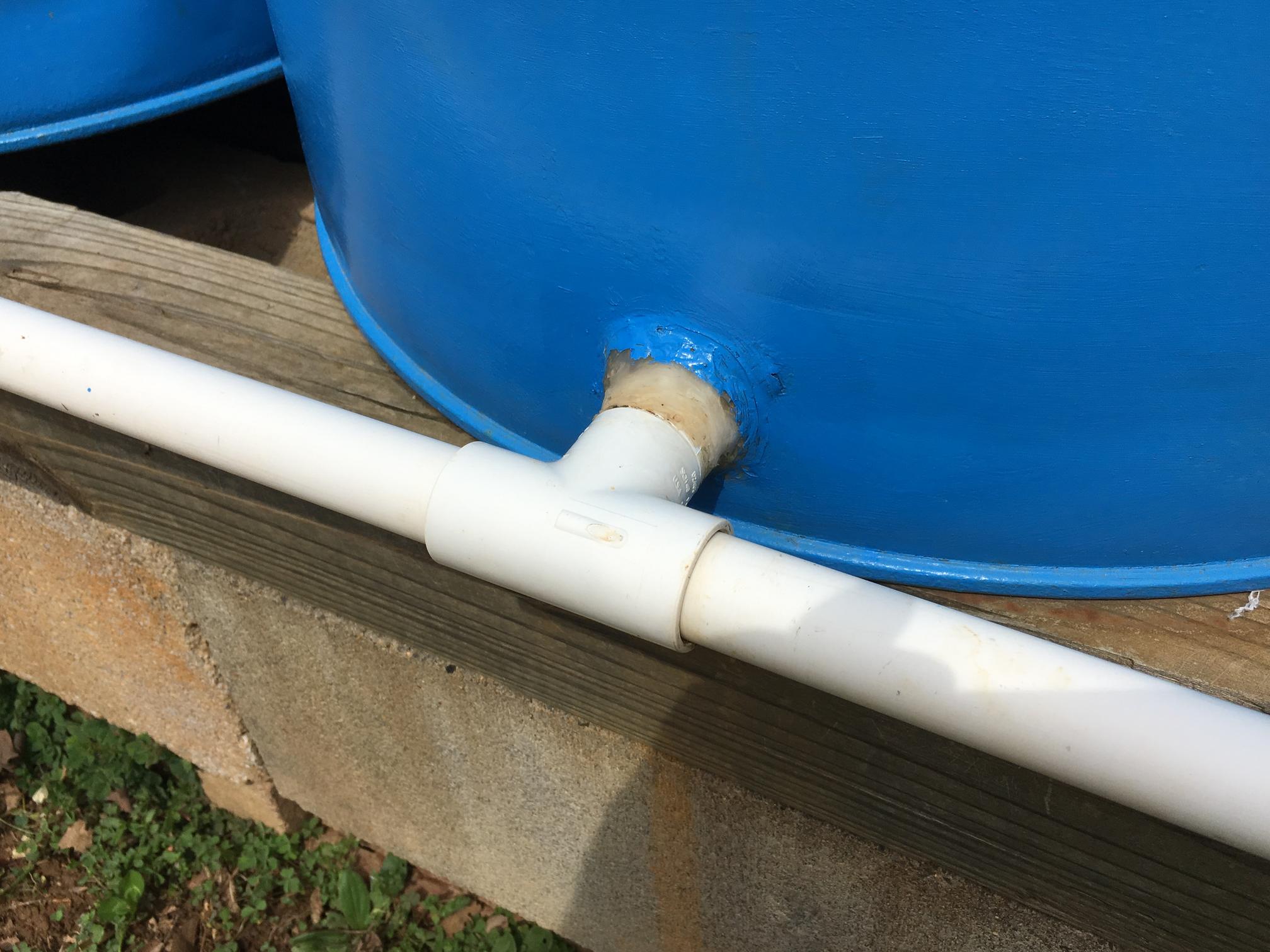
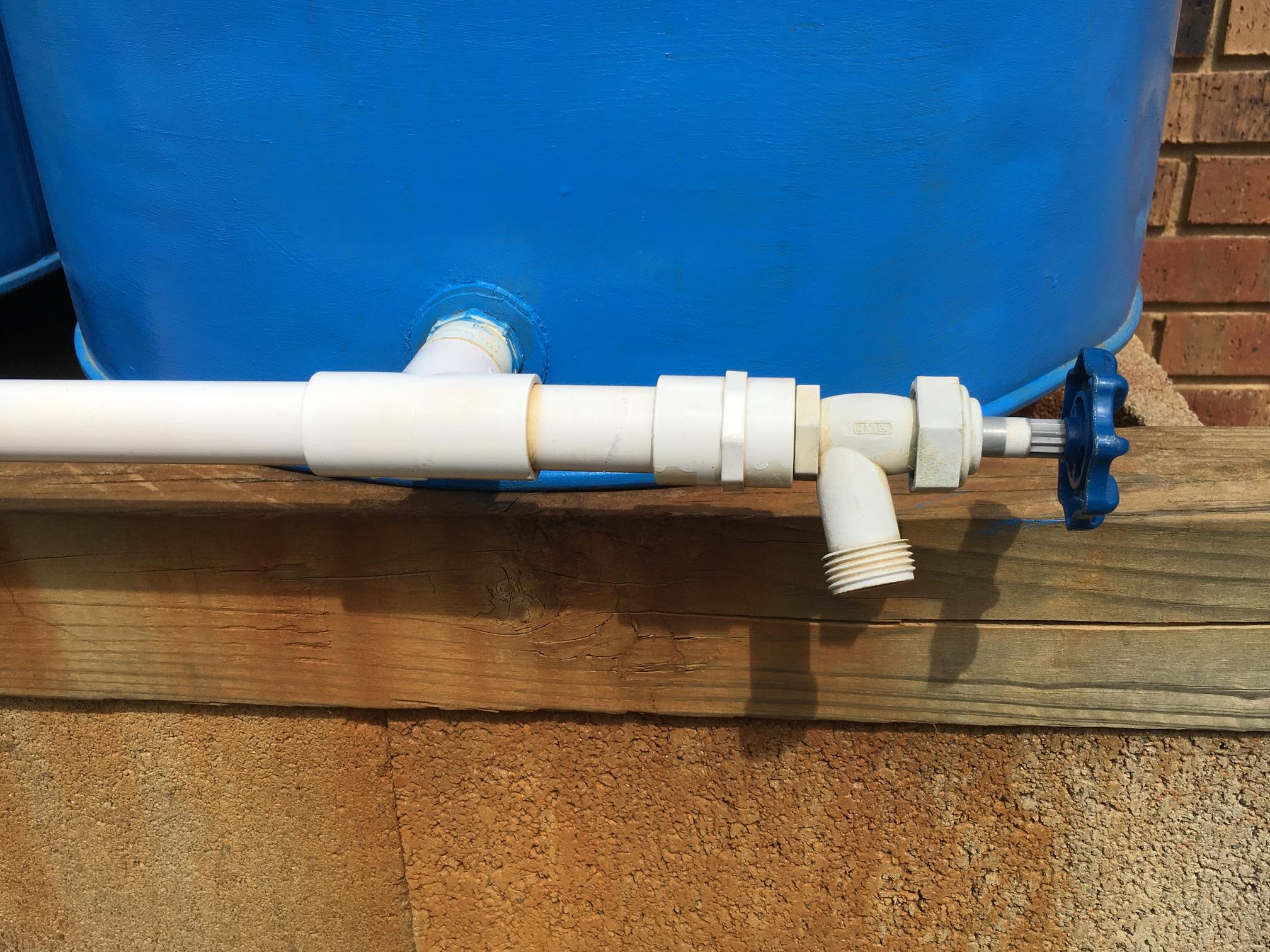
I drilled a 1 1/4” hole on the side of each barrel, 2” up from the bottom, and inserted a 1” x 3/4” PVC adapter (thread & slip) pipe threaded on one side and secured it with a nut. I used a rubber washer on both sides of the barrel to prevent leakage and, just as added insurance, sealed both sides with a waterproof sealant. I then attached 1” PVC elbows, pipes and tees to link each of the barrels together. (Figure 3.) At the end of the piping (the barrel furthest from the downspout), I added a plastic faucet with threads for a hose attachment (Figure 4.) My rain harvesting system was complete. Now for the fun part (Reference Figure 1.) You will notice that only the first barrel has water emptying into it from the top. None of the other barrels has any water emptying into their top. That is because as the first barrel begins to fill with water, the water flows through the 1” PVC piping into the second barrel, then to the third, and so on. Water always seeks its own level, so all of the other barrels fill as the first one does. Essentially, the barrels fill from the bottom up! (I always have fun with that one when I explain it to my neighbors.)
Figure 4
It is fairly easy to calculate the number of gallons you will collect from the amount of rainfall you receive. The size of your roof, the “catchment area,” will determine how much rainwater you will harvest during any one rainfall. To calculate the number of gallons you will collect, you will need to measure the dimensions of the roof from which you will collect water. Convert each measurement into inches (multiply x 12). Multiply the two numbers together and determine the number of square inches of the roof or “catchment area.” Then, multiply this by the number of inches of rain you receive. Divide that number by 231 because one gallon equals 231 cubic inches. The result is the number of gallons you will collect.
The Example of My Roof
I am collecting rainwater from only one side of my garage roof. That roof measures 12′ x 32′ or 144” x 384”; the catchment area is therefore 55,296” square inches. Let’s assume I get 1.5” of rainfall. Multiply the total square inches by the amount of rainfall and divide that amount by 231. In this example, 55,296 x 1.5 = 82,944 / 231 to determine 359.0 gallons of harvested rainwater. I have eight 55-gallon barrels for a total of 440 potential gallons of water storage. With 1.5” of rain, I have already collected 80% of all the water my barrels can hold. That’s not bad!
This is a relatively easy rain harvesting system to construct. I already had the concrete blocks and 4 x 4 posts. The 55-gallon barrels were given to me, so all I was out was some PVC piping, rubber washers, a tube of sealant, and a faucet. The project took me a couple of days working just part-time to construct the foundation, drill holes in the barrels, and cut and tie together all the PVC piping. I worked the entire project by myself. With help, it could have been done in much less time. I’ve used this system to harvest rainwater from early spring through the fall with excellent results. My barrels have never leaked and are nearly always full. After I use them to water my garden, they are always ready to accept every bit of rainwater that falls. In the hot summer, a half inch of rain doesn’t seem like much, but a half inch of rain on my 55,296 square inch catchment area is equal to nearly 120 gallons of free water, which is more than a welcome thing for a thirsty garden.
My biggest question in designing and building this rainwater harvesting system was whether or not I’d actually have enough water pressure coming through the hose to water effectively. I did have one slight advantage. My garden is on a gently sloping hillside, so I had not only the water pressure within the barrels themselves but a slight drop in elevation. I could stand in the center of my garden, which is forty feet from my water barrels, and had enough water pressure that I could hold my thumb over the end of the hose and squirt water a good four feet away. For me, that was acceptable. Of course, if you wanted to add a small water pump, you could do far better. But this was my project, and I’m pleased with the results.
Additional thoughts and hints:
With the height of the concrete blocks and the 4” x 4” posts, I had a good foot above ground level for the barrels. You cannot go so high that the foundation is unsteady, but some height is an advantage. It allows plenty of room to attach your garden hose and also for filling buckets, watering cans, et cetera, and it provides for better drainage when watering with a hose. In addition it makes for easier weed eating or mowing right next to the concrete blocks without the PVC pipe or barrels being in the way.
I also covered each barrel with a top. You don’t want all manner of debris settling in the water, not to mention mosquitoes and bugs. The cleaner you are able to keep the stored water, the easier and faster it will flow through your hose.
I did not cement any of the PVC pipes together. They fit snugly enough that they never leaked. When very cold weather comes, I drain the tanks and take the piping apart to keep any residual water from freezing and bursting them. It’s an easy job, taking only minutes; plus, it gives me a chance to thoroughly inspect and clean any sediment that may have settled in them during the past several months of use. (If you live in a more temperate climate, you’ll be able to leave your system intact.)
The first time I took the piping apart, I numbered each PVC piece with a permanent marker so reconstructing them next spring would be an easy chore to put them back in exactly the same location. Theoretically, all the pieces should be interchangeable, but with even slight variations in drilling holes and cutting PVC pipe, well, it’s just easier reassembling everything exactly like I originally put it together.
This design will work with one barrel (you’ll forgo any of the connecting PVC pipe) or with any number of barrels you choose. I used eight because I wanted to have an ample supply of water to use during drought periods, and 440 gallons seemed about right to me. You can start with two or three and add to it as time goes by.
No doubt, there are many designs for rainwater catchment systems. The design I used was easy to construct, required very little time, and was more or less permanent. It also cost me very little, because I had four barrels and was able to scrounge four more. I’ve used harvested rainwater to water my garden for several years now with little maintenance and no trouble. Plus, for much of the year, I rest easy knowing that if for any reason the grid goes down, I’ve plenty of water ready for my Berkey filter.
Every bespoke SIEGE buckle goes through an hours-long artisanal process resulting in a belt unlike anything else, with blazing fast performance and looks and comfort to match.
#1 Trusted Gravity Water Purification System! Start Drinking Purified Water now with a Berkey water filtration system. Find systems, replacement filters, parts and more here.
The files that you think you deleted from your portable drive using the Windows “delete” command or the Mac “move to trash” command are still there; you just can’t see them. Learn how to securely delete files from the .trashes and hidden files from thumb drives by doing an Internet search on the topic of .trashes file and how to securely delete old files from them. This is a must do for anyone using a USB thumb or SD card. If you have a Windows computer and can find the option to “show hidden files” you should do that. Look into using Apple’s FileVault.
The mini-SD card is small enough that it can easily be concealed underneath a round band-aid stuck to your skin.
Why The Permian Doesn’t Keep OPEC Awake At Night. While the much touted Permian basin is a fantastic formation of hydrocarbon holding rocks, the effect of this play on global oil markets is wildly overstated.
o o o
Auto Loans: The Next Debt Bubble?. The auto-loan market has recently ballooned, but the delinquency data raises questions about how much longer these spending habits can last.
2 Pound Bags – Aluminum Powder – 30 micron. Great for mixing your own Thermite powder. (Amazon also sells black iron oxide. To be ready for Thermite cutting and welding, make sure to order the “natural” variety iron oxide, not synthetic.) Note that the seller of this aluminum powder is Alpha Chemical—a former SurvivalBlog advertiser for several years, and a very trusted source with exceptional customer service.
I just discovered that Repack Boxes (one of our very generous Writing Contest prize donors) has added several new varieties of die cut cardboard cartridge boxes to their already diverse product line. The new types include: .30-06, .303 British, 7.62x54r, .44 Magnum, 10mm, and 12 Gauge. The new 12 gauge shell box is cleverly designed to fit in a standard M16 30 round magazine pouch. New customers can get a special 15% discount at checkout by using the coupon code “NEW”.
o o o
Beat Extreme Heat and Stay as Cool as a Cucumber, Even Grid-Down. Excerpt: “But Our Ancestors Survived Extreme Heat Without Ac, How Did They Do It?” (Note: if you move your mouse off of the screen while you read the page, you get an annoying “subscribe” pop-up. Just reload the page to get rid of it.) – T.J.
HJL’s Comment: An old news clip from the L.A riots, but a good reminder that you are pretty much on your own when things get really bad. Note: This video clip is on Facebook, but no account is needed to view.
o o o
Are Millennials/ Generation Z Ready for SHTF?. Generation Z and millennials, as with all generations before were shaped by the parenting and society that preceded them. – Canadian Prepper
On April 18th, 1906, an earthquake estimated at close to 8.0 on the Richter scale struck San Francisco, California, killing hundreds of people as it toppled numerous buildings and started fires that engulfed whole neighborhoods. Are you prepared to cope with such a disaster?
The mainstream media has recently featured many articles about multi-millionaires buying opulent shelter spaces marketed by companies like The Survival Condo Project and Terra Vivos Reportedly, these swank leased shelter spaces are being gobbled up by the rich and famous. (Important Caveat: Those are just two well-publicized examples among many similar ventures, and I’m not criticizing them, per se. I have serious doubts about the efficacy of all such leased retreat space ventures, if and when things fall apart.)
Survival preparations are not like buying a service, such as car detailing or house painting. You can’t just “have it done” by someone else and expect to actually survive a major disaster to see full restoration of normal day-to-day life. You need to learn these skills for yourself. You need to construct things for yourself, tailor them to your own family’s particular needs, and then maintain them yourself. The most crucial skills can’t be learned by just reading a book or by watching a video. You need to truly learn these tasks by performing them and, in some cases, developing the muscle memory to match. Unless you are willing to get your hands dirty and honestly learn by doing, then you are just fooling yourself. In essence: True preparedness is a do-it yourself (DIY) proposition. Again, you can’t just “have it done”.
Furthermore, you need to be the one who is in control of your own family’s retreat. If you enter into a service contract, then you are trusting someone else to complete the construction and then someday actually allow you access to your leased millionaire bunker space. After the Rule of Law evaporates, that might never happen. I suspect that many of these big ventures are catering to folks who are overly trusting or downright naïve.
What happens if you arrive at the 11th hour to a prepared shelter that is not under your own control? Just consider the hypotheticals of a true TEOTWAWKI event. Unless you arrive at that “secure bunker” quite early, then there is a distinct possibility that human nature will kick in and your “guaranteed pre-paid space” will be occupied by someone else. By whom? What if it’s occupied by someone more aggressive who shoves his way in or by someone who bribes their way in for their unexpectedly large entourage, or what if it’s even occupied by someone who is simply allowed in by a paid gatekeeper who caves in to the strong emotions of his familial bonds. If you end up as the proverbial “third guy in line”, then you might find the gate locked and the door firmly barred when you arrive. For a fictional example, see the plight of Yuri Karpov– the Russian trillionaire in the movie 2012. Those much-touted “layers of security” might work against anyone who arrives after the facility reaches its capacity (even a “full vested shareholder”). Never underestimate the corrupting influence of human nature, especially in times of utter chaos. To back up a bit, it is crucial that you understand the difference between sole ownership of a piece of property versus just renting or leasing it.
Understanding the essentials of genuine ownership of any property, whether it is something as small as a car or something as large as a ten section Texas cattle ranch, all comes down to four factors:
Title
Control
Use
The Ability and Right to Dispose or Convey
Without controlling all four of those factors, you don’t fully own anything. This was eloquently described in an old John Birch Society documentary film titled Overview of America, written and narrated by John F. McManus.
Let’s go through those factors as described by McManus, point by point:
Title
First, is the factor of title. If you don’t hold title to something, then you don’t fully own it. This is like leasing an automobile but not holding the “Pink Slip” in your own name. Sure, you may be allowed to drive it, but you don’t really own it. It belongs to someone else.
Control
Second is control. This factor harkens back to the old saying: “Possession is nine tenths of the law.” Let’s continue with the analogy of an automobile. Let’s say that you hold title to a car. But you lent it out, and it is currently being driven and garaged by your nephew, Freddie, who took it with him when he enrolled in college out of state, and he has both sets of keys to the car. So is that car yours? Legally, perhaps, but not unless you retain or regain control of it. Often, people have to resort to lengthy and expensive court battles to regain control of property.
Use
Thirdly is use, which is closely associated with control, but the two terms are not completely synonymous. In the analogy of the car that you loaned to Freddie, as long as that car is garaged out of state, then you have neither the control nor the use of it. Control is represented by the garage. Use is represented by the car keys.
The Ability and Rights to Dispose or Convey
The last factor is “the ability and right to dispose or convey”. Again, let’s use the analogy of a car. If you are making payments to a bank on a car, then it isn’t truly yours until after it is paid off. The right to sell or give away any piece of property is often tangled or “clouded” by debt obligations.
Think through those factors. Now consider the incongruity of the phrase: “Time Share Condo Ownership.” Ha! Parenthetically, I should mention that I once had a consulting client who mentioned his time share in Hot Springs, Arkansas and how he considered it his “back-up retreat location”. Talk about wishful thinking!
Without all four factors of ownership, you are not the true owner of anything. If, with those four factors in mind, you then evaluate a leased or shared shelter or retreat space and compare that to a privately-owned retreat property that you occupy year-round, there is a vast difference! Please give serious, prayerful, well-reasoned consideration before entering into any agreement with anyone for a “safe place” venture that your family’s safety depends on!
In my many years of retreat consulting to preppers and survivalists of all income levels, I’ve witnessed several group retreat ventures fall apart. My advice on this is: Beware of any retreat venture where there is “shared” or “common” property. At the very least, this can lead to the classic Tragedy of the Commons. At worst, it can end with ruined family fortunes and a lot of expensive lawyers involved. In my experience, it is best that each nuclear family hold separate title to contiguous parcels where each family builds their own residence on each parcel. This arrangement maximizes the advantages of mutual security but minimizes the risk of false expectations, failed promises to put in a share of work, and unfulfilled promises to pitch in on shared expenses.
If a retreat truly belongs to you, then you only have to worry about human nature in the confines of your own family. Beyond that, you have a situation with far too many variables and factors that can quickly get beyond your control when the Schumer Hits the Fan. – JWR
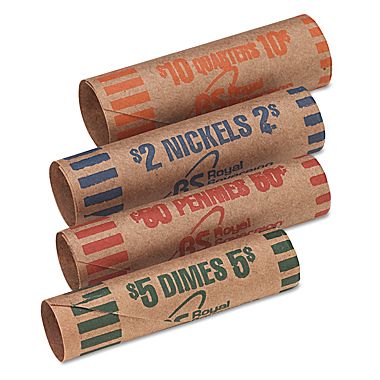
I decided to make my own coin rolls instead of spending any coins for them. I started with paper, but it turned out like origami gone wild. So I put on my thinking hat and asked, why not aluminum foil (for the coin rolls, not the hat)? But does silver and aluminum react? Apparently, it does in a good way if you add a baking soda solution. So I rolled away and am quite pleased with the outcome. That’s $100 face value in quarters in a pint-size vacuum sealed bag. What do you think? – R.T.
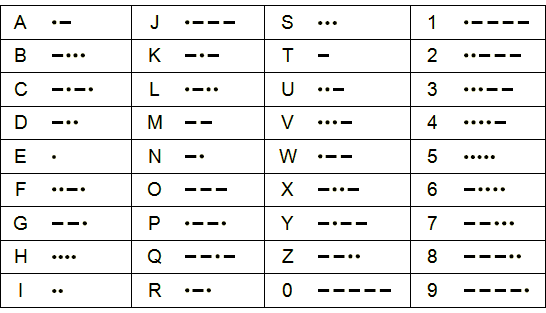
Dear Editors: There is a good Morse Code practice group in the Pacific Northwest every morning on 3.970 mhz LSB at 8:00 PST.
The guy sends Trivia questions to the others using Morse Code. Each person who checks in gets to take a turn on a rotating list. The code is sent at the speed each person is comfortable with. Once the question is sent and received, that person repeats the question by voice to confirm they copied it correctly. But if they can’t ANSWER the trivia question, anybody can jump in and try to answer it.
This way of learning Morse Code is way more fun than the old code practice tapes. Plus, the trivia is fun and educational.
They are always looking for new “fresh meat” to start learning the Morse Code. They will slow way down for newcomers, and the entire group is very encouraging and patient with the new guys. They ALL were the “new guy” at one time not so long ago.
They ask that you check in with your call sign, but you don’t have to participate until you feel ready. Just ask to be put on the “Lurker List” and enjoy the trivia. – T.C.
Anyone looking for colloidal silver should check out this small company in Montana: Ion Silver. Their product is made with a special process that puts very small (“ionic”) silver particles in suspension, and that unlike their competitors, their solutions don’t “go brown” with silver dropping out of solution.