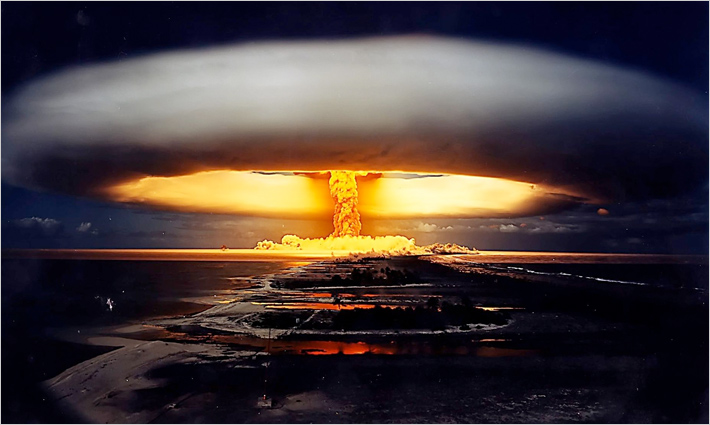
Although many don’t view a nuclear event as a likely disaster scenario, it’s important to learn about all the possible issues that may impact your family in uncertain times. Given the instability in the Korean Peninsula and elsewhere, the issue of nuclear blasts and the radiation they emit is a timely subject.
Understanding the Definition of Radiation
The quick definition of radiation is energy given off by unstable matter in the form of rays or high-speed particles. The following is some basic chemistry paraphrased from the U.S. Nuclear Regulatory Commission (US NRC): All matter, including you, is composed of atoms. Atoms are made up of various parts; the central nucleus contains minute particles called protons and neutrons, and the atom’s outer shell contains other particles called electrons. The nucleus has a positive electrical charge, while the electrons have a negative electrical charge. Neutrons are, well, neutral. These entities work within the atom toward a stable balance by getting rid of excess atomic energy (called radioactivity). Unstable nuclei want to become stable and may emit energy; this emission is what we call radiation.
Types Of Nuclear Weapons
Until the recent missile launches by North Korea, most people were concerned about the use of “dirty bombs“ by terrorists. A dirty bomb is not technically a nuclear weapon. It uses conventional explosives to disperse radioactive material in the general area. Usually, the effect of the explosion causes more damage and casualties than the radioactive elements.
Continue reading“Radiation Issues In Nuclear Blasts- Part 1, by Dr. Bones of doomandbloom.net”