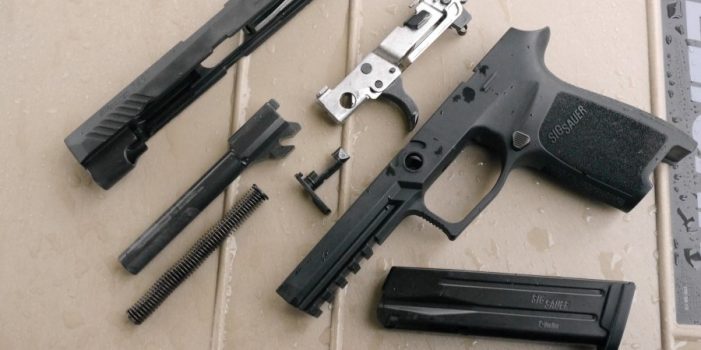
To begin, I should mention that our main carry pistols here at the ranch are all Glock Model 21 and Glock Model 30 .45 ACPs. I intend to keep those as our family’s standard for the foreseeable future. But in the past two years I’ve branched out into buying several SIG Model P320 9mm pistols. I like the clever modularity of these pistols. The same serialized trigger group module can be used in assembling everything from a subcompact pistol to a full size race gun. I also find their ergonomics quite good, their controls instinctive, and their trigger pulls decent–right out of the box. Notably, a subcompact variant of the SIG P320 is now my designated “Visiting the Big City” carry pistol. My willingness to carry that pistol on those infrequent trips tells you how much trust the design.
SOme History
I should back up a bit and explain that there are have been four major waves in in the history of semi-auto pistols: The first wave began experimentally before 1900 with some rather clunky steel frame designs like the C93 Borchardt and the Mauser C96 “Broomhandle”. The second wave was typified by the sleek Browning design, with many variants that dominated the market for the next 80 years. The third wave came with the advent of the Glock 17, which was the first practical and popular striker-fired polymer frame pistol design. (Although, arguably, it was predated by a decade by the HK VP70. But that was a design with both atrocious sights and a very heavy, creepy trigger pull. Thus, Glock was the first company to Get It Right, with a polymer frame pistol.) The fourth and most recent wave of handgun design combines both polymer frames and modularity.
Continue reading“Window of Opportunity: The Modular Pistol Revolution”