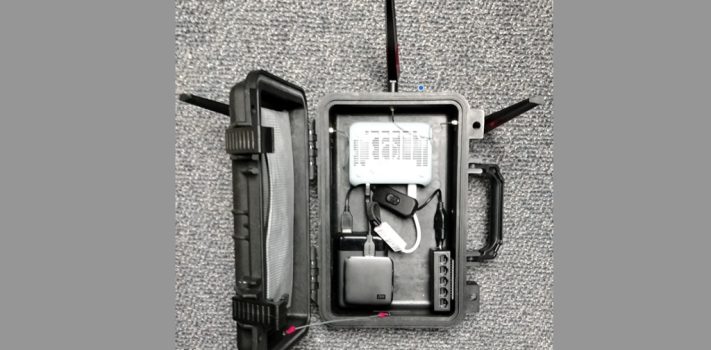
Having an operational computer network running in a post-SHTF world may seem frivolous to some people. But if you have any plans to use computers, tablets, or cell phones as part of your post-disaster operations, it can provide the capability for those devices to communicate, share data and synchronize their activities. It can also provide some support for important things like WiFi security cameras and WiFi sensor monitoring.
In a previous article (parts 2, 3, 4, 5) on SurvivalBlog I discussed how to set up a mobile WiFi/Ethernet network running a local cloud server (NextCloud) in a box for use in disaster scenarios. Since then, I’ve discussed the article with a number of friends and acquaintances and they all said they like the idea but thought that setting up and managing a NextCloud server was way too complicated for someone who is not a techno-geek like me. They wanted to know if there was a way to do something similar that was less complicated but still provided some useful functionality beyond just letting systems communicate with each other. I took the challenge, did some research and came up with what I think is a fairly decent alternate simplified solution.
The Hardware
As with the previous version the core of the network is a GL.iNet WiFi travel router. For this simplified solution I chose the newer GL-MT3000 (Beryl AX), which is a significant upgrade over the GL-MT1300 (Beryl) I used in my previous article – a faster dual-core CPU, double the RAM memory, 8 times as much NAND flash and significantly faster WiFi speeds. It also supports the new WiFi 6 standard (IEEE 802.11ax), which can provide significant bandwidth improvements if you have laptops or mobile devices that support it. Like its predecessor, it can run various network applications directly on the router, but the performance improvements make doing so actually usable. It’s also powered with a 5V 3A USB-C port (not USB-C Power Delivery (PD)), so you can run it from a USB power bank that has at least one port that can provide 3A. It is fully capable of running various network applications directly on the router, which we’ll cover shortly. The GL-MT3000 lists for around $85, but it’s occasionally on sale for around $60.Continue reading“A Simplified Disaster Network – Part 1, by J.M.”