I’ve encountered an attitude and habit among some of my consulting clients that is alarming: Very few of them have properly zeroed all of their guns. Granted, many of these clients own more than 100 guns and have busy lives as doctors, lawyers, and business executives. But there is no excuse for them failing to at least zero their core defensive and hunting gun batteries. The “I’m planning to get around to that…” excuse doesn’t suffice.
I suppose that I should take a step back here, and address a more fundamental issue in family preparedness: This is the issue of “stuff” versus skills. It is all too easy to fall into the rut of piling up stuff but neglecting to develop the knowledge, experience, and hands-on skills to go along with all that stuff. The failure to have guns zeroed is a symptom of this much larger problem. Owning a plethora of guns, supplies, tools, and gadgets does not magically make you prepared. It doesn’t magically make your family safe. It doesn’t magically make you knowledgeable or skilled at arms. In essence: Un-zeroed rifles are just voodoo talismans. And any gear of nay sort that you haven’t actually practiced with is just stuff.
Having a pile of “new-in-the-box” guns may be a great investment. But unless you are confident and competent in their use, then they are only symbols of your desire to be prepared. And unless they are zeroed, there is no way that you can shoot them accurately beyond just pub darts-throwing distance. You have probably already heard the phrase: “When it all hits the fan, you won’t rise to the occasion. No, you will default to the level of your training.” Or, perhaps you’ve heard the corollary: “Your speed and accuracy on your best day in a gun fight will be worse the than your worst day at the range.” Those phrases are often repeated by gun trainers, for good reason: They are ground truth. Please take them to heart. Get out there and train, but first get those guns zeroed.
Boresight Zeroing
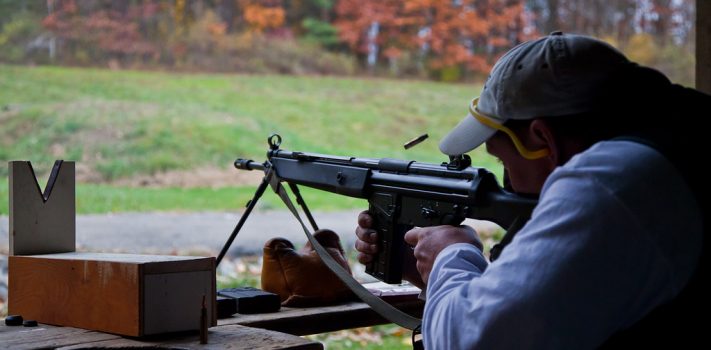
The process of zeroing rifles hasn’t changed much since I grew up in the 1960s. If anything, it has become easier. This is because the majority of hunting rifles are no longer pump or lever action. These days, most are bolt action. And the majority of battle rifles no longer have closed-back receivers (like M1 Garands, FN49s or M1 Carbines.) Instead, most are AR, AK, FAL, or HK pattern guns with open-backed receivers. With both bolt actions and open-back receiver semi-autos, partial disassembly allows you to sandbag a rifle’s upper (or barreled action) and then alternately look through a scope (or iron sights) and then peer down the bore and confirm that the sights or scope line up with your bore sight. You don’t need to fire a single round of ammunition to get a pretty decent zero.
There are many primers out there in the Interwebzs about boresighting, so I won’t recount the whole process here. Oh, and unless your rifle has a closed-back receiver, you don’t need to use a fancy laser boresighting device. You can use the time-proven Mark I Human Eyeball. By boresighting first, you will save yourself a pile of ammunition and a ton of grief. I strongly recommend that you first establish a good boresight zero, and then it will only take two or three shots to confirm or dial-in a perfect zero.
First, an Appleseed Shoot
If you don’t already have a lot of training then I recommend that you attend a Project Appleseed shoot. It is good quality training, available for just a nominal fee. You will also receive some valuable American History lessons, between the shooting sessions.
Here is their mission statement:
“Project Appleseed isn’t a gun club or a militia, nor is it a historical society. Instead, we are a non-partisan group of men and women (known as the Revolutionary War Veterans Association) who are committed to upholding the values and principles of America’s founding fathers. We use rifle marksmanship instruction as a gateway to help bring our nation’s history to life and to show that many of the values that our forefathers relied on to win our independence are still very much in demand today.
Through clinics and events, we teach rifle marksmanship and early American heritage to introduce individuals of all skill levels to the knowledge that was so crucial to the success of our nation’s founders. Aside from the fun and camaraderie of these events, the designed takeaway is a renewed sense of civic responsibility that each attendee can then implement in his or her own community. If we can reconnect enough people with the selfless civic virtue of our forefathers, we as a nation will all be better off.
Our goal is to create a nation of Riflemen. We’d love for you to join us.”
Then Get Advanced Training
After you and your teen children have attended a couple of Appleseed smallbore shoots, then it is time to move on to more advanced training. A good three day defensive handgun shooting course is a must. Then take a two-day practical rifle course. And then, if you can afford it, take both a long range rifle course and a team tactics course. That is all money well-spent. In terms of budgeting, I consider it more important to own fewer guns, but spend the rest of your gun budget on learning how to confidently use that small number of guns. Sadly, most Americans instead just opt for “more guns, more guns”.
Needless to say, don’t attend any class until you’ve first established a good zero with both your planned primary gun, and your backup gun. (Always bring a backup, in case you have a mechanical problem with your primary. I’ve seen it happen, and it isn’t fun.)
With the return of warm weather to the northern Hemisphere, I encourage SurvivalBlog readers to get out and do some shooting! Most importantly: Zero all of your rifles and pistols! – JWR