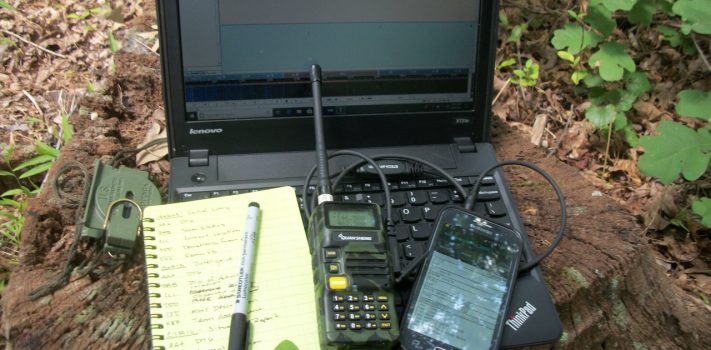
SurvivalBlog presents another edition of The Survivalist’s Odds ‘n Sods— a collection of news bits and pieces that are relevant to the modern survivalist and prepper from “JWR”. Our goal is to educate our readers, to help them to recognize emerging threats and to be better prepared for both disasters negative societal trends. You can’t mitigate a risk if you haven’t first identified a risk. Today, we focus on a DIY Radio Data Terminal.
A DIY Radio Data Terminal
NC Scout’s latest, over at the great American Partisan site: A DIY Radio Data Terminal On The Cheap. Take the time to read all of it, but here is a pericope:
“First and foremost, in keeping with the basic principles of clandestine radio communications for guerrilla groups, we’ve got to keep our time on the mic short and transmitting power low, and if at all possible, using a directional antenna such as my small UHF Yagi on a simple camera tripod. Transmitting a long message can take some serious time, is susceptible to interference and/or jamming, and also might not be understood on the other end. But most importantly, the largest drawback of using your own voice over the radio is that if a sophisticated opponent is monitoring you, they now have a voice to record and exploit. Students in my Signals Intelligence course have learned exactly how dangerous that can be, creating a massive amount of confusion in a short period of time. After all, exploitation is the primary goal of intelligence- how can I use what I’ve collected against an enemy?
So that points us in the direction of digital communications. For most, one of two things will come to mind here. Either a digital handheld radio, normally a DMR, D-Star or Fusion, or one of the many modes found in a free program called FLDigi. FLDigi is normally thought of only for HF radio, but it has a lot of uses on VHF and UHF as well. And because it gets very little use in these bands, most folks won’t know what it is if/when they hear it. Not only that, with some of the wider band modes available, its transmission time is incredibly fast. A long message, such as a detailed CYRIL report, can be sent in just over four seconds. So if you’re following the other points of a solid communications plan, you’re going to be a hard target to catch.”
Will We Lose The 2-Meter Band?
Reader SOG sent this: No Strong Opposition to 144 – 146 MHz Reallocation Proposal at CEPT Meeting.