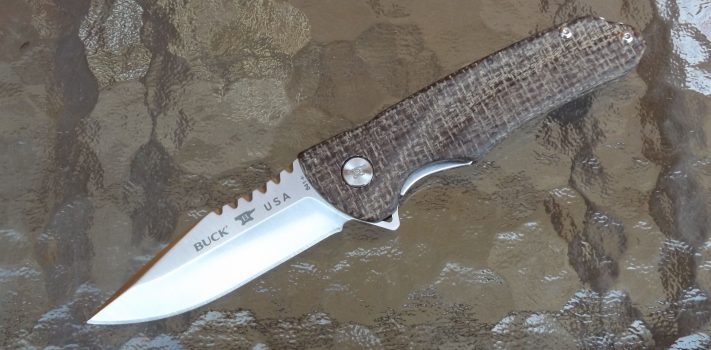
Buck Knives is one of America’s oldest knife companies, and with good reason. Buck senses the pulse of the knife buying public, and they have produced some of the most rock-solid knife designs over the years, that are still in production. A knife executive of a major knife company once told me that, a “good” knife design has a three year shelf-life. That means that after about three years, that design no longer holds an interest to the knife buying public. But take a look at many of the Buck designs – like their classic Model 110 that have been around for decades, yet they are solid sellers. I couldn’t tell you how many times I’ve heard someone say, when they saw a large folding knife, with laminated wood handles and brass bolsters on it, and it was called a “Buck Knife”. This is just like facial tissues are usually called “Kleenex”. It has become a generic term, and in reality, it is kudos to the original maker of that product, that it is so readily recognized.
Buck Knives lives on, in Idaho. They finally packed-up and had enough of Kalifornia, and moved to a more free state – and they don’t come much more free than Idaho is. I’ve entertained the thought numerous times about just packing-up and moving to Idaho, from Oregon. The Oregon I live in now, is nothing like the Oregon I knew, when I first moved here in 1979. Oregon is on the fringe of becoming the very next Kalifornia – a state that is pretty much Communistic. Perhaps if I were much younger, I’d just pack-up and move – but such is not the case…my next move will be, into a nice used 5th wheel trailer, and I’ll sell my small homestead. I don’t need the space and acreage we have now – its hard to keep up with the chores. Not quite sure where the wife and I will place our 5th wheel, but whatever doesn’t fit inside of it, will be sold at a garage sale. More than likely, we’ll remain in Oregon – some place – not about to let the liberals run us out of our chosen home state with their idiotic politics.
In recent years Buck Knives has really turned-up the heat on turning out new knife designs. As anyone who has owned a Buck Knife knows, they always come scary sharp out of the box, and hold that edge a good long time. However, when time came to re-sharpen your Buck, it was a real pain to do so, because of the edge geometry and the high Rockwell hardness of the blade. It took a master or someone with a Master’s Degree in knife sharpening to get that job done. Not too many years ago, Buck made a few changes in their process, and their knives — while still holding a good sharp edge, for a good long time — can now be more easily re-sharpened. Way to go, Buck!Continue reading“Buck Knives 841 Sprint Pro Folder, by Pat Cascio”