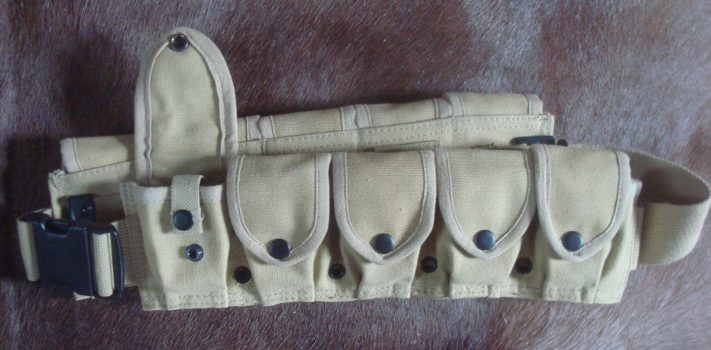
M1 Garand cartridge belts and Altoids tins are a match made in prepper’s heaven. You may already have some of these vintage items gathering dust. If not, they are easy to find. Together they can be a literal lifesaver, more capable than smaller survival kits and far less bulky than the typical bugout bag.
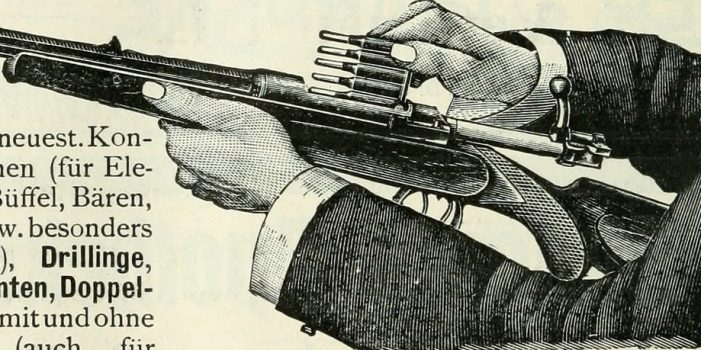
The M1 cartridge belt is an adjustable canvas belt with 10 snap-closure pockets, each measuring approximately 3 ¾” x 2 ¾” x 1”. It was standard issue from about 1910 until the full adoption of the M14 rifle in the late 1950s. The belt was originally designed to carry 100 .30-06 cartridges in 5-round stripper clips. When the Garand came along, GIs instead used these to carry ten 8-round en bloc clips instead. Coincidentally, Altoids tins, at about 3 ½” x 2 ½” x ¾”, also fit just fine…but you probably don’t need ten tins of breath mints. The good news is that lots of other things fit in them when the candy is gone.
Things Came In Tins
When I was young, lots of great things came in tins. Empty, they could be used in any number of ways. Prince Albert tobacco tins, for example, made perfect back-pocket fishing kits. A few worms, a hook, some line wrapped around the outside, and you were set for the day. Band-Aid tins were thicker and didn’t fit my Levi’s as well, but held more marbles or baseball cards. Even Premium saltines came in tins: big ones, maybe five inches square and a foot long. I now wish that I had a hundred of them.
Altoids tins are about the only ones left. I doubt there’s a prepper of my generation who didn’t turn an Altoids tin into a shirt-pocket survival kit, or perhaps a first-aid kit. These are still viable projects. In recent years, recycling Altoids tins has become virtually a cottage industry. There is seemingly no limit to the ways they have been reused. They are particularly popular for small electronic devices. At the end of this article I have included links to some of the most popular and ingenious uses. Many of these projects tend to be just-for-fun, but the solar iPhone charger could have a practical application. The tins are so useful that they can even be bought empty, and in any quantity you might require. Twelve cost about $12 at Amazon. Unless you really hate the Altoids label, you might as well buy them filled and eat the candy.
Where It All Began
I began with a shirt-pocket survival kit – I don’t recall what brand of tin I used. The concept is simple: a container small enough to have with you all the time, packed with tools to make fire, purify water, catch food, treat minor injuries and find your way back to civilization. These took a little ingenuity. At the time a lot of handy items were not readily available for purchase. I had to waterproof matches with nail polish. The best fire starters we had were charcloth and extra-fine steel wool. Cotton balls saturated with Vaseline worked, but were rather messy. Nobody made neat little towelettes and sterile swabs in mylar pouches. Superglue hadn’t been invented. We didn’t even have duct tape! My early kits were built around a button compass, fishline, hooks and sinkers, a single-edged razor blade or X-Acto knife, waterproof matches, a few band-aids and a small container of antiseptic, and a carefully-folded sheet of aluminum foil. I ‘tested’ my kits on day hikes in the woods, caught and cooked a few fish, and went home convinced I could conquer the world.Continue reading“Outdoor Survival: Of Belts and Tins, by Randy in S.C.”