What got us here:
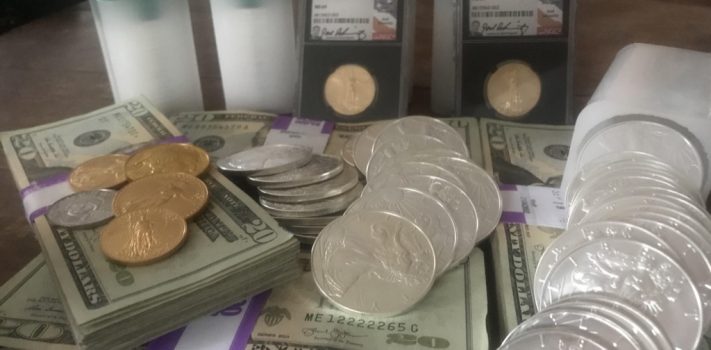
In the coinage act of 1792, Congress in the United States declared the definition of our monetary units (The Dollar and the Eagle) and defined the character of each of these units with specified weights, measures, and the number of grains in silver or gold for each of these monetary units. They went on to declare the silver to gold ratio to be 15:1 which at the time was a worldwide standard. Should that balance not be declared and maintained the undervalued units would naturally migrate to other world economies. In the following 80 years, our economy had grown to include $7.55 billion almost equally divided between silver and gold.
In the early 1870s a financial interest from Great Britain used £100,000 to influence the United States Congress to change our economy from a bi-metal monetary system to one backed by gold alone. The citizenry, still engulfed in reconstruction from the Civil War, had become accustomed to the circulation and trade of paper currency representations of money for the preceding decade which made the public unaware, but this act reduced the actual legal tender available in the United States to $4.5 billion and changed the status of silver from “legal tender” to a commodity like wheat, tobacco, or cotton. While the costs of goods and services quickly adjusted to the shortened money supply and were virtually halved in price, the nation’s outstanding debt of $200 billion remained, which in turn caused a series of depressions throughout the 1890s. Silver had been the currency of the population and everyday transactions, while gold was held as a greater store of wealth by the banks, money lenders, and industrialists. After the unconstitutional coin act of 1873, the only people with “legal tender” were those that held gold.
The transfer of wealth from the average citizens of the United States to the debt collectors was unprecedented. Generations of Americans avoided debt at all costs until the 1980s when credit became “king”, and by then even gold had been removed from our monetary system entirely. Today, “commodities” like gold and silver are measured in fiat currencies that are valued only by the judgment and conscience of the politicians of that nation’s government. While these fiat currencies are traded for goods and services, they remain debt instruments with no stores of wealth or tangible value to back them up. The banks, financial institutions, and governments all have a vested interest in devaluing gold and silver to control not only the custody of these wealth instruments, but also to prop up the perceived value of their fiat currencies.
Despite the banks, governments, and financial institutions best efforts to decouple gold and silver from the value of their currencies, the precious metal’s purchasing power remains largely the same. For 50 years the investment markets, banks, financial institutions, and governments have all profited from manipulating the cost of precious metals and forcing commerce to be transacted in their fiat currencies. Worldwide trade in goods and services and the entire economy rely on these manipulations; however, while the fiat currencies of the world have plummeted in real value, the world’s population has awakened to the realization that they can trade these debt instruments for historic wealth, and so begins the 21st-century battle. While the politicians and banks worked to lower the costs of precious metals to prop up the perceived value of their fiat currencies, the people began trading these fiat currencies for the true wealth instruments of gold and silver, the “powers that be” have become outsmarted by their own manipulations.Continue reading“Demonetizing Precious Metals, by Serena”