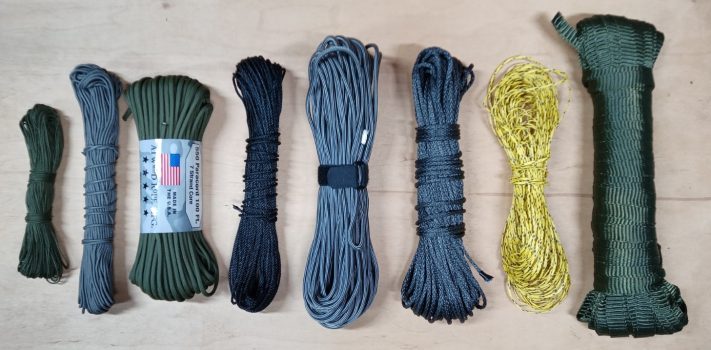
If you ask anyone involved in preparedness ‘what are five things I should always include in my kit?’, the one item that is guaranteed to appear near the top in every list is ‘cordage’, or more specifically, parachute cord {“paracord”). The idea of including cordage as part of your survival preps and everyday carry kits makes a lot of sense, as it has dozens of uses in survival situations, including:
- Making a shelter
- Making a splint
- Make a sling
- Fishing line
- Restraining someone
- Making traps
- Attaching gear
- Making repairs
- Raising and lowering things
- Grip wrapping
- Climbing
- Bundling
- Pulling/towing
These are just a few of the things you can do with the right cordage. However, all cordage isn’t the same, and the typical 550 paracord may not always the best answer. My goal in this article is to provide you with some details on a number of common options for cordage in order to help you select the right one(s) for your specific needs.
Factors
When you’re looking at cordage as part of your various preps, you need to understand what your requirements are in order to make the best decision. Think about the various situations you may run into and how you might use cordage in each of them. In many instances the best answer may be to stock different types of cordage for different situations; that’s obviously a lot easier to do at home or in your vehicle as opposed to when you’re on foot, but given the light weight and relative strength of modern cordage options, carrying two or three different types of cordage makes a lot more sense today than it did a few decades ago.
Once you have a handle on your requirements you next need to understand what the strengths and weaknesses are for different types of cordage options. Like everything in life, different types of cordage have different characteristics, so you’ll need to balance your requirements and the tradeoffs of each type in order to make the best decision.Continue reading“The Tao of Cordage – Part 1 , by J.M.”