(Continued from Part 1. This concludes the article.)
Paracord
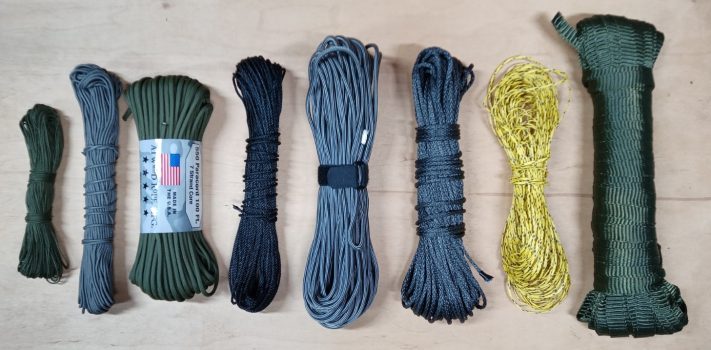
As I’ve mentioned several times, 550 paracord is the granddaddy of prepper cordage. Virtually every survival-related blog, forum, book and other information source has recommendations to include 550 paracord in your preps. 550 paracord was originally developed to use as lines on parachutes, so it’s strong and stretches a lot (up to 30%) to absorb the shock of the parachute deploying. From a survival perspective, it’s a kernmantle style, so you can extract the internal strands and use those for fishing line, sewing thread, etc. and still use the external sheath for other heavier tasks.
While I have several spools of 550 paracord in my home preps, I believe that it’s not necessarily the best option for my mobile kits like EDC, get home bags (GHBs) and bug-out bags (BOBs), and it’s certainly not a good choice for camping and backpacking. 550 paracord has 7 internal strands, and carrying 100’ of 550 paracord means that I’ll have 700’ of thin line, which is significantly more than I’ll ever conceivably need, and I don’t need 550 lbs. of static strength to make shelters. Decent quality 550 paracord runs about $0.10 per foot.
For mobile kit there are other paracord options that I believe make more sense. Not everyone is aware of it, but there are several other classes of paracord, including 750, 425, 375 and 275. Each of them has a different number of internal strands with different thicknesses, but the one I’ve settled on for most of my mobile kit is 275 paracord. 275 lbs. of static strength is more than enough for most of the tasks I’m planning on, and it has 5 thin internal strands that I can still remove for lighter tasks. It’s a lot lighter and thinner than 550 cord, so I can carry almost 4 times as much for the same space and weight if I need to, or the same length for ¼ of the weight and space. Quality 275 paracord runs about $0.08 per foot.Continue reading“The Tao of Cordage – Part 2 , by J.M.”