Economics and Investing:

Does anyone really believe this Pollyanna pie-in-the-sky nonsense now coming from the mainstream media? With QE3, We All Win — Poor and Rich Alike. What balderdash! Let’s face facts, folks: The Federal Reserve has backed itself into a corner. They can’t do anything that will trigger higher interest rates. So the only arrow left in their quiver is monetization (“quantitative easing” is the gentler, sugar-coated name.) Their brilliant plan is to re-inflate the housing bubble by buying up $40 billion per month, indefinitely, in mortgage derivatives using make-believe money. This pure fiat “money” is coming from their Sunshine Pump. I can only ask: How long can that continue? And how long will it be until our foreign creditors demand a higher rate of return to roll over their Treasury paper? Once interest rates rise, the party will be over. We will see a credit collapse and then a collapse of the US Dollar.

The producers of the popular Silver Bullet, Silver Shield videos have begun minting their own one-ounce .999 fine silver medallions. They are being sold for as little as $2.99 over the spot price of Silver. If you orders yours using the link from SurvivalBlog, we will earn a small sales commission to help defray our considerable monthly bandwidth expenses.

Over at Dr. Housing Bubble: Betting the house with the Fed – Stock market at levels last seen in December of 2007 – Examining what has changed and impact of Federal Reserve on housing. QE3 preemptive strike on fiscal cliff?

At OilPrice.com: Libya – Doomed from Day One

Seeking Alpha‘s analysis: 324 Years Of The Gold-To-Silver Ratio And $195 Silver

Items from The Economatrix:

Gold & Silver Prices Today On Fire!

How The Financial Collapse Would Happen In An Obama Second Term

US Jobless Claims Rise To Highest In Two Months

Fed Bets Big In New Push To Rescue Economy.


Odds ‘n Sods:

Rick in New York mentioned this latest bit of Bloomberg-inspired insanity: New York OKs nation’s first ban on super-sized sugary drinks

   o o o

Sue C. was the first of several readers to send this: Gun Sales Hinge on Obama Re-Election: Cabela’s, Other Retailers Prepare for Surge in Demand

   o o o

G.G. forwarded a link to some Slate commentary that confirms my conjecture about the secret cache of Revlon Equave Hydro Nutritive Shampoo: The Biggest Problem With the Post-Apocalyptic Show Revolution: the Women’s Perfect Hair.

   o o o

R.B.S. sent this news from Oz: Superbugs spread into NSW community. And in related news, AmEx sent this: NIH superbug claims 7th victim


Approaching Fire or Extreme Fire Alert, by Matthew Stein, P.E.

After living in The States off and on for several years, in 2008 Andrew and Mary Hall moved back to their home in Buxton Australia so they could  be closer to their aging parents. It was a modest three bedroom two bath house with exterior walls of “mud brick” (adobe) that helped keep the home’s interior cool during the hot Australian summers. With large eaves, a metal roof, and adobe style mud brick walls, many would consider their home to be reasonably fire resistant, but its construction proved no match for the forces of nature that turned the neighboring towns of Buxton and Marysville into deadly infernos on Australia’s tragic “Black Saturday” on February 7, 2009.
The prior week, the weather had been extremely hot, with several days recording temperatures of over 40°C (104°F). On that Saturday morning, record breaking temperatures combined with long term drought conditions and high winds (over 60 MPH) to generate the most serious fire conditions that anyone could remember. An official “extreme fire alert” was issued along with a strict “no burning” command. Mary remembers looking at the thermometer on that day, and it read a blistering 47°C (117°F)! Around 4:30 in the afternoon, a neighbor came by and pointed out a large ominous plume of smoke rising to the southwest. Andrew dialed 000 (The Aussie equivalent to America’s 911), and it just cut out. When attempts to call the fire department also failed, they decided to pack-and-go. Knowing that they did not have enough water and other resources to stay and fight should a major wildfire break out, Andrew and Mary’s fire plan had always been to evacuate. They packed some clothes, the dog, a few files, their computers, and a couple bicycles into the car and left their home, hoping and praying it would still be standing upon their return. 

Andrew and Mary headed for a friend’s place with a defensible piece of property that included a swimming pool and a dammed reservoir, plus an extensive supply of fire fighting materials such as pumps, a tractor, and backpack sprayers. Unlike Andrew and Mary’s property, which backed up to a steeply wooded hillside, their friend’s property was mostly grassland, making it easier to hold back a bush fire. About 10:30 PM a 3 meter (10 foot) high wall of fire descended upon that property,  and for the next eight hours family, friends, and neighbors fought to keep the flames and flying embers at bay. Exhausted, around 6 AM they were able to catch an hour  and a half of fitful sleep before braving the drive back to their home to survey the damage. At this point, they still had hopes that a favorable wind direction had spared their home. As they walked up the hill to their front yard, they saw that all but three mud brick walls had been totally obliterated. Except for the few things they had packed in their car they day before, all of their personal belongings and the tools for Andrew’s bicycle repair business had been reduced to cinders and scraps of molten metal.

Andrew also had a commercial coffee roaster (“The Great Divide Coffee Roasting”) housed in a shed on his partner’s property just outside of the neighboring town of Marysville. The entire commercial section of Marysville, except for the bakery, had also been destroyed by the fire, but miraculously, the shed that  the coffee roaster was stored in, as well as their friend’s home, had survived. Both were scorched by the flames, but spared the destruction which had taken all but 14 of over 400 buildings in Marysville. In spite of having lost their home, one of their businesses, and nearly all their personal possessions, they fared much better than many others in the surrounding area who had lost their lives or loved ones. On what has become known as “Black Saturday”, bush fires took the lives of 173 people, wiped out whole towns, and entire families were found incinerated in their cars while trying to escape the inferno.
In addition to the details of their trials and losses, Mary also had this to say in her official statement to the local police, “I don’t believe we would have done anything any differently. As far as having adequate warning, we weren’t given any. Other than knowing that it was a high fire danger day, there was no real warning. I don’t know that having had any other warning would have made a difference. I know I didn’t hear any siren or warning sound that day.” For my friends Mary and Andrew, knowing when to stand and fight, and when to pack and run, clearly meant the difference between life and death for hundreds of folks on that blazing hot Saturday in Australia!

p>

Extreme Fire Alert, or Approaching Fire

  • Stay tuned to local radio stations, but keep your eyes and ears open, not counting on authorities for proper warning. STAY SAFE! BEST TO ERR ON THE SIDE OF CAUTION!
  • Keep pets and children close at hand and ready for rapid evacuation.
  • Place 72 hour emergency kits in car(s) along with important documents and computer backup files (“My Life in a Box”). Park cars facing towards the driveway exit for a speedy evacuation.
  • When concerned about an approaching fire, a lawn sprinkler left running on your roof improves the chances for saving your home.
  • Hose down bushes and hedges next to your home, and trim back if you feel it may be helpful or necessary.
  • Close all windows and doors. Block foundation and roof vents to slow penetration of superheated firestorm gases inside the building envelope.
  • Close fireplace or chimney dampers to minimize the “chimney effect” from drawing air up your chimney. Whatever volume of air draws up your chimney, will be replaced by superheated air from the outside firestorm.
  • Remove drapes from windows and move furniture into center of rooms away from windows.
  • Turn off natural gas lines at the meter (you may need to contact your gas company to have a qualified workman safely turn your gas back on) and propane lines at the tank. Place a lawn sprinkler on your propane tank.
  • Remove gas grills and portable propane tanks far from the home, as well as combustibles such as portable gasoline cans.

When a Fire Strikes Your Home

Crawl under the smoke

Remember that hot air rises, so if your step into a hallway filled with choking blinding smoke, drop to your knees to see if that will get you into a bearable level of smoke so you can speed crawl your way to safety.

Putting out a clothing fire with a blanket, or rolling on the ground

Normal types of fires needs oxygen in order to burn. When hair or clothing catches on fire, quickly smother the fire with a towel, blanket or jacket tightly wrapped around the burning area on the victim. Alternately, get the victim to roll on the ground to smother the flames, or grab and hug the victim while using your own body to smother the flames.

Bust through sheet rock walls

In an emergency situation, realize that most homes are built with interior walls covered in sheetrock. If necessary to avoid a fire and smoke filled hallway, or to gain access to a room to rescues a family member, realize that this sheetrock can be easily kicked through to allow a person to slip between the studs from one room to another without using a door or window.

When to Make a Stand, and When to Pack and Go

The 2001 Martis Fire started about two miles downwind from our neighborhood.
When a fire threatens, remember the story of Andrew and Mary Hall, keeping in mind the fate of those less fortunate families that were found incinerated inside their cars after being overtaken by a fire storm during Australia’s infamous “Black Saturday.”

When it comes to wildfires, it is better to err on the side of caution than to risk all in a moment of valor!


A Book Review by T.M. from Arkansas: The Original Counter-Argument

The Original Counter-Argument: The Founders’ Case Against the Ratification of the Constitution, Adapted for the 21st Century, by Paul Douglas Boyer
ISBN: 978-14477450673
Paperback and Kindle Kindle edition available from Amazon.com
298 pages, appendixes, bibliography, nice size print for those of us who wear eyeglasses.
Bad news first: there is no index. (Any nonfiction work should always have an index.)

How many times have you heard ‘they-he-she violated my rights’? How many times have you wondered just how many rights are in the Bill of Rights? How many citizens have actually read the Constitution, the Bill of Rights, and the Articles of Confederation? Too boring?

Gratefully, all three documents are written in such a manner we do not need a lawyer to understand the wisdom of the Founding Fathers of this nation. The documents are included in this book as appendixes. Each is short, easy to read, and alone are worth the price of the book.

Another interesting appendix is the Population Chart of the first seventeen states from 1790-2010. One state leads the charge to overpopulation, while a handful has barely grown at all.

The most interesting document in the book is a short transmittal letter written by George Washington. I suggest you read it first, and then read the remainder of the book from the beginning. Then read the letter from a wise man once again.

The author presents thirty opinions from the beginning of the great debate concerning the need for a constitution. Some are less than a page in length while others are more long-winded. All are interesting and still relevant to the discussion. Each essay has a short, less than a page, introduction to set the stage, and a short list of key points after each essay. Both are helpful, and are not the author’s opinion. Whether you agree or disagree with each essay, they all add to your knowledge base of the most important documents of our nation.

It is surprising who opposed our constitution and how close the votes for ratification were in each state. The debates were spirited, thoughtful, and at times quite heated, as they should have been. The debate still rages today, and should continue as long we exist. Is our federal government too powerful is the eternal question.

Copies of the proposed constitution were printed and widely distributed to the citizenry for their input. People were encouraged to study the documents and voice their opinion. Nowadays, our legislators do not even read most of the legislation they cast a vote for or against.
The author is not an historian, which may be why this book is so good. With a Master’s Degree in Electrical Engineering from Johns Hopkins University, he has applied his training to pick apart a complex issue, and the book is presented in an easily understood format.
You would do well to include this book on your reference shelf.

Our Constitution will be 225 years young on 17 September 2012, and a good day to buy this book. Happy Birthday to us all.


Pat’s Product Review: Propper Brand Outdoor Clothing

I have literally lost count of the number of SurvivalBlog readers I’ve heard  from, who asked “what is the best camo pattern…” Well, there is no easy or absolute right answer to this questions. It depends on the terrain, that you’ll be operating in, as to what camo pattern works best. I have always been fond of the old Woodland camo pattern – but it’s getting harder and harder to find this surplus clothing.

Without a doubt, I believe the US Army’s ACU gray digital camouflage pattern is one of the worst camo designs to come along. It doesn’t matter what terrain you might be in, if you are wearing ACU, you stick out like a sore thumb. The US Army has finally realized this, and are switching to other camo patterns.

The old US military woodland camo pattern is a really decent design and works pretty well, when you’re in the woods or grassy areas. However, it’s not the best camo pattern. Enter the new Propper Clothing blended  A-TACS foliage green blended pattern, that is really outstanding. First of all, the Propper uniforms are sewn to US mil-specs, and vat-dyed 50% Nylon/50% cotton rip stop fabric. There is hook and loop face for attaching rank insignia and unit patches, as well as name tags. The Mandarin collar can be worn up or down, and the hook and loop sleeve cuff closure provides positive closure and adjustments. There is a 3-slot pen pocket on the left sleeve and shoulder pockets are designed to fit optimally with the OTV.

Propper’s matching blended camo pattern pants  are made of the same material, and feature leg cuffs with front closure ties. Also featured are knee pouches with hook and loop closure for internal knee pad inserts. Button fly with a drawstring bellowed calf storage pocket and forward-tilted cargo pockets. Now, without a doubt, both of these clothing items are super-strong – we’re talking seriously tough material, that will give you years of service. Ok, so what’s the big deal, you ask? Mil spec ACU clothing is built strong as well.

The “blended” A-TACS foliage green camo pattern on the Propper clothing is unlike any other camo pattern you’ve seen. It’s really hard to describe, but the colors aren’t “printed” – instead, the colors are actually “blended” – kinda like working with different water-based colors on a piece of paper, where you get the different colors to blend together. I’m not sure how Propper pulled this off, but I’m blown away at how well this camo can blend into the woods in the Pacific Northwest here in Oregon. I did a test, I walked across the road to my neighbors property, and placed the Propper shirt and pants on some blackberry bushes – this is only about 50-yards from my front door. Keep in mind, I knew where I placed the clothing. When I walked back to my front door, I turned around and it literally took me a few seconds to find where the clothing was on the blackberry bushes. I asked my wife and oldest daughter to come outside and find the “hidden” clothing – they couldn’t find it – even when I was pointing at it. That, my friends, is an outstanding camo pattern for the woods. It is perhaps the best camo pattern I’ve run across for staying hidden in the woods.

There are many SurvivalBlog readers who are hunters, and the Propper Foliage Green blended camo, would make an outstanding clothing for still or stalk hunting. It would be great for bow hunters who use tree stands – you just blend into the background with this foliage green camo pattern. I wish I knew how Propper was able to make this camo pattern, it’s very unique, to say the least. But very effective, to be sure. Check out the web sites above for a close look at the camo pattern, however, keep in mind, the photos don’t do justice to the camo – you can’t do this clothing justice, until you see (or not see it) in the woods. When I go hunting this coming Fall, this is what I’ll be wearing. And, if I ever have to bug out for the boonies, this will be my camo clothing of choice.

These Propper camo clothing items are made in The Dominican Republic. The jacket/shirt and trousers retail for $59.99 each. However, you won’t be wearing this clothing out anytime soon, so if you are in the market for some of the best woodland pattern camo clothing, that will hide you, take a close look at the Propper line-up.

Okay, on to my “uniform” of the day. I don’t honestly recall when I last wore a pair of jeans, or a suit – I believe the last time I had a suit on, was about 11-12 years ago, when my oldest daughter graduated from college. My “uniform” of the day usually consists of cargo pants, a t-shirt and hiking boots. During the summer months, I wear some kind of button-down shirt over my t-shirt, to conceal my handgun. I’ve been wearing cargo pants, long before they ever became popular, like they are today.

Along with the A-TACS Foliage Green blended camo clothing above, that I received for test and evaluation, I also received Propper’s Lightweight Tactical Pants. These are a step-up from my usual cargo pants, in that, they are designed for “tactical” use – plenty of pockets and other added features that you will find of use when carrying concealed. You’ll see SWAT teams wearing these pants (they come in various colors) as well as street cops wearing these pants. However, you’ll also be able to wear these pants off-duty as well…and “no” you don’t have to be a cop to wear these pants – they are great for everyday wear.

Okay, bear with me, there are a lot of features on the Propper Lightweight Tactical Pants. Fade, shrink and wrinkle resistant, DuPont Teflon fabric protector repels stains and liquids, low profile appearance for use on and off duty, includes a D-ring for keys or tools, extra-large belt loops, action-stretch waistband for enhanced comfort, reinforced seat and knees,zipper fly, nine-pocket design, two cargo pockets with hook and loop closure, two hook and loop closure back pockets with wallet (pocket in a pocket), two front pockets with reinforced opening for folding knife or multi-tool, internal openings for knee pads, cell phone pocket, two hidden coin pockets and they also come with a free matching belt. That’s a lot of features, to be sure.

The Propper Lightweight Tactical Pants are 65/35 poly cotton ripstop DuPont Teflon fabric. And, the fabric is coated to repel stains. In my case, this really comes in handy, especially when I’m in the yard playing with some of my German Shepherds and they are playing rough with me – I’m always getting my pants (and everything else) dirty – I often wonder why I bother to have my wife wash my pants, ’cause next time I put ’em on, and play with the dogs, they are dirty all over again.

Over the years, I’ve tried quite a few different cargo-type pants, some are good, some are really good, and some I wore one-time and gave them away. These new lightweight tactical pants, are really a cut above most of the rest. When I tried the pants on, they actually fit like they were supposed to. This isn’t as easy as you might think – some pants, just don’t feel right when I put them on. I almost felt like I was “dressed-up” in these pants. As comfortable as they were, they were even more comfortable after they were washed. For me, if my pants aren’t comfortable, I won’t wear them – simple as that. Additionally, the belt loops are spaced properly so when you wear a gun on your belt, the gun is just in the right position.

I’ve purchased similar tactical cargo pants for a lot more money, than these Propper pants retail for $39.99. I’m sure you’ll find a good color selection, as well as size selection. For me, these are the only tactical/cargo style pants that I’ll be purchasing in the future. Yeah, I really liked ’em that much.

If you’re looking for some other type of tactical/survival/military clothing, be sure and visit http://ustacticalsupply.com/apparel.aspx and check out some of the other excellent clothing products they have. Every time I visit the walk-in store at US Tactical Supply, they always have something new and exciting there, that I find I must have.

Now, I know this article won’t end the debate over which camo pattern is “best” for concealment. However, if you find yourself operating in a wooded area, or the mountains, with lots of trees and shrubs, I think this A-TACS foliage Green camo clothing will be hard to beat – it really is amazing how well you blend into the woods when wearing this clothing. – SurvivalBlog Field Gear Editor Pat Cascio


Letter Re: To Arms!

Mr Rawles,
I must contest the foolish statement made by Mr. Prentice in his essay, To Arms! Prentice’s labeling Unlawful LEO Activity as a credible threat to the life of civilians is borderline absurd.  Yes, there are bad cops in our police forces. That’s nothing new and those officers should be purged as soon as possible and serve time in jail if needed. Bad cops irritate good cops and ruin the good will honest officers struggle daily to build. But there are bad cops because police officers are not super human genetically enhanced automated machines. We are picked from your neighborhood, go to your colleges, and live next door to you. The average cop sees far more death, depravity, and tragedy that most soldiers will ever encounter over their 25 year career. The average cop could easily qualify for a medical retirement based on the traumatic stress that we endure daily. The majority of all your blog followers would love to have 2, 3, 4 local cops living on their block to provide a Neighborhood Watch on steroids. Yes, even good cops have bad days and sometimes lose control. So throw the bum out? If so your local PD would have no officers employed very quickly.

Prentice’s belief that the average preppers should consider the local cop as a deadly threat is foolish and dangerous. Foolish in that the overwhelming majority of officers willfully run to your emergency with out reservation. They willfully, dutifully, risk their lives to save yours for low pay, horrendous working conditions and far to often with career ending injuries or PTSD issues. Yes, the bad ones out there do tarnish the work and valor of the honest cop. But to equate these few bad officer to the total vast good cops and deputies is reckless. Prentice equates officers to muggers, home invaders, foreign invasion, kidnappers, active shooters and even wild animal attack. Really? This is no different than the Prepper that steals, kills, or hurt others for what ever reason. It gives the rest of us  preppers a bad reputation and subjects us to public ridicule.

Prentice’s comparing police officers with such significant criminal activity is dangerous, very dangerous. He espouse the idea of active resistance to law enforcement. The cop or deputy is tense to say the least as their lives are at risk every time they put their uniforms on. Active resistance to police action is a commonly accepted danger sign to the LEO community. It is taught in the academies and learned through survival nightly.  If a person disagrees with an officers arrest rational and actively resist the officer, it will not end well. Pull a gun on a cop and dang right the LEO will fight for their life to get home that night! The officer also has the right to self defense. It is far better to get the incident recorded or witnessed than contest the officer physically if you disagree with reasons for arrest or detention. Fight the issue in court and/ or make a complaint with the officer’s internal affairs division. If the officer is a bad officer they will be removed from the department. But to promote active resistance to police officers is dangerous.

Why this route? Very few citizens know what their rights are or what heir responsibilities are. To physically resist or fail to comply with a legal order given by an LEO simply because you disagree with the offices rational for the arrest or detention is dangerous.  Instead of treating your local officers as a threat to you I suggest a some what radical but effective alternative. Rarely do officers receive thanks or appreciation for risking their lives night after night for strangers. I suggest thanking officers every time you can. We officers need your approval, your appreciation. This is not posterior kissing to get out of a ticket but a genuine thanks. We need to know that our lives and efforts have not been wasted. That the scars we endure, both physically and mentally, were worth the pain. Far to often we only see the negative that society has to offer. Officers rarely receive thanks or appreciation from those we protect. Your thanks, or hello will do far more than just bring a smile to our faces. It is a healthy reminder of why we officers run to danger. We need the approval and appreciation from the good people of society. Yes, there are incidents where rouge officers fail themselves, their fellow officers, and society.  But only the very minute few actively violate their oaths of office and pose a threat to society. This is why Prentice is foolish and dangerous in stereotypical labeling LEOs as a significant threat to the average citizen.

Thank you, – Mark B.

JWR Replies: I agree that in the present day that local law enforcement is not a threat. Nor are most of our other neighbors. However, under the exigent circumstances of a major, widespread disaster some police might be co-opted into enforcing martial law, or might be co-opted into enforcing new unconstitutional laws, or they might even go rogue in order to feed their own families, but I think that would be a rarity.

It is difficult to predict how things might play out in a societal collapse. I agree that generally most local police officers and sheriffs deputies will be part of the solution rather than part of the problem. But it would be foolish to assume that at least a few who are in positions of authority won’t be tempted to overstep their bounds in the midst of chaos and a power vacuum created by an extended interruption the power grids, a lack of telecommunications and the loss of influence of–or perhaps even the very existence of–whole sectors of government and public services.


Recipe of the Week:

Adele Davis Low-Sugar Granola

This is nutritionist Adelle Davis‘ recipe, that I copied from a magazine in a doctor’s office waiting-room more than 30 years ago, and have since shared with many dozens of people.

In a large pan (a shallow roasting pan is good) combine dry ingredients, mixing well:

5 c. regular rolled oats

1 cup chopped almonds

1 cup raw sesame seeds

1 cup raw sunflower seeds

1 cup shredded coconut

1 cup powdered milk (not instant mix)

1 cup soy flour [or wheat flour]

1 cup wheat germ.

In a 2 cup measuring cup, combine 1 c. honey and 1 c. vegetable oil.  Mix very thoroughly with the dry ingredients.  Using a large mixing spoon in each hand saves time.

Spread evenly in the pan and bake at 300 degrees.  After 30 minutes, remove from oven and stir the mixture.  Return to oven for another half-hour or until a toasty golden brown.

Stir and chop so that clumps don’t form upon hardening. Toasted nuts could be added while stirring.

Store in airtight containers.

Chef’s Notes:

This granola tastes like oatmeal cookies, but is much more nourishing – and wonderful to take on long trips where mealtimes are uncertain. Small zip-lock baggies and plastic spoons are easy to pack.


Useful Recipe and Cooking Links:

Adelle Davis Tiger’s Milk (“Pep Up” )Recipe

Adelle Davis Whole Wheat Bread Recipe


Currently Available as Free Kindle e-Books:

The Quinoa Cookbook: Nutrition Facts, Cooking Tips, and 116 Superfood Recipes for a Healthy Diet

100 Easy Recipes in Jars

Make and Freeze Recipes: Great Foods You Can Cook, Freeze, and Use Quickly and Easily

Do you have a favorite recipe that would be of interest to SurvivalBlog readers? Please send it via e-mail. Thanks.


Economics and Investing:

Unlimited monetization: Get Ready For An Epic Fiat Currency Avalanche

First corn and now wheat: Weather Woes Sow Worry on Wheat. Stock up your larder before prices gallop! (Thanks to U.E. for the link.)

John Embry Expects a Silver Price Explosion Driven by Physical Shortage

Items from The Economatrix:

German Court’s Backing Bailout Fund to Test EU Resolve on Crisis

Fed Seen Starting QE3 While Extending Rate Pledge to 2015

Gary North:  Gold Bugs and Anti-Gold Bugs, It’s a Fight for Civilization


Odds ‘n Sods:

Safecastle’s current “Repel the Chaos” sale has transitioned to Week 4, with the following special offers (ending September 21st): 1.)  Safecastle Royal members who make any single purchase (one weekly incentive per member) totaling at least $450 receive a free Katadyn Vario water filter and a 20-pack of MP1 purification tablets ($117 value). 2.)  Or, make a purchase of at least $1,250 and receive a free Katadyn Pocket water filter. (a $379 value), and 3.)  They are now discounting selected Mountain House can cases up to 33% for a very limited time. Don’t miss out.

   o o o

Reader Steve H. wrote to mention that he found a great deal on used, original U.S.G.I. woodland pattern camouflage Gore-Tex Bivouac (“bivy”) bags. These cost Uncle Sugar $200+ each, but are being sold as surplus at just $39.15 each!

   o o o

My dear Mum sent this: A solar tractor, solar chain-saw, even a solar MG, all built by a engineer John Howe of Maine.

   o o o

A.S. mentioned that the 35-year-old survivalist classic novel Lucifer’s Hammer will finally be available as an unabridged MP3 audio book. The release date is Tuesday, September 18, 2012.

   o o o

My September 6, 2012 interview on Coast To Coast AM is now available at YouTube.

   o o o

Reader “Out of Sight Out of Mind” (OSOM) recommended Michael Bane’s television series The Best Defense. It is noteworthy that Bane has included Michael Z. Williamson (SurvivalBlog’s Editor at Large) in several segments of the show. OSOM’s comments: “These short videos are a really valuable acting out of criminal attack scenarios and the best tactics to handle.  Probably more important than tactics, they are great for priming your situational awareness and avoidance instincts. Happily, most of us don’t live in a criminal jungle on a day to day basis – but we need to mentally ‘pre-load’ the ability to switch gears fast.”


Note from JWR:

Today we present another entry for Round 42 of the SurvivalBlog non-fiction writing contest, as well as a guest article. The prizes for this round include:

First Prize: A.) A gift certificate worth $1,000, courtesy of Spec Ops Brand, B.) A course certificate from onPoint Tactical. This certificate will be for the prize winner’s choice of three-day civilian courses. (Excluding those restricted for military or government teams.) Three day onPoint courses normally cost $795, and C.) Two cases of Mountain House freeze dried assorted entrees in #10 cans, courtesy of Ready Made Resources. (A $350 value.) D.) a $300 gift certificate from CJL Enterprize, for any of their military surplus gear, E.) A 9-Tray Excalibur Food Dehydrator from Safecastle.com (a $300 value), F.) A $250 gift certificate from Sunflower Ammo. and G.) A $200 gift certificate, donated by Shelf Reliance.

Second Prize: A.) A Glock form factor SIRT laser training pistol and a SIRT AR-15/M4 Laser Training Bolt, courtesy of Next Level Training. Together, these have a retail value of $589. B.) A FloJak FP-50 stainless steel hand well pump (a $600 value), courtesy of FloJak.com. C.) A “grab bag” of preparedness gear and books from Jim’s Amazing Secret Bunker of Redundant Redundancy (JASBORR) with a retail value of at least $300, D.) A $250 gift card from Emergency Essentials, and E.) Two cases of Meals, Ready to Eat (MREs), courtesy of CampingSurvival.com (a $180 value) and F.) A Tactical Trauma Bag #3 from JRH Enterprises (a $200 value).

Third Prize: A.) A Royal Berkey water filter, courtesy of Directive 21. (This filter system is a $275 value.), B.) A large handmade clothes drying rack, a washboard and a Homesteading for Beginners DVD, all courtesy of The Homestead Store, with a combined value of $206, C.) Expanded sets of both washable feminine pads and liners, donated by Naturally Cozy. This is a $185 retail value, D.) A Commence Fire! emergency stove with three tinder refill kits. (A $160 value.), and E.) Two Super Survival Pack seed collections, a $150 value, courtesy of Seed for Security.

Round 42 ends on September 30th, so get busy writing and e-mail us your entry. Remember that there is a 1,500-word minimum, and that articles on practical “how to” skills for survival have an advantage in the judging.


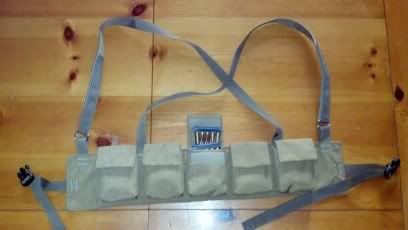
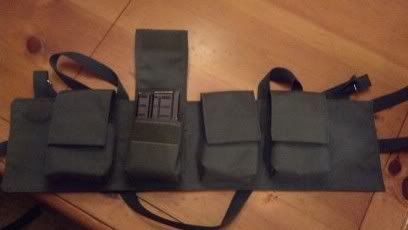
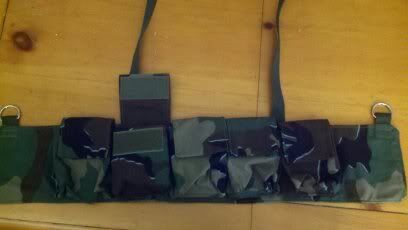
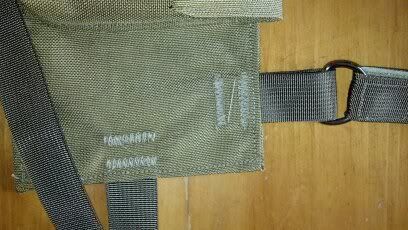
Making Your Own Chest Rigs, by Jeff J. in Arizona

Among the different weapons I own I have several Russian WWII Mosin Nagants. I have wanted for some  time to find some kind of chest rig and or web gear to use with these rifles so they could possibly be used as battle rifles. I have several of the Russian surplus ammo pouches that came with these rifles but I wanted something that could hold more stripper clips and was more modern. I searched numerous times on the internet and could never find a dedicated Mosin Nagant chest rig. Finally, I found 1 seller on Ebay who was selling a chicom SKS style Mosin Nagant chest rig. The seller wanted over $70 for this 1 rig. That was way out of my price range at that time. This did give me a good idea though for making my own Mosin Nagant chest rig. Although this article explains how I made my Mosin Nagant chest rig the idea is to show how you can make a similar rig for your specific weapon.

After seeing this 1 Chicom style rig on EBay, I remembered that I owned a Chicom SKS chest rig. I took it out and went over it examining it to see how it was built and what I would have to do to make something similar. The common SKS chicom chest rig is made of olive drab colored canvas fabric. There are multiple pouches used to carry 7.62x39mm ammunition on 10 round stripper clips. They also have canvas webbing straps used for shoulder straps and waist straps. These also usually just tie around the waist without any buckle and also tied around the shoulder strap to adjust the strap length. The flaps that secure the pouches are secured with a wooden dowel and loop system. These rigs are bare bones and work very well. They were used in Korea and later in Vietnam.

So I decided I was going to make a chest rig and see how it worked out. Just for some background though, I have to admit I know nothing about sewing. I never learned to sew and never had a reason to sew. I had bought my wife a sewing machine several years earlier as she wanted to learn to sew but she also has no experience sewing. So I decided I would learn. I opened up the user’s manual for my wife’s sewing machine and read it cover to cover. When I was done I turned on the switch and started practicing. I am in no way an expert in sewing and I am sure I have been doing a lot of things wrong. That being said, I want to share my experience making this Mosin Nagant chest rig as best as I can. Please forgive me if I do not use the correct sewing terminology.

I figured that I needed to begin purchasing some supplies before I began. I started with fabric and began looking online for fabrics I wanted to use. I planned on buying military camouflage fabric that was actual surplus stock. I also thought I should maybe buy some nylon cordura. The four fabrics I initially chose and bought were the US surplus woodland ripstop camo, US surplus 3 color desert NYCO ripstop camo, OD nylon 1000 denier coated cordura, and coyote brown nylon 1000 denier coated cordura.
I also looked at the USMC MARPAT in woodland and desert surplus fabric, CADPAT, MARPAT nylon cordura, DPM, desert DPM, and Flecktarn cordura. Maybe later I will purchase one of these other fabrics to use for this project.

I then searched for an bought nylon webbing strap. The original Chicom SKS rig used cotton webbing straps. I found and bought 1″ OD nylon webbing strap and 1″ coyote brown webbing strap.

Next I went looking for hook and loop closure (Velcro) as I did not want to use the wood dowel and loop system on the SKS rig. I am sure a button and button hole or snaps would be the perfect solution as hook and loop is noisy but my very limited sewing skills made me use the hook and loop. I found at a local fabric depot multiple yards of OD 1.5″ hook and loop and off Ebay I bought beige/tan 1″ hook and loop. I decided to stick exclusively with the beige/tan for all my tan colored projects as coyote brown hook and loop was very expensive compared to the other available colors. More current demand maybe.

I then went looking for the hardware pieces for the rigs. First I looked for “D” rings to use on the back side of the shoulder straps to be used to adjust the length for different sized people. I found many different kinds of “D” rings on the market, chrome, colored, metal, and plastic in all shapes and sizes. I skimped on this part and ended up buying a 4 pack of 1″ steel “D” rings at Wally world as it was a nearby source and cheap. I also realized I did not want to just tie the waist strap around my body like the design on the original SKS chest rig. The easiest fix was to add a side release buckle. Again there were multiple choices, colors, sizes, and styles. Even ones with emergency whistles built into the buckles. I settled with a black 1″ plastic buckle again at Wal-Mart since it was right next to the “D” rings.

When I bought my thread I looked around at what was available for strength and sunlight resistant. I knew that there were different kinds of threads and some were a lot stronger than others. I found 1600 yard spool cones from a US seller on Ebay. I bought 1 OD and 1 Coyote brown spool of #69 bonded nylon T70 thread. This particular thread is made for use in luggage, tents, upholstery, and other heavy duty applications. It is also chemical and sunlight resistant.

My next step was to make a pattern so my pieces could have some kind of uniformity. I decided to use poster board for the pattern pieces. Again, I took out my SKS chest rig and compared and borrowed some of the measurements from it. Next, I took 3 loaded 7.62x54r Mosin Nagant stripper clips and stacked them staggered one on top of the other. I then measured their combined height, width, and length.  I wanted my rig to hold 15-20 full stripper clips so I planned for 5 pouches with hook and loop fastened flaps. I measured so that each pouch could hold 3 or 4 charged stripper clips.

When the pattern was complete I had 3 pieces of cut poster board. One for the base piece of the rig, one for the pouches, and on for the flaps. When I made my measurements I took into account that I wanted to double each piece of fabric. I wanted the same material seen on the outside of the rig also seen inside the pouches and the bottom side of the flaps. I also knew this would add more strength to the rig.  

Here are some links with pictures of the chest rigs I made:
http://i1253.photobucket.com/albums/hh599/jeffinaz/1346192682659.jpg
http://i1253.photobucket.com/albums/hh599/jeffinaz/1345947292807.jpg
http://i1253.photobucket.com/albums/hh599/jeffinaz/1337126802846.jpg
http://i1253.photobucket.com/albums/hh599/jeffinaz/1346192685418.jpg

Here are the measurements for my Mosin Nagant chest rig pattern:
Base= 27 3/4″ long x 5 3/4″ wide
Pouch= 12″ long x 6 3/4″ wide
Flap= 10″ long x 3 7/8″ wide
Hook and Loop= 3″ long x 5 pieces both male and female sides

Here are the general instructions for how I then built my chest rig. I started by laying out the desired fabric face down on a table. I then traced the pattern pieces onto the back of the fabric for each piece I needed to cut out. I found that a Sharpie marker worked best on the Cordura and a dark colored pencil did a great job on the camo ripstop fabric. In all I traced 2 base pieces, 5 pouch pieces, and 5 flap pieces.

I started with the flaps first. I folded each piece of fabric length wise and then ironed a crease to make a visible seam in the middle. Then I opened the piece up and placed a male side hook and loop piece centered and 3/8″ from the middle crease and sewed it onto the flap piece. I then folded the flap in the opposite direction so the pattern or outside was inside and then sewed the two long sides with a 1/8-1/4″ seam. I then pulled the flap right side out and used a ruler corner to push out the corners. last, I pressed out the seams I had just sewn so the flap had the correct shape and sewed another seem across the first, along both long sides about 1/4″ from each side. I left the bottom of the flap open at that time as I later would sew across it when I attached it to the base. This was done 5 times for each flap.

Next, I went onto the pouches. As I had done with the flaps, I also folded the pouches in half length wise and ironed a crease in the middle. I opened the piece up and placed the hook and loop female piece centered and about 3/8″ from the crease and sewed it on. I then refolded the piece at the crease and sewed a seam across the crease about 1/4″ from the it to make the top of the pouch. Then I marked a 1 3/4″ x 1 3/4″ square on both bottom corners of the pouch and cut them out. I then folded the pouch out at the inside corner of the 1st cut so the two perpendicular lines of the cut were resting on top of each other. There I sewed a seam down to create the pocket(bottom corners) in the pouch. I left 3/8″ at the bottom of the seam un-sewn. Afterwards, I repeated the same thing on the 2nd cut of the pouch. Before turning the pouch right side out I cut a triangle piece about 3/8″ off the corner of the bottom of the seam I had just sewn(reason why I left 3/8″ unsewn on seam). This later helped when folding the corners in to sew it to the base. As before, I did this 5 times for each of the 5 pouches.

On to the base of the chest rig. This part takes the most attention as you have to add and sew the webbing into this piece along your “D” rings. To begin, I mated the two base pieces together with the two faces against each other and the inside denier coating facing out. I pinned the two pieces to keep them together and from moving while I sewed. First, I sewed 1 of the long sides with a seam about 1/8-1/4″ from the side. Next, I took the first waist strap(cut to your desired length) and placed it inside the 2 base pieces. I extended it outside about 1.5″ from the side and centered and then sewed a similar seam to the first along the 1st side.

The 2nd long side would be more work than just sewing a seam. I would have to add 4 more pieces of webbing along that side. before starting I measured 2″ from each end and marked the Cordura and then again at 8″ from each end. At the two 2″ measurements I placed a folded 6″ piece of webbing strap with a “D” ring on it making sure the “D” ring was again on the inside of the two base pieces. As I had done with the 1st waist strap, the 2 ends of these two pieces stuck out of the base about 1.5″. At the 8″ measurements I took my shoulder straps and folded them so they would both fit in between the base pieces with the other webbing straps. One end of both straps again extended 1.5″ from the base at the 8″ measurement marks. Once these 4 webbing straps were anchored at their measurement I sewed another seam across the 2nd length equal to the first.

This left the 2nd side open. Here I would then pull the base of the rig right side out with all the webbing straps now exposed. To help keep the true shape of the base I would again push out the corners with a stick or ruler and press the seams out. I then would sew another seam over the three seams on the outside of the base. To close the base I would insert the 2nd waist strap 1.5″ and centered on the side and fold the ends in to make a similar seam as the others and then sew a 1/4″ seam across it.

To finish the base, I sewed a staggered stitch at 2 points across each of the six 1.5″ pieces of webbing strap that were inserted into the base’s side. This added strength to the webbing straps where they were attached and took the majority of the weight off the side seams.

The last major piece to be sewn is to attach the flaps and the pouches to the rig base. This is done in 2 steps. First I placed the center flap on the rig base centered and 1″ from the top and pinned it in place. Second, I pinned the remaining 4 flaps in place 3/4″ from each other again at 1″ from the top of the rig. I then sewed the 5 flaps in place across their open ends to the rig base.

The pouches take a little work to get in place the first few times. I would take the first pouch and fold in the bottom 3/8″ piece at the end. Then center the pouch over the corresponding flap where it will be sewed on. I would pin the bottom of the flap 1/2″ from the bottom of the rig base and then sew across the folded 3/8″ attaching the bottom of the pouch. Once the bottom is attached you fold in each of the two remaining sides 3/8″ as you did to attach the bottom. Align each side from the bottom in a straight line up to where it will overlap the corresponding flap at the top edge. Pin the 2 sides in place and sew them equal to how the bottom was sewn. Once this is done that pouch is finished, continue with each pouch until all 5 are complete.
To finish the chest rig, I cut and sewed two 8″ pieces of male and female hook and loop onto the ends of the shoulder straps. This allows you to adjust the length of the straps as needed for different sized people. Cross the shoulder straps and run the end through the opposite “D” ring and secure with the hook and loop closure. Add the side release buckle onto the two sides of the waist straps and the chest rig is finished.

The cost for making these rigs was a bit more for me as I purchased 4 different kinds of fabric and 2 different kinds of thread and hook and loop. I did this to be able to make numerous rigs. Here is a list of the items I bought and their cost plus shipping. With exception to the “D” rings and the side release buckles purchased at Wally world I bought all the components from US sellers on eBay and or local fabric shops in my area.

  • 5 yards Olive Drab 1000 denier coated cordura                                       $34
  • 1 yard Coyote Brown 1000 denier coated cordura                                  $15
  • 2 yards 3 color desert US surplus NYCO ripstop                                    $16
  • 1 yard Woodland US surplus ripstop                                                         $12
  • 10 yards, 1″ Beige Hook and Loop (male and female)                             $7.95
  • 5 yards, 1.5″ Olive Drab Hook and Loop (male and female)                   $12
  • 70 yard roll, 1″ Olive Drab nylon webbing                                                $34
  • 4 yards, 1″ Coyote brown nylon webbing                                                  $15
  • 1,600 yard spool, #69 T70 Olive Drab nylon thread                                 $7
  • 1,600 yard spool, #69 T70 Coyote brown nylon thread                            $7
  • black 1″(25mm) side release buckle                                                     $1.97
  • 4 pack of 1″ D-rings                                                                             $0.78F

For each yard of fabric I was able to make almost three complete chest rigs. I might have been able to get all three from the 1 yard of fabric if I had maybe laid out the pattern pieces in a different way.

For those who stuck with me through this article I wanted to add this rig will work with other calibers and weapons stripper clips. After making the first rig I realized I could also use 3-4 8mm Mauser stripper clips in it and they fit perfectly. I am sure you could use the above chest rig with the same measurements for almost any 30 caliber sized high powered rifle on its corresponding stripper clips. This could include .308, .30-06, 6mm Swedish Mauser, 7.5 Swiss Schmidt Rubin, 8mm Mauser, and many others. You can adjust the measurements above to fit any size charged stripper clips you want to use. I had even thought of maybe sewing in a looped elastic band inside the pouch so you could place and carry individual rifle rounds if you did not have any stripper clips.

After perfecting my rig for my Mosin Nagant I wanted to see if I could make a chest rig for my G3 magazines. Aside from surplus German Flecktarn G3 magazine pouches and some rubber or plastic double pouches there are not a lot of choices for chest rigs for the H&K 308 style rifles on the market. I measured out the magazines as I had done above with the stacked stripped clips. However, I goofed and measured wrong. My pouches were too short when the magazines were inserted and the flap would barely close. My fix was easy though, I tried putting FAL magazines in the pouches and they fit perfectly. So now my G3 pattern is my FAL pattern. Later I will redo the G3 chest rig with longer pouches.

These chest rigs are very minimal and would work perfectly worn under a Rucksack or BOB without causing too much discomfort. Some of the larger MOLLE and similar vest and chest rigs are a lot bulkier. But you can carry more gear in them. For me having both gives me a choice of either.

I may have to upgrade the shoulder straps to a wider webbing strap and or padded shoulder straps. 1″ nylon webbing may be to narrow and cause pain over the shoulders with increased weight from larger and heavier magazines. I wanted to weigh one of the rigs loaded with strippers before finishing this but I do not have a scale. I did load up one of the rigs and found the weight was very negligible compared to any chest rig with loaded magazines.

I also noticed the surplus ripstop fabric was not as strong as the nylon cordura. Although I really like the look of the surplus fabrics they might not hold up as well as the stronger cordura. I figured if I wanted to  I could back the surplus fabric with a piece of cordura. Another thing I found while searching for fabrics to buy was there were numerous nylon cordura fabrics with matching patterns to many of the surplus patterns. My next purchase of fabric will probably be nylon cordura in woodland MARPAT design.

Currently I am working on making a chest rig for my daughter’s four 25 round Ruger 10-22 magazines. This rig is a little different as it is almost 10″ tall and the sides are angled instead of squared. Maybe I will make a chest rig for AK-47 30 round magazines and H&K93 40 round magazines. I also am thinking to try my hand at making different style rigs like SADF Pattern 70, NCStar VISM, AK-47 drum rigs, etc.

I guess the main reason for this article is to show that if you cannot find the gear you need, then make it. Remember, I have no experience in sewing and I have made six of these chest rigs from scratch.


Guest Article: To Arms!, by William Crosby Prentice

The title of this essay could be either a call to action, or a toast to weapons.  Either way, the purpose is to discuss the decision of whether or not, and to what extent, a person should be armed.  The author is biased in favor of being as heavily armed as is legal under any given circumstances, and has a hard time coming up with reasons for not being armed.

The Right of Self Defense
I would bet that nearly all of those that regularly visit SurvivalBlog will agree that a person has a natural right, independent of and senior to any legal system, to defend his life and property.  This audience would also tend to agree that this right extends to defending others who are under an attack that could result in their loss of life or sustaining great bodily injury. 

The perversion by government of the self-defense right, and the attempt by governments to create a monopoly on the use of force, is at the root of our problems with government.  There are many governments, such as that of New Zealand, that do not recognize a right of self defense.  The United Nations also has trouble with that concept. The assertion by governments of a monopoly on use of force and denying it to individuals, and the use of that force to coerce obedience, to seize property, and to take lives, is perhaps the greatest of all evils.

Denying that individuals have the right of self-defense is an amazing thing, but you hear “civilized” people make that argument all the time.  Once you have been conditioned to think that the right to self defense is even debatable, you might find yourself also debating whether or not you should even consider arming yourself to do so.  If you are worrying about whether or not you should or can arm yourself, then this essay is aimed at you.

Weapons
Humans have big brains, and are bipedal, so that they can maximize the use of “tools.”  A review of the scientific literature makes it clear that “tools” is a PC alternative to the word “weapons.”  Humans are hard-wired to use weapons, and being interested in perfecting that ability does not make you uncivilized, it makes you more human.  Being disarmed makes you a slave rather than a citizen, a human beast of burden, who differs from a plow-horse only in that a human slave is also a “tax-payer.”

Many people have an innate abhorrence of weapons, and regard any act consistent with owning or using a weapon to be inexcusable.  Weapons guru Jeff Cooper coined the term “hoplophobic” to describe them.  The views of such people are ignored in this paper, because such irrational sentiments are of no interest to evolved humans who believe in individual freedom and personal responsibility.  (Note: I am often seized by a perverse desire to see the onset of a TEOTWAWKI event because hoplophobes and their progeny will be among the first to succumb, greatly benefiting the species.)

To defend your life and property you have to be willing to fight, and fighting involves weapons.  The array of weapons ranges from the natural weapons of the human body that martial artists seek to develop, to the group-served weapons and machines fielded by modern armies.  It would be nice to live on a nuclear powered aircraft carrier and use it for your personal protection, or to have a fleet of armed drones at your disposal to eliminate your enemies, but that would mean enslaving millions of tax-payers and forcing them to pay for it.  Let’s take a look at what is possible and effective for the individual to use for his own defense and those of his family or tribe.

Threat Assessment
A professional security assessment, whether involving the geopolitical strategy of a superpower or the defense of a small antimony mine in the ungoverned regions of Honduras, is built around the definition and analysis of a threat.  As in all strategic exercises, we begin not with what we think we know, but with the right questions, which in this context would include:

  • What/who is the threat, and its objectives, means, weapons, and capabilities?
  • What is the realistic probability of attack, and can you change that by deterrence/avoidance?
  • If there is an attack, what is the most effective response/defense? and,
  • How will the threat evolve if and when you successfully deal with an attack?

Security assessments for major commercial facilities in dangerous environments are often substantial documents requiring hundreds of man-hours from a diverse group of experts to compile.  For our purposes, the model can be condensed into a shorthand form that, with practice, can be effectively applied to any situation.  Let’s look at a few situations:

Wild Animal Attack – This can include mountain biking in Orange County, where lions have attempted to feast on bikers, or the backpacker entering grizzly country in Yellowstone, or the older couple taking their grandchildren to the local park where a pair of pit bulls is running amok (don’t freak – I like pit bulls, grizzlies and cougars!).  The probability of such an attack is normally small, but indeterminate; an attack might be avoided or deterred depending on the circumstances (aggressively resisting a mildly hungry cougar) or avoided with timely local intel (avoiding a recent grizzly kill noted on a map for you by a ranger).  If you can’t rely on avoidance/deterrence, then I prefer a large-caliber rifle (my 500 A-Square works great on cape buffalo), but that isn’t usually convenient and might not be legal, so a large-caliber pistol is the most practical defense most of the time.  Evolution of the threat isn’t a consideration – you aren’t likely to shoot a grizzly to death one day and find another one wearing Kevlar the next.

Muggers – The most commonly portrayed self-defense situation is that of a person innocently going about their business in public and being robbed, assaulted, or jacked.  Again, you might be targeted or randomly selected, and although avoidance/deterrence is possible, it can’t be depended upon.  The self-defense handgun you train with most regularly is the right weapon to carry here, but if it is illegal to carry a pistol, and you chose to refrain from doing so, then by all means equip yourself with the appropriate number of knives and a sturdy walking stick. Threat evolution is a factor – muggers learn to avoid people who might be carrying, and might also focus on gun-free zones.

Home Invasion, Burglary – When you are sitting at home, or lying in bed, you probably feel pretty safe, and you might be, particularly if you have a good security system, which should include dogs and guns. On the other hand, if it were possible to determine all of the independent variables, you could decide that you are more likely to suffer an attack at home than you are out and about. The safest approach here is to have firearms strategically located around the house, with appropriate measures in force to prevent misuse by children or incompetent adults.  If you carry concealed during the day, then why not continue to do so after you get home? 

Unlawful LEO Activity – What if you are assaulted by law enforcement acting outside the law.  I have many friends in law enforcement, who are just as upset about these incidents as we are.  If you think this is uncommon, then check out these web sites: here, and here.  Note also a disturbing recent report that certain jurisdictions hard-pressed in the current economic environment might use drug sniffing dogs and the right to property forfeiture to increase public revenues.  I am not a lawyer, but according to my research, there is a common law right to use force (but not lethal force) to physically resist improper police actions.  As noted at The Volokh Conspiracy, a recent Michigan case reaffirmed that right, while earlier Indiana rulings first negated then reinstated that right.  If you are the victim of such an incident, but are not in mortal danger, then it may be best to ensure there are lots of witnesses and lawyer-up later on.  If your life is in danger, then in my own mind a deadly assault under color of authority is the same as any other assault or home invasion.

Abduction – Imagine you have been abducted, beaten, sexually abused, and awaken to find yourself bound and gagged in the trunk of a moving car.  This is as bad as it gets.  There are those out there that would advocate continued cooperation, but I would argue that you are probably only alive because it is more convenient to kill you somewhere else.  I would also argue that cooperation is not consistent with pay-back.  If you are tied up, get loose, and root around in the trunk until you find a weapon – something like a tire iron.  Even if there is nothing that serves as a weapon, as soon as that trunk pops open your job is to kill your attacker(s) with whatever you have available.  What have you go to lose?

Active Shooter – The recent Aurora, Colorado, active shooter case produced an amazing storm of blog activity.  Some people pointed out that a single armed citizen sitting in the theater could have saved the day, and others dismissed that idea, ignoring the fact that something along those lines had really happened in 2007, where an armed citizen killed a shooter in a Colorado Springs church before he could get revved up.  Apparently the theater is a gun-free zone, so if you armed yourself and went to the movies, and someone saw your pistol, you would have to leave and apologize, or explain to the local police that you didn’t see the sign.  Even if you are only armed with a knife and/or a walking stick, if you are close enough you are just as dangerous as the shooter is, and the closer you are the less you have to lose since he will probably shoot you anyway.  The active-shooter threat has evolved – they always seem to select gun-free zones to attack. 

Military Attack – I can’t ignore this one.  Let’s say you have joined the Army, gone through your training, and have been assigned to a unit being deployed to Pick-a-Stan, and that you are not a combat veteran.  First of all, you should hunt down the individuals within the unit, particularly senior NCOs, who have been there and know what they are doing – stay close to them and learn everything you can.  Also, augment your EDC gear in meaningful ways, and ensure your issue weapons are not flawed.  Get tight with your fire team and talk about what is going to happen, and what has been happening, every day.  If you have incompetent leadership that is intent on getting you killed, discuss it with your team and figure out what to do.   In combat it is inevitable that people will be killed, but who gets killed is a function of training and circumstance; take your training seriously and become the most competent fighter you can be.  Don’t become a victim of circumstance.  Stay in shape, stay sober, stay alert, stay alive.

The Point – As you can see from the truncated threat analyses above, I can’t think of a single strategic/survival situation where you wouldn’t be better off carrying, and using, the most powerful weapon that you can use effectively and are legally entitled to carry.  Maybe you could avoid bloodshed by giving a mugger your wallet, but if that is the course you select, why not do so while retreating slowly gun in hand?  The grizzly in front of you might just be startled, and maybe you can act submissive and creep away, but why not do that while holding your 454 Casull at the ready?  It may be more comfortable on the couch if you take your Kimber out of your waistband and put it upstairs unloaded, but why not just loosen your belt a little and leave it on until you go to bed?

Firearms
If you have made the decision that arming yourself is a good idea, then let’s jump right to firearms, because firearms are the most effective personal defense tool you can have.  Volumes have been written on the best self-defense weapon, and you can devote the rest of your life to research in that area, so just let me say this about “which” firearm:

The best firearm for defending yourself is the most powerful weapon you can legally possess and use well, and which is in your hand at the time that you need it. 

There are several subordinate points to that main rule, including:

  • A long gun is better if you can get it, but for concealed carry you are stuck with pistols;
  • A large caliber is better than a smaller, if you can competently wield and accurately shoot it (if your carry gun is so heavy that you constantly elect not to carry it, even around the house, or if the recoil is so abusive that you are afraid of it, then it is the wrong weapon); and,
  • You must regularly train in the use of your weapons (range time is not the only way to effectively train, dry firing drills are very effective).

Empty Hands
For reasons discussed elsewhere, I have good reasons for having acquired certain skills. I trained in the martial arts from an early age.  I was in lots of fights, and I won more than I lost.  Despite that, maybe because of it, I never willingly put myself into a situation where I am only armed with natural weapons.  I also no longer allow myself to be lured into a social encounter. The reasons for this are numerous, but the most important ones are:

  • It is stupid – as the old expression goes, if you roll around in the mud with pigs you will never come out smelling like a rose, even if you “win;”
  • It doesn’t usually remain a friendly bout for long – often friends will pitch in on either side or someone produces a weapon;
  • If you are well trained and fit, and you win, and the other person gets hurt, you are screwed, whether he started it or not; and,
  • If you are a CCW holder, and things get out of hand, you will lose your CCW, and never be able to get it back.

On the other hand, if it is a true survival situation, and you have no weapons, you will wish you had invested in the training.  You are also going to wish you had not had that last drink, that you had been keeping in shape generally, and that you or your significant other didn’t have such a big mouth.

My own preference is for martial arts that focus on combat rather than sporting aspects, and which also include weapons training integrated into the system.  It is only natural that I put in a plug for Kali-Escrima and Jeet Kune Do.  I have never studied Krav Maga, but I have worked out with guys that did study it and it seems very effective. 

The UFC/MMA thing contains much that is useful, and the Brazilian Jiu-Jitsu guys are correct that most one-on-one social street fights end up on the ground. Also, an intensive grappling workout is the toughest of all forms of conditioning I have been exposed to, so ground-fighting is a perfect ten for pure PT. Note however, UFC/MMA is still a sport with rules, and rolling around on the ground seeking your favorite submission hold while your opponent’s friends start kicking you, or he gets his blade out, is a tactical mistake.

I would suggest that the best – most efficient – martial art for you to study is the one taught in a location you can conveniently and frequently get to, is taught by people that will listen to and focus on your objectives and needs, and will keep you in great physical shape.  Also, there is nothing wrong with moving around from school to school and picking up what you can.  It was Sifu Bruce Lee who said “Absorb what is useful, reject what is not, and add what is specifically your own.”

In Between
There is a vast array of weaponry in between firearms and empty hands.  This includes knives, sticks, baseball bats, pepper spray, a belt with a heavy buckle, swords, spears, the staff, your car, broken bottle, almost any tool you can find in a workshop, and various improvised weapons such as a rolled-up Wall Street Journal. 

The walking stick along with good solid folding combat knife (or neck knife) is hard to beat.  It is also a combination that is compatible with the legal systems of most countries in the world.  A trained fighter so equipped is more dangerous at close range than a man armed with a pistol that is still holstered.  You can of course substitute an umbrella for the cane, or a rolled up newspaper. 

The cane-knife combination can make use of a number of weapons systems training regimes – the training I am most familiar with is the espada y daga components of Kali-Escrima.  However, if you happen to have trained in Kendo, then you will find that a relatively heavy cane is a lot like a samurai sword.  A knife alone is of course very deadly, even more deadly if the one using the knife is well trained, fit and conditioned to an ugly combat situation.  Many martial arts involve training with the knife, and some are almost solely devoted to it. 

The problem with most of these weapons is the same as with martial arts themselves, they are most useful in younger, bigger, fitter and well trained individuals.  The advantage of firearms is that smaller, older, weaker people can effectively use them.  Non-firearms weapons that have the same advantage, plus having the advantage of being (usually) non-lethal, include both pepper-spray (such as the one from Kimber, for example) and conductive energy weapons (such as Taser).  Both require some training to be most effective, which can be obtained locally throughout the USA.  They may not be legal, however, in all jurisdictions, so check it out if you are getting on a plane.

Beyond Firearms
Day-to-day self defense considerations rarely result in deciding upon such weapons systems as squad automatic weapons, mines, mortars, grenades, heavy machine guns, RPGs, MANPADS, or even armored vehicles.  This is the sort of thing that you would typically include in your planning for after the SHTF.  If your planning scenario includes this type of weapons system, then you need to invest heavily in legal advice and the requisite permits, and you will need a weapons budget much bigger than I have.  I wish you luck and I would really love to see what you come up with.

Children and Weapons
First of all, it goes without saying that you keep weapons safely locked away from children that are not properly trained in handling them.  If your children have been trained and indoctrinated, then I consider it your choice as to how secure the weapons need to be.  By the time my children were in their early teens they could field strip every weapon in the house, and I didn’t worry about something being left lying around unless a stranger was in the house.  When another child was in the house the weapons went into safe storage.  In this day and age, the way I did things might be illegal in some jurisdictions, so be sure and check if a relatively lenient policy would otherwise by your decision.

From a parents’ point of view, I regard weapons as being nearly the same as sex.  If they haven’t shown an interest, then don’t bring it up – unless they are at an age that you should worry that they haven’t shown an interest.  Actually, guns and/or hunting might be a more common kitchen table topic than sex in most homes, so the subject might be more likely to come up than sex in some families. 

In some homes, the kitchen table discussion might be more likely to include sex-change surgery for children than the best handgun to carry.  If that does describe your family, then I still advocate an early non-judgmental discussion of firearms if and when your child brings up the subject, to be followed by actual exposure to basic firearms training if a real interest is expressed.  This is not an area where enforced ignorance is good, any more than it is in the matter of sex.

With regard to bearing arms, I believe the earlier the better, consistent with the law.  A child can accompany an adult in the field and carry his own firearm as soon as he or she is able to complete a hunter’s safety course.  I think this may be the best way to ease children into the art of responsibly bearing weapons.  The concealed carry laws of all of the states I am familiar with confine that right to an adult (amongst other conditions), so even the most responsible child will not be able to carry a concealed firearm.

It is never too early to get your kids involved in martial arts, and that is an excellent way to begin instilling the philosophy of self reliance and personal responsibility into your child.  Again, as discussed above, if that martial arts training is more realistic, then it is better, and if it includes exposure to various weapons, then that is wonderful.   Since children are generally discouraged from carrying any sort of weapons, a good parent who refuses to wimp out on this subject will make sure that his or her children are aware of what can be accomplished with improvised weapons. 

I grew up in a different world than the one we are stuck in right now, and I had a knife on me all the time, even at school, from a very early age.   I still have one of them around here – a Barlow with a Bowie blade and a sheep foot blade of fairly soft steel that was easy to sharpen.  I think the first thing I cut with my first pocket knife was my thumb – that was how everyone in my day and age learned about sharp knives.  My kids had knives at an early age, but I think that they got in trouble for it whenever they got caught with them at school.  With today’s zero-tolerance laws I have no doubt but that it is probably a felony to let your kid walk around with one in public now.  Please check the laws of your state, county and city, the rules of your homeowner’s association and the policies of your schools before letting your children carry a knife.  

It is a dangerous world, and you can’t be with your children all of the time.  I gained some comfort that my own children had some training, and could react productively to a survival situation.  If you decide to not train your children at all, or if you tell them to trust in the authorities, such as their teachers or administrators, religious leaders, or local law enforcement, then in my opinion you are simply teaching your children to become victims.  If I can’t be there, then I would prefer that my children or grandchildren be dangerous in their own right, rather than have them depend on someone who might let them down. 

Legal Issues Relating to Weapons and Self-Defense
The possession and use of weapons, and the application of deadly force, is an important area of the law, and one that is constantly changing in various jurisdictions.  You can be sure that if you are involved in a self-defense situation, especially one involving a firearm, once you have survived the physical threat you will then have to deal with the legal aftermath, both criminal and civil.  Check with your local police or sheriff’s department for guidance, consult the hundreds of web sites devoted to weapons and the law.  Better yet, go visit a local attorney that advertises a specialty in firearms law and invest in an hour of his time. 

Summary
My bias is pretty evident by now.  I believe that you should always be as heavily armed as you are legally entitled to be, bearing weapons you are trained in and can use effectively.  If you are not legally entitled to carry a firearm to a certain location, then don’t go there.  If you have to go there, then arm yourself in some legal manner, such as walking stick and pocket knife.  Work out with those weapons so that you can actually apply them in practical situations. 

There are dangerous people out there who won’t worry about legality.  They will be waiting around for someone that looks vulnerable.  Make sure you are not what they are looking for.  Better yet, be more dangerous than they are.

The Author
Despite the state’s appalling politics, the author lives peacefully in California.  He is engaged in the business of financing energy and technology firms, and is the acting CEO of a private military contracting firm.  He is also devoted to the personal pursuits of rock climbing, martial arts, and hunting.  Prentice is also the author of Feral, a novel with significant Libertarian overtones, and the short story Purgatory.