Letter Re: Biblical Prepping

Hugh,

One more comment: Just because these are difficult times, that does not necessarily mean we are about to enter the Tribulation of Scripture. History is littered with dark days. In fact, good times are the exception. Had I been alive in the 1930s-1940s, I’d have thought the Dust Bowl was the famine, the Spanish Flu was the plague, the Great Depression was the financial ruin, and Hitler was the anti-Christ. The return of Christ may very well be 1,000 years away; maybe this is just the precursor to Dark Ages II? This is not our world. Maranatha. – CDV


Economics and Investing:

Pay off our debt? Not likely, say some. – G.G.

o o o

Ellen Brown: Big Banks Will Take Depositors Money In Next Crash

o o o

Russia is finally using all that gold they’ve been hoarding. On Thursday, the Central Bank of Russia announced that gold reserves dropped by $4.3 billion in just one week, reports Vesti Finance. – CDV

o o o

Items from Mr. Econocobas:

“These Are Astonishing Figures, Evidence Of A 1930s-Style Depression”

One-Fifth of Americans Don’t Plan to Pay Off Their Debt

Russia Set to Raise Main Lending Rate


Odds ‘n Sods:

Gruber: Killing ‘Marginal’ Babies ‘Saved the Government over $14 Billion’. – H.L.

o o o

Big Banks Conspire with Gov’t to Confiscate Accounts

o o o

Obama administration claims a right to hide evidence before Supreme Court. – B.B.

o o o

9 Ways to Boost Your Immune System and Avoid Being a Victim of the Flu Season . – D.S.

o o o

Courtesy of The Daily Sheeple: If you are like me, and you worry about the life span of your water filters in a collapse situation, and how you’ll keep purifying drinking water after your supply of filters runs out, then this video is for you. – H.L.


Notes for Thursday – December 11, 2014

Today, we present another entry for Round 56 of the SurvivalBlog non-fiction writing contest. The $12,000+ worth of prizes for this round include:

First Prize:

  1. A Gunsite Academy Three Day Course Certificate, good for any one, two, or three course (a $1,195 value),
  2. A course certificate from onPoint Tactical. This certificate will be for the prize winner’s choice of three-day civilian courses. (Excluding those restricted for military or government teams.) Three day onPoint courses normally cost $795,
  3. DRD Tactical is providing a 5.56 NATO QD Billet upper with a hammer forged, chromlined barrel and a hard case to go with your own AR lower. It will allow any standard AR type rifle to have quick change barrel which can be assembled in less then one minute without the use of any tools and a compact carry capability in a hard case or 3-day pack (an $1,100 value),
  4. Gun Mag Warehouse is providing 30 DPMS AR-15 .223/5.56 30 Round Gray Mil Spec w/ Magpul Follower Magazines (a value of $448.95) and a Gun Mag Warehouse T-Shirt. An equivalent prize will be awarded for residents in states with magazine restrictions.
  5. Two cases of Mountain House freeze dried assorted entrees in #10 cans, courtesy of Ready Made Resources (a $350 value),
  6. A $300 gift certificate from CJL Enterprize, for any of their military surplus gear,
  7. A 9-Tray Excalibur Food Dehydrator from Safecastle.com (a $300 value),
  8. A $300 gift certificate from Freeze Dry Guy,
  9. A $250 gift certificate from Sunflower Ammo,
  10. KellyKettleUSA.com is donating both an AquaBrick water filtration kit and a Stainless Medium Scout Kelly Kettle Complete Kit with a combined retail value of $304,
  11. TexasgiBrass.com is providing a $300 gift certificate, and
  12. Two cases of meals, Ready to Eat (MREs), courtesy of CampingSurvival.com (a $180 value).

Second Prize:

  1. A Glock form factor SIRT laser training pistol and a SIRT AR-15/M4 Laser Training Bolt, courtesy of Next Level Training, which have a combined retail value of $589,
  2. A FloJak EarthStraw “Code Red” 100-foot well pump system (a $500 value), courtesy of FloJak.com,
  3. Acorn Supplies is donating a Deluxe Food Storage Survival Kit with a retail value of $350,
  4. The Ark Instituteis donating a non-GMO, non-hybrid vegetable seed package–enough for two families of four, seed storage materials, a CD-ROM of Geri Guidetti’s book “Build Your Ark! How to Prepare for Self Reliance in Uncertain Times”, and two bottles of Potassium Iodate– a $325 retail value,
  5. $300 worth of ammo from Patriot Firearms and Munitions. (They also offer a 10% discount for all SurvivalBlog readers with coupon code SVB10P),
  6. A $250 gift card from Emergency Essentials,
  7. Twenty Five books, of the winners choice, of any books published by PrepperPress.com (a $270 value),
  8. TexasgiBrass.com is providing a $150 gift certificate,
  9. Organized Prepper is providing a $500 gift certificate, and
  10. RepackBox is providing a $300 gift certificate to their site.

Third Prize:

  1. A Royal Berkey water filter, courtesy of Directive 21 (a $275 value),
  2. A large handmade clothes drying rack, a washboard, and a Homesteading for Beginners DVD, all courtesy of The Homestead Store, with a combined value of $206,
  3. Expanded sets of both washable feminine pads and liners, donated by Naturally Cozy (a $185 retail value),
  4. Two Super Survival Pack seed collections, a $150 value, courtesy of Seed for Security,
  5. Mayflower Trading is donating a $200 gift certificate for homesteading appliances,
  6. Ambra Le Roy Medical Products in North Carolina is donating a bundle of their traditional wound care and first aid supplies, with a value of $208,
  7. APEX Gun Parts is donating a $250 purchase credit,
  8. Montie Gear is donating a Y-Shot Slingshot and a Locking Rifle Rack (a $379 value).

Round 56 ends on January 31st, so get busy writing and e-mail us your entry. Remember that there is a 1,500-word minimum, and that articles on practical “how to” skills for survival have an advantage in the judging.


Becoming a Top-Tier Survivalist and Representing the Prepper Community, by M.M. – Part 3

We are continuing through the list of skills in the third point– “Acquire Skills”– of six points that will be presented and detailed that, if implemented in your own life, will greatly increase your chances of success, both in surviving TEOTWAWKI and in breaking the stereotype of the “kooky prepper.”

Shelter Building

Shelter building is easily self-taught, especially if you buy some books on the subject and have the ability to “think outside the box.” The 1911 edition of the Boy Scouts Handbook shows many ways to construct shelters using a single piece of cloth (without ever cutting it), sticks, and cord. There are also various methods for building a shelter using only natural materials. For any shelter construction, it is key to ensure that your shelter is water resistant; that it will not collapse under the weight of snow, rain saturation, or its own materials; and that it blends in with the surrounding environment. Don’t be that guy camping underneath a blue poly tarp that’s visible from a mile away during TEOTWAWKI (or anytime for that matter). Either buy an actual military shelter (tent, bivy, canopy, or army poncho), or be prepared to construct a good natural shelter each time you set up camp. Also, be sure to have the appropriate woods tools with you to assist in construction, including a hefty fixed blade knife and a folding saw (mine is a Sawvivor, which is no longer produced), and possibly a hatchet or tomahawk with a head consisting of both blade and hammer, which is especially useful for pounding stakes into the ground.

Land Navigation

In BUD/S we spent about two weeks learning and practicing land navigation. During the first week we studied the use of USGS (United States Geological Survey) 1:24,000 scale UTM (Universal Transverse Mercator) grid maps in conjunction with compasses and map tools, and the following week we used those tools and skills to navigate through the mountains inland from San Diego near the Mexican border. Each day we were required to individually find our way to seven of the dozens (if not hundreds) of points our instructors had hidden throughout the national forest. The points consisted of spruce-blue tomato stakes about a foot tall with a dog tag hanging from the top of each one by a short steel cable. We needed to find six out of seven points per day to pass the course; the distance between points ranged anywhere from 100 yards to several miles. Then, in squads, we completed a night navigation course consisting of chemlight points that were not as easy to see from a distance as you would think. In SQT, our land nav course was done in partners over a three-day period, walking about 26 miles through the mountains with a full load-out. At the Team, we again conducted a solo land nav course through the forests of Virginia, both in the daytime and at night. (I kept many sticks from poking my eyes out by wearing clear shooting glasses.) Never were we allowed to use a GPS to aid in navigation, and smart phones didn’t exist yet, as far as I remember. All navigation was done using the Silva Ranger compass.

GPS’s, like all electronics, can (and will) fail at the worst possible time. Also, the government can turn off or encrypt the signals from GPS satellites, and I believe they are likely to shut the system down for civilian use in the case of WROL (Without Rule Of Law). An EMP (Electro-Magnetic Pulse from a nuclear detonation or solar flare) could also cause significant problems for your GPS. The Silva Ranger consists of a liquid-filled compass with a mirror and sighting notch for taking accurate bearings, as well as scale rulers to use with your maps. This compass is capable of amazing accuracy, depending on the user’s skills, and it will function flawlessly, regardless of environmental or governmental factors, as long as you take care of it..

You may have some difficulty finding a military-grade land nav course to use for your own practice. However, I have heard that orienteering clubs have courses laid out on public lands and private campgrounds across the country. You can also hone your skills by geocaching, using your map and compass. Once you become proficient, you can challenge yourself further by setting up your own orienteering course for a local Boy Scout troop. (Just make sure you plot the points accurately, or you’ll have some disgruntled scouts to answer to.)

First Aid

For medical training, you can learn basic first aid from the Boy Scouts or the American Red Cross. We learned to dress gunshot wounds, apply tourniquets, and give IV’s during SQT, but you will probably need to attend EMT training or join the military yourself to satisfactorily learn those skills. Becoming a corpsman in a combat unit would provide you with a wide array of medical skills and experiences from which to draw upon, in the case of TEOTWAWKI. A great source of military and survival medical supplies is www.chinookmed.com.

Shooting

I have a great interest in firearms, and I am very much in favor of defending and strengthening our Second Amendment rights. I would like to see the amendment enhanced to read, “A well armed citizenry being necessary to the security of a free state, the right of all Americans to keep and bear weaponry equivalent to any and all government arms and equipment, especially for use against tyranny in government and common criminals, shall not be infringed upon or regulated by the government or any corporate entity, at any level, in the least degree, outside the walls of a jail or prison.”

My only firearms experience prior to BUD/S was earning the Shotgun Merit Badge at summer camp and firing three rounds of 22LR during a winter Klondike Derby. Pellet and BB guns aside, I never touched another real firearm until BUD/S. In Third Phase, we were trained to manipulate, fire, disassemble, clean, reassemble, and store the Sig P226 semi-auto pistol, S&W 686 revolver, Remington 870 pump-action shotgun, HK MP5 sub-machinegun, Colt M4 carbine, MK-46 (SAW– Squad Automatic Weapon), MK-243 (M60 machinegun), and M79 and M203 grenade launchers. In SQT, we retrained on some of those same firearms, as well as the AK47 carbine, M14 rifle, Browning M2 machinegun, Carl Gustav and AT4 recoilless rifles, and LAW rockets. At the Team, we fired the HK MK23 semi-auto pistol, and I was privileged to try out the boat-mounted Twin 50’s (two M2’s sharing one trigger) as well as the MK-19 automatic grenade launcher. I have also owned and become proficient in using around thirty personal firearms since purchasing my first shotgun back in 2002. In BUD/S, we had the basic firearms safety rules drilled into us, and we spent a lot of time dry firing (and drawing and re-holstering with the P226– our primary sidearm) before we ever fired any shots on a range. We had to qualify as experts in both pistol and rifle from the 25-yard line and 200-yard line respectively; we conducted Immediate Action Drills on a live-fire range (to practice returning fire and breaking contact from an enemy ambush), and we practiced our own ambushes and raids, as well as room clearing in a mock ship and kill-house/town. We became familiar enough with our firearms that we could disassemble, reassemble, load, shoot, and rectify malfunctions without giving any of it a second thought.

Now, I understand that not all survivalists all able to train with and master firearms to as great an extent as the Navy SEALs, but there are certain measures that all gun owners should take to become responsible and proficient shooters. As far as I have noticed the general public to be concerned, you are considered much more trustworthy with a firearm if you have been professionally trained rather than if you have been self taught or received casual instruction from a friend or relative. From my own observations of untrained or poorly-trained persons tending to do foolhardy things with firearms, I find this perspective to be justified. Prospective gun owners should attend and graduate from at least one professionally-instructed course (preferably more) to learn basic firearms safety, proper maintenance, shooting fundamentals, and self-defense/tactical shooting skills as well as techniques for clearing malfunctions during high-stress situations. Blackwater USA (now Academi) offers such courses, and so does a personal friend and fellow SEAL through his business www.tridentfitness.net. Training should be undergone for both handguns and long guns, and I do not consider hunter safety courses or concealed carry courses to offer sufficient firearms training for anybody, much less for serious survivalists. You need training that is based on the use of firearms as battle weapons.

4. Carry and Use Quality Gear

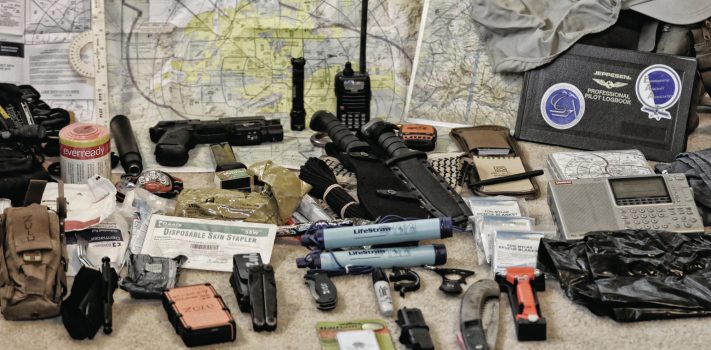
To me, a major indicator of whether somebody is a novice prepper, a kook, or a truly prepared survivalist is the type and quality of gear that he selects. Many of us are living on a tight budget and it’s simply not feasible to purchase the top-end version of every gear item we need. Still, it is important to always make quality a high priority, and for some items you really should only consider top-end candidates and save up as necessary to buy them. Here I will detail my own EDC items and recommendations: a watch, sunglasses, phone, flashlight, lighter, pocketknife, and handgun. I also normally carry my wallet, but I made it myself and it’s very unique, so I can’t recommend a store-bought equivalent. In the future, I hope to write another essay covering a full TEOTWAWKI combat load-out, but for now I’ll just stick with the ROL (time when Rule of Law is in effect) essentials.

Watch

The ability to determine time is essential to following a daily schedule and coordinating events with others. My watch is a Seiko automatic, which is internally wound by body movement. I was told by a reputable watch dealer/repairman that it should run for 15 to 20 years without needing any service, as long as it doesn’t experience any hard impacts. The same man tells me that Luminox watches, which are made specifically for military use, are also excellent. My Seiko has modern glow-paint on the hands and numerals and holds a dim glow all night long after being exposed to sunlight throughout the day, or after shining a bright light on it for a few seconds. Luminox uses tritium for the same purpose, which will glow continually for between 12 and 20 years. Either a Seiko or a Luminox will set you back about $300. The only other watches I care for are Casio G-Shocks and the Timex Atlantis. Both offer water resistance to 50m or deeper but will only last about three years before requiring a battery replacement and may be more prone to failure in the case of an EMP, whereas such an event is less likely to affect an analog watch. Analog watches are often made with a rotating bezel to provide a simple stopwatch function, and they can be used to determine cardinal direction if you know the trick.

Sunglasses

Sunlight is terrible for virtually everything that doesn’t contain chlorophyll, and your eyes are especially susceptible to damage from both direct and indirect solar radiation. I find it incredible how so many people go about their daily lives without wearing anything to shield their eyes from the UV rays or even the sheer brightness of the sun. My current sunglasses are the Oakley XX. I wear them anytime I’m outdoors between sunrise and sunset. I had a pair of Oakley Fives that I liked better (basically the XX without any of the rubber pieces), but I lost them kayaking while riding a wave in Florida. I believe that Oakley makes the best sunglasses on the market, and they offer a lifetime warranty on their frames for the rare cases in which they break. (They will not replace scratched lenses, so be careful with them.) Most SEALs wear Oakleys because of their comfort, ruggedness, clarity, and highly protective lens coatings. They are relatively expensive, but you can get a major discount on most models if you have served in military or law enforcement by going to www.oakleysi.com and applying for membership. (You’ll have to e-mail Oakley a copy of your DD-214 or current government ID.)

Phone

I don’t really care much for owning or carrying a cell phone, as doing so makes a person feel obligated to be available to others when he would rather not be, because the phone acts as a GPS tracking device and because (being a transmitter of radio signals) a cell phone is a potential source of cancer-causing radiation when carried close to one’s body. My current phone is an iPhone, and it basically functions as a tiny Mac computer, so that makes me less reluctant to carry it. (I normally keep it off my body whenever possible though.) It is fully compatible with my actual computer (a MacBook Pro), and MagPul makes excellent tactical cases for it that are available in black, foliage, and flat dark earth. Some practical apps you may want to load into your phone are “Daylight”, which provides the civil, nautical, and astronomical morning and evening twilight times as well as actual sunrise and sunset times. (This is very useful for mission planning.) Other helpful apps include Trimble Outdoors’ “Navigator”, which provides digital and zoomable USGS Topo maps for the entire country with a “current position” indicator, and “BulletDrop”, which calculates ballistics based upon data you provide (cartridge specifications, zero, yardage, and wind speed). All of these apps are free.

Flashlight

I began regularly carrying a flashlight about two years ago, when my job necessitated it for reading, writing, and performing inspections before dawn and in enclosed spaces. Before that time, I just performed tasks in the dark by feel, which I still frequently do. I wear a Maglite Solitaire LED flashlight on a bead chain around my neck. This is a top-quality American-made flashlight, and it is much brighter than its incandescent predecessor. Advertised as a keychain flashlight, the Solitaire runs 1:45 hours on one AAA battery, measures approximately 4” by ½”, is waterproof, and wearing it around the neck allows a person to easily access and bite it for hands-free use. If you prefer a pocket- or belt-carry flashlight, the Mini Maglite Pro+ LED is very nice and bright. It runs on two AA batteries and can be used as a flashlight or as a “candle”. (The Solitaire also does this, but it won’t stand on end as well.) I also have a Mag-Tac flashlight, but I don’t care for it a whole lot. Despite it being extremely bright, it’s too bulky for comfortable pants-pocket carry, and it doesn’t function as a candle for area lighting, although I do take it running at night. The only other quality American EDC flashlights I’m aware of are made by Surefire, but they are outrageously priced, and I don’t believe there is much performance difference between them and Maglite; you’re really just paying for the name and a more tactical look. For a weapons light, Streamlight makes the TLR series in my home state of Pennsylvania. I don’t think you can find a better weapon light than the TLR-1s, which has a watertight aluminum housing and utilizes a very bright LED, but if you prefer the addition of an aiming laser, the TLR-2s is a good option.

Tomorrow, we’ll continue the list of quality gear.


Letter Re: Six Common Misconceptions About EMP

A question for the writer of the EMP article. Though the article was informative, he, like pretty much everyone else that writes about EMP’s or other forms of grid failure, completely ignores the 900 # gorilla in the room. Can we expect the 100+ nuclear power plants in the country to have meltdowns when the grid can no longer supply the power these plants need? In particular, what about the spent fuel pools? My understanding is that they have emergency generators and anywhere from a few days to a few weeks worth of fuel on hand but even if somehow those generators weren’t damaged by the EMP, I somehow doubt the government has realistic plans to keep them fueled and care for the workers needed to run the nuke plants. Thanks. – B.U.

Hugh Replies: This is an issue that the Nuclear Regulatory Commission is aware of, and, if their literature is to be believed, is actively preparing for. According to their web site, the NRC has been dealing with this exact issue for 30 years and has stringent controls in place to ensure the outcome. They believe that as of two years ago, nuclear plants in the United States can shut down safely. It would be good to hear from someone knowledgeable on the subject as to how that relates to the real world.


Economics and Investing:

The American Dream deferred for young Americans: Living in rentals, inflated college tuition, and low wages await millions of young Americans.

o o o

Welcome To The Recovery: 40% of Americans Live Paycheck To Paycheck (Up From 30% In 2012) – G.G.

o o o

Items from Mr. Econocobas:

Why the Greek Stock Market Is Crashing Again

Video: Peter Schiff – Fed Can’t Raise Rates Without Pricking Bubble

Chris Martenson interviews Mike Maloney – The Coming Wealth Transfer


Odds ‘n Sods:

FBI Plans to Have 52 Million Photos in its NGI Face Recognition Database by Next Year. – RBS

o o o

Why flu shots are the greatest medical fraud in history. – D.S.

o o o

Al Qaeda Terrorist Wanted by FBI Crossed Back and Forth Into U.S. From Mexico. – P.M.

o o o

With future uncertain, Colorado shields its water. – D.S.

o o o

The Treasury Department is Seeking Survival Kits for Bank Employees and Thousands of Cellphone Users Received a Government “Emergency Alert”. – B.B.


Hugh’s Quote of the Day:

“Adventures are only interesting once you’ve lived to see the end of them. Before that, they are nothing but fear, and being too cold or too hot or too wet or too hungry, and getting hurt.” ? Holly Lisle, The Silver Door


Notes for Wednesday – December 10, 2014

Infidel Body Armoris having a 10% off sale for the rest of December. This could be the time to get that level IV armor you’ve been wanting for Christmas!

o o o

Today, we present another entry for Round 56 of the SurvivalBlog non-fiction writing contest. The $12,000+ worth of prizes for this round include:

First Prize:

  1. A Gunsite Academy Three Day Course Certificate, good for any one, two, or three course (a $1,195 value),
  2. A course certificate from onPoint Tactical. This certificate will be for the prize winner’s choice of three-day civilian courses. (Excluding those restricted for military or government teams.) Three day onPoint courses normally cost $795,
  3. DRD Tactical is providing a 5.56 NATO QD Billet upper with a hammer forged, chromlined barrel and a hard case to go with your own AR lower. It will allow any standard AR type rifle to have quick change barrel which can be assembled in less then one minute without the use of any tools and a compact carry capability in a hard case or 3-day pack (an $1,100 value),
  4. Gun Mag Warehouse is providing 30 DPMS AR-15 .223/5.56 30 Round Gray Mil Spec w/ Magpul Follower Magazines (a value of $448.95) and a Gun Mag Warehouse T-Shirt. An equivalent prize will be awarded for residents in states with magazine restrictions.
  5. Two cases of Mountain House freeze dried assorted entrees in #10 cans, courtesy of Ready Made Resources (a $350 value),
  6. A $300 gift certificate from CJL Enterprize, for any of their military surplus gear,
  7. A 9-Tray Excalibur Food Dehydrator from Safecastle.com (a $300 value),
  8. A $300 gift certificate from Freeze Dry Guy,
  9. A $250 gift certificate from Sunflower Ammo,
  10. KellyKettleUSA.com is donating both an AquaBrick water filtration kit and a Stainless Medium Scout Kelly Kettle Complete Kit with a combined retail value of $304,
  11. TexasgiBrass.com is providing a $300 gift certificate, and
  12. Two cases of meals, Ready to Eat (MREs), courtesy of CampingSurvival.com (a $180 value).

Second Prize:

  1. A Glock form factor SIRT laser training pistol and a SIRT AR-15/M4 Laser Training Bolt, courtesy of Next Level Training, which have a combined retail value of $589,
  2. A FloJak EarthStraw “Code Red” 100-foot well pump system (a $500 value), courtesy of FloJak.com,
  3. Acorn Supplies is donating a Deluxe Food Storage Survival Kit with a retail value of $350,
  4. The Ark Instituteis donating a non-GMO, non-hybrid vegetable seed package–enough for two families of four, seed storage materials, a CD-ROM of Geri Guidetti’s book “Build Your Ark! How to Prepare for Self Reliance in Uncertain Times”, and two bottles of Potassium Iodate– a $325 retail value,
  5. $300 worth of ammo from Patriot Firearms and Munitions. (They also offer a 10% discount for all SurvivalBlog readers with coupon code SVB10P),
  6. A $250 gift card from Emergency Essentials,
  7. Twenty Five books, of the winners choice, of any books published by PrepperPress.com (a $270 value),
  8. TexasgiBrass.com is providing a $150 gift certificate,
  9. Organized Prepper is providing a $500 gift certificate, and
  10. RepackBox is providing a $300 gift certificate to their site.

Third Prize:

  1. A Royal Berkey water filter, courtesy of Directive 21 (a $275 value),
  2. A large handmade clothes drying rack, a washboard, and a Homesteading for Beginners DVD, all courtesy of The Homestead Store, with a combined value of $206,
  3. Expanded sets of both washable feminine pads and liners, donated by Naturally Cozy (a $185 retail value),
  4. Two Super Survival Pack seed collections, a $150 value, courtesy of Seed for Security,
  5. Mayflower Trading is donating a $200 gift certificate for homesteading appliances,
  6. Ambra Le Roy Medical Products in North Carolina is donating a bundle of their traditional wound care and first aid supplies, with a value of $208,
  7. APEX Gun Parts is donating a $250 purchase credit,
  8. Montie Gear is donating a Y-Shot Slingshot and a Locking Rifle Rack (a $379 value).

Round 56 ends on January 31st, so get busy writing and e-mail us your entry. Remember that there is a 1,500-word minimum, and that articles on practical “how to” skills for survival have an advantage in the judging.


Becoming a Top-Tier Survivalist and Representing the Prepper Community, by M.M. – Part 2

We are continuing the first point– “Be Fit”– of six points that will be presented and detailed that, if implemented in your own life, will greatly increase your chances of success, both in surviving TEOTWAWKI and in breaking the stereotype of the “kooky prepper.”

Flexibility

As far as flexibility goes, you should do a full stretch routine, both after your warm-up and after your cool-down. Stretches should be held for 10-20 seconds without any bouncing, and while stretching you should feel some discomfort but not pain as your muscles loosen up. Failure to stretch properly could result in injuries or cramps during PT and cramps or stiffness overnight and the following day. Be especially wary of sudden cramping of the calf muscle while swimming with fins, as this could get you into trouble during an open-water swim.

Agility

Everything I’ve covered so far will appear more or less normal and healthy in the eye of the public. However, you also need to work on agility– your ability to move quickly with balance and coordination. In BUD/S and at the Team, we practiced this mostly through the use of four different obstacle courses on three Naval bases. Obstacle courses are hallmarks of militaries and militias, so unless you have the property and money to build your own obstacle course out of the sight of nosy neighbors and uppity passersby, you will probably have to make use of playgrounds, skate parks, rocks, trees, and other public amenities for your obstacles. Parkour, or Free Running, is a sport in which common structures are negotiated as obstacles by running, jumping, and climbing. I would suggest developing your own “obstacle course” based upon the resources available in your community and training on it in normal athletic clothes. If anybody ever asks what you’re doing, tell them it’s Parkour and it’s popular in Europe.

Also, if you plan on ever bugging out with your BOB/GOOD kit, then you should add ruck humping to your PT regimen. You can do this as a trail hike with a weighted civilian backpack (at least 50lbs) to avoid any undesirable attention. I only own Army ALICE rucksacks, and I like to carry a weighted prop to simulate a rifle when I do a ruck hump (as we did in the Navy), so I wait until after dark and walk the perimeter of a local golf course where nobody sees me.

While one of Richard Mercinko’s 10 Commandments of SpecWar states, “The more thou sweatest in training, the less thou bleedest in war,” you don’t need to go crazy with PT. One to three hours a day is fine. Be sure to take a break on Sunday and even Saturday, if you like. Your body needs time to recover.

Diet

In addition to exercise, diet is very important to your overall fitness and health. Most people know which foods are healthy to eat and which foods are not, so I’m not going to delve into the basics here. However, there are two aspects of nutrition that are frequently overlooked– proper portion sizes and the avoidance of dangerous food additives. Portion size is fairly easy to control; just use a salad plate, or envision how much food might fit on one, and eat that amount at each mealtime rather than what would fit on a full-size dinner plate. My wife tells of a thin old man who said that the key to his health is that he has always left the table just slightly hungry. So don’t over-indulge yourself, and eat less if you’re exercising less.

Avoiding dangerous food additives is a real hassle and is especially difficult to do if you aren’t buying your own groceries. Try not to eat foods that contain sodium nitrate, sodium nitrite, or any dyes (especially Red #40). Also, never ingest aspartame, acesulfame potassium (acesulfame K), or monosodium glutamate (MSG). These chemicals are known to have deleterious health effects in many people and cause damage to the eyes, nervous system, reproductive system, and more. They are found in most commercially-smoked meats, candies, artificial sweeteners, soup bases, and brightly-colored foods. Always check the list of ingredients on the food label, because many products that you would think are healthy are most definitely not; yet, there are also plenty of difficult-to-pronounce ingredients that are completely harmless. Anytime I come across a questionable ingredient, I look it up in the Consumer’s Dictionary of Food Additives, which lists FDA health concerns associated with each substance.

2. Educate Yourself

As a prepared individual, you should have a natural desire to understand the workings of the world around you. This includes maintaining constant situational awareness by scanning your environment for possible threats and opportunities, studying the current political climate and any news relevant to your particular region or situation, and researching the Bible, law, world and national history, our founding documents, military tactics, homesteading, and wilderness survival (to name only a few subjects). You should also familiarize yourself with the correct nomenclature and terminology to use for preparedness gear items and activities as well as the use of proper grammar in general, especially for when you’re speaking to non-preppers or posting on the Internet. Remember that you’re a representative of the prepper community! As old Biff Tannen once stated, “It’s leave, you idiot! Make like a tree and leave! You sound like a fool when you say it wrong!” So don’t call magazines “clips”, cartridges “bullets”, or semi-automatics “assault weapons”; you should also learn the reasons why. Furthermore, it would behoove you to conduct your own research into controversial topics, especially so-called “conspiracy theories”, and seek to learn the truth of such matters. The chances are that if a subject is controversial, it’s because only a portion of the population knows and is willing to accept the truth. However, if you don’t want to appear to the mindless masses as a kook, then only attempt to share your findings if you can prove the information beyond a shadow of a doubt, and don’t spend all of your time researching. (Actually, they’ll still think you’re a kook.) It’s easy to get carried away, even to the point of obsession, when you start digging deep into the conspiracies of the powers that be, but balance your time with other interests and especially with physical activity.

3. Acquire Skills

A favorite story of mine that my mother tells is that when I was about two years old she placed me outside in a playpen beneath the beech tree, went back inside, and headed upstairs to exercise on the NordicTrack. Partway through her workout, she heard, “Hi Mom!” and became somewhat alarmed when she looked out the window and saw me hanging with one hand from a branch on the beech tree that was level with the second story window and waving to her with the other hand. She raced downstairs and coaxed me back down to the ground; I descended fine on my own. Some skills come naturally to us, but most need to be learned. I believe that a major part of what makes preppers appear kooky to the general public is the lack of expertise in essential skills, as well as engagement in prepping activities that really serve no practical purpose. Some basic skills that every survivalist should be proficient in are:

  • shooting,
  • knife sharpening,
  • swimming,
  • climbing,
  • fire-making,
  • first-aid,
  • shelter building,
  • land navigation,
  • knot tying,
  • radio use and etiquette,
  • proper care and storage of gear and consumables, and
  • dressing oneself appropriately for any given situation, as well as maintaining a professional and attractive appearance.

The best way to learn and practice many skills is to join an organization that is qualified to teach you the skills properly. When I was in the Boy Scouts in the late 1990’s, they did a great job of this. Anymore, I’m not so sure, but I believe some troops still have a lot to offer their members. If you join the military for one of the many combatant positions offered, you are almost guaranteed to learn a great deal of survival and fighting skills. It would be best to try out for one of the special operations groups, as they receive better training than the regular military regarding the fields you will likely be most interested in. If you don’t care to get paid to learn and practice skills, then you can pay to learn them at the many private civilian schools across the U.S., or you can try teaching yourself. The following are details of the skills I believe to be basic essentials:

Maintaining Appearance and Demeanor

Maintaining your appearance and demeanor actually is a skill, and many preppers do not possess it. Your personal standards should be similar to those of military and law enforcement personnel. As noted already, preppers need to keep themselves in excellent physical shape. Being overweight is a sign that you don’t have respect for yourself, and you will not easily earn the respect of others while in that condition. Keep your hair short (men only) and neat, and refrain from getting tattoos and piercings (earrings are acceptable for women). Your clothing should be clean, fit you properly, and be appropriate for both everyday activities and for use during adverse conditions. Camouflage should be avoided during Rule of Law, in favor of solid natural colors, as the general public associates camo clothing with kookiness. Please do not wear clothing that has skulls and other symbols of death printed on it; the last thing the prepper community needs is to give the public and the media reasons to associate us (essentially the already-demonized militia) with the glamorization of violence and death. I personally avoid wearing clothing with any sort of print most of the time. When interacting with others, think before you speak; also, do not use slang or foul language. Avoid alcohol, tobacco, and any sort of drugs– illegal or not. As a survivalist, others should be able to look up to you as a leader in times of trial, and that won’t happen if you look and act like a punk.

Knife Sharpening

You should be skilled at knife sharpening. Using whetstones or a diamond rod, a very dull old edge can be turned into a good working edge in about 5-10 minutes, and a fresher edge can be honed razor sharp in one or two minutes. The use of gimmicky (and oftentimes expensive) sharpening kits may seem novel to some people, but such devices really mark the prepper as unwilling or unable to learn and master a basic survival skill. Kit sharpeners are also difficult to fit into a BOB load-out. I prefer diamond rods, as they do not wear out and I use them almost exclusively to sharpen my own knives, which are all as sharp as can be. Upon mastering this skill, you can sharpen knives for your friends and family (especially their dull kitchen knives that all clank against each other in the utensil drawer) to demonstrate that survivalists are handy to have around. In addition to keeping your blades sharp, keep them clean. Residues on the steel can cause corrosion, collect dust and bacteria, and hinder your ability to cut. They are also an indicator that you don’t care for your gear. Clean your knife with dish detergent, Goo Gone, or lighter fluid whenever necessary, and take care not to dull the edge in the process.

Fire Building

This is a skill that most people are able to perform under normal circumstances, despite knowing little about it. You should be able to gather and process a variety of flammable materials and identify the materials as tinder, kindling, and fuel. In a natural environment, you would gather such items as dry grass and weed stems, pine needles, fur and feathers, or you could process dry wood into very fine shavings, to use as tinder– the part of your fire that you actually light. The burning tinder is used to ignite kindling, which consists either of sticks up to the size of the width of your fingers or, even better, a dry log processed into finger-width pieces. (Sticks often hold moisture inside the bark, whereas the inner wood of a seasoned log tends to be very dry.) The kindling is used to ignite fuel– logs measuring about wrist-width and larger. In an urban or suburban environment, a multitude of materials could be substituted for those listed above, such as lint, paper, greasy food wrappers, or clothing for tinder; cardboard, wood stakes from construction sites, and fence pickets for kindling; and furniture legs, fence posts, and pallets could be used for fuel. Items, such as candles, petroleum jelly, and flammable liquids other than gasoline (which has explosive tendencies), may be readily available in civilized areas to assist your fire starting. My favorite method of fire construction is the log cabin build; this is done by stacking the kindling like Lincoln Logs and filling the center of the “cabin” with tinder, but sometimes a teepee build is easier, depending on the materials you’ve been able to gather. If you don’t want to spend the time and energy cutting up larger logs, you can just feed them lengthwise into the fire as time passes. As a survivalist, you should be able to start a fire in most environments and weather conditions, a lifeless sandy desert and portions of the Earth’s snow-covered poles being notable exceptions.

Knot Tying

I won’t go into great depth discussing knot tying, as it’s very difficult to instruct how to tie knots without visual examples, but you should be able to tie basic knots, including the:

  • square knot,
  • bowline,
  • sheet bend,
  • clove hitch, and
  • taut-line hitch.

You should understand the purpose of each knot and know how to use it to serve your needs. In BUD/S we had to prove we could tie the aforementioned knots underwater on breath hold, first at nine feet in the pool and later at 50 feet in the dive tower. This was for the purpose of being able to tie detonation cord while rigging underwater demolitions, which we eventually did in the surf off San Clemente Island. You can try tying knots underwater if you like, but you should definitely be able to tie the basic knots without looking, so you’ll be able to tie them in the dark when necessary. I find this particularly important when setting up hammocks and shelters at nighttime, when flashlights would give away my position. The use of multiple overhand knots is an unacceptable substitute for correct knot tying technique; each knot you tie should be attractive (a pretty knot is a proper knot), secure, and easy to loosen when its job is complete. I like to incorporate a slipknot into most knots I tie so that when I’m ready to undo them, I can simply pull the running end rather than pulling out the Leatherman. This is as simple as passing the running end of your line back through the last loop before tightening the knot. The more knots you can properly tie the better; this is one skill set that you can use to impress survivalism-naysayers on a regular basis.

Swimming

I learned how to swim mostly on my own. I failed every stroke in swim lessons when I was little, yet I spent a significant portion of each summer swimming at the local pool. Then, when I was older, I went on to swim and free-dive alone in nearby rivers and at the beach (mostly around jetties in the ocean and beneath bridges in the bay along the coast of New Jersey). I joined the high school swim team during my senior year and competed in breaststroke and freestyle (for whatever reason competitive swimming doesn’t include sidestroke). Later, in the Navy, I swam up to 5-1/2 nautical miles in the ocean (about 6-1/3 statute miles) using the sidestroke with fins. During college, I trained and life-guarded for two summers at an outdoor pool, where I performed one rescue. Swimming is a skill that everyone should possess. The ability to swim properly and quickly will keep you out of trouble around the water, and it may even enable you to save another person’s life, earning you-– the survivalist-– the admiration and gratitude of your unprepared community. If you need to learn to swim, you can be trained as a Boy Scout at summer camp or through adult swim lessons at most public pools and gyms. However, to learn the “combat sidestroke”, you’ll probably have to figure it out on your own, unless you know a veteran who can teach you properly (this video may also help).

Tomorrow, we’ll continue the list of basic, essential skills in the “Acquire Skills” section of this five-part article.


Letter: Regarding Ebola PPE

Mr Editor,

I’m a small town Fire Chief here. From considerable reading on the subject as I plan for our EMS personnel, I agree with your opinion that N95 is a lame attempt at respiratory protection from Ebola. However, I disagree strongly with anyone suggesting depending on a castoff “gas mask”, discarded decades ago by some 3rd world military, to protect your lungs. Obsolete military gear of unknown history was likely improperly stored and not maintained for years or decades and, equally important, has filters of unknown capability, age, and condition. All filters have a shelf life. How old are those filters in your stock? Dry rot in the inhalation or exhalation disks (valves) if present. Dry rot in the seal?

A better plan is to purchase Fire Dept surplus (or new) Scott brand SCBA (airpak) facepiece (mask), an adapter for filter cartridges, and current production filters. Why?

1. SCBA facepieces, even old, typically have been well maintained and stored in a dry, heated fire station during their life and not in a subzero warehouse, while sitting on a drum of avgas. A SCBA facepiece provides full protection of ALL your facial mucus/orifices and has a large viewing lens which provides much better visibility that military “gas masks”.

2. The same Scott SCBA facepieces, uniquely, are used for the full range of respiratory protection from airpaks, to supplied air, to various powered filter paks, et cetera. Scott facepiece models, in order of age, are: AV2000, AV3000, AV3000 Sureseal, AV3000HT. All have small, medium, and large sizes for a fit/seal for most face sizes/shapes. Each model has improved voice emitters. Electronic voice amplifiers are available if needed.

3. You can easily arrange for a “Quantitative fit test” for an SCBA facepiece. There is no way you are going to fit test that M___ or Chicom POJ for mom or the kids. Without a fit test to verify you have a leak-free respirator, you have nothing; you have NO respiratory protection. The test should cost you $25-35/person. Testing with a Quantifit tester (as by Scott dealer or industrial safety firm) will take about 5 minutes. Shave before you test or you will not pass. Most adults will use a size medium and pass in a higher % for new models, as the design of the seal (face to mask) has improved (reduced leakage). AV3000Sureseal is the most forgiving/easiest to fit. OSHA says a business is “supposed” to do test annual, but …..

4. A wide range of P100 (99.9%) filter cartridges are available. Basic P100 filters are $9/set (two). Higher capacity P100 filters with special capabilities run $15+/set. A 742 twin pack filter adapter is needed at approx. $30-35 to connect the filters to the facepiece. To change filters, make a ¼ turn to remove the old filter from the adapter and then install a new filter. Repeat for the other side of the facepiece. https://www.scottsafety.com/en/us/pages/ProductDetail.aspx?productdetail=Adapters

All the facepiece models listed use the same filter adapter. I would not recommend adopting the 40mm style filter, though Scott does have a 40mm adapter if that floats your boat (legacy cop equipment). Note that the AV2000 is obsolete, but thousands are used, or stored, at FD nation/world-wide. A new AV3000Sureseal will cost you around $210; a used AV2000 on ebay will be well under $100. If buying used, I’d recommend buying AV3000 (or AV3000 Sureseal) from a local FD so they can upgrade to AV3000HT. It might be tax deductible for you. Scott is by far the largest mfg of SCBA in the U.S. and the world, so you won’t have to go far. There is a good chance you can arrange to buy the filter adapter and filters through them and set up a fit test. It is good to have friends down at the local (volunteer) Fire Station; these guys are the opposite of the cops.

If you want to increase your protection with a positive pressure or supplied air source while working on a patient, then you can add on a Scott SCBA. Older used units are available for a few hundred $.

The other North American SCBA mfg is MSA, but they’re less common and their equipment is less flexible, facepieces are more expensive, less flexible and do not have most of the benefit described above. There are a couple of European SCBA manufacturers, but don’t bother.