2005 -2014 SurvivalBlog Archive Now Available!

The expanded 2005-2014 SurvivalBlog Archive is now available as either a digital download, or as a DVD. Now, you’ll get not just one extra year of the blog but many more bonus books. (49 books, in all!)

This is a complete archive DVD of all of the SurvivalBlog posts from 2005 to 2014. The article titles on this DVD are keyword searchable and are provided in both HTML and PDF. Effectively, it emulates SurvivalBlog offline, on your PC. It runs on Windows, Mac, and Linux.

With this DVD, you’ll always have access to the SurvivalBlog archives, even if the Internet is not available, and if you are online while using the DVD, then the links to external web sites (from both HTML and PDF) will be fully functional.

The amount of information on the archive DVD is immense. The HTML file is 102 megabytes and 1,441 pages long! (So we don’t recommend printing a hard copy.)

See more details and order your copy today!


Why You Should Build Community Before SHTF, by J.W.

Establishing a network of local contacts is imperative for long-term survival during and after SHTF. As survivalists and preppers, we take excruciating measures to prepare the tiniest details for what events might come. We read up on which ammo will pierce an engine block the best. We invest time choosing food-grade plastic in which to store kitchen staples, and we upgrade to the fanciest water-purification systems and run practice drills for if an intruder were to crash through our front door. Then, we debate those things on the Internet, because we as humans love to get lost in the details. Not only are those fun, but they’re concrete concepts that are easy to wrap our heads around.

However, I can’t help but notice that we invest our time, energy, and money on details like those instead of tackling some of the bigger, more uncomfortable problems. It’s as if we’re beginner golfers wasting time arguing the benefits of graphite shafts over steel, when what they should be doing is hitting golf balls.

All those little preps are great, but they’re all on the tactical level and deal with specific situations. There’s one major strategic piece of survival during a disaster that often isn’t discussed, and some survival sites even specifically say to not do it. Maybe it’s because telling you this doesn’t sell survival gear.

Here’s what you need to do, not just today but regularly and habitually, to prepare for a disaster:

Make getting to know your neighbors a survival goal.

That’s right. Make connections with people around you now, because your survival depends upon it.

Whoa now! That’s an unpopular opinion, to say the very least. Forming bonds with those who live in close proximity goes against the standard survivalist line that hungry people will be reduced to animal-like bandits after supermarkets run dry, looting each other’s homes to get their hands on whatever food or supplies they can, Walking Dead-style, and consequently you’ll have to protect your stash at all costs.

To illustrate, a buddy of mine told me he pictured himself sitting on his roof with his AR taking potshots at starving welfare bums who were trying to abscond with his stash of MREs. “I wonder how they’ll react when they see the body of the last bastard who tried,” he joked.

The mentality that you should take steps to guard your supplies against roaming bands of opportunistic thugs is a popular one. Yes, you should have preparations to do that. However, planning to defend your home fortress as a lone wolf, during and after SHTF, might be a winning strategy in the short term, but in the long term it’s not sustainable. You need the help of others, and not just fellow family members, but others who live near where you do. You need allies, and you need to be allied with others as well.

The self-sufficient, lone wolf with the “I-will-bug-out-and-play-Rambo-in-my-wilderness-retreat” survival paradigm may work well for one or two guys who head into the woods and try to live off the land, and it’s debatable just how self-sufficient they’d actually be for more than a few days. For anybody who says they’re going to wander out into the woods and start living “My Side of the Mountain”-style, good luck with that. A guy who did it and succeeded had to steal to survive, and it was nearly unsustainable. Even Thoreau regularly went to his mom’s house while he was living in the woods near Walden Pond. As a result, a more realistic survival plan is to craft relationships with a bunch of folks who live close enough to you that, if you lost long distance communications, you’d still have a social circle that you could use to get what you need to survive.

The point that I’m trying to make isn’t to let your neighbors and those who live around you in on how prepared you are, nor should you trust them all the time. What I’m trying to say is that there’s a lot of prep value in positive relationships with those who live near you. In the same way that you store supplies in your home for a rainy day, there’s a lot to be gained by, say, doing a favor for somebody who lives nearby and putting that debt in the bank, so to speak, so you can withdraw it when it’s needed.

But what if you bug out? What if they do?

Are you going to stay bugged out for forever and live like the Swiss Family Robinson? In all likelihood, you’re going to return to your permanent home after the worst has passed, whether it’s a storm, civil unrest, earthquake, or other disaster. In a long-term event, like an economic collapse, your community will look less like Hurricane Katrina and more like the Great Depression. Less like World War Z and more like The Grapes of Wrath.

Plus, since your neighbors are a lot like you, they’ll likely bug out themselves and then return to life as usual after the worst is over, at which point they’ll start recovering, which requires access to resources, which requires connections.

Here’s a central question to ask yourself as you’re prepping:

How will you fit into your community once SHTF is over?

Will you be known as the crazy guy who stocked up on guns and ammo, razor-wire-fenced his compound, blacked out his windows, and has the dead bodies of would-be-looters piled in his yard? Or will you have a circle of friends who respect and protect you because you’ve built connections through talking, trading, and helping one another, and for which you’d do the same? Or best of all, will you be the hub of your neighborhood’s social wheel, through which others must go in order to get to other connections that could benefit them?

Now, you might be thinking “Sure, I’m okay with being the crazy guy… at least I’ll be ALIVE.” What you’re missing, though, is that the two aren’t mutually exclusive. It’s entirely possible to have in place plenty of preps– food, clothing, shelter, fuel, water, security, the whole shebang– and still maintain civil relationships with those around you.

But what about when those few passing bandits take the opportunity to break and enter?

It’s certainly in the realm of possibility, although with the weight of your allies to back you up, you’ll be much better equipped to handle such a situation than you would be if you were an outsider to the community. This is the value of a neighborhood watch. When you try to take everything into your own hands and exclude your neighbors, you lose out not only on each other’s eyes and ears, but also each other’s connections.

Get this; your neighbors are a lot like you.

For the most part, our neighbors are normal, hardworking, smart folks, just like ourselves, who want the same things we do. Sure, there are plenty of bad apples, especially if you live in a place where crime tends to be higher and the folks tend to be rougher, such as trailer parks and the local ghetto. However, don’t let those few spoil the bunch. If you live on the same street or in the same neighborhood, chances are good that the folks who live nearby earn about the same amount of money, have similar cultural backgrounds, watch the same news channels, have the same level of education, and so on.

I hear trumpets of disagreement already starting to blare, but hear me out: You’re likely thinking of the one person who lives nearby who’s different from what goes as “ordinary” in your community; you think of somone with different skin color, the rich or poor guy, the old people, the new family with two little kids, and so forth, because outliers are easy to spot. We, as humans, tend to spot differences much more easily than we spot similarities. But you’re neglecting to realize that most everybody else who lives around you is probably a lot like you. This is especially true in rural areas and small communities.

This makes the people who live around you very valuable in SHTF situations. I’m not only talking about using them as tools to get the stuff that you want, such as bartering your stash of whiskey and cigarettes for their now-empty-tanked car. I’m also not just talking about trading intel, such as where the National Guard is going to be setting up aid stations. Of course, on a strategic level, it’ll be useful to have folks in your circle of friends who have specialized skills. Medicine comes to mind. That doesn’t necessarily mean they’re a doctor; they could be anybody who could provide basic medical care.

Instead, by having healthy relationships with the people who live close to you– your next door neighbors, two, three, four doors down, the next street over, or who live on the farm a mile down the road from you, as is my case– you preserve and strengthen your standing within your neighborhood community, and you get a lot of trust from those who live nearby. You even might start to get protection. You’ll be seen as a leader, which is especially appropriate considering your sizable survival skill base and cache of stuff to barter.

Having those reliable ties with those around you also strengthens your barter network. Assuming that everybody else will start bartering also, having more connections multiplies the amount of weight you have in the local market economy.

A barter economy is built on social connections.

The mathematical reason this works is because of the number of connections made in just a few degrees of separation. If you have ten solid connections with ten other folks who live around you, and each of them has ten, and each of them has ten, then you have a thousand connections right there you could easily milk for whatever supplies and information you want. If you have twenty connections yourself, then by three degrees of separation you now have a full 2,000 contacts, which is huge.

Back in pre-industrial days, everybody operated this way. If you needed something, you contacted the best person you knew to get it, and if they couldn’t get it, they’d contact the best person and so on. The power was in having the contacts.

Also, there’s gain to be had from being the guy who knows two skilled people who need each other’s skills but don’t know each other. If your small engine mechanic neighbor needs a nurse, and you know where to find one and he doesn’t, that gives you some degree of power. It’s not power so that you can misuse it but that he would be willing to reward you for it, even if it’s only with more trust and goodwill. A lady I know has a bunch of dogs and needs a kennel, and she doesn’t know anybody who has one, but I do. She’d probably bake me a pie or something if I told her. A guy might be into home brewing, but he needs access to clean water; you know a guy with a fancy water purification system. And so on.

A guy who’s popular, well-liked, and demonstrates value has a whole lot better chance of survival than somebody who’s not included in any social circle.

It’ll pay to be seen as somebody with value. Therefore, you should continuously try to build relationships with the people who live close to you. In fact, you might already have a leg up. If you live in a place where nobody really knows each other (i.e., any suburban city or larger), you have a blank canvas that you can make your own, and if the crazy cat lady two doors down doesn’t know the veterinarian four doors down but you do, then you have some power, because putting them in touch would make them both more willing to help you out.

Here’s your “to-do” list:

  • When you see somebody who lives close to you outside, go introduce yourself to them and chitchat. The simple fact that you took the first step to meet them will make you look like a leader.
  • Say “hello” to the folks you see on the sidewalk. Be approachable.
  • Try to get others to trust and respect you. Be a good neighbor. Keep your property clean, and don’t be a nuisance. Mowing grass before dawn, letting your dog poop in others’ yards, and hanging “No Trespassing” signs around your yard won’t score you any points, just to scrape the surface.
  • Be generous; for example, a new family who moved near me once brought all their neighbors a fresh loaf of homemade bread, and it paid huge dividends to them down the road in terms of trust. That’s something that simply opens the door to a positive neighbor relationship from day one. Plus, I know they have basic cooking skills, and I have lots of flour. Also, offering a beer is seldom turned down.
  • When you talk to the folks who live near you, practice the basic How to Win Friends and Influence People-style advice– talk about them, find out what they’re passionate about, and hint that you might have a way to get them what they want.
  • If you think it’s appropriate, invite one of your neighbors over for a barbecue or dinner or something. The point is that you’re showing an interest in them, and so down the road you could call on them. When SHTF happens, you’ll have an ally.
  • Make a point to get to know the people around you– what their talents are, what they have at home, if they’re threats, and how you could deal with them, and what they have to offer you.

These are good pieces of advice for anybody, anyway.

All the while, keep practicing your finely-honed prepper observational skills. Here are some things to think about:

  • Are these people or their family members a possible threat?
  • What do they want that you have, or know how to get your hands on?
  • Is their home well-defended?
  • Do they have skills that would be useful to you, or to somebody else you know?
  • Do they have items worth bartering or even fighting for?
  • What are their needs, and how could you help them reach them?
  • Are they sheeple, destined to be only casualties?

Remember when interacting to be reasonable. Don’t spout off about how you’re a prepper and you have home surveillance and 10,000 cans of beanie weenies to support you in the economic collapse that is sure to happen any second now. Don’t be dumb.

As you get to know more of the folks who live nearby, it’s useful to keep basic information on them in a notebook. Don’t be creepy, but something as simple as “John who lives at 312 Oak Street, has a wife, one teenage boy, two dogs, plays tennis, and works at Walmart.” Do it discreetly when you get home, of course.

What they won’t know is that “Unassuming, Neighborly Ol’ You” is actually a wolf in sheep’s clothing, prepared for the hairiest of situations. In a SHTF scenario skills become tremendously more valuable. You, as a survivalist, own exactly the kinds of skills that other folks will be looking for. You know how to live with less, how to cook from scratch, how to grow a garden with next to nothing, woodsmanship, how to identify edible plants, how to hunt and make your own weapons, blacksmithing, and what have you. Trade those skills, or teach them, for a sizable fee after SHTF. While you certainly shouldn’t bet the farm by being dependent on your ability to barter after SHTF, your chances of survival move way up the sliding scale because of extra flexibility you’ve built in.

So there you go.

We need to be much, much more proactive. Make friends with your neighbors. Don’t advertise how well off you are; your survival might depend on it. Plus, doing this makes your community better, anyway. In fact, that is community.

Your best chance at making it in a widespread SHTF disaster might lie in the social groundwork you’re laying today. In a long-term SHTF event, such as an economic collapse, it won’t matter as much how many cool survival gadgets you own, what kind of tactical vest you wear, or how many rounds of ammunition you’ve stockpiled. What will matter more is the size of the network of social connections you have.

Also, remember not to get lost in the details.



Three Letters Re: Livestock Guardian Dogs

HJL,

We’ve had Anatolian Shepherds for twelve years. They are very independent dogs and very protective of their charges. They must be acclimated early but will guard your herds and flocks thereafter. Ensure you have good fences to keep wandering animals away from your herd and flock, as the dogs will kill them. I’ve had to bury all manner of animals that have tried to eat my chickens. Get two dogs, so they have each other to burn off excess energy with each other rather than try to do so with the herd. I don’t allow visitors near my guardians, as they take their job seriously. – W.H.

o o o

Hugh,

This is in response to a post, concerning (Herd) or guardian dog. Russian Shepherd may be a excellent choice! RLK

o o o

Dear Hugh,

We have goats, sheep, cows, and chickens and live in cougar, wolf, bear, and coyote country; consequently, livestock protection dogs are a must. We have over the years owned seven pure bred Anatolian Shepherd’s and currently have four. They are awesome dogs, but they are NOT for most people. More in a minute.

I put dogs into four categories of protection.

  1. Useless but a lovable pet.
  2. A “yapper” that is a good alarm but not capable of defending you.
  3. A guard dog. German Sheppard, etc.
  4. Livestock protection dog.

The primary difference between a guard dog and a livestock protection dog is size, strength, and intuition. A livestock protection dog because of size and strength has a good chance at killing a cougar or a wolf, and when the dogs are run in pairs it would be a very bad day for a cougar to try to attack the livestock, or us. More to the point, the dogs should act as a deterrent, which is where size helps. After all, why fight a dog to get at a goat when there are plenty of unprotected deer running around. While German Sheppards, et cetera are awesome dogs in their own right, they are, on balance, no match for a cougar or wolf. Organizations such as the AKC categorize the typical guard dog as a “Large Breed” and the livestock dogs as “extra large breeds”. As an aside, the Anatolians are a 6,000 year old breed of dog from the Anatolian Region of what is now Turkey.

To be successful, all livestock protection dogs need three things– good fencing, a job, and plenty of space. These dogs will roam great distances if you let them, and for two reasons I would not utilize these dogs without good fencing. 1) I want them around the homestead when I need them. 2) I want to define their “line in the sand” if you will. I don’t need them scraping with a cat two miles from the homestead that is no threat to my livestock. Just because they are capable of killing a cat doesn’t mean it’s a sure thing, and it certainly doesn’t mean they will be uninjured doing so. Most of these dogs will intuitively know what their job is and how to do it better than you could train them to, but there MUST be a job to do. That is what they were born to do. The smallest pasture we have one works in about an acre, and that is space enough when supplemented with an occasional run with a four-wheeler. We once had a family arrange to visit and see our dogs that had heard of the Anatolians and wanted one for their city house back yard pet. We couldn’t have discouraged this more.

These are pack animals. That’s how they know who to guard and who is okay. You’re either part of the pack or you’re not. If you, and in our case we (wife and myself), do not authoritatively assume pack leader position, you will have problems, because the dogs will sense that void and they will assert themselves as pack leader. Caesar Milan’s book “Be the Pack Leader” is an excellent primer on this. This is where most people get into trouble with all dogs and especially guardian dogs. It was more challenging for my wife than me, as I am big; she is small. I grew up with large dogs, and she did not. One breeder we got two of our dogs from gave her excellent advice. Bearing in mind that our two males weigh as much or more than my wife does. If the dog is challenging your role as pack leader, she was told to take it to the ground on its side, lay on it with your chest on its front shoulders, and scream at it like it just killed your child until it relaxes and submits. With one of our males that we adopted, she had to do that 20+ times and still has a chipped tooth to prove it! Five years later, he knows his place in the pack, is very sweet to us, and would trade his life to protect either one of us without hesitation. This will not be nearly as much of a problem if you get the dogs as puppies and follow Caesar’s plan in the book.

To reinforce “pack” we do not allow guest dogs to come to the homestead, you NEVER take dogs like these to a dog park, and when they do go to the veterinarians its pre-arranged that they go in the back door straight to the exam room. Animals who are not members of the pack are not to be seen as “friendlies”, as you will confuse the mission of the dogs. Additionally, it would be bad manners for them to attack Fido in the waiting room! I think your audience can envision scenarios where feral dogs are a problem and they will need to be seen as threats and run off or killed, not as potential play mates.

Health wise, these are generally extremely healthy and strong animals with one exception. In the past two years we have had two cruciate ligament problems. In both dogs they were complete tears. We have been told that this is not attributable to the breed of the dog as much as the size, strength, and intensity. With the female, since she was younger and had no complications, our local veterinarian was able to perform the replacement surgery, and the total bill for that was $1,200. The male was older and had some complications, so the surgery was done at Washington State University Veterinary Hospital, and it was over $4,000.

The AKC web site under the “Meet the Breed” section of Anatolian Shepherds says they are “a working guard dog without equal”. We have certainly seen things to support that claim. For example, I have witnessed a dog get a smell of a problem; they bark a certain unique way that gets the goats attention; she rounded them all up and herded (ran) them into the barn, and then ran back to the perimeter fence to address the problem. All this in well under a minute. I personally would never own another breed than an Anatolian now. None the less, I hope I have painted a picture of a type of dog that serious consideration should be given to before adopting.

As a side note, the person requesting information did not mention the Great Pyrenees’ breed, which along with the Anatolian is one of the most common protection dogs, at least in our part of the country. They are awesome dogs also worthy of anyone’s consideration. We opted for the Anatolians over the Pyrenees for two reasons: 1) Where we live, it gets very hot in the summer. Pyrenees tend to be thicker bodies with long hair, so we felt the heat would be tough on them. 2) Pyrenees, in our unprofessional experience, tend to be happier, family-oriented pets that are capable of protecting the livestock, while the Anatolians have more “edge” and consequently work as both a livestock protection dog and a formidable guard dog. None the less, I know people who are very happy with their Great Pyrenees dogs.

A couple of resources;

We have gotten two dogs from the National Anatolian Rescue people. They do great, often thankless work. We have had zero regrets about the dogs we have gotten from them. Please support them if you can.

http://www.nasrn.com/

One of our Anatolians was adopted from the Columbia Cascade Great Pyrenees’ Club. They also do good work and frequently have great dogs for adoption, and undoubtedly there are regional chapters around the country. You look at the pictures on their web site and you can’t help but love that breed.

http://nwgreatpyrenees.com/

We have purchased two Anatolians from a very reputable breeder that I would recommend. I am sure there are others as well, yet this is the only one we have done business with personally. For a first Anatolian, I would buy one from a breeder. It is more expensive, but you’re not adopting someone else’s problems. The Anatolians that we have adopted have come with some behavioral “issues” that needed working through. It’s not a problem once you are experienced with the breed, but it’s way easier, for example, to assert pack leadership when you get them as a puppy.

Anatolian Breeder; Marcia St, John of St. John’s Creamery.

http://stjohncreamery.com/about.html

Best of good luck on your journey to walking down your path of livestock guardian dog ownership. I hope it will be as rewarding to you as it has been to us. -JP


Economics and Investing:

Currency Wars: Is Surrender And Option?

o o o

The United States Is Imploding, On The Eve Of Destruction.

o o o

Items from Mr. Econocobas:

Draghi Commits to Trillion-Euro QE in Deflation Fight – I love it. “The risk of deflation forced Draghi’s hand.” Again, it’s more nonsense. It should read “with deflation threatening to collapse our debt-based monetary system, Draghi bails out the banks and sets the pace for assets bubbles”

Davos Not So Sure About That Fed Rate Increase You’re Expecting


Odds ‘n Sods:

From SurvivalBlog reader B.B. comes this video – Lars Andersen: a new level of archery . I have long sat on the border of whether archery was a path i wanted to go down for SHTF. High power bows and the need for feeding them aluminum shafts have always kept me in check. However, this video has changed my perception completely. This is now a skill I highly desire.

o o o

Background checks: inside the mind of Alan Gottlieb – RBS

o o o

The Worst News Story of 2015. – J.L.

o o o

The ultimate nanny phone: The app that can tell if you’re depressed: Ginger analyses your phone activity to monitor your health – and can even call a doctor if it thinks you are sick. – T.P.

o o o

Edible Public Park Helps to Feed 200,000 People Every Year. – H.L.


Notes for Friday – January 23, 2015

January 23rd is the birthday of John Moses Browning, born 1855. He was the brilliant designer of dozens of guns, including the M1911 pistol, Browning Automatic Rifle (BAR), and the venerable M2 .50 Caliber Machinegun. The latter is still in service in at least 95 countries, and I wouldn’t be surprised if it is still in service in 2075 or even 2100.

o o o

Today, we present another entry for Round 56 of the SurvivalBlog non-fiction writing contest. The $12,000+ worth of prizes for this round include:

First Prize:

  1. A Gunsite Academy Three Day Course Certificate, good for any one, two, or three course (a $1,195 value),
  2. A course certificate from onPoint Tactical. This certificate will be for the prize winner’s choice of three-day civilian courses. (Excluding those restricted for military or government teams.) Three day onPoint courses normally cost $795,
  3. DRD Tactical is providing a 5.56 NATO QD Billet upper with a hammer forged, chromlined barrel and a hard case to go with your own AR lower. It will allow any standard AR type rifle to have quick change barrel which can be assembled in less then one minute without the use of any tools and a compact carry capability in a hard case or 3-day pack (an $1,100 value),
  4. Gun Mag Warehouse is providing 30 DPMS AR-15 .223/5.56 30 Round Gray Mil Spec w/ Magpul Follower Magazines (a value of $448.95) and a Gun Mag Warehouse T-Shirt. An equivalent prize will be awarded for residents in states with magazine restrictions.
  5. Two cases of Mountain House freeze dried assorted entrees in #10 cans, courtesy of Ready Made Resources (a $350 value),
  6. A $300 gift certificate from CJL Enterprize, for any of their military surplus gear,
  7. A 9-Tray Excalibur Food Dehydrator from Safecastle.com (a $300 value),
  8. A $300 gift certificate from Freeze Dry Guy,
  9. A $250 gift certificate from Sunflower Ammo,
  10. KellyKettleUSA.com is donating both an AquaBrick water filtration kit and a Stainless Medium Scout Kelly Kettle Complete Kit with a combined retail value of $304,
  11. TexasgiBrass.com is providing a $300 gift certificate, and
  12. Two cases of meals, Ready to Eat (MREs), courtesy of CampingSurvival.com (a $180 value).

Second Prize:

  1. A Glock form factor SIRT laser training pistol and a SIRT AR-15/M4 Laser Training Bolt, courtesy of Next Level Training, which have a combined retail value of $589,
  2. A FloJak EarthStraw “Code Red” 100-foot well pump system (a $500 value), courtesy of FloJak.com,
  3. Acorn Supplies is donating a Deluxe Food Storage Survival Kit with a retail value of $350,
  4. The Ark Instituteis donating a non-GMO, non-hybrid vegetable seed package–enough for two families of four, seed storage materials, a CD-ROM of Geri Guidetti’s book “Build Your Ark! How to Prepare for Self Reliance in Uncertain Times”, and two bottles of Potassium Iodate– a $325 retail value,
  5. $300 worth of ammo from Patriot Firearms and Munitions. (They also offer a 10% discount for all SurvivalBlog readers with coupon code SVB10P),
  6. A $250 gift card from Emergency Essentials,
  7. Twenty Five books, of the winners choice, of any books published by PrepperPress.com (a $270 value),
  8. TexasgiBrass.com is providing a $150 gift certificate,
  9. Organized Prepper is providing a $500 gift certificate, and
  10. RepackBox is providing a $300 gift certificate to their site.

Third Prize:

  1. A Royal Berkey water filter, courtesy of Directive 21 (a $275 value),
  2. A large handmade clothes drying rack, a washboard, and a Homesteading for Beginners DVD, all courtesy of The Homestead Store, with a combined value of $206,
  3. Expanded sets of both washable feminine pads and liners, donated by Naturally Cozy (a $185 retail value),
  4. Two Super Survival Pack seed collections, a $150 value, courtesy of Seed for Security,
  5. Mayflower Trading is donating a $200 gift certificate for homesteading appliances,
  6. APEX Gun Parts is donating a $250 purchase credit,
  7. Montie Gear is donating a Y-Shot Slingshot and a Locking Rifle Rack (a $379 value).

Round 56 ends on January 31st, so get busy writing and e-mail us your entry. Remember that there is a 1,500-word minimum, and that articles on practical “how to” skills for survival have an advantage in the judging.


Prepping for Prepping: Initiating the Uninitiated, by R.S.

If you are like many in the prepping community (not of the lone wolf variety), then you have developed or are working to develop a network of people with similar ideology regarding SHTF or TEOTWAWKI. We’ve been taught to believe that there is strength in numbers, and OPSEC aside, I tend to agree that surviving together beats surviving alone.

In that case, you will inevitably need to reach out to people to build your network, and if you’ve had more than two if these conversations, I’m sure you’ve run into someone that either thinks you’re crazy or needs a great deal of convincing. So, I’ve put together this handy guide of “Do’s and Don’ts” (or Don’ts and Do’s, as it were) for wooing those you have targeted.

Don’ts

Step 1: Don’t be crazy.

You are already walking headlong into a topic that, while increasing in popularity, is still on the fringe of what most people are comfortable discussing. My 12-year-old son is still a bit uncomfortable talking about prepping. He is at that age where anything that makes him not “normal” is bad. Most unsuspecting people are much this way. They are walking around thinking about their weekend plans, or they’re thinking about how much they hate their job or driving to soccer practice. If you pop up and start talking about Armageddon, you will like get a less than warm reaction. As Emerson said, “Nothing great was ever accomplished without enthusiasm.” However, a tempered enthusiasm at first will do you well. Beginning with an over the top approach could doom your little foray.

Step 2: Don’t “Chicken Little” them.

You’re preparing for a super volcano eruption or a massive financial collapse or a CME that will cause an EMP, all of which will make the SHTF and leave us in a WROL situation. See where I’m heading? You’ve just acronymed yourself right out of the conversation. Of course, you wouldn’t use those in conversation, but even using the words themselves could have forced your unwitting audience to consider the apocalypse. For most people, the sky isn’t falling, so starting with the assertion that it is falling could get you put in prepper purgatory by your unsuspecting acquaintance.

Step 3: Don’t discuss the zombies.

Stop. Just stop. I know you want to talk about them. It makes you feel like Rick Grimes or Milla Jovovich. Still, DO NOT DO IT. First, it violates rule one. Second, unless you’re recruiting 14-year-old boys, the person who reacts well to this approach is not your target market. My brother made this very mistake when first discussing prepping with his wife. He spent a good few weeks rebuilding any credibility with her, regarding any discussion about anything related to his desire to prep.

Step 4: Don’t eliminate hope.

There is a big difference between preparing for an inevitable collapse and preparing for a possible collapse. Helping people see the possibility of bad things happening is a primary element of this discussion. However, if you simply deliver it in the context of an inevitable collapse, you will likely be tuned out quickly. As a side note, if this is your view of things, I’d urge you to consider your perspective. Hope is a critical component of survival. While we see the continued decay of society in so many ways, don’t give up on it. Strive to be a positive instrument of change in your family and community. Like most of you, I hope I never have to use my preps for a true unintended survival situation.

So let’s recap; don’t be a creepy, crazy, “the world is ending”, zombie apocalypse, fear mongerer. That seems simple enough, right?

With that in mind, let’s take a look at some positive ways to network our way into building the greatest prepper group known to man.

Do’s

Step 1: Do know what you’re looking for.

You will need to consider whether you are looking for like-minded people or whether you are trying to recruit someone who has never considered prepping (at least in the way we think of it). For the purposes of this article, we will focus on recruiting a newbie. While you may not want an entire group of people that you have to convince, you will almost surely have someone important to you that needs convincing. Since that is often family who you don’t want to leave behind, I’ll focus on that.

Step 2: Do observe your fellow fellows.

Much scouting can and should be done before ever having a conversation about your secret past-time. Does this person have any habits or hobbies that indicate they’d been interested in prepping? My wife, for example, never considered the idea of prepping. However, she loves gardening and the idea of homesteading. She has long warned me of the dangers of our modern farming methods– using pesticides, GMO foods, and such. Armed with that information, it was a relatively easy conversation as we discussed the need to simply begin planning for a longer-term situation.

The friend, who lives off fast food and depends on mass transit every day, is going to be in for more of a shock. Still, that doesn’t mean they are a lost cause.

Step 3: Do start small.

I’ve been a prepper for a long time, but I’ve only been prepping for a few months. Stay with me; it makes sense, I promise.

First, I was a Boy Scout as a kid. On some level, I was taught to “Be Prepared” from the time I was young. When I went on camp outs, I was prepared. Unfortunately, I can’t say that it transitioned to my everyday life. It wasn’t until I became acutely aware of the possibilities for disaster that I used what I had learned years ago to start preparing my entire family.

Second, nearly every adult is already preparing, even if they don’t know it. I would suggest that this is maybe your most compelling argument to make. A case in point, do you pay for car insurance? Do you pay for renter’s or home owner’s insurance? Do you have life insurance or disability insurance? Are you saving money for retirement? If you have an Internet connection and are reading this article, I feel safe saying that 99% of you would answer at least one of those questions in the affirmative. If so, you’re already prepping. You may not call it that, but you are.

Insurance is simply protection against a future disaster of some kind. While insurance is important and in some cases legally required, it will only get you so far. Worse yet, you are still vulnerable to a great deal of possible disasters. What happens if you lose your job? Insurance isn’t going to pay for that. What happens if your furnace goes out in the middle of a storm? Even if you have a home warranty that would happen to cover the cost of fixing it, that won’t keep you warm until the repairs can be made.

You’re putting money away for retirement, which is simply a down payment on a future lifestyle. That’s great! Have you considered a future where the status quo is no longer, and if there is a disaster of some kind. Again, a little insurance will only get you so far. When people realize that they are already investing in protection against disasters, it’s much easier to then help them consider what other potential disasters are out there that they are not protected against.

Step 4: Do use the news.

Get people’s reaction to the Ebola outbreak. See what their opinion of the Sony hack is. What about the Ferguson riots, anyone? Did you hear that Russia has seen 50% devaluation of the Ruble this year alone? What if that was us?

It’s all around us, every day. Gauging people’s reaction to the things that are happening right now moves you from the hypothetical disaster to something much closer to home. Giving someone a delicious food to eat is much more compelling than trying to describe the taste to them. I’m not suggesting that you use fear mongering, but people should understand the problem before the solution truly has value.

Step 5: Do practice what you preach.

People see what you do long before they hear what you say. One of the most persuasive cases you can make is an everyday approach to being prepared. If you’re the guy who has a generator running when the rest of the block is down during the storm, you’ll gain credibility…and probably visitors.

If you’re the one with water when a water main breaks, you have credibility. If you’re the one with jumper cables when a neighbor’s car dies, you gain more credibility.

Recently, some friends and I went to a help a lady from our church. The day we showed up at her house, an ice storm hit, making her steep driveway extremely slippery. She is a shut-in and didn’t have anything in her garage to deal with the ice, so we couldn’t get the trucks and tools closer than the street. Fortunately, I carry salt in my car for just such an occasion. I salted the drive, and the problem was solved. Upon seeing this, my friend commented, “Now there’s a man who’s prepared.”

While not a major disaster, it was an opportunity to solve a problem that stood before us– a problem that no one else was ready for. That laid the groundwork for a future conversation with my friend about being prepared for whatever comes.

For those people in your life that you’re looking to sway, just remember, prepping is pragmatic and practical. We’re not doomsday militant (though I do love me some guns) whackos. I just want to be able to provide for and protect my family in whatever situation comes our way. Don’t you?


Letter: Livestock Guardian Dogs

Hello Hugh or Jim,

I am hoping to get feedback from your readers on Livestock Guardian Dogs. I am interested in the breeds called Turkish Boz Shepherds, Kangals, and Anatolian Shepherds. I don’t know anyone personally that has one and would like to hear opinions from someone besides the breeders. They are fairly uncommon in this country, and I don’t speak Turkish.

Since SurvivalBlog readers are more likely to have livestock to protect, I thought someone might have some information to share with me.

Thanks in advance for any help you can give. – A.S.


Economics and Investing:

Russian Food Price Inflation Reaches Up to 150%. – H.L.

o o o

Rickards: Brace For Financial Storm 6x Larger Than 2008 – A.M.

o o o

Items from Mr. Econocobas:

Switzerland Wins As Its Central Bank Surrenders

Video: Peter Schiff :: Inflation Deterring Economic Growth

The Euro Crashes To 12 Year Lows And Now The US Commerce Secretary Starts To Grumble About A Strong Dollar – Keep in mind the only way to win a currency war is to not fight and surrender, but don’t be mistaken the U.S. will likely join the war in full force again soon, in a race to the bottom.

Why Falling Prices Are Actually a Really Bad Thing – This is utter NONSENSE and goes to show how basic economic common sense isn’t so common any more. The only true statement is #5, but it cuts both ways, inflation kills savers. So what do you want to reward, saving and producing OR borrowing and consuming? Again complete nonsense from the financial media.


Odds ‘n Sods:

“If You Question Authority, You Are Mentally Ill”, Report Finds – J

HJL adds: The issue is even deeper than this article states. The DSM used to be about bonafide mental disorders/diseases. Now it is a manual to describe any deviant behavior (intentional or unintentional) for coding purposes within ObamaCare. The result is that many things that are simply personal preferences or intentional behavior are now classed as mental disorders. Anyone can access tax dollars through these faulty medical diagnoses, and worse, anyone can be found mentally defective should TPTB need such a diagnoses.

o o o

Beartooth Transforms Smartphone Into 2-Way Radio. – G.P.

o o o

It’s hard to imagine that things have come to this: Wee do it this way! German court supports man’s right to pee standing up. – RBS

o o o

From “The Art of Manliness”: How to Travel Around the World With Just a 20lb Backpack. – M.G.

o o o

Kalashnikov, Made in USA. – RBS


Hugh’s Quote of the Day:

“My survival was up to me. I had nothing and I had no one. What I did have, I told myself, was my mind, my imagination, my memory, my feelings, my spirit. These were important and powerful things.” ? John Marsden, A Killing Frost


Notes for Thursday – January 22, 2015

Today, we present another entry for Round 56 of the SurvivalBlog non-fiction writing contest. The $12,000+ worth of prizes for this round include:

First Prize:

  1. A Gunsite Academy Three Day Course Certificate, good for any one, two, or three course (a $1,195 value),
  2. A course certificate from onPoint Tactical. This certificate will be for the prize winner’s choice of three-day civilian courses. (Excluding those restricted for military or government teams.) Three day onPoint courses normally cost $795,
  3. DRD Tactical is providing a 5.56 NATO QD Billet upper with a hammer forged, chromlined barrel and a hard case to go with your own AR lower. It will allow any standard AR type rifle to have quick change barrel which can be assembled in less then one minute without the use of any tools and a compact carry capability in a hard case or 3-day pack (an $1,100 value),
  4. Gun Mag Warehouse is providing 30 DPMS AR-15 .223/5.56 30 Round Gray Mil Spec w/ Magpul Follower Magazines (a value of $448.95) and a Gun Mag Warehouse T-Shirt. An equivalent prize will be awarded for residents in states with magazine restrictions.
  5. Two cases of Mountain House freeze dried assorted entrees in #10 cans, courtesy of Ready Made Resources (a $350 value),
  6. A $300 gift certificate from CJL Enterprize, for any of their military surplus gear,
  7. A 9-Tray Excalibur Food Dehydrator from Safecastle.com (a $300 value),
  8. A $300 gift certificate from Freeze Dry Guy,
  9. A $250 gift certificate from Sunflower Ammo,
  10. KellyKettleUSA.com is donating both an AquaBrick water filtration kit and a Stainless Medium Scout Kelly Kettle Complete Kit with a combined retail value of $304,
  11. TexasgiBrass.com is providing a $300 gift certificate, and
  12. Two cases of meals, Ready to Eat (MREs), courtesy of CampingSurvival.com (a $180 value).

Second Prize:

  1. A Glock form factor SIRT laser training pistol and a SIRT AR-15/M4 Laser Training Bolt, courtesy of Next Level Training, which have a combined retail value of $589,
  2. A FloJak EarthStraw “Code Red” 100-foot well pump system (a $500 value), courtesy of FloJak.com,
  3. Acorn Supplies is donating a Deluxe Food Storage Survival Kit with a retail value of $350,
  4. The Ark Instituteis donating a non-GMO, non-hybrid vegetable seed package–enough for two families of four, seed storage materials, a CD-ROM of Geri Guidetti’s book “Build Your Ark! How to Prepare for Self Reliance in Uncertain Times”, and two bottles of Potassium Iodate– a $325 retail value,
  5. $300 worth of ammo from Patriot Firearms and Munitions. (They also offer a 10% discount for all SurvivalBlog readers with coupon code SVB10P),
  6. A $250 gift card from Emergency Essentials,
  7. Twenty Five books, of the winners choice, of any books published by PrepperPress.com (a $270 value),
  8. TexasgiBrass.com is providing a $150 gift certificate,
  9. Organized Prepper is providing a $500 gift certificate, and
  10. RepackBox is providing a $300 gift certificate to their site.

Third Prize:

  1. A Royal Berkey water filter, courtesy of Directive 21 (a $275 value),
  2. A large handmade clothes drying rack, a washboard, and a Homesteading for Beginners DVD, all courtesy of The Homestead Store, with a combined value of $206,
  3. Expanded sets of both washable feminine pads and liners, donated by Naturally Cozy (a $185 retail value),
  4. Two Super Survival Pack seed collections, a $150 value, courtesy of Seed for Security,
  5. Mayflower Trading is donating a $200 gift certificate for homesteading appliances,
  6. APEX Gun Parts is donating a $250 purchase credit,
  7. Montie Gear is donating a Y-Shot Slingshot and a Locking Rifle Rack (a $379 value).

Round 56 ends on January 31st, so get busy writing and e-mail us your entry. Remember that there is a 1,500-word minimum, and that articles on practical “how to” skills for survival have an advantage in the judging.


SurvivalBlog’s Annual Disclaimers, Provisos, and Public Notices

SurvivalBlog, a private information service, is obliged to post some disclaimers and provisos, annually. These notices are current as of January 1, 2014 and remain in force unless later specifically revoked or modified by the Editor.

Advertising and Reviews

Per FTC File No. P034520: SurvivalBlog accepts cash-paid advertising. To the best of my knowledge, as of the date of this posting, none of our advertisers that sell the products mentioned in this blog have solicited SurvivalBlog or our staff to write any reviews or endorsements, nor have they provided me any free or reduced-price gear in exchange for any reviews or endorsements. JWR is not a stock holder in any company. SurvivalBlog does, however, benefit from sales through the SurvivalBlog Amazon Store. If you click on one of our Amazon links and then “click through” to order ANY product from Amazon.com (not just the ones listed in our catalog), then we will earn a modest sales commission.

Several of our advertisers have overlapping product lines. We believe in competitive free market economics, so we do not offer any “exclusives”, “non-compete” agreements, or “protected territories.”

Letter Posting Policy

All writings that you send us must be original works and their copyright will become the property of SurvivalBlog. Anyone sending a letter or article grants the right for posting, reproduction, or any other use by SurvivalBlog. To differentiate: Any items that you send that are not intended for posting must include “NOT FOR POSTING” in the subject line.

I will post letters from readers that are topical. Please e-mail us your letters. OBTW, I will only post a letter writer’s initials and location, unless they specifically tell me otherwise. Anyone sending a letter or article grants the right for posting, reproduction, or any other use. Again, all writings must be original works, and the copyright will become the property of SurvivalBlog.

I reserve the right to reject or edit letters for foul language, blasphemy, racism, anti-Christianity (or bad doctrine), anti-Semitism, and assorted off-topic tin foil hat rants about Gray Aliens. If you see “[Rant Snipped]” in a letter, then you’ll know that someone crossed the line.

I also edit letters to conceal the identities of their writers, which might otherwise be compromised by the letter contents or contextual references. Please let me know how you’d like your letters or articles signed.

No Forums and No Autoposting

Why is there no SurvivalBlog forum and no “autoposting” or semi-automated moderated replies to blog posts? Because: A.) They are a security risk to my readers. B.) I don’t have to have the time to moderate the posts, and C.) I know from past experience that if I were to allow autoposts, it would quickly degenerate into a venue for flame wars and foul language. So I will pick and choose the letters that will be posted. (It’s my ship, and I’m the Captain. Sorry.)

I am the sole “filter” for what is posted on SurvivalBlog. Just e-mail me what you’d like me to post. (There is no “Post” button, so don’t look for it!)

Not a Financial Adviser

Per the SEC Investment Advisers Act of 1940 (as amended): I am not a paid investment counselor or adviser. I am not a stockholder of any company. I am not employed by any company. I receive no payment or benefit from any company in exchange for my investment recommendations. I do not make stock buying recommendations. Make all investments at your own risk.

Not a Public Accommodation

As a private subscription information service, SurvivalBlog is not a “public accommodation” and is therefore exempt from all Federal regulations, including the Americans with Disabilities Act (ADA.)

Consulting Services

I am a paid consultant on survival-related topics, including relocation, logistics, communications, firearms, privacy, communications security, food storage, caching, vehicles, field gear, signals intelligence, retreat architectural concepts, and retreat security. I provide my Vonage phone number or Skype name only to pre-paid consulting clients. Before hiring me for consulting, please first search the SurvivalBlog archives and FAQs. I also strongly recommend that you read my book “How to Survive the End of the World as We Know It”. That book answers a lot of questions that I typically get from consulting clients. (And buying a $14 book beats paying $150 for consulting.)

If you need my expertise about something that I haven’t already published, then my fee is $150 per hour, with a one hour minimum. You can send pre-payment via PayPal.

My PayPal address is: james@rawles.to

Be sure to include your e-mail address, phone number, and and the best time to schedule the call in your online payment instructions.

You can also send pre-payment for hours of consulting (in 30 minute increments) via U.S. Postal Service Money Orders, “Forever ” postage stamps, or personal check.

On the advice of my attorney, I never have and will not ever discuss any potentially criminal activities such as bomb making, poaching, poisons/toxins, fully automatic firearms conversions, active insurrection, coups, or firearms suppressor (“silencer”) construction. If you raise any such topics, then I will immediately terminate the consulting call; there are no exceptions.

Not a Doctor or Attorney

I’m not a doctor, and I don’t give medical advice. Advertisements for any medical device, treatment, drug, or food supplement is solely the responsibility of the advertiser and are in no way endorsed or accredited by SurvivalBlog.com, or its principals. SurvivalBlog.com is not responsible for the use or misuse of any product advertised on this blog site.

I’m not a lawyer, and I don’t give legal advice. The laws, regulations, and case citations contained within this blog do not constitute legal advice. Laws change frequently. Consult a lawyer if you have legal questions. If you choose to act upon the details cited in the blog without doing your own research, then you do so at your own risk.

Many Voices

In part because SurvivalBlog has many contributing authors, we cannot guarantee the accuracy or reliability of what is published in the blog. Consider it only one of many sources of information that you must test against standard references and compare against your local climate and conditions, as well as your local laws. (See: “Accuracy, Safety, and Legality,” below.)

No Social Networking Presence

Please refrain from trying to get me to join Twitter, LinkedIn, or any of the other social networks. I get more than 150 e-mails per day, and that is bad enough, but getting an extra 20 proclaiming that “John Smith is following you on Twitter” and “I’d like to add you to my professional network on LinkedIn” is distracting. I consider these networks a security risk, so I don’t respond to any of these requests.

Your Privacy

For your privacy, we do not compile or sell any lists of e-mail or snail mail addresses. Parenthetically, don’t expect me to remember what pen name you use. If you want to continue with using one pen name, then please sign all of your e-mails that way. SurvivalBlog also does not allow third parties to screen scrape or wrap our website in a frame or i-frame in order to track user visits.

Right of Non-Association

SurvivalBlog.com is an entirely private information service that is my sole property made available to others as a form of free personal expression under my de jure Preamble Citizen’s right as later guaranteed in the First Article in Amendment to the Constitution. SurvivalBlog.com is not a “public accommodation” and it is preemptively exempt from any forced or coerced accommodation, via legislation (or bureaucratic interpretation thereof) or any dictate, directive, or decree by any agency of government or by any NGO or by any individual under any future “Fairness Doctrine” or similar charade. I reserve the right to refuse service (to wit: to refuse posting, linking, or mention of anyone or anything, at my sole discretion) to any person, agency, corporation, or other entity. I make these reservations for the sake of maintaining sound business practices, competitiveness, and to maintain my moral and religious principles.

My Agent

My literary agent is Robert Gottlieb, the Chairman of Trident Media Group. He handles all inquiries on publishing, licensing, foreign translations, and motion picture rights.

Links and Quotes

Our links to articles at third party web sites are offered for informational purposes only. These links are most often at the suggestion of individual SurvivalBlog readers. Not every link is checked in detail. We are not responsible for updating links that have become obsolete at third party sites. The authenticity, political persuasion, morality, and religious standpoint of those articles and any other articles housed at those sites are not necessarily endorsed by the editors of SurvivalBlog. A link on SurvivalBlog does not constitute an endorsement!

At SurvivalBlog, we err on the side of linking rather than quoting. Not only does this make SurvivalBlog quicker to read, but it also keeps us well within the standards of “Fair Use” for quotations. All articles that are quoted, re-posted, or linked are done so with great discretion and out of genuine professional courtesy under the doctrine of Fair Use, with legal precedent dating to the Statute of Anne of 1709, and confirmed by the doctrine of “Fairness Abridgement” in Gyles v Wilcox (1740) and later codified under 17 U.S.C. § 107.

Accuracy, Safety, and Legality

The content of this blog site is not guaranteed for accuracy, reliability, safety, or legality in all jurisdictions. It is presented for educational purposes only. You are responsible for your own actions. This includes your stupidity or carelessness. Refer to manufacturer documentation for safety and dosing information. Consult a locally-licensed attorney to check on the legality of the devices, formulas, and practices mentioned in SurvivalBlog in your locale. Do not write me to ask for legal advice!

SurvivalBlog is All Free, But Copyrighted

The content of this blog site is free to access, but copyrighted. Permission to use up to 800-word excerpts is summarily granted (no need to e-mail me for permission), but only if you include full attribution–most notably a link to the survivalblog.com URL.

And if I forgot to mention something, I reserve that, too! 😉


Motorizing a Country Living Grain Mill for 12-volt Battery and Solar, by I.S. – Part 2

We’re continuing the instructions for motorizing a Country Living Grain Mill that can run on battery- or solar-generated power. Part 1 dealt with the full list of material and the first step, building the base board. Here, we continue with instructions.

  1. Create and Prepare the Motor Mounting Board. This is a critical but confusing step, so pay attention!
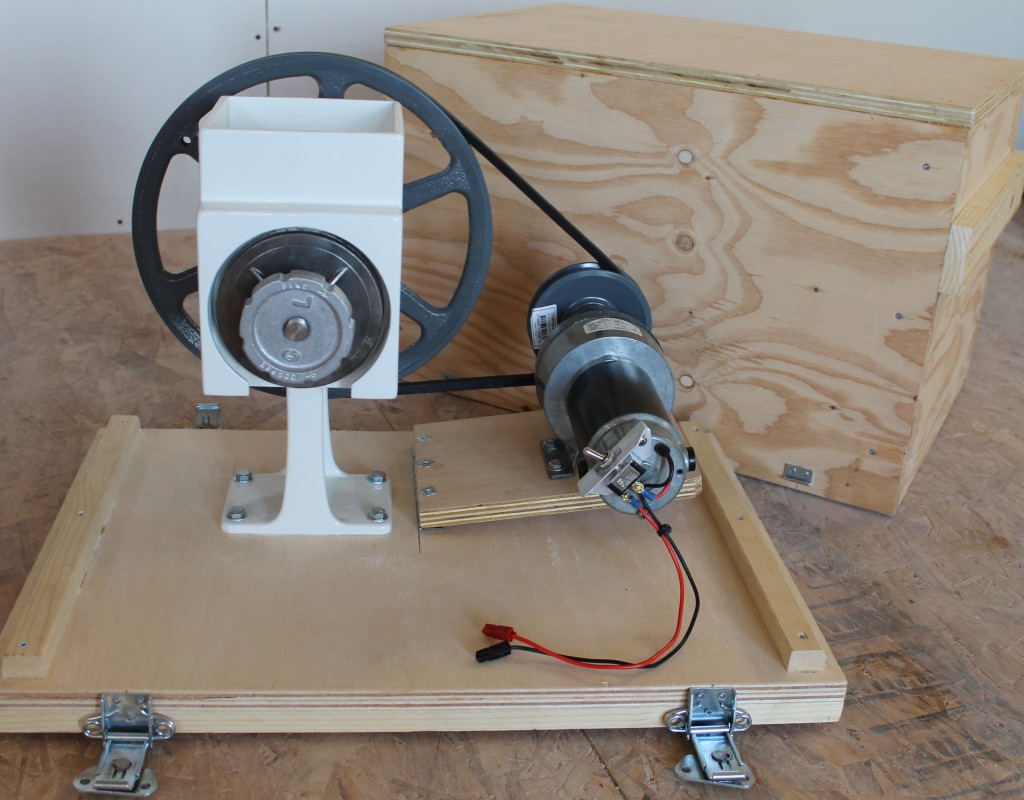
    Grain Mill pic1

    1. Cut a 6-1/2” x 9-1/2” piece of 3/4″ plywood. The longer sides will be the front and rear. Mark one flat side as bottom. You will mount the hinge to the bottom and the motor to the top at opposite ends. Think of it as a half see-saw. The hinge will be the fulcrum and the motor will be the person sitting on one end.
    2. Locate the hinge mounting holes. Fold the 6” continuous hinge, and place it underneath the board along the left side. The hinge should have 1/4″ of board extending beyond either end (6” hinge and 6-1/2” board). Mark the hinge mounting holes.
    3. Drill the hinge mounting holes with a 1/8” pilot drill, then with a 1/4” drill. Press three of the #8 T-nuts into the top of the board.
    4. Attach the hinge to the motor mounting board and to the base board. You will need six #8-32 x 3/4″ Flat Head Phillips Machine Screws. When finished, the motor mounting board should lay flat to the right of the mill.
    5. Locate the motor mounting holes. The motor mounts on the top of the mounting board, towards the right side, with the shaft and pulley end of the motor to the rear (in line with the mill pulley). The mounting holes for the integral motor mount on the Duoyou 12 volt motor are on a 4” by 1-1/2” spacing. To manually locate the bolt holes for the Duoyou 12v motor:
      1. Measure 4-3/4” in from the left edge, and draw a line parallel to the left edge. Now measure 8-3/4” in from the left edge, and draw another parallel line. The lines should be spaced 4” apart.
      2. Measure 3-3/8” in from the rear edge, and draw a line parallel to the rear edge. Now measure 4-7/8” in from the rear edge, and draw another parallel line. The lines should be spaced 1-1/2” apart.
      3. Verify your grid is correct by placing the Duoyou 12v motor over it. The crosses should line up with the motor mount holes. Correct any discrepancies. The exact placement of the motor on the board is not critical, but it is necessary for the motor’s pulley and the mill’s pulley to line up. Note that both pulley shafts have about 1/4″ adjustment to the front and rear for final adjustment.
    6. TEST FIT. If all was done correctly, the placement of the motor should be correct. However, before you drill holes for the motor, verify that the distance between the mill pulley and motor pulley will be sufficient with the following procedure:
      1. Use a scrap of 3/4″ wood to prop up the motor mounting board. Measure 15” in from the left side of the base board. This is where the 3/4″ scrap’s edge should be laid. Doing so will prop your motor mounting board up so that the right end is perhaps 2” above the base board.
      2. Slide the belt over the mill pulley. Mount the motor pulley to the motor if you have not already done so. Slide the belt over the motor pulley, and position the motor as close to your four hole marks as you can. The belt should have no slack in it, but it does not have to be taut.
      3. If the belt still has a lot of slack in it, you will want to mount your motor further out (to the right) on the mounting board. If the belt is too tight and you cannot get the motor to within 1/4″ of your hole marks, redraw your hole marks closer to the hinge point by as little as necessary.
    7. Drill the motor mounting holes with a 1/8” pilot drill, then a 5/16” drill. Place 1/4″ T-nuts on the bottom of the motor mounting board and seat them into the board using a 1/4″ bolt and washer to draw them in. Then remove the 1/4″ bolt and washer.
  2. Assembly
    1. Mount the hinge to the base board and motor mounting board, if you have not already done so.
    2. Mount the Duoyou 12v motor to the motor mounting board.
    3. Mount the Country Living Grain Mill to the base board.
    4. Lift the motor up so that it pivots closer to the mill, and place the v-belt over the two pulleys. As you release the motor, it will pivot down and away from the mill, thus providing sufficient belt tension.
  3. Wiring and Control
    1. Toggle Switch Mount. This method uses a piece of aluminum angle, mounted to the rear of the motor. One side of the angle is flush to the motor back; the other side provides a flat surface to mount the toggle switch. If you chose to do this, you will need a hacksaw, file and both 3/16” and 1/2″ drill bits. A toggle switch can be mounted in various locations through other means; improvise and find what works best.
      1. Cut a piece of 1” aluminum angle, 2” long. File or sand down any sharp edges or corners.
      2. On the back of the Duoyou motor, there are two Phillips screws that attach the motor to the gearbox. Remove the top screw.
      3. Hold the angle with one side flush to the motor back and the other side flat as a top. You may need to hacksaw or file a portion of one side of the aluminum away to accommodate the bulge on the end of the motor case. Drill a hole for the motor screw with the 3/16” bit, once you have it in a good position.
      4. Drill a 1/2″ hole on the top side of the aluminum angle where you wish to mount the toggle switch.
      5. Cut the positive (red) wire 2” or more from where it comes out of the motor. Strip, crimp, and then connect the appropriate connectors to your toggle switch.
    2. Zip tie the black and red wires together for strain relief (optional).
    3. If you chose not to use the blade-type connectors from the factory, cut them off and use whichever connectors you chose. Make certain they can handle a continuous 12+ amp load at 12 volts. This project uses Anderson PowerPole connectors to connect to a variety of wires with battery clamps, extension, solar panels, and so forth.
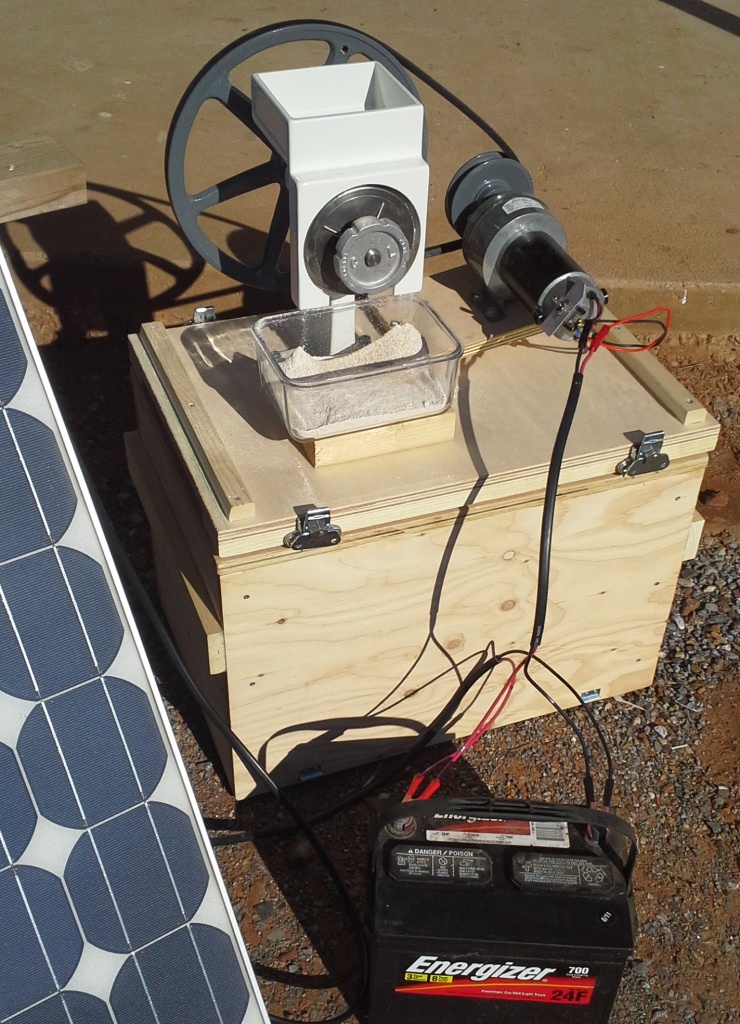
    4. Connect to a 12-volt power source, such as car batteries, deep cycle batteries, or directly to 12v solar panels of 150 watts or more. Fill the hopper with grain. Place a bin underneath the mill, and enjoy!

Project 2: Instructions to build the Storage and Transportation Crate:

Grain Mill pic2

  1. Take the front and back pieces of the crate (1/2” ply measuring 15” by 24”). On what will be the inside of the crate, add the four 14” long pieces of common board (ripped to 1”). These are reinforcements for the inside of each corner. Lay them flat on the plywood. Inset them from the edges exactly the width of your end pieces (1/2”, or to be exact, 15/32”). Place one end flush with the top edge of the plywood, leaving 1” of the bottom edge protruding beyond the board. Glue, clamp, and secure each piece to the plywood with three #6×1-1/4” wood screws, started from the plywood/exterior side.
  2. Using your square, begin building the ends of the crate. Attach the two 15”x15” pieces of plywood to the front and back sides from the previous step. Use your square to true everything up, and then glue and screw the sides to the corner reinforcements. It may be helpful to build this over the base, using it and the pieces you added to the sides of the base as a jig, or build it upside down over the top piece, using the top to make certain everything is true.
  3. Once the base is complete, add the 16”x24” top of 1/2″ or 3/4″ material. Glue and screw it in place with your #6 wood screws.
  4. Add the two 1×3 by 16” board to either side as handles. A good placement seemed to be 4” below the top level. Use glue and wood screws to secure.
  5. Finally, add the butterfly latches to secure the crate to the base:
    1. Fit the crate over the base. If it is tight getting it on and off, you can plane or sand the inside edges of the plywood or better still, the sides of the 1×1 by 14-3/4” strips mounted on the base. Find the direction that fits best (if one fits better than the other) and label it “FRONT”.
    2. Take the butterfly latches and extend them. Two will mount to the front and two to the rear. Find a good distance in from each edge and height from the bottom to mount all four. For this project, the center of each latch was placed 4” in from either edge, the top of the latch mount flush with the top of the 3/4″ board. The small hooks were mounted on the crate front and back, centered 4” in from the edge and 1/2″ up from the bottom edge. Wherever you mount them, make certain when they are latched they will be drawn down or tensioned against the springs of the latch.
  6. Your crate is now complete! Place it over the mill and latch it down. You can use it as a seat, or set the mill on it for a table.
  7. Bonus – there is a lot of unused space in the top of the crate, above the motor. Use scrap wood to fabricate a storage box inside the top to store spare parts and accessories (power bar, corn auger, battery jumpers, etc.) This way you can remove the crate, flip it over and access spare parts and accessories that will always be stored with the mill.

Troubleshooting – Common Problems

  1. Mill turns in wrong direction. From the front position (pulley behind the mill), both motor and mill should be turning in the counter-clockwise direction. If they are not, reverse the connections going to the motor.
  2. Mill does not turn while using solar. While the motor is rated for 12amps at 12 volts (144 watts), I have found when using only 150 watts of old solar panels the motor bogs down at fine grinds. Back the grind off a little bit and try again. Make certain your panels are positioned to create maximum power. If this continues happening, consider upping your solar wattage or adding a battery to the system.

Conclusion

You should now have a robust, motorized mill. It is easily transportable, allowing you to mill outside, close to solar generation and keep the mess outside, or take it on the road to use elsewhere. In storage it will be well protected; in milling your manpower will be free for other tasks, and your family will benefit from fresh flour and wholesome bread

I’ve also provided a pdf of the Grain Mill Drawings. Enjoy!