Notes for Friday – March 13, 2015

SurvivalBlog writing contest number 57 only has two weeks left. Make sure you get that article you have been writing finished up and entered!

o o o

Safecastle is moving to an “Annual Membership” model, but before they do, they want you to know that SurvivalBlog Readers can get the lifetime membership for free. Just enter “SURVIVEFREEMEM” as the coupon code and get the lifetime membership, valued at $49, and lock your benefits in now.

o o o

Today, we present another entry for Round 57 of the SurvivalBlog non-fiction writing contest. The $12,000+ worth of prizes for this round include:

First Prize:

  1. A Gunsite Academy Three Day Course Certificate, good for any one, two, or three course (a $1,195 value),
  2. A course certificate from onPoint Tactical. This certificate will be for the prize winner’s choice of three-day civilian courses. (Excluding those restricted for military or government teams.) Three day onPoint courses normally cost $795,
  3. DRD Tactical is providing a 5.56 NATO QD Billet upper with a hammer forged, chromlined barrel and a hard case to go with your own AR lower. It will allow any standard AR type rifle to have quick change barrel, which can be assembled in less then one minute without the use of any tools, and a compact carry capability in a hard case or 3-day pack (an $1,100 value),
  4. Gun Mag Warehouse is providing 30 DPMS AR-15 .223/5.56 30 Round Gray Mil Spec w/ Magpul Follower Magazines (a value of $448) and a Gun Mag Warehouse T-Shirt. (An equivalent prize will be awarded for residents in states with magazine restrictions.),
  5. Two cases of Mountain House freeze dried assorted entrees in #10 cans, courtesy of Ready Made Resources (a $350 value),
  6. A pre-selected assortment of military surplus gear from CJL Enterprize (a $300 value),
  7. A Model 120 Series Solar Generator provided by Quantum Harvest LLC (a $340 value),
  8. A $300 gift certificate from Freeze Dry Guy,
  9. A $250 gift certificate from Sunflower Ammo,
  10. KellyKettleUSA.com is donating both an AquaBrick water filtration kit and a Stainless Medium Scout Kelly Kettle Complete Kit with a combined retail value of $304,
  11. TexasgiBrass.com is providing a $300 gift certificate, and
  12. Two cases of meals, Ready to Eat (MREs), courtesy of CampingSurvival.com (a $180 value).

Second Prize:

  1. A Glock form factor SIRT laser training pistol and a SIRT AR-15/M4 Laser Training Bolt, courtesy of Next Level Training, which have a combined retail value of $589,
  2. A FloJak EarthStraw “Code Red” 100-foot well pump system (a $500 value), courtesy of FloJak.com,
  3. Acorn Supplies is donating a Deluxe Food Storage Survival Kit with a retail value of $350,
  4. The Ark Institute is donating a non-GMO, non-hybrid vegetable seed package–enough for two families of four, seed storage materials, a CD-ROM of Geri Guidetti’s book “Build Your Ark! How to Prepare for Self Reliance in Uncertain Times”, and two bottles of Potassium Iodate– a $325 retail value,
  5. $300 worth of ammo from Patriot Firearms and Munitions. (They also offer a 10% discount for all SurvivalBlog readers with coupon code SVB10P),
  6. A $250 gift card from Emergency Essentials,
  7. Twenty Five books, of the winners choice, of any books published by PrepperPress.com (a $270 value),
  8. TexasgiBrass.com is providing a $150 gift certificate, and
  9. RepackBox is providing a $300 gift certificate to their site.

Third Prize:

  1. A Royal Berkey water filter, courtesy of Directive 21 (a $275 value),
  2. A large handmade clothes drying rack, a washboard, and a Homesteading for Beginners DVD, all courtesy of The Homestead Store, with a combined value of $206,
  3. *Expanded sets of both washable feminine pads and liners, donated by Naturally Cozy (a $185 retail value),
  4. Two Super Survival Pack seed collections, a $150 value, courtesy of Seed for Security,
  5. Mayflower Trading is donating a $200 gift certificate for homesteading appliances,
  6. APEX Gun Parts is donating a $250 purchase credit,
  7. Montie Gear is donating a Y-Shot Slingshot and a Locking Rifle Rack (a $379 value), and
  8. Two 1,000-foot spools of full mil-spec U.S.-made 750 paracord (in-stock colors only) from www.TOUGHGRID.com (a $240 value).

Round 57 ends on March 31st, so get busy writing and e-mail us your entry. Remember that there is a 1,500-word minimum, and that articles on practical “how to” skills for survival have an advantage in the judging.


Guest Post: Silver and Gold: Shelter From the Storm, by Gary Christenson

What storm? The stock and bond markets in the US are doing great, the media has sold the strong employment story, and all those nasty wars are far, far away.

So the top few percent are doing well and are sheltered from the storm, but what about the rest of us? What storms are pounding us?

  • Currencies are based on debt, and those dollars, yen, and euros are created every day to keep various financial bubbles inflated. Global debt is $200 Trillion and cannot be repaid except with deeply devalued currencies. Central banks are creating currencies, monetizing debt, reducing interest rates, and frantically promoting inflation to avoid deflation.
  • Inflationary forces are powerful. Huge devaluation of our currencies is occurring. This extends the illusion of exponential growth and diminishes the debt hardship. Most of what we need, such as food, energy, and health care will cost more every year.
  • Deflationary forces are also powerful. What happens when a few $Trillion of sovereign debt defaults and triggers many more $Trillion in derivative payouts – that might cause a chain of bankruptcies? Expect deflation in our bubble assets.

What will central bankers and politicians do? Extend and pretend, print currencies, create far more debt, and fabricate stories about how everything is good.

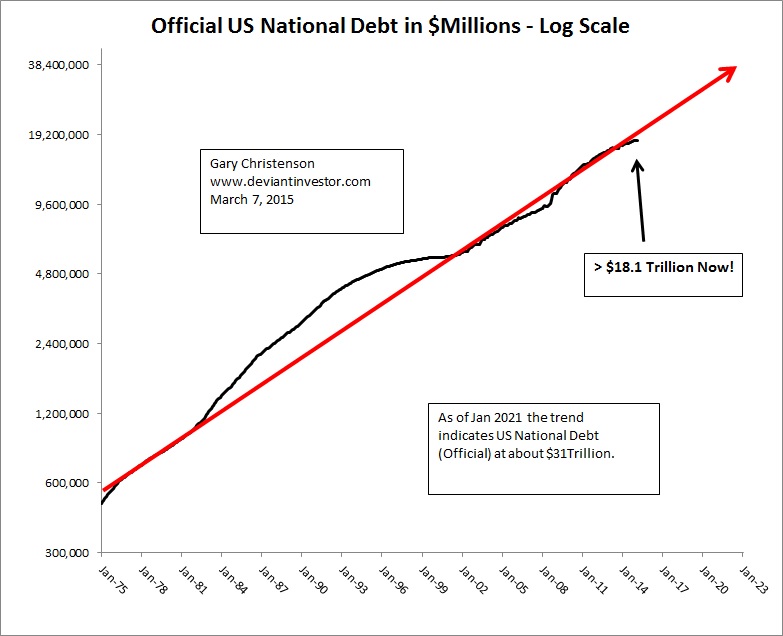
Look at the US national debt for the past 40 years. The exponential trend is clear – up 9% per year on average and about 10% per year since the 2008 recession/depression. It will rise until Congress drastically cuts spending (just kidding) or some nasty reset occurs. Exponential increases do not last forever so our current exponential increases in debt, stock prices, welfare, military expenses, and economic stupidity will end someday.

R-ND

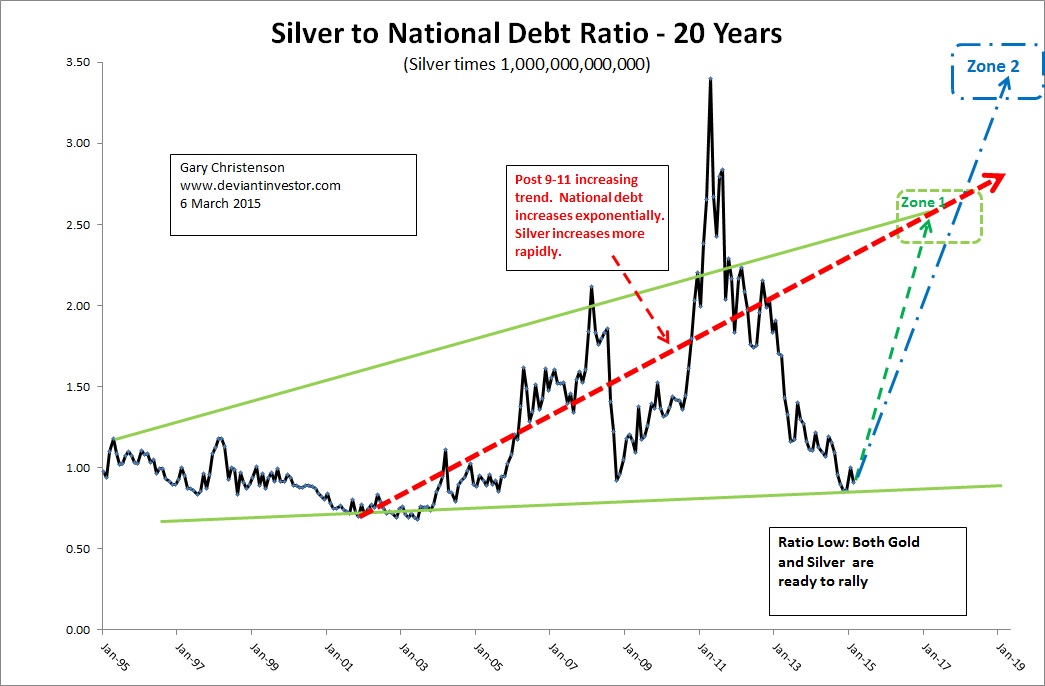
Gold and silver are real money, while dollars, euros, and yen are paper substitutes that circulate as currency in place of money. Look at the graph of the ratio of silver to the national debt for the past 20 years. Note the long term rise in the ratio and especially the increase since 9-11. Yes, there has been huge volatility in silver prices as shown by the ratio, but silver and gold – real money – are demonstrating their true value in the face of escalating debt.

R-SI-ND

Debt will increase and silver prices will rise more rapidly. Since silver and gold have been crushed during the past four years while stocks and bonds have rallied to new highs, expect those trends to reverse this year. When stocks and bonds decline central banks will accelerate their creation of currencies to reflate them and debt will increase even more rapidly, along with silver and gold prices.

Current (March 2015) Ratio

0.87

US National Debt

$18.15 Trillion

Silver price

$15.81

Suppose (more of the same – no hyperinflation):

Zone 1 (Approximately 2017) Ratio:

2.5

US National Debt

$23 Trillion

Silver Price

$55

Zone 2 (Approximately 2020) Ratio:

3.5

US National Debt

$30 Trillion

Silver Price (no hyperinflation)

$85 – $105

Other possibilities:

  • Global war and hyperinflation: They will create unbelievable levels of debt and tremendously higher silver and gold prices. $150 silver and $5,000 gold will look inexpensive if the US dollar hyper-inflates.
  • Nuclear war, financial and economic collapse, sovereign debt defaults, civil wars and new governments (unlikely, I hope): We better pray our leaders don’t push the world into such a global catastrophe. If they do who knows how high silver and gold will be priced and which currencies and governments will survive.
  • Everyone plays nice and there is minimal need for wars, false-flags, and other distractions. Extend and pretend miraculously works through the end of the decade. In that unlikely and benign case, US national debt increases at only 9% per year to about $28 Trillion, the silver to national debt ratio is subdued at 2.0 – 2.5 and silver is priced at only $50 – $75 in this “best of all possible worlds”. (More of the same, no hyperinflation, only small wars, it’s all good, etc.)

Bottom Line:

  • Debt will increase substantially from here, until a massive reset occurs.
  • Gold and silver, in spite of financial cartel resistance, will assert their real value and be priced much higher, depending on the quantity of debt created, loss of confidence in government and central bankers, and the amount of chaos that occurs during the coming storm.
  • Exponentially increasing systems do not last forever. Gold and silver do.
  • Paper currencies eventually revert to their intrinsic value – effectively zero. (Famous last words: “It can’t happen here!”)
  • Don’t worry, be happy, and trust gold and silver more than paper and promises.
  • I discuss the price of gold (no hyper-inflation) through the year 2021 using an empirical model based on the US national debt. You can read about the book here and here and here.

Read: Bill Holter: Being “Polite”

Originally posted by Gary Christenson at The Deviant Investor


Prepping on a Budget, by C.G. – Part 1

For many people, prepping seems like something only people with a good deal of time and/or disposable income can do. Shows like NatGeo’s Doomsday Preppers and, unfortunately, some YouTube channels give the impression that if you don’t have several years of food and enough weapons and ammo to outfit a small militia stored somewhere in a mountain bunker you can’t join the prepper club. Remember that the TV show is, at least partly, scripted, staged, and creatively edited, and some of the more questionable YouTube channels are run by gear/gun snobs. There are, however, ways to prep on a budget. All that matters is that you get the supplies and gear that work, last, and will be there when you need them.

Food

MREs and freeze-dried foods are what are popular right now, and for good reason; they can be stored for years, if they are not in extreme temperatures. Unfortunately, either of those options can be expensive. If you run into low-cost MREs, beware; they may be about 12-18 months from expiring. I haven’t seen any inexpensive freeze-dried anything, but if you find something, be very suspicious. Obviously, fresh meat, cheese, milk, or anything that has to be refrigerated or frozen will not work for long-term storage or in an emergency if the power goes out. Dried foods, like rice and beans, work and will keep for years if stored right, and they can be bought in bulk (20 lb. bags). Also, pasta or noodles of any kind will work as well, and they’re inexpensive. Canned foods will last for years as well, if stored properly, regardless of the “use by” date. If they go past the date, they may degrade in taste and nutritional value a little bit, but they will hold up fine and be safe to eat for years. Also, flour, sugar, salt, corn meal and spices will keep for years as well, provided that the packages are not compromised, and flour, corn meal, salt, and sugar can be bought in bulk. Also, don’t be afraid to buy store brands; they are just as good as name brands and will last just as long. Of course, there is a downside to this, which is that weight will certainly be a problem should you be forced to bug out. Twenty pounds each of rice and beans is, of course, 40 lbs., and canned foods are heavy as well. However, if you’ve been forced to relocate and if you’ve planned well, you should be able to get a few days (depending on how many people you’ll be supporting) worth of rice and noodles. This is where Ramen noodles would come in handy; while not very nutritious, they are light, inexpensive, and don’t take up much room. Dry seasonings, such as beef or chicken bullion (put a few cubes in a Ziploc bag) or Ramen seasoning packets, will make your meals palatable enough to eat for a couple of days; and realistically, most people are not going to last for more than two or three days carrying everything they need to live long term (60 lbs. minimum) on their backs.

Water

During a disaster or emergency, water may not be safe to drink. As a general rule, unless you can be 100% sure that the water you are going to drink is safe, such as bottled water or water that you have stored and/or purified yourself, it is better to assume it is unsafe. Of course, the easiest way to treat water is to boil it, and you should always have plenty of matches on hand, as well as lighters, fire steels, and other ways to light fires in your bug-out-bag/emergency kit, all of which can be bought very inexpensively. However, you may not always be able to have a fire. For example, you may not be in an area where you can safely make a fire, or you may not want a fire so as to go unnoticed. Also, if you boil water, unless you are out in the middle of winter, you will have to let it cool down for a few hours so that you will not raise your core body temperature. If you can not boil water, the best purifier is unscented household chlorine bleach. First, use a paper coffee filter, any kind will work, to filter out any solid particulates from the water, then use one or two drops per liter or two to four drops per gallon; stir and let it sit for 30 minutes to kill anything harmful in the water. Bleach can be bought by the gallon and is relatively inexpensive. One gallon will purify several gallons of water. Water purification tabs are also an option, but the amount of water that they will purify compared to bleach makes the bleach the best option. Again, the weight and size of a gallon of bleach will be a problem if you are forced to move on foot, but enough bleach can be poured in a 20 oz. Coke bottle to purify enough water for a couple days.

Shelter

Shelter can be a bit more tricky when on a budget. Obviously, if you are able to stay in your home, shelter will be a non-issue, and if you have to evacuate in your car you will be able to survive, but if you are forced to evacuate on foot, portable shelter will be an issue. If you are by yourself, a small tent can be found fairly inexpensively, but if you have someone with you who is depending on you, larger tents can run into high dollar territory. You will need enough room in the tent for everyone and their gear to fit inside, which means that a four-person tent will realistically fit two people or maybe three, if one of them is a small child. Some people talk about making shelters out of what they can find in nature, and that is a good skill to have if you are ever stranded on a mountain road, but natural shelters are incredibly hard, and labor intensive, to make. While that may be better than nothing in some cases, they are not ideal in inclement weather because, unless you have an incredible amount of practice, they will not shed water and will not hold heat in. Note that I am not saying not to build one if you have to, nor am I saying that it is a skill you should not learn. If, however, there is another option, take it. Obviously a good tent is preferable, but if that is out of your price range, tarps can be bought for less than $10. A tarp and 50 ft. of paracord will make a suitable shelter to spend a night in and move on the next morning. An added advantage is that a tarp and paracord are very light and easy to carry in a backpack. Unfortunately, sleeping bags are going to be one of the things where “you get what you pay for”, and there isn’t really going to be any exception to this rule with regard to sleeping bags. You can buy an Ozark Trail sleeping bag for less than $20 at Walmart, but it’s not going to be very high quality. The zippers aren’t going to last very long, and those are rated for 40-60 degrees. Obviously, the sleeping bag you will need will depend on the part of the country you live in. You will need a lot more insulation in Montana than you will in Florida, no matter what time of the year it is. However, being warm is an absolutely necessary part of your survival. Of course, you can always roll up a bunch of blankets and carry them with you, but blankets are usually not waterproof. You can use a tarp and some blankets to make a bed roll, like the ones popular in the 1800s, but those become heavy and unwieldy in short order. Things like space blankets and bivy bags are okay, in an extreme emergency, like the mountain road example above, but for long-term survival, your health is going to depend upon having the right sleeping bag for your environment.

Gear

Gear, like backpacks, paracord, something to cook and eat with, and other things, can be bought inexpensively at any Walmart or Academy. The Game Winner bags from Academy, which I use, are high quality and affordable. I have seen some packs at Walmart from time to time that seem to be reasonably well made and not too expensive, though I think the Game Winners are better for the money. Mess kits and camping utensils are reasonably priced, if you stay away from name brands (like Coleman, etc.). A one-person mess kit (I can not stress enough that this will work for only one person), which can be used for cooking, and a camping utensil set– knife, fork, and spoon– can be bought for less than $20. For cooking, fires will always work, but if you must have a stove for some reason, obviously a two-burner Coleman stove will be too big to carry around with you, though it would work in an emergency at home, as will a grill, propane, or charcoal, if you have one (and yes, you can use it to cook in skillets and pans), but there are many different options for single-burner stoves that are inexpensive and can be easily carried with you, or you can make your own. To make your own, all it takes is a couple of coke cans, a nail, some high-temp sealant, and denatured alcohol. Things like a hatchet, saw, and portable shovel can be found at Home Depot for a few dollars. First aid is another “you get what you pay for” thing. Of course you can buy low-cost bandages, gauze, et cetera, but some things, like QuikClot, should be name brand and will be expensive. However, if you need QuikClot, it will save your life. Knives are the subject of great debate, but if you have a good, fixed blade survival knife and a good folding knife, you should be fine. There are some inexpensive yet good quality folding knives out there. The SOG Trident, which I carry, is $50 now at Walmart. That’s a vast improvement over the $100+ that they used to cost. Winchester (the gun company) has a line of knives you can buy at Walmart for $20 or less. They are made by Gerber and are nice knives. Some of Buck’s knives are around $20-$30. By far the best survival fixed blade, and my personal preference, is the Gerber Bear Grylls survival knife. When you look at survival knives, forget the old hollow handled knives with the “survival kit” in the handle and a compass on top. Those will break, if you try to use them very hard at all. You want a full tang knife, where there is one piece of steel from the tip of the blade through the handle. It’s not necessary, or even advisable, to buy a bowie knife or a full size Ka Bar. A good quality Bowie will set you back a few hundred dollars, and a Ka Bar, while it’s a great knife, may be too big and unwieldy; it can also give the wrong impression if someone sees you with it. Flashlights are another thing that you will see people pay mind boggling amounts of money for, which is not necessary at all. A good mini mag-lite LED is bright, tough, reliable, and they use standard AA batteries. Yes, a Surefire tac-light is smaller, brighter, and it’s cool looking, but it’s also going to run over $100, and they take Lithium CR 123 batteries, which are hard to find and can cost $15 for two. Coleman also makes some nice flashlights that are very bright and compact, and they’re well under $100. A giant 3D cell mag-lite, or one larger (yes, they make them all the way up to 6D cell batteries) is not necessary and, if you’ve ever tried to carry one in a flashlight ring on your belt, they’re big, heavy and quite inconvenient and uncomfortable to carry with you.


Letter Re: Storing Canned Goods in Cat Liter

HJL,

Sorry to bother you, but after reading an article that you linked on Survival Blog I just can’t get this off my mind. It was the Doomsday Prepper meals article, and it said that Wayne Martin “stores canned goods in buckets of cat litter to increase the life expectancy of the product”. Is this to keep the cans from rusting as when kept in a damp basement? I can’t find any reference to that on the Internet except where the cat litter is used as a desiccant alongside of the actual food. Any comment on this would be appreciated. Thank you. – R.M.

HJL Responds: The article was interesting for the pictures it presented of the meals. However, the author had the “Doomsday Prepper” mentality. They often profile those who are extreme, and as a result you get some “interesting” concepts. The only thing that cat litter will do is act as a desiccant. Unfortunately, it’s not very good at doing that job. While it will absorb and hold large amounts of water, it doesn’t do much for humidity unless you are regularly drying it out in an oven or other such device. It’s more of a “feel good” band-aid, and you are better off not having the clay compounds, which have absorbed some humidity, up against metal rings or cans.


Odds ‘n Sods:

Mutating H7N9 bird flu may pose pandemic threat, scientists warn

Special Note: Down in paragraph 8, is this nugget:

“By collecting and sequencing a large number of samples, they found that the H7N9 virus is mutating frequently, acquiring genetic changes that might increase its pandemic potential.”

o o o

World record? 100 inches of snow may have clobbered Italy in 18 hours, review pending. – P.M.

o o o

A very neat DIY tactical shovel that would make a great addition to a B.O.B.

o o o

Mysterious spy cameras collecting data at post offices. – H.L.

o o o

Sharia Enforcement at University of New Mexico: “Resolution 6S” passes. B.B.


Hugh’s Quote of the Day:

“I was born with more power inside myself than I ever dreamed. But along with it there came no more sense than any other idiotic kid. Somewhere along in here I need to grow up into a man I can stand to live with. A man who doesn’t just survive, but deserves to.” ? Orson Scott Card, The Lost Gate


Notes for Thursday – March 12, 2015

Today, we present another entry for Round 57 of the SurvivalBlog non-fiction writing contest. The $12,000+ worth of prizes for this round include:

First Prize:

  1. A Gunsite Academy Three Day Course Certificate, good for any one, two, or three course (a $1,195 value),
  2. A course certificate from onPoint Tactical. This certificate will be for the prize winner’s choice of three-day civilian courses. (Excluding those restricted for military or government teams.) Three day onPoint courses normally cost $795,
  3. DRD Tactical is providing a 5.56 NATO QD Billet upper with a hammer forged, chromlined barrel and a hard case to go with your own AR lower. It will allow any standard AR type rifle to have quick change barrel, which can be assembled in less then one minute without the use of any tools, and a compact carry capability in a hard case or 3-day pack (an $1,100 value),
  4. Gun Mag Warehouse is providing 30 DPMS AR-15 .223/5.56 30 Round Gray Mil Spec w/ Magpul Follower Magazines (a value of $448) and a Gun Mag Warehouse T-Shirt. (An equivalent prize will be awarded for residents in states with magazine restrictions.),
  5. Two cases of Mountain House freeze dried assorted entrees in #10 cans, courtesy of Ready Made Resources (a $350 value),
  6. A pre-selected assortment of military surplus gear from CJL Enterprize (a $300 value),
  7. A Model 120 Series Solar Generator provided by Quantum Harvest LLC (a $340 value),
  8. A $300 gift certificate from Freeze Dry Guy,
  9. A $250 gift certificate from Sunflower Ammo,
  10. KellyKettleUSA.com is donating both an AquaBrick water filtration kit and a Stainless Medium Scout Kelly Kettle Complete Kit with a combined retail value of $304,
  11. TexasgiBrass.com is providing a $300 gift certificate, and
  12. Two cases of meals, Ready to Eat (MREs), courtesy of CampingSurvival.com (a $180 value).

Second Prize:

  1. A Glock form factor SIRT laser training pistol and a SIRT AR-15/M4 Laser Training Bolt, courtesy of Next Level Training, which have a combined retail value of $589,
  2. A FloJak EarthStraw “Code Red” 100-foot well pump system (a $500 value), courtesy of FloJak.com,
  3. Acorn Supplies is donating a Deluxe Food Storage Survival Kit with a retail value of $350,
  4. The Ark Institute is donating a non-GMO, non-hybrid vegetable seed package–enough for two families of four, seed storage materials, a CD-ROM of Geri Guidetti’s book “Build Your Ark! How to Prepare for Self Reliance in Uncertain Times”, and two bottles of Potassium Iodate– a $325 retail value,
  5. $300 worth of ammo from Patriot Firearms and Munitions. (They also offer a 10% discount for all SurvivalBlog readers with coupon code SVB10P),
  6. A $250 gift card from Emergency Essentials,
  7. Twenty Five books, of the winners choice, of any books published by PrepperPress.com (a $270 value),
  8. TexasgiBrass.com is providing a $150 gift certificate, and
  9. RepackBox is providing a $300 gift certificate to their site.

Third Prize:

  1. A Royal Berkey water filter, courtesy of Directive 21 (a $275 value),
  2. A large handmade clothes drying rack, a washboard, and a Homesteading for Beginners DVD, all courtesy of The Homestead Store, with a combined value of $206,
  3. *Expanded sets of both washable feminine pads and liners, donated by Naturally Cozy (a $185 retail value),
  4. Two Super Survival Pack seed collections, a $150 value, courtesy of Seed for Security,
  5. Mayflower Trading is donating a $200 gift certificate for homesteading appliances,
  6. APEX Gun Parts is donating a $250 purchase credit,
  7. Montie Gear is donating a Y-Shot Slingshot and a Locking Rifle Rack (a $379 value), and
  8. Two 1,000-foot spools of full mil-spec U.S.-made 750 paracord (in-stock colors only) from www.TOUGHGRID.com (a $240 value).

Round 57 ends on March 31st, so get busy writing and e-mail us your entry. Remember that there is a 1,500-word minimum, and that articles on practical “how to” skills for survival have an advantage in the judging.


Getting Home, by D.K. Vet

Now, I feel relatively secure in my prepping, having been at it for several years. Food, check. Arms and ammo, check. Water, tent, first aid supplies, heating sources, et cetera, check, check, check. All is well and good, as long as I am home or near home and can shelter in place or pack up and move out of Dodge. However, there are several times every year when I am away from home and not just in the next county. We spend time in Florida and go to vet conferences in other states. When we’re somewhere else, we are totally dependent upon what’s locally available. We all know local sources can be depleted in a matter of hours.

I carry concealed every day, even at home, but you can’t do that on a plane anymore, unlike the ‘60s and ‘70s. Yes, I can pack and declare a pistol or rifle when I go to a state with reciprocity, and maybe I should always do that when I can, especially if it’s for an extended time. My insecurity grows the farther I get from home. Many knowledgeable sources believe that when the SHTF, it will happen quickly, whether it’s an economic crash, an electromagnetic pulse, grid collapse, or failure of civility. What if I’m away from home? It’s a 17-hour drive from Florida to home, nearly non-stop. If I’m in Arizona, that’s more of a three-day trip by car, providing the roads are clear, there are no roadblocks, and an EMP hasn’t knocked out transportation.

So, what is there to do? Should I stay home until our country has been reset to original intent Constitution rule? Well, that will require a Second Revolution (2R), because as corrupt as things are in Washington, a hundred more elections won’t change a thing. As Einstein defined “insanity,” that’s doing the same thing over and over again, expecting different results. Like voting R/D/R/D/R/D and thinking that someone eventually will reduce the size of our federal government, eliminate earmarks, eliminate the Federal Reserve, or vote for term limits. Ha. The series “House of Cards” is far closer to fact than to fiction.

When I travel, I make sure we have plenty of cash. How much? Well, ten Franklins is good. Consider the possibility that you have a rental car in Las Vegas and you have to get home to Illinois. You see on TV that there is a general trucker’s strike and rioting is beginning in the cities because the grocery store shelves have gone bare. The very first thing to do would be to get to a gas station, buy as many 5-gallon gas cans as will fit in the trunk, and load the car and them all up with gas. Get some road maps, if you don’t already have them, because you will want to avoid the bigger cities on the way home. Even little crossroad towns might give you trouble. To get an idea of what it would be like to travel 250 miles on foot to get home, read Going Home by A. American.

When renting a car, even for a short stay, consider getting an SUV or 4-wheel drive vehicle that would be more road-worthy than an economy car. It may be a trade-off of durability for gas economy, but you want something that is less likely to break down on a back road. The more ground clearance your vehicle has, the better also. Get green, tan, or some other “earth color” if you can pick one. Think blending in instead of standing out, like silver or red would.

How can you arm yourself if you don’t have a gun? Is there a sporting goods store nearby? Even a Walmart? Buy a gun and a couple boxes of bullets, if you can (being a non-resident), or at least get a couple of fixed-blade knives, a hatchet, or a knife that you can fashion into a short spear. Compound bows and crossbows work, too. Got money left? Get gallons of water and pop-lid canned goods, like beef stew or anything you can eat cold or hot out of the can. Get a couple of spoons and a few butane lighters while you’re at the store, if there’s anything left. Remember the saying about “nine meals to anarchy?” Don’t put this off, if it looks like things are going bad quickly. Too late will be tough scheisse.

One thing you can still pack in your checked luggage is a good knife or two, or even a tactical hatchet. Edged weapons are still okay, and do not need to be declared. I just traveled with two pistols and had to declare them in my checked bag. The bag, guns, and I were escorted over to an inspection area, where the gun cases were swabbed for explosives (for other than gun powder, apparently). They must be looking for bombs using gun cases as concealment. They never even looked at the guns; I just had to lock the cases.

Other considerations regarding an emergency road trip home would include a can or two of “fix-a-flat,” or even the inexpensive battery-powered air pump at an auto parts store. Some new cars today have a mini air pump that plugs into the cigarette lighter as part of the inflatable spare tire kit. A multi-tool would be handy, as would a roll of duct tape, some baling-type wire, and several flashlights. You don’t need shelter if you sleep in the car, but you will be better off rotating drivers and pressing on home. Consider a small backpack or two in case the car breaks down totally and you have to proceed on foot. Did you pack good road shoes? All-weather jackets with hoods could keep you alive if you’re hoofing it. Grab some big, 55-gallon heavy trash bags if you see them. They make great rain covers and ground cover, too, to curl up on.

By all means, use your credit cards while you can, but it is likely that the system behind them will soon shut down and you will have to fall back on your cash. As you can see, $100 won’t last long when you’re preparing to drive home. Silver one-ounce coins are heavy, but it wouldn’t hurt to pack a few of those, too, in case paper money quickly becomes worthless. That’s why you need to buy what you can with fiat currency ASAP.

Take stock of everything in your rental car. Check the glove box, trunk, and compartments for a spare tire, jack, inflator (if it’s a doughnut), and any safety items. Some have a first aid kit, too. Likewise, take stock of everything in your luggage, carry-on, and on your person(s). Nail trimmers, ball-point? pens, eye drops, and lip moisturizer sticks will all be useful. I’ve flown for many years, even internationally, with an Exotac® fire starter, a magnet-base mini red lens flashlight, and a Swiss-Tech® Utili-Key on my key chain without confiscation. Also have a little key chain stainless container full of aspirin. Seven keys kind of masks things, too.

Before checking out of your hotel room, grab all the small shampoos, soaps, and even the little sewing kit. If your trip home is long, you will probably want to freshen up a few times on the way. You might just take a couple of the wash cloths and towels, too. If there is someone at the desk, you can pay them for the towels on the way out.

With one person driving, the other should be constantly scanning ahead, and a decent pair of binoculars are easy to pack on a vacation or trip. Your navigator should be watching for road blocks or people gathered by the road. Avoid them at all costs, because they are not there to help you on your way. Every person you meet is a potential enemy who will swiftly kill you for what you have, or worse. Be constantly on guard, and do not stop within sight of other people.

Regarding Lt. Col. Dave Grossman’s classification of sheep, sheepdogs, and wolves, I have an acquaintance who said he was a sheepdog but could become a wolf if that’s what was needed to keep his family alive. That’s disconcerting, to say the least. I wouldn’t necessarily want him in my group, but you have to understand that it is very likely in a “failure of civility” situation; everyone will become a predator in some way, and everyone will also become prey. You may not be able to discern wolves from sheep until it is too late, because they will all be wearing sheep’s clothing, and there is no animal more deceptive than man. So consider everyone a potential enemy.

All bridges will become potential choke points for people to ambush you or hold you up for ransom or take whatever you have that they want. Crossroads with woods or buildings nearby can also be ambush points to watch out for. You can be reasonably sure if these points are controlled by our military that it may be safe to approach and pass through. However, if government contingency plans are activated, they could also confiscate your weapons, transportation, food, and fuel, before shuttling you off to a FEMA camp. It’s better to stand off, unseen, and observe what is going on there for a while. Let somebody else approach them and be the goat. Highway overpasses can also harbor bandits, and it would be good to observe from a distance before approaching.

If it looks like you will be trekking home, see if you can find a bicycle (or two) with sturdy tires. Your gluteus maximus will toughen up after the first few days, but you’ll cover many more miles faster this way. Average walking speed is three to four miles per hour, but a bicycle can put you up to 10 to 15 mph. Tough touring tires will get you over 4,000 miles (not the skinny 10-speed tires, which may go 1-3k). You’re not trying to impress anyone with a high-tech racing bike, so look for sturdiness and heavier tires. Think about fixing flats, too, and get a small patch kit with tire changing spoons.

When I fly, I dress for potential survival travel. I wear a long-sleeve 5.11® shirt and pants, and have on Thorlo® over-the-calf anti-fatigue socks. Underwear is reflected by the weather, remembering the adage that in cold weather, “cotton kills.” Wicking polypropylene would be the all-weather choice. I always wear waterproof boots covering above the ankle, usually Vasque® lightweight hiking boots. Consider the possibility of a crash landing in which you are lucky enough to survive but have to walk to civilization. I see people on the plane in shorts and wearing flip-flops, but I feel fine the way I’m dressed.

A hat– baseball cap or lightweight stocking cap– that you can stow somewhere in your 7-pocket pants could be a lifesaver as well. Since most of your body heat is lost through the top of your head, in cold weather you want to conserve this. Columbia® makes a light cap with reflective “Omni-Shield®” lining that really keeps your head warm. Any cap with a brim, or a soft, foldable boonie hat would be fine for warmer weather. Above all, you want to avoid getting sunburned, even in the winter.

You can make it home in days, if in a car with no problems along the way. On a bicycle it will be weeks, for sure. On foot, depending on the distance, it could take months. Consider the pioneers crossing the western plains, walking alongside their covered wagons. The 2,000-mile Oregon Trail took 160 to 170 days to travel. The pioneers had to worry about Indians and bandits, but they were all armed and ready for the unexpected. Things won’t be much different today in that respect, but you may not have the security of firearms. Avoiding trouble by avoiding people will be imperative.

If there are friends or family that live between you and home, and the phones are working, contact them with your plans. It may be worthwhile to go a little out of your way to hole up with them for a few days before proceeding. If they live in a city, find out what the conditions are there; it may be more dangerous than it’s worth. Get accurate directions to their location.

The time of the year is certainly important, too. I wouldn’t try walking home when the temperatures get below freezing at night. Going from north to south might not be as bad in the winter, but going the other direction and you are at the mercy of the weather and it will add tremendously to your problems. Keeping yourself dry is very important, because you can become hypothermic in even moderate temperatures. Your body will cool down to the ambient temperature quickly if you are undernourished, stressed, and improperly dressed. Wet clothing facilitates loss of body heat.

I’m glad my odds are good that when the world collapses, I will be at home and able to take advantage of my “stuff.” Millions of Americans today are oblivious to anything taking place beyond their TV screens, hand-held games, or cell phones. Good luck to them. Sorry, but I’m too old to carry you. I have enough on my hands just saving myself and my family. There will be a tremendous winnowing of the chaff. Remember the Marines’ gung-ho motto, “Improvise, adapt, and overcome.”

Oh, and last but not least, always have a small New Testament or Bible along in your travels. Borrow the Gideon’s from that hotel room, if you have to. It can help you through many trials and tribulations. Prayers go up; blessings come down. Getting home safely is the objective.

Letter Re: Firearms Philosophy

In his book– Tools for Survival– JWR states that he is in the “narrow but deep” firearms camp rather than the “broad range” of firearms camp. I suggest a third alternative: Go for the “narrow but deep” philosophy first with a military style rifle with quality optics and a military style handgun and LOTS of mags and ammo for each (and, arguably, a shotgun). Then, slowly supplement that with other less expensive firearms with less ammo. These firearms should be non-military as, for example, lever action rifles, bolt action hunting rifles, and revolvers, with smaller quantities of ammo.

Why?

The non-military firearms are far less likely to be outlawed or seized by the government and would become quite valuable in such an event during which time the military style weapons could be “gotten rid of”. Also, these old guns are just nice to have around.

Finally, it’s a good idea to have lots of .22 rimfire ammo and weapons no matter what your philosophy, as most of us already know. When all the center fire is shot up, rimfire will rule the world, I predict.

HJL Responds: Despite the current administration’s push to outlaw certain military caliber ammunition, military ammo will always be the least expensive and most plentiful there is. The more esoteric the caliber you stock, the less likely you are to find sources for the ammo or reloadable components as time goes on. For that reason alone, a “narrow” philosophy centered around military arms makes the most sense. The sheer number of firearms that are already on the streets makes the possibility of removing those same firearms very slim through legal means. If you prefer not to use a military caliber, it simply means that you need to be aware of what your long-term ammunition needs are and stock accordingly. One thing I have been contemplating in recent weeks, due to the scarcity of .22LR ammunition, is a pellet rifle. Even the 3000psi cylinders can be refilled with a hand pump, if you have to, and they pack as much punch as the .22LR ammunition.


Odds ‘n Sods:

Insect salads, sprouting seeds, dehydrated meats and canned cat food: The meals America’s ‘Doomsday Preppers’ will be eating on the day the world ends revealed . – JBG

o o o

Illegals to Get Social Security As Soon as 2017

o o o

Safecastle has military surplus Beef Patties in stock along with 31-41% off on Mountain House foods. Great sales on Katadyn filters too. Check it out. Safecastle has also stated their intention to become a membership warehouse and are offering SurvivalBlog readers free memberships.

o o o

Professors: US flag symbolizes racism, should not be displayed on campus. – B.B.

o o o

Tomgram: Pratap Chatterjee, Is Drone Warfare Fraying at the Edges?. – D.P.


Hugh’s Quote of the Day:

“She had a vision of the two of them trapped on a tiny raft surrounded by miles of open water. It would be a kind of test, like surviving on a desert island–but that’s what a marriage was, wasn’t it? They would have to help each other or die.” ? Stewart O’Nan, Songs for the Missing


Notes for Wednesday – March 11, 2015

Today, we present another entry for Round 57 of the SurvivalBlog non-fiction writing contest. The $12,000+ worth of prizes for this round include:

First Prize:

  1. A Gunsite Academy Three Day Course Certificate, good for any one, two, or three course (a $1,195 value),
  2. A course certificate from onPoint Tactical. This certificate will be for the prize winner’s choice of three-day civilian courses. (Excluding those restricted for military or government teams.) Three day onPoint courses normally cost $795,
  3. DRD Tactical is providing a 5.56 NATO QD Billet upper with a hammer forged, chromlined barrel and a hard case to go with your own AR lower. It will allow any standard AR type rifle to have quick change barrel, which can be assembled in less then one minute without the use of any tools, and a compact carry capability in a hard case or 3-day pack (an $1,100 value),
  4. Gun Mag Warehouse is providing 30 DPMS AR-15 .223/5.56 30 Round Gray Mil Spec w/ Magpul Follower Magazines (a value of $448) and a Gun Mag Warehouse T-Shirt. (An equivalent prize will be awarded for residents in states with magazine restrictions.),
  5. Two cases of Mountain House freeze dried assorted entrees in #10 cans, courtesy of Ready Made Resources (a $350 value),
  6. A pre-selected assortment of military surplus gear from CJL Enterprize (a $300 value),
  7. A Model 120 Series Solar Generator provided by Quantum Harvest LLC (a $340 value),
  8. A $300 gift certificate from Freeze Dry Guy,
  9. A $250 gift certificate from Sunflower Ammo,
  10. KellyKettleUSA.com is donating both an AquaBrick water filtration kit and a Stainless Medium Scout Kelly Kettle Complete Kit with a combined retail value of $304,
  11. TexasgiBrass.com is providing a $300 gift certificate, and
  12. Two cases of meals, Ready to Eat (MREs), courtesy of CampingSurvival.com (a $180 value).

Second Prize:

  1. A Glock form factor SIRT laser training pistol and a SIRT AR-15/M4 Laser Training Bolt, courtesy of Next Level Training, which have a combined retail value of $589,
  2. A FloJak EarthStraw “Code Red” 100-foot well pump system (a $500 value), courtesy of FloJak.com,
  3. Acorn Supplies is donating a Deluxe Food Storage Survival Kit with a retail value of $350,
  4. The Ark Institute is donating a non-GMO, non-hybrid vegetable seed package–enough for two families of four, seed storage materials, a CD-ROM of Geri Guidetti’s book “Build Your Ark! How to Prepare for Self Reliance in Uncertain Times”, and two bottles of Potassium Iodate– a $325 retail value,
  5. $300 worth of ammo from Patriot Firearms and Munitions. (They also offer a 10% discount for all SurvivalBlog readers with coupon code SVB10P),
  6. A $250 gift card from Emergency Essentials,
  7. Twenty Five books, of the winners choice, of any books published by PrepperPress.com (a $270 value),
  8. TexasgiBrass.com is providing a $150 gift certificate, and
  9. RepackBox is providing a $300 gift certificate to their site.

Third Prize:

  1. A Royal Berkey water filter, courtesy of Directive 21 (a $275 value),
  2. A large handmade clothes drying rack, a washboard, and a Homesteading for Beginners DVD, all courtesy of The Homestead Store, with a combined value of $206,
  3. *Expanded sets of both washable feminine pads and liners, donated by Naturally Cozy (a $185 retail value),
  4. Two Super Survival Pack seed collections, a $150 value, courtesy of Seed for Security,
  5. Mayflower Trading is donating a $200 gift certificate for homesteading appliances,
  6. APEX Gun Parts is donating a $250 purchase credit,
  7. Montie Gear is donating a Y-Shot Slingshot and a Locking Rifle Rack (a $379 value), and
  8. Two 1,000-foot spools of full mil-spec U.S.-made 750 paracord (in-stock colors only) from www.TOUGHGRID.com (a $240 value).

Round 57 ends on March 31st, so get busy writing and e-mail us your entry. Remember that there is a 1,500-word minimum, and that articles on practical “how to” skills for survival have an advantage in the judging.


Practical Personality Assessment, by M.B. – Part 2

Reasons

I’d like to articulate three powerful reasons to become a student of personality types.

1) To Explain Preparedness in a Way that Others Will Accept

“A wise man’s heart guides his mouth, and his lips promote instruction.” (Prov. 16:23)

One of the best reasons to try to discover someone’s personality type is so that you can more effectively communicate with him or her.  We probably all have family members or friends who refuse to listen, despite our best attempts to convince them of the need to prepare.  Sometimes part of this is because of personality differences.  For example, you could spend all day explaining how logical it is to prepare, but if you are talking to a Red it is going to be like water off a duck’s back.  Here are some tips on how to approach the subject with the four personality types.  There is no guarantee that these strategies will work, but they’ll certainly improve your odds. (Really, they can help you communicate more effectively in any context.) 

Blue:  Keep things logical and fact based.  Avoid emotional pleas, rants, and conspiracies theories.  A Blue will likely view these as irrational and will be turned off, so do not talk about a zombie apocalypse! When it fits, use material from authoritative sources that the person is likely to respect. Here are some examples of what you could say: “I can’t believe the National Debt just broke the $18 trillion dollar mark. Somehow I don’t think Washington is ever going to change. What do you think will happen in this country if we just keep heading down this road?” Another approach might be to say, “I was working on my emergency kit this weekend. You know, the CDC has come right out and said that if there is a serious emergency people are going to be on their own for at least three days. I’m not crazy; I just want to make sure my family is taken care of if something like that happens.” Or, you could say, “We’ve started putting some of our retirement savings aside to invest in silver. The experts we’ve read have recommended 5% of your portfolio be invested in precious metals and we were nowhere close to that. I’ve looked at how silver has performed over the last 10 years, and it has actually done really well. You might want to think about it yourself.”

Green:  Emphasize that preparing gives you more control over your life. Try to build a foundation by breaking preparation down into small steps that can be understood, organized, and controlled.  If you pile too much onto a Green all at once, they may be overwhelmed and decide that the situation is beyond their control.  This could cause them to give up on it altogether. For example, you might say, “Sometimes I’m amazed at all the ingredients that go into store-bought foods. I’m thinking of starting a garden so that I can know exactly what we are eating.” “Did you see any of the news footage of those riots? There was no way the police were going to be able to provide security for everyone who lived in that neighborhood. It makes sense to me to have some way of protecting your own home during difficult times.” “After all the volatility in the stock market over the last few years, I’ve decided to start putting some of my savings into silver coins. I like the idea of having something physical that I can touch rather than putting all my trust in mutual funds and bank accounts.”

Red:  As much as possible, introduce them to prepping in fun, interactive ways.  Don’t talk about all the horrible scenarios you’ve played out in your own mind, because if the person associates preparedness with negative emotions they are very likely to avoid the subject.  Describe in positive terms the benefits of preparing. For example: “Our family is planning to go camping over the weekend next month. Why don’t you guys come with us? I think it will be a lot of fun.” “I was always worried about my husband since he has a family history of heart disease, but after taking a CPR course I feel much more relaxed and confident since I know what to do.” “Remember how we were talking the other day about crime rates going up in the county? I found out that there is a basic pistol class being offered in town in a couple weeks. Maybe we could sign up and go together?” “I was thinking of building a solar dehydrator as a fun project to do with the kids on Saturday. I know you are more handy than I am. If you are not busy, could you come over and help? I’ll fire up the barbeque for lunch.

Yellow:  Relate prepping to real-world events and personal experiences.  Give them chances to imagine themselves in a survival scenario.  Keep things simple and high level at first, and offer to show them what you’ve done if they need help with the details. A Yellow will probably tune you out if you spend 15 minutes discussing the pros and cons of Kydex vs. leather holsters. For example:  “Did you hear about that town in Ohio where no one could use water from the tap for two or three days?  What do you think we would do if something like that happened here?” “Wow, that was a great movie. Have you ever thought about what you would do in a survival situation like that?” “I was so glad I had a first aid kit with me when my son cut his arm at the park last year. I don’t know what I would have done without it. Do you keep a first aid kit in your car?” “If a tornado like that ever came through our town, I would want to be one of the people who had extra food and supplies that I could hand out to our neighbors. I sure wouldn’t want to be one of the refugees wondering what my family was going to eat the next day.”

2) To Better Select and Interact with Members of Your Survival Group

It is generally accepted that few people can survive all on their own, and almost no one can actually thrive in isolation.  That means we need other people in our survival group, and for maximum effectiveness we need to understand each of them well. 

Knowing a potential group member’s personality can help you make a much more informed decision about whether or not to invite them to join. I’m certainly not saying that you should accept or reject a person solely based on their personality. It’s just that personality is an important consideration. If your group is dominated by Reds and you are considering asking a Blue to join, be aware that he or she may have some very different ideas about how the group should function. That can cause conflict, but it can also be a great opportunity for your group to compensate for weaknesses in a particular area.

Part of knowing personality ahead of time is also simply setting expectations. Before he joins the group, you might need to warn a Blue that he’ll have to make compromises and go along with the group’s decisions, even if he doesn’t think it is the most logical choice. You might need to warn a Yellow that she’ll have to follow the agreements and rules that are in place even if she doesn’t see the value of them.

Once your group is established, understanding one another’s personalities can have a profoundly positive impact on how you interact as a group. Seeing things through another person’s eyes makes it much easier to “be patient, bearing with one another in love.” (Eph. 4:2). Several years ago I was involved in a lengthy email discussion with my pastor over a theological issue. I kept trying harder and harder to explain the logic behind my position, and he kept trying harder and harder to show me examples of good people who agreed with him. In hind sight, I realize that we were talking past each other because of our different personalities. The same thing can happen in a survival group. A Green wants everyone to standardize around the same rifle, but a Yellow wants everyone to pick what feels right for them. A Blue wants to extract promises that no supplies will be distributed to beggars, but a Red insists that starving people cannot be sent away empty handed. How a group finds answers to these conflicts will be different in each situation, but I guarantee compromise will be easier if you know that the other person is acting out of their natural personality type, instead of out of willful arrogance or stubbornness.

3) To Compensate for Your Own Weaknesses

If we think about the strengths and weaknesses of each personality type, I’m sure each one of us would like to have all the strengths and none of the weaknesses, but of course no one is perfect. We all have weaknesses and natural tendencies that can get us in trouble. What Sun Tzu had in mind when he wrote that famous line about knowing ourselves is more than just knowledge. We must strive to improve ourselves based on that knowledge. While some people argue that our fundamental personality type will never change, we can’t use that as an excuse for not improving in our weak areas.

How can we do this practically? I recommend two strategies– learn from others and make conscious efforts to practice “thinking outside of your personality”. Learning from others can be as simple as interacting with them and asking them questions. Ask someone of a different personality type what they thought about the sermon on Sunday or how they felt things went the last time your survival group met together. Just being aware of how different people perceive things can open your own eyes to things you never used to notice. My wife is somewhere between a hundred and a thousand times better at reading people than I am. So after we’ve interacted with someone new, I try to always ask her what she perceived. Slowly (very slowly) I am trying to develop this skill by learning from her. In the meantime, I can partially compensate for my weakness by trusting her judgment.

It is more difficult to practice “thinking outside of our personality”, because most people find it uncomfortable, but there is no doubt that it helps. Do you lack people skills? Join a small group at church or volunteer at a local rescue mission where you will be forced to interact with others. Do you struggle with being creative? Volunteer to help the local YMCA put together some material promoting their summer camps. Is organization a weak point in your life? Commit yourself to planning all the details for the next Boy Scout camp out. Is logical thinking something you dread? Put yourself in a situation at work in which you need to set aside your emotions and make solid decisions. Also, don’t just drag yourself through these activities; recognize them as opportunities to grow and throw yourself into them, doing the best that you possibly can. Take training to “think outside your personality” as seriously as you would training in firearms, food preservation, or gardening. Like those skills, it will certainly pay dividends.

Understanding and applying personality types is an extremely valuable skill. I hope through this article I’ve provided a practical foundation upon which you can build. We must all learn and grow as individuals, taking advantage of our strengths and the strengths of those around us and compensating for both our weaknesses and theirs.

Soli Deo Gloria (All for the Glory of God)