Pat Cascio’s Product Review: CRKT Hunt ‘n Fisch Knife

I don’t know about you, but I’m sick and tired of hearing about people dying from cancer. We’ve all been touched by this deadly disease; we all know someone who has passed away after a fight with cancer. We keep hearing encouraging reports that “they” are close to finding a cure for cancer, but there are so many different types of cancer that I wonder if we’ll ever get a leg up on it. Still, we all continue to hope and pray.

Just last week, my oldest daughter lost one of her German Shepherds to cancer. It was a fast-moving cancer that two vets said was “common” in German Shepherds, yet I’ve never heard of it, and I’ve been around German Shepherds most of my adult life. The cancer my daughter’s German Shepherd had seemingly took his life in a matter of hours. My daughter was out of town on a business trip and had a dog sitter. The following day, the dog sitter had to go to work, so I checked on my daughter’s two German Shepherds around noon; they were both fine. When my daughter got home at 5:00pm and then came next door to our house for dinner, she asked if I had noticed anything different about Toby– her male who was also a trained service therapy dog. I said, “Nope.” He was fine at noon. After we ate, my daughter went back home and called us. She said Toby almost fell over. It appeared to me that he had a seizure. She rushed him to the vet, who diagnosed Toby with cancer. They told her to rush him to the emergency clinic 13 miles away. My daughter was going to spend the $2,500 on surgery, in hopes of saving Toby, but Toby died as they prepped him for surgery. That’s how fast that sort of cancer moved. The tumor had ruptured, and he literally bled to death within a couple of hours.

All of this brings us to the new Columbia River Knife and Tool  Hunt ‘n Fisch small fixed blade hunting knife, designed by custom knife maker Larry Fischer. I didn’t know Larry, but I was touched by the story of his collaboration with CRKT on his design. Fischer was an avid outdoorsman who took a no-nonsense approach to everything he did. Larry loved to bow hunt and was on the National Board Of Directors for the Backcountry Hunters and Anglers Association as well as serving as past president of the Idaho Traditional Bowhunters. Sadly, Larry lost his battle with pancreatic cancer. It took his life in 14 months. If you know anything about this sort of cancer, the survival rate is extremely low. Yet, Fischer fought it as best he could. I also want to mention that 100% of the profits from the Hunt ‘n Fisch design goes to the Pancreatic Cancer Action Network in memory of Larry Fischer, www.pancan.org!

100_5715

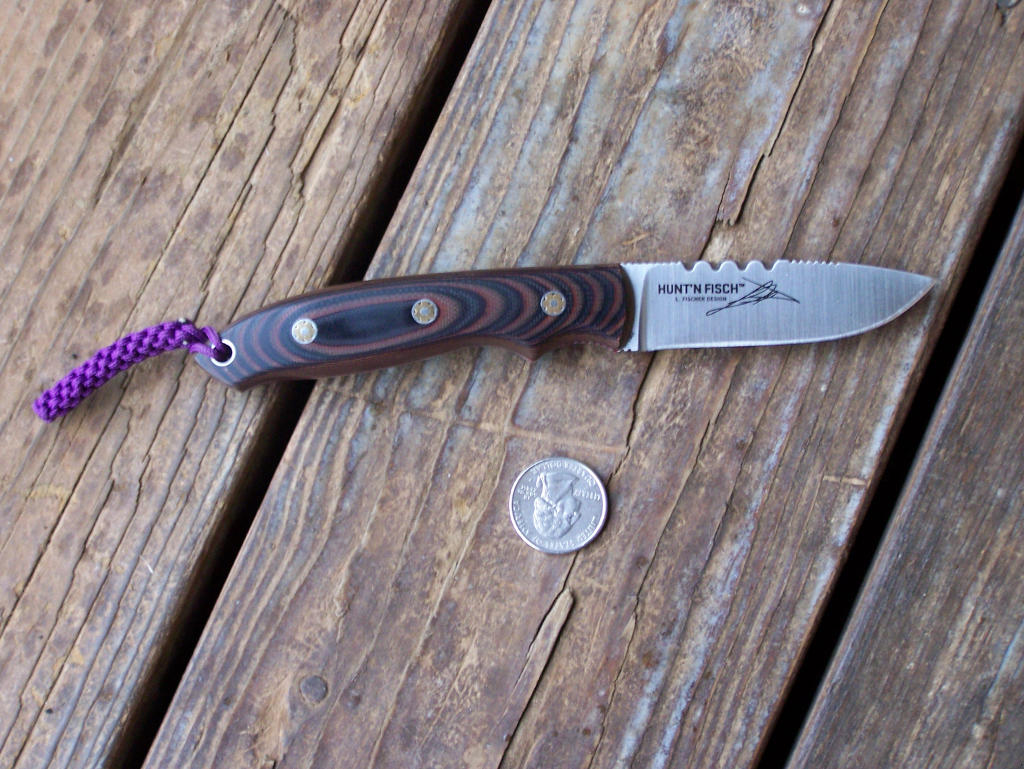
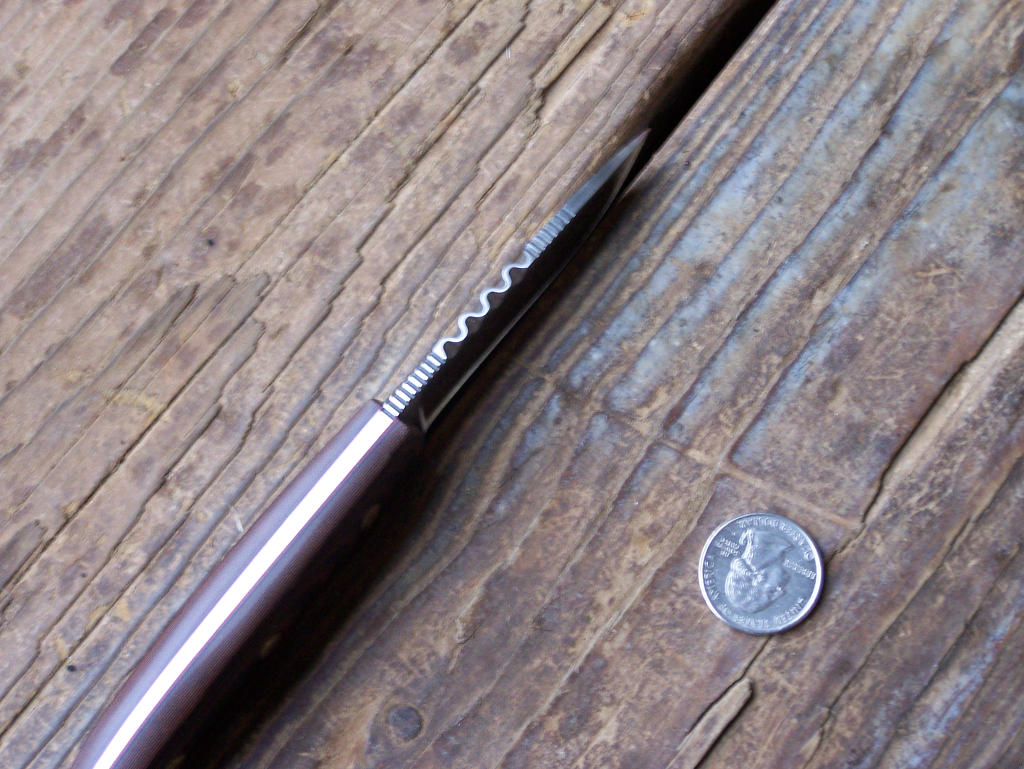
If you’ve followed my knife articles over the years, you know that I don’t particularly like small knives, whether fixed blade or folder. I’ve always found that, for the most part, I can usually do more chores with a larger knife than I can with a small knife, but that’s not always the case, and I’m the first to admit it. The Hunt ‘n Fisch has a blade length of only 2.99 inches, although it appears shorter than that for some reason. The blade steel is 8Cr13MoV– a high-tech stainless steel that holds a good edge and is easy to re-sharpen, too. Rockwell on the blade is 56-60, which is a bit hard, but as I mentioned it’s fairly easy to resharpen. The blade is a drop point design with a flat grind, too. The handle material is multi-colored G-10; it’s very eye catching. The overall length of the knife is 7.15-inches, but once again it looks smaller. The knife only weighs 3.6 oz, so it’s light weight. I like the file work on the top of the blade, which is very appealing though it has no served purpose other than to, well, look cool!

I liked the expertly made leather sheath that comes with the Hunt ‘n Fisch. The sheath is designed to slide onto the belt horizontally, and it is comfortable to carry. The handle is easy to access, and the sheath is molded to hold the knife securely, too.

100_5717

I tested the Hunt ‘n Fisch for more than a month and a half around my digs. Usually I test a knife for a couple weeks, but there was just “something” about this little fixed blade knife that had me addicted to it. I used it for all manner of chores in the kitchen, working on the pick-up truck and around the homestead, and for trimming blackberry vines, which is a never-ending chore in Western Oregon. Many folks don’t know that blackberries are not native to Oregon, but they sure gained a foothold once they were planted. While it’s nice to have all the free blackberries we want in late summer and early fall, it’s a chore keeping the wicked vines in check. They grow fast. To be sure, all over our area, you can have all the blackberries you care to pick. The vines have wicked thorns that seem to reach out and grab you, but the delightful blackberries are all natural and delicious. My wife loves making blackberry syrup for our pancakes. We always wear heavy, long-sleeve shirts and gloves when we pick blackberries, but we still get scratched from the wicked thorns. However, it’s worth it in the end. It’s free food for the picking!

I don’t see the Hunt ‘n Fisch as a survival-type knife per se. It’s just too small for many of the tasks you might need it for. However, if you hunt, this little knife would come in handy when you are dressing out big game. Unfortunately, this past hunting season, I didn’t get out there and get a deer tag. The deadline slipped away from me, but the Hunt ‘n Fisch would have made a dandy hunting knife to be sure. It is small enough that you can carry it on your belt every single day. You forget you have it there, until you need it. No matter what, a fixed blade knife is always going to be stronger than a folding knife. I don’t care what make a folder is or what type of locking mechanism it has, there is that possibility of the lock failing and the blade closing on your fingers, doing serious damage. That’s not so with a quality fixed blade knife!

100_5720

The Hunt ‘n Fisch comes with a lanyard on the butt of the knife; however, it was too short to be of any use, in my humble opinion. Of course, you can easily replace the lanyard with longer 550 paracord if you so desire. I also love the friction grooves on the bottom/front of the handle and along the top/front of the blade that makes for a sure grip even under all sorts of nasty weather and conditions.

To top it all off, the screws holding the G-10 handle scales on the Hunt ‘n Fisch are gold colored and embellished. This knife screams “custom” to my way of thinking.

I’ve saved the best for last, and that is suggested retail price. It’s $99.99, and if you shop around carefully you can usually find CRKT products discounted quite a bit. Now, here’s the bad news: the Hunt ‘n Fisch isn’t on the market as of this moment, however, CRKT expects to have a good supply in stock very shortly. I’d get my order in early. This is going to be a hot seller. We are talking custom quality at a factory price. What’s not to like here? Additionally, as I pointed out earlier, 100% of the profits from the sale of this knife goes to a worth cause– the fight against pancreatic cancer. You’ll be doing yourself a favor by getting one of these dandy little fixed blade knives. You’ll have a fantastic knife, and you’ll be helping in our fight against cancer. How can you lose?

– Senior Product Review Editor, Pat Cascio


Recipe of the Week: Chewy’s Augmented Mac ‘n Cheese, by D.D.

Carbs are easy to store, but mixing them with protein and flavors make mealtime more than another item on the daily task list. This recipe is named after our dog-shaped vacuum cleaner that went crazy when I prepared this and enjoyed the “accidental” dropping of ingredients on the floor.

Ingredients:

  • 8oz ground beef
  • 1/2 onion, chopped
  • 1 foil packet of mushroom gravy mix
  • 1/2 cup of milk
  • 1 box of macaroni and cheese

Directions

  1. Boil the macaroni noodles in a pot of water until soft; lightly drain and transfer to a holding bowl.
  2. In the same pot, toss in the ground beef and onion, using the fat to cook it all down.
  3. When the meat is browned, add the cooked noodles back in and add the remaining ingredients (including the dry cheese packet).
  4. Simmer over low heat. Add water to achieve the consistency you desire.
  5. Eat with a happy tummy.

My advice is to get this recipe to the point where you like it before testing out SHTF adjustments, below:

  • Use rehydrated onions
  • Instead of milk and powdered mushroom gravy mix, use a can of mushroom soup
  • Instead of ground beef, use a 10oz can of meat; this could be chicken, too
  • Dish can also be cooked in a RoadPro RPSL-350 12 volt crock pot for off-grid use. (Yes, I tried this, and it took 2 hours total)

DD in Colorado

o o o

Do you have a favorite recipe that would be of interest to SurvivalBlogreaders? Please send it via e-mail. Thanks!


Letter Re: Largest Bank’s War on Cash

I note that under Chase’s new rules, cash cannot be used to make a payment on a loan account. So payments on debt have to come through a deposit account. The Internal Revenue Service regards all deposits to deposit accounts as income. You have to offer proof that a given deposit is a transfer of funds from income previously recorded or proceeds from a loan to have the deposit excluded from income. Undocumented, it is known as phantom income to small business owners, as they are forced to pay tax on deposits they cannot prove to be from non-income sources. It is very important to keep good records.

Since debt can only be reduced by income and income is taxed, they are eliminating anyone’s ability TO avoid tax by engaging in cash transactions to earn money in order to pay off debt. They are making sure that the government can collect all the tax possible to pay interest on all those bonds they have bought. This is a necessary development that must precede dramatic increases in tax rates. As interest rates rise, taxes will have to go up to cover debt service and all those other obligations.

I know that I will have to pay tax on income in my journey to being debt free. It is important to use the rules to your favor using a combination of passive entities and active entities to achieve your goals. – R.V.


Odds ‘n Sods:

Battlefield America: The War on the American People – H.L.

o o o

Supreme Court: Police can’t hold suspects without probable cause, to wait for drug-sniffing dog. – RBS

o o o

Princeton study as a warning to Europe: US is no longer a democracy. – L.J. This is a German site, English translation available on Google.

o o o

Video: Can US agencies balance security and the Constitution?

o o o

DIM WIT? St. Louis Police chief calls for the law-abiding to leave their guns at home. “We got cameras” he says.. – T.P.


Notes for Sunday – April 26, 2015

On April 26, 1986, the world’s worst nuclear accident occurred at the Chernobyl plant in the Soviet Union. An explosion and fire in the No. 4 reactor sent radioactivity into the atmosphere; at least 31 Soviets died immediately.


Street Combat – This Ain’t No Game! – Part 5a of 9, by Pat Cascio

[Street Combat – This Ain’t No Game is a SurvivalBlog exclusive.]

Chapter Three – GUNS & KNIVES

When we get into the topic of guns and knives, it holds a special place in my heart. I have carried a handgun since I was 18 years old and some sort of pocket knife even longer.

Deadly weapons don’t necessarily have to be used in the way they are generally intended for them to make an impact. Sometimes, the mere presence of one of these deadly implements is enough to stop an attack. The following is a true story. I know, I know; usually when someone starts out with the words “true story”, it’s not exactly true. Well, this one is!

CASE STUDY: Armed Robbery Admission

It was January 1975 at Chicago, Illinois Police Headquarters, which also houses various court rooms. I was present in one of these courts for a number of shoplifting arrests I had made while working temporary, plain clothes, store security detail.

While awaiting one of my court cases, I heard an elderly black man (probably in his late 60’s or early 70’s) explain to the judge the circumstances leading up to his arrest. The following is almost verbatim what this man said.

“Yore honors, I admits to going into that store. I admits that I had me this gun. I also admits that I wuz gonna rob that store. But, this here man (the elderly black man was pointing at a plain clothes police officer standing next to him) never told me he wuz no police man. He only pointed his gun at my head and said ‘Bye-bye mother f- – – er.'”

At this point the entire court room was laughing hysterically, including the judge. Court had to be recessed for 15 minutes while the court regained its composure.

LESSON LEARNED:

Never admit to attempting an armed robbery. The old gent above received a fairly stiff jail sentence. Silent hold-up alarms work, at least sometimes!

TECHNIQUE USED:

The plain clothes (tactical) officer didn’t need to fire his weapon. However, his judicious choice of words caused the elderly robber to cease and desists his actions IMMEDIATELY!

The elderly hold-up man wasn’t all that upset about being caught for his crime, but he sure enough was upset with the way the police officer identified himself as well as his carefully chosen challenge. Intimidation worked. Enough said?

Over the years, while working as a police officer, private investigator, or security officer, I had several occasions in which I drew my gun. There have also been occasions when I would have been justified (under the law) in firing.

CASE STUDY: Equalizing the Hefty Shoplifter

While working for one particular detective agency in Chicago, I was assigned to work a plain clothes store security detail for the two weeks leading up to Christmas. The store was Alden’s, a mail order outlet store. This was a fairly small outlet store with probably less than 5,000 square feet.

I worked with my partner, Dave Guritz, and four other security officers at this store, plus Alden’s had two off-duty Chicago Police Officers also working the store. That was plenty of security for a store so small in size, or so we thought.

The two Chicago Police Officer wore security guard uniforms and worked near the front door and cash registers. The rest of us either worked the floor or observed the store’s patrons from behind two-way mirrors in a specially built booth. We averaged 25 shoplifting arrests per day! Yes, you read that right; we had 25 shoplifting cases per day!

For some now forgotten reason everyone had gone to lunch and I was working alone. While observing a rather tall and heavily-built Puerto Rican “shopper” from behind the two-way mirror, it soon became obvious that this was no ordinary shoplifter. This fellow had on a long dress coat with “booster” pockets built into it. This is a sure sign of a professional shoplifter.

The two-way mirrors we worked behind were built onto a special platform that was raised several feet off the floor. I was looking down on this shoplifter when he carefully folded two men’s suits up and hid them inside his booster-pocketed coat.

I knew the character was big, but I had no idea just how big he was until I hurried down from my hiding place and met him at the front stairwell. He stood 6′ 7″ tall and weighed around 225lbs. I knew this was going to be trouble!

I identified myself as store security and had my badge in my left hand. I politely (really!) asked this pro to please turn around and accompany me back to the store’s security office.

I was told in no uncertain terms that he was “going to walk all over” me. He was big enough to do it, too. I looked hopelessly for help, but none was to be found. I drew my Smith & Wesson Model 39-2, 9mm pistol from my shoulder holster and placed in square in this monster’s face. He came along quietly.

LESSON LEARNED:

It’s simply amazing how much a person learns as they grow older. Such is my case. I should have followed this pro out the door and got a license plate number from his car. We could have called the police and caught him driving away or at home. My only excuse is that I was young, dumb, overly enthusiastic, and inexperienced.

I could have looked the other way when I saw the size of this guy and let him “walk”. No one would have been any wiser. The odds are that he would have returned later for some more “shopping” at a time when the rest of the store’s security staff had returned.

Under Illinois statute, I was justified in drawing my weapon. The “disparity in size” and his threat aimed at me (“I’m going to walk all over you”) gave me legal grounds to equalize the disparity in size. This guy was capable of carrying out his threat, even with my martial arts training. I don’t know if I would have been the victor in a fight.

TECHNIQUE USED:

The threat of deadly force and my clear intention of using it against this professional thief, turned his attention to doing the right thing. Many times, I’ve heard people say that they are only buying a handgun to scare someone away. They say they wouldn’t (or couldn’t?) ever shoot someone. This is a poor approach to self-protection. A seasoned professional criminal can detect if you’re serious in your threat. If they know you are only bluffing, they’ll take your gun away from you and use it on you.

I had every intention of using my 9mm (for self-defense,) against this monster of a thief, and he knew it! Oh, I wouldn’t have shot him for his shoplifting, even though it was a felony theft, but had he tried to “walk all over” me, as he claimed he would do and I believe he meant those words, he would have met my great equalizer– the 9mm!

CASE STUDY: The Young Bully

Knives have always held a special place in my life. I can still recall the very first knife I received. My grandfather got a hunting knife and hatchet set for me when I was about six or seven years old. I thought it was the best knife in the world. Today, you can probably buy the same knife for about $5. Nevertheless, I thought I had a real bear-killing knife.

Long before Spyderco came out with their easy one-handed opening knife, we were pretty limited to knives that were fixed blade or pocket knives that required two hands to open. That is until my cousin Tony devised a way to make a standard pocket a one-handed affair.

All the gang members in the area were carrying a certain type of pocket knife during the 60’s. It wasn’t anything special, but I do recall these knives had something akin to a clip point blade, which was about 3″ long. A “genuine” simulated bone handle accompanied the entire affair.

When the knife was closed, the back of the blade stuck out of the handle just enough so you could readily grasp it. You still couldn’t use one hand to open it though. This was easily corrected with a flat file and about 15 minutes of your time. About two-thirds of the way toward the front of the knife, the file was used to remove about a 1/3″ of the handle material. The file made a nice little, squared cut into the handle. It short order, you had a one-handed opening knife. With a little practice, you could flick the blade open almost as fast as you can with today’s one-handed openers.

Before I was old enough to carry a gun, I carried a pocket knife, similar to the one described above. I got pretty good at flicking it open.

Jack K was one of the slower kids in our 6th grade class. If I recall correctly, Jack K was probably about 15 or 16 years old and still in the 6th grade. Jack K was also a bully!

One evening my friend, Andy Silva, and I were in Knapps Pool Hall having a Coke or Pepsi. We weren’t old enough to shoot pool yet, but Jack K was always in the pool hall usually shooting pool with someone. This evening found Jack K sitting all alone at a table.

Jack K thought this was a good opportunity to shake Andy and me down for some money; maybe he needed it for a game of Eight Ball. Anyway, we both refused to give up what precious little pocket change we had with us. Jack K threatened to beat us up if we didn’t come across with the money, but we held firm.

After we finished our drinks, we went outside with Jack K right behind us. I had already gotten my neat little one-handed opening pocket knife, and it was in my hand yet unseen by Jack K because it was pretty dark outside. When Jack K grabbed me and told me what he was going to do to me, I let loose with the knife.

LESSON LEARNED:

First of all, we should NOT have been in the pool hall; we weren’t old enough, and there were usually some local “toughs” who occupied the place. Had we been a bit smarter, we would have gone to the bowling alley for our sodas instead of the attached pool hall.

As I’ve mentioned elsewhere in this book, no matter how big a person is (and Jack K was pretty big compared to me), if you can catch ’em by surprise you’ve got a fighting chance.

TECHNIQUE USED:

Plain and simple, I cut Jack K right across the top of his hand. He immediately let loose of me and told me what he was going to do to me later, but nothing ever happened.

I believe most people have a real fear of someone with a knife. I know this was true in my case, because of the times I faced knife-wielding attackers. However, I overcame my fears and fought back.

In the above incident, I caught Jack K by complete surprise, and the sight of his own blood was enough for him. The attempted theft of our money ended right then and there.

CASE STUDY: Shoot Out at Traffic Light

The early 1970’s still echoed the violence and demonstrations against the Vietnam War. I found myself working full-time for the Illinois National Guard. I enlisted in the Guard when I was 17 years old; my folks wouldn’t sign the necessary parental consent papers for my enlistment in the Regular Army. During my stint with the Guard, I saw my share of riots and demonstrations against the war. However, on this one particular evening the events had nothing to do with the Vietnam War or race riots.

I was working late one summer evening at the armory on Madison Street, on the west side of Chicago, which is a predominately black neighborhood. Our armory was located just a few short blocks from the (then) infamous black Panthers Headquarters.

It was approximately 7:00pm when I left the armory, and as is the case during the summer months in Chicago it was hot and humid. My car didn’t have an air conditioner, so I drove with the windows rolled all the way down.

While stopped at an intersection, waiting for the light to turn green, I noticed three black men standing in front of a tavern across the street from me. They hurled all sorts of racial remarks at me. I urged the light to change green, yet it didn’t! A shot rang out. I felt the bullet whiz past me. It struck the front passenger side door, shattering the rolled down window inside the door frame. My heart was pumping at this point. In all honesty, I didn’t know if I had been shot or not. I looked down at my uniform and saw no trace of blood.

I drew my Browning .32 acp auto, and without looking (or aiming) I emptied the magazine in the direction of my attackers. They took off running down the street. I ran the red light and headed home. It wasn’t until I arrived safely at home that I called the police and made a report. Nothing ever came of this incident to my knowledge.

LESSON LEARNED:

First of all, I should have left the armory at my usual time. The west side of Chicago was no place for a white man during the turbulent late 1960’s and early 1970’s. There had been a number of race riots in this area in the preceeding years (and months).

Secondly, I should have simply ran the red light. There were no other cars in front of me, and traffic was extremely light. Our battalion commander had instructed all of the full-time Guard employees about such matters and had given all of us some additional escape and evasion driving lessons.

Lastly, I should have looked where I was shooting. I was justified in returning gun fire to defend myself. While in uniform, we were authorized to carry concealed or openly.

TECHNIQUE USED:

This is an easy one. It was pure terror and sheer luck! I was driven by my youth and inexperience in these matters, as I was only 18 years old! Although I had been thoroughly trained in the use of all sorts of handguns (and long guns), I didn’t have the street sense to look where I was shooting. I simply drew my handgun and instinctively fired in the general direction of the threat. Luckily, no innocent bystanders were hit.

Thus far, I’ve only discussed the incidents that did not result in anyone getting shot. Lest anyone reading this believe that the mere presence of a gun will always work, you are sadly mistaken! If you purchase a firearm for self-defense or the defense of others, you’d better be prepared to use it. I made my mind up long ago that I would not hesitate using deadly force to save my own life or the lives of those in my charge. The following case illustrates this.

CASE STUDY: Shooting the Home Burglar

The fall of 1970 brought about a series of burglaries in our middle class neighborhood (in Chicago). Most of these burglaries took place during the evening hours, which is unusual. Contrary to popular belief, most burglaries take place during the day, when folks are at work or school.

I had abandoned my little Browning .32 acp by this time and laid claim to a neat little Smith & Wesson Model 36 Chief Special revolver. There’s a certain mentality in Chicago that exists to this day. It’s that most people who own handguns for self-defense carry (illegally) either a .38 Snubby or a totally under-powered .25 acp autoloader. I was caught up in the thinking of the day and had to have a little .38 for everyday carry to and from the National Guard Armory. I had two Colt Government Model .45’s at home; one of these should have been my carry gun in those days. Hind sight is wonderful, isn’t it?

I made a habit of keeping my revolver under the pillow on my bed when I came home from work. I couldn’t legally carry if I was out of uniform or off duty, but that’s another story.

My two oldest sisters were still in high school at the time. They were both on the volleyball team and asked me to drive them to a game (or maybe it was a practice) that evening.

I distinctly remember locking the front door as we left. As a matter our routine, someone was always coming or going, and the front door was usually left unlocked.

The roundtrip to the school and back only took about 10-12 minutes. When I returned home, I found ajar the front door, which I knew I had closed locked when I left. The only lights on in the house were in the living room. I left all the rest of the lights off and proceeded to creep up the stairs to my bedroom to retrieve my little .38 snubby from under my pillow. Like most people, I knew my house in the dark. There was no need to turn on any light switches to find my room, bed, and gun!

Just as I reached under my pillow and had my hand on my gun, someone shoved me and started to run down the steps to the main floor. I was right behind him. I fired two shots using point shooting techniques, and I heard the burglar scream out an obscenity. He ran out the back door, with me in hot pursuit. I never did catch him or fire any more shoots.

I called the Chicago Police. When they arrived, they discovered that there was one bullet hole in the wall along side the stairwell. Obviously, the other shot hit the burglar, and that’s why he cried out. The police made a search of the area and never found this creep. We did find that this character had broken out one of the panes of glass in the back door, reached in, and unlocked the door. Why he had opened the front door still remains a mystery. Perhaps, he opened it to look out to see if anyone was walking by.

LESSON LEARNED:

I should have gone next door to a neighbor’s house and called the police when I realized that someone had broken in. This would have been the smart thing to do. My excuse (and it’s a good one) is that I was only 18 years old (almost 19) at the time.

Secondly, after making the decision to retrieve a gun, I should have grabbed one of the guns my father kept downstairs in his room. It was foolish to insist upon following my own desire and taking the chance of getting attacked (which did happen) and going to my own room to get my own gun.

As an aside, I was an avid knife collector at the time. I had quite a collection of bayonets, Bowie knives, and hunting knives on the wall in my room. The burglar could have easily armed himself with one of those knives; instead of pushing me, he could have stabbed me in the back.

TECHNIQUE USED:

My cousins, Leroy Moe Laneve and Abner Leneve, taught me how to point shoot when I was 15 years old. I made my first visit down to Kentucky with my grandmother and purchased my very first gun during that trip. It was my country cousins– Moe and Abner– who really taught me how to shoot rifles and pistols. Abner was good enough to be an exhibition shooter for one of the ammo or firearms companies. Sadly, the day of the exhibition shooter was long gone by this time.

Moe was confined to a wheelchair because of an automobile accident that left him paralyzed from the waist down. Regardless, he could shoot the eye out of a crow at 75 yards without much trouble. Abner was a better shot and could toss rocks into the air and hit them (with a rifle or pistol), without aiming, nine times out of ten. Abner taught me how to point shoot, and I quickly applied this method to all my close quarters combat shooting. It wasn’t until 1990 that I met the legendary Col. Rex Applegate, who is recognized at the master of point shooting. Since that time, the good Colonel has taught me even more about close quarters combat shooting and the art of point shooting.

When I fired the double-tap at the burglar, who was running down the stairs, I used point shooting. It was too dark to see the sights, and there was no time to aim, even if I could see the sights. The distance involved was only about five feet.

The hole remains in the wall after all these years. My parents recently sold that house to a Chicago Police Officer!

Not all my encounters were deadly or potentially deadly. Like a lot of people, I still needed to be delivered from a little bit of a mean streak that I had. So much time has passed since this next incident took place, I think I’m safe to “fess-up” about it.

CASE STUDY: Who’s Boss in My House

Remember my friend, Andy Silva, who I mentioned earlier? Well, Andy was a bit bigger than me and about a year or so older. When you’re 10-13 years old, age and size make a difference. Remember, I was a skinny kid in those days, too.

I don’t recall the exact circumstances that led up to this case study, but I do recall that Andy and I were horsing around in my bedroom. I recall that my grandmother had told us to put an end to things, but Andy was persistent.

I was pinned on my bed and in pain. I don’t recall exactly what Andy was doing to me, but I believe he was applying a pressure point. (Andy was deeply involved in judo and karate in those days.) I remember telling him that I’d had enough and to stop, but he didn’t. I fought back and retrieved one of the many knives I had in my knife collection (on my desk).

LESSON LEARNED:

Never trust anyone (completely), not even your best friend. For some reason, Andy was determined to show me who the “boss” was that evening. I wasn’t about to submit to that, not in my own house and my own bed room.

TECHNIQUE USED:

It was very simple. I grabbed the first knife I could lay my hands on, which in this case was a Fairbairn-Sykes Commando Dagger. These babies have a point on them like a needle; they’re real sharp!

I stabbed Andy in the arm, and the “who was going to be ‘boss’ battle” was over immediately. Oh, don’t get me wrong, I didn’t stab Andy all that deeply, just enough to draw blood and let him know I wasn’t about to put up with his behavior that night.

Needless to say, Andy didn’t come around for quite some time after that. I do recall him saying something to the effect that I was crazy or something like that. I was making a reputation for myself.


Letter: Disinfecting Drinking Water

Hi,

Your articles have mentioned calcium hypochlorite. I went to the pool store today, and they had sodium dichloride.

Should I ask specifically for the first? I’m not sure if the girl behind the counter is going to know how to help me on this one. Thanks – D.

HJL Responds: We only recommend calcium hypochlorite, even though sodium dichloride is also used as a disinfecting agent. The pool shop should be able to order it for you. You are basically looking for a chlorine bleach solution to stabilize and disinfect your water. Liquid bleach has a very short shelf life, and the powdered calcium hypochlorite will get you that bleach solution with a harmless calcium sediment as a byproduct. When you mix a batch up, just let the sediment settle out. It is important to look at the label of the product that you are buying. Managing pool chemicals is a different process than disinfecting drinking water. You need to make sure that you are not getting any harmful additives in the product you purchase.


Economics and Investing:

Negative Interest Rates: It Is Like A Black Hole That Sucks In More And More Matter – Read: Capital – And Never Lets Go. This Financial Black Hole Story Will Also End With A Sudden Implosion, A Flash Of Light And A Big Bang, Just Like In Space…

o o o

What Will Happen to You When the Dollar Collapses?. – G.G

o o o

Deutsche Bank unit pleads guilty in U.S. Libor-rigging case. – G.G.

o o o

The Mystery Of China’s Gold Holdings Is Coming To An End


Odds ‘n Sods:

Nets Skip Wisconsin Police Raids Against Conservatives; Fox Exposes. – RBS

o o o

Constitution Revolution: How Does Washington Justify Its Unconstitutional Behavior?. – JBG

o o o

Declassified Report Shows Doubts About Value of N.S.A.’s Warrantless Spying . – JBG

o o o

New Way the U.S. Projects Power Around the Globe: Commandos . – T.P. A good read but requires a subscription.

o o o

Al Qaeda Hostage’s Family Paid $250,000 For Release, Obama Regime Didn’t Tell Them He’d Been Killed In January So They Continued To Negotiate . – B.B.


Hugh’s Quote of the Day:

Then Jesus again spoke to them, saying, “I am the Light of the world; he who follows Me will not walk in the darkness, but will have the Light of life.” John 8:12 (KJV)


Notes for Saturday – April 25, 2015

Today, we present another entry for Round 58 of the SurvivalBlog non-fiction writing contest. The $12,000+ worth of prizes for this round include:

First Prize:

  1. A Gunsite Academy Three Day Course Certificate, good for any one, two, or three course (a $1,195 value),
  2. A course certificate from onPoint Tactical. This certificate will be for the prize winner’s choice of three-day civilian courses. (Excluding those restricted for military or government teams.) Three day onPoint courses normally cost $795,
  3. DRD Tactical is providing a 5.56 NATO QD Billet upper with a hammer forged, chromlined barrel and a hard case to go with your own AR lower. It will allow any standard AR type rifle to have quick change barrel, which can be assembled in less than one minute without the use of any tools, and a compact carry capability in a hard case or 3-day pack (an $1,100 value),
  4. Gun Mag Warehouse is providing 20 Magpul pmags 30rd Magazines (a value of $300) and a Gun Mag Warehouse T-Shirt. (An equivalent prize will be awarded for residents in states with magazine restrictions.),
  5. Two cases of Mountain House freeze dried assorted entrees in #10 cans, courtesy of Ready Made Resources (a $350 value),
  6. A pre-selected assortment of military surplus gear from CJL Enterprize (a $300 value),
  7. A Model 120 Series Solar Generator provided by Quantum Harvest LLC (a $340 value),
  8. A $300 gift certificate from Freeze Dry Guy,
  9. A $250 gift certificate from Sunflower Ammo,
  10. KellyKettleUSA.com is donating both an AquaBrick water filtration kit and a Stainless Medium Scout Kelly Kettle Complete Kit with a combined retail value of $304,
  11. TexasgiBrass.com is providing a $300 gift certificate, and
  12. Two cases of meals, Ready to Eat (MREs), courtesy of CampingSurvival.com (a $180 value).

Second Prize:

  1. A Glock form factor SIRT laser training pistol and a SIRT AR-15/M4 Laser Training Bolt, courtesy of Next Level Training, which have a combined retail value of $589,
  2. A FloJak EarthStraw “Code Red” 100-foot well pump system (a $500 value), courtesy of FloJak.com,
  3. Acorn Supplies is donating a Deluxe Food Storage Survival Kit with a retail value of $350,
  4. The Ark Institute is donating a non-GMO, non-hybrid vegetable seed package–enough for two families of four, seed storage materials, a CD-ROM of Geri Guidetti’s book “Build Your Ark! How to Prepare for Self Reliance in Uncertain Times”, and two bottles of Potassium Iodate– a $325 retail value,
  5. A $250 gift card from Emergency Essentials,
  6. Twenty Five books, of the winners choice, of any books published by PrepperPress.com (a $270 value),
  7. TexasgiBrass.com is providing a $150 gift certificate, and
  8. RepackBox is providing a $300 gift certificate to their site.

Third Prize:

  1. A Royal Berkey water filter, courtesy of Directive 21 (a $275 value),
  2. A large handmade clothes drying rack, a washboard, and a Homesteading for Beginners DVD, all courtesy of The Homestead Store, with a combined value of $206,
  3. *Expanded sets of both washable feminine pads and liners, donated by Naturally Cozy (a $185 retail value),
  4. Two Super Survival Pack seed collections, a $150 value, courtesy of Seed for Security,
  5. Mayflower Trading is donating a $200 gift certificate for homesteading appliances,
  6. APEX Gun Parts is donating a $250 purchase credit,
  7. Montie Gear is donating a Y-Shot Slingshot and a Locking Rifle Rack (a $379 value), and
  8. Two 1,000-foot spools of full mil-spec U.S.-made 750 paracord (in-stock colors only) from www.TOUGHGRID.com (a $240 value).

Round 58 ends on May 31st, so get busy writing and e-mail us your entry. Remember that there is a 1,500-word minimum, and that articles on practical “how to” skills for survival have an advantage in the judging.


“Internet” Without Infrastructure – Part 5, by R.H.

The Postmaster network

Postmasters, of course, will be able to communicate through this network between themselves and share information. In this way, they will know the health of the network in various areas. They will be the first ones with the most knowledgeable about encryption and programs that are available. At first, many Postmasters may not know much about encryption or how to use the tools, but they can learn about it and even share copies of the software through the network. As soon as most Postmasters have mastered it, they can start providing encryption as a service across the network.

If the network gets overloaded, they can set up subnetworks to take some of the load. They can help set up private networks for groups that need them, using separate pouches if necessary but sharing the same protocols, transfer routes, and personnel. As with almost anything, there is always a danger of politicization, which much be guarded against.

Sabotage

An important duty of all Postmasters, and actually anyone using the network, is to be alert for sabotage and do everything possible to prevent it and minimize any damage.

One simple way for the system to be sabotaged would be for some “Evil Postmaster” to intentionally make some alteration on the contents of all files in his pouch, rendering them useless, and then to transfer the pouch to other Postmasters. Any of the files that had already existed in their unaltered state on other Postmasters’ pouches would be okay, because existing files are not overwritten during the swapping protocol, but any files that were only in the “Evil Postmaster’s” pouch and any that are new to the other Postmasters would be passed on in their corrupted state. This could be detected quickly by other Postmasters, if they were in the habit of sending encrypted messages between themselves, because they would discover the corruption of their messages. Once detected, they could make an effort to quarantine the corrupted files by not passing them on.

In a more advanced scenario, once Postmasters have become more experienced, they would be able to proactively detect corrupted files by using specialized software to compare the contents of messages with the same filename. Unless files have been intentionally corrupted, the contents will be identical except in very unusual cases. In this case, it may be possible to detect that the files have been corrupted but not possible to tell which of the two copies is the “real one”. In this case, both the good one and the bad one can be passed on if the postmaster adds an additional character to the end of the filename. The receiver will then have to determine which one is right. If he has used encryption, this will be easy, because only the real one will decrypt successfully.

In general, Postmasters should have a good understanding of how the network operates and be on the lookout for problems. When a pouch comes in from another community, he should know what to expect in terms of the quantity of new messages. If it’s a lot more than what he expected, he should at least be curious about it and try to understand what’s going on. He might want to ask the other postmaster if he knows why there were so many. This will help him better understand the workings of the network and puts him in a much better position to notice suspicious activity. He needs to be and act much more like a sentry than a post office employee.

Even in the face of some sabotage, however, most messages are likely to get through. This is because of the redundancy of the system. The more postmasters there are in the network, the less damage that a saboteur is likely able to accomplish. If senders send multiple messages, and preferably send them through multiple postmasters, most are likely to get through.

There are other ways that the network can be harmed, such as attempting to flood the system with large numbers of false messages, or sending very large files by breaking them up into many little files. These things can be detected and thwarted using methods such as those described above.

A basic kit of software tools and instructions that any Postmaster may need should be included on each pouch or in a separate pouch. This should include (but not be limited to) the following:

Postmaster Toolkit:

  • This document and text copies of the linked material as well as additional information on encryption and security.
  • PGP tools
  • ZIP tools
  • VeraCrypt (another advanced encryption tool)
  • File shredding tools
  • File search tools
  • File directory comparison tools
  • File management tools
  • Custom Postmaster tools (yet to be developed)
  • All of the above for as many platforms as possible, including Windows, Mac, Linux, Android, IoS (Apple Mac, iPhone, and iPad).

Note that although a toolkit would be a great boon to the Postmaster network, it also opens us up to one of the most dangerous forms of sabotage that could occur. The tools themselves could be sabotaged or replaced with counterfeits, which would appear to be operating normally while actually leaving “back doors” open. This would not be easily done, but it could be, and I would not be at all surprised to find out that certain government agencies or even some advanced terror networks already have counterfeit versions of these tools at their disposal. Viruses could easily be placed in any of the tools, which could be devastating. There are solutions to all of this, both highly technical and otherwise, but it is something that Postmasters need to be constantly aware of.

The above toolkit, once standardized, should be packaged in an encrypted file (possibly using VeraCrypt) and signed with a known public key to help ensure its authenticity. However, even this could be faked, unless some method of certifying public keys (without the Internet) is used. See the document referenced above on how PGP works for more information on certification. There are certainly challenges ahead, but until the Postmaster network has become knowledgeable enough about encryption and skilled enough to use the tools effectively, we don’t want to make things so complicated that we discourage the growth of the network in the first place. It needs to be simple to begin with.

The level of security discussed here may or may not be something we actually need today, but it may possibly mean the difference between life and death in the future. Especially in a time of war, we will need to stay two steps ahead of our enemy. These are extremely powerful tools and, combined with good operational security, they should be an important part of our arsenal.

The more diligent, innovative, and coordinated the Postmasters are the better the system will work. If the network of Postmasters were to become power hungry or corrupt, they would likely find the current system too “loose and unstructured” for them, or they would start describing it as dangerous. Soon it would start to look like some sort of government bureaucracy. When this happens, it may be better to just start building and using a separate network.

Summary

As I said early on in this article, it is inevitable that people, faced with a collapsed infrastructure, will start transferring messages using SneakerNet. It is also certain that people will collaborate on the transfer of files in some way. Some type of network will come into existence. By using the key points of this article, a much, much simpler and more effective network can exist. One last time, the key points are:

  1. Each message is stored in a separate file.
  2. The filename of each message is the unique identifier for that particular message.
  3. The first part of each filename contains a unique identifier for the recipient of the message or the name of a site or blog, while the remainder of the filename consists of additional characters to ensure that the message filename itself is unique.
  4. Messages, named as described above, can then be combined, recombined, copied, and shared over and over again, without the need for special tools.
  5. Using very small, inexpensive, portable storage devices with very large capacity (stock up now!), these messages are easily spread far and wide.
  6. When the network eventually fills up in any given area, large files are purged first. When there are no more large files, old files are purged. Both of these operations can be performed without special tools.
  7. If problems occur, sub-networks, separate private networks, trusted networks, and whole new networks can be set up almost instantly using these same techniques, allowing the system to be partitioned or “reset” in any way and at any time that people see fit. Nobody owns it.
  8. Encryption of one sort or another is the only way to prevent others from reading your messages, to verify the authenticity of a received message, and to ensure that it has not been altered. Everyone is in charge of their own security; ignore this fact at your peril!

There is much more to be said about how this system can be used, ways it could be sabotaged, and how to prevent that from occurring or fixing it when it does. Additional techniques, methods, and protocols will be developed and improved over time. Software applications and tools could simplify the work of a Postmaster enormously, but this will be easier if they are written and distributed before TEOTWAWKI. With fairly simple, specialized software, pouches could be merged with the click of a button. However, all of the basics of how to handle files have been covered here. Prepare, stock up, spread the word, and practice! If the infrastructure comes down before you are ready, at least keep these principles in mind and start finding a way to create, gather, and transfer files as described.

One more note: If this type of communication ever becomes “illegal”, know that you are already living under martial law, and if you start hearing a lot of talk about how the network is being used by “terrorist groups” (either the ISIS type, or the Constitutionalist type), and so it needs to be “clamped down” or “regulated” or “controlled”, just realize that just means that someone doesn’t like free communication for their own reasons. This is potentially a very powerful medium, and that power could be used for good or evil. Naturally, we will do everything we can to prevent it from being used to forward evil, but that’s the best that can be done. I think we can do a better job of keeping it in the right hands than some faceless government agency would be able to do. We can do it without completely destroying the power and freedom of the medium; I very much doubt that “they” can. Even if they were to try, this medium really can’t be controlled. All you would have to do is start fresh and learn from what happened before.

To free communication!


Two Letters Re: “Internet” Without Infrastructure

HJL,

Almost precisely this concept was described by the New York Times back in 2004, except instead of exchanging files on USB keys, they were exchanged via a small computer on a moped that connected to an access point in each village as the moped drove through. From a technical perspective, the solutions are nearly identical and the two could easily be combined, not to mention combining with amateur radio VHF and/or HF links for high-priority or long distance communications. – J.F.

o o o

Hugh,

The “Internet” Without Infrastructure article by R. H. is very intriguing. It makes sense that part of our preps should be to create part of the system that R.H. proposes, in order to allow that system to be used as quickly as possible after the regular Internet fails.

I believe we should exercise this alternate infrastructure in parallel with the current system. Maybe a web site should be setup where practitioners of the alternate internet could perfect the operating rules and exercise it. Regards – C.R.