Odds ‘n Sods:

The Simple Off-Grid Guide To Making Paper. – D.S.

o o o

I wonder how long before this shows up in North America or Europe? China unveils world’s first facial recognition ATM. – B.B.

o o o

Is it time for civil disobedience of kludgeocratic bureaucracy?. – JBG

o o o

Global Warming Agenda driven “study” attempts to paint Christians as anti-science fools: New study reaffirms the link between conservative religious faith and climate change doubt. – T.P.

o o o

House Democrat Backed By Insurance Companies Pushes Mandatory Gun Insurance


Hugh’s Quote of the Day:

“We’d stared into the face of Death, and Death blinked first. You’d think that would make us feel brave and invincible. It didn’t.” ? Rick Yancey, The 5th Wave


Scot’s Product Review: Armasight Night Vision Accessories

I recently reviewed the $549 Russian-made Armasight Spark Core night vision device and promised to do an update on some of the accessories that can be used with it. If you recall, I liked the monocular unit (which was $90 less when I bought it) and felt it offered a lot of bang for the buck, enough so that I purchased it on my own and then reviewed it. I still like it, but I am very concerned about not being able to get a response from Armasight on several questions. I contacted them both as a purchaser looking for product support and as a SurvivalBlog writer looking for information. I received no reply from emails or phone calls. They also neglected to answer a request to borrow some of the accessories for a review. Even if they don’t want to make anything available, courtesy should mandate a reply. For those reasons, I have doubts about recommending the product, but I want to review some accessories for it in case readers want to take a chance.

The first is the $145 Armasight Quick Release Picatinny Mount Adapter #26. One of the primary reasons I chose this unit was for the weapons mount. It is very useful as a handheld monocular, but like the far more expensive PVS-14 used by the U.S. military it offered the possibility of using it behind a red dot sight at night. This was the only unit I could find on the market in this form in this price range, and the fact that it promised better performance than most Gen I units also appealed to me.

Thankfully, I got the mount for $20 less than the current price, but I was still disappointed at the cost. It is a specialized item, which does drive up the price, but I have purchased other items that were probably harder to make that cost a lot less. Still, if you price mounts for a PVS-14, you will likely pay even more.

When the mount arrived, I was reasonably impressed with the quality. It is not up to what one might get from LaRue Tactical or some of the other American companies, but the finish is acceptable and it seems sturdy. It appears to be an aluminum alloy with a matte anodized finish that has worn off at the contact points, which is not a surprise. It weighs 3.25 ounces and has two adjustable quick release locking levers– one to latch the mount to a Picatinny rail on a rifle, and the other to the 3/8 inch dovetail rail on the Spark. This rail, by the way, works with the tip-off mounts used on .22 rifles. I haven’t figured out a way to take advantage of that, but there might be some use for it I haven’t thought of yet.

When I put it on an AR though, I began to get frustrated. I had hoped to just be able to add it to the AR when needed and remove it when not. Regular readers may have noticed I like backup iron sights (BUIS) on rifles, and the mount absolutely will not go on over the Troy BUIS I use. I have to move the Spark farther forward than I want to keep the rear sight on and that means the Aimpoint M4S my AR wears has to move forward too. Oops, now I just ran out of rail, since my carbine doesn’t have an extended rail.

I thought about the option of spending more money and buying the GG&G Cantilever mount, to move the Aimpoint far enough forward so the Spark can clear the BUIS, but thankfully I realized before doing it that it still doesn’t leave enough space for the Aimpoint on the rail. The only solution is to spend a bunch of bucks and buy a handguard with a full length rail. So much for the idea of getting it to work the way I wanted it to on my AR at no further cost. It always amazes me how projects keep on growing.

The next problem is that the mount does not line the Spark up with the Aimpoint using the Aimpoint factory QRP2 mount. The effect is somewhat like not lining your eyes up with a telescope; part of the view is occluded and in the dark, and that is a real problem. Your field of view is already narrowed by the night vision device and then further narrowed by the Aimpoint. Narrowing it more, by not lining it up with the sight, is a bad thing.

The mount places the Spark slightly lower than the Aimpoint, which is in a co-witness mount, meaning that the red dot is in the same plane of sight as the iron sights. The Spark needs to move up or the Aimpoint needs to move down. Moving the Aimpoint down means the front sight will be in the way of the red dot, which is not a good plan.

Moving the Spark up could probably be accomplished by removing the mount on the Spark and shimming it up a few millimeters; that’s what I was trying to get advice from Armasight about. I’m a bit hesitant to start pulling the thing apart. There is a warranty to consider, and I don’t want to wreck expensive gear. I had hoped that Armasight had an Aimpoint solution or would tell me it was safe to pull off the mount and shim it. I had no such luck, as they won’t answer my messages.

One thing I did discover was that increasing the space between the sight and the Spark helps by allowing me to see around the Aimpoint, which increases situational awareness. My first thought was that it would be best to have the Spark as close as possible to the Aimpoint, but that turned out to be wrong. There was still the problem of occlusion from the Spark not being centered on Aimpoint, though.

I have looked for a number of ways to raise the Spark other than to remove the mount and shim it, but I have not come up with a good answer. It I do, I will report back. In the meantime, it can be used, and it is better than the naked eye. However, it is not what it could be. I have tried holding the Spark in line with the Aimpoint, and it is much better than with the mount. That’s not, however, a usable method in the field.

I have read reviews on Amazon that people are having good luck using it with Eotechs. I have never used them, as I prefer the battery life on the Aimpoint. I also took a class from an instructor with many Eotech failure stories. I wouldn’t mind trying one, but I trust my instructor and have limited funds to spend, so I stick with Aimpoint. I would, however, be delighted to review one if offered.

I did not get a chance to shoot with it as the range I used to use at night is no longer available. I had to settle for dry fire drills, and they simply aren’t the same. One concern I have is muzzle flash and how the Spark will handle it. When I find another location to use at night, I will report on it.

The mount, in short, has been a disappointment. I can use it, but not up to its full potential unless I figure out a way to raise it a bit and add a full length rail to my AR.

Armasight IR810 Detachable Infrared Illuminator

Infrared light really boosts most night vision equipment, and I assumed that having more on tap would be a good idea. The Spark surprised me with how well it sees into shadows and on nights without moonlight, but extra light in the form of infrared will add clarity and definition to what you see when it is really dark. The Spark has a built-in illuminator, which works well indoors, but it only goes about 10-15 yards outside depending on the subject. Items with high infrared reflectivity would show farther away.

As I looked for a supplemental illuminator, I knew I wanted one that could attach directly to the Spark, which has three rails that can be used to mount it on a helmet, weapon, or attach accessories to the Spark. It was natural to check out the Armasight illuminators that, at the time I bought mine, included two Armasight recommended for the Spark– the $115 ($90 when I bought mine) Armasight IR810 Detachable Infrared Illuminator and the $199 Armasight IR810W Detachable Wide Angle Adjustable X-Long Range Infrared Illuminator. Neither product is currently listed on the Armasight web page, apparently having been replaced with newer products that I’ll touch on later. They can still be found, however, so it would be worth describing them.

Thanks to budget, I bought the less expensive one, which was a mistake due to the fact the beam, even though adjustable, was narrower than the field of view for the Spark. While it still gives you good light where it shines, it doesn’t cover everything you can see, and that erodes situational awareness, which is always a struggle in the dark.

Making the wrong choice was my fault, however. Both products have a zoomable lens, and I should have paid closer attention to this. The IR810 zooms from 2 to 12 degrees, while the IR810W zooms from 2 to 30 degrees. The field of view of the Spark is 30 degrees, and that should have given me pause before I clicked the spend money button.

Both units are from Ukraine, which means using illuminators and night vision from warring countries. One of the reasons I decided to buy this gear when I did was a fear that it might become unavailable due to the conflict; I have seen the prices climb substantially in the weeks since I ordered mine, and I would not be surprised if that is an effect of the war.

You use a single CR123A battery in either light. I was unable to determine if it could handle a rechargeable 123. Those normally produce 3.7 volts as opposed to the 3 volts from a primary cell, so there are often issues when using the rechargeables. The Spark instructions warn against any battery that exceeds 3.2 volts, so I am stuck using primary batteries in it as well. I have been trying to transition to rechargeable batteries for all of my equipment using solar chargers, so this is a point of concern.

I think the light easily met the promise of reaching 300 meters, and I suspect it goes farther when set to the tightest beam. How far you can see depends on how well the subject reflects light, of course. There is also the fact that the Spark is 1x, so it does not magnify what you see unless you can afford one of the supplemental lenses for it.

The light appears very sturdy and came with an adapter to convert the 3/8 inch dovetail on the Spark to a Picatinny rail, which is what the mount for the light requires. I have seen references that it is not always packaged with the adapter, so caveat emptor. I didn’t see any claims that it is waterproof, but there is an O-ring on the battery cap. I would most fear water intrusion through the lens, which must rotate in or out as it zooms.

There are four power settings on a rotary dial on the battery cap that serves as an on-off switch. A really nice touch would have been interconnecting it with the power switch on the Spark so you would only have one switch to contend with in the dark, but that would have run up the cost.

Both the light and mount appear made of a sturdy aluminum alloy anodized with a black finish. Together they weight 4.7 ounces, and the light is five inches long with the lens zoomed out and 1.5 inches tall in the mount. The light is 1.1 inches in diameter at its largest point.

The light emits 810nm infrared, which means if you shine it on something at night, you won’t be able to see the reflected light with your naked eye. If, however, you are looking back at the light, you can see a bright red glow, if you are looking directly at it and on axis with the lens. If someone else is using the light and you have night vision, it is as if they were waving a bonfire around, even at long distances. Always remember that you can see a light source farther that the person with the light can see you. This is, of course a major drawback when you have to use illumination.

One of the other questions I was unable to get answered by Armasight was whether higher frequency infrared light sources would work with the Spark. I wanted to know if I could use 850nm lights with it. I didn’t get an answer, alas. The higher frequency lights produce a bit less visible light, which makes it a little more difficult for an observer without night vision to spot the light source. I do note now that both of the lights Armasight recommends for the Spark on their website are 850nm, which indicates they should work. I wish I had known.

I don’t know the real costs of things like infrared light sources, but when I compare this to some of the very nice conventional flashlights on the market, I have to wonder about the price. There are lower cost infrared lights from other countries, but I don’t like to deal with one of them.

Armed with my current knowledge, I would be shopping for an 850nm light that has at least a 30 degree wide beam. It should have multiple power settings, as too much light will wash out your view. Something that would be very nice would be a tape switch that could be placed in a convenient spot to allow you to turn the light on or off with just a press. It would also use rechargeable batteries. Armasight has a new light that meets those specs, but it comes from China, and I am looking for other alternatives.

Armasight Transfer Adapter/Swing Arm to PVS7/PVS14 Headset/Helmet #37 JRH Enterprises PVS-14 Night Vison Helmet Mount Kit

These two products work together, so I will cover them at the same time. As useful as the Spark is as a monocular or weapon sight, I also wanted to try it on a head mount. There are times one wants to move about and have their hands free. There is a $99 harness, but I was more interested in seeing how it might work on a helmet. JRH enterprises was kind enough to loan me two of the $225 helmet mount kits for the PVS-14 night vision unit, and I then purchased the $99 Armasight #37 adapter for the PVS-14 mount.

I will describe the PVS-14 mount a bit before getting to the Armasight adapter. I was extremely impressed with these units, which are the same ones used by the military. They came out of packaging with National Stock Numbers just as if they were to be issued to soldiers and were made by Norotos, a small company that specializes in this sort of equipment for military and governmental organizations. There is a mounting plate that can be screwed to the helmet or held on with a strap, which was not part of the kits I got. You could probably adapt the plate to most any helmet with the strap and some jury rigging.

Once you get the plate on, there is an arm that snaps onto it. The arm allows the user to either flip the night vision unit up and out of the way or down to use. There are additional adjustments to help line it up with your eye. The arm can be used with a variety of night vision devices, having a standardized socket that an arm appropriate to the device in question plugs into. The device itself then mounts on the arm.

I found these mounts to be extremely sturdy and well made with all controls working smoothly. They were as good quality as I expect to find all military equipment.

Not surprisingly, since the Spark is Russian, it won’t work with the standard arm one would use the US PVS-14. Armasight makes the #37 adapter mentioned above, however, to remedy this and thankfully to allow the owner to use standard U.S. mounts.

At first, I thought it was all made of some sort of polymer, but when I scraped on it some parts revealed silver underneath, indicating metal while others were indeed polymer as scraping revealed more black. The metal appeared to be aluminum, and the entire thing was finished in a nicely textured black crinkle finish, which was finer on the polymer parts. They seemed to have chosen metal for the parts that need to endure more stress.

I found it difficult to get into one of the mounts from JRH but persevered in pushing, and it did go in. It got easier as time went on. I was unable, unfortunately, to get it into the second one at all. I suspect tolerance stacking. The Armasight is on the far end in one direction, and the Norotos mounts are on the other, which is not unexpected when dealing with parts from different countries; however, it is still frustrating. I will probably have to take a file to it to get it to go into the second mount if that turns out to be a need.

In use, you click the arm onto the helmet mount and then latch the Spark onto the arm. You flip it up when not using it and down to see through it. You have to decide which eye to put it in front of. Most users place it in front of the non-dominant as it gets in the way when trying to shoot if in front of the dominant eye. Additionally, looking into the glowing green screen doesn’t help night vision, although it doesn’t hurt it as much as lighting things up with a regular flashlight, since green light is less damaging than white light. Being left-eye dominant, I swung it over to the right eye.

Despite the adjustments available on the Norotos mounting arm, I had a bit of trouble getting it to line up with my eye, which made it difficult to use. There were also problems with the glasses I am cursed with needing. Finally, I am strongly left-eye dominant, and my brain really doesn’t like have to switch to the right eye.

Since I chose to use a strap to hold the mount onto the helmet, I was able to shift the mount over a bit to get it to line up better with my eye. If I had bolted it to the helmet, though, I am not sure what I would have to do. It would be great if either the mounting arm or the adapter had a bit of left to right adjustment available.

There isn’t much to do with glasses other than accept the hassle, but the eye dominance is something that I think will take work and practice to get over, which brings us to the learning curve issue with night vision. Do not pop any night vision on and expect to own the night. That would be a huge mistake. It is very different from normal vision and the only way to get used to it is practice. The limited field of view is a big problem as is the conversion of the image from color to a green scale. Things just look wrong and you have to work at seeing. As an example, sometimes objects that appear dark to the naked eye are bright in night vision. A dark shirt, for example, washed in a detergent with brighteners may glow.

When using it helmet mounted, I found I had to move slowly and carefully and take pauses to reorient. You have to do a lot of head swiveling. Blinking my dominant eye a lot helped, too.

Depth perception is also affected, since the image is a monocular one presented on an electronic tube. I have wanted to try driving with it but haven’t had a chance yet. I suspect it will be tricky. It amazes me that pilots, particularly helicopters ones, can fly with them, since depth perception is so critical for things like landing.

I did try it with a handgun, but remember that you have to focus the Spark for the distance to the object being observed. That means other things are out of focus, including a handgun at arm’s length.

As a recap, the place where the Spark helps me is looking into shadows. On a bright moonlit night, if you give your eyes a chance to adapt, you can see quite well, probably better than you can through the Spark since you have full use of your field of vision and depth perception. Deep shadows are a different matter, as is a moonless or overcast night. The Spark can help you see better in those circumstances. Adding infrared illumination helps even more, and being able to mount it to my head or a weapon is a real boon.

I’m glad I have the Spark, but I remain concerned with my inability to get a response from Armasight. That makes me very cautious about recommending it. I will say that, if you can afford the $3,000 or more it takes to get into Gen III, that’s the route you should take, as those units are far batter, but it you have limited means more like me, the Spark and its accessories are worth a cautious look.

– SurvivalBlog Field Gear Editor, Scot Frank Eire



Ruger Mini-14, .300 AAC Blackout Tactical Rifle, by Pat Cascio

I still remember the very first Ruger Mini-14 I owned. It was in .223– the only caliber available at that time. It was 1983, and I really didn’t get a chance to shoot the little Mini-14 until a vacation from Chicago back to Oregon to my brother-in-law’s ranch a few months later. Some unforeseen circumstances found my wife and I stuck in the Chicago, IL area from 1982-1984. My stepfather and mother made the trip with us to Oregon, and my stepfather brought along his Universal M-1 Carbine. We had a lot of fun shooting, but my stepfather was blown away by the Mini-14 and the fast .223 round it was shooting. We would both fire at the same time into a hill about 200-yards away, and the rounds from my Mini-14 were hitting the hill a good second faster than the .30 M1 Caliber Carbine rounds were. You could hear the “thud” when the rounds hit the hillside.

Since 1983, I’ve owned quite a few Ruger Mini-14s, as well as the Mini-30 that fires the 7.62X39 round, and for some reason I’ve always had a difficult time holding onto a Mini-14. To be sure, some of the early Mini-14s were okay guns, but they were not the most accurate, in my humble opinion. That has changed a long time ago! When I went to work for the late Col. Rex Applegate, in 1990, I was afforded the opportunity to meet a lot of people in the firearms field. One I didn’t meet but talked to a number of times was Bill Ruger himself. He and Applegate were best friends, and they spoke on the phone weekly, if not more often. Not many gun writers could pick-up their phone and talk directly to Bill Ruger. So it was quite an honor for me, a fellow just starting out as a gun writer, to have that privilege.

I don’t believe Bill Ruger ever got the full recognition he so richly deserved as a firearms designer. Ruger probably designed more firearms than John Moses Browning did, and Bill Ruger wasn’t one to just copy someone else’s designs; he come up with fresh ideas and built his firearms tank-tough, to be sure.

When the Mini-30 first came out, I snapped one up. However, back then, there wasn’t much in the way of 7.62X39 ammo to be had. Additionally, the gun only came with a 5-rd detachable magazine, and everyone wanted 20 or 30 rd magazines. Some aftermarket magazine makers came out with higher capacity magazines, but none were very reliable. The Mini-30 languished for a lot of years. The gun was superb in all respects, and many people don’t realize that the 7.62X39 round is very accurate in the right guns. The AK-47 doesn’t allow you to squeeze the accuracy out of this round. It was my friend and famous gun writer, the late Chuck Karwan, who told me how accurate the 7.62X39 round was, and then he demonstrated it to me in a bolt action rifle he had. I don’t recall what brand or make it was.

Now, Ruger has come out with a new Mini-14, and this time it is in .300 AAC Blackout. To be honest, I didn’t have any first-hand experience with this round. Sure, I’d read about it quite a bit and was tempted to get an upper for an AR-15 in .300 Blackout, as it is commonly referred to, but I never did. I was content with the .223/5.56 round that most ARs fire. About a month ago, Ruger sent me a press release on the new Mini-14 in .300 Blackout, and for some reason it intrigued me to no end. A Mini-14 that can fire a more potent and .30 caliber bullet, using the same magazines that are used in a Mini-14 that fires .223 rounds. I had to have one. Well, it was two weeks before my sample arrived– a long two weeks. What we are looking at with the .300 AAC Blackout round is basically a .223 shell casing that is trimmed down and necked up to take a .30 caliber bullet. It works!

100_5988

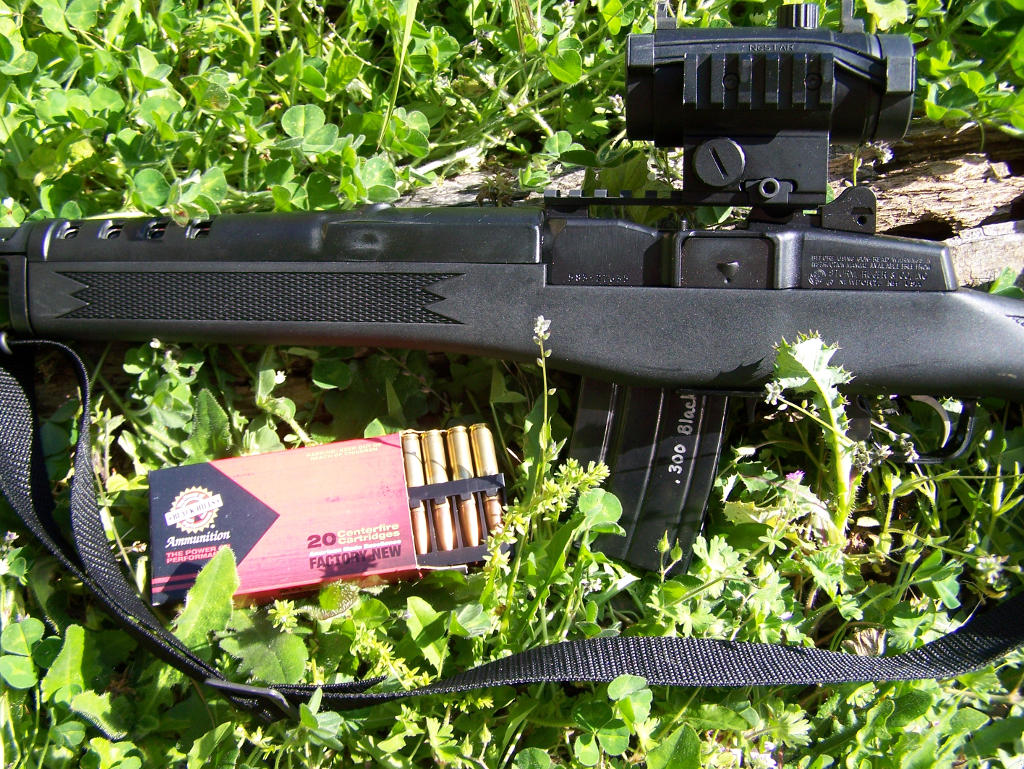
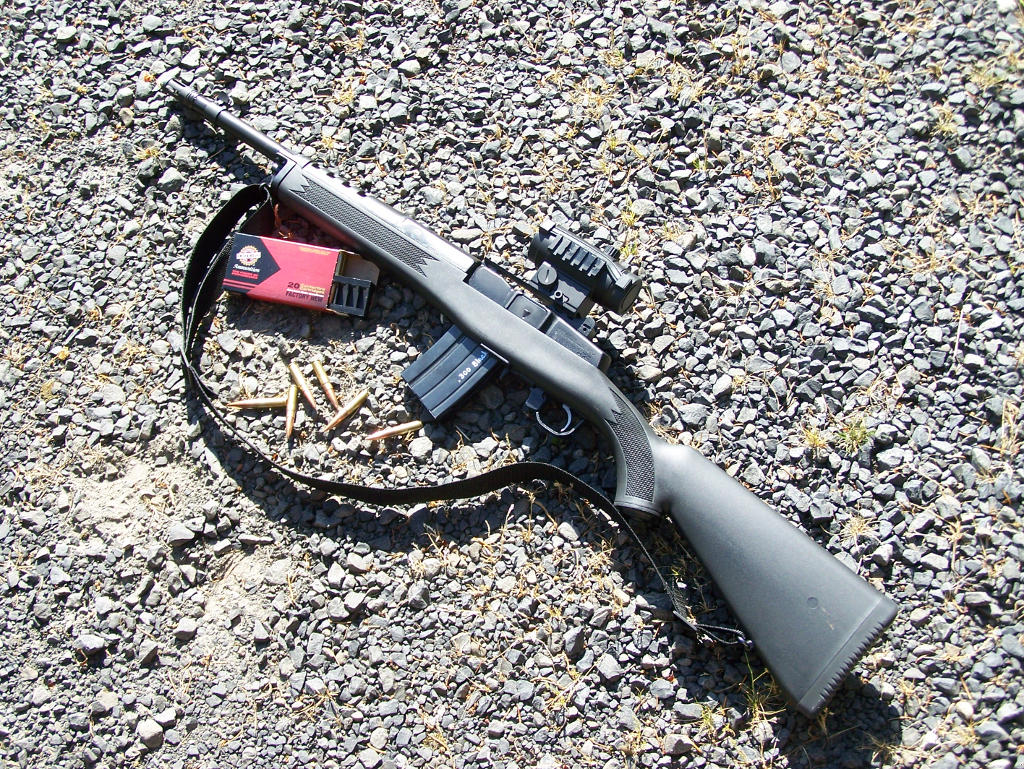
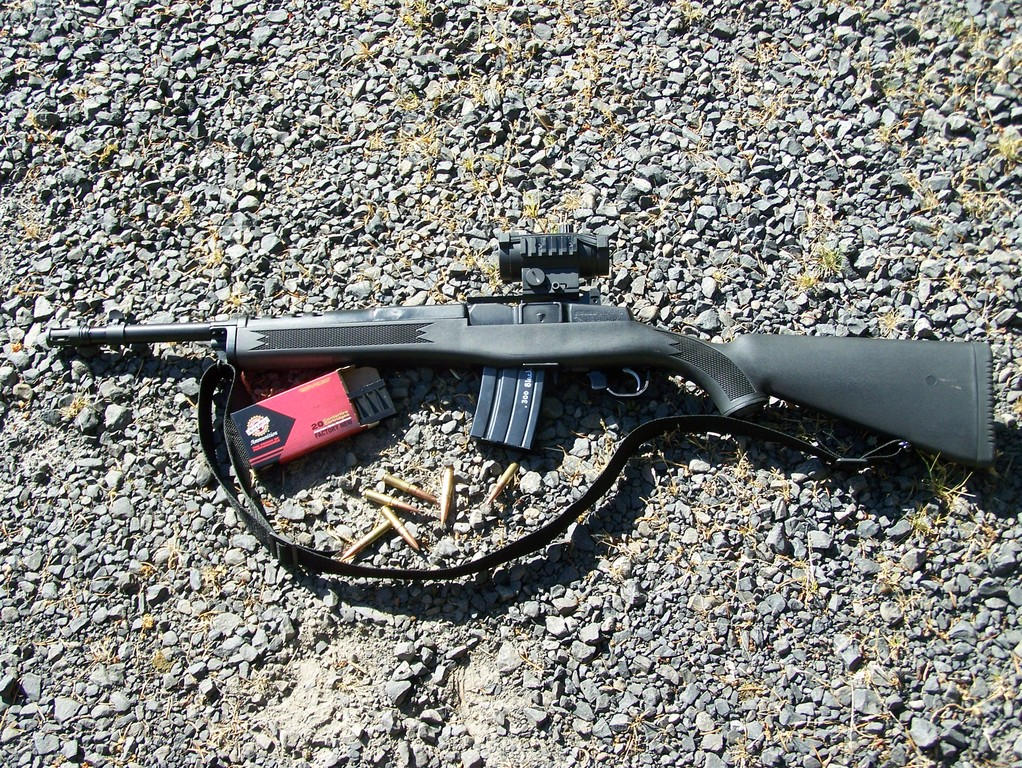
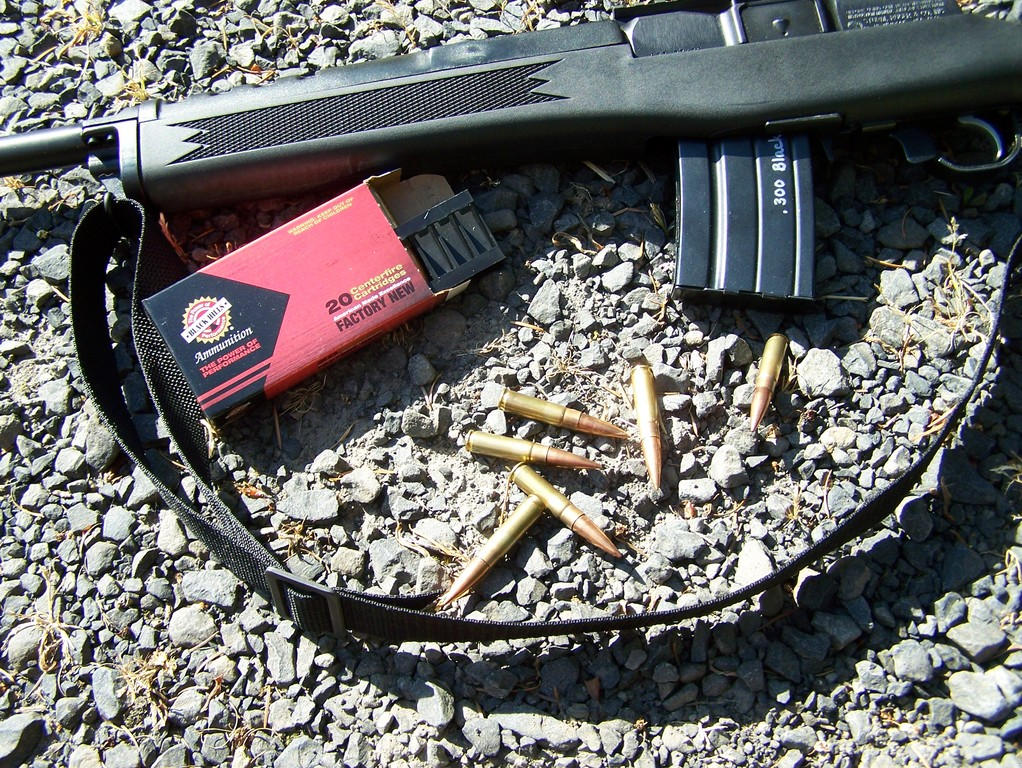
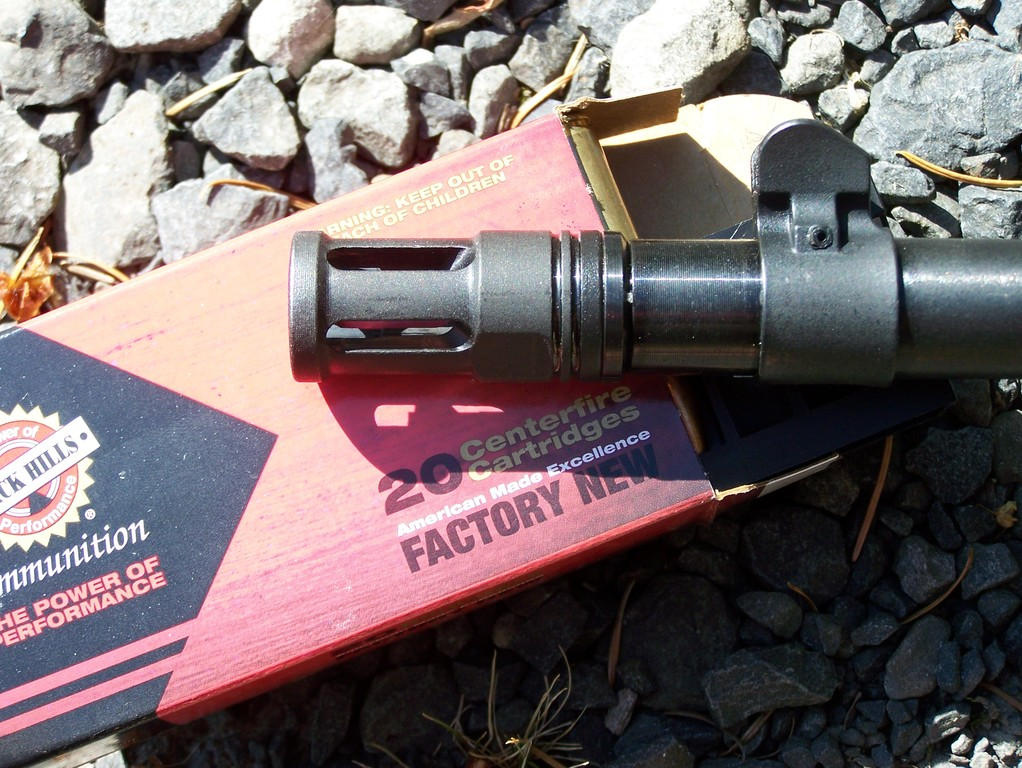
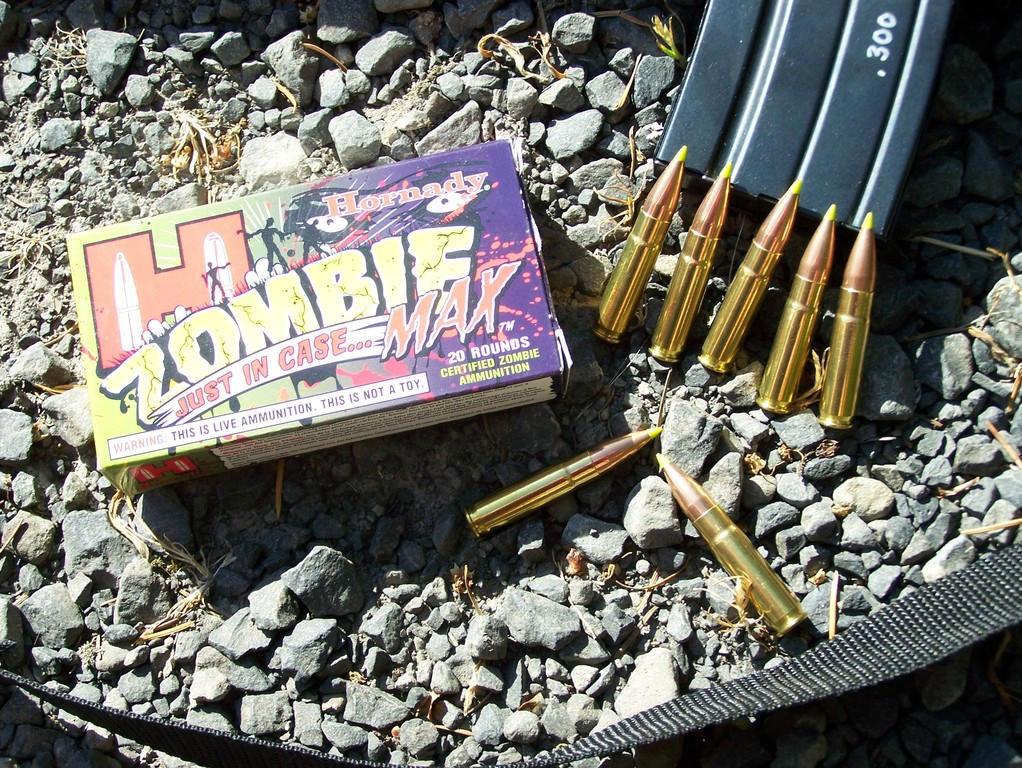
A quick look at the .300 Blackout in the Mini-14 is in order. The gun comes with a black polymer stock with a nice recoil pad on it. It’s not that the recoil pad is needed; the gun doesn’t “kick” that much. The rear sight is adjustable for elevation and windage; the barrel is slightly over 16-inches in length; and needless to say, it is chambered in .300 Blackout. Instead of coming with a 5-rd magazine, like other Mini-14 do, this gun comes with two twenty-round magazines. In the press release, Ruger stated that the mags would be marked as .300 AAC Blackout; however, mine weren’t. The reasoning behind this is that you won’t load any .223/5.56 rounds into this magazine and then mistakenly load the mag into the rifle. It will more than likely chamber the round, and it might even fire it, but it’s a dangerous situation. I marked my two mags with a silver Magic Marker, writing .300 Blackout on both sides, and I purchased some aftermarket 30-rd magazines and did the same thing. The finish on the new Blackout is subdued black. It looks nice and very tactical in appearance. The front blade sight is protected by “wings” on either side of it. Looking through the rear sight, the front sight is nice and crisp for a good sight picture. The gun only weighs 6.75 lbs and has an overall length of 36.25 inches. It handles fast in the hand.

100_5992

By my count, there are at least 16 ammo companies that are making .300 AAC Blackout ammo. However, none was to be found in my neck of the woods. NONE! I called on long-time friend, Jeff Hoffman, who owns and operates Black Hills Ammunition www.black-hills.com with his lovely wife, Kristi. Jeff was able to help me out. Black Hills Ammunition is producing the .300 Whisper round that is almost identical to the .300 AAC Blackout round. The .300 Whisper was developed by J.D. Jones many years ago as a wildcat round that is extremely popular. However, what Advanced Armament Corporation did (they are the AAC in the .300 AAC Blackout nomenclature name) was to ever so slightly change their round and then call it something different. Now, Jeff Hoffman informed me that you can safely fire .300 Whisper in any rifle chambered in .300 AAC Blackout. However, there are reports of some .300 Whisper chambered firearms that won’t safely fire the .300 AAC Blackout round. So be advised, and don’t try to fire .300 AAC Blackout in a gun chambered in .300 Whisper. Jeff Hoffman knows what he’s talking about, and I take anything he has to say about ammunition as gospel.

100_5993

The .300 AAC Blackout round was designed to be fired from rifles in one of two ways. The lighter rounds, that come in around 110-125 grains in weight, are supersonic rounds. The heavier 200+-grain rounds are meant to be fired in the same firearms with a sound suppressor on it. Yes, you can fire the heavier rounds in any .300 AAC Blackout chambered semi-auto; however, without the sound suppressor attached, the action won’t function, and you’ll have a single shot rifle. The idea behind the sub-sonic rounds is specifically for firearms with sound suppressors on ’em for taking out enemy sentries; at least that’s one function of the round. The Ruger Mini-14 .300 Blackout has a birdcage flash suppressor on it that can be removed and a sound suppressor installed. I refuse to jump through the red tape to obtain a sound suppressor! So, my testing was limited to supersonic rounds.

100_5994

Right off the bat, I noticed that this new Mini was dead-on zeroed from the box, for a 300-yard zero. Nice! The ammo from Black Hills is their 125-gr OTM (Open Tip Match) round, again in .300 Whisper. Just for fun and to test function, I managed to “kill” quite a few large rocks downrange at my usual shooting spot. To be sure, the .300 Whisper blew those large rock into little pieces; a .223 round wouldn’t have done the same. The recoil is worth noting. This round recoils slightly more than a .223 does and less than a 7.62X39 does, and it was the brainchild of Advanced Armament Corporation to have a round that closely resembled the AK-47 round 7.62X39 that could be fed from existing .223 magazines without any alterations. They succeeded! Using the factory Ruger magazines and the 30-rd aftermarket mags I bought, there were zero feeding problems.

100_5995

Ruger includes scope rings, as well as a flat-top Picatinny rail for those wanting to install some sort of red dot sight on this rifle. I installed an inexpensive, real inexpensive, red dot sight, and it failed me. After every shot, the red dot sight would turn off. I replaced it with another identical red dot sight, and it wasn’t much better – maybe I could get 2 or 3 rounds fired, before it would shut down. And, I do NOT attribute this to the recoil of the gun/caliber – it is the cheap scopes. However, when I could get the red dot to stay on, I was getting 2-inche groups at 100-yard with this little rifle – I was more than a little impressed, to say the least. I’m searching my office, for a Nikon 3-9X40 scope I have here……some place – so I can really wring the most accuracy out of this new Mini and the .300 Whisper rounds, I still have on-hand, from Black Hills Ammunition.

100_5997

These days, it takes a LOT to impress me, when it comes to knives and firearms – so many are just the same ol’ thing, just dressed up differently. Well, I thought the same of this Mini-14 in .300 AAC Blackout – before I got it. Yeah, there was “something” that drew me to this gun, when I got the press release from Ruger – still don’t know what that “something” was, though. I’m impressed with this new Mini-14 in .300 Blackout!

Near the end of my testing, my local gun shop happened to get in one box of Hornady .300 Whisper “Zombie Max” ammo in 110-gr with a green tip, of course, designed for killing the living dead. This lighter-weight round shot a little bit lower at 100-yards than the 125-gr OTM Black Hills .300 Whisper round did, as you would expect; to be expected, lighter bullets tend to fall faster than heavier ones do. I was getting 3-inch groups, but with more of this ammo I can probably tighten up the groups a bit. Overall, the Black Hills .300 Whisper OTM is the round of choice for my target shooting needs.

100_6001

Still, after shooting this .300 Blackout Mini-14 for several weeks, I’ve yet to run across any actual .300 AAC Blackout ammo in my area. All shooting has been done with .300 Whisper, with the compliments of Black Hills Ammunition. I’m hoping the .300 Blackout round shoots just as nicely and as accurate as the .300 Whisper round does. In the meantime, I’m in the process of requesting some more .300 Whisper ammo from Jeff Hoffman. The problem with this Mini-14 in this caliber is that it is way too much fun to shoot. Since I got this gun sample, I have forsaken my AK-47s and my AR-15s. Sorry guys, but I’ll take you out shooting again soon, I promise!

There’s still “something” about this gun/caliber combo that intrigues me to no end, besides the fun factor. I’m seriously thinking about getting a 5-rd magazine and taking this gun out deer hunting this Fall. All the deer I’ve shot in the past were all shot at well under 150 yards, and out of those most were 100 yards or under. With the proper hunting bullet installed, the .300 AAC Blackout will get the job done. Through my research on this round, I’ve come to the conclusion that this round was designed to take out enemy troops out to 450 yards, which is the same as the .223 round will do, however, the .300 Blackout will do it faster. A heavier bullet will get the job done, and the 125-gr fodder should do it. Of course, if your shooting skills are up to it, you can take out the enemy far beyond 450 yards. Just remember your ballistic tables and bullet drop at longer distances.

All that’s left to do is for me to get my hands on some .300 AAC Blackout ammo, or lacking that, a good supply of .300 Whisper ammo. For any semiauto center-fire rifles meant for self defense or going into a SHTF scenario, I demand no less than 1,000-rds for each gun in that caliber. So, I have my work cut out for me, because .300 Blackout ammo isn’t cheap. I’ve checked online and the same is true for .300 Whisper ammo. However, I’ll start building up my .300 Blackout/Whisper ammo supply just as soon as I’m done with a little more fun shooting with this sample. Then I’ll have to raise the funds to purchase this sample, because it is NOT going back to Ruger. It has found a new home. So, if you’re in the market for something with a little more “umph” than the .223, and you don’t really like an AK (for some reason) take a close look at the new Mini-14 in .300 AAC Blackout. Full-bolt retail is slightly over $1,000. However, checking gun broker, I’m seeing them for sale for slightly more than $700. That’s a bargain in my book for such an outstanding shooter in a hard-hitting caliber. I got mine; you get yours!

– Senior Product Review Editor, Pat Cascio


Recipe of the Week: Salmon ‘Souffle’, by JVB

My uncle likes his little luxuries, even when we’re eating LTS food. Here’s one of his favorites.

Ingredients:

  • 1 14-oz can salmon
  • 1 can condensed mushroom soup
  • 1/2 cup powdered cheese
  • 6 Tbsp powdered eggs
  • 1 cup water
  • 1/4 tsp pepper (optional)
  • 1/2 tsp onion powder (optional)

Directions:

  1. Drain and flake salmon in casserole dish.
  2. Add mushroom soup; mix with spoon.
  3. Alternate powdered cheese along with half the water while mixing.
  4. Alternate powdered eggs, along with the rest of the water while mixing.
  5. Add spices, mix.
  6. Cover and bake at 350F until firm, approx 30-40 minutes.

Makes about four servings.

o o o

Do you have a favorite recipe that would be of interest to SurvivalBlog readers? Please send it via e-mail. Thanks!


Letter: The Noose is Tightening

HJL,

Report from Maryland: I went to the bank today to make a deposit (two medical insurance reimbursement checks). I was informed that I had to show my drivers license or passport to make a deposit. (Up until now ID had to be provided only for withdrawals.)

Then, the teller told me I needed to provide personal information:

  • name of employer,
  • annual salary,
  • citizenship of another country or dual citizenship,
  • foreign bank account holdings, and
  • because it is a joint account, I was told to provide the same for my spouse.

I’ll let you and others imagine my response.

I asked the teller if she worked for TSA. “No,” she said, “but these are new government requirements based on a new law.” I told her I had been a customer of that bank for 35 years and asked why now do they need to know everything about me? – M.B.


Economics and Investing:

How Long Can OPEC Maintain Its Current Strategy?

o o o

Here’s a sad statistic from a Georgia think tank—Georgia Public Policy foundation:

Cost of government: Federal regulation and intervention cost American consumers and businesses an estimated $1.88 trillion in 2014 in lost economic productivity and higher prices, according to “Ten Thousand Commandments,” by the Competitive Enterprise Institute. If U.S. federal regulation was a country, it would be the world’s 10th largest economy, ranking behind Russia and ahead of India. Given that our total national economy is somewhere in the $18 trillion range (GDP was listed as $16.7 trillion in 2013), government regulation adds 10% to the cost of all goods and services produced in the country. You can read the article “Ten Thousand Commandments” at Cost Of Government Regulation And Intervention – D.R.

o o o

Video: US Economy Worse Than Originally Thought, US Government Readies For A National Crisis – Episode 679. – J.C.

o o o

FATCA New Currency Law Could Be Devastating for Anyone Holding U.S. Dollars


Odds ‘n Sods:

The fine folks at the Paratus Familia blog have posted a very useful piece about U.S. military surplus GP Medium tents.

o o o

Administration preps new gun regulations. – G.G.

o o o

The working class Hunger Games – Reality TV show now pits working class against working class family for the chance to earn $101,000 for a mostly affluent audience.

o o o

Lest you think the Fox Network isn’t part of the problem: Lucifer Makes Prime Time – M.R.

o o o

And even more about the moral decline of of our society – When The “Sharing” Economy Goes Too Far: Syphillis Cases Soar 79% In A Year. – H.L.


Notes for Sunday – May 31, 2015

May 31st, 1895 was the birthday of George R. Stewart. Prior to his death on August 22, 1980, he was a novelist, university professor, and toponymist. In the preparedness community, he is best remembered as the author of the classic post-pandemic novel Earth Abides.

o o o

Our friends Frank and Fern have just celebrated the second anniversary of their blog. It is packed with a lot of great information and some sage homesteading advice. If you have not yet visited, then be sure to check it out! – JWR


Street Combat – This Ain’t No Game! – Part 8 of 9, by Pat Cascio

Chapter Six

Carjacking

Carjacking has become such a serious and violent crime that I decided to include an entire chapter on this all-important topic. In the past if someone wanted to steal your car for a joy ride or to use it in the commission of a crime, they did so at night while you slept. Or for that matter, they would steal your unattended car from a mall parking lot, while you shopped inside. Things have changed! People are now being seriously injured and sometimes killed by carjackers.

In the blink of an eye, it could happen in your own driveway! Most carjackings happen in as little as 15 seconds. That 15 second timeframe is from start to finish!

While carjackings represent only two percent of the vehicles stolen, about 35,000 carjackings occur annually. FBI records show that in 52% of the carjackings, the offender succeeded in stealing the victim’s motor vehicle. Carjacking is now a federal crime– a felony.

FBI Reports

The FBI has recently released some interesting facts about carjackers. First of all, the carjacker is usually armed (77% percent of the time). Fifteen large metropolitan areas account for 90% of all carjackings. Most carjackings occur between 8:00pm and 11:00pm, and nearly half of all carjackings happen on Friday, Saturday, and Sunday. More carjackings occur in December (27%) than any other month. Parking lots are the favorite areas for carjackers, followed by city streets, residential driveways, car dealerships, and gas stations.

Another interesting statistic that the FBI reports is that the primary motive for carjacking is to secure transportation after robbing the driver or to obtain transportation to commit a crime. Carjackers are real scum-of-the-earth, to be sure.

Carjacking Methods

There are several different carjacking scenarios. Carjackers can attack a motorist at a traffic light, gas station, parking lot, or any other area where a driver stops or exits their vehicle, even fast food drive-thrus. Carjacking gangs often employ the old “bump and run” techniques in which the thieves in one car pull up behind an unsuspecting driver and bumps their car. When the driver gets out to inspect the damage, the thieves forcibly take control of the situation and the car.

DOJ Report

The U.S. Dept. of Justice released a survey in March 1994, NCJ-147002, that gives us further information on this fast-growing type of crime. Each year on average between 1987 and 1992, .2 per 1,000 Americans age 12 or older (or 2 per 10,000) were victims of a completed or attempted carjacking.

Here’s some information that I found of interest. Men were more likely than women (.3 per 1,000 compared to .1 per 1,000) and blacks were more likely than whites (.4 and .2 respectively) to be victimized by carjacking. Persons age 35 or older were less likely than younger people to become carjacking victims. I would have bet good money that women would have placed higher in the “victim” category. I wonder if the U.S. Department of Justice is being honest with us on this one.

Of the 77% of carjackers who were armed, handguns were the most commonly used weapon in the completed offenses but not in the attempts. It sure sounds like the serious carjackers favor firearms in the commission of their crime. The DOJ breaks this down as follows: offenders were armed with handguns in 59% of the completed carjackings and 17% of the attempted carjackings.

Carjacker Profile

Another statistic worth noting is that the typical carjacking offender’s age was between 21 and 29. About half of the completed carjackings were committed by offenders in this age group. An additional 12% were committed by offenders 18-20 years of age.

About half (54%) of all completed or attempted carjackings were committed by groups of two or more offenders, so you have a pretty good chance of facing more than one offender should an attempt be made to carjack your vehicle! A prepared and aware motorist might be able to defend himself from a lone unarmed carjacker, but the odds are against you if there are multiple carjackers who are armed.

The DOJ report states, “Carjacking, a type of robbery, is theft or attempted theft of a motor vehicle by force or threat of force.” This sounds pretty serious to me, and it is! In 24% of the completed and attempted carjackings, the victims were injured. Four percent of all victims of attempted or completed carjackings suffered a serious injury, such as gunshot or knife wounds, broken bones, loss of teeth, internal injuries, loss of consciousness, or “undetermined” injuries requiring two or more days of hospitalization. On top of the loss of your car, you can expect a day in the hospital to run you approximately $1,000. Unfortunately, the DOJ report doesn’t give any statistics regarding actual deaths of motorists at the hands of carjackers. I find this omission strange, to say the least. Why did the DOJ leave this statistic out of their report?

Okay, now that I’ve made you aware of the seriousness of carjackings and probably scared the bejabbers out of you, what can you do to defend yourself against a carjacking?

Carjacking Defense

First of all, keep all your doors locked in your vehicle, even if you’re only driving down the street to the local 7-Eleven. Secondly, when you’re at the gas station, turn off your car, no matter what, whether you pay at the pump or pay inside. Third, always be aware of your surroundings. (Remember to exercise mental awareness.) As you approach your vehicle, glance underneath it to check for danger. Also, before you open your car door check the back seat for anyone who might have gotten in and be “hiding.” Fourth, install an anti-theft device that has a “panic” button that you can activate if you sense trouble. Fifth, drive in the center lane (if possible) when on highways; this reduces your chances of becoming a “bump and run” theft victim. Sixth, seek out a good, unarmed self-defense instructor, and take your training seriously. Lastly, if confronted with a carjacker(s) who is armed and intent on using deadly force against you, use your legally-concealed handgun to fend off the attack.

Firearms Training

All this brings us to the use of point shooting to defend yourself if attacked while in or near your vehicle. I know this will sure raise a “red flag” of the aimed shooting proponents, but please hear me out on this subject before you criticize my logic.

First of all, I want to stress the importance of being a well-rounded combat shooter. You MUST be trained in both aimed and point firing techniques. I believe it’s important to ALWAYS use aimed fire when you have the time, distance, light, and so forth. Unfortunately, you probably won’t have these luxuries at the hands of carjackers. As reported by the DOJ, most carjackings are over in less than 15 seconds. This hardly gives you time to react, draw your weapon, aim, and fire, and do all of this from the driver’s seat of your vehicle.

My friend and associate, John McSweeney, teaches a point shooting technique I have dubbed the “Swing”. John and I have honest differing opinions on some subjects, and our teaching techniques are somewhat different. However, when it comes to employing the “Swing” in carjacking defense, we are in 100% agreement!

I’m a “disciple” of the legendary Col. Rex Applegate. Much (not all) of what I teach in my point shooting classes is based upon the real-life combat, proven, methods of point shooting developed by Captains Sykes and Fairbairn. However, Applegate further refined Fairbairn’s and Sykes’ techniques over the years, so much so that in my humble opinion Applegate is the true father of real-life combat (handgun) techniques.

John McSweeney also teaches some of Applegate’s point shooting techniques in his handgun classes. Where McSweeney’s system differs from Applegate’s is with McSweeney’s use of the “Swing.” McSweeney has studied distances involved in law enforcement officers being killed/assaulted. The FBI report on this subject (1992) concludes that five feet (and less) were the distances involved in 367 officers being killed/assaulted. Another 127 law enforcement officers were involved in deadly confrontations from 6-10 feet, 77 officers were involved in a deadly confrontation of 11-20 feet, and only 79 officers had a deadly confrontation at 20 plus feet.

Therefore, McSweeney concludes that the greatest number of shootings (367) of police officers took place at five feet or LESS! The circumstances of a typical gunfight (if there is such a thing) involves three things:

  1. close range,
  2. low light, and
  3. extreme stress.

As we have seen by the DOJ report, carjackings pretty much fit the above three conditions.

No matter what I may write, there simply will be those opponents of point shooting who refuse to be swayed by the facts involved in real-life handgun combat. McSweeney relayed a real-life story to me about one of his point shooting students. A security officer in Chicago, IL was working as a bouncer in a bar on the near north side. Earlier that evening this bouncer had bounced four Mexicans out of the bar. (The bouncer was of Mexican descent as well.)

The bouncer was followed home by the above four individuals. As he (the bouncer) got out of his car, they surrounded him. The bouncer was legally armed. All four attackers had knives, which they thrust at the bouncer. He drew his 9mm Glock and fired three rounds in point shooting fashion– McSweeney’s “Swing”. He swung from one to the other. He hit three of the assailants in the gut; the range was two yards (6 feet)! The fourth assailant knifed the bouncer in the back, just missing his heart. The bouncer told McSweeney that he had no time to aim; he simply drew his 9mm and fired, hitting three assailants before being knifed in the back. Fortunately, the bouncer’s wife heard the commotion and called the police. The fourth assailant fled the scene but was captured later. All four assailants were arrested and sent to jail.

McSweeney does comment about Applegate’s method of point shooting in Applegate’s book Kill Or Get Killed. McSweeney claims that Applegate says if you “swing” this causes you to shoot before or after the target. McSweeney’s method calls for you to “swing” on to the target, then stop, then fire. The process is:

  • swing,
  • stop, and then
  • fire”.

This is a mite slower than firing while you swing, but it’s 100% more accurate, according to McSweeney. I’ve tried swinging and then firing; it doesn’t work, just like Applegate said. I’ve also tried swinging, stopping, and then firing. McSweeney’s method works!

At first, it would appear that Applegate and McSweeney are at odds, when it comes to “swinging” in their point shooting methods. Such is not the case! Applegate states in Kill Or Get Killed that “you can’t swing and shoot.” He’s right! McSweeney states that you can swing, stop, and then shoot. He’s right!

Testing the Facts

Now, I have a little test for all you proponents of aimed shooting (only). Get into the driver’s side seat of your vehicle, and let’s assume you’re sitting at a stoplight. A carjacker approaches with a weapon in hand; he’s intent on using deadly force to relieve you of your vehicle. Now, draw your handgun and attempt to aim it and fire. It’s pretty difficult, isn’t it? The range is probably no more than two or three feet. Any attempt to stick your handgun out the window to aim and it will more than likely be met with the carjacker taking control of your handgun.

Now, let’s suppose that you are faced with two carjackers (read the statistics). Both are armed; one approaches from the driver’s side window, and the other approaches from the passenger side window. Draw your handgun, aim, and fire first at one carjacker and then the other. It’s probably impossible or at the very least extremely difficult, isn’t it? Again, the range will probably be just two or three feet on the driver’s side and no more than four or five feet on the passenger’s side.

McSweeney also related a story to me about two shoplifters in Plantation, FL. A parking lot security patrol officer, with his gun in hand, attempted to grab one of the suspects, who was armed. The bad guy falls on his back, draws, and fires four shots at the security officer and hits him with all four shots. The bad guy was only doing what came naturally– pointing and firing. What was the range involved? It was probably no more than three or four feet!

I don’t know how many times I’ve read the proponents of aimed fire-only claim that point shooting takes many hours to learn and is difficult to retain. To them, I say “nonsense!” McSweeney, Applegate, Brad Steiner, myself, and other point shooting instructors have found that you can train a person on a one-to-one basis in point shooting in a mere hour or two. A class of 10-12 students can be trained in point shooting in four to six hours. Plus, contrary to what many aimed shooting-only proponents claim, point shooting doesn’t require a great deal of practice on the range in order to retain the skills you learned. When faced with multiple attackers at very close range– 10 feet or less– it’s tough to beat McSweeney’s method of “swinging” from one assailant to the next.

When faced with up-in-your-face ranges of two or three feet at a stoplight in heavy traffic, the McSweeney “Swing” is the best method to use.

It would be nice if we could have our gun in-hand and have plenty of time, light, and distance to enable us to aim shoot. Unfortunately, real-life scenarios don’t provide for this.

Having deployed point shooting techniques myself, I can attest to the close range(s) involved, the low light, and the extreme stress. Under extreme stress, your fine motor skills (like aiming) a gun go out the window.

I’m sure the proponents of aimed fire-only will disagree with the Applegate method of point shooting or McSweeney’s “Swing.” I’ll not attempt to confuse them with the facts, as reported by the DOJ and the FBI. However, for me, I’ll be sure to be “Swinging” if I’m unlucky enough to be a victim of a carjacker who is intent on using deadly force against me.

I must stress that the information related to you in this article that was gleaned from the DOJ is a bit dated; it is from March 1994. If what I’m seeing on tv and reading in the newspapers is any indication of the current trend, carjackings are on the increase.

Your Best Defense

Your best defense is a good offense. Be alert and aware of your surroundings at all times. Make every effort to stay out of the “bad” part of town, especially at night. Use your “sixth” sense; if something doesn’t feel or look “right”, it probably isn’t, so get out of the area as quickly as possible. Keep your car doors locked at ALL times. If you have air conditioning, use it in the summertime, and keep your windows rolled up.

Remember, this is Street Combat – This Ain’t No Game!


May In Precious Metals, by Steven Cochran of Gainesville Coins

Welcome to SurvivalBlog’s Precious Metals Month in Review, where we take a look at “the month that was” in precious metals. Each month, we cover the price action of gold and examine the “what” and “why” behind those numbers.

May was a dance between gold and the greenback, as the two fell back into a negative correlation. Gold traded in a tight range between $1185 and $1195 for the first part of the month, before a weakening dollar helped both gold and silver rally to a three-month high. The dollar hit a four-month low on May 15, then rallied into the end of the month, putting pressure on commodities. Even though the dollar was gaining strength from a euro that was weakened by quantitative easing from the European Central Bank, gold fought hard and kept the $1206 support level for days. When that broke and prices fell under $1200, the $1186 support level proved resilient.

Precious Metals Market Drivers in May

(Still) Greece

The socialist government in Greece, determined not to give up its pledge to rescue the welfare state, continued its attempts to extort more bailout funds from the rest of the EU. However, their brinkmanship has destroyed much of the sympathy they formerly had from other nations. German Chancellor Angela Merkel has faced growing opposition to sending the Greeks more German taxpayer money in yet another bailout, especially one that does not live up to the previously agreed-to provisions of the last bailout. Even members of Merkel’s own party are threatening to break ranks and would rather see Greece leave the EU than to pour more money down that hole.

One prominent opponent to letting Greece renege on its bailout conditions is the influential German Finance Minister, Wolfgang Schaeuble. Schaeuble turned the Greeks’ threat to hold a referendum about accepting a bailout back against them, saying that perhaps the Greek public should vote on whether to continue under the established bailout rules or not. In a Dirty Harry “make my day” move, he has also publicly said it would be prudent for the leftist government in Athens to prepare a form of scrip (IOUs) to pay domestic bills with, if they can’t agree to terms with creditors.

Greek citizens aren’t showing much faith in their leaders, as they continue to pull billions of dollars worth of deposits out of the banking system to keep the government from seizing it. Much like the Germans during the Weimar Republic did in the 1920s, they are buying hard assets, such as gold and durable goods like cars, in case the country exits the EU and introduces a greatly devalued drachma as the new national currency.

Although the almost complete lack of cash forced prime minister Tsipras to go back on a major campaign promise and stop blocking the sale of Greece’s largest shipping port (which had been started by the previous administration,) he drew the line at reforming Greece’s bloated welfare state and government.

Things came to a head, when the Greek government used its emergency funds at the IMF to pay its bill to… the IMF. This prompted the IMF to begin work on implementing “The Cyprus Plan” on Greece, where the banks would be shut down and deposits over the insured amount seized er “exchanged for bonds in reconstructed banks” in order to recapitalize the Greek financial sector. This caused gold to spike to a three-month high and silver to jump close to a four-month high.

The Greek Interior Minister, who has no say in economic policy but is used by the leftist government to scare EU creditors, announced on May 24 that the government would not be making any more IMF loan payments without a new bailout being approved. It was learned that the previous weekend the ruling council of the governing Syriza Party had voted on pre-emptively defaulting on the nation’s debts. The final vote was 95 against, 75 for, meaning only 11 more delegates would have to change their vote next time it comes up (and it WILL come up again), for Greece to self-destruct.

Despite the fact that Greece has plummeted back into recession under the leftist Syriza Party after the economy had started growing again under the previous administration, other socialists and anti-austerity parties have been gaining ground in southern Europe. The Socialist Party of Portugal has announced that it will reverse austerity policies there if elected this fall, and the Podemos Party in Spain, often called “the Spanish Syriza,” made gains in recent elections, helped by serial political corruption scandals in the ruling party.

David Stockman, in his “Contra Corner,” gives us a look at what happens when a nation lives beyond its means until the entire system collapses, in this article on the hardships suffered by everyday people in Greece.

Start Of The Market Collapse?

The global bond market suffered a meltdown in early May and dragged the stock market down with it. Liquidity is disappearing as the “big boys” get out of the market, taking their profits while the mom and pop investors keep piling in. More than $450 billion in the bond market was wiped out, as investors found out that the “sure thing” of deflation and falling oil prices wasn’t as certain as they’d thought. Even without the Fed raising interest rates, signs of inflation heating up are already appearing. The high prices, negative yields, and high volatility of the bond market has changed bonds from being “risk-free returns” to “return-free risks.

Older, wiser heads are warning that the stock market’s days are numbered, too. Stock prices are now 10% higher than the entire worth of all the companies. You could sell all the stocks, take the money and buy everything every company owns, down to the staplers in the offices, and still have billions of dollars left over. That doesn’t sound like a rational stock market to me, and more people are taking notice. This is why Bank of America is telling its clients that the markets are in a Twilight Zone, and they need to reduce exposure to stocks and bonds and stock up on cash and gold before it’s too late. ScotiaMocatta notes in turn that gold is a cheap safe haven right now and says a strong upside surprise may be in the cards.

Jim Rickards says that Warren Buffett already sees a Weimar-style hyperinflation scenario building, and you can tell it from what he’s investing in.

Middle East

We are perhaps closer to a nuclear war in the Middle East than we have ever been, and we’re getting closer. In addition to Israel’s nuke arsenal, Iran’s efforts to build The Bomb has prodded the Wahabbi royalty of Saudi Arabia to go public with plans to counter Iran with an atomic bomb that they will buy “off the shelf” from Pakistan. Saudi foreign aid is the only reason the Pakistani government hasn’t collapsed from its debts, and Islamabad will be more than happy to provide the protectors of Mecca with a turn-key solution to counter the Shiite threat of Iran.

Emphasizing both the betrayal the Kingdom feels has been perpetuated by Obama and the extremist views of the royalty, the Saudi King refused Obama’s invitation to a summit of Persian Gulf leaders and instead met with the most fanatic Muslim clerics of the kingdom.

The Saudi-led coalition of Sunni monarchies continues conducting airstrikes in Yemen, where they say Iran is supplying the Shiite insurgency that has forced the government into exile. Fighting along the border between Saudi Arabia and Yemen emphasize the danger to the oilfields of the world’s largest oil producer, especially since the richest oilfields are in areas that have a sizable Shiite population.

Speaking of extremists, the terrorist army ISIS has conquered Ramadi, the capital of Anbar province in Iraq. The Iraqi army, which outnumbered the Sunni terrorists, fled in terror instead of fighting, leaving hundreds of vehicles (including at least ten fully-functional M1A1 Abrams tanks) for ISIS to capture. Since many former Iraqi army soldiers from the Saddam era are now in ISIS, they have the crews to use these tanks against Baghdad. The only effective force the government has to counter ISIS are the various Shiite militias, including the Al-Sadr Brigade, which killed hundreds of U.S. soldiers during the American occupation of Iraq. These men hate the U.S. as much as they hate ISIS, and their prime goal is to extend Shiite hegemony (and Iranian influence).

To follow up on the stunning victory in Ramadi, ISIS took the last of three border crossings between Syria and Iraq from the Syrian army, and now they have a clear highway linking their holdings in eastern Syria and Anbar province in Iraq. Of the three border crossings between Iraq and Syria, ISIS controls two, and the Syrian Kurds control the northern-most one.

The Salafist terror group has also conquered the ancient Syrian city of Palmyra, whose historic ancient ruins the jihadists have sworn to destroy. (This is only partially true. In order to raise money, they video the large buildings being destroyed, then sell the smaller antiquities on the black market after the videos have increased demand for surviving relics.)

ISIS’s next target may be breaking the government siege of rebel-held areas near Damascus, thereby winning the starving people there to their side in the final fight for Syria.

On The Retail Front

German demand for physical gold jumped 20% in the first quarter of 2015, as neither a Greek default nor more German taxpayer money being given to them were particularly appealing.

The Perth Mint bullion blog has posted a handy guide to spotting fake Perth Mint Gold Bars and cautions against buying precious metals on eBay. (Gainesville Coins is an authorized Perth Mint distributor.)

The Royal Canadian Mint, which releases reports on a three-month lag, has reported that silver demand held steady in 2014, and the Mint recorded the second-highest profit in history.

Market Buzz

Speaking of Canadians and silver, the Motley Fool says that “Silver is shaping up to be the precious metals deal of the decade.

This report says that we may have seen “Peak Silver” in mining supply. There’s simply not been enough exploration to find enough new deposits to replace the existing silver mines that are running empty. Unfortunately, the new deposits that are being discovered are not nearly as large as the ones that are running dry.

MarketWatch’s commodities reporter notes that the frenetic pace of stimulus measures in China could mean a 40% spike in silver prices by the end of the year.

On the subject of China and precious metals prices, Jeff Clark at Casey Research thinks we will see the next gold bull market start before October, since the IMF may require China to reveal its gold reserves before deciding in October whether to include the yuan as a reserve currency or not. If it is added to the SDR basket, then the U.S. dollar, euro, and Japanese yen will have to give up some of their weighting. It looks like the demise of the dollar as the world’s most important currency is continuing.

The Financial Times notes that the power in setting the global gold price is moving from London to Shanghai as liquidity in the West dries up.

The World Gold Council reports that the first quarter of 2015 was the 17th consecutive quarter of net central bank gold purchases, and Russia added 30.5 metric tonnes of gold to its reserves in March (the latest date for which figures are available).

Austria’s central bank has announced that it is repatriating 140 tonnes of gold from England. This will bring the amount of Austrian gold reserves at the Bank of England from 80% to 30% (224 tonnes to 84 tonnes). Austrian gold held at home will rise from 17% to 50%, and the amount held in Switzerland will rise from 7% to 20%.

Austria has company; Texas is building its own state bullion depository in order to repatriate its gold from New York.

Jim Rickards thinks that central banks will need bailouts themselves in the not-so-distant future, causing the public to make a run on gold.

Looking Ahead

Janet Yellen is saying to prepare for an interest rate hike before the end of the year. While we really don’t think it will happen in June, watch the “good news is bad news” meme whipsaw both the stock and bond markets, especially since so many of the big players are taking profits and heading to the sidelines. This is going to mean less liquidity, which means large orders are going to move the market prices much more than normal.

Of course, the Greek crisis is supposed to come to a head in a couple of weeks, but that’s what we’ve been told for months. If the socialist government messes up and pushes Germany too hard, they may find themselves out of the EU and sinking near to third-world status with no one willing to lend them money (except possibly Russia). It remains to be seen if the Arab monarchies are going to do something about ISIS before it’s too late, and Iran is likely to keep pushing the Sunni kingdoms as hard as they dare.

In closing, it’s sobering to look at this chart from the Washington Post and realize that many of our children have never lived in a world where their nation was not at war: Here’s How Much of Your Life the United States Has Been At War.

– Steven Cochran is the Content Manager/Editor for Gainsville Coins


Letter Re: Surviving Science

HJL,

Your surviving science log reminded me of a high school chemistry class experience. The year before had been physics. That class I aced with no problems. (I had lots of garage experience with levers and such.)

However, chemistry was something I couldn’t get my brain “wrapped around”.

In chem class we had the typical of the times (1959 to 1961) chem class desks that included flasks of hydrochloric acid, nitric acid, sulfuric acid, and some glycerin for lubricating the glass tubes for going through the rubber stoppers used in various experiments.

We had desk partners; mine was a typical girl (sorry) who memorialized the week’s chapter and vomited back the answers on the Friday test. (There was no association of the subject with the real world.) I, on the other hand was always asking myself, “Can I use this somehow?”

Later in the year, (remember that for later), I came across a formula in the text book that was only half there. That irked me. I thought I should remember the rest of the formula. (I do have a good memory, even for stuff I don’t care about.) I paged back through the previous chapters until I found what I was looking for. The first half of the complete formula for nitroglycerin!

I wrote out the complete formula, checked it against the rules, and put it in my text book.

The next “lab period” I started in. My lab partner had no idea what I was doing. I told her to just look like I was copying her. However, as the teacher came around, he noticed something was amiss. He looked over what I had spread across the desk, asked to look through my text book, found my scribbled formula, looked at my desk partner and asked “What is he doing?“ She got the classic deer in the headlights look and shrugged her shoulders. He looked at me and said, “Pour it out the window.” (By now it was spring, and we had the windows of the classroom open. There was a bush row under the downstairs classroom windows.)

The teacher said to me, “You were on your way for a “D” in this class. You just earned a “C”. Do not turn in any more weekly tests. I do not want papers showing that you do not deserve a “C”. I thought “I can do that.”

The lesson to be learned? Even “book learning” can have a practical side. – K.S.