Lately it’s becoming quite clear that the global financial system has passed the point of no return and is essentially doomed. My question now is, when the system begins its meltdown, those who will be able to get their money out before it’s all lost will no doubt be putting that money into hard assets as fast as they can. This of course will cause gold and silver to skyrocket. So here’s the question, should I sell my gold and silver at these fantastically high prices and receive a lot of paper money, which may become worthless due to hyperinflation, or illegal to keep as cash, or risky to put in a bank? Or do I sell half of the silver and gold and try to buy other hard assets while prices still are reasonable?
It is hard to find sound and honest financial advice in these upside-down, whacked out financial times, so I turn to SurvivalBlog, where I know I will get a straight story. – TWT
HJL Responds: In a time of economic upheaval, obtaining equipment, parts, spares, and supplies will most likely be exceedingly difficult, so the basics need to be covered first. If you have PMs but you do not have food, life will get expensive in a hurry because you cannot eat PMs. Traditionally, PMs do not fare very well during the economic upheaval because an established barter market does not generally exist and people have difficulty in shifting their thinking from valuing things in fiat dollars to whatever the market wants. Your comment about selling for “fantastically high prices” is an example of the difficulty in transitioning how we value things and we all have this difficulty. PMs do work very well for holding value through the economic upheaval until the market is somewhat stabilized though. Understand that if the established market is a grey or black market, PMs will generally hold less value if you use them than would a commodity that is in demand at the time. For this reason, the standard advice is to make sure the Beans, Bullets, and Band-aids are taken care of first. Then make sure any tangible assets that could be required are dealt with (tractor, spare parts, tools). Consider debt relief, then start thinking about storing value in PMs for the other side of a crises. Anytime you can deal directly with a commodity that is in demand rather than PMs, your position will improve. Consider fiat money only as required to deal with obligations that have no other way to satisfy them. If you already hold PMs and do not have the basics covered or debt relieved, consider selling the PMs now and taking care of those issues.
If cash becomes illegal, there will be an alternative market that picks up, but your ability to transition from the regulated market to the alternative market will be controlled by your debt to the financial institutions and the taxes collected by whatever government is in place. Obviously, the less stake you have in either of those two institutions, the more freedom you have in your own financial affairs.
#1 Trusted Gravity Water Purification System! Start Drinking Purified Water now with a Berkey water filtration system. Find systems, replacement filters, parts and more here.
There might be no saving the world’s top banana Another reason why it is critical that people continue to plant non-GMO heirloom seeds of all kinds to add variety to food sources. Having only one viable strain (in this case shippable) risks doing without someday. Corporations, such as Monsanto and others, have moved towards just a FEW GMO varieties and use heavy-handed tactics to “force” farmers, even in third-world countries to use ONLY their seeds and sell Roundup, which is toxic. – H.L.
o o o
An update to an earlier story: Comments disabled/censored at “Letter to stingy American consumers”. I went back to re-read comments between yesterday and tonight; I noticed this articled was disabled from receiving more comments. Also of note is that at least two dozen comments have been removed, which had no offensive profanity, but all the missing comments made reference to some combination of pitchforks, boiled rope or guillotines. – formerly middle class America
FOR SALE: Self-sustaining Rural Property situated meticulously in serene locales distant from densely populated sanctuary cities. Remember…HISTORY Favors the PREPARED!
“And it came to pass, when the ark set forward, that Moses said, Rise up, Lord, and let thine enemies be scattered; and let them that hate thee flee before thee. And when it rested, he said, Return, O Lord, unto the many thousands of Israel.” Numbers 10:35-36 (KJV)
Find your secure and sustainable home. The leading marketplace for rural, remote, and off-grid properties worldwide. Affordable ads. No commissions are charged!
Every bespoke SIEGE buckle goes through an hours-long artisanal process resulting in a belt unlike anything else, with blazing fast performance and looks and comfort to match.
Don’t get MAD; Get Prepped! The road warrior bounty sale is still going on at Safecastle with discounts of up to 41% on Mountain House products and lots of added bonuses.
A Gunsite Academy Three Day Course Certificate, good for any one, two, or three course (a $1,195 value),
A course certificate from onPoint Tactical. This certificate will be for the prize winner’s choice of three-day civilian courses. (Excluding those restricted for military or government teams.) Three day onPoint courses normally cost $795,
DRD Tactical is providing a 5.56 NATO QD Billet upper with a hammer forged, chromlined barrel and a hard case to go with your own AR lower. It will allow any standard AR type rifle to have quick change barrel, which can be assembled in less than one minute without the use of any tools, and a compact carry capability in a hard case or 3-day pack (an $1,100 value),
Gun Mag Warehouse is providing 20 Magpul pmags 30rd Magazines (a value of $300) and a Gun Mag Warehouse T-Shirt. (An equivalent prize will be awarded for residents in states with magazine restrictions.),
Two cases of Mountain House freeze dried assorted entrees in #10 cans, courtesy of Ready Made Resources (a $350 value),
A pre-selected assortment of military surplus gear from CJL Enterprize (a $300 value),
A Model 120 Series Solar Generator provided by Quantum Harvest LLC (a $340 value),
A $300 gift certificate from Freeze Dry Guy,
A $250 gift certificate from Sunflower Ammo,
KellyKettleUSA.com is donating both an AquaBrick water filtration kit and a Stainless Medium Scout Kelly Kettle Complete Kit with a combined retail value of $304,
TexasgiBrass.com is providing a $300 gift certificate, and
Two cases of meals, Ready to Eat (MREs), courtesy of CampingSurvival.com (a $180 value).
A FloJak EarthStraw “Code Red” 100-foot well pump system (a $500 value), courtesy of FloJak.com,
Acorn Supplies is donating a Deluxe Food Storage Survival Kit with a retail value of $350,
The Ark Institute is donating a non-GMO, non-hybrid vegetable seed package–enough for two families of four, seed storage materials, a CD-ROM of Geri Guidetti’s book “Build Your Ark! How to Prepare for Self Reliance in Uncertain Times”, and two bottles of Potassium Iodate– a $325 retail value,
A $250 gift card from Emergency Essentials,
Twenty Five books, of the winners choice, of any books published by PrepperPress.com (a $270 value),
TexasgiBrass.com is providing a $150 gift certificate, and
RepackBox is providing a $300 gift certificate to their site.
A large handmade clothes drying rack, a washboard, and a Homesteading for Beginners DVD, all courtesy of The Homestead Store, with a combined value of $206,
*Expanded sets of both washable feminine pads and liners, donated by Naturally Cozy (a $185 retail value),
Round 59 ends on July 31st, so get busy writing and e-mail us your entry. Remember that there is a 1,500-word minimum, and that articles on practical “how to” skills for survival have an advantage in the judging.
Click Here --> The Civil Defense Manual... The A to Z of survival. Looks what's in it... https://civildefensemanual.com/whats-in-the-civil-defense-manual/
#1 Trusted Gravity Water Purification System! Start Drinking Purified Water now with a Berkey water filtration system. Find systems, replacement filters, parts and more here.
The solutions shown so far may not adequately protect computer-based software-defined radios, hybrid transistorized-vacuum tube radios, or fully solid-state QRP or low-power stations, or transistorized shortwave radios. These radios will need to use protection that clamps at a much lower voltage than 700 volts! While transistor transmitters may use power amplifier transistors that may have breakdown voltages in the scores to hundreds of volts, the input circuitry of many QRP transistorized receivers will likely be fried with voltages well under 100 volts. There are a couple of solutions that can offer lower-voltage clamping more appropriate to these lower-power transistorized radios.
Certainly the grounding antenna switch described above, as well as some coax cable somewhere if possible, should be utilized. Shortwave radios with a collapsible antenna should have it at minimum size when not in use. The case of transistor-based equipment should ideally be constructed of metal, for its shielding ability, and ideally grounded, and any wires longer than a couple of inches (e.g., Morse code key, speaker wire, headphone wire) should have protection added. A typical electromagnetic-interference technique of adding a 0.01- 0.1 microfarad ceramic capacitor across those kinds of low-frequency signals wires (to ground/shield) will knock out a lot of the higher frequency components of an EMP E1 surge.
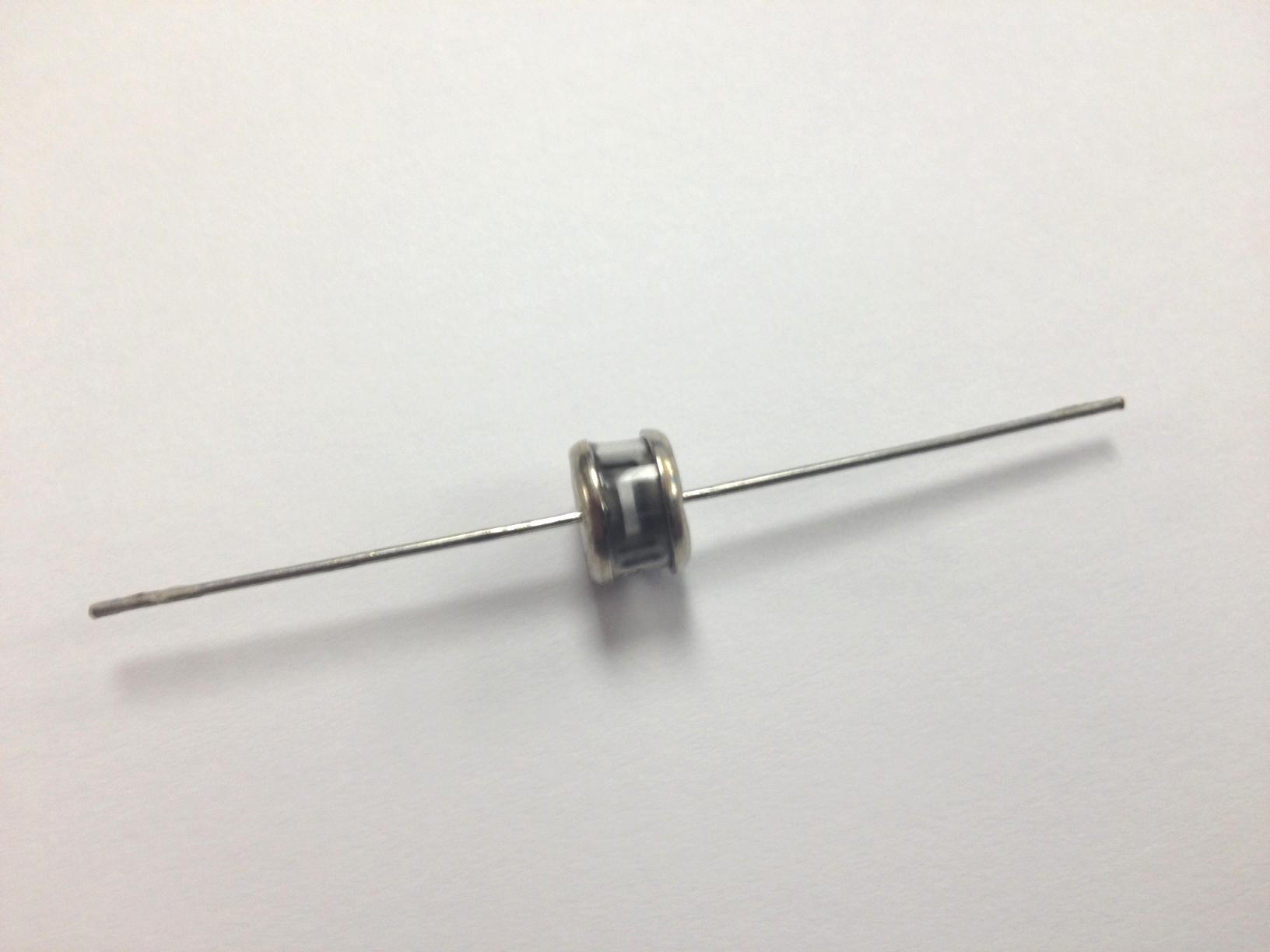
To provide further voltage clamping for those low-signal lines, a metal-oxide-varistor device (“MOV”, as shown in Figure 4) can also be placed across speaker and similar wires. These semiconductor devices do not have a “polarity” and do not conduct until their breakdown voltage is reached. They come in a dizzying array of protection (breakdown) voltages and can protect repetitively unless the onslaught is extremely large. An 18-volt MOV suitable for speakers, headphones, many Morse code keys, and probably digital data lines as well, is available for less than $1.[1] One can select higher or lower voltage ratings as appropriate.
Figure 4: Metal oxide varistor designed to pass 140VAC (RMS) and to clamp at 198 volts, capable of shunting 6,500 amperes for 20 microseconds (which is much longer than an E1 EMP pulse). These are available in many different breakdown voltage levels, including levels suitable for Morse code keys, speaker, and headphone wires.[1]
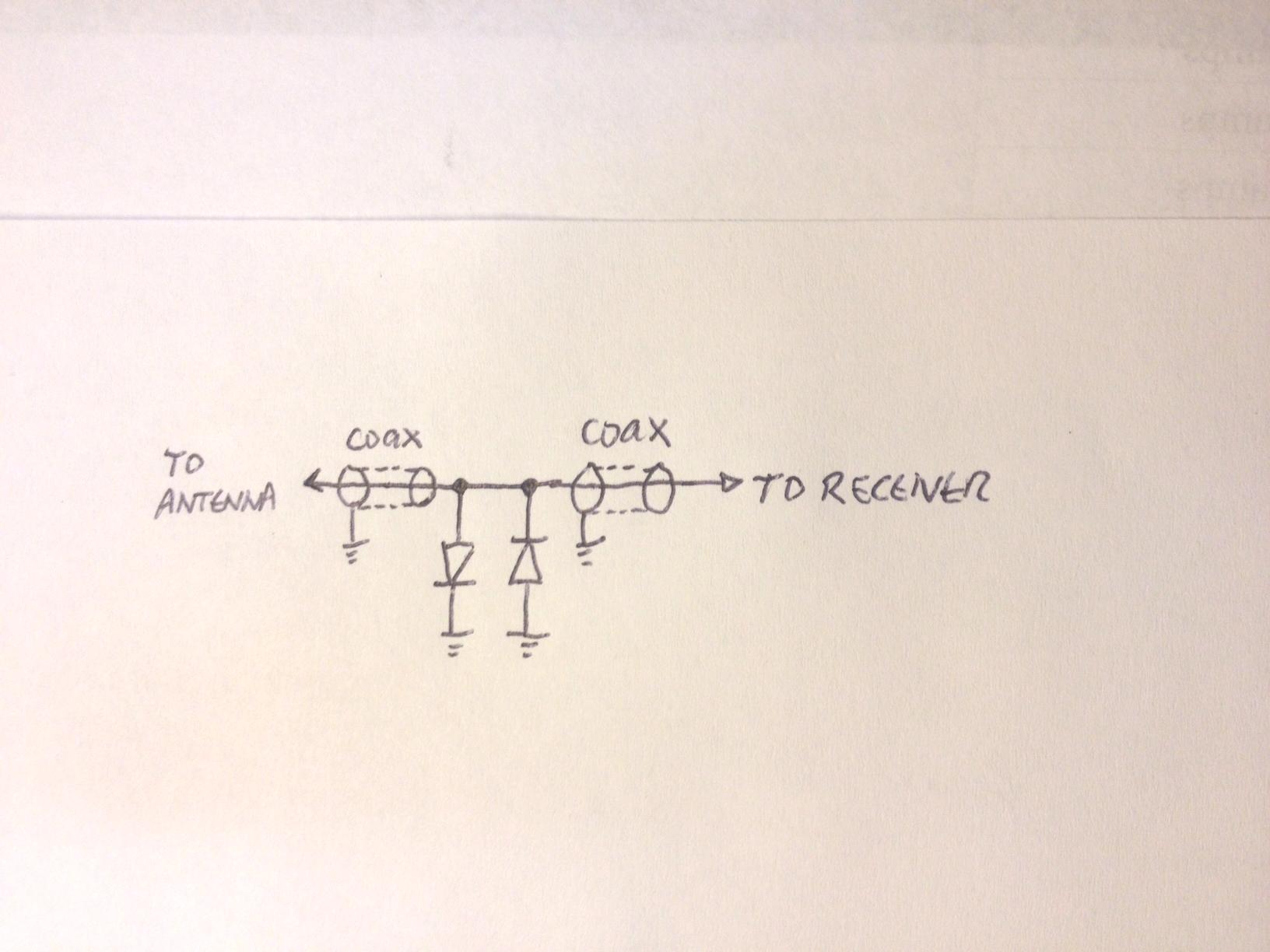
To protect a transistorized receiver, “back-to-back” silicon diodes (see schematic, Figure 5) can be connected at the receiver input between the center conductor and the shield, either connecting inside the feedline connector or added inside the receiver’s enclosure. The reverse breakdown voltage rating is of less importance. One diode conducts and limits the voltage to 0.6 V when the center conductor is driven positive, and the other conducts and limits the voltage to -0.6 V when the center conductor is negative, so the peak-to-peak AC voltage is limited to 1.2 VAC. Because the transmitter may well produce more than this voltage, there has to be some relay or other mechanism to disconnect the receiver from the transmission line during transmitting, so these diodes don’t short out the transmitter output. This type of protection has been used in some commercial and homebrew QRP transceivers to protect the receiver even from the transmitter output. (References [2] and [3] give examples.) A small signal diode, such as a 1N914 or 1N4152, will have a negligible amount of capacitance of a few picofarads and a very fast response but be able to carry a current of a few amperes for a microsecond. At the cost of a bit more parallel capacitance added to the line, a heavier power diode, such as the 1N4004 or 1N4007, can be used for the back to back diodes, with a peak current capability of more than 30 amperes. For most of the high frequency Ham bands, the added capacitance of the heavier power diode will not be noticeable to the receiver. When I tested this on 40 meters, there was absolutely no discernible loss in received signal strength. However, in my heart of hearts, I don’t trust just two diodes to protect a transistor receiver connected to a very long wire antenna from EMP. I would therefore use four diodes– two small-signal diodes like 1N914, and two heavier ones like 1N4004/ 1N4007. Additionally, I would also connect a 60-volt gas discharge surge arrestor (see next section) from the center conductor to ground as “belt and suspenders” protection for my valuable radio! In the case of a transistorized shortwave antenna with a small collapsible antenna, using two back-to-back diodes connected with short wires between the antenna (at its base) and chassis “ground” or “ground” on the internal circuit board (often a very long trace encircling the entire border of the circuit board) would probably add a large amount of protection.
Figure 5. “Back-to-back” diodes shunting both positive and negative higher voltages to ground so that only very small voltages can reach the receiver.
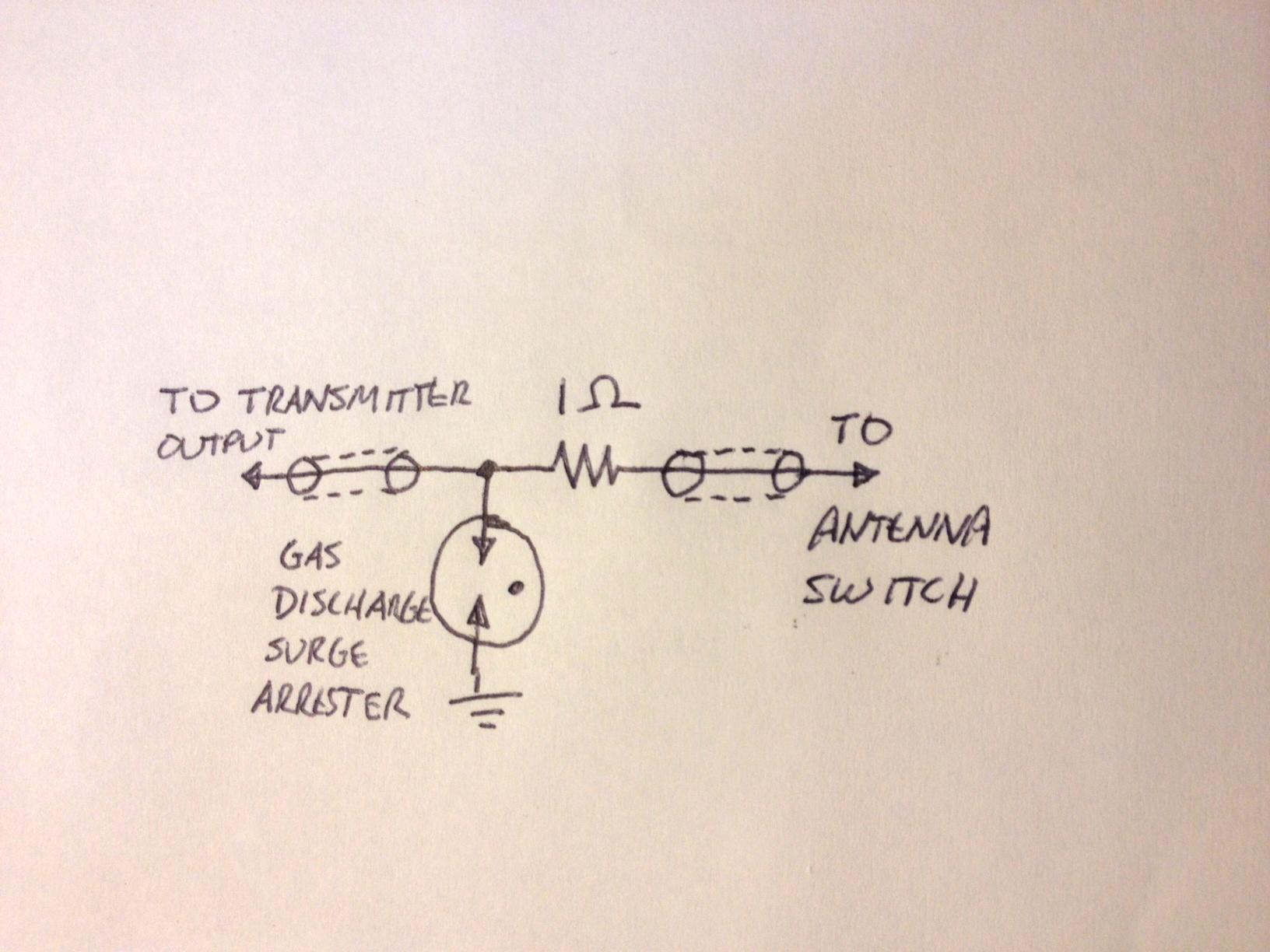
Fully protecting the antenna output of a transistorized QRP transmitter is a bit more difficult, because one must again allow passage of the normal power output voltages generated for commonly-encountered SWR ratios, yet short out voltages just higher than those to protect the transistor amplifier. If for a single instant a power amp transistor or any other within the transmitter is exposed to, say, a voltage greater than its rated Vceo or Vcbo voltage, that transistor is likely to be irreparably damaged. (It might be a good idea to stock up on some spares.) While the punch of lightning is long enough to literally melt/burn conductors and thus leave an indelible mark wherever it coursed, the E1 EMP is gone so quickly that likely only the PN junctions of semiconductors are invisibly but very effectively destroyed. Some transistor designs have relatively little margin of voltage safety. However, it is also possible that the output tuned circuit of the amplifier will screen out some of the frequency spectrum from reaching the vulnerable transistor, also. If we assume an SWR of better than 2:1 and the common 5-watt output, the output voltage is on the order of 31VAC RMS, or under 50 volts peak. One immediately thinks of using a MOV (available in all manner of voltages) to provide protection. The problem with using metal oxide varistors is that they have far larger capacitance (often THOUSANDS of picofarads) than is tolerable in the matching circuits of typical QRP HF transmitters. To get an acceptably lower capacitance requires once again using a gas discharge tube, such as the Bourns Inc. 2020-15T-C2LF. This gas discharge tube has a breakdown at 60volts (the selection of breakdown voltages for gas-discharge is somewhat more limited than for MOVs) and can shunt up to 10 kiloamperes. It is manufactured in a 3-wire version with two surge arrestors connected together. Simply connect the center wire of the pack to the transmitter output and both outer wires to the shield (ground). The capacitance is less than 1 pF; it will not affect your transmitter’s tuning, and the price is less than $3! [4] It may possibly provide adequate protection for the transistorized QRP transmitter. However, this obviously cannot be guaranteed, as we are dealing with enormous instantaneous currents. To give your gas-discharge surge arrester a fighting chance to clamp that voltage sufficiently, I suggest that you add a 1-ohm carbon or carbon-film resistor in series with the center conductor, on the antenna side of your 60-volt gas discharge surge arrestor. (See Figure 6) This can be a common 1/2 watt or 1 watt resistor, just not a wire-wound one. It will not appreciably affect your transmitted power.
Figure 6. Combination of gas discharge surge arrester and series 1 ohm resistor to protect 5W output transistor transmitter. Voltage to the transmitter may be limited to approximately 60 volts.
CB Radios
These same solutions just described for transistorized QRP transmitters above can be applied to common transistorized CB AM transceivers. Twelve-watt single sideband transceivers with feedline SWR below 2:1 may also work well with this system.
In conclusion, for about the price of a fast food meal and a bit of wiring, one can purchase and install all the protection devices reasonably useful to protect either a QRP transistorized or higher-power vacuum tube Ham radio station, and thus have a reasonable chance of surviving a first or second strike, even while using the equipment. Equipment not in use should be disconnected from antennas; a shorting antenna switch can make this more convenient. Spare equipment should be left completely unconnected, and if economically possible, backup radios stored in a Faraday cage. As a side benefit, one gains some appreciable near-vacinity lightning protection. Power line protection from E2/E3 components of an EMP attack will be discussed in a later writing.
This is a long time reader here with a question you likely get often. I realize the following is an overly simplistic question, given the enormous complexities of an individual’s financial and preparedness state, but I’m hoping for a relatively simplistic answer.
Assume you were approached by a debt-free individual and handed anywhere from $5-15k. You are told it is “extra’ money and asked to invest it in something tangible. What would you be inclined to spend it on, assuming they had the basics (beans/bullets/bandaids) covered? Would it be precious metals, redundant equipment, or something else? Or perhaps you’d make a checklist with many small items? Would the amount you were handed ($5k, 10k, or 15k) change your answer? If so, how?
JWR Responds: Presently, I would invest it in silver bullion coins. Coincidentally, silver recently went into a dip, so it is a good time to buy.
The College Commencement Speech Every Graduate Needs To Hear – I work with a large group of young people at my church, and when the correct opportunity presents itself I try and encourage kids to make sure if they go to college to get a definable skill, otherwise start a business or learn or go to school for a trade. Sometimes the indoctrination of our culture is for you go to school or you are a failure, and it can be hard to overcome. This is a humorous article about a very serious issue.
“Very soon nations will understand that in reality Water is the most expensive natural resource for their survivals. Not Middle East oil neither African gold.” ? M.F. Moonzajer
On this day, June 4th, in 1944 United States Navy Task Group 22.3 captured U-505, a German submarine and with it an intact Enigma cypher machine. This was the first time since the USS Peacock seized HMS Nautilus in 1815 that the USN had captured an enemy vessel at sea. The sub, reunited with its periscope a decade ago, is displayed at the Museum of Science and Industry, in Chicago.
A Gunsite Academy Three Day Course Certificate, good for any one, two, or three course (a $1,195 value),
A course certificate from onPoint Tactical. This certificate will be for the prize winner’s choice of three-day civilian courses. (Excluding those restricted for military or government teams.) Three day onPoint courses normally cost $795,
DRD Tactical is providing a 5.56 NATO QD Billet upper with a hammer forged, chromlined barrel and a hard case to go with your own AR lower. It will allow any standard AR type rifle to have quick change barrel, which can be assembled in less than one minute without the use of any tools, and a compact carry capability in a hard case or 3-day pack (an $1,100 value),
Gun Mag Warehouse is providing 20 Magpul pmags 30rd Magazines (a value of $300) and a Gun Mag Warehouse T-Shirt. (An equivalent prize will be awarded for residents in states with magazine restrictions.),
Two cases of Mountain House freeze dried assorted entrees in #10 cans, courtesy of Ready Made Resources (a $350 value),
A pre-selected assortment of military surplus gear from CJL Enterprize (a $300 value),
A Model 120 Series Solar Generator provided by Quantum Harvest LLC (a $340 value),
A $300 gift certificate from Freeze Dry Guy,
A $250 gift certificate from Sunflower Ammo,
KellyKettleUSA.com is donating both an AquaBrick water filtration kit and a Stainless Medium Scout Kelly Kettle Complete Kit with a combined retail value of $304,
TexasgiBrass.com is providing a $300 gift certificate, and
Two cases of meals, Ready to Eat (MREs), courtesy of CampingSurvival.com (a $180 value).
A FloJak EarthStraw “Code Red” 100-foot well pump system (a $500 value), courtesy of FloJak.com,
Acorn Supplies is donating a Deluxe Food Storage Survival Kit with a retail value of $350,
The Ark Institute is donating a non-GMO, non-hybrid vegetable seed package–enough for two families of four, seed storage materials, a CD-ROM of Geri Guidetti’s book “Build Your Ark! How to Prepare for Self Reliance in Uncertain Times”, and two bottles of Potassium Iodate– a $325 retail value,
A $250 gift card from Emergency Essentials,
Twenty Five books, of the winners choice, of any books published by PrepperPress.com (a $270 value),
TexasgiBrass.com is providing a $150 gift certificate, and
RepackBox is providing a $300 gift certificate to their site.
A large handmade clothes drying rack, a washboard, and a Homesteading for Beginners DVD, all courtesy of The Homestead Store, with a combined value of $206,
*Expanded sets of both washable feminine pads and liners, donated by Naturally Cozy (a $185 retail value),
Round 59 ends on July 31st, so get busy writing and e-mail us your entry. Remember that there is a 1,500-word minimum, and that articles on practical “how to” skills for survival have an advantage in the judging.
Electromagnetic Pulse (EMP) is a serious national threat with growing public awareness. A high-altitude atomic/nuclear explosion sends electrons plowing through the earth’s magnetic field lines and thus generates powerful radio waves that impact the earth below the explosion within a radius of many hundreds to thousands of miles.
The peak field strength is immense, on the order of 50 kilovolts per meter, and covers a very broad frequency spectrum, from very low frequencies, past 100 MHz; but the first wave (named E1) is evanescent, over in a mere microsecond or so. There are additional, slower incident waves– E2 and E3, but these are more of a powerline problem and are not addressed in this article. (I will write on this aspect in a later article.)
Figure 1. 350-volt clamping gas discharge surge arrester. Installing this versatile protection device requires only a small amount of wiring/soldering. Figure 2 shows these surge arrestors applied to the center conductor of a popular SWR measurement device. The SWR meter would then be connected to the transmitter side of the shorting antenna switch described above.
The survival problem is the instantaneous destruction (by overvoltage) of transistors, diodes, integrated circuits, FETs, and microprocessors by the immense voltages. Millions of volts and thousands of amperes may flow on ordinary shortwave or Ham radio antennas and feedlines from the E1 wave, for an instant. Handheld VHF/UHF walkie-talkies with antennas only a few inches long won’t be hit with nearly the same level of damaging power that will assault high-frequency (HF) rigs with scores of feet of antennas and feedlines. This article concerns those vulnerable high frequency stations with antennas more than two feet long. Of course, these are the very stations useful for getting interstate, national, and international news and messages flowing.
What about Faraday cages? To protect against E1 EMP, many plan to simply store vulnerable equipment inside an effective Faraday shield– a good quality metal trash can with a tight-fitting lid is suggested, possibly with aluminized tape covering gaps in the lid seal. “Nested” Faraday shields, such as wrapping aluminum foil around the sensitive radio and placing it within a cardboard box inside the trashcan, are also often suggested.
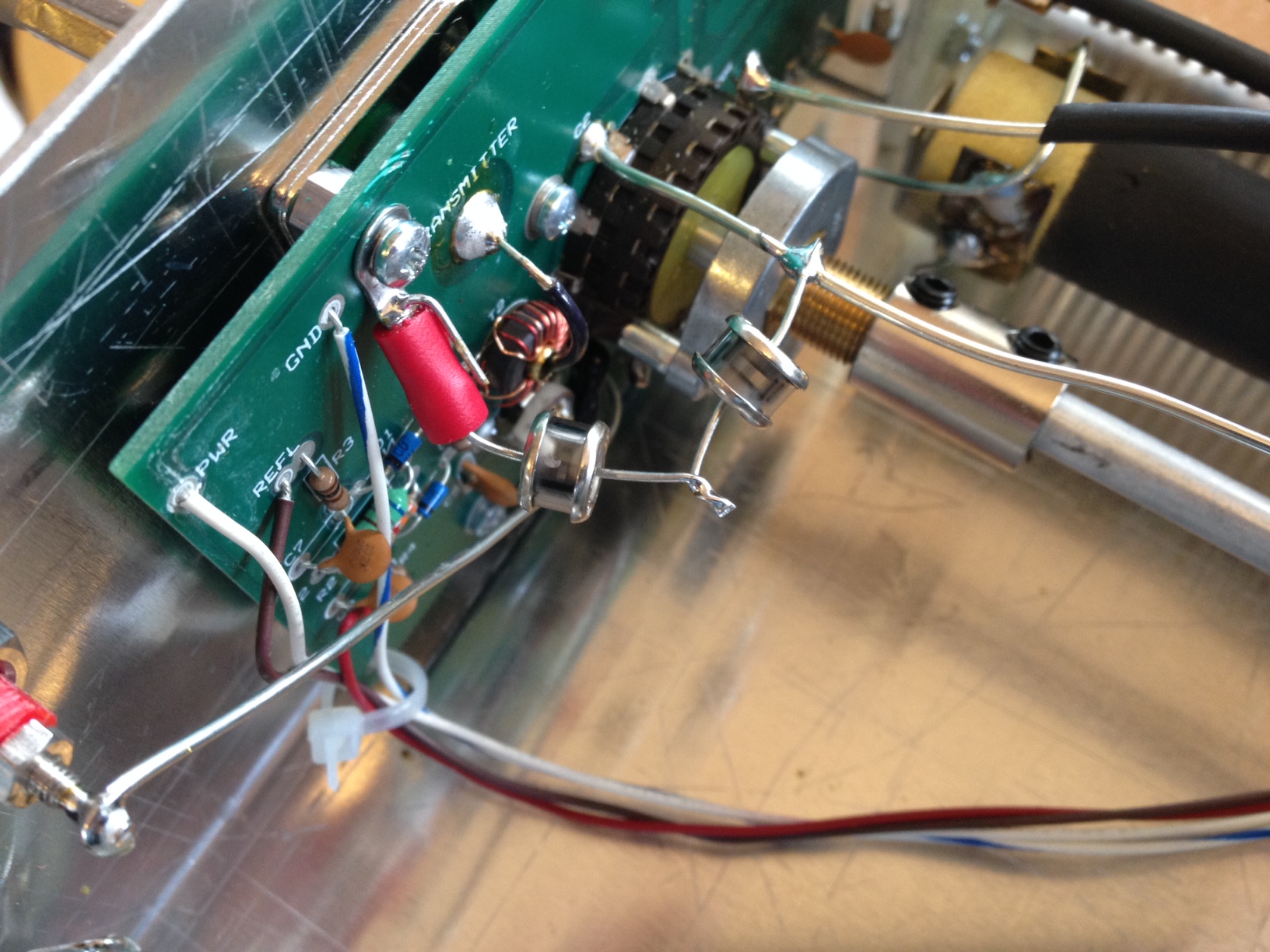
Figure 2. Two gas-discharge voltage clamping devices in series connected between the center conductor of a popular standing wave ratio measurement device and the shield/ground. A small bit of insulation slid over the wiring avoids contact with the metallic frame, and after this photo was taken insulating plastic tape was used to cover the devices prior to reinstalling the cover.
The inadequacy of the Faraday solution is twofold:
It cannot protect equipment that is in use at the time of the attack, and
It basically means you don’t dare use your surviving equipment, possibly for years after the initial attack. What if the enemy fires a second or third salvo? One would reasonably worry. What good is equipment that remains vulnerable and may be destroyed if put to use?
There is, therefore, a significant need to have a level of protection available for up-and-running, connected communications equipment, particularly high frequency Ham radio equipment, while possibly also storing spares.
The good news is that, using simple commercially-available surge devices, this article will explain how a reasonable protection strategy can be implemented at a cost in the range of $20! Part One of this article will handle the protection of vacuum-tube type radios, and Part Two will tackle the somewhat more difficult situation of transistorized HF radios (including CB). One of the great advantages of Ham radio is that the licensed users are allowed to build and modify their own stations, and this is one situation where that really pays off.
E1 EMP has characteristics of both extremely high power electromagnetic (radio) interference as well as a very nearby or direct lightning strike. (Lightning also generates enormous radio waves and is a primary cause of background noise on HF frequencies.) Hardening techniques therefore are a combination of shielding and hefty over-voltage circuit protection devices. A side benefit will be an increased level of protection against nearby lightning strikes.
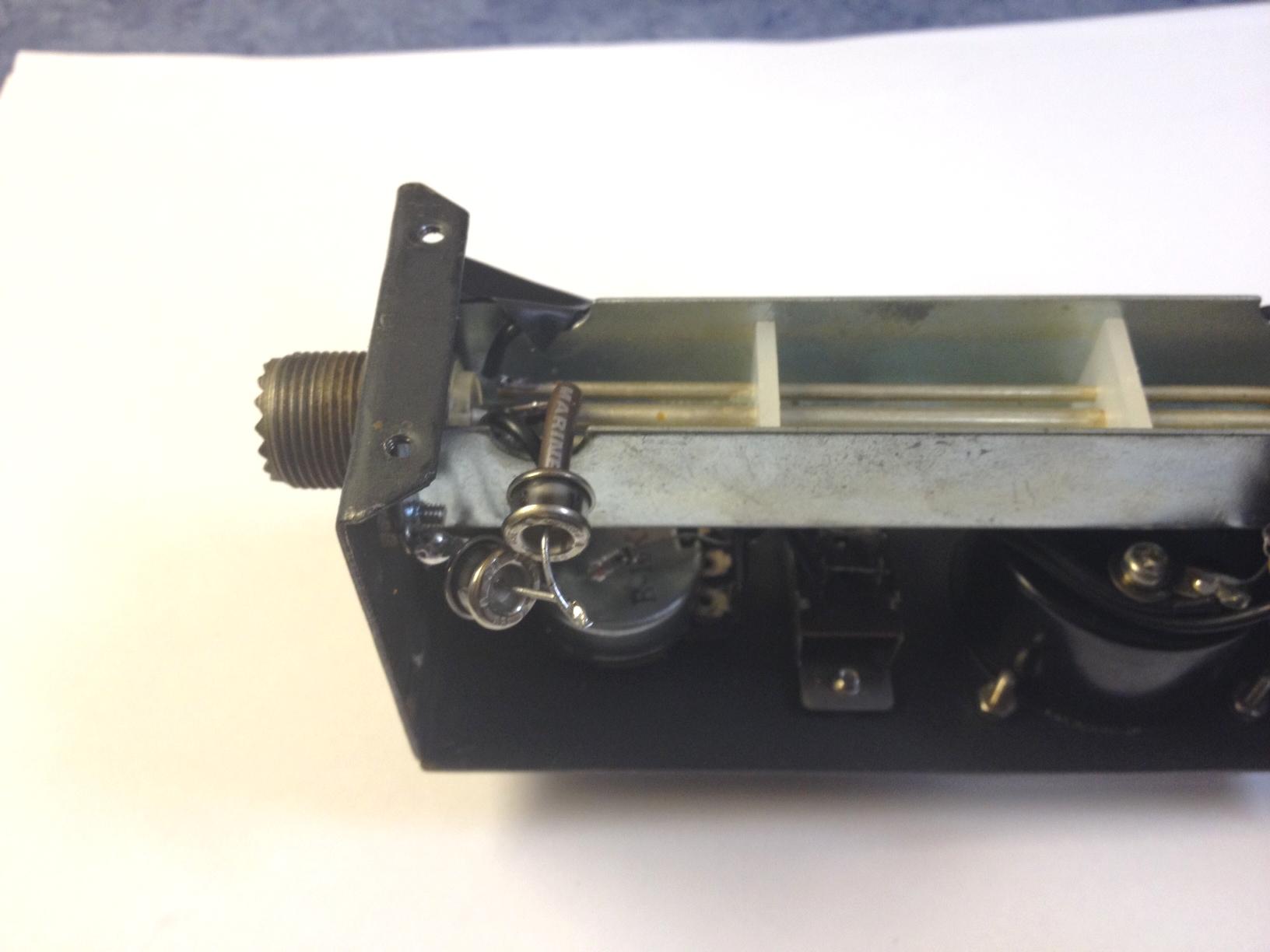
Figure 3. Two gas-discharge voltage clamping devices in series connected to the center conductor at the “transmitter end” of the circuitry of a popular antenna matching device, and then (red crimp terminal) connected to chassis “ground.” This location was chosen so as to provide some protection to the SWR measurement portion of the antenna matching tuner. They should be installed on the side of the circuitry that has the 50-ohm impedance (closest to the transmitter, not the antenna side), rather than the possibly high-impedance antenna side, where normal voltages may be much higher. For those not ready to modify such equipment, Bodson described a simple technique of adding these gas-discharge surge arrestors to the transmission line by using a common “UHF – T” coax connector, and his article gives good instructions for doing so. [2] This level of protection was adequate in Bodson’s tests to successfully protect vacuum-tube based Ham radio equipment (receivers and transmitters) from simulated E1 EMP-induced voltages. In Part Two, I will discuss the somewhat more difficult task of protecting transistorized/computerized equipment, including external additions to CB transceivers and shortwave receivers.In a widely-disseminated four-part series of articles published in QST magazine during 1986, Dennis Bodson of the Office of Technology and Standards, National Communications System, explained the problem in detail and tested possible solutions.[1, 2] Using his recommended solutions, vacuum tube radio equipment survived simulated EMP attack, and some solid-state radios did as well, even when connected to antennas. The purpose of this article is to explain how one can easily implement those solutions with HF communications equipment and commercially-available surge protection devices available right now.
Solutions for Connected Tube-Type Equipment
There is no sense in tempting fate. When the equipment is not in use, a shorting antenna switch near to the entry of the transmission feedline to the residence can be utilized to conveniently disconnect the equipment from the antenna and further to automatically short out the antenna transmission line. An example of such a switch (there are many) is the OPEK Model CX-201 two-output coaxial switch.[3] When the antenna is de-selected, this switch mechanically grounds the feedline from that antenna, which would knock down the EMP E1 reaching your equipment by many orders of magnitude (manufacturer claims 50dB).
Secondly, simply using coaxial cable as part of the feedline system provides a small amount of protection, as it will arc over with a few kilovolts (depending on the type of cable utilized), somewhat limiting the voltage. (It might be wise to keep some spare coax cable in your Faraday storage compartment.)
Voltage clamp devices are the next (and possibly most important) protection to employ. How does one choose the clamp voltage level? If you are going to transmit, you must ensure that your protection system will not short out your own transmissions (potentially damaging your transmitter)! The transmitter’s output RF voltage is dependent on the standing wave ratio (lower SWR means lower voltage), the feedline impedance (for coax, usually 50 or 75 ohms), and transmitter power. For reference, a 100-watt transmitter output with a 50-ohm transmission line and a well-matched antenna with a 1.5:1 SWR will generate about 110 volts of RF AC in its feedline while transmitting. Obviously, a protection system that shorted out any voltage over 100 volts won’t work well in this instance. The clamping voltage needs to be higher, particularly if you may have worse SWR or a linear amplifier.
A very simple solution that accommodates and reasonably protects most higher-power vacuum tube-based, Ham radio stations, and which indeed performed very well in Bodson’s tests, was to take two 350-volt small gas-discharge surge arrestors (BI-A350; see Figure 1; specification sheet Ref.[4]), wire them in series, and then connect the resulting package between the center wire of the coax transmission line and the shield, with as short a wire length as practical. These gas discharge tubes can carry surge currents from 5-20 thousand amperes. (The device lifetime is shorter with higher current surges.) They are under $4 each from multiple suppliers.[5] With two in series, the breakdown voltage will be in the neighborhood of 700 volts.
Reading your bank policies note made me want to share an experience I had recently.
I took my income tax return check to my local credit union for deposit only, no cash back. My wife had signed the check. They told me, “We can only deposit this check into an account you are both on.” I said, “There is no such an account.” Well, then she will need to come in with you. I said, “Okay, forget about it.” I took the check to my local PNC Bank (where it’s my sole account) who deposited it minus the hassle. I didn’t even waste my time trying to explain to the local credit union that they already have laws against forgery.
Surprisingly, I’ve had much more bad luck with credit unions making up rules as they go along than big banks (except Bank of America, who’s really bad). – d.
HJL Replies: I’m pretty convinced at this point that practically any banking institution is going to have issues. Many of the issues are driven by external factors such as regulators and legislation, but I also had a relative that was a bank auditor and to some extent the problems can be due to what mood the person driving them is in on that particular day (bad hair day?). With the government desiring to track every possible financial transaction, all banking institutions will come under increasing pressure to track, record, and report such information. I think we are going to hear of more privacy and constitutional violations as time moves forward, no matter the size of the bank. Small banks may have higher employee satisfaction ratings, which result in better customer satisfaction, but they have far less ability to absorb mistakes or movements in the financial world. They are generally beholding to the larger banks anyway. Nothing we are hearing about now has been unexpected, and JWR has been beating the drum for a number of years to get out of debt and hold as little position in financial institutions as necessary.
I recently ran across an article from the Wall Street Journal; the piece itself was either a really bad attempt at a satire or it was mockingly smug. The article itself is not necessarily what you should read. I found that the comment section was truly amazing. I laughed, I smiled, and I felt that I wasn’t alone in the fight… My fellow American’s are alive and well, and there is a growing tide of revolution. I invite you to read the comments section. I don’t know how long the WSJ will keep it up. – T.C.

![Figure 4: Metal oxide varistor designed to pass 140VAC (RMS) and to clamp at 198 volts, capable of shunting 6,500 amperes for 20 microseconds (which is much longer than an E1 EMP pulse). These are available in many different breakdown voltage levels, including levels suitable for Morse code keys, speaker, and headphone wires.[1]](https://survivalblog.com/wp-content/uploads/2015/06/img_10051.jpg)