Scot’s Product Review: Regulation Tactical Belt, Glide Panel, Magazine Pouches, and Load Bearing Brackets

Regulation Tactical is a California-based company that sells U.S.-made tactical gear. It was founded by a Marine who, “after three combat tours, got tired of the problems his issue gear created and wanted to create solutions for them.” I have not used Marine issued gear nor done combat tours, but I think Regulation has definitely created some interesting and useful solutions to some of the difficulties caused by carrying handguns and magazines and wearing hard body armor.

Glide Instructor Belt

The first item in the review is the $29.99 Glide Instructor Belt, which solves the problem of removing and then replacing an outside the waist band (OWB) holster, which is a pain with a normal belt. It is a clever multiple layered device with lots of Velcro, and it reminds me of the inner/outer systems used with many competition and police duty belts. The idea is that you have an inner belt with Velcro that goes through your pants’ belt loops and thenan outer belt with more Velcro on which you have all of your gear. When you are ready for business, you just apply the outer belt to the inner one and off you go to shoot targets or deal with bad guys. Back in my days of shooting action pistol matches that didn’t require concealment, I used this sort of rig and found it surprisingly secure.

The Glide Instructor belt dispenses with having to wear two belts and has what I believe is a unique system of three layers that overlap where the two ends of the belt connect. There is an inner layer on the shooter’s dominant side that connects to the tongue from the dominant side with Velcro. The outer layer on the shooter’s dominant side then attaches to the inner layers with Velcro and goes over the belt loops. Having the outer layer go over the belt loops is the key to the neat trick this belt performs for folks who use outside the waistband holsters. You can quickly, easily, and safely put on and remove your handgun in one quick operation by peeling up the outer layer and slipping it through the holster’s belt loops. You do get the ripping Velcro sound, of course, but you don’t have to undo your belt and unthread it to get the holster and gun off and then rethread it to hold your pants up.

Additionally, remember that there are three layers of Glide Belt. Two of them are still holding your pants up while you are putting on or taking off your weapon. We often have other gear secured to our belts– spare magazines, multi-tools, and the like; all of that weight will pull your pants down. You need three hands during this operation if using a regular belt; you’d need two to thread things and a third to hold it all up.

For anyone who has to come and go from non-permissive locations, this is a real blessing. I often find myself going through this ordeal of restricted freedom and one of the worst parts of the problem (besides being disarmed) is the additional handling of the weapon, often in places where is it awkward, such as a car. In many cases, one will unholster the weapon in the process, which is less safe than leaving it holstered. A holstered handgun, assuming it’s in a well-designed holster and weapon, is very safe. It is far less safe to have to be moving the pistol around in your hand, particularly in the close confines of a vehicle. With the Glide Belt, you simply pull up the outer layer, slide the holster with handgun off, secure it safely, and reattach the outer belt layer.

There is also the benefit of having removed the holster rather than leaving it on your belt as I have often done to avoid the struggle with removing the holster. Should you have to go through a security point, you won’t have to explain why you have a holster and where your weapon is. Trust me, even empty holsters can raise hackles on an anti-freedom security person.

I usually wear an inside the waist band (IWB) holster and choose models with snap on belt loops so I can remove the whole rig in one operation. The issue of getting the thing off is one of the reasons. While I think the IWB conceals better, it is less comfortable. However, since I have been wearing this belt, I have been finding myself using some of the fine OWB holsters I own a lot more often and enjoying the extra comfort they provide.

My one glitch is that I am on the absolute maximum edge of one of the sizes, and if I were to gain more weight (my wife cooks too well and I’m spending too much time writing instead of exercising) I will have problems. If you are at the very top boundary of a size, it might be smarter to grudgingly take the larger one.

The belts can be had in black, ranger green, coyote brown, or MultiCam. I chose Ranger Green for the one I purchased to match my Scout uniform and the olive drab cargo pants and shorts I frequent.

The workmanship is very nice with excellent stitching, and the materials appear durable and of high quality. The Velcro is the military grade hook and loop, and it works well; the layers adhere strongly to one another. They make so much noise when you peel them off that I learned not to remove it in the bedroom after my suffering wife has gone to sleep. You can reduce the noise level by going slow, but that takes patience.

I will admit to finding the instructional video on using the belt to be helpful. I’m left-handed, and I initially got a bit perplexed on how to use it, but after a little head scratching, it became quite clear. I normally thread belts into the left side of my pants, but with this one, the video showed it going in the other way. It suddenly dawned on me that the video was for the majority of people who are right-handers, and when I use it I could keep on threading it the same way as my regular belts. Duh.

I wondered about how securely it would hold up the pistol, but I had zero problems with a steel Colt Commander, which at 43 ounces loaded with a seven round magazine is significantly heavier than a Glock 17 at 32 ounces, which is a pistol probably more commonly carried these days than my Colt.

I found this to be a very ingenious design and quite useful for those who must disrobe from their sidearm. It works well, and the price, when compared to similar sorts of belts, is extremely reasonable. It is now my go-to belt for OWB holsters. In black, it might be inconspicuous enough to wear with dressier clothes, if the belt loops are wide enough.

Glide Panel

The $4 Glide Panel is used with the Glide Belt when one has gear with 1.75-inch loops. The Glide Belt is 1.5 inches wide so that it will work with most jeans and trousers. We often wind up with holsters made with 1.75 inch belt loops and this leads to slop that can delay the draw stroke or cause discomfort, as the weapon has more room to slip about. The Glide Panel is simply a somewhat rigid 9-inch long strip that is still flexible enough to wrap around the body and widens the belt to 1.75 inches. It has Velcro on both sides. You stick it to the outer layer, the holster goes on, and then it is all pressed down on the inner layer. It works well and helps make for a more solid carry, as the handgun is always where it should be and not flopping around. I am usually careful to size my belts and holsters to match, but this crafty bit of gear allows you to get by with one less belt if you have holsters in both 1.5- and 1.75-inch sizes, as I do.

Ammo Pouch AR-15 Reflex Mag Pouch MkII

Regulation Tactical loaned me two of their $35 ammo pouches. These are clever and highly versatile items that, like the Glide Belt, make use of a lot of Velcro.

The pouch can be configured in several ways; I hope I don’t miss any. First, you have a choice to use a shock cord retainer, if you want extra security in retaining your magazines or put it aside if you want faster access to a reload. You can configure the pouch to hold one or two magazines. Finally, you can remove or leave the spring, which retains the magazines.

The spring was the interesting part to me. Its purpose is to provide secure magazine retention, even if you configure the pouch to hold two magazine and you have withdrawn one. This is no easy trick. Conventional pouches simply can’t retain a magazine after the first one is used, and on those you need to have a flap or strap secured with a hook, loop, or snap. If you don’t secure the pouch, the magazine can be lost, whch is not good. On the other hand, a flap or strap slows down access to a reload, which is also not good.

The spring includedby Regulation Tactical’s pouch pushes the magazines forward and has enough tension to hold in a single magazine after the first is removed. It also creates some space behind the magazines to make it easier to extract one than you can from a pouch that pulls them tight against the body.

Another extremely well thought out function is that the spring pushes the outer magazine against the sloped bottom of the pouch, which means it rides about ¾ of an inch higher than the inner magazine allowing you to grasp it more easily.

The only drawbacks of this system are that it makes the pouch about ½-inch thicker than a standard two-magazine pouch and it can take more effort to extract or insert a magazine. The spring will compress if you lie on it when prone, but it will always be a bit thicker than a conventional pouch as the spring can only collapse so far and there is a need for more layers of material to accommodate all of the adjustments available with the design. There is no way around the effort if you wish to retain magazines without a cover.

You can remove the spring and create a lower profile magazine carrier for one or two magazines as well as reducing the effort to draw a magazine, but bear in mind you will have to use the shock cord strap to retain the second magazine once the first is removed, which means it is in the way. If you set it up for just one magazine, however, you can make it tight enough to hold the single magazine without the shock cord retainer.

I thought it worked brilliantly using the spring with GI- or H&K-style AR metal magazines with indented ribs. Some polymer magazines have protruding ribs and baseplates, and they took a bit of futzing to get the tension right, but it could be done. The only ones I decided were a bad bet were Thermolds, which were very difficult to get working as they have very prominent ribs that catch as you pull out the first magazine and can pull the second one out with it. TangoDown magazines were a snap and just as easy as the metal ones. Lancers were a bit more trouble than the TangoDowns, while Magpuls were a little harder to fit than the Lancers. The Gen 3 Magpuls were easier than Gen 2’s as the baseplates on the Gen 3 aren’t as wide.

One thing that made it harder, especially with the polymer magazines, was if the Magpul rubber loops that many of us like to use had been installed on the magazines. These make the magazine quite a bit wider at the base as well as creating some additional friction when you extract a magazine. You can get it to work, but it will take more effort to set the pouch up. The problem is that proper function depends on getting the width of the pouch right, and when the magazine is wider at one end, it forces you to make it a bit looser than optimum for retention. If you get it tight enough to surely retain the last magazine with the pulls installed, you wind up with needing more effort than I like to remove or insert the second magazine. I had the least trouble using the pulls on metal and TangoDown magazines and the most with the Magpul Gen 2 magazines. I would advise replacing pull loops with the Magpul Ranger Plates for use with this pouch.

It is important to seat the magazines properly, which isn’t hard to do. You want to be sure that the front magazine rides higher so that it is easy to grasp and extract. All you have to do is be sure to fully seat the rear magazine.

The pouch has the ubiquitous MOLLE/PALS straps to attach it to some sort of carrier, and they also link to some belt adapters on their site if you want to use it on a conventional belt.

This is one of the best efforts I’ve seen to create a two-magazine pouch that doesn’t require a flap or strap to retain the second magazine after the first is withdrawn. It also offers some additional options for lower profile carry so it is quite versatile and worth a good look if you need pouches. I’m thinking about replacing some of my pouches with them. The pricing is quite good too. As with the belt, they are available in black, coyote brown, MultiCam, and ranger green.

Load Bearing Brackets

These gizmos are intended to help the user better distribute the weight of a plate carrier with armor, and they appear to do the trick. I only spent a couple of hours using them, but I felt they performed as intended.

The basic idea is to shift some of the weight from the user’s shoulders and back to their waist by connecting the plate carrier to a belt. One might note that this strategy is widely used with backpacks, and it is very effective at reducing fatigue and stress on the neck, shoulders, and back. As one who spent many years carrying heavy camera equipment, I welcome any chance to move the weight from my shoulders to someplace else.

The LBBs provide brackets that attach to the plate carrier and to a belt. The belt, in my case, was a second one that rode higher than my normal belt. This worked with my anatomy and was welcome as it allowed me to add a belt at the lower level for a holster and other gear. Your anatomy might be different, and you might wind up attaching it to your normal belt. In that case, you would lose a bit of flexibility as the LBBs occupy some space. If you can make it work with a separate belt, you have more options on how to use your gear. In my case, it means I can use my belt with or without the plate carrier without having to remove it from the carrier. In any case, the belt needs to be stiff and supportive, like a police duty belt. A flexible web belt isn’t going to work well.

The attachments to the carrier are via MOLLE/PALS straps, while the attachment to the belt is a wraparound strap that secures with Velcro. I watched the video to be sure I got it right, though the instructions printed on a nice bandana were reasonably clear. I could have done it without the video but might have done it twice rather than once.

A side benefit is that since the LBBs hold the plate carrier up, they seem to allow more air to get under the carrier, which has a welcome cooling effect.

The heavier the load you carry, the greater the benefit with the LBBs. Steel plates are very popular these days, and they are quite heavy; so, the LBBs merit a look if you have a set.

The LBBs might seem pricey at $125 for a set of four or $65 for a set of two, but if one is going to be wearing armor for any length of time, they might turn out to be well worth it. They require a good deal of labor to create and show high quality, so the price isn’t unreasonable. As with the other gear, you get a choice of black, coyote brown, MultiCam, and ranger green.

– SurvivalBlog Field Gear Editor, Scot Frank Eire


Pat Cascio’s Product Review: Double Tap Defense Derringer

Back in early 1974, I worked as a plain clothes store detective for a chain called Wieboldt’s Department Stores. If I recall correctly, they had about 16 stores in and around the Chicago area. Sadly, they went out of business in 1986. I was moved around, several times, from one store to another, and ultimately I ended-up on the tactical team. We traveled around to different stores, mostly working on employee thefts, because the employees didn’t know who we were. Prior to this, I was the assistant security manager, which again was a plain clothes, armed store detective, at a suburban store in Lombard, IL. At that time, it was a fairly well-to-do suburb. I have no idea if it is still like that. It was a VERY boring store to work at, because the rich just didn’t shoplift.

While working at the Wieboldt’s store in Lombard, IL one of the duties I had was taking daily bank deposits to the bank at the end of the mall parking lot, where the store was located. The company was too cheap to pay for armored car service, to haul a bag of money and checks from the store to the end of the parking lot. On Monday mornings, I could be carrying as much as $50,000 or $60,000 in cash for the deposit. The money was in a bank bag, and it was stuffed inside of a store labeled paper bag, supposedly so no one would know what I was carrying. The walk wasn’t that far, maybe a couple hundred yards. It was quicker to walk to the bank than it was to get in my car and drive there and back, so I always walked to the bank.

At the time, I carried a S&W Model 15 nickel-plated snub-nose revolver in a shoulder holster. I never cared for inside the waist holsters, and I still don’t! While making the daily deposits for the store, sans Sundays, I carried a little two-shot .22 LR derringer in my right front jacket pocket, and I kept my hand on that little derringer while walking to the bank. I surmised back then that I could at least get off one or maybe both shots from that little handgun, if someone was attempting to rob me of the bank deposit and then I’d have time to reach for my main handgun to further engage the attacker. Luckily, no one ever tried to relieve me of the money I was carrying. That was my first experience at carrying a two-shot handgun.

Over the years, that little two-shot derringer found a new home. My mother borrowed it for her business, and where it ended up, I have no idea. My mother and aunt ran a hand-blown glass business, in a rather tough neighborhood in Chicago, and I guess they felt protected by that little two-shot handgun. I’ve since owned a couple more two-shot derringers, as well as a couple single shot handguns, and I guess you could call them “derringers” as well. Never were they my first-line of defense, though.

100_5976

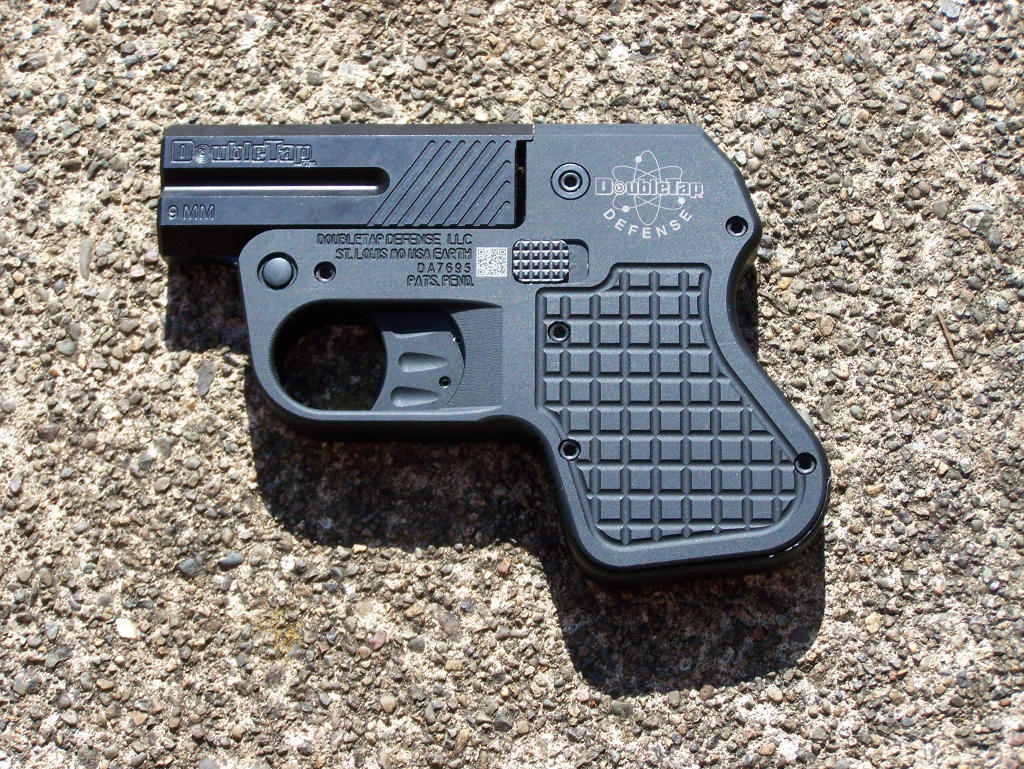
Enter the Double Tap Defense two-shot derringer. I don’t have all the details as to why this little handgun was so long in coming on the market, but it was a couple years late in coming out. The PR firm that was handling all the advertising for this company kept promising “next week” or “next month” for a sample. After more than a year of waiting, I asked to have my name removed from the gun writer’s list of those who requested a sample. At some point, a little over a year ago, the local gun shop that I haunt received a couple of the Double Tap handguns, and they were priced at $499! OUCH!!! I passed!

100_5979

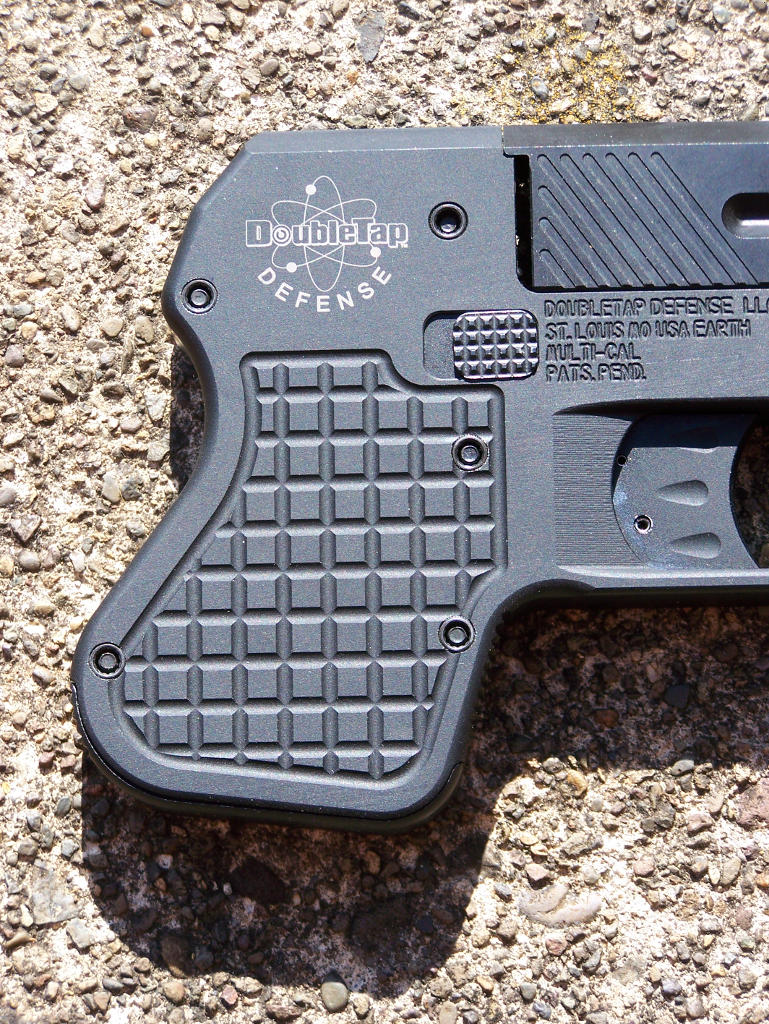
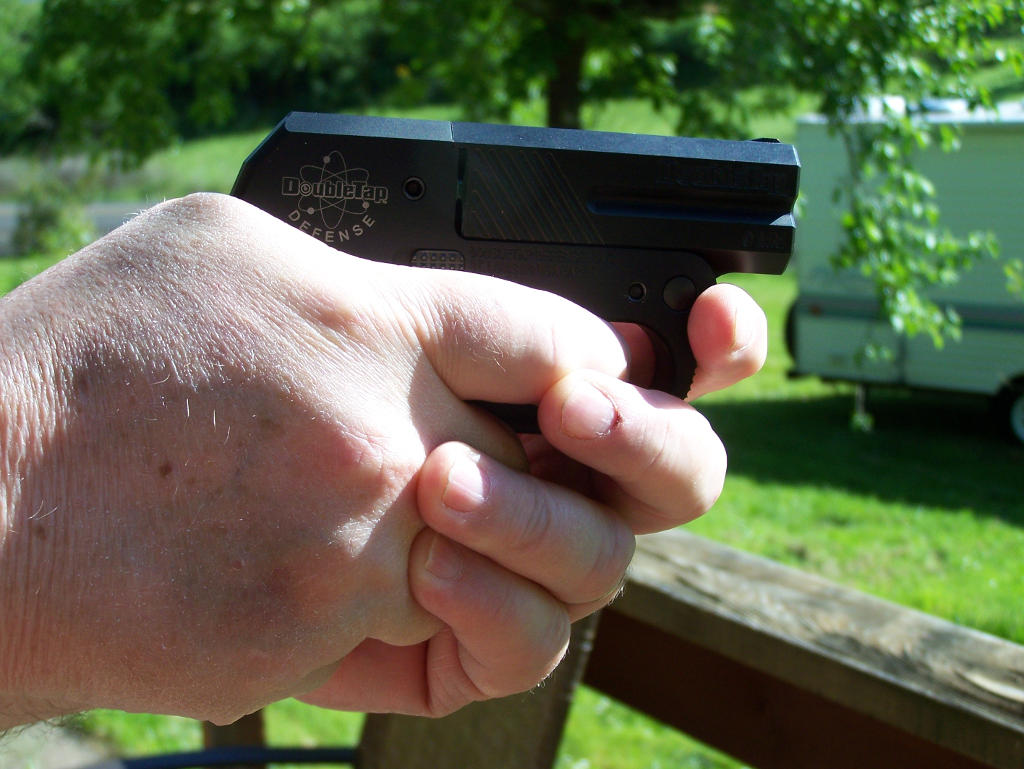
Recently, my local gun shop scored a fantastic deal on Double Tap handguns, in 9mm or .45ACP. They were (still are) selling them for $269 each. While sitting there, waiting on UPS to bring me another gun sample that day for an article, I got to playing around with the .45ACP Double Tap, and I was impressed as to how well it was made. It’s not your typical two-shot derringer, where you have to cock the external hammer for each shot. Instead, the Double Tap is fired by simply pulling the trigger twice to fire both barrels. While the trigger pull is rather long, it is smooth. Kudos go to Double Tap on that aspect of the gun. The front sight is attached to the barrel, while the rear sight is part of the frame of the gun. To my aged eyes, I could not see either the front or rear sights without my reading glasses on.

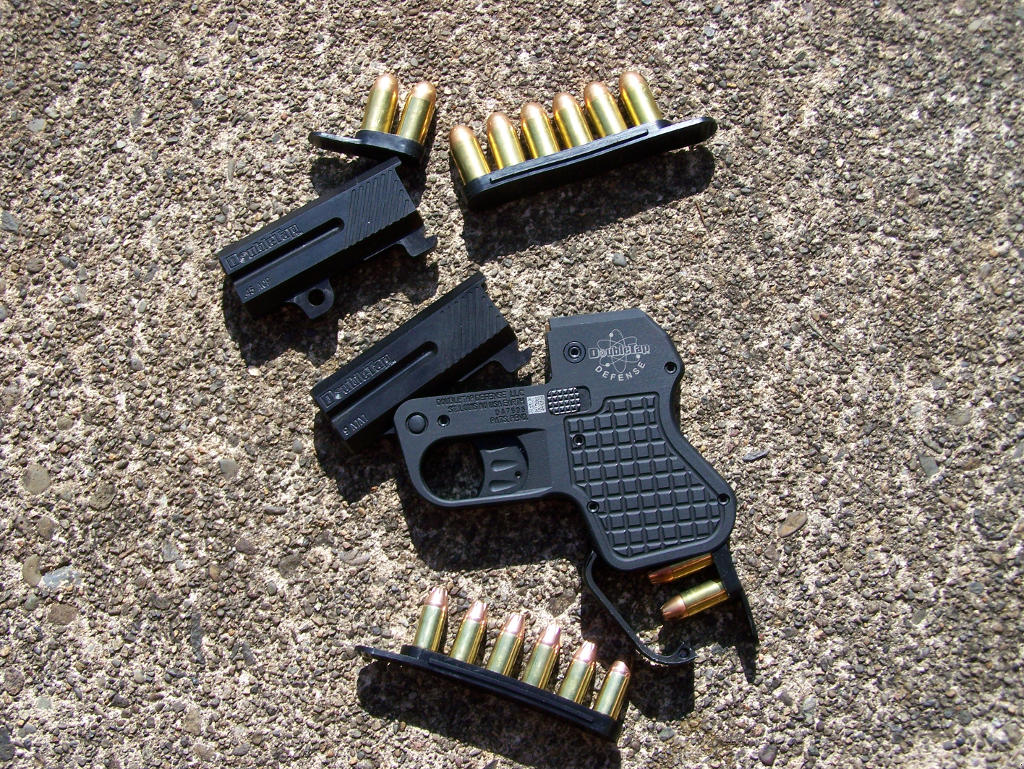
At present, Double Tap Defense is offering their little gun, which fits nicely in your hand or a pocket, in two calibers– 9mm or .45ACP– with the promise of other calibers to come. Also, you can easily swap barrels so you can fire either caliber; it takes all of 30-seconds to push out a pin, remove the barrel, put on another barrel, replace the pin, and you’re ready to go. I purchased the .45ACP that day at the gun shop! The 9mm barrel was selling for $99.00 at the shop. Ihave more on this later.

100_5981

The Double Tap has a 3″ Bbl, and that’s about as short as you can get it, without sacrificing any more velocity than you’re already going to lose from a .45ACP or 9mm round. There is also an ambidextrous thumb release for easy opening of the barrels, one stacked on top of the other. The gun is not made out of stampings; it’s CNC machined and made in the USA! No plastic parts are to be found on the gun, either. The finish is standard Mil-Spec gray and durable! You can also get an optional ported barrel, at a bit more money if you want that feature. You can have your Double Tap in Aluminum or Titanium; the Ti model is quite a bit more. The gun weights in at 15-oz for the Aluminum-framed version. I purchased the Aluminum version. All-in-all, the gun is very well made.

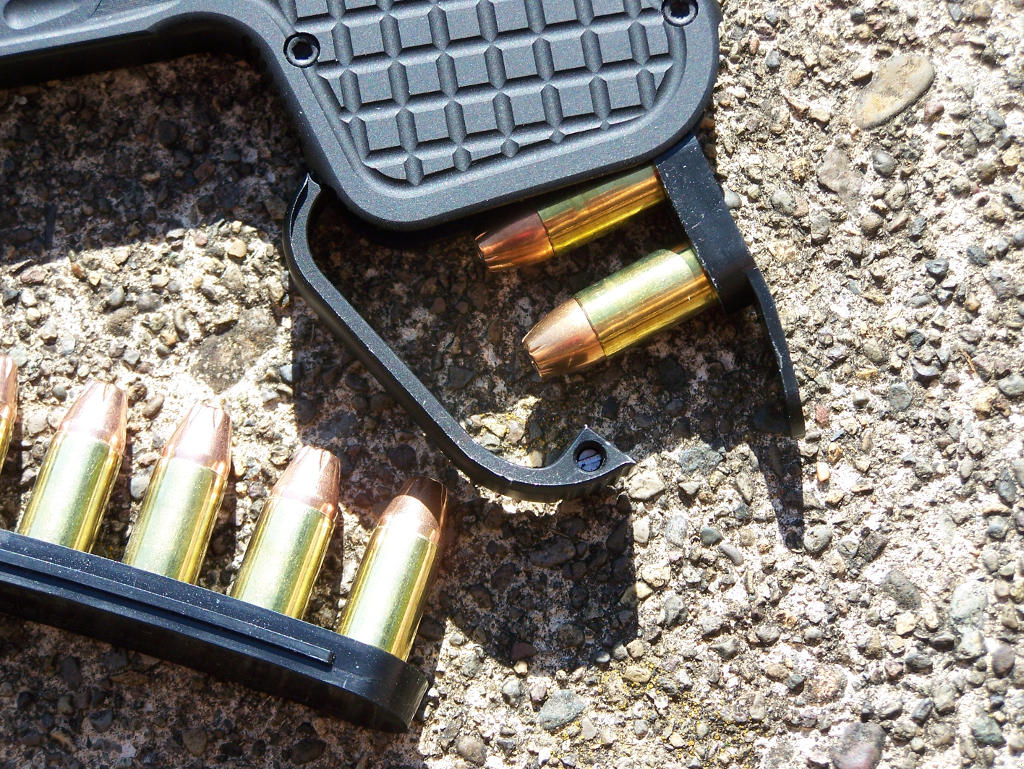
In the grip of the Double Tap, there is a hidden compartment with room for two additional rounds that are placed on a two-round speed strip, so they don’t rattle around and are fast and easy to get to for a fairly fast reload, believe it or not. I thought the little gun would be slow to reload two more rounds, after firing the first two rounds. Nope! The speed strip makes it fast and easy! You also get another speed strip that holds six more additional rounds that you can carry in a purse or pocket. All things considered, I couldn’t really find anything to fault with the little Double Tap, that is, until I fired it.

100_5983

I’m here to tell you that I’ve fired some light-weight .44 Mag revolvers with +P loads before, and while they caught my attention they didn’t hurt my hand. The Double Tap hurt the web of my hand, and it hurt for several days! I had some Black Hills Ammunition 230-gr FMJ and 230-gr JHP loads on hand to test in the Double Tap. From Buffalo Bore Ammunition I had their 160-gr low-recoil, standard velocity 160-gr Barnes TAC XP, all copper hollow point loads. To be sure, Double Tap states that you should NEVER fire +P rounds in their little guns. That’s understood!!! Good!!!

Right after I fired the first round from the Double Tap, I honestly thought that the gun might have blown-up in my hand. It hurt that much. Now, I’m no little wimp of a guy, to be sure. However, my hand hurt, and it hurt a lot. I fired the second barrel; it too hurt the web of my hand, a LOT! I fired several more rounds, using the speed loader, and it really does making reloading fast and easy. However, no matter what ammo I used, it hurt my hand. A young man who works at the gun shop told me I was a wimp. Well, he had the opportunity to fire the Double Tap at my digs, and he didn’t want to fire the second barrel, but I chided him into do so. Now, he is about 6′ 6″ tall and easily weighs in at 300-lbs; he’s strong, real strong. Yet, the Double Tap was too much for him. His father, who is also that big, didn’t find any joy in firing the Double Tap either.

100_5986

I purchased the 9mm dual barrel at the gun shop, hoping it wouldn’t hurt as much as the .45ACP version did. Now, while the 9mm was more comfortable to shoot, it still stung the web of my hand. It didn’t hurt like the .45ACP did, but it stung pretty good, too! I used some Black Hills 9mm ammo for testing out the 9mm barrels, and these were only their 115-gr FMJ loads, not hot-stepping +P loads. Still, the gun stung my hand.

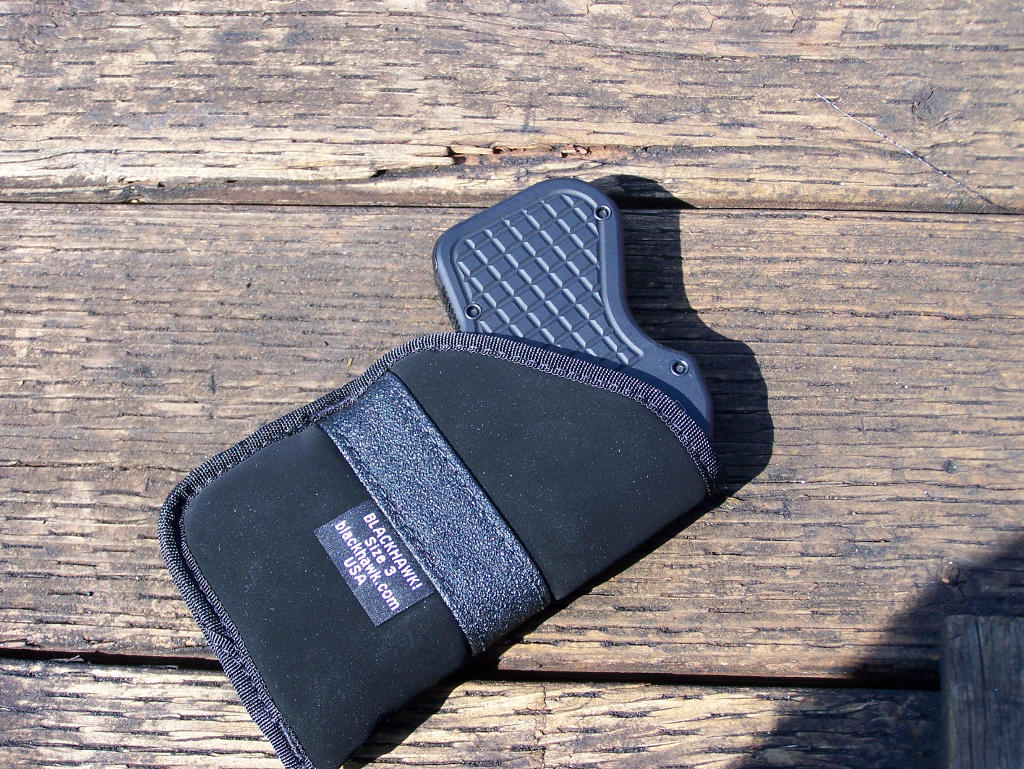
I carried the little Double Tap in my right rear pocket of my cargo pants in a pocket holster from Blackhawk Products, www.blackhawk.com, and the Double tap rode nicely in this holster. It’s the only way to carry a gun in your pocket. You must use a holster designed for pocket carry. Don’t ever just carry a handgun loosely in your pocket, like I did many years ago.

Here’s my thoughts on the Double Tap. First of all, I would never carry the Double Tap as my one and only self-defense handgun. Two shots just aren’t very comforting. Secondly, from my point of view, this gun is best reserved for up-close and personal self-defense. I could hit a target at 15-feet with the lower barrel, which is zeroed for the sights. However, using the second barrel, I could completely miss the target, because there was no such thing as a “group” when firing the Double Tap. The Double Tap is NOT a gun you want to go out and practice with on a regular basis. It will either hurt the web of your hand in .45ACP, or it will surely sting your hand in 9mm, period! This wasn’t just me; others who fired the gun said the same thing.

The Double Tap is best reserved as a back-up handgun to whatever your main handgun is you carry for self-defense. In my case, it would be a back-up to my back-up, which is a Ruger LCP .380 ACP that I carry on my ankle. However, I don’t see myself actually needing a main handgun and two back-up handguns. I honestly wouldn’t recommend the Double Tap to a woman; it just hurts too much to shoot, period! I know, some will say “any handgun is better than no gun at all.” Well, maybe that’s true and maybe not! If you are recoil shy or sensitive when you fire the Double Tap in practice, you may completely miss your target in real-life because you will be anticipating the hurt that the Double Tap delivers on both ends. The Double Tap is a handgun you buy, take out and fire half a dozen rounds through it, and then carry it, take it out six months later to fire again, and carry it. Believe me, it will not give you much pleasure to shoot a box of ammo through this gun in one shooting session or, for that matter, over several shooting sessions.

100_6038

One last thing that I wanted to mention is that the front of the trigger guard on the Double Tap has serrations on it for placement of the index finger of your off-hand when firing the gun two-handed. Well, don’t!!! I mean, don’t place your finger there! It is too close to the lower barrel, and I can see someone getting their finger in front of the barrel when firing in a hurry and completely blowing that finger off.

I was really hoping the Double Tap was going to be a handgun I would like to carry as a back-up gun only, never as a main gun for self-defense. However, the recoil and hurt was enough for me to just get rid of the gun in very short order. Was it well made? You betcha! Double Tap has done an outstanding job. It’s probably the best made two-shot derringer I’ve ever seen, and I like the double-action trigger pull, too. I would like to see this gun in .380ACP for a more enjoyable shooting session, one that wouldn’t hurt my hand so much. Double Tap has said they are coming out with more calibers. For me, the .45ACP was too painful to shoot. Six rounds was my absolute max pain threshhold; the 9mm was better, but it still stung. Once again, it wasn’t just me complaining about the Double Tap hurting the hand when fired. Maybe others are more manly than me and my friends, but we just didn’t get a lot of pleasure at all out of shooting the Double Tap.

– Senior Product Review Editor, Pat Cascio


Recipe of the Week: Homemade Graham Crackers, from A.J.

One of the things our family (everyone from toddlers to great grandparents) really enjoys for snacks as well as a dessert ingredient is graham crackers. When SHTF occurs and there are none in the stores, we’ll have the choice of going without or making our own. We’ve started making our own from our stores, as we need to now be in the habit of knowing how to provide what we want and need in the future. Wheat berries store a long time. We have a Country Living flour mill that grinds extra fine flour, beautifully. We raise chickens for eggs and have resources to provide honey and most of the other ingredients so that we won’t go without our graham crackers, even if we have to manually grind the flour. Here’s our recipe, so you don’t have to go without this wholesome and yummy snack either. We based this recipe on the one from Nancy Silverton’s Pastries fromthe La Brea Bakery Cookbook.

Ingredients

  • 2 1/2 cups flour (I use hard winter white wheat berries, freshly ground for this flour, but pre-ground all-purpose flour will also do.)
  • 1 cup brown sugar
  • 1 tsp baking soda
  • 1/2 tsp salt
  • 1/2 cup unsalted butter, cold and cubed
  • 1/3 cup honey
  • 1/4 cup milk
  • 1 Tbsp vanilla extract
  • 3 Tbsp cinnamon sugar (optional)

Directions

  1. In your mixer bowl, combine on low speed the flour, brown sugar, baking soda, and salt.
  2. Add the cold butter and mix on low speed until reaches a consistent crumble appearance.
  3. In a small bowl, whisk the honey, milk, and vanilla extract together. Add to the flour crumble mixture, mixing on low speed until it forms a smooth dough.
  4. Divide the dough in half. Wrap each half in plastic wrap and refrigerate 2-3 hours.
  5. After the dough has chilled. Preheat oven to 350 degrees Fahrenheit.
  6. Turn one portion of dough out onto a large sheet of parchment paper that is lightly floured; roll it into a rectangle that is about 1/8” thick. Mine usually comes out to about 14×10”.
  7. Transfer the parchment paper containing the rolled dough onto a large cookie sheet.
  8. Using a knife, cut the dough into four columns and three rows or use a square cookie cutter. Use a fork or toothpick to poke holes into the crackers. (This is a fun job for the kids.)
  9. Repeat the rolling, transfer, cutting, and hole poking with the second portion of dough.
  10. Optional: Sprinkle the dough with cinnamon sugar, or other spice/flavoring.
  11. Bake 15-20 minutes,until slightly browned. Cool for 10 minutes before cutting apart and serving.
  12. Store in airtight container or ziploc bag at room temperature or in freezer for longer storage.

o o o

Do you have a favorite recipe that would be of interest to SurvivalBlog readers? Please send it via e-mail. Thanks!


Letter Re: Egg Rationing

HJL,

I am one of THOSE who do not yet have their own chickens but hopefully within a couple of months though. You may have seen this already. I haven’t experienced the rationing, but I bought eggs in April at $1.97 a dozen and went back yesterday to discover they were $2.97 a dozen at my local Walmart. Wow! – C.P.

HJL Replies: We have had chickens for a number of years now and have enjoyed the fresh eggs tremendously. The price of eggs have always been a bit of a sore point with me though. I cannot produce eggs as inexpensive as what you can buy them at Walmart. Even with the recent increase in egg prices, I am not sure that I save any money. However, the quality of the eggs is far above anything that I can buy. Modern egg farms have the science of eggs down, and they tend to keep the chickens just barely above starvation by just feeding them enough to optimally produce. As a child, I can remember buying grade AAA eggs at the local grocery store. Good luck with that today. The best I have seen in years is grade AA with most being grade A. The eggs my chickens produce are well above the AAA grade and taste much better. Even if I never break even on the cost of the eggs, I know exactly what goes into mine, and I actually like my chickens.


Odds ‘n Sods:

Police Seize 6 Children Simply Because Family Was Camping – D.S.

o o o

Huge problem for gun-grabbers: Polls reveal Americans know guns make their homes and neighborhoods safer. – H.L.

o o o

You Can Be Prosecuted for Clearing Your Browser History. – T.P.

“Prosecutors are able to apply the law broadly because they do not have to show that the person deleting evidence knew there was an investigation underway.”

o o o

The president’s pistol: Ronald Reagan carried a handgun in his briefcase at all times during his administration, author reveals. – G.G.

o o o

New gun blamed for rise in LA County deputy shootings – Smith & Wesson M&P9. – T.J.

Of course, it couldn’t possibly be the training and the fact that the trigger finger is on the trigger when it shouldn’t be. – HJL


Notes for Sunday – June 14, 2015

During the American Revolution, the Continental Congress adopted a resolution on June 14th, 1777, stating that “the flag of the United States be thirteen alternate stripes red and white” and that “the Union be thirteen stars, white in a blue field, representing a new Constellation.” The national flag, which became known as the “Stars and Stripes,” was based on the “Grand Union” flag– a banner carried by the Continental Army in 1776 that also consisted of 13 red and white stripes.

o o o

Today, we present another entry for Round 59 of the SurvivalBlog non-fiction writing contest. The $12,000+ worth of prizes for this round include:

First Prize:

  1. A Gunsite Academy Three Day Course Certificate, good for any one, two, or three day course (a $1,195 value),
  2. A course certificate from onPoint Tactical. This certificate will be for the prize winner’s choice of three-day civilian courses. (Excluding those restricted for military or government teams.) Three day onPoint courses normally cost $795,
  3. DRD Tactical is providing a 5.56 NATO QD Billet upper with a hammer forged, chromlined barrel and a hard case to go with your own AR lower. It will allow any standard AR type rifle to have quick change barrel, which can be assembled in less than one minute without the use of any tools, and a compact carry capability in a hard case or 3-day pack (an $1,100 value),
  4. Gun Mag Warehouse is providing 20 Magpul pmags 30rd Magazines (a value of $300) and a Gun Mag Warehouse T-Shirt. (An equivalent prize will be awarded for residents in states with magazine restrictions.),
  5. Two cases of Mountain House freeze dried assorted entrees in #10 cans, courtesy of Ready Made Resources (a $350 value),
  6. A pre-selected assortment of military surplus gear from CJL Enterprize (a $300 value),
  7. A Model 120 Series Solar Generator provided by Quantum Harvest LLC (a $340 value),
  8. A $300 gift certificate from Freeze Dry Guy,
  9. A $250 gift certificate from Sunflower Ammo,
  10. KellyKettleUSA.com is donating both an AquaBrick water filtration kit and a Stainless Medium Scout Kelly Kettle Complete Kit with a combined retail value of $304,
  11. TexasgiBrass.com is providing a $300 gift certificate, and
  12. Two cases of meals, Ready to Eat (MREs), courtesy of CampingSurvival.com (a $180 value).

Second Prize:

  1. A Glock form factor SIRT laser training pistol and a SIRT AR-15/M4 Laser Training Bolt, courtesy of Next Level Training, which have a combined retail value of $589,
  2. A FloJak EarthStraw “Code Red” 100-foot well pump system (a $500 value), courtesy of FloJak.com,
  3. Acorn Supplies is donating a Deluxe Food Storage Survival Kit with a retail value of $350,
  4. The Ark Institute is donating a non-GMO, non-hybrid vegetable seed package–enough for two families of four, seed storage materials, a CD-ROM of Geri Guidetti’s book “Build Your Ark! How to Prepare for Self Reliance in Uncertain Times”, and two bottles of Potassium Iodate– a $325 retail value,
  5. A $250 gift card from Emergency Essentials,
  6. Twenty Five books, of the winners choice, of any books published by PrepperPress.com (a $270 value),
  7. TexasgiBrass.com is providing a $150 gift certificate, and
  8. RepackBox is providing a $300 gift certificate to their site.

Third Prize:

  1. A Royal Berkey water filter, courtesy of Directive 21 (a $275 value),
  2. A large handmade clothes drying rack, a washboard, and a Homesteading for Beginners DVD, all courtesy of The Homestead Store, with a combined value of $206,
  3. Expanded sets of both washable feminine pads and liners, donated by Naturally Cozy (a $185 retail value),
  4. Two Super Survival Pack seed collections, a $150 value, courtesy of Seed for Security, LLC,
  5. Mayflower Trading is donating a $200 gift certificate for homesteading appliances,
  6. APEX Gun Parts is donating a $250 purchase credit,
  7. Montie Gear is donating a Y-Shot Slingshot and a Locking Rifle Rack (a $379 value), and
  8. Two 1,000-foot spools of full mil-spec U.S.-made 750 paracord (in-stock colors only) from www.TOUGHGRID.com (a $240 value).

Round 59 ends on July 31st, so get busy writing and e-mail us your entry. Remember that there is a 1,500-word minimum, and that articles on practical “how to” skills for survival have an advantage in the judging.


Personal Notes of Application From SurvivalBlog’s “The Frog in A Slowly Heating Pot”- Part 2, by C.F.

Self-reliance/independence

Self-reliance and independence is required in every area, if we wish to be free. It is always better to take the side of truth. Freedom is dangerous; tyranny is worse. Helpless dependence upon humanity is bondage. Helpless dependence upon Christ is freedom, for He is our source of ability.

Remember the principle “that every man be armed” does not require that every man be armed with any particular tool but that every man be armed with the most effective equipment he can obtain and be trained in its proper and effective use. “Put on the whole armor…, and having done all, to stand,” declared the apostle.

Physical fitness is every bit as important as tools, if not more so. Our health is our most valuable possession. Therefore, we should strive for a lifestyle that will include large amounts of moderate outdoor exercise. Again, use what you have rather than sitting around wishing you were younger, stronger, wiser, or more skilled.

Mechanics of Battle

In an open area, such as the parking lot, contact weapons are very effective. On the other hand, when obstacles and barricades are available, projectile weapons offer a huge advantage. In their situation, bows and arrows would have given a valuable advantage over axes and similar tools. Obviously, firearms would be preferred.

Any large weapon that requires space to operate– a spear, bow, or long gun– should be coupled with a side-arm to use if the enemy should get too close. A 5-inch-plus belt knife is good. Instant accessibility is vital. It should be strong enough to withstand its operator’s adrenaline, have an effectively efficient point for penetrating, and an effective finger guard. Hopefully, it will be just as useful for utility purposes as for combat.

Building the Wall

Barricades were built across each driveway, including the driveways of the unoccupied homes. “From the road, all our laneways curved up to our homes through stands of hardwoods and cedars… an effective screen in every sense of the word.” When the raid came, staying out of sight was of vast importance. The raiders saw two men and one gun.

The Truck Trap

Under the unique circumstances, it was a stroke of genius! It was non-injurious but effective.

The Engagement

“Six days after our re-organization,…” How many days did it take to implement the reorganization? I’d guess that they barely had the defenses in place in time.

“Mark heard trucks coming down the road. The baby monitor crackled a warning, and Sue yelled out to John, Peter, myself, and our boys. We all grabbed our gear and went to the barricade.”

“They stopped at our laneway. There was silence for a moment, and then we heard a guy yell, ‘I’m telling you, this is the place! I saw him in town a few days ago with his truck.’”

There was a clue. These guys weren’t lost.

“They pulled apart our barricade.” “The trucks came up the laneway.” “The first truck got stuck between the logs [in the carefully-located truck trap]. Eight men poured from the trucks.”

Why were three trucks and eight men? Why not send one truck with two or three men to each house? Did they expect to harvest three truckloads of loot?

“You guys make fine targets.” That was a fair warning, a wise challenge.

“They looked around but couldn’t see us for the trees.” This is so important. They had only heard one man yell.

“We don’t want any trouble. We need food.”

This sounds as if they were pleading and comes across as disarming and asking for pity. They wanted easy pickings. Plunder will cease only when labor becomes significantly less painful than plunder. This is a law of human nature. These fathers/husbands/brothers were determined to make plunder painful.

“You can’t stop us all!” Nice threat, bullies. Are you sure? These words are anything but peaceable. They betray the venom of violent intent.

Mr. H, again, was the only one who spoke. Yet, he spoke of “we” and “us.”

With regards to food, he said, yes, we’ll help you. “Love your enemies.” Matthew 5:44. “If thine enemy hunger, feed him.” Romans 12:20. However, you could poach your own deer without attacking people and risking getting shot for it. (Survival hunting in a life-threatening food emergency is lawful.) You could come without such a show of force and simply ask for food.

Notice that Mr. H. did not say anything to indicate that they had any food, except what they had just harvested, and they did not show the men how to “unstick” the truck or give them time to figure out how.

Reactionary Space

Until the men were safely out on public right-of-way, it would not be safe to send anyone to get a haunch of deer, and until the truck was unstuck and down to the hole in the barricade nobody could be tolerated in the laneway. Only when the invitation was given to send ONE MAN up to get the truck, could ONE MAN be allowed to come up the lane. Any violation of orders would be an act of belligerence.

Note that no warning shots were fired. None were needed. They needed every single cartridge that the shotgun could hold to be reserved for real targets, and five choice words were perfectly effective as warning. If he had fired a warning shot, it might have given the attackers grounds for filing legal charges.

A warning shot may betray reluctance to employ force. This reluctance reduces the psychological effect of a verbal warning.

Finally, these desperate, hungry men were probably not normally violent. We see no evidence of illegal weapons in their hands such as what a city gang might have. Neither did we see these items in the hands of the mob at Home Depot. These were simply strangers, neighbors-turned-looters. It is a blessing that they were stopped from committing a crime. Hopefully, they were deterred from harming others and found a better way to feed their families than by robbery.

Peace Through Strength

When land line phones, cell service, and Internet are all out of commission, the violent element feels that “the cat is away,” so “the mice can play.” Nobody can call the police!

“When a strong man armed keepeth his palace, his goods are in peace,” said Jesus. Mr. H and company followed Nehemiah’s example; and like Nehemiah, their efforts were rewarded. They did not suffer loss of life or critical infrastructure, only minor damage to property.

“But when a stronger than he shall come upon him, and overcome him, he taketh from him all his armour wherein he trusted, and divideth his spoils.” Matthew 11:22.

“Except the LORD build the house, they labour in vain that build it: except the LORD keep the city, the watchman waketh but in vain.” Psalm 127:1.

“Thou art my King, O God: command deliverances for Jacob. Through thee will we push down our enemies: through thy name will we tread them under that rise up against us. For I will not trust in my bow, neither shall my sword save me. But thou hast saved us from our enemies, and hast put them to shame that hated us. In God we boast all the day long, and praise thy name for ever. Selah.” Psalm 44:4-8.

Faith in God requires us to exert all the energy and wisdom He gives. However, if we trust in our own efforts and fail to give credit where credit is due, God will humble us. It is better to humble ourselves under the mighty hand of God.

The Maple Leaf

“I saw the maple leaf on his shoulder. The army was here checking on us to make sure we were safe.”

Excellent. That is what they should do. However, beware. If martial law is declared, the visit of the maple leaf could likely involve confiscation or the commandeering of supplies, vehicles, firearms, livestock, and/or the owners thereof. It would make the visit of the raiders pale into the shadows.

So, not only is it necessary to be prepared to shelter in place and to withstand civil unrest, but plans should be in place to escape the iron talons, on short notice, when the pot boils over. In the example here, would they have had one minute, three minutes, or five minutes, in which to melt into the woodwork? Would they have been aware of such a change in government? Would they have wisdom to relate to a total lockdown of travel, permits for travel, roadblocks everywhere, and unknown other new impositions?

Thank God for a little respite. He is still holding the winds of strife.

The Shorter Path

“And it came to pass, when Pharaoh had let the people go, that God led them not through the way of the land of the Philistines, although that was near; for God said, Lest peradventure the people repent when they see war, and they return to Egypt.” Exodus 13:17.

America, including Canada, has been very sheltered, far more sheltered than were the Israelites during their sojourn in Egypt. Today, God wants to lead His people into the heavenly Caanan, but many of us are soft. We have not seen war. Our conflicts have been petty affairs. We enjoy our secure society that insulates us from the harsh realities of nature and the harsher realities of demon-possessed humanity. We have no clue what “the land of the Philistines” is like.

Likewise, Jesus wanted to prepare His disciples for the shock of His agony, capture, torture, and death. “I have yet many things to say unto you, but ye cannot bear them now. Howbeit when he, the Spirit of truth, is come, he will guide you into all truth: for he shall not speak of himself; but whatsoever he shall hear, that shall he speak: and he will show you things to come.” John 16:12, 13.

Thank God that He is patient. He is leading on gently, not allowing us to be over-driven. “If men should overdrive them one day, all the flock will die.” Genesis 33:13.

Yet, the day of battle is coming. As with Israel, the time to enter Caanan is coming. Here is what they did:

“And all the children of Israel murmured against Moses and against Aaron: and the whole congregation said unto them, Would God that we had died in the land of Egypt! or would God we had died in this wilderness! And wherefore hath the LORD brought us unto this land, to fall by the sword, that our wives and our children should be a prey? were it not better for us to return into Egypt? And they said one to another, Let us make a captain, and let us return into Egypt.” Numbers 14:2-4.

They had not even attempted to obey. They wanted to die, so that they wouldn’t need to try! They refused to believe that God would do all that human power could not, so that they could obey His commands.

“If thou hast run with the footmen, and they have wearied thee, then how canst thou contend with horses? and if in the land of peace, wherein thou trustedst, they wearied thee, then how wilt thou do in the swelling of Jordan?” Jeremiah 12:5.

Faith would have enabled Israel to take the shorter path into Caanan. If their faith had been strong, they could have skipped 40 years of wandering in the wilderness. Maybe God would have led them in by the way of the Philistines, maybe not. In any case, we have the failure to avoid repeating.

Our Essential Training

“Come where Christ is, and you will have light. Talk unbelief, and you will have unbelief; but talk faith, and you will have faith. According to the seed sown will be the harvest. If you talk of heaven and the eternal reward, you will become lighter and lighter in the Lord, and your faith will grow, because it is exercised. Fasten your eyes upon Jesus, dear friends, and by beholding you will become assimilated to his image. Do not allow your thoughts to dwell continually upon things of the earth, but place them upon things that are heavenly, and then, wherever you are, you will be a light to the world.

“Live the life of faith day by day. Do not become anxious and distressed about the time of trouble, and thus have a time of trouble beforehand. Do not keep thinking, ‘I am afraid I shall not stand in the great testing day.’ You are to live for the present, for this day only. Tomorrow is not yours. Today you are to maintain the victory over self. Today you are to live a life of prayer. Today you are to fight the good fight of faith. Today you are to believe that God blesses you. And as you gain the victory over darkness and unbelief, you will meet the requirements of the Master, and will become a blessing to those around you.” Historical Sketches, 142-143.

“All who are under the training of God need the quiet hour for communion with their own hearts, with nature, and with God. In them is to be revealed a life that is not in harmony with the world, its customs, or its practices; and they need to have a personal experience in obtaining a knowledge of the will of God. We must individually hear Him speaking to the heart. When every other voice is hushed, and in quietness we wait before Him, the silence of the soul makes more distinct the voice of God. He bids us, “Be still, and know that I am God.” Psalm 46:10. This is the effectual preparation for all labor for God. Amidst the hurrying throng, and the strain of life’s intense activities, he who is thus refreshed will be surrounded with an atmosphere of light and peace. He will receive a new endowment of both physical and mental strength. His life will breathe out a fragrance, and will reveal a divine power that will reach men’s hearts.” The Ministry of Healing, pg. 58.

This training is the door to all other training. God gives the farmer wisdom (Isaiah 28:24-26). He gives the workman skill (Exodus 31:2, 3). He is the best teacher of military science (Psalm 18:34; 144:1).

“Success is not the result of chance or of destiny; it is the outworking of God’s own providence, the reward of faith and discretion, of virtue and persevering effort. The Lord desires us to use every gift we have; and if we do this, we shall have greater gifts to use. He does not supernaturally endow us with the qualifications we lack; but while we use that which we have, He will work with us to increase and strengthen every faculty. By every wholehearted, earnest sacrifice for the Master’s service our powers will increase. While we yield ourselves as instruments for the Holy Spirit’s working, the grace of God works in us to deny old inclinations, to overcome powerful propensities, and to form new habits. As we cherish and obey the promptings of the Spirit, our hearts are enlarged to receive more and more of His power, and to do more and better work. Dormant energies are aroused, and palsied faculties receive new life.” Christ’s Object Lessons, pgs. 353-354.

May God help us to follow His leading faithfully. This will prepare us for every emergency.


Letter: Instinct Shooting

Pat:

I have a question about instinct shooting. Several years ago I saw a video showing a technique called “index shooting”. This video had the shooter standing with his handgun arm locked at right angel and elbow locked to side with handgun approximately six inches out from lower ribcage. Wrist is locked and shooter swings torso to change radial firing direction. Off hand is held up toward chest with palm pressed to upper chest to keep it behind the muzzel. In the video demo the shooter was very accurate, but I have not seen this technique elsewhere and have lost the link long ago. This may not be called “index shooting”. Any info would be appreciated. Thanks. – J.B.

Pat Cascio Responds: There are several different types of Point Shooting, or Instinct Shooting, being taught out there, and one particular method– the one I learned from the late Col. Rex Applegate– is simply called Point Shooting, and it can easily be learned in an hour or less. There are several methods demonstrated in my DVD Tactical Point Shooting by Paladin Press. One method is the “Lift” that I favor; another is the “Swing”, demonstrated by the late John McSweeney, and there is another method that is called the “Push” and taught by Sheriff Jim Wilson, in the DVD. I believe the DVD is only $9.95 from Paladin Press.

In the DVD entitled Rex Applegate, The Lost Tapes that I produced for the good Colonel back in 1992, you will see two young men demonstrating Instinct Shooting. I taught both of these young men how to do this over an hour lunch break. Mas Ayoob also teaches a form of Point Shooting in his book Stress Fire. Applegate’s DVD also sells for $9.95 from Paladin Press and is very informative.

Lastly, you may want to purchase a copy of Kill Or Get Killed, which was written by Col. Applegate during WWII, when he was with the OSS. Here he demonstrates Instinct Shooting, as well as a lot of other self-defense techniques. This book is the longest and best-selling book on close combat methods in history.

I have found that Point Shooting, in most cases, is very accurate out to about 18-21 feet with a modicum of practice. However, keep in mind that aimed shooting is always best, when you have the time, the light, and other factors working for you. When you don’t, resort to Point Shooting!


Odds ‘n Sods:

7 Key Events That Are Going To Happen By The End Of September. – J.C.

o o o

An interesting reality show is getting ready to air on the History Channel. Advertised as “no props, no camera crews and no safety nets”, Alone is set to air on June 18th at 10/9C. Take a peek at the sample videos. – K.B.

o o o

SpaceX Plans to Launch Network of Satellites to Provide Off Grid Internet Access. – W.

o o o

DALLAS POLICE SHOOTING: ‘Zombie Apocalypse Assault Vehicle and Troop Transport’. – JBG

o o o

12 Reasons America Doesn’t Win Its Wars. – J.M.


Hugh’s Quote of the Day:

“And they brought young children to him, that he should touch them: and his disciples rebuked those that brought them. But when Jesus saw it, he was much displeased, and said unto them, Suffer the little children to come unto me, and forbid them not: for of such is the kingdom of God. Verily I say unto you, Whosoever shall not receive the kingdom of God as a little child, he shall not enter therein. And he took them up in his arms, put his hands upon them, and blessed them.” Mark 10:13-16 (KJV)


Notes for Saturday – June 13, 2015

Today, we present another entry for Round 59 of the SurvivalBlog non-fiction writing contest. This entry is a little bit different than the normal “how-to”. Rather than presenting an article of his own experience, this author has given us an inside track to his thinking while analyzing another article on the blog. He shares how the information he reads applies directly to him and what he can learn from it. I’ve included it as an example of what we should all be doing for any experience. Evaluate what happened, change what didn’t work, and emphasize what did work. You might call it an “after-action report” of sorts.

The $12,000+ worth of prizes for this round include:

First Prize:

  1. A Gunsite Academy Three Day Course Certificate, good for any one, two, or three day course (a $1,195 value),
  2. A course certificate from onPoint Tactical. This certificate will be for the prize winner’s choice of three-day civilian courses. (Excluding those restricted for military or government teams.) Three day onPoint courses normally cost $795,
  3. DRD Tactical is providing a 5.56 NATO QD Billet upper with a hammer forged, chromlined barrel and a hard case to go with your own AR lower. It will allow any standard AR type rifle to have quick change barrel, which can be assembled in less than one minute without the use of any tools, and a compact carry capability in a hard case or 3-day pack (an $1,100 value),
  4. Gun Mag Warehouse is providing 20 Magpul pmags 30rd Magazines (a value of $300) and a Gun Mag Warehouse T-Shirt. (An equivalent prize will be awarded for residents in states with magazine restrictions.),
  5. Two cases of Mountain House freeze dried assorted entrees in #10 cans, courtesy of Ready Made Resources (a $350 value),
  6. A pre-selected assortment of military surplus gear from CJL Enterprize (a $300 value),
  7. A Model 120 Series Solar Generator provided by Quantum Harvest LLC (a $340 value),
  8. A $300 gift certificate from Freeze Dry Guy,
  9. A $250 gift certificate from Sunflower Ammo,
  10. KellyKettleUSA.com is donating both an AquaBrick water filtration kit and a Stainless Medium Scout Kelly Kettle Complete Kit with a combined retail value of $304,
  11. TexasgiBrass.com is providing a $300 gift certificate, and
  12. Two cases of meals, Ready to Eat (MREs), courtesy of CampingSurvival.com (a $180 value).

Second Prize:

  1. A Glock form factor SIRT laser training pistol and a SIRT AR-15/M4 Laser Training Bolt, courtesy of Next Level Training, which have a combined retail value of $589,
  2. A FloJak EarthStraw “Code Red” 100-foot well pump system (a $500 value), courtesy of FloJak.com,
  3. Acorn Supplies is donating a Deluxe Food Storage Survival Kit with a retail value of $350,
  4. The Ark Institute is donating a non-GMO, non-hybrid vegetable seed package–enough for two families of four, seed storage materials, a CD-ROM of Geri Guidetti’s book “Build Your Ark! How to Prepare for Self Reliance in Uncertain Times”, and two bottles of Potassium Iodate– a $325 retail value,
  5. A $250 gift card from Emergency Essentials,
  6. Twenty Five books, of the winners choice, of any books published by PrepperPress.com (a $270 value),
  7. TexasgiBrass.com is providing a $150 gift certificate, and
  8. RepackBox is providing a $300 gift certificate to their site.

Third Prize:

  1. A Royal Berkey water filter, courtesy of Directive 21 (a $275 value),
  2. A large handmade clothes drying rack, a washboard, and a Homesteading for Beginners DVD, all courtesy of The Homestead Store, with a combined value of $206,
  3. Expanded sets of both washable feminine pads and liners, donated by Naturally Cozy (a $185 retail value),
  4. Two Super Survival Pack seed collections, a $150 value, courtesy of Seed for Security, LLC,
  5. Mayflower Trading is donating a $200 gift certificate for homesteading appliances,
  6. APEX Gun Parts is donating a $250 purchase credit,
  7. Montie Gear is donating a Y-Shot Slingshot and a Locking Rifle Rack (a $379 value), and
  8. Two 1,000-foot spools of full mil-spec U.S.-made 750 paracord (in-stock colors only) from www.TOUGHGRID.com (a $240 value).

Round 59 ends on July 31st, so get busy writing and e-mail us your entry. Remember that there is a 1,500-word minimum, and that articles on practical “how to” skills for survival have an advantage in the judging.


Personal Notes of Application From SurvivalBlog’s “The Frog in A Slowly Heating Pot”- Part 1, by C.F.

First of all, let me say that Mr. N.H., who wrote The Frog in a Slowly Heating Pot, is a skilled writer; he provided a very picturesque, succinct, and articulate article. More importantly, the experience he shared was dynamic and highly educational. It was not some far-fetched, improbable scenario, but a very common and probable one, and the lessons he learned can be a blessing to many, it seems.

Yes, we have questioned the story’s authenticity, but upon close examination I cannot find anything that would prove it to be fictitious based on internal evidence. If it is fictitious, the author has committed a grave offense, with significant legal ramifications, since he entered it in a non-fiction contest. However, unless evidence is forth-coming, we will consider it to be his best effort at sharing his actual experience, including some numb-skullery that anyone would be prone to. The one item we can’t quite reconcile is the day-count. It seems he missed a day somewhere. However, this would be an easy thing to get mixed up about, and I doubt he kept a diary during the events.

I’ve looked into his story and researched it a bit to identify a likely location that fits his story. The basic timeline of his story looks like:

  • First storm– two days before Second Storm
  • 2nd Day– It’s cold; he’s checking on neighbors, et cetera.
  • 3rd Day– He heard first vehicles and went to town; he saw the sign in bank window; neighbors’ relatives arrive
  • 6th Day– Town trip, man wanting ride; pumps smashed, bank window broken, “NO GAS”
  • 7th Day– City trip, Home Depot incident, which prompts reorganization
  • 12th or 13th Day?–the raid
  • 13th or 14th Day?–the military comes by. End of story.

They took the warning! The earlier ice storm gave them a taste, the second one hit with vengeance, and they were prudent enough to go to their refuge.

“The same voice that warned Lot to leave Sodom bids us, ‘Come out from among them, and be ye separate, . . . and touch not the unclean.’ Those who obey this warning will find a refuge.” Country Living, pg. 6.

Those who fail to take the warning will come up to the crisis unprepared, like the five foolish virgins of Matthew 25. Training cannot be transferred in an instant. Skill cannot be transferred. Like food, it must be grown. This requires time and effort. True education is a lifestyle. If you don’t have it, get out of the way of those who do, and pick up all you can as you go.

They had a farm to go to! Very few people do. Also, they were better equipped than their close neighbors. Peter and Wendy had relatives willing to take them in.

Yet, they were not very well prepared. Food ran out in a few days. (It seems that they were not growing and storing the bulk of their own food year by year. This may be understandable, since they live in the city five days a week.) If they had been fully immersed in the agricultural cycle, with grain in dry storage, potatoes, carrots, beets, apples, et cetera in the cellar and home-canned foods stored that were harvested in season, they certainly would not have run out in two weeks, even with more than twice as many mouths in the house.

They were dependent on a generator for water. Without it, they would have been melting snow and ice. John and Carol would have been doing it on a campfire. Depending on an outdoor fire for melting snow, when you do not have firewood stored, is not nice, especially when your house is a walk-in freezer!

The Thief Magnet

The big hazard with engine-powered generators is mentioned– noise. A solar system solves this, to the relief of everyone’s nerves. It also reduces the consumption of fuel. It too can fail, but it is better in most ways. Solar systems can be stolen too, but they are easier to hide than noisy generators. (Unless the thieves have aerial observation abilities.)

“We have lots of wood… fuel… food.” Everyone seems to think that. Reality is, when the world grinds to a halt and you need to feed a small town from your own store and make a bunch of adjustments that require unusual parts and pieces, nobody has “lots” of anything. Often, we have lots of what we don’t need. However, the saying goes: For want of a nail the shoe was lost, for want of a shoe the horse was lost, for want of a horse the knight was lost, for want of a knight the battle was lost, for want of a battle the kingdom was lost. So, a kingdom was lost, all for want of a nail.

We are totally dependent upon God to supply countless details over which we have no control. Yet, He requires us to do all in our power to foresee needs and provide for them, and He often steps in and supplies our lack in ways that we would never expect or imagine.

No mention is made of chainsaws, but I’d guess they had some. This would save a huge amount of time. However, the hand tools are absolutely vital, just as we need buckets in case the plumbing quits.

“The neighborhood was full of fairly self-sufficient farmers.” Wonderful! However, John and Carol didn’t seem well equipped. They had no wood stove! Were they able to winterize their plumbing before it froze and broke? Hopefully they were the exception to the rule and were the ones less-ready than most.

It was a situation of no phones, no Internet, no power, no banks, and NO MONEY. Only the cash in hand worked. There was no bank-by-mail either, most likely, because only the more central post offices probably have trucks coming and going, and there’d be no rural delivery for a while. So, cash in hand is what works in these kind of situations.

“NO GAS.” Apparently, there was still gas in the tanks on the third day, in the small town, but it was gone by the sixth day.

In the small town, in three days, people had gone from taping up signs to breaking windows.

Most likely, by the sixth day, the big city had most of its power, phone, and deliveries back in operation again. News reports would seem to indicate that a large portion of service was restored within 24-48 hours, but rural areas would usually be slower to recover. They tend to have lots of little overhead wires.

Frog Moment

“The small warning signs were not heeded; they were ignored as pitiable acts by a few lunatics.” “He kept saying, ‘Civilization is not over!’”

“Small warning signs.” We might say “straws in the wind” for those in tornado country, or “burnt bark and twigs falling” for those in forest fire country. “Coming events cast their shadows before.” The Desire of Ages, pg. 636.

They knew people were desperate. They had seen the vandalism. He had seen someone attempting to steal his generator, way out in the farming district, and escaped losing the source of power and running water only by the grace of God and the wise bravery of the dogs.

This “frog factor” is what got them into the mess at Home Depot. If they had been aware, they wouldn’t have gotten close enough to the crowd to hear what was going on. Thankfully, he wasn’t paralyzed when the mob attacked the truck!

The incident at Home Depot got their attention, but the seed of the next incident– one that could have cost them everything– had been planted the day before, closer to home.

If they had been better provisioned and aware, they would probably have never ventured into town at all during this period. However, they would not have seen, first-hand, the danger of venturing, and we would not have this lesson to study.

The Raid

The coming of the desperadoes could have ended in disaster. However, God gave the author and his group wisdom to prepare some limited defenses and then allowed only the form of attack that these defenses were able to bear. At the same time, He showed them how easily they might have been harmed, and that He approved their diligence.

The Lord helped them recognize danger early enough to mobilize the full defensive force. He gave them wise words, miraculously wise, and He put fear in the hearts of the assailants. He preserved everyone from injury.

The Informer

How did that guy who asked for a ride, find their house? Did he recognize Mr. H? We don’t know. However, if the license plate on their truck was connected to the physical address of the farm, this would do it. It seems that this fellow was in strange territory, but he had accurate directions to the address. Did he have access to the records lodged with the Department of Motor Vehicles? Was he an off-duty policeman? Did he have a GPS, or a map? We don’t know. Whatever the case, he saw that they had a load of supplies.

The Reorganization

After the experience at Home Depot, the men of the house did what every man should do. “Let every man be wide awake for himself, and try to save his family. Let him gird himself for the work. God will reveal from point to point what to do next.” Country Living, pg. 6. “A prudent man foreseeth the evil, and hideth himself: but the simple pass on, and are punished.” Proverbs 22:3, 27:12.

“Likewise at the same time said I unto the people, Let every one with his servant lodge within Jerusalem, that in the night they may be a guard to us, and labour on the day.” Nehemiah 4:22.

It appears that one of the three families had a cold house. It is also obvious that it is easier to guard one house effectively, than three houses. So, moving crucial supplies and valuables to a single location, where all can join in the security effort, is wise. Actually, combining three households into one may be an ideal concentration of force.

In this case, yes, it was four families. It made for a total of 11 people that we know about. (Apparently, Peter and Wendy had at least one son.) The fourth family contributed mainly their labor and a reluctant mindset; yet, it was a blessing that they could escape the city, and I’m sure it changed their lives for the better.

Setting a Watch

“Someone was always awake and alert.” “We patrolled day and night.” In order to do this effectively, it is necessary to have at least three people. Four is better, allowing four two-hour shifts through the night, with two-hour naps staggered through the day, if all is ideal. If only two people try to maintain around-the-clock guard duty, it will be hard to do much else other than besides eating and sleeping. While lone persons can try to stay alert 24/7, they will sleep by fits and starts, and their overall well-being will suffer.

In the arrangements made in this story, the patrolman routinely checked the other two houses. It almost sounds like these three homes were at “the end of the road”, because the patrol trails did not cross the road? If they had needed to cross a through-road, that point would have been a weak link in their security, making the patrol obvious to through-traffic. Or, maybe they were all on the same side of the road?

“So neither I, nor my brethren, nor my servants, nor the men of the guard which followed me, none of us put off our clothes, saving that every one put them off for washing.” Nehemiah 4:23.

Communication

“The work is great and large, and we are separated upon the wall, one far from another. In what place therefore ye hear the sound of the trumpet, resort ye thither unto us: our God shall fight for us.” Nehemiah 4:19, 20.

Communication is vital to all warriors. Nehemiah proves this. By far, the most crucial communication is pointed out by Paul in connection with the Christian’s armor: “Praying always with all prayer and supplication in the Spirit, and watching thereunto with all perseverance and supplication.” Ephesians 6:18

Nehemiah’s entire expedition and work centered in prayer. He had a secure, instant, reliable communication with his Captain, but he also used other methods to communicate with humanity.

Military has always used several types of signals. First of all, they’ve used silent visual signals. (Hand signals, flags, and lights would be in this category.) Second, they’ve used auditory signals. Whistles can be heard effectively in spite of gunfire, voices, or other noise. The trumpet, or siren, carries well over long distances and is of long enough duration to get one’s attention. Africa is famed for its “jungle telegraph”– drums. Third, the running messenger has been used.

In the story, the family had baby monitors that they were able to use to communicate. I don’t know what kind, or how they worked, but at least the patrolman could communicate with the people at the house. Two-way radios would be better than one-way. Some baby monitors do offer two-way communication. It appears that shortness of range may be a main downside to the baby monitor. However, it might be offset by low power consumption, in some cases.

Today, for a few dollars, FRS radios can be had. Substantially better is the Baofeng VHF-UHF hand-held radio–also very inexpensive. It is excellent for Ham radio applications, and can be used in conjuction with public emergency service and business radios if necessary. It can be used as a 125-channel scanner.

If you have no license for Amateur Radio or otherwise, stick to the five frequencies of the Multi-Use Radio Service (MURS), and the low-power, narrow-band setting. This should keep you legal, while allowing you to communicate for several miles. (With a good antenna, 30 miles is common, line-of-sight.) It is also legal to use MURS for business communication.

The Baofengs are totally capable of communicating with FRS and GMRS 12radios (including the analog [CTCSS] and digital [CDCSS] privacy codes) if needed, in an emergency. NOTE: Privacy codes do not give you any protection from eaves-droppers. They only make it so you can’t hear unless the person talking has set their radio to transmit the specific code you have selected. Then, that code will activate your receiver. (This is seful if there is too much irrelevant radio traffic from unrelated parties that irritates or desensitizes the person who is responsible for monitoring.)

If you need to obfuscate your radio communication from local thugs, it would be good to set up a military style system of codes and frequency shifts. With Ham radio equipment (such as the Baofeng or others), you can work split-beat (using two channels, so if one channel is found, only a one-sided conversation will be heard by the listener), as well as selecting from thousands of frequencies. However, this requires organization and training.

Another reason why the Baofeng radios are good is that the lithium-ion battery system and charging system are high quality. This is very important when it is necessary to keep the radios running day and night, day after day. By contrast, FRS radios tend to gobble up disposable batteries, and often do poorly with rechargeable batteries. So, if you have one Baofeng (or a scanner) for the base station, it can listen all the time, and hear the FRS units talking. Then if someone at the base station needs to respond, the operator can pick up an FRS radio and use it briefly, saving a lot of batteries compared to leaving the FRS radio on all the time for monitoring.

Radio accessories:

  1. Extra batteries. For the Baofeng, get at least one or two spares per radio.
  2. A small inverter that will run the battery charger from a 12-volt power source, such as the lighter plug in a vehicle.
  3. External antenna. For off-road/wilderness use and at home, get a Slim-Jim antenna. (It can be hung from a tree, a pole, or a piece of PVC pipe.) For use on a vehicle, get a magnetic mount-type antenna. Be sure to get the proper adapter to connect the antenna (which usually has a PL259 connector) to the tiny SMA connector on the radio. A good external antenna will greatly increase the effectiveness of the radio, compared to the “rubber duck”. (The antenna for the 150 MHz band seems to work well with the 450 MHz band also.)
  4. Earbud with attached microphone. (You don’t want a noisy radio speaker blaring out at the worst possible moment, betraying your presence. If the radio is under your coat, you can communicate by pushing the little button on the wire that hangs along your neck, instead of having to fish the radio out from under stuff.)

CB radios are okay, too, if all the channels aren’t too cluttered by foul-mouthed truckers. However, they are rather obsolete, except for use by truckers.

All-Arm! Yes, this is what “alarm” means, and when violence breaks out, all must arm. “Therefore set I in the lower places behind the wall, and on the higher places, I even set the people after their families with their swords, their spears, and their bows.” “…half of my servants wrought in the work, and the other half of them held both the spears, the shields, and the bows, and the habergeons [body armor]… every one with one of his hands wrought in the work, and with the other hand held a weapon. For the builders, every one had his sword girded by his side, and so builded. And he that sounded the trumpet was by me.” Nehemiah 4:16-18.

The operative law here is, “All they that take the sword shall perish by the sword.” Matthew 26:52. If a person initiates violence against the peaceable and innocent, the attacker will die violently, sooner or later. If a person makes a violent assault and is killed by the defenders as the result, it is his own fault, Exodus 22:2. If an unjust man succeeds in his injustice, God is the eternal guardian of justice and the defender of the oppressed, and at the right time, full punishment will be executed. Jesus reminded His disciples of this as they watched Him submit to be murdered– to save all who will accept Him as king. It was equally a threat to all who fail to believe and repent.

Martin Luther declared, “He who has the greatest faith is he who is most able to protect.” Christ protected His disciples completely, even while surrendering Himself to be murdered. He had faith enough to obey His Father and also faith enough to know that He could call 60,000+ angels to rescue Him with a devastating show of destructive force. He had faith to do the right thing at the right time. Peter was self-confident and unprepared, and he did the wrong thing at an inappropriate time. Unlike the men of Issachar (1 Chronicles 12:32), Peter did not understand the time or what to do, but Christ mercifully righted the wrong, and left the case for our learning.

You may not have a gun. Oh well. You may not have a sword, spear, or bow and arrows, but you do have weapons! They are still viable today, even after the invention of gunpowder and the hydrogen bomb. The question is, are you spiritually, intellectually, and physically trained to use them rightly? Or have you been disarmed before the battle by a slave’s theology and philosophy?

If so, study the example of Jesus Christ, as revealed in the length and breadth of Scripture. He is the proto-typical warrior who fought the first battle in heaven, when a slick-tongued passive rebel refused to leave. He is the Captain of Yahweh’s armies, and He can be your Captain if you enlist in His ranks. Go visit Abraham– the father of the faithful, and get some training along with the rest of his household. He will command you after him, to do judgment and justice. Go to David, the shepherd of Israel, the man after God’s own heart, who will teach you to use the staff, the sling, and the bow, and teach you the importance of having modern steel weapons, while trusting in God alone (Psalm 44). Paul will rightly divide between “physical” and “carnal,” and teach you what authority is and who the Author is. Go to the history of God’s people in all ages, and get some “reality therapy”. Talk to Ziska, Procopius, Janavel, Arnaud, Adolfus, and countless others who knew the rules of Providence. Be sure to find history that has not been censored by pacifists, who cannot afford for their boys to know the truth, and must blank out vast portions. George Whitefield rightly described the doctrines of non-resistance and passive obedience to evil as “abominations of the whore of Babylon.” This statement was deeply rooted in the experience of two centuries. These doctrines are unbiblical and accrue to the benefit of evil.

In the story, everyone had weapons– baseball bats, axes, kitchen knives, et cetera. However, the firearms were obviously the most prized. That is what bagged the deer, that is what the watchman carried, and that is what was kept in the kitchen in case the other defenses failed. When the raid happened, the rifle (a .22?) still remained in the kitchen. Six or so defenders armed themselves, and only one had the shotgun.

Of the four households, it seems that only the author’s family had any firearms? Most farmers have at least a .22 or shotgun for pest control. If they don’t, it is unlikely that they are bowmen or skilled enough to make a sling useful. They could throw rocks and sticks, but so can the mob. Bows and arrows are more expensive, require more training, and tend to be less effective in return, than firearms. Whatever the availability or choice of weapons, the preparation must be made before the emergency. Foresight required.

“And he said unto them, When I sent you without purse, and scrip, and shoes, lacked ye any thing? And they said, Nothing. Then said he unto them, But now, he that hath a purse, let him take it, and likewise his scrip: and he that hath no sword, let him sell his garment, and buy one.” Luke 22:35, 36.

When our situation suddenly changes, we find that our needs change. For the disciples, life as they knew it was just about to end forever. Therefore, it was wise for them to batten down the hatches and pull themselves together. Note that they weren’t advised to get new shoes or better clothes, although these could be good. They weren’t advised to get a backpack or extra food. They were advised to be certain that every man had a sword.

“And they said, Lord, behold, here are two swords. And he said unto them, It is enough.” Luke 22:38. In our story, they had two guns. It was enough for the present necessity, but as for the disciples, the end of the world had not arrived yet. The days of trouble, with an increasing threat of criminal treachery and violence, were only beginning. They were in this for the long haul, as we are.

“Canadian gun control laws were no longer seen as a blessing.”

At least the raiders didn’t seem to be loaded down with firearms. And quite frankly, under these circumstance, if all four gunless defenders of the barricade had had bows and arrows, in addition to their hatchets, hoes, or who knows what else, it would have rendered them formidable indeed, at least until the mob did the same.

There is no benefit to be gained from unjust laws, such as those to which the Canadians and many of their neighbors to the south cling, as slaves hugging the security of their fetters. “Job security,” “medical security,” “police protection,” “compulsory education” (protection from freedom to learn) are all what causes people to feel so secure that they can’t think or move.