Notes for Tuesday – June 16, 2015

Today, we present another entry for Round 59 of the SurvivalBlog non-fiction writing contest. The $12,000+ worth of prizes for this round include:

First Prize:

  1. A Gunsite Academy Three Day Course Certificate, good for any one, two, or three day course (a $1,195 value),
  2. A course certificate from onPoint Tactical. This certificate will be for the prize winner’s choice of three-day civilian courses. (Excluding those restricted for military or government teams.) Three day onPoint courses normally cost $795,
  3. DRD Tactical is providing a 5.56 NATO QD Billet upper with a hammer forged, chromlined barrel and a hard case to go with your own AR lower. It will allow any standard AR type rifle to have quick change barrel, which can be assembled in less than one minute without the use of any tools, and a compact carry capability in a hard case or 3-day pack (an $1,100 value),
  4. Gun Mag Warehouse is providing 20 Magpul pmags 30rd Magazines (a value of $300) and a Gun Mag Warehouse T-Shirt. (An equivalent prize will be awarded for residents in states with magazine restrictions.),
  5. Two cases of Mountain House freeze dried assorted entrees in #10 cans, courtesy of Ready Made Resources (a $350 value),
  6. A pre-selected assortment of military surplus gear from CJL Enterprize (a $300 value),
  7. A Model 120 Series Solar Generator provided by Quantum Harvest LLC (a $340 value),
  8. A $300 gift certificate from Freeze Dry Guy,
  9. A $250 gift certificate from Sunflower Ammo,
  10. KellyKettleUSA.com is donating both an AquaBrick water filtration kit and a Stainless Medium Scout Kelly Kettle Complete Kit with a combined retail value of $304,
  11. TexasgiBrass.com is providing a $300 gift certificate, and
  12. Two cases of meals, Ready to Eat (MREs), courtesy of CampingSurvival.com (a $180 value).

Second Prize:

  1. A Glock form factor SIRT laser training pistol and a SIRT AR-15/M4 Laser Training Bolt, courtesy of Next Level Training, which have a combined retail value of $589,
  2. A FloJak EarthStraw “Code Red” 100-foot well pump system (a $500 value), courtesy of FloJak.com,
  3. Acorn Supplies is donating a Deluxe Food Storage Survival Kit with a retail value of $350,
  4. The Ark Institute is donating a non-GMO, non-hybrid vegetable seed package–enough for two families of four, seed storage materials, a CD-ROM of Geri Guidetti’s book “Build Your Ark! How to Prepare for Self Reliance in Uncertain Times”, and two bottles of Potassium Iodate– a $325 retail value,
  5. A $250 gift card from Emergency Essentials,
  6. Twenty Five books, of the winners choice, of any books published by PrepperPress.com (a $270 value),
  7. TexasgiBrass.com is providing a $150 gift certificate, and
  8. RepackBox is providing a $300 gift certificate to their site.

Third Prize:

  1. A Royal Berkey water filter, courtesy of Directive 21 (a $275 value),
  2. A large handmade clothes drying rack, a washboard, and a Homesteading for Beginners DVD, all courtesy of The Homestead Store, with a combined value of $206,
  3. Expanded sets of both washable feminine pads and liners, donated by Naturally Cozy (a $185 retail value),
  4. Two Super Survival Pack seed collections, a $150 value, courtesy of Seed for Security, LLC,
  5. Mayflower Trading is donating a $200 gift certificate for homesteading appliances,
  6. APEX Gun Parts is donating a $250 purchase credit,
  7. Montie Gear is donating a Y-Shot Slingshot and a Locking Rifle Rack (a $379 value), and
  8. Two 1,000-foot spools of full mil-spec U.S.-made 750 paracord (in-stock colors only) from www.TOUGHGRID.com (a $240 value).

Round 59 ends on July 31st, so get busy writing and e-mail us your entry. Remember that there is a 1,500-word minimum, and that articles on practical “how to” skills for survival have an advantage in the judging.


Paleo Food Storage With Ideas for Celiac/Gluten Intolerances and Dairy-Free Diets – Part 1, by Utah Suburban Prepping Gal

When I first became serious about prepping, I looked to the guidelines found on the LDS (Mormon) website. This means grains, beans, sugars, and dairy, so I spent the next few years stocking up on these four. A few years later I discovered the Paleo diet, which resulted in great health benefits for me, such as increased mental focus, elevated mood, fat loss, and clearer skin. However, I faced a dilemma. Everything in the basic food storage I had accumulated was now off-limits. Basically, the Paleo diet consists of meat, vegetables, nuts, fruit, and “good” oils, like lard, tallow, butter, and olive oil. Of course everyone will say, “When you are starving, you will eat what is available.” To which I would like to make two points in response. First, when you are in a survival situation, the last thing you want to be dealing with, on top of all of your other problems, is a disrupted gut. Switching your diet back and forth does have unpleasant consequences. Second, the best food storage is one that you rotate, keeping it fresh. So, how does one deal with food storage and Paleo eating?

Fats and Oils

The basic Paleo diet is centered around meat and vegetables, with healthy fats/oils. So, let’s start with healthy fats/oils. Healthy oils do not include the seed-derived oils, such as canola, nor the partially-oxidized fats, such as Crisco. Rather healthy oils include the old classics, like olive oil and butter. Initially, I started with those two familiar, easy-to-find sources of fat. I was already using them, and so rotation was no problem. Both olive oil and butter freeze well, which help them keep a long time, as long as you have a working freezer and electricity. When it comes to butter, it is best kept frozen for up to a year. Also, keep it tightly wrapped, as butter absorbs odors like a sponge. The good news is that if your freezer or the electricity goes out, butter keeps a lot longer out of refrigeration than most people realize. Keep it away from light, and keep it wrapped and/or in a ”butter bell” or crock, which uses water to seal the butter away from air exposure, which turns butter rancid. It also keeps the butter soft and spreadable. Lehman’s carries these. In a butter bell, the out-of-refrigeration time frame is 30 days. Olive oil freezes well, with reports on this site giving a limit of up to eight years. It also keeps well on the shelf, although be careful to keep it in dark containers as it is susceptible to going rancid with light exposure. Freeze olive oil in plastic, to allow for a bit of expansion. Since olive oil has a strong taste and isn’t a good choice for high-heat cooking and butter will eventually go rancid even in a butter crock, I kept looking for better long-term storage choices.

Coconut oil was new to me before eating Paleo, but the good news is that it keeps well. I also discovered plain old tallow and lard. Be careful when buying lard, because you can find partially-hydrogenated lard in the grocery store. Remember partially-hydrogenated equals trans fats, which are very bad for you. On the shelf I keep tallow, lard, and coconut oil. Coconut oil has an indefinite shelf life; lard and tallow keep for at least a year on the shelf. Another good choice for long-term storage is palm shortening. If it is unopened and kept in a cool, dark place, it has an indefinite shelf life. Once it is open, it has only a three-year shelf life. It has a high smoke point for frying (meaning it can be used at high heat without beginning to smoke, unlike olive oil), and it has no odor or taste for baking.

Another choice that has a good shelf life is clarified butter (a form of which is also known as ghee.) Clarifying butter yourself is really very easy. Put unsalted butter in a pan on the stove on low heat and watch as proteins come to the top. Then, you can very carefully skim off the floaters or let it lie at the bottom of the pan and what is left, after you then pour off through a strainer, is the pure buttery oil. If you were to buy ghee, you would see expiration dates going out about one or two years, but one particular brand I found is sold in a can and has a shelf life of 10 or more years. The details are found at PleasantHillgrain.com, explaining that the canned ghee has this excellent shelf life because it has only one percent moisture content. Even after you open the canned ghee, it can be kept on the shelf for months without refrigeration so long as you keep it away from contaminants. Refrigeration is actually not recommended, because it can lead to condensation and the moisture can contaminate and spoil the ghee. So you can clarify butter, put in a bottle, and keep it on your shelf for a time, depending on how well you removed the moisture, or you can buy it canned and keep it unopened for 10 or more years, and then keep it on the shelf once opened. Clarified butter has the advantage of having a high smoke point and so can be used to cook in a higher heat than regular butter. The other advantage is that it is delicious. Face it; you cannot say that for much of the food that keeps well long-term.

My mother told me that years ago when the family went through a financial crisis and she was using the food storage to feed us that the recommended amount of oil in the LDS guidelines was far too low. She said when she was cooking and baking with the food storage every day that she went through the oil very quickly. The rest of the year’s supply lasted a year, but the oil ran out at about three months. So, even if you aren’t eating Paleo and are following standard food storage recommendations, you might want to grab some extra fat/oil.

To sum up, stock canned clarified butter and palm shortening for the long-term; freeze olive oil and keep coconut oil on the shelf for the medium term; and freeze butter and keep lard and tallow on the shelf for the short term (one year).

Vegetables

Vegetables, of course, may be stored in many ways. Even without a proper root cellar, I am able to keep potatoes, butternut squash, sweet potatoes, onions, and apples in a cool room for months at a time. In order to keep vegetables for longer periods of time, you can pressure can them in bottles. Various companies offer freeze-dried and dehydrated vegetables, to further help with this effort. You can dry vegetables yourself. Frozen vegetables are another option, although of course this method relies on electricity, which may be unreliable in an emergency. I am not going to spend much space on this subject in this article because it has been well covered in many other articles and publications. I will point out though that vegetables that you grow and preserve yourself have the ingredients that you provide, rather than mystery and harmful ingredients.

Protein

We are all familiar with keeping meat in your freezer, but I really don’t like the freezer being my first choice because it is dependent upon electricity. You can get freeze-dried meat at a lot of retailers. Also, I discovered in a food storage cookbook, a method for canning chunks of meat. I had never seen that before, so I did not realize it was even possible. When I mentioned it to my father, he recounted how his mother would can entire chickens in actual #10 cans, and that when it came time to eat them she would open the can and the meat would slide right off the bones. My grandmother was an Idaho farm wife and probably knew a lot more about these things than I have been able to figure out. The book I was referring to is called Cooking with Food Storage Made Easy by Debbie G. Harman. I think canning is an excellent way to keep meat without reliance on constant electricity. You can bottle or can chicken, turkey, pork, and beef. You can even can fish. This gives you a shelf stable and moist product. The official recommendations are that this keeps for a year. After that it is still edible, but the nutritional value starts to go down. So can your meat, then rotate it regularly.

Another canning option is to can broth– chicken broth, beef broth, and so on. A good broth becomes even more important in times of stress and sickness. Chicken broth made with bones and chicken feet is thick and full of healthy gelatin. It is of great comfort to have bottles of canned, homemade chicken broth on the shelf. Also, rather than plain broth, you can also make chicken soup and can it. There is a chicken soup recipe in that same book by Harman, which has carrots, celery, onion, and chicken chunks in the broth. As you can see, this gives us an excellent soup. Just open the bottle, pour it in a pan, and warm it up, or you could then add cooked rice or noodles, if your diet allows. Another addition that adds protein would be to heat the soup and then beat some eggs and add them slowly to the hot soup with a fork, creating egg drop soup. Canning chicken soup rather than just broth is a wonderful way to provide healthy quick meals for your family instead of relying on the commercial dreck.

Other storage options for meat includes drying the meat yourself. Making beef jerky allows you to control the ingredients. This can help you avoid soy products, excessive sugar, and chemicals that often make their way into commercial jerky.

Cured ham is yet another way to supply your family with meat. If you buy an old-fashioned cured ham, you can hang it in a dry place, and it will keep for up to three years. One strategy is to buy one or more large hams each year, and on the third year start using the oldest hams. Here’s a fair warning: this ham is not the sticky, sweet ham that many of us are now familiar with but the old-fashioned salty ham that older cookbooks refer to. You can’t beat a method that requires no electricity to keep. I buy mine from www.newsomescountryham.com.

Other sources of protein include eggs. Initially I looked at the commercially-prepared, dried eggs, but I had heard quite a bit about there being harmful effects, so I kept looking. Mother Earth News conducted an experiment on storing eggs in a solution of sodium silicate (also known as waterglass, which you can get at drug stores). For this, you use one part sodium silicate and nine parts water, and store at room temperature. This was apparently an old-fashioned way to keep eggs. If you keep chickens, you are already aware that egg production drops off during the winter. Mother Earth News reported that the unwashed eggs kept fresh with no refrigeration and lasted in this solution at least seven months. (Although a couple of the eggs went bad over time, so crack them in bowls separately from each other. My grandparents used to do that with all eggs, and now I know why.) Therefore, during the high production summer months you could put away eggs in the solution, thereby providing your family with sufficient eggs during the winter. You can also freeze eggs, although the result is a little watery, so it would be best to use them mixed in something that you are baking rather than trying to eat them alone. Eggs naturally come with a protective coating. If you don’t wash it off, they can be kept at room temperature for a couple of weeks. Store-bought eggs have been washed and must be refrigerated.

Canned fish is a source of protein that is familiar to many of us. Don’t just stop at tuna. You can also find canned mackerel, canned salmon, canned sardines, canned anchovies, and canned shrimp. The dates I have found on these cans of fish are usually pretty good, up to three or four years in the future. So if you make them a part of your regular diet, you can rotate and keep a nice two- to three-year supply on hand at all times. I think this is very important, not just for the health benefits of eating fish but also to provide some variety to your diet when things become more difficult.

You can buy beef chunks canned commercially. They are found in large number 10 cans of beef chunks at Sam’s Club. You can also buy canned bacon, which would not be a staple but which would be a nice source of flavor for other dishes.


A Book Review of “Memories of Poland…”, from TM in Arkansas

Memories of Poland Lessons From Growing Up Under Communism by Paylie Roberts
©2015 Paylie Roberts
ISBN: 978-0692423400 397 pages $17.95 retail price
Published by Paylie Roberts Books
Available from Amazon.com, BarnesandNoble.com, or other booksellers.

This is one of those books reviewers like because it is a good book, yet hate because it is difficult to categorize. By the author’s own admission, it is history, biography, and a treatise of her Libertarian views, so take your pick.

As a prepper and scholar of 20th Century Eastern Europe, I was doubly pleased to receive a copy of this book in my mailbox. That part of the world has no end of lessons we can learn about government gone amok against its citizens. The problem is most folks slept through history class and have no idea where Poland is located. This is aggravated by the fact that most history books are boring and dry. This book is not.

I have two criticisms: First, this non-fiction work has no index or bibliography. I assume this manuscript was created on a computer and as such, an index and bibliography are simple to create. Even though time consuming, the process of adding these items is also an aid to catching typos and other errors in the narrative, and are a great aid to the reader trying to find certain information. Secondly, at first glance, the cover of the book makes one think the title is Solidarno??, which is Polish for Solidarity, a trade union. The union plays a major role in Polish history and this book, but it is not the title.

That said, this book is worthy of your time. The author departed Poland at the age of eight, and the memories of her homeland are hers as a young child and secondhand stories from her older family members. They are all valuable real-life testimony of just how bad governments can become.

I agree with the author’s thesis that the USA is sliding into totalitarianism. I would say that most governments are following suit, as that is what governments do. Some would say we are already there, but there is always time to turn the tide. We need to return to “the land of the free” and stop being the “land of the monitored”. Chapter 10 is aptly named: “Options: Fight, Flight, or Act Outside the Box.” There are many good suggestions on how to fight back against oppressive government that is worth the price of the book.

The forty-five pages of references are a gold mine of additional information for anyone wanting to dig deeper into the various subjects. I usually read a book like this with two bookmarks: one in the narrative and one in the endnotes. Keeping a sheet of paper close at hand for notes as you go is beneficial, as I was always admonished to never write in a book.

This book begins in Poland in the early 1980s with corrupt government officials, food rationing, all telephones tapped by the intelligence services, and a shortage of toilet paper. That sounds like Venezuela or China today, or the entire lifespan on the Soviet Union.

There is a good comparison of socialized medicine and the Affordable Care Act, public education, national identification cards, government spying on citizens, and political correctness in all lifestyles.

The author explains the decision to turn off her television and the life of her family has been better ever since. Your blood pressure goes down and the constant negative junk is no longer intruding in your home and your brain. I recommend you turn off your television and read this book.


Letter Re: Doubletap

Survivalblog,

I recently purchased a doubletap in .45 ACP as well. I have to 100% agree with Pat’s findings. I had exactly the same experience and pain. I’m contemplating purchasing the rubber “training” grip that is advertised and hoping that helps. Otherwise, I like the gun. – B.H.


News From The American Redoubt:

Dredgers plan peaceful protest on Idaho river. – D.H.

o o o

Head of Spokane NAACP quits amid furor over racial identity

o o o

Wyoming: Skier rescued after 400-foot fall near Beartooth Pass

o o o

Industry: Wyoming coal exports wouldn’t affect global demand

o o o

Wranglerstar (one of our favorite bloggers) just posted a noteworthy 10% off discount code for Whitlox Coal/Wood-Fired Compact Forges.

Further explanation of these forges can be found here.


Odds ‘n Sods:

Colt Defense Files for Chapter 11 Bankruptcy Protection

JWR’s Comment: When you take this news in the context of the recent post-scare dip in gun prices, we are clearly in a “Buyer’s Market.” Now is a good time to stockpile some stripped AR-15 lower receivers, especially if you can purchase any from private parties at gun shows, sans papiere. It might also be worthwhile to buy a Colt-made M4 as an investment piece, if you can find one of the Law Enforcement-marked Colts (such as the LE6920 / LE6921 / LE6940) that has BOTH takedown pins. (Rather than the “Sporter” monstrosities that have screws in place of the proper front pivot pins.)

o o o

The tenth book in the Holding Their Own series published by Prepper Press has been released. The Toymaker continues the story of post-apocalyptic Texas with a fast paced adventure.

o o o

Stephen Hunter: The case of Tamir Rice. – P.W.

o o o

Your car is a cyber security risk, Kaspersky warns. – B.B.

o o o

ID card for every child in Scotland. – H.L.

o o o

Swimming in a Pond Is Now a Trendy “Thing

GOOD GRIEF!!! The so-called developed world seems to be made up of way too many namby pamby people who are sheltered from reality and FUN! No wonder a prolonged grid down scenario will result in probably 95% of the population gone within a few weeks! They do NOT know how to fend for themselves and live off the land; they have no really USEFUL skills! I can remember swimming in almost any pond, and even a stream after a torrential downpour! We were sharing the water with turtles and snakes as well as minnows and whatever! – H.L.


Hugh’s Quote of the Day:

“I have thought that a man of tolerable abilities may work great changes if he first forms a good plan and makes the execution of that same plan his whole study and business.” – Benjamin Franklin


Notes for Monday – June 15, 2015

Following a revolt by the English nobility against his rule, King John put his royal seal on the Magna Carta, or “Great Charter” on this day in 1215AD. This document, essentially a peace treaty between John and his barons, guaranteed that the king would respect feudal rights and privileges, uphold the freedom of the church, and maintain the nation’s laws. Although it was more a reactionary than a progressive document, the Magna Carta was seen as a cornerstone in the development of democratic England by later generations.


Scot’s Product Review: Regulation Tactical Belt, Glide Panel, Magazine Pouches, and Load Bearing Brackets

Regulation Tactical is a California-based company that sells U.S.-made tactical gear. It was founded by a Marine who, “after three combat tours, got tired of the problems his issue gear created and wanted to create solutions for them.” I have not used Marine issued gear nor done combat tours, but I think Regulation has definitely created some interesting and useful solutions to some of the difficulties caused by carrying handguns and magazines and wearing hard body armor.

Glide Instructor Belt

The first item in the review is the $29.99 Glide Instructor Belt, which solves the problem of removing and then replacing an outside the waist band (OWB) holster, which is a pain with a normal belt. It is a clever multiple layered device with lots of Velcro, and it reminds me of the inner/outer systems used with many competition and police duty belts. The idea is that you have an inner belt with Velcro that goes through your pants’ belt loops and thenan outer belt with more Velcro on which you have all of your gear. When you are ready for business, you just apply the outer belt to the inner one and off you go to shoot targets or deal with bad guys. Back in my days of shooting action pistol matches that didn’t require concealment, I used this sort of rig and found it surprisingly secure.

The Glide Instructor belt dispenses with having to wear two belts and has what I believe is a unique system of three layers that overlap where the two ends of the belt connect. There is an inner layer on the shooter’s dominant side that connects to the tongue from the dominant side with Velcro. The outer layer on the shooter’s dominant side then attaches to the inner layers with Velcro and goes over the belt loops. Having the outer layer go over the belt loops is the key to the neat trick this belt performs for folks who use outside the waistband holsters. You can quickly, easily, and safely put on and remove your handgun in one quick operation by peeling up the outer layer and slipping it through the holster’s belt loops. You do get the ripping Velcro sound, of course, but you don’t have to undo your belt and unthread it to get the holster and gun off and then rethread it to hold your pants up.

Additionally, remember that there are three layers of Glide Belt. Two of them are still holding your pants up while you are putting on or taking off your weapon. We often have other gear secured to our belts– spare magazines, multi-tools, and the like; all of that weight will pull your pants down. You need three hands during this operation if using a regular belt; you’d need two to thread things and a third to hold it all up.

For anyone who has to come and go from non-permissive locations, this is a real blessing. I often find myself going through this ordeal of restricted freedom and one of the worst parts of the problem (besides being disarmed) is the additional handling of the weapon, often in places where is it awkward, such as a car. In many cases, one will unholster the weapon in the process, which is less safe than leaving it holstered. A holstered handgun, assuming it’s in a well-designed holster and weapon, is very safe. It is far less safe to have to be moving the pistol around in your hand, particularly in the close confines of a vehicle. With the Glide Belt, you simply pull up the outer layer, slide the holster with handgun off, secure it safely, and reattach the outer belt layer.

There is also the benefit of having removed the holster rather than leaving it on your belt as I have often done to avoid the struggle with removing the holster. Should you have to go through a security point, you won’t have to explain why you have a holster and where your weapon is. Trust me, even empty holsters can raise hackles on an anti-freedom security person.

I usually wear an inside the waist band (IWB) holster and choose models with snap on belt loops so I can remove the whole rig in one operation. The issue of getting the thing off is one of the reasons. While I think the IWB conceals better, it is less comfortable. However, since I have been wearing this belt, I have been finding myself using some of the fine OWB holsters I own a lot more often and enjoying the extra comfort they provide.

My one glitch is that I am on the absolute maximum edge of one of the sizes, and if I were to gain more weight (my wife cooks too well and I’m spending too much time writing instead of exercising) I will have problems. If you are at the very top boundary of a size, it might be smarter to grudgingly take the larger one.

The belts can be had in black, ranger green, coyote brown, or MultiCam. I chose Ranger Green for the one I purchased to match my Scout uniform and the olive drab cargo pants and shorts I frequent.

The workmanship is very nice with excellent stitching, and the materials appear durable and of high quality. The Velcro is the military grade hook and loop, and it works well; the layers adhere strongly to one another. They make so much noise when you peel them off that I learned not to remove it in the bedroom after my suffering wife has gone to sleep. You can reduce the noise level by going slow, but that takes patience.

I will admit to finding the instructional video on using the belt to be helpful. I’m left-handed, and I initially got a bit perplexed on how to use it, but after a little head scratching, it became quite clear. I normally thread belts into the left side of my pants, but with this one, the video showed it going in the other way. It suddenly dawned on me that the video was for the majority of people who are right-handers, and when I use it I could keep on threading it the same way as my regular belts. Duh.

I wondered about how securely it would hold up the pistol, but I had zero problems with a steel Colt Commander, which at 43 ounces loaded with a seven round magazine is significantly heavier than a Glock 17 at 32 ounces, which is a pistol probably more commonly carried these days than my Colt.

I found this to be a very ingenious design and quite useful for those who must disrobe from their sidearm. It works well, and the price, when compared to similar sorts of belts, is extremely reasonable. It is now my go-to belt for OWB holsters. In black, it might be inconspicuous enough to wear with dressier clothes, if the belt loops are wide enough.

Glide Panel

The $4 Glide Panel is used with the Glide Belt when one has gear with 1.75-inch loops. The Glide Belt is 1.5 inches wide so that it will work with most jeans and trousers. We often wind up with holsters made with 1.75 inch belt loops and this leads to slop that can delay the draw stroke or cause discomfort, as the weapon has more room to slip about. The Glide Panel is simply a somewhat rigid 9-inch long strip that is still flexible enough to wrap around the body and widens the belt to 1.75 inches. It has Velcro on both sides. You stick it to the outer layer, the holster goes on, and then it is all pressed down on the inner layer. It works well and helps make for a more solid carry, as the handgun is always where it should be and not flopping around. I am usually careful to size my belts and holsters to match, but this crafty bit of gear allows you to get by with one less belt if you have holsters in both 1.5- and 1.75-inch sizes, as I do.

Ammo Pouch AR-15 Reflex Mag Pouch MkII

Regulation Tactical loaned me two of their $35 ammo pouches. These are clever and highly versatile items that, like the Glide Belt, make use of a lot of Velcro.

The pouch can be configured in several ways; I hope I don’t miss any. First, you have a choice to use a shock cord retainer, if you want extra security in retaining your magazines or put it aside if you want faster access to a reload. You can configure the pouch to hold one or two magazines. Finally, you can remove or leave the spring, which retains the magazines.

The spring was the interesting part to me. Its purpose is to provide secure magazine retention, even if you configure the pouch to hold two magazine and you have withdrawn one. This is no easy trick. Conventional pouches simply can’t retain a magazine after the first one is used, and on those you need to have a flap or strap secured with a hook, loop, or snap. If you don’t secure the pouch, the magazine can be lost, whch is not good. On the other hand, a flap or strap slows down access to a reload, which is also not good.

The spring includedby Regulation Tactical’s pouch pushes the magazines forward and has enough tension to hold in a single magazine after the first is removed. It also creates some space behind the magazines to make it easier to extract one than you can from a pouch that pulls them tight against the body.

Another extremely well thought out function is that the spring pushes the outer magazine against the sloped bottom of the pouch, which means it rides about ¾ of an inch higher than the inner magazine allowing you to grasp it more easily.

The only drawbacks of this system are that it makes the pouch about ½-inch thicker than a standard two-magazine pouch and it can take more effort to extract or insert a magazine. The spring will compress if you lie on it when prone, but it will always be a bit thicker than a conventional pouch as the spring can only collapse so far and there is a need for more layers of material to accommodate all of the adjustments available with the design. There is no way around the effort if you wish to retain magazines without a cover.

You can remove the spring and create a lower profile magazine carrier for one or two magazines as well as reducing the effort to draw a magazine, but bear in mind you will have to use the shock cord strap to retain the second magazine once the first is removed, which means it is in the way. If you set it up for just one magazine, however, you can make it tight enough to hold the single magazine without the shock cord retainer.

I thought it worked brilliantly using the spring with GI- or H&K-style AR metal magazines with indented ribs. Some polymer magazines have protruding ribs and baseplates, and they took a bit of futzing to get the tension right, but it could be done. The only ones I decided were a bad bet were Thermolds, which were very difficult to get working as they have very prominent ribs that catch as you pull out the first magazine and can pull the second one out with it. TangoDown magazines were a snap and just as easy as the metal ones. Lancers were a bit more trouble than the TangoDowns, while Magpuls were a little harder to fit than the Lancers. The Gen 3 Magpuls were easier than Gen 2’s as the baseplates on the Gen 3 aren’t as wide.

One thing that made it harder, especially with the polymer magazines, was if the Magpul rubber loops that many of us like to use had been installed on the magazines. These make the magazine quite a bit wider at the base as well as creating some additional friction when you extract a magazine. You can get it to work, but it will take more effort to set the pouch up. The problem is that proper function depends on getting the width of the pouch right, and when the magazine is wider at one end, it forces you to make it a bit looser than optimum for retention. If you get it tight enough to surely retain the last magazine with the pulls installed, you wind up with needing more effort than I like to remove or insert the second magazine. I had the least trouble using the pulls on metal and TangoDown magazines and the most with the Magpul Gen 2 magazines. I would advise replacing pull loops with the Magpul Ranger Plates for use with this pouch.

It is important to seat the magazines properly, which isn’t hard to do. You want to be sure that the front magazine rides higher so that it is easy to grasp and extract. All you have to do is be sure to fully seat the rear magazine.

The pouch has the ubiquitous MOLLE/PALS straps to attach it to some sort of carrier, and they also link to some belt adapters on their site if you want to use it on a conventional belt.

This is one of the best efforts I’ve seen to create a two-magazine pouch that doesn’t require a flap or strap to retain the second magazine after the first is withdrawn. It also offers some additional options for lower profile carry so it is quite versatile and worth a good look if you need pouches. I’m thinking about replacing some of my pouches with them. The pricing is quite good too. As with the belt, they are available in black, coyote brown, MultiCam, and ranger green.

Load Bearing Brackets

These gizmos are intended to help the user better distribute the weight of a plate carrier with armor, and they appear to do the trick. I only spent a couple of hours using them, but I felt they performed as intended.

The basic idea is to shift some of the weight from the user’s shoulders and back to their waist by connecting the plate carrier to a belt. One might note that this strategy is widely used with backpacks, and it is very effective at reducing fatigue and stress on the neck, shoulders, and back. As one who spent many years carrying heavy camera equipment, I welcome any chance to move the weight from my shoulders to someplace else.

The LBBs provide brackets that attach to the plate carrier and to a belt. The belt, in my case, was a second one that rode higher than my normal belt. This worked with my anatomy and was welcome as it allowed me to add a belt at the lower level for a holster and other gear. Your anatomy might be different, and you might wind up attaching it to your normal belt. In that case, you would lose a bit of flexibility as the LBBs occupy some space. If you can make it work with a separate belt, you have more options on how to use your gear. In my case, it means I can use my belt with or without the plate carrier without having to remove it from the carrier. In any case, the belt needs to be stiff and supportive, like a police duty belt. A flexible web belt isn’t going to work well.

The attachments to the carrier are via MOLLE/PALS straps, while the attachment to the belt is a wraparound strap that secures with Velcro. I watched the video to be sure I got it right, though the instructions printed on a nice bandana were reasonably clear. I could have done it without the video but might have done it twice rather than once.

A side benefit is that since the LBBs hold the plate carrier up, they seem to allow more air to get under the carrier, which has a welcome cooling effect.

The heavier the load you carry, the greater the benefit with the LBBs. Steel plates are very popular these days, and they are quite heavy; so, the LBBs merit a look if you have a set.

The LBBs might seem pricey at $125 for a set of four or $65 for a set of two, but if one is going to be wearing armor for any length of time, they might turn out to be well worth it. They require a good deal of labor to create and show high quality, so the price isn’t unreasonable. As with the other gear, you get a choice of black, coyote brown, MultiCam, and ranger green.

– SurvivalBlog Field Gear Editor, Scot Frank Eire



Pat Cascio’s Product Review: Double Tap Defense Derringer

Back in early 1974, I worked as a plain clothes store detective for a chain called Wieboldt’s Department Stores. If I recall correctly, they had about 16 stores in and around the Chicago area. Sadly, they went out of business in 1986. I was moved around, several times, from one store to another, and ultimately I ended-up on the tactical team. We traveled around to different stores, mostly working on employee thefts, because the employees didn’t know who we were. Prior to this, I was the assistant security manager, which again was a plain clothes, armed store detective, at a suburban store in Lombard, IL. At that time, it was a fairly well-to-do suburb. I have no idea if it is still like that. It was a VERY boring store to work at, because the rich just didn’t shoplift.

While working at the Wieboldt’s store in Lombard, IL one of the duties I had was taking daily bank deposits to the bank at the end of the mall parking lot, where the store was located. The company was too cheap to pay for armored car service, to haul a bag of money and checks from the store to the end of the parking lot. On Monday mornings, I could be carrying as much as $50,000 or $60,000 in cash for the deposit. The money was in a bank bag, and it was stuffed inside of a store labeled paper bag, supposedly so no one would know what I was carrying. The walk wasn’t that far, maybe a couple hundred yards. It was quicker to walk to the bank than it was to get in my car and drive there and back, so I always walked to the bank.

At the time, I carried a S&W Model 15 nickel-plated snub-nose revolver in a shoulder holster. I never cared for inside the waist holsters, and I still don’t! While making the daily deposits for the store, sans Sundays, I carried a little two-shot .22 LR derringer in my right front jacket pocket, and I kept my hand on that little derringer while walking to the bank. I surmised back then that I could at least get off one or maybe both shots from that little handgun, if someone was attempting to rob me of the bank deposit and then I’d have time to reach for my main handgun to further engage the attacker. Luckily, no one ever tried to relieve me of the money I was carrying. That was my first experience at carrying a two-shot handgun.

Over the years, that little two-shot derringer found a new home. My mother borrowed it for her business, and where it ended up, I have no idea. My mother and aunt ran a hand-blown glass business, in a rather tough neighborhood in Chicago, and I guess they felt protected by that little two-shot handgun. I’ve since owned a couple more two-shot derringers, as well as a couple single shot handguns, and I guess you could call them “derringers” as well. Never were they my first-line of defense, though.

100_5976

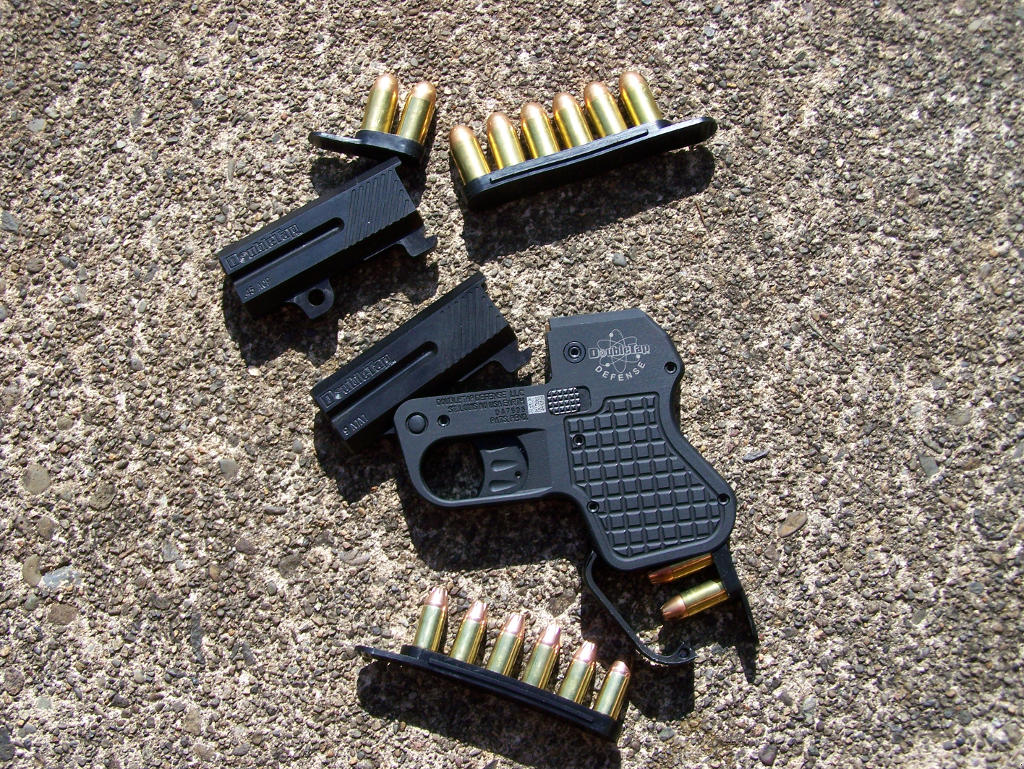
Enter the Double Tap Defense two-shot derringer. I don’t have all the details as to why this little handgun was so long in coming on the market, but it was a couple years late in coming out. The PR firm that was handling all the advertising for this company kept promising “next week” or “next month” for a sample. After more than a year of waiting, I asked to have my name removed from the gun writer’s list of those who requested a sample. At some point, a little over a year ago, the local gun shop that I haunt received a couple of the Double Tap handguns, and they were priced at $499! OUCH!!! I passed!

100_5979

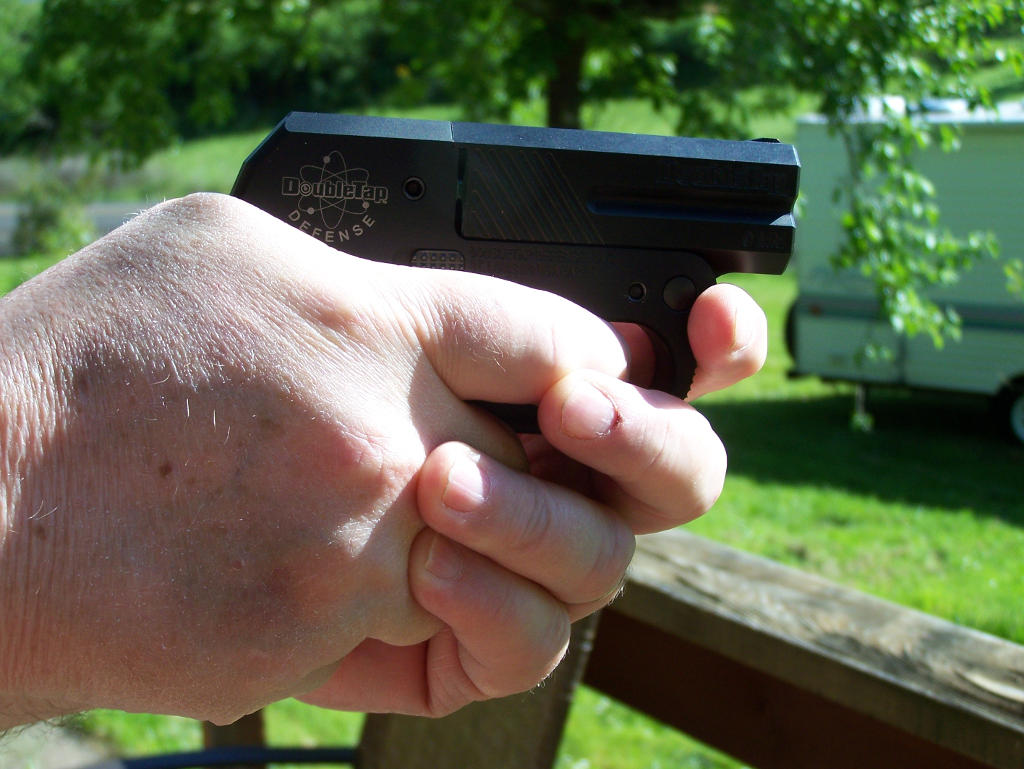
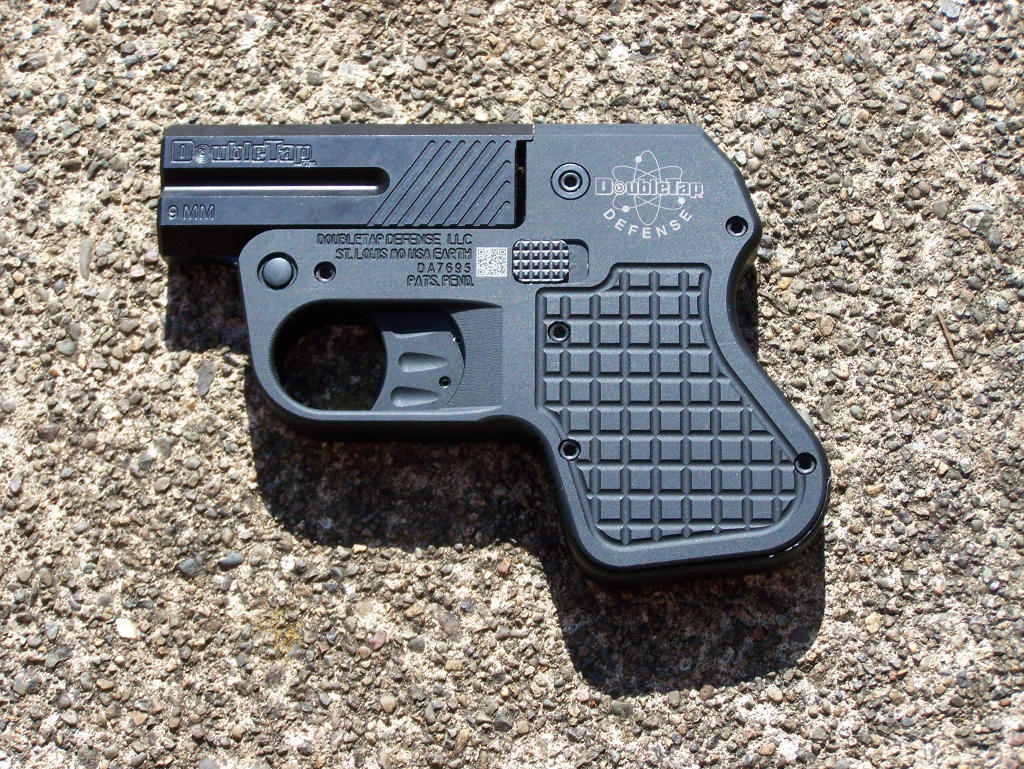
Recently, my local gun shop scored a fantastic deal on Double Tap handguns, in 9mm or .45ACP. They were (still are) selling them for $269 each. While sitting there, waiting on UPS to bring me another gun sample that day for an article, I got to playing around with the .45ACP Double Tap, and I was impressed as to how well it was made. It’s not your typical two-shot derringer, where you have to cock the external hammer for each shot. Instead, the Double Tap is fired by simply pulling the trigger twice to fire both barrels. While the trigger pull is rather long, it is smooth. Kudos go to Double Tap on that aspect of the gun. The front sight is attached to the barrel, while the rear sight is part of the frame of the gun. To my aged eyes, I could not see either the front or rear sights without my reading glasses on.

At present, Double Tap Defense is offering their little gun, which fits nicely in your hand or a pocket, in two calibers– 9mm or .45ACP– with the promise of other calibers to come. Also, you can easily swap barrels so you can fire either caliber; it takes all of 30-seconds to push out a pin, remove the barrel, put on another barrel, replace the pin, and you’re ready to go. I purchased the .45ACP that day at the gun shop! The 9mm barrel was selling for $99.00 at the shop. Ihave more on this later.

100_5981

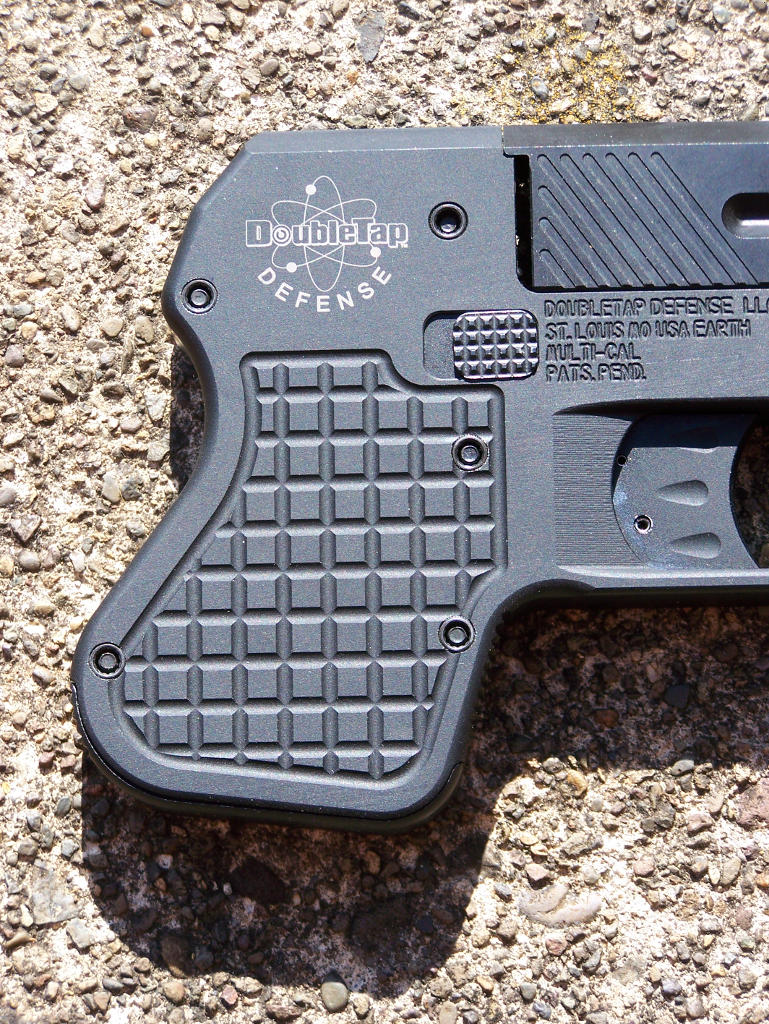
The Double Tap has a 3″ Bbl, and that’s about as short as you can get it, without sacrificing any more velocity than you’re already going to lose from a .45ACP or 9mm round. There is also an ambidextrous thumb release for easy opening of the barrels, one stacked on top of the other. The gun is not made out of stampings; it’s CNC machined and made in the USA! No plastic parts are to be found on the gun, either. The finish is standard Mil-Spec gray and durable! You can also get an optional ported barrel, at a bit more money if you want that feature. You can have your Double Tap in Aluminum or Titanium; the Ti model is quite a bit more. The gun weights in at 15-oz for the Aluminum-framed version. I purchased the Aluminum version. All-in-all, the gun is very well made.

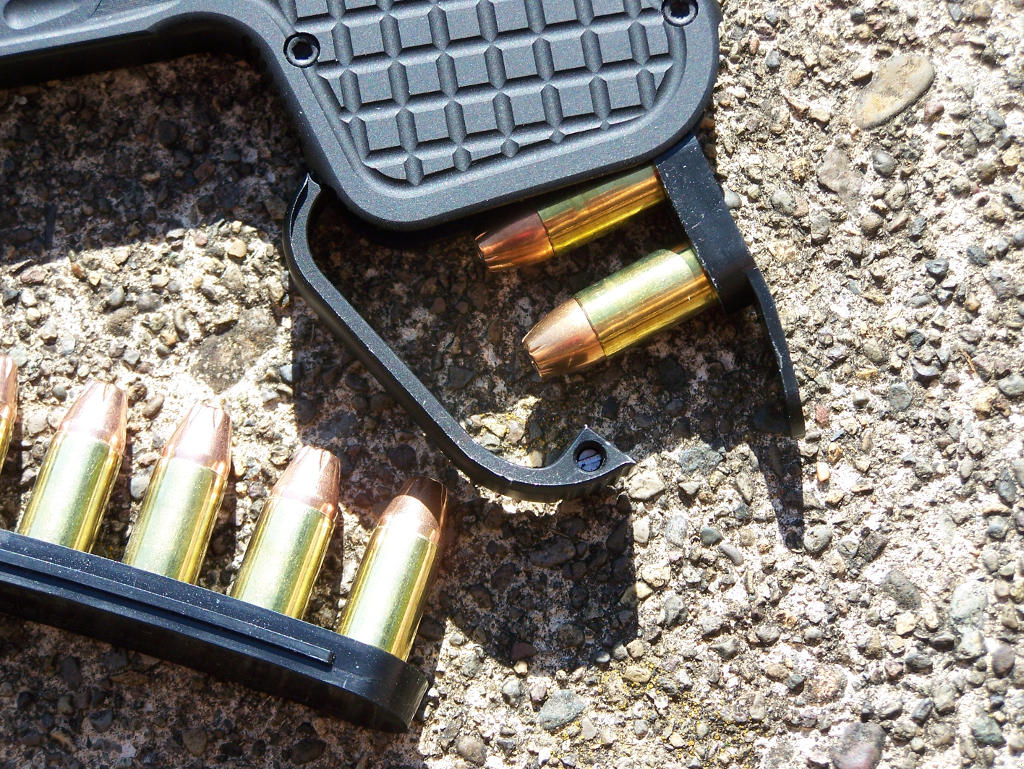
In the grip of the Double Tap, there is a hidden compartment with room for two additional rounds that are placed on a two-round speed strip, so they don’t rattle around and are fast and easy to get to for a fairly fast reload, believe it or not. I thought the little gun would be slow to reload two more rounds, after firing the first two rounds. Nope! The speed strip makes it fast and easy! You also get another speed strip that holds six more additional rounds that you can carry in a purse or pocket. All things considered, I couldn’t really find anything to fault with the little Double Tap, that is, until I fired it.

100_5983

I’m here to tell you that I’ve fired some light-weight .44 Mag revolvers with +P loads before, and while they caught my attention they didn’t hurt my hand. The Double Tap hurt the web of my hand, and it hurt for several days! I had some Black Hills Ammunition 230-gr FMJ and 230-gr JHP loads on hand to test in the Double Tap. From Buffalo Bore Ammunition I had their 160-gr low-recoil, standard velocity 160-gr Barnes TAC XP, all copper hollow point loads. To be sure, Double Tap states that you should NEVER fire +P rounds in their little guns. That’s understood!!! Good!!!

Right after I fired the first round from the Double Tap, I honestly thought that the gun might have blown-up in my hand. It hurt that much. Now, I’m no little wimp of a guy, to be sure. However, my hand hurt, and it hurt a lot. I fired the second barrel; it too hurt the web of my hand, a LOT! I fired several more rounds, using the speed loader, and it really does making reloading fast and easy. However, no matter what ammo I used, it hurt my hand. A young man who works at the gun shop told me I was a wimp. Well, he had the opportunity to fire the Double Tap at my digs, and he didn’t want to fire the second barrel, but I chided him into do so. Now, he is about 6′ 6″ tall and easily weighs in at 300-lbs; he’s strong, real strong. Yet, the Double Tap was too much for him. His father, who is also that big, didn’t find any joy in firing the Double Tap either.

100_5986

I purchased the 9mm dual barrel at the gun shop, hoping it wouldn’t hurt as much as the .45ACP version did. Now, while the 9mm was more comfortable to shoot, it still stung the web of my hand. It didn’t hurt like the .45ACP did, but it stung pretty good, too! I used some Black Hills 9mm ammo for testing out the 9mm barrels, and these were only their 115-gr FMJ loads, not hot-stepping +P loads. Still, the gun stung my hand.

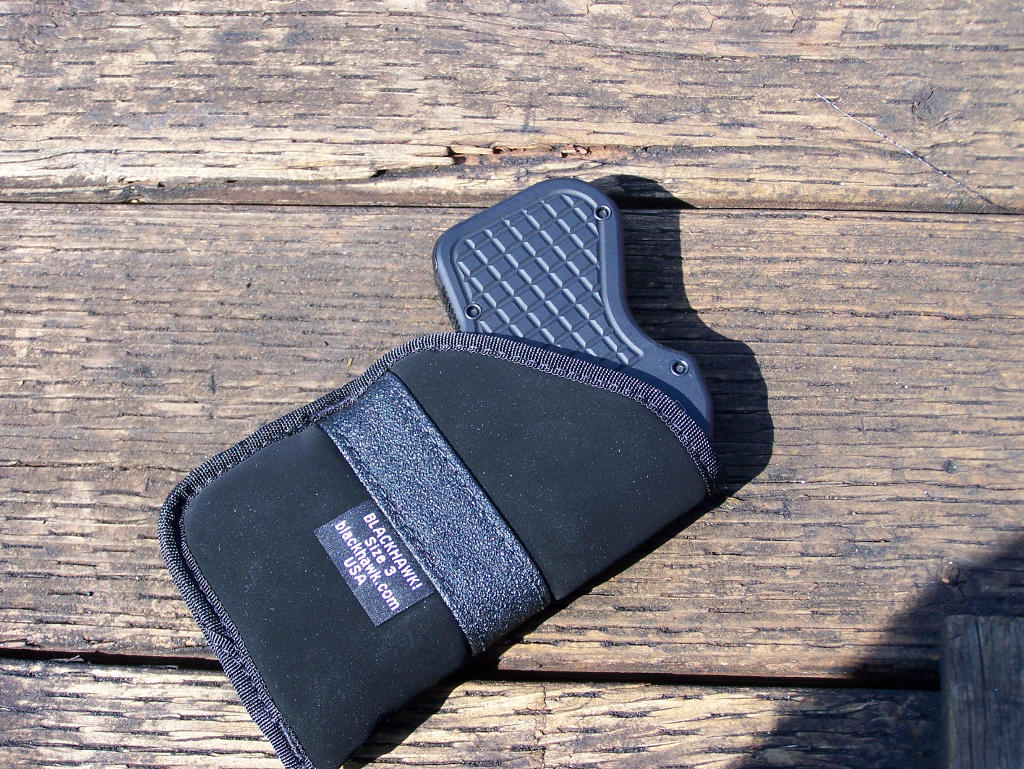
I carried the little Double Tap in my right rear pocket of my cargo pants in a pocket holster from Blackhawk Products, www.blackhawk.com, and the Double tap rode nicely in this holster. It’s the only way to carry a gun in your pocket. You must use a holster designed for pocket carry. Don’t ever just carry a handgun loosely in your pocket, like I did many years ago.

Here’s my thoughts on the Double Tap. First of all, I would never carry the Double Tap as my one and only self-defense handgun. Two shots just aren’t very comforting. Secondly, from my point of view, this gun is best reserved for up-close and personal self-defense. I could hit a target at 15-feet with the lower barrel, which is zeroed for the sights. However, using the second barrel, I could completely miss the target, because there was no such thing as a “group” when firing the Double Tap. The Double Tap is NOT a gun you want to go out and practice with on a regular basis. It will either hurt the web of your hand in .45ACP, or it will surely sting your hand in 9mm, period! This wasn’t just me; others who fired the gun said the same thing.

The Double Tap is best reserved as a back-up handgun to whatever your main handgun is you carry for self-defense. In my case, it would be a back-up to my back-up, which is a Ruger LCP .380 ACP that I carry on my ankle. However, I don’t see myself actually needing a main handgun and two back-up handguns. I honestly wouldn’t recommend the Double Tap to a woman; it just hurts too much to shoot, period! I know, some will say “any handgun is better than no gun at all.” Well, maybe that’s true and maybe not! If you are recoil shy or sensitive when you fire the Double Tap in practice, you may completely miss your target in real-life because you will be anticipating the hurt that the Double Tap delivers on both ends. The Double Tap is a handgun you buy, take out and fire half a dozen rounds through it, and then carry it, take it out six months later to fire again, and carry it. Believe me, it will not give you much pleasure to shoot a box of ammo through this gun in one shooting session or, for that matter, over several shooting sessions.

100_6038

One last thing that I wanted to mention is that the front of the trigger guard on the Double Tap has serrations on it for placement of the index finger of your off-hand when firing the gun two-handed. Well, don’t!!! I mean, don’t place your finger there! It is too close to the lower barrel, and I can see someone getting their finger in front of the barrel when firing in a hurry and completely blowing that finger off.

I was really hoping the Double Tap was going to be a handgun I would like to carry as a back-up gun only, never as a main gun for self-defense. However, the recoil and hurt was enough for me to just get rid of the gun in very short order. Was it well made? You betcha! Double Tap has done an outstanding job. It’s probably the best made two-shot derringer I’ve ever seen, and I like the double-action trigger pull, too. I would like to see this gun in .380ACP for a more enjoyable shooting session, one that wouldn’t hurt my hand so much. Double Tap has said they are coming out with more calibers. For me, the .45ACP was too painful to shoot. Six rounds was my absolute max pain threshhold; the 9mm was better, but it still stung. Once again, it wasn’t just me complaining about the Double Tap hurting the hand when fired. Maybe others are more manly than me and my friends, but we just didn’t get a lot of pleasure at all out of shooting the Double Tap.

– Senior Product Review Editor, Pat Cascio


Recipe of the Week: Homemade Graham Crackers, from A.J.

One of the things our family (everyone from toddlers to great grandparents) really enjoys for snacks as well as a dessert ingredient is graham crackers. When SHTF occurs and there are none in the stores, we’ll have the choice of going without or making our own. We’ve started making our own from our stores, as we need to now be in the habit of knowing how to provide what we want and need in the future. Wheat berries store a long time. We have a Country Living flour mill that grinds extra fine flour, beautifully. We raise chickens for eggs and have resources to provide honey and most of the other ingredients so that we won’t go without our graham crackers, even if we have to manually grind the flour. Here’s our recipe, so you don’t have to go without this wholesome and yummy snack either. We based this recipe on the one from Nancy Silverton’s Pastries fromthe La Brea Bakery Cookbook.

Ingredients

  • 2 1/2 cups flour (I use hard winter white wheat berries, freshly ground for this flour, but pre-ground all-purpose flour will also do.)
  • 1 cup brown sugar
  • 1 tsp baking soda
  • 1/2 tsp salt
  • 1/2 cup unsalted butter, cold and cubed
  • 1/3 cup honey
  • 1/4 cup milk
  • 1 Tbsp vanilla extract
  • 3 Tbsp cinnamon sugar (optional)

Directions

  1. In your mixer bowl, combine on low speed the flour, brown sugar, baking soda, and salt.
  2. Add the cold butter and mix on low speed until reaches a consistent crumble appearance.
  3. In a small bowl, whisk the honey, milk, and vanilla extract together. Add to the flour crumble mixture, mixing on low speed until it forms a smooth dough.
  4. Divide the dough in half. Wrap each half in plastic wrap and refrigerate 2-3 hours.
  5. After the dough has chilled. Preheat oven to 350 degrees Fahrenheit.
  6. Turn one portion of dough out onto a large sheet of parchment paper that is lightly floured; roll it into a rectangle that is about 1/8” thick. Mine usually comes out to about 14×10”.
  7. Transfer the parchment paper containing the rolled dough onto a large cookie sheet.
  8. Using a knife, cut the dough into four columns and three rows or use a square cookie cutter. Use a fork or toothpick to poke holes into the crackers. (This is a fun job for the kids.)
  9. Repeat the rolling, transfer, cutting, and hole poking with the second portion of dough.
  10. Optional: Sprinkle the dough with cinnamon sugar, or other spice/flavoring.
  11. Bake 15-20 minutes,until slightly browned. Cool for 10 minutes before cutting apart and serving.
  12. Store in airtight container or ziploc bag at room temperature or in freezer for longer storage.

o o o

Do you have a favorite recipe that would be of interest to SurvivalBlog readers? Please send it via e-mail. Thanks!


Letter Re: Egg Rationing

HJL,

I am one of THOSE who do not yet have their own chickens but hopefully within a couple of months though. You may have seen this already. I haven’t experienced the rationing, but I bought eggs in April at $1.97 a dozen and went back yesterday to discover they were $2.97 a dozen at my local Walmart. Wow! – C.P.

HJL Replies: We have had chickens for a number of years now and have enjoyed the fresh eggs tremendously. The price of eggs have always been a bit of a sore point with me though. I cannot produce eggs as inexpensive as what you can buy them at Walmart. Even with the recent increase in egg prices, I am not sure that I save any money. However, the quality of the eggs is far above anything that I can buy. Modern egg farms have the science of eggs down, and they tend to keep the chickens just barely above starvation by just feeding them enough to optimally produce. As a child, I can remember buying grade AAA eggs at the local grocery store. Good luck with that today. The best I have seen in years is grade AA with most being grade A. The eggs my chickens produce are well above the AAA grade and taste much better. Even if I never break even on the cost of the eggs, I know exactly what goes into mine, and I actually like my chickens.


Odds ‘n Sods:

Police Seize 6 Children Simply Because Family Was Camping – D.S.

o o o

Huge problem for gun-grabbers: Polls reveal Americans know guns make their homes and neighborhoods safer. – H.L.

o o o

You Can Be Prosecuted for Clearing Your Browser History. – T.P.

“Prosecutors are able to apply the law broadly because they do not have to show that the person deleting evidence knew there was an investigation underway.”

o o o

The president’s pistol: Ronald Reagan carried a handgun in his briefcase at all times during his administration, author reveals. – G.G.

o o o

New gun blamed for rise in LA County deputy shootings – Smith & Wesson M&P9. – T.J.

Of course, it couldn’t possibly be the training and the fact that the trigger finger is on the trigger when it shouldn’t be. – HJL