
“The excessive use of force creates legitimacy problems, and force without legitimacy leads to defiance, not submission.” – Malcolm Gladwell
- Ad USA Berkey Water Filters - Start Drinking Purified Water Today!#1 Trusted Gravity Water Purification System! Start Drinking Purified Water now with a Berkey water filtration system. Find systems, replacement filters, parts and more here.
- Ad California Legal Rifles & Pistols!WBT makes all popular rifles compliant for your restrictive state. Choose from a wide range of top brands made compliant for your state.
Notes for Tuesday – June 30, 2015
June 30th is the second anniversary of the tragic death of 19 hotshots in the Yarnell Hill Fire (in 2013).
o o o
SurvivalBlog advertiser KI4U, Inc has just nailed down the master distributorship for Intershelter domes, and through the end of July they will be offering an Introductory Special that will save thousands of dollars off of normally $7,500 or $12,500 retail cost domes. Make sure you contact them directly, as they are not allowed to print the specials they are offering.
o o o
Repackbox is having a blowout sale:
- Genuine U.S. Military Issue AN/UDR-13 Radiac Units…NEW for $225
- Brand New USA Made USGI M2A1 50 cal Ammo Cans…for $10 each
o o o
Today, we present another entry for Round 59 of the SurvivalBlog non-fiction writing contest. The $12,000+ worth of prizes for this round include:
First Prize:
- A Gunsite Academy Three Day Course Certificate, good for any one, two, or three day course (a $1,195 value),
- A course certificate from onPoint Tactical. This certificate will be for the prize winner’s choice of three-day civilian courses. (Excluding those restricted for military or government teams.) Three day onPoint courses normally cost $795,
- DRD Tactical is providing a 5.56 NATO QD Billet upper with a hammer forged, chromlined barrel and a hard case to go with your own AR lower. It will allow any standard AR type rifle to have quick change barrel, which can be assembled in less than one minute without the use of any tools, and a compact carry capability in a hard case or 3-day pack (an $1,100 value),
- Gun Mag Warehouse is providing 20 Magpul pmags 30rd Magazines (a value of $300) and a Gun Mag Warehouse T-Shirt. (An equivalent prize will be awarded for residents in states with magazine restrictions.),
- Two cases of Mountain House freeze dried assorted entrees in #10 cans, courtesy of Ready Made Resources (a $350 value),
- A pre-selected assortment of military surplus gear from CJL Enterprize (a $300 value),
- A Model 120 Series Solar Generator provided by Quantum Harvest LLC (a $340 value),
- A $300 gift certificate from Freeze Dry Guy,
- A $250 gift certificate from Sunflower Ammo,
- KellyKettleUSA.com is donating both an AquaBrick water filtration kit and a Stainless Medium Scout Kelly Kettle Complete Kit with a combined retail value of $304,
- TexasgiBrass.com is providing a $300 gift certificate, and
- Two cases of meals, Ready to Eat (MREs), courtesy of CampingSurvival.com (a $180 value).
Second Prize:
- A Glock form factor SIRT laser training pistol and a SIRT AR-15/M4 Laser Training Bolt, courtesy of Next Level Training, which have a combined retail value of $589,
- A FloJak EarthStraw “Code Red” 100-foot well pump system (a $500 value), courtesy of FloJak.com,
- The Ark Institute is donating a non-GMO, non-hybrid vegetable seed package–enough for two families of four, seed storage materials, a CD-ROM of Geri Guidetti’s book “Build Your Ark! How to Prepare for Self Reliance in Uncertain Times”, and two bottles of Potassium Iodate– a $325 retail value,
- A $250 gift card from Emergency Essentials,
- Twenty Five books, of the winners choice, of any books published by PrepperPress.com (a $270 value),
- TexasgiBrass.com is providing a $150 gift certificate, and
- RepackBox is providing a $300 gift certificate to their site.
Third Prize:
- A Royal Berkey water filter, courtesy of Directive 21 (a $275 value),
- A large handmade clothes drying rack, a washboard, and a Homesteading for Beginners DVD, all courtesy of The Homestead Store, with a combined value of $206,
- Expanded sets of both washable feminine pads and liners, donated by Naturally Cozy (a $185 retail value),
- Two Super Survival Pack seed collections, a $150 value, courtesy of Seed for Security, LLC,
- Mayflower Trading is donating a $200 gift certificate for homesteading appliances,
- APEX Gun Parts is donating a $250 purchase credit,
- Montie Gear is donating a Precision Rest (a $249 value), and
- Two 1,000-foot spools of full mil-spec U.S.-made 750 paracord (in-stock colors only) from www.TOUGHGRID.com (a $240 value).
Round 59 ends on July 31st, so get busy writing and e-mail us your entry. Remember that there is a 1,500-word minimum, and that articles on practical “how to” skills for survival have an advantage in the judging.
- Ad STRATEGIC RELOCATION REALTYFOR SALE: Self-sustaining Rural Property situated meticulously in serene locales distant from densely populated sanctuary cities. Remember…HISTORY Favors the PREPARED!
- Ad USA Berkey Water Filters - Start Drinking Purified Water Today!#1 Trusted Gravity Water Purification System! Start Drinking Purified Water now with a Berkey water filtration system. Find systems, replacement filters, parts and more here.
Amazing Affordable Force Multipliers – Part 2, by Tupreco
EMP-Proof Your Radio Comms With a USGI Ammo Can Inexpensively
How can you EMP-proof select comm gear for under $100? You can do this more easily than you might think. Radio comms are radio-based systems that can communicate across distances from a few miles up to thousands of miles, under the right atmospheric conditions. In order of range (and cost) these radio comms include walkie talkies using the Family Radio Service (FRS) and the General Mobile Radio Service (GMRS). Next, at higher cost and more range, is citizens band radio or CB. At the top end in price and range is Amateur Radio, fondly known as Ham radio. Be aware that all cell-based devices, like cell phones and tablets, are also radio comm systems, but they all rely completely on third parties that are under government regulation to keep the system operational. For that reason we will limit ourselves to direct two-way radio issues only.
The rugged storage capabilities provided by USGI metal ammo cans are obvious. But an amazing non-obvious feature is their ability to act as a shielding enclosure to protect your sensitive comm and other sensitive electronics from an EMP event. Large-scale high energy atmospheric transients can come from a solar coronal mass ejection (CME) striking earth’s atmosphere or a strong electromagnetic pulse (EMP) from a localized EMP device or a nuclear detonation. Regardless the source, the effect is that the same potential for damage exists when power lines or antennas convert these high-energy fields into current flow through the attached wires or other conductors. The result is significant damage to connected circuit components that are unable to withstand the overload. This can all take place in a few milliseconds.
Fortunately, an electrically conductive solid metal box like an ammo can has an inherent property called the Faraday cage effect that can shield its contents from large external transients. Michael Faraday realized in 1836 that an electrostatic electric field would not penetrate a metal enclosure. Later it was determined that same effect prevents penetration from other energy fields such as electric, magnetic or radio frequency. The Faraday cage works because the traveling energy field transforms into an induced voltage and current flow across the surface of the conductor (in this case the metal box) to ground or eventually dissipates into the surrounding area without affecting the contents of our box which is now our Faraday cage. Secondary grounding is not essential. However, make sure no conductor like a power cord or antenna is connected through or penetrates the enclosure or all shielding bets are off. Those penetrating conductors will act as an antenna also and expose the contents to unwanted energy spikes. To clarify your own understanding of EMP and RF shielding I direct you to Don White’s excellent book on the subject.
To implement this idea, put your radio gear or other sensitive electronics inside the box and make sure it is closed tightly. Making sure the top and bottom are electrically connected with an ohm meter is a nice for peace of mind. Ammo cans usually contain a rubber seal between top and bottom but connect electrically through the hinge pins. You may want to attach a small gauge lead as a redundancy between the top and bottom. A decent alternative to an ammo can would be to use a large zip style static shielding bag that is kept tightly closed. The zip close style sized for a 5-gallon bucket would be a good choice. If you use such a bag, then the outside box composition doesn’t matter, because the conductive foil layer inside the bag is the actual Faraday cage.
Plan to purchase some assortment of spare walkies, handheld or mobile Ham set, cell phone, and solar charger and have them properly stowed. I use two deep .50 cal cans to hold four GMRS and FRS walkie-talkies with charger bases ($60 total for both sets), a Cobra CB base, and CB handheld (bought used with antennas for $100), two Baofeng UV5R dual band handheld Ham radios (bought new on Amazon with spare batteries, hands-free mike headsets, upgraded antennas for $125), and a 50W Kenwood TMV71 dual-band Ham radio (like-new for $300 at a Hamfest) with a 15 Amp hr battery (new on Amazon for $30). The Kenwood can also double as a relay repeater that can extend the range of the Baofengs to about 30 miles. The folding solar charger (GoalZero $75) is to keep it all topped off and is rated at 7 watts with outputs of USB 5V and jacks for 12V. Make sure you have all the adapters you need as well. It is snug, but it all fits. The total of what I paid for the gear is shown. Adding the cost of an antenna for the Kenwood, some rechargeable AAs for the handhelds, and the two deep 50 cal cans off Craigslist cost me a total of just under $775. I consider the extra investment in stowed gear some of the least expensive insurance available, because the ability to be back on the air the very “day after” for short range comms at the retreat or over some distances with the Kenwood Ham radio to reach others will be priceless.
Wireless Video Security System Using Smart Phones
Would remote motion-activated images sent to your smart phone for $100 interest you? I thought so. We are now officially a generation of screen junkies. Recent research tells us that the average adult uses their smart phone or tablet to do an average 224 tasks per day, and that doesn’t consider the impact of new apps and features added with each upgrade. I’m not here to debate the culture of mobile screen fixation but to highlight an app that can turn the familiar mobile device, a mixed network of Androids and iPhones, into a sweet motion-activated video surveillance system. It’s not just your smart phone anymore; it becomes your pocket motion-sensitive wireless video security system, and it’s as functional as it is inexpensive.
It started when I got my backup phone. I had reported a roadside emergency via 911 in late 2012 and discovered that law enforcement had locked my cell phone to monitor the audio until they were satisfied things were resolved. This is now standard practice everywhere. The next day I researched and bought a backup smart phone. Specifically, it was an LG Android TracFone purchased on Amazon for $25 with three months service and 600 minutes air time. If I ever have another emergency and call 911, I now have a way to make important calls to my family, lawyer, or other emergency responder if needed. Now I renew annually and get 600 minutes of airtime and 12 months of service for $99. Sometime later, I saw a free motion detector app called Motion Detector Pro from MVA on Google Play. MVA also has a version for the iPhone, but I feel a lot better leaving a $25 Android phone as an unattended camera than I do a $200 iPhone.
Select the correct version for your iPhone or Android 2.2 or higher. Next, download and install the app. Only the device used for surveillance needs the downloaded app. Open the app and choose your options from the settings tab to setup your device as a remote surveillance camera with motion detection functionality. Once the adjustable motion threshold is triggered, it sends an email or a text message with a linked picture to whatever device or email account you specify. It gives you remote video capability to monitor an area of your choosing with your smart phone and get notification if a trigger event occurs. I will leave the possibilities to you.
Once enabled, it will take a picture when the camera sees a movement and send it to an email or another phone. The sensitivity and area for motion detect are user defined. You can remotely start, stop, and reset it by using a password-protected text message. It also indicates real-time on the phone’s display where the movement is detected. There is also a user-enabled stealth mode, which closes the app so the phone looks off as soon as it is touched. You can also store the surveillance images on the cloud or locally on the phone’s SD-card. I have used these features, and they all seem to work on my inexpensive LG phone.
Using this system made it possible for a friend to ride his $800 mountain bike to work and safely park it unattended. The phone points outside his office window with a clear view of the bike. Several times he has been alerted on his daily carry cell phone with an image of someone “looking” at it up close. When he immediately shows up, they either ask questions or move along, but now everyone knows it is being watched, which is very cool. On a final note, the app is ad-supported, but you can make the ads go away for a nominal donation via the app’s settings menu.
Make sure you can power everything off-grid. Keep in mind that you won’t be multiplying much force with the devices described here without some way to power them. Much has been written on Survivalblog about making sure your battery-operated devices and portable communication gear can be recharged in the absence of grid power. Off-grid alternatives can be easily managed in the short term with a generator, as long as fuel is available. My favorite option is solar from a fixed or small portable system. It will of course need to be EMP-proofed. Also, there is thermoelectric power generation, like the BioLite campfire unit. It works, but it is a low power solution. Wind or hydro power are additional ways to keep your stuff charged. Rather than replicate the detail of the choices here, search “off grid power” on SurvivalBlog, and read some of the excellent articles there. I have two linkable Honda 2kW generators, a 1500W portable solar system mounted on a 6 x 14 utility trailer, and several portable folding chargers from 7W to 125W, and lots of Sanyo eneloops. Just remember the old joke: Q. “What do they call a flashlight without batteries?” A. “A hammer.”
- Ad Ready Made Resources, Trijicon Hunter Mk2$2000 off MSRP, Brand New in the case
- Ad Civil Defense ManualClick Here --> The Civil Defense Manual... The A to Z of survival. Looks what's in it... https://civildefensemanual.com/whats-in-the-civil-defense-manual/
Letter Re: Amazing Affordable Force Multipliers
HJL,
I enjoyed reading this article about inexpensive thermal/IR force multipliers, but there are a few things I’d like to mention about these. Turning on any smart phone in a combat situation would look like someone holding up a 60” flat screen to anyone with real night vision and would probably draw the attention of the naked eye too. PVS 4s can spot a man puffing on a cigarette from over a mile away, so imagine what the light emitted from a smart phone looks like whether it’s facing you or not. To use a thermal smart phone effectively, you’d need a shroud around it to prevent all the light from escaping and being picked up by other night vision devices. I suppose a baseball cap, some bailing wire, and some duct tape strategerie might make a decent smartphone/thermal/harness/shroud for hands-free and inconspicuous use. Smart phones also get hot while in use, so they’d be visible on thermal too. Also, another cheap but extremely effective night vision device is the one that came with the Call of Duty 2 video game. They are cheap, made in China, available on eBay, but are very effective in the dark. They’re fully shrouded too. – G.G.
- Ad Survival RealtyFind your secure and sustainable home. The leading marketplace for rural, remote, and off-grid properties worldwide. Affordable ads. No commissions are charged!
- Ad Don't wait - get the ultimate US-made ultra-high performance US-made SIEGE Stoves and stunning hand-crafted SIEGE belts for Christmas. For stocking-stuffers see our amazing fire-starters. Gifts that can save lives. Big Sale!Every bespoke SIEGE buckle goes through an hours-long artisanal process resulting in a belt unlike anything else, with blazing fast performance and looks and comfort to match.
News From The American Redoubt:
Navy SEAL Team veteran William Rapier will be the instructor for a SRC Rural Property Defensive Tactics Course, September 4th-6th, 2015, in Bonners Ferry, Idaho.
o o o
Mayor of Boise to pull down Mississippi state flag – T.H.
o o o
Washington: Hundreds of homes evacuated in central Washington fire’s path
o o o
Wyoming: Cheyenne sees boom in rabbit population
o o o
- Ad LifeSaver 20K JerryCan Water PurifierThe best water jerrycan you can buy on the market! Mention Survivalblog for a Free Filter ($130 Value)
- Ad Trekker Water Station 1Gal Per MinuteCall us if you have Questions 800-627-3809
Economics and Investing:
Puerto Rico’s Governor Says Island’s Debts Are ‘Not Payable’ – JBG
o o o
When you have to trot out analysts to characterize something as a “calculated retreat” and “not a panic”, it’s a pretty good guess that the panic is on… Greek Debt Crisis – J.H.
o o o
Items from Mr. Econocobas:
Greece Will Default To IMF Tomorrow, Government Official Says – There is still decisions to be played out here but if there is a “default” (extremely likely) and a no vote on Sunday, how this plays out could very well be very ugly…
Greece Closing Banks as Expiring Bailout Spurs Withdrawals
Credit Risk Gauges in Europe Rise by Most Since Lehman on Greece
- Ad Click Here --> Civil Defense ManualNOW BACK IN STOCK How to protect, you, your family, friends and neighborhood in coming times of civil unrest… and much more!
- Add Your Link Here
Odds ‘n Sods:
Federal Judge Orders Brady Center to Pay Ammo Dealer’s Legal Fees After Dismissing Lawsuit – D.S.
o o o
New Jacksonville, FL Bill would make it Illegal to Back into Your Own Driveway – T.P.
HJL adds: The author of this bill is obviously not a fireman and has never spent time around a firehouse. For those who don’t know, pulling in front-wise to parking spots and then having to back out in a hurry or in an emergency is a sure-fire way of getting people hurt or killed. Emergency personnel know to take the extra time and back into their parking spot so when they leave in a hurry, they are pulling forward.
o o o
o o o
States Seeking Voter Citizenship Proof Denied by U.S. Supreme Court. – B.B.
o o o
The well-regarded “Selco” is now transitioning from purely online courses to also deliver physical courses as well. Interestingly, this is largely due to his assessment that the skills covered are going to be necessary for folks to use in the very near future and he feels a duty to share his experiences directly with students in order to give them the best training and learning opportunity possible. – T.C.
Hugh’s Quote of the Day:
“The end of the law is, not to abolish or restrain, but to preserve and enlarge freedom.” – John Locke
Notes for Monday – June 29, 2015
June 29th, 1868 is the birthday of astronomer Dr. George E. Hale. Dr. Hale was credited with founding the Yerkes Observatory in Chicago and the Mount Wilson and Palomar Mountain Observatories in Southern California. He also invented the spectroheliograph and first learned that the sun’s outer shell is made of gas. He photographed colossal hurricanes of incandescent vapor and discovered that the flaming whirlpools of hydrogen leaped 300,000 miles from the surface of the sun and were large enough to engulf the earth like a cinder in a furnace.
Scot’s Product Review: Blue Force Gear Vickers Combat Application Sling and More
I’m not sure who first coined the phrase, but whoever it was suggested that we think of a sling as a holster for a long gun, and I’ve always rather liked that analogy. Some slings also help the shooter be more accurate by providing support in shooting positions. By and large, however, the main use of the sling is to carry a long arm while keeping one or both hands free for other purposes.
There are a number of types of slings and ways to attach them to a rifle or shotgun. The most common is a simple carry strap that attaches at the butt of the weapon and near the tip of the forend. To use it, we simply hang the rifle over our shoulder with the muzzle up or down. Muzzle up with the rifle over the dominant shoulder is called American carry, while muzzle down over the support shoulder is called African carry. Both styles have their proponents, and both have their uses. Knowing how to use the long arm from both positions is a good idea, if for no other reason than varying the shoulder that the rifle is carried on lessens fatigue. One generally should keep a hand on a slung weapon to keep it stable, but when you need to, you should be able to use both for brief tasks.
Moving a step up, we get to the loop sling, which has a loop through which we thrust the support arm. Once we have it adjusted properly, it can greatly enhance our steadiness by locking the rifle to our body. I only recently figured out how to use the U.S. GI web slings that have a clip on one end as a support sling. The loop sling can be used just as you would use a simple carry strap with the advantages of support when you need it. The only disadvantages are some extra cost, the learning curve, and the time it takes to get into them.
Some variants of the loop sling are the Ching and Rhodesian slings, and I’ve written about the ones made by Andy Langlois. The huge advantage of these slings is the speed at which they can be deployed into the support position while providing almost as much steadiness as a regular loop sling. Again, they can be used to carry the long arm just as you would with a carry strap.
In recent years, however, we’ve seen the arrival of new slings– the so-called tactical one point, two point, and three point slings. The one point sling is a simple loop that attaches to the mid-point of the weapon. You can slip it over their head to carry the rifle much as one would carry a camera or binoculars on a neck strap or put the support arm through as well to take some of the weight off the neck. Many people like this sling as it makes it very easy to shoulder the weapon to the right or left shoulder for shooting around obstacles. When carrying the weapon, it dangles with the muzzle down, which is why some hate it as the muzzle is often aimed at the shooter’s feet. You also have to take care should you wish to kneel or crouch to keep the muzzle from digging into the dirt. While seeing the advantages of being able to get your rifle to either shoulder easily, I am one of those bothered by muzzling my feet.
I’m going to skip to the three point sling next. These have a long strap that runs between the forend and the butt of the rifle. One end of the sling itself is fastened to the butt, while the forward end has some latitude to slide up and down the strap on the side of the rifle. Some really like this style sling, but I quickly rejected it as I am left-handed. The strap that runs along the side of the rifle interferes with the ejection port and other controls when set up for a lefty. There is generally a means to adjust the slings’ length on the fly so you can keep the weapon close or give it slack to allow you to shoulder the arm. To use it, you put it over your head and slip your support arm through so the weapon rides across the front of your body at something like a 45-degree angle with the muzzle pointing down to the support side. You can just let go of it if you need both hands for some other task, though it is best to always keep a hand on it for purposes of control. To use the rifle, set the length properly, lift the rifle to your shoulder, and fire. To switch shoulders, you have to pull the slider to lengthen the sling, then weave your support hand out of the sling and swap sides. It is more trouble than the single point to switch shoulders, but with practice it can still be done quickly.
The two point sling is my favorite variant of the tactical sling. It looks much like a carry strap but is longer so you can carry the rifle diagonally across your body as you would with the three point sling. It also has a quick adjust feature to lengthen or shorten it by pulling on a tab, straps, or loop. While a normal carry strap or loop sling is attached to the bottom of the weapon, a two point should be attached to the side or top so that it doesn’t flip over and present your rifle upside down. You should be able to adjust it so you can also use it as you would a carry strap for American or African carry. This is the style sling I have chosen for my needs, feeling that the only down side is that it doesn’t provide a loop that can be used to enhance steadiness.
While both three point and two point slings largely avoid the issue of pointing the rifle at your feet, you have to remember it is still pointing somewhere, and if you are around others it is possibly pointing at THEIR feet. In the last class I took, I noticed a lot of subtle dancing as people maneuvered to avoid this issue. It would have been amusing, except for the photos I’ve seen of shot feet.
One other point on the need to adjust the length of these slings is that you may or may not have armor. Armor makes you bigger, so the sling has to get longer to compensate.
You have options about where to attach the ends of the two point sling. I generally put them near the tip of the forend and at the butt, but you can move both ends closer to the middle of the rifle. The midpoint attachment offers some advantages; if one needs to swap shoulders, you can probably do it without having to pull the support arm out of the sling, as seen in this video. You have to have the midpoint sockets, alas, to make this work, which I don’t on most of my weapons.
I tried very hard to avoid tactical slings as I regarded them as a bit of an affectation, and I just kept using carry straps on my AR for many years. After a class, though, I realized I was handicapping myself. It was simply faster and easier to deploy a rifle using a tactical sling than a strap from African or American carry. I am sure there are those who can do it better than I can, but the class opened my eyes to what would work best for me. The other issue is transitioning to a handgun in case of a malfunction or running dry. With a tactical sling, you can just drop the dead carbine and go to the pistol. With a strap, you have to re-sling the rifle to your shoulder, which is definitely slower and clumsier. True, you could just drop the carbine, but that feels a lot like throwing away a gun to me.
When I asked instructor Bill Jeans, whose video I reviewed and who has sadly retired, what sling he recommended, he immediately pointed me to the $45 Blue Force Gear Vickers Combat Applications Sling. I got one and liked it so much that I bought more.
The sling, designed by Army special ops veteran Larry Vickers, is made of two lengths of 1.25-inch wide Cordura webbing with five pieces of hardware. You also need to have some way to attach it to your rifle, which will probably be sling swivels, though there are other options, like snaps and hooks. While many weapons have integral loops for attaching a sling, I strongly suggest that you use a method that allows you to easily detach it. This makes maintenance and storage easier as well as enables you to get out of it quickly in the event you get hung up on something. Friends have related stories of military personnel losing their lives when they got tangled up trying to get out of crashed aircraft. I really like push-button, quick detachable (QD) swivels and use them everywhere I can, but I’ll mention an enhanced version for emergencies later.
You have a choice of metal or Acetal hardware with the Vickers sling. I chose the more economical Acetal, which is a high strength thermoplastic, though I note that the loop that holds the two sections of the sling together appears to be steel, since it attracts a magnet. In theory, I would prefer metal, but the $20 cost savings and the fact that I know Acetal to be incredibly strong won me over.
The webbing can be ordered in multicam, coyote brown, black, wolf, foliage green, OD, kryptek highlander, kryptek typhoon, and orange. Wolf is a grey color, as one might guess. I have them in multicam, coyote, and foliage green, but I rather wish they were all in OD, since that color works quite well in my environment. I wound up with the hodgepodge by getting what was available at the moment or taking advantage of sales.
Something I really like about the webbing they use is that it has little or no sheen. I have purchased slings from other companies that were shiny and reflective. Shiny is bad if you want to remain unobserved. I spent a fair amount of time and energy spraying them with paint to make them dull. (Yes, you can paint webbing.) The Blue Forces slings aren’t slippery, either, so your rifle won’t slide off the shoulder as badly as some slings I’ve used.
The slider that adjusts the length of the sling has a web tab about 3.25 inches long and is made of a contrasting color of cordura, which makes it easy for the user to visually find the slider. It operates smoothly and easily yet somehow always holds its adjustment.
All three of the slings I purchased show excellent workmanship, and the materials are very high quality.
One thing you find when you use this sort of sling on an AR is that it works better if you attach it to the side of the weapon rather than the bottom. On an AR, assuming you have the usual military style front sight, my favorite method for the front end is the $38.95 GG&G Sling Thing that bolts into the open triangle in the front sight base. It has a socket for a push button QD swivel, which can be attached to either side, keeping lefties and righties happy. One very cool feature is that the swivel rotation is limited, which means you can’t twist the sling up into a tangled mess. The Sling Thing was another tip from Bill Jeans.
Another method to attach the sling is to use a Blue Force Gear Universal Wire Loop (UWL). There are several variants, but the one I like best is the $19 Molded UWL. This has a loop to which one can attach a sling as well as a socket for a push button QD sling swivel. The idea is that the stainless steel wire that forms the loop is threaded through the front sight base and then the loop is pushed through and the sling attached. The wire is coated with nylon to protect the finish on your weapon. It will work with any weapon, not just an AR, and I found it great for attaching a sling to the Century Arms AK I recently reviewed. The nice thing is that I can push it between the barrel and gas tube and get it to the right side of the AK so that the sling works properly for poor lefties like me.
I should point out that the Molded UWL is made of nylon with a metal insert for the QD swivel. It seems incredibly tough to me, but if you want metal, the Universal Wire Loop w/ Push Button Socket is available for $35.
Should you want to use it on something that requires a longer wire loop, they also have the plain old $26.00 Universal Wire Loop https://www.blueforcegear.com/universal-wire-loop-uwl-3-25.html without the QD socket with a three inch longer loop. I really like the idea of the QD socket, though, so I would stick with one of those unless I really needed the extra length.
Attaching the sling to the butt of an AR carbine is pretty easy as most have collapsible stocks and these invariably have slots for slings. I’m not crazy about using those slots, however, as I like to be able to completely remove the sling at times. Again, GG&G to the rescue with their $36.95 rear Sling Thing . Many aftermarket stocks, like the B5 SOPMOD I like, also feature built-in sockets for pushbutton QD swivels, which is a good feature in my view. The B5 also limits swivel rotation so klutzes like me don’t tangle up the sling.
If you have an AR with a non-collapsible buttstock, Blue Force Gear offers $14 adapters for them. I haven’t tried them on other weapons, but they would probably work if the stock dimensions are similar and there is a sling loop in the right spot to hold the adapter in place.
For an emergency when you need to get out of your sling, Blue Force Gear sells the $30 Rapid Emergency Detachment Swivel (RED Swivel) https://www.blueforcegear.com/rapid-emergency-detachment-swivel-red-swivel.html. The RED Swivel is a QD swivel with a different means of detaching it from the mount. Instead of pushing in a small button that might be hard to find in a bad moment, there is a knob on a short piece of wire that you pull. If you have to get out of your sling, grab it and yank. Because the knob is round, it isn’t likely to catch on things and dump your rifle when you were planning on keeping it. Since it sticks out a bit and is larger than the push button, it is much easier to find by feel; you just slide your hand down the sling toward the muzzle and there it is.
I’ve talked about the difference between one point and two point slings. What if you want both? Blue Force Gear sells a way to get that. It’s the $14.75 to $22.00 Burnsed Socket. Again, you get a choice between nylon or metal with metal costing more. This small gadget threads onto your two point sling and allows you to remove the front of your sling from the forend of your rifle and attach it to the sling near the rear swivel, which needs to be attached to the mid-point of the weapon. This gives you a sling that can be a one point or two point one, depending on circumstances. I personally prefer the two point sling, but if I were in a circumstance where I thought I would need to frequently operate the rifle from my support shoulder, this is an attractive option to have available.
If you need a way to attach a sling to the midpoint of your weapon, wander around the GG&G site. They offer a number of solutions to that problem, some requiring no gunsmithing, just the knowledge of how to get the stock off.
Many of us have rifles and shotguns stored in racks or safes, and their slings frequently get tangled up with stuff as we try to extract a weapon. The Blue Force $6 Sling Sleeve https://www.blueforcegear.com/sling-sleeve.html is an effort to get that situation under control. The idea is to slip the elastic sleeve onto a sling and then loop the sling up and stuff it in the sleeve. This shortens the sling so there is less dangling webbing to get caught on things. To free the sling, give it a tug; voila, you are in business. There are other, more economical ways to do this; rubber bands and bungee cords come to mind, but this works well and looks better than the other options.
The best deal from Blue Force Gear is probably the Vickers 221 Sling. You get the sling, a Burnsed Socket, a RED Swivel, and a regular QD swivel all for $80. If you bought all of that separately, you would pay over $100. Knowing what I know now, I’m really sorry I didn’t do it this way when I bought my slings.
The one bit of gear from Blue Force that doesn’t work well for me is the $49 Ten-Speed Triple M4 Mag Pouch. Please note that I said “doesn’t work well for me”. It is actually a pretty amazing magazine pouch in that it essentially isn’t there. It attaches to a carrier or belt via the ubiquitous MOLLE/PALS straps and is composed of a tough elastic material. As the name implies, it holds three AR magazines, each in its own pocket and requires no flaps or other retention devices to securely hold the magazines. It weighs almost nothing, and when the magazines are withdrawn, it might as well not be there since it collapses on itself. It comes in multicam, black, coyote, OD, and wolf.
My difficulty with it is twofold. Since the magazines are in separate pockets, it takes up some width on a belt or carrier. The way I have my gear setup, there isn’t room for it. What’s probably more important for me is how hard it is to stuff magazines in it. The pouches offer tremendous security for your magazines, but that makes it hard to get them in. Ribbed polymer magazines are tougher than GI metal ones. My problems may not be deal breakers for your use, so they are worth a look if you want a minimalist approach to carrying magazines. They are extremely well made and should survive hard use without problems.
I make no promises, but every time I’ve ordered something from Blue Force Gear there has been a small but nice bonus gift in the package. One year, a December order came with a tactical Christmas stocking. That is now my son’s favorite place to get gifts.
– SurvivalBlog Field Gear Editor, Scot Frank Eire
Pat Cascio’s Product Review: Kershaw’s Emerson CQC-4KXL
I still remember the first time I toured the Kershaw Knives plant, some 20+ years ago. It was for an article in Knives Illustrated. I wrote for Knives Illustrated for many years, probably longer than any other writer at that time, and I was promoted to their West Coast Field Editor position, where I mostly covered knives made in the Pacific Northwest area. To be sure, Oregon alone houses numerous knife companies itself. It might just be the cutlery capitol of the USA.
Back during my first Kershaw tour, if I recall, they only had, at best, a couple dozen employees, who actually made and assembled the knives. During my last tour of Kershaw, they had just moved into a new building, and they were already making plans on expanding the building, because they were growing so fast. I didn’t count all the heads, but I’m guesstimating, Kershaw had a couple hundred employees producing the knives, not to mention all the administrative personnel in the front offices. I was given free-reign to walk around any place in the plant, talk to any employees I wanted to talk to, and take pictures of anything, with a few exceptions of some of their hi-tech computerized machines that I can’t even discuss. I don’t want to give away some of the Kershaw “secrets”. I’ve never been afforded that kind of freedom to tour a plant on my own. Yep, I was given a tour by Thomas Welk, who is their PR guy. However, after that, I was told to just tour everything and anything I wanted to.

About a year or so back, Kershaw teamed up with Ernest Emerson– the father of tactical folders, in my humble opinion. They started producing some of Ernie’s designs, both in the Kershaw line-up as well as the Zero Tolerance line– their professional-grade, extra-heavy duty knives. I received samples of the Kershaw and ZT lineup and tested them for articles. Some of these have appeared on the SurvivalBlog.com website. I’m always anxious to receive new products from Kershaw and ZT, especially the Emerson-designed folders of late. I was cruising the Kershaw website a month or so back and noticed some of the newest Emerson designs. The CQC-4KXL folder caught my attention. It’s the biggest Emerson folder that Kershaw is producing, in terms of blade length. I had to have one, so I sent a quick e-mail to Thomas Welk, and the reply back saying “It’s on the way” was greatly appreciated. If Welk tells me something is on the way, it’s on the way, then!
The CQC-4KXL has a blade that is just shy of four inches in length. Many states or locales have restrictions on folding knife blade lengths. Many mandate you can’t have a folding knife with a blade longer than four inches. Go figure. The blade is made out of 8Cr14MoV stainless steel, and I don’t have a clue as to what this steel is, nor does it really matter to me. The blade came shaving-sharp and remained that way throughout my testing. The one handle scale is made out of textured black, G10 laminate, with a stainless steel liner, and the other side has a stainless steel handle, that also incorporates the frame lock, which is perfectly fitted, and it is also a bit thicker than many frame locks are, too. The blade locked up tight, very tight, to the blade. The blade is manually opened in one of two ways. One is via the disk thumb stud, and the other is the Emerson patented “wave” feature, which I will write more about shortly. There is also a reversible pocket/clothing clip for right or left front pocket carry. The stainless steel blade has a nice satin finish to it, and it has the Emerson design logo on it. The shape of the handle itself is just perfect for my hand, and I honestly don’t know how Emerson can come up with so many different handle designs that all feel great in my hand. Yet each is slightly different from another design. The top front portion of the blade has some friction grooves that match perfectly with the friction grooves on the wave; this is nice! For those who wonder or care about such things, this Emerson-designed folder is manufactured in China. As I have said before, you get as good of a knife as you want from China. You want a 50-cent knife? You’ll get one. You want a thousand dollar knife? You can get one of those, too. I have no love for the Chinese government, however, this knife is produced in a factory that is NOT owned by them.
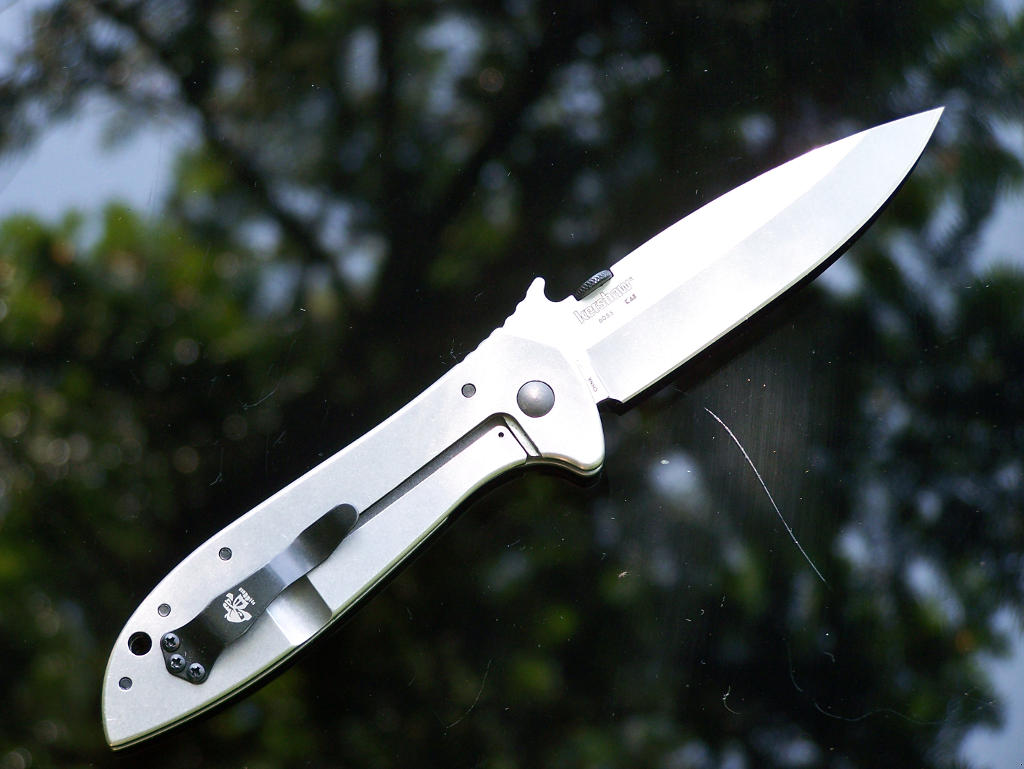
The blade comes in right at 3.9 inches, so it is just under that four inch regulation that so many states or locales have regarding blade length on folding knives. Closed, the knife is five inches long, and opened it is nine inches in length. Weight is a bit hefty– right at 6.1-oz. The knife feels good in the hand, yet doesn’t feel heavy in the pocket. The thumb disk is black as is the pocket clip. The pocket clip also has the Emerson broken skull logo on it, which is cool!
Now, let’s discuss the wave feature that Emerson designed and patented. It is quite unique and one of those “why didn’t I think of that” designs. The wave feature actually looks like a wave on the ocean, which is something surfers can appreciate. The wave makes this folder the fastest-opening folding knife I’ve ever used, bar none. When the knife is clipped inside your pocket, you simple start to draw the knife out of your pocket, adding a little bit of rearward pressure (don’t pull the knife straight up), and with that little bit of rearward pressure and a steady pull upwards, when the knife leaves your pocket the blade will automatically open-up. No, it’s not an automatic folder; you are still opening it manually as you pull it out of your pocket. It takes all of five minutes of practice to master this simple skill. Check out the video on the Kershaw website, and you’ll see how fast and simple this technique is. It just blows me away how such a simple addition to a folding knife blade can rapidly open a folder. Also, if you want, you can open the knife using the thumb disk, but I honestly don’t see any need for it.
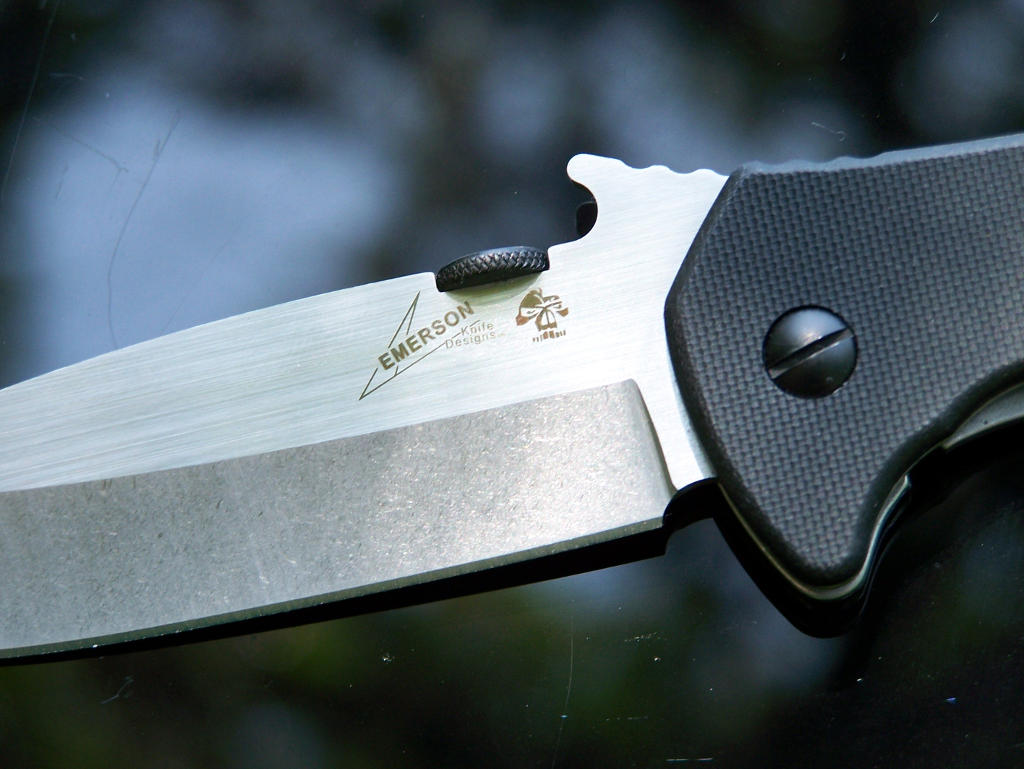
The blade shape itself is almost dagger-esque in shape, and it holds the thickness of the blade out front as long as it can before coming to a point. This type of blade is extremely useful for all kinds of cutting chores. I used the Emerson around the kitchen quite a bit, slicing a lot of veggies for my new smarter eating plan, after I suffered a mini stroke. I don’t especially like fresh fruits and veggies, but I’ll do whatever it takes to drop some weight, plus it afforded me the opportunity to really put the CQC-4KXL to work many times per day. The blade made quick and easy work around the kitchen fast. As is the usual routine, many UPS, FedEx, and USPS boxes were opened. Plus, the knife was “stabbed” into stacked cardboard, and it easily stabbed up to the handle. The blade design isn’t the best for slashing moves, but it worked, once again, on stacked cardboard boxes. One test I always do is cutting down blackberry vines, which are super tough to cut. Many lesser knife blades can’t cut them with a single slashing move, but the CQC-4KXL had no trouble cutting through the vines. I also cut poly rope, and if you’ve ever tried to cut this stuff, you know how slick it is. Many knife blade simply slip right off the slick material. The Emerson easily cut through the poly rope.

Many of the people I associate with weren’t familiar with the wave feature, and they had to watch me draw the knife from my pocket numerous times and watch how fast I could do it. They couldn’t figure out the wave feature until I placed the knife in their pockets and showed them how easy it was to do. Everyone, to a person, loved the way it worked. Again, it’s so simple and so easy to master, and so super fast!
If you go to the Emerson Knives website, you’ll see quite a few of Ernie’s designs, and one thing you will also see is that many of his knives are out of stock. It’s an ongoing thing for Emerson. No matter how fast they turn out his knives, they can’t keep up with supply and demand, ever! So, you could end up waiting months for a particular Emerson folder. I applaud Emerson for teaming up with Kershaw and ZT Knives on numerous collaborations of his designs. If you look over both websites, you’ll see quite a few Emerson designs, and I’m betting good money you’ll find more than a few of Emerson’s folders that you’ll want. Best of all, they are priced right. The CQC-4KXL has a full-retail price of only $64.99, and I’m here to tell you that I believe Kershaw priced this one too low. If I saw this knife in a catalog or a knife shop and it was priced at $150, I would still buy it. It looks for all the world just like a Emerson Knives (factory) folder. It is “that” well made and finished to perfection.
As an aside, I had to get a replacement CQC-4KXL. When my oldest daughter was doing the photography on this knife for this article, she decided to “steal” the knife. She has an early Emerson CQC folder that she’s had for at least 2 years. She has good taste in knives and guns. So, I had to get a replacement for my own use. How much do I like this CQC-4KXL? Well, I’ve been carrying it in my right front pocket for three weeks now, where my Zero Tolerance Model 0630 used to be, and I have no desire to put the 0630 back in my pocket at this time.
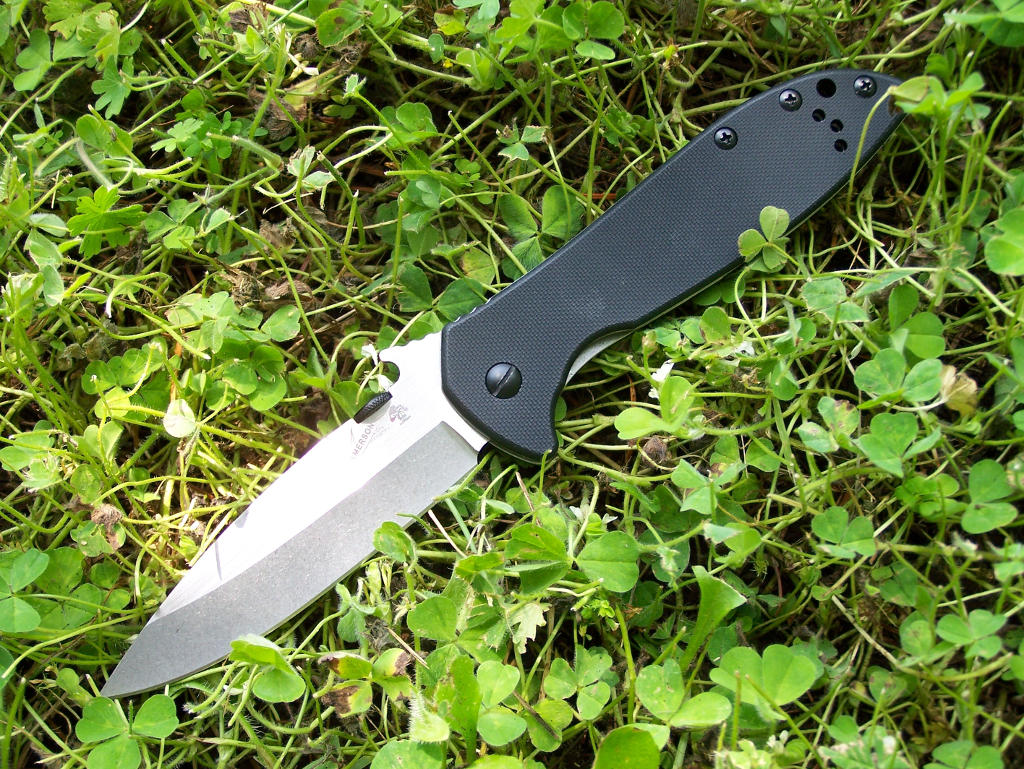
The Kershaw CQC-4KXL Emerson-designed folder would make a fantastic city survival knife, used for all kinds of daily cutting chores at work, or at home, as well as a last-ditch self-defense weapon, if that’s all you have on you at the time. The speed you can draw the knife from your pocket will have a bad guy scratching his head thinking perhaps you pulled a switchblade knife on him, and for some strange reason many folks believe that a switchblade is more deadly or dangerous than some other type of folding knife. The CQC-4KXL might just give a bad guy time to pause and rethink his criminal actions with the speed at which you can draw the knife and have it in hand with which to defend yourself.
Better get your CQC-4KXL, before Kershaw realizes that they priced this folder too low.
– Senior Product Review Editor, Pat Cascio
Recipe of the Week: Baked Pineapple, by BanjoNinja
At our house, people would fight over the pineapple on an Easter or Christmas ham, until a friend suggested this recipe. It’s a favorite recipe, for the holidays or anytime, that is good tasting and relatively inexpensive to make:
Ingredients:
- one can of crushed pineapple
- one can of chunked pineapple
- one can of pineapple rings
- 1 cup flour
- 3/4 cup brown sugar (packed), plus about 4 tablespoons for later
- 1/2 stick butter, chilled
- 1 tsp. cinnamon, plus more to taste
Directions:
- Preheat oven to 350 degrees.
- Spray a 9 x 13 baking dish with non-stick spray.
- Drain and reserve the juice from the crushed and chunk pineapple.
- Mix the crushed and chunk pineapple with the flour and brown sugar in large bowl. This mixture will be somewhat dry, so add the reserved juice a little at a time until it resembles a thick, lumpy milkshake.
- Add the cinnamon and mix thoroughly.
- Pour into the sprayed baking dish.
- Layer the pineapple rings on top of the mixture.
- Sprinkle the remaining brown sugar on top of the rings.
- Slice the chilled butter into slices, and arrange them on the pineapple rings.
- Season with cinnamon on top.
- Add more of the reserved pineapple juice until it is barely up to the level of the pineapple rings.
- Bake for 45 minutes, or until the top is nicely browned.
You may need to add or subtract some of the pineapple juice depending on how juicy the fruit is. You can add more flour to get a more “cake-like” consistency, but you will probably need a deeper or larger baking dish. This is great to transport to family events and can be served cold or hot. I warmed it up on the grill once and it was awesome. Good luck!
o o o
Do you have a favorite recipe that would be of interest to SurvivalBlogreaders? Please send it via e-mail. Thanks!
Letter Re: Illusive Self-Sufficiency
HJL,
I have a question for you and the SB readers. This is our third year living on our rural retreat and fifth year prepping in earnest. We have animals, a large garden, stored food, and other essentials. We’ve come a long way, but I can’t help but think when I survey everything how far we still have to go to become truly self-sufficient. Our garden wouldn’t come close to feeding our family year-round, but I’m already stretched to capacity with the current size, not to mention the animals and general farm chores (like cutting and splitting wood for the winter). Of course, I still have a day job, but it is flexible as I am self-employed. In a TEOTWAWKI scenario, all my time would be freed up for manual labor, but still, true self-sufficiency seems like an illusive dream.
I’m curious how others are doing on their quest towards self-sufficiency and if they have any sage advice to share. Thanks – RG
HJL Replies: True, complete self-sufficiency is tough to achieve and generally results in compromises and lifestyle choices that we wouldn’t normally choose. When you have no one else to depend on, you have to produce everything yourself. In 1978, Soviet geologists prospecting in remote Siberia found a family doing just such a thing. The story is quite moving but has a practical side to it. Sans contact with other people, communications skills suffered as did their living conditions. The name of the game was bare minimalist survival, as that was all they could do. Certainly, survival in Siberia is much tougher than independent survival on a tropical island where things grow of their own accord. Locations such as Siberia, or semi-arid deserts, like much of the southwest, mean that much more of your time is taken up with simply providing enough calories to survive.
This is the reason we believe you should surround yourself with like-minded individuals. You can still maintain a relative amount of individuality, yet have the greater strength of the group when it comes to tasks requiring specialization or protection. It’s hard to find the time to shoe your own horse when you are tending a garden tasked with all of your food needs, but one man can certain shoe a village of horses and barter that service for garden produce from those who farm.
Total self-sufficiency can be achieved, but it’s not a lifestyle that I would choose to live when other options are available.
Economics and Investing:
Nature Provides Novel Solution To Energy Storage Problem
o o o
A Wary Athens Awaits the Referendum on Austerity. – JBG
o o o
Puerto Rico Debt Crisis Mounts With Key Deadline Just Week Away. – G.G.
o o o
Greece Update: Run On Banks Risks Leaving Them Cashless – JBG
o o o
The world is defenseless against the next financial crisis, warns BIS. – G.G.
o o o
Items from Mr. Econocobas:
Greek Capital Controls Begin: Greek Banks, Stock Market Will Not Open On Monday
Odds ‘n Sods:
A consulting client asked about sources for military surplus vehicles. One auction firm that is reputable is GovPlanet.com. But as with buying any used vehicle, caveat emptor! – JWR
o o o
Slave or Rebel? Ten Principles for Escaping the Matrix and Standing Up to Tyranny Some Americans are beginning to realize that they are slaves, and that if they don’t act soon they will find themselves imprisoned in the electronic. – H.L.
o o o
Tom Hammond’s Soldering Tips. – T.P.
o o o
‘Sneak & peek’ warrants allow police to secretly enter homes without notice. – H.L.
o o o
Orthodox Christians Must Now Learn To Live as Exiles in Our Own Country. – GJL