Scot’s Product Review: Work Sharp Guided Sharpening System

It’s probably just me, but when I get a nice, sharp, new knife, my first response is glee at how well it cuts, but then fear creeps into my mind, the fear of dulling it. Making it dull means having to make it sharp again. Will it ever be as sharp as it was new? Sometimes I find myself trying to avoid using it and looking for a box cutter with a disposable blade instead. That kind of defeats the purpose of having a good knife, which led me to confront my fear of sharpening years ago. I’ve learned to do it and even enjoy putting a good edge on something once after it’s all over, but I still dread the prospect of having to do it. The basic idea is simple; remove the dull part of the blade and leave the sharp part, but the devil is in the details. The details have led me to try every sharpening method and tool I can get my hands on.

The best way to sharpen a knife, by the way, is to keep the edge it started with. Every knife blade is sharpened at an angle to generate a cutting edge, and that angle varies depending on the purpose of the knife. Something used for fine slicing will need a finer angle than something intended for chopping through bones. There is the issue of single vs. double bevels. A single bevel can produce a finer, sharper edge for precision work but at the expense of the durability a double bevel can provide. The type of abrasive device used to make the edge determines its shape. A flexible one, like a belt sander, produces a convex edge. A flat surface, like a stone or diamond plate, gives a flat edge, while a grinding wheel leaves a concave edge. Each angle, bevel, and shape has its place in the cutting world. A big part of the trick of sharpening is to recognize how your knife was made and determine the best strategy for sharpening it based on its purpose and original design. This is where the difficult part comes in, figuring out what a particular knife needs. Using a different method and angle will cause you more work, since you must first reshape the edge, which means removing more of the knife.

Last year I reviewed the $90 Work Sharp Original Knife & Tool Sharpener, which is kind of a handheld belt sander, and I found that it worked quite well, though one has to be careful to use good technique as the tip comes off of the belt. I do not appear to be the only one who managed to use bad technique and round a few knife tips before catching on. The chief problem for me was that it seemed natural to follow the curve of the blade, when it is actually correct to pull it straight across or even at a downward angle. Despite having to take some care with its use, I have grown fond of it, as it will provide a good edge on a lot of knives in a hurry. Besides knives, you can sharpen other things, like lawn mower blades, axes, and scissors with it. I also like to sharpen shovels, and it works well for that too. Remember that since it is a belt sander, it produces a convex edge. If you sharpen a knife with a different shape edge, you will be reshaping it the first time you sharpen it.

Work Sharp is an innovative firm, however, and they seem to create new products in rapid succession. One of their new products was the Guided Field Sharpener I touched on recently, not knowing they had a similar but greatly enhanced tool on the way, which is the Work Sharp Guided Sharpening System.

Just for a quick review, the $35 Guided Field Sharpener, as the name implies, is something you can easily take on hunting or camping trips. One of the biggest problems many of us have in sharpening is getting the edge at the wrong angle and then wobbling as we go. Getting the angle wrong can ruin the edge at worst and usually means removing more metal than necessary. Wobbling leads to enhanced dullness, which is not exactly our goal. The guide on this tool gets you started at a 20 degree angle, which is a good angle for most knives, and a good start can lead to a good finish to the stroke. You get coarse and fine diamond abrasive plates, a ceramic rod with coarse and fine surfaces, along with a grooved surface for fish hooks, a small diameter ceramic rod for serrated edges, and a leather strop. They even included a wrench for dealing with broad head arrows. All of the abrasives can be replaced when they wear out, and the diamond ones can be removed to use on tools that might not work with the holder. They did perplex me by putting the instructions inside the tool under one of the plates, but I failed to read the box that said where they were. Oops. It is a slick device with the caveat that if your knife has a different angle edge, you will reshape it the first time you use the tool. Since it uses flat plates for sharpening, you will get a flat edge, so if your knife started life with a convex or concave edge, you will be changing that too.

The Guided Sharpening System could be viewed as the Field Sharpener’s big brother. For me, its neatest new trick is the Pivot-Response System, which allows the sharpening surface to pivot as the knife is drawn across it, following the blade’s curve. The idea is that since the abrasive follows the knife edge, it maintains the same angle on the edge as it is stroked across the plates. You can do this manually, but it is harder. I like easier, so this feature pleased me. You can lock the plate in a fixed position for straight blades.

Another key to the tool’s ability to sharpen is the interchangeable abrasives. You start with a holder for diamond plates that are very similar to the ones on the Field Sharpener, but they’re larger, which makes it easier to sharpen longer knives. Work Sharp provides coarse (320 grit) and fine (600 grit) diamond plates, and if you buy the $35 upgrade kit you get extra coarse (220 grit) and extra fine (800 grit) diamond plates along with a leather strop plate. The strop includes a polishing compound to help refine the blade. The plates are held in the tool by magnets that do an excellent job of keeping them where they belong. With the basic tool, you get a great range of abrasive surfaces to deal with knives, whether they are in poor or good condition, but the upgrade kit lets you deal with even more and to create a razor’s edge with the strop.

The plate holder can be removed and replaced with a holder that has three ceramic rods for additional sharpening and serrated edges. The main rod can be rotated from coarse to fine and also has a spot for fishhooks. There are two shorter rods of different diameters that can be used with knives with small serrations.

The next key is the system of interchangeable guides. When you use the tool, you start the blade on a guide that gets you at the right angle. That– getting the starting angle correct– is one of the hardest problems for many of us. You still have to use diligence as you move the knife across the plates or rods, but at least you start right and you start consistently. Consistency is critical in sharpening. If you don’t keep each stroke at the same angle, you will not arrive at a sharp edge anytime soon.

Work Sharp gives you 17 and 20 degree guides, and this is one area where I would like to see more options. These two angles work well for most knives, but there are some that need different angles. Some blades, such as those with a Scandinavian grind, use a single bevel with smaller angles while some heavy duty knives intended for things like batoning fire wood have double bevels and larger angles. Finer angles are better for precise cutting while steeper angles are more durable and can handle abuse better. I have a couple of knives I plan to review in these categories that I need to keep at their original bevels to be able to better evaluate them and these angles, alas, do not match the ones available on the Work Sharp.

Something I have liked about all of the Work Sharp products I’ve used is how much they try to help you use their tools properly. The website has excellent and informative videos, and the instructions are clear and easy to follow. The Guided System includes a tree to help you determine how to use it for different sorts of knives and gives you a formula for how many strokes to use on each surface. While the formula is a good starting point, each knife will be different and may require more or fewer strokes.

When I did what I was supposed to do and didn’t take short cuts, I got excellent results. Some of my problems were using more pressure than Work Sharp suggests and forgetting to check for a burr before moving to the other side of the blade. Getting the burr indicates that you have reached the edge and pushed a bit of metal ahead of it, which usually folds to the other side of the knife. That’s when you get to flip it over and give the other side the same number of strokes, which should leave another burr on the opposite side at which point you can move up to the next abrasive. You want the burr to be even along the length of the edge, so you may work on parts of it more than others. Getting the burr is the true indicator that the blade has gotten enough strokes.

Before you start sharpening, you want to evaluate the state of the edge. Ideally, you have not pulled my stunt, which is to make the knife dull. It is easier to keep a knife sharp than it is to restore the edge. Sharpening removes metal, and the less you have to remove the better. Taking off metal is time consuming; the more you take off, the less knife you have left. If you take care of the knife, you may be able to get by with just the ceramic rods or strop. If the knife is dull or the blade is damaged, then you will be starting with the diamond plates. I usually try the fine one for a few strokes to see if it is doing the job, but if not I go to the coarse one. You will start to get a feel for just how dull your knife is and what you need to start with.

To restate, the first time you use a new sharpening tool, you may find that you have to reshape the edge to match what the tool produces. If your knife has a 22 degree bevel and you sharpen it on this tool, you will be reshaping the blade to 20 degrees; that may take extra work and require the use of coarse diamond plates. Another issue is that different types of tools create different edges. As noted above, you will also be making a flat edge, and if your knife is concave (hollow ground) or convex ground, you will be changing that shape too.

Using the tool is really simple. I was very surprised at how well it stayed in place while in use. It is just heavy enough and has rubber feet that stick well to many surfaces. It is important to get a good position in relation to the tool. I have been in the habit of standing at a kitchen counter while sharpening, and found with this sharpener that my initial position led to rocking the blade as I drew it back towards me. I did better seated at a table, though if I adjust the angle I positioned the tool at when standing, I could overcome the problem.

The pivot is used with curved blades and I felt it definitely improved performance. You can get the same effect by lifting the handle slightly as you move towards the tip, but the pivot worked better for me by injecting more consistency than I get by lifting the handle. You don’t use the pivot with straight blades. The pivot is engaged or disengaged by moving a slider. The slider also locks the plate or ceramic holder into the tool, which is good if you are moving it about.

As you stroke the knife across the plates, Work Sharp suggests that you stop before the tip comes off the plate. If you twist it and pull it all the way off, there is a potential to round it.

The diamond plates that come with the tool do an excellent job of shaping and basic sharpening. The extra coarse and extra fine plates in the upgrade kit add versatility. The extra coarse can quickly remove metal for reshaping, but I think it should be used sparingly. The extra fine plate refines the edge more and should save a little time with the ceramic rods.

The box it comes in can be used to store the sharpener, but I would really like to have a tool roll for it. I assume the box will eventually wear out and it’s not the best solution should you want to travel with it. The slots in a roll would keep the diamond plates and ceramic rods from banging together. Having a few extra slots would also allow for spare parts.

I’m not sure how long the plates and rods last. I’ve done about 15 knives, and the abrasives are still going strong. A couple of the knives needed a lot of work, but most were in decent shape. Sooner or later, you will probably wear something out, and Work Sharp says that you can get replacements for it, though they aren’t on the website as I write this. They told me you can just call and they will take care of you.

The most novel thing about this sharpener is probably the 42-year warranty. Work Sharp, a U.S. company based in Oregon, wanted to celebrate the fact they have been in business for that long and plan to be around a lot longer.

I like the tool, and it is now my primary sharpener for most knives. I’m still using the Original on some for speed and ease, but I have pretty well left other tools and methods behind.

– SurvivalBlog Field Gear Editor, Scot Frank Eire


Pat Cascio’s Product Review: Cold Steel’s Special Forces Shovel

Ever since I was a little tyke, which is going back many decades, I’ve had an interest in anything having to do with the military, especially military gear. When I was a kid, back in the Bridgeport neighborhood of Chicago, IL, my friends and I would play “soldier” or “cowboys and Indians” all of the time. These days, if kids are seen pointing toy guns at one another, the police are called. What a shame!

I was the envy of most of the kids on my block when I was a kid. I had a genuine U.S. military canteen, complete with canteen cover, pistol belt, entrenching tool, and the old “Castro” style military cap. I was told that if you could dig a hole deep enough you could dig your way to China. The backyard where I lived probably still has some holes that I dug with my entrenching tool. To be sure, all this military gear was purchased at an Army/Navy Store, which is something you rarely see any longer. When I was younger, even into my teens, I would haunt two Army/Navy stores in downtown Chicago, always, and I mean always, walking out with a military treasure of some sort.

These days, it’s getting extremely difficult to find genuine U.S. military surplus, thanks to some policies put in place by Bill Clinton when he was president. Most U.S. military surplus these days is either destroyed or sold or even given away to foreign governments for their militaries. How sad is that1? We, the taxpayers, have paid for this equipment and we should have the opportunity to purchase it back, if we want it. You can find U.S. military-style uniforms and gear, but the definitive word there is “style”. Also, we have companies claiming they manufacture military “plus” gear or military “spec”, but whose “spec”? It sure isn’t U.S. military spec. It’s all very misleading. The reader simply assumes these companies are selling U.S. military-spec gear and clothing, when it is made to military-spec of some foreign military.

100_6169

In my well-packed bug out bag, I carry a very small tri-fold shovel, and everyone should have a small shovel of some sort in their BOB. If you don’t, you aren’t prepared. Yeah, you can “dig” a hole with your sheath knife; however, it will dull, and you could possibly break the blade. It’s not an ideal digging tool. In my emergency box in my pick-up truck, and in my wife’s SUV, we have tri-fold shovels, and we don’t have cheap ones, either. They are some of the better ones on the market. I have had to use one of these shovels more than a few times, and it pains me to say that I had to dig out one of my SUV’s back in Colorado Springs, CO one day when it got high-centered in a high snow drift. The 4-wheel drive wouldn’t get me out, but the shovel saved the day.

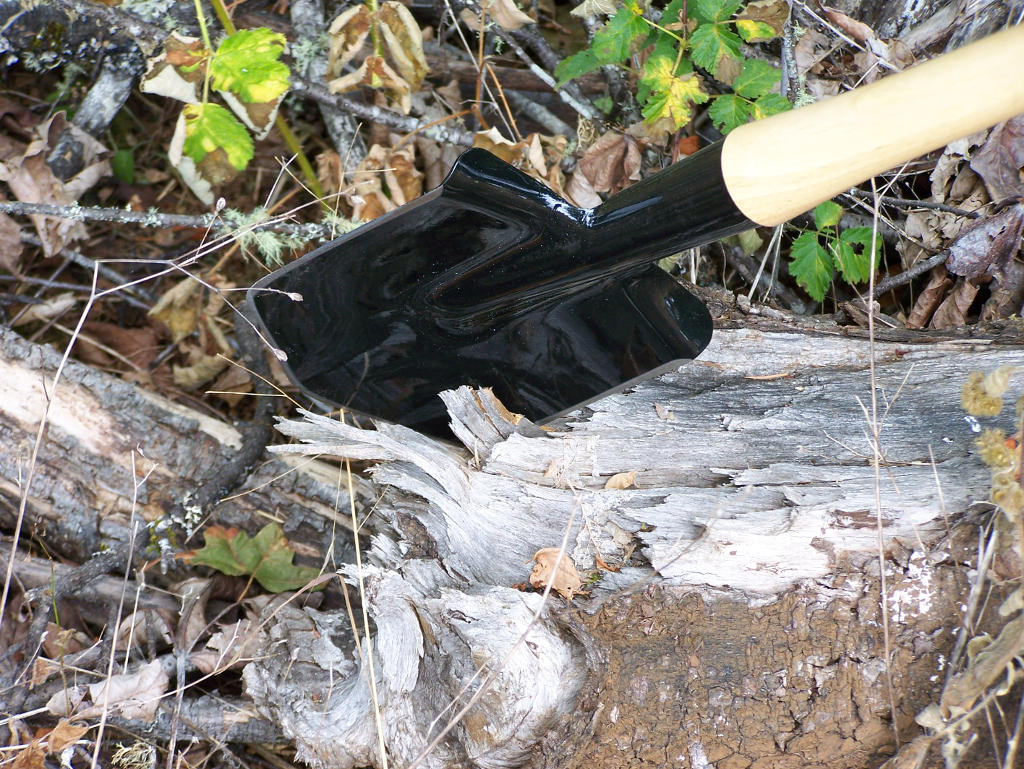
My long time friend, Lynn Thompson, who owns Cold Steel produces an almost exact duplicate of the Russian Special Forces (Spetsnaz) shovel, and I’ve wanted one for the longest time. It is one of those products at Cold Steel that is forever on backorder. They can’t produce them fast enough to keep up with supply and demand. The Cold Steel Special Forces Shovel is, in my humble opinion, the absolute best-built military-style shovel in the world, and I use the term “style” only because I’m not aware of any military issuing this shovel. The Cold Steel Special Forces Shovel is an improved version of the Russian Spetsnaz shovel. It has steel that is twice as thick as that found on the Spetsnaz version, and a thick, hard-wood handle, that will take a beating. The SF shovel has a broad, flat head, that is sharpened. Yes, you read that right; it’s sharpened on three sides, and it is sharpened to an axe-like sharpness, which is a tough working sharpness. However, with some time, you can sharpen it to the sharpness of a knife. However, I recommend against that sharpness; it will easily damage the edge of the shovel’s blade. With the edge that comes on the SF Shovel, you can chop a small tree down, and it works great around my small homestead, cutting down blackberry vines.

A small shovel can do all kinds of chores that you wouldn’t expect. Most people think of digging a hole as the only use for a shovel. How about using it as an emergency paddle for a small boat or as a cleaver or hatchet? It could be used as a weapon, like throwing it as a tomahawk, or used as a defensive shield against a fist or a knife attacker. You can even use it as a shovel to dig fox holes, trenches, or a sniper’s blind.

100_6176

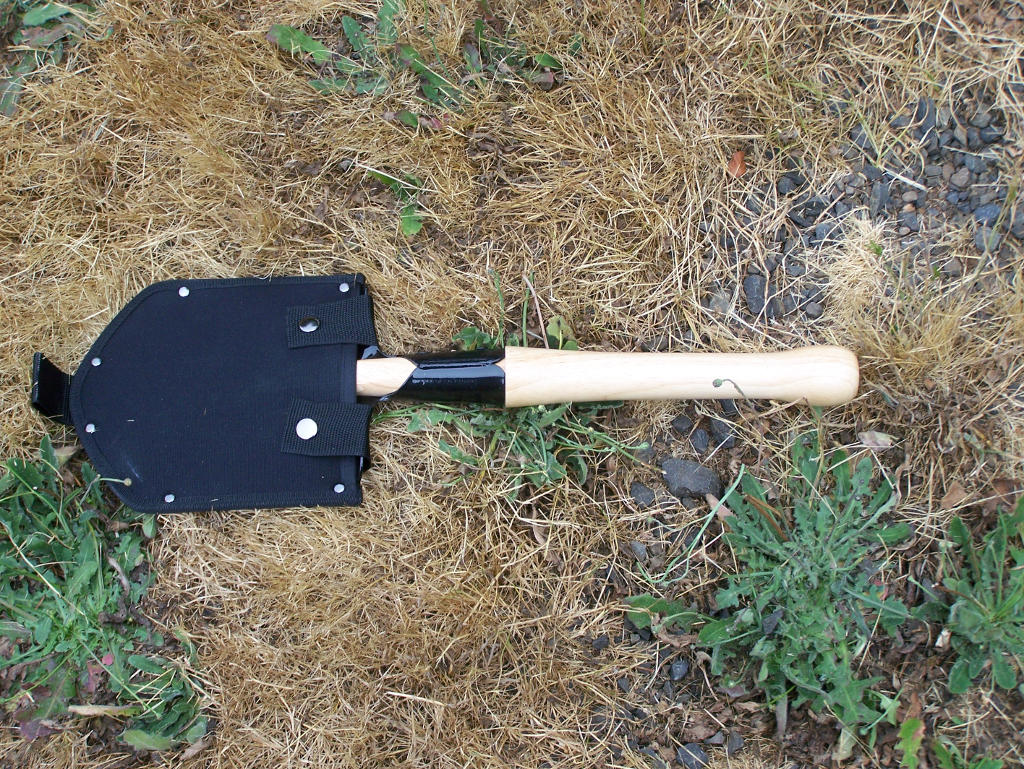
You need to take a few minutes to watch the above link and see all the different torture tests that Cold Steel puts this SF shovel through. It is eye-opening, to say the least. Several of the tests involve using the SF shovel as a throwing weapon. To be sure, I had to test my sample the same way, and with very little practice I could get my SF shovel to stick in tree trunks. The Cold Steel SF shovel isn’t a folding shovel; it is a fixed blade with a handle. You can’t fold it. However, it makes it all that much more sturdy. I’ve had some tri-fold and even bi-fold shovels collapse while using them or even break. The shovel only weighs slightly more than 26-oz, too, so it’s not too heavy to pack around. The blade is black powder coated to help protect the medium carbon steel blade from rust. However, the sharpened edges are bare from sharpening them, so put a coating of protective oil or some Birchwood/Casey “barricade” on it to help prevent those exposed edges from rusting. The SF shovel also comes with its own Cor-Ex Sheath that can be attached to a backpack, which is easier than storing it inside the pack, too.

100_6177

I honestly abused my SF shovel, throwing it, chopping with it, and digging with it. Under my soil and on my digs, there are many small and big rocks, so digging is a next to impossible task. However, the SF shovel was up to it. I guess I was really amazed, maybe shocked, that the shovel could chop as well as it did. It chopped better than any small hatchet I’ve owned, and it even works as a machete and better than most machetes do.

If you don’t have a small shovel in your bug out bag, or your emergency box in your vehicle, then this is the one you want to buy. Even if you do have another lesser shovel, I would still buy a Cold Steel Special Forces Shovel. I’m totally blown away with this product. It does so many things, other than being useful as a shovel. This is one survival tool you’ll want to have with you, especially in the wilderness. Full-retail is less than $37 and can be found for a bit less when you can find them. In my book, this is a deal and one absolute “must have” survival tool. My SF shovel is in my emergency box in my pick-up. If I ever have to leave my pick-up during a breakdown, my backpack will have the SF shovel in it.

– Senior Product Review Editor, Pat Cascio


Recipe of the Week: Honey Oatmeal Bread, by C.S.

Ingredients:

  • 1 cup quick-cooking oats
  • 1/3 cup butter
  • 2 cups boiling water
  • ½ cup honey
  • 1 Tablespoon salt
  • 2 pkgs. yeast
  • 2 eggs
  • 6 to 7 cups flour
  • 1 egg, slightly beaten
  • 1 Tablespoon water
  • Additional oats to coat the top of the bread

Directions:

  1. In a large mixer bowl, combine oats, butter, boiling water, honey, and salt.
  2. Cool to warm (105 to 115 degrees). Stir in yeast.
  3. Add 2 eggs and 2 ½ cups flour. Beat at medium speed, scraping bowl often, until smooth.
  4. Stir in enough remaining flour to make dough easy to handle.
  5. Turn dough onto a lightly floured surface; knead until smooth and elastic. Add more flour as needed until dough is no longer sticky.
  6. Place in a greased bowl. Lightly grease the top of dough. Cover, let rise until double in bulk (about 1 hour).
  7. Punch dough down, and divide dough in half. Shape and place into greased loaf pans. Cover and let rise until double in bulk.
  8. In a small bowl, combine remaining egg and 1 Tbsp. water. Gently brush mixture over the top of the loaves. Sprinkle with oats.
  9. Preheat oven to 350 degrees and bake for 25-35 minutes or until loaf sounds hollow when tapped. Let rest for 1 minute, and remove from pans.
  10. Serve with Honey Butter, if you like

NOTE: To make Honey Butter, combine the following ingredients in a bowl:

  • ½ cup soft butter
  • 2 Tablespoons honey

o o o

Do you have a favorite recipe that would be of interest to SurvivalBlog readers? Please send it via e-mail. Thanks!


Letter: Every Prepper Needs A Bar!!

Hugh,

In all the material I have read over the years, I don’t think I have ever seen info about every prepper needing a bar. It is one of the most important items that you can have. You will need it often, and there are times it will be critical to have one.

My bar has many names. My dad called it a cheater bar. My neighbor calls it a digging bar. I call mine a pry bar. Oh, we are talking about a TOOL bar, not the kind where you get juiced. With all the various projects that will happen around your place, you will find this tool a handy, if not imperative, item to have around. Here are some pictures of various types that are available.

In the past week or so we have used my bar to get rocks out of post holes we were digging, to lift and hold a plow that we were replacing a broken bolt in, to pry and force open a door on a conex container, and align corner posts on a fence being built. While this is a tool that is seldom mentioned, it is one that will be regularly used.

Mine is 72″ long, weighs about 20 pounds, and is carbon steel, so it will not bend under load. I think I paid about $40 for it several years ago at a local farm supply store. Don’t think you can use a piece of galvanized pipe in place of this bar; that simply will not do the job. Get serious. Get yourself a bar. – Bison Billy at the end of the dirt road


Hugh’s Quote of the Day:

“There is not a man in the country that can’t make a living for himself and family. But he can’t make a living for them and his government, too, the way his government is living. What the government has got to do is live as cheap as the people.” – Will Rogers


Notes for Sunday – August 02, 2015

Today, we present another entry for Round 60 of the SurvivalBlog non-fiction writing contest. The $12,000+ worth of prizes for this round include:

First Prize:

  1. A Gunsite Academy Three Day Course Certificate, good for any one, two, or three day course (a $1,195 value),
  2. A course certificate from onPoint Tactical. This certificate will be for the prize winner’s choice of three-day civilian courses. (Excluding those restricted for military or government teams.) Three day onPoint courses normally cost $795,
  3. DRD Tactical is providing a 5.56 NATO QD Billet upper with a hammer forged, chromlined barrel and a hard case to go with your own AR lower. It will allow any standard AR type rifle to have quick change barrel, which can be assembled in less than one minute without the use of any tools, and a compact carry capability in a hard case or 3-day pack (an $1,100 value),
  4. Gun Mag Warehouse is providing 20 Magpul pmags 30rd Magazines (a value of $300) and a Gun Mag Warehouse T-Shirt. (An equivalent prize will be awarded for residents in states with magazine restrictions.),
  5. Two cases of Mountain House freeze dried assorted entrees in #10 cans, courtesy of Ready Made Resources (a $350 value),
  6. A pre-selected assortment of military surplus gear from CJL Enterprize (a $300 value),
  7. A Model 120 Series Solar Generator provided by Quantum Harvest LLC (a $340 value),
  8. A $300 gift certificate from Freeze Dry Guy,
  9. A $250 gift certificate from Sunflower Ammo,
  10. KellyKettleUSA.com is donating both an AquaBrick water filtration kit and a Stainless Medium Scout Kelly Kettle Complete Kit with a combined retail value of $304,
  11. TexasgiBrass.com is providing a $300 gift certificate, and
  12. Two cases of meals, Ready to Eat (MREs), courtesy of CampingSurvival.com (a $180 value).

Second Prize:

  1. A Glock form factor SIRT laser training pistol and a SIRT AR-15/M4 Laser Training Bolt, courtesy of Next Level Training, which have a combined retail value of $589,
  2. A FloJak EarthStraw “Code Red” 100-foot well pump system (a $500 value), courtesy of FloJak.com,
  3. The Ark Institute is donating a non-GMO, non-hybrid vegetable seed package–enough for two families of four, seed storage materials, a CD-ROM of Geri Guidetti’s book “Build Your Ark! How to Prepare for Self Reliance in Uncertain Times”, and two bottles of Potassium Iodate– a $325 retail value,
  4. A $250 gift card from Emergency Essentials,
  5. Twenty Five books, of the winners choice, of any books published by PrepperPress.com (a $270 value),
  6. TexasgiBrass.com is providing a $150 gift certificate, and
  7. RepackBox is providing a $300 gift certificate to their site.

Third Prize:

  1. A Royal Berkey water filter, courtesy of Directive 21 (a $275 value),
  2. A large handmade clothes drying rack, a washboard, and a Homesteading for Beginners DVD, all courtesy of The Homestead Store, with a combined value of $206,
  3. Expanded sets of both washable feminine pads and liners, donated by Naturally Cozy (a $185 retail value),
  4. Two Super Survival Pack seed collections, a $150 value, courtesy of Seed for Security, LLC,
  5. Mayflower Trading is donating a $200 gift certificate for homesteading appliances,
  6. APEX Gun Parts is donating a $250 purchase credit,
  7. Montie Gear is donating a Precision Rest (a $249 value), and
  8. Two 1,000-foot spools of full mil-spec U.S.-made 750 paracord (in-stock colors only) from www.TOUGHGRID.com (a $240 value).

Round 60 ends on September 30th, so get busy writing and e-mail us your entry. Remember that there is a 1,500-word minimum, and that articles on practical “how to” skills for survival have an advantage in the judging.


Bugging Out “Alone”, by Professor Prepper

There have been many articles written about the folly of bugging out into the wilderness in a TEOTWAWKI event. However, if you want to see what it will be like to bug out alone in the wilderness to try to survive, then you need to watch the History Channel’s new show Alone. The concept of the show is to drop 10 survival experts off on Vancouver Island alone, with minimal supplies. The last man on the island wins $500,000. You can read the ten men’s bios and the list of the 10 survival items that each chose on the History Channel website http://www.history.com/shows/alone. Most of what I relate in this article has already been written about on countless blogs and in articles and books. I’ll just try to put them into the context of this survival experiment.

The Story of Alone

Remember that these ten men are trained survival experts. Many have faced serious danger as members of the armed forces. These are MEN. The fifth episode takes us through day eight, when there are only four men left. Five trained survival experts lasted from one night to four nights alone in the wilderness. The sixth survivalist left on the morning of day eight. How long do you think that you, the weekend survivalist, would last?

To be fair to these men, let me describe Vancouver Island. It is like a tropical rain forest. It rains all of the time, and everything is wet. The constant wetness causes several problems. First, making fire is difficult. All tinder and fire wood sources are wet. Fire brings comfort and confidence when you are alone in the woods. Fire can repel predators and is essential for purifying water. The four men who remain have solved that problem. The competitors have learned to process tinder by collecting and drying it. They store tinder and firewood in their shelters to keep it dry. One enterprising competitor made what he called char dust. It is made using the same method that is used to make char cloth, but his medium is cedar dust that is created by shaving a cedar stick. He used the metal tin that contained his fish hooks to char the dust in the fire. By using the char dust as tinder, he was able to get an ember with just one strike of his fire steel. Before, using tinder gathered in the forest, it would take 100+ strikes to ignite the damp tinder.

In addition, the island is home to 200 wolves, 7000 black bears, and 1000 cougars. It is a predator-dense island. Predators have been the reason that four of the six men left. Bears and cougars would walk right up to the men’s tents at night, and one was actually charged by a bear. A few of the men are armed with bows; most have axes, and all have knives and bear spray. That’s not how I want to face a bear or cougar!

The men who have tapped out so far are:

Josh (Day 1) – was dropped into an area with a heavy population of bears. He said that his camp was surrounded by bear trails.

Chris (Day 2) – heard wolves attacking and tearing at their prey just yards from his tent on the first night. Left the next morning.

Joe (Day 4) – after three days of not being able to make fire due to wet conditions, Joe moved his camp to the beach and succeeded in making fire and boiling water. He also succeeded in losing his ferro rod. He would have had to stay with his fire to keep it going, thus limiting his ability to find food or sleep. He tapped out due to the stress of surviving in the rain without fire for three days with the loss of the ferro rod being his tipping point. He tapped out on day four.

Wayne (Day 5). Wayne was charged by a bear on a trail. He also had one or more bears sniffing around his tent and camp most of the night. He tapped out in the early morning hours of day five. Wayne had been showing signs of stress before this, due to loneliness and the survival conditions.

Brant (Day 6) – After many days of looking for a water source, Brant finally locates water. Brant had not been able to make fire, so he tried to purify water by filtering it through moss. After have been without water for several days, he drank about 10 quarts of this “filtered” water. That night, he experienced severe stomach cramps and hallucinations. It turns out that he was drinking brackish water. Brackish water happens where sea water and fresh water mix. The water contains more sodium than freshwater but not as much as seawater. The sodium levels are extremely dangerous. He had to tap out because he was thirsty and didn’t investigate his water source carefully enough nor boil it. Even experts make mistakes when under duress.

Dustin (Day 7) – After surviving a day and night in his tent during a severe storm (winds up to 50 mph), Dustin tapped out. He said that it was scary being in a tent in the woods and hearing trees crashing down in the woods due to the 40-50 miles per hour winds. Dustin had also been showing signs of stress before this, but the storm and its inherent dangers were his tipping point.

Four men remain: Sam, Alan, Lucas, and Mitch. Each of these men, while suffering from extreme loneliness, have shown a stronger mental state. They have been less bothered by the rain, dealing with it as just another survival problem to solve. They may have been luckier in their drop sites than the other men, but they have all built adequate shelters, made fire, and found food. Alan frequently eats sea slugs and kelp, because they require little effort to catch. Mitch used his gill net to catch a large trout one day. He enjoyed a great meal, though a cougar checked out his camp that night, coming within ten feet of his fire. The smell of the trout may have attracted the cougar. Sam has dined on small crabs and kelp. I have not seen Lucas catch food, and he has expended a lot of calories, first trying to build a cabin and then on a canoe. He spent four or five days on the canoe but was successful. He can now fish in the bay or explore some of the rivers.

All four men frequently describe being very lonely and missing their families. Several have missed significant events, such as birthdays. Several have even let out their stress by crying. This seems to have helped with their stress levels, because they have then been able to push on. Last Thursday’s episode took us through day 14.

Lessons Learned So Far

Mental Side of Surviving Alone

I’m not sure how you prepare for being alone except by heading out into the wilderness for a few weeks at a time with no books or entertainment to occupy your time. The stress of being alone has contributed significantly to most of the men tapping out. The stress of survival is bad enough, but add loneliness and seemingly survivable events become the tipping points that cause the men to tap out. My lesson is one that has been continuously preached: network and form a survival group. Your chances of surviving in the woods increases exponentially with other, trusted people. Imagine how much each man’s mental condition would improve if one man could stand watch while the other slept? Or how much better it would be to just have a companion for conversation instead of talking to the camera? Rare will be the lone wolf who can survive. I would have thought that all ten men had the survival mindset described in so many blogs, but it appears that only a few of them do.

I also watch other shows where people live in extreme conditions. Very few of them go it alone. Most who do have neighbors that live nearby who can drop in to help or at least provide some human contact and conversation.

Water

Several men struggled to find a source of fresh water. Going several days without fresh water, or without a fire to purify the water, caused much stress among the men. After several days without water, Brant didn’t investigate his source of fresh water and did not boil it to purify it. It turned out that he was drinking brackish water, which caused intestinal distress and hallucinations. Death could have followed had he not called for help. Mitch had to move his camp to find freshwater. Joe also moved his camp but more to find dry tinder and wood to be able to purify water. My lesson learned is to be careful in finding freshwater and never drink it without purifying it. If you choose to bug out, have multiple methods for purifying water. Also know several methods for collecting or finding water in the area that you plan to bug out to. Mitch collected rainwater from his tarp, while he searched for a freshwater source. This was just enough water to sustain him.

Fire

Fire brings comfort, protection from the elements and some predators, as well as is one method to purify water. Even though most of these men knew friction methods for making fire, Vancouver Island is a rain forest. Conditions were too wet to use that method. The men basically only had one method, a ferro rod, to make fire. One contestant recovered a jar from the beach that may have been used as a magnifying class to start a fire had he needed it. The men had to adapt to the conditions by learning to dry their tinder (or create tinder in the form of char dust) and fire materials. The lesson learned here was to know many methods for making fire and take many easy methods into the woods with you. Matches, lighters, fire steel, magnifying glasses (or your eye glasses) are just a few of the ways to start fires. In addition to taking tinder sources with you, know how to find dry tinder, even in wet conditions. I have seen many articles online on how to find tinder and build fires under wet conditions.

Predators

Be prepared to deal with predators, both four- and two-legged ones. You say, “I will have my trusty AR and several handguns with my stash of ammunition.” However, first, I wouldn’t want to face a bear with a .223. I’ve seen feral hogs run away after a solid hit with a .223. There aren’t any bears in your area? Good. Still, facing any predators alone has small odds for your survival. Cougars hunt at night where they have the advantage. Wolves hunt in packs, again to their advantage. The human predators are probably the ones that you have to fear the most in a TEOTWAWKI situation, and they also hunt in packs. The lesson learned is that a survival group is better suited to face predators. More people may keep a predator from even approaching your camp. You have someone to watch your back while getting water or looking for food. A survival group may also have a wider variety of weapons to use on larger predators. As a “lone wolf,” you may not be the apex predator in the woods.

Summary

I recommend watching all episodes several times to in order to glean as much information as you can. The History Channel site also has several interviews with some of the men who tapped out early. They describe the conditions and the impact on their mental state. You can learn much from these interviews. To put it bluntly, surviving alone is tough, even for survival experts. If you have been one who thought that all of those articles describing how “lone wolves” will not survive in the wilderness did not apply to you, then watch Alone. Six survival experts lasted less than a week, and four of them lasted less than four days. They had a satellite phone to call for rescue. In a TEOTWAWKI event, there will be no rescue.


Letter Re: The Importance and Art of Fire-Making

Hugh,

I’m in agreement with pretty much everything in N.P’s excellent article; everything except his repeated reliance on a Bic lighter, especially in the sub-zero conditions he described. Butane lighters become useless below about 15°F, at which point butane won’t vaporize. A better choice would be the tried and true Zippo lighter, which will light at any temperature and is wind-resistant. The only downside to the Zippo is that the fuel in it will evaporate over time and will need to be periodically refilled, whether it’s used or not. If you find yourself in the conditions N.P. described and a butane lighter is all you have, be sure to carry it on your person as close to the body as possible to keep it warm. – P.H.


Economics and Investing:

Some progressives never learn: CEO Raises Salaries to $70K for EVERY Employee, Now has to Rent Out his Own Home to Make Ends Meet

o o o

Puerto Rico: No money available to make $58M bond payment – G.G.

o o o

Big Chunk Of JP Morgan’s Gold Holdings Withdrawn In One Day

o o o

It Won’t End Well: Unemployment In Italy Has Hit All Time New Highs. Canada’s Economy Shrinks Again, On A Verge Of A Recession. U.S. Wage Growth Is The Weakest Sine 1982.


Odds ‘n Sods:

I don’t think I agree with the analysis, but it’s an interesting read on the breakup and reconstruction of the United States sent in by FEB

o o o

Windows 10 is spying on almost everything you do – here’s how to opt out
-and-
Windows 10: The first 5 things you need to do immediately after you install it – T.P.

o o o

Kroger Executive Stands Firm Against Group’s Demand to Ban Guns from Store – PJP

o o o

Messaging App Weaves Smartphones Into an Alternative Internet – G.G.

o o o

‘Production Versus Plunder’ Part 18: The Re-conquest


Notes for Saturday – August 01, 2015

August 1st is celebrated as Swiss Independence Day, in recognition of the signing of the Federal Charter of 1291, which united Switzerland’s first three cantons. As of 2015, Switzerland has been free and independent for 724 years. Having a well-armed populacehas assured that.

August 1st is also remembered as the election day in 1946 that sparked the Battle of Athens, Tennessee, when returning World War II veterans took up arms to oust a corrupt local government that was rigging an election.

o o o

Today, we present another entry for Round 60 of the SurvivalBlog non-fiction writing contest. The $12,000+ worth of prizes for this round include:

First Prize:

  1. A Gunsite Academy Three Day Course Certificate, good for any one, two, or three day course (a $1,195 value),
  2. A course certificate from onPoint Tactical. This certificate will be for the prize winner’s choice of three-day civilian courses. (Excluding those restricted for military or government teams.) Three day onPoint courses normally cost $795,
  3. DRD Tactical is providing a 5.56 NATO QD Billet upper with a hammer forged, chromlined barrel and a hard case to go with your own AR lower. It will allow any standard AR type rifle to have quick change barrel, which can be assembled in less than one minute without the use of any tools, and a compact carry capability in a hard case or 3-day pack (an $1,100 value),
  4. Gun Mag Warehouse is providing 20 Magpul pmags 30rd Magazines (a value of $300) and a Gun Mag Warehouse T-Shirt. (An equivalent prize will be awarded for residents in states with magazine restrictions.),
  5. Two cases of Mountain House freeze dried assorted entrees in #10 cans, courtesy of Ready Made Resources (a $350 value),
  6. A pre-selected assortment of military surplus gear from CJL Enterprize (a $300 value),
  7. A Model 120 Series Solar Generator provided by Quantum Harvest LLC (a $340 value),
  8. A $300 gift certificate from Freeze Dry Guy,
  9. A $250 gift certificate from Sunflower Ammo,
  10. KellyKettleUSA.com is donating both an AquaBrick water filtration kit and a Stainless Medium Scout Kelly Kettle Complete Kit with a combined retail value of $304,
  11. TexasgiBrass.com is providing a $300 gift certificate, and
  12. Two cases of meals, Ready to Eat (MREs), courtesy of CampingSurvival.com (a $180 value).

Second Prize:

  1. A Glock form factor SIRT laser training pistol and a SIRT AR-15/M4 Laser Training Bolt, courtesy of Next Level Training, which have a combined retail value of $589,
  2. A FloJak EarthStraw “Code Red” 100-foot well pump system (a $500 value), courtesy of FloJak.com,
  3. The Ark Institute is donating a non-GMO, non-hybrid vegetable seed package–enough for two families of four, seed storage materials, a CD-ROM of Geri Guidetti’s book “Build Your Ark! How to Prepare for Self Reliance in Uncertain Times”, and two bottles of Potassium Iodate– a $325 retail value,
  4. A $250 gift card from Emergency Essentials,
  5. Twenty Five books, of the winners choice, of any books published by PrepperPress.com (a $270 value),
  6. TexasgiBrass.com is providing a $150 gift certificate, and
  7. RepackBox is providing a $300 gift certificate to their site.

Third Prize:

  1. A Royal Berkey water filter, courtesy of Directive 21 (a $275 value),
  2. A large handmade clothes drying rack, a washboard, and a Homesteading for Beginners DVD, all courtesy of The Homestead Store, with a combined value of $206,
  3. Expanded sets of both washable feminine pads and liners, donated by Naturally Cozy (a $185 retail value),
  4. Two Super Survival Pack seed collections, a $150 value, courtesy of Seed for Security, LLC,
  5. Mayflower Trading is donating a $200 gift certificate for homesteading appliances,
  6. APEX Gun Parts is donating a $250 purchase credit,
  7. Montie Gear is donating a Precision Rest (a $249 value), and
  8. Two 1,000-foot spools of full mil-spec U.S.-made 750 paracord (in-stock colors only) from www.TOUGHGRID.com (a $240 value).

Round 60 ends on September 30th, so get busy writing and e-mail us your entry. Remember that there is a 1,500-word minimum, and that articles on practical “how to” skills for survival have an advantage in the judging.


Round 59 Non-Fiction Writing contest Winners Announced!

First Prize goes to PrepperDoc for “Protecting Both Tube and Transistor HF Communications Equipment From E1 EMP Pulse – Part 1” & “Part 2” which was posted on June 5th and 6th. He will receive the following prizes:

  1. A Gunsite Academy Three Day Course Certificate, good for any one, two, or three day course (a $1,195 value),
  2. A course certificate from onPoint Tactical. This certificate will be for the prize winner’s choice of three-day civilian courses. (Excluding those restricted for military or government teams.) Three day onPoint courses normally cost $795,
  3. DRD Tactical is providing a 5.56 Nato QD Billet upper with a hammer forged, chromlined barrel and a hard case to go with your own AR lower. It will allow any standard AR type rifle to have quick change barrel, which can be assembled in less than one minute without the use of any tools, and a compact carry capability in a hard case or 3-day pack (an $1,100 value),
  4. Gun Mag Warehouse is providing 20 Magpul pmags 30rd Magazines (a value of $300) and a Gun Mag Warehouse T-Shirt. (An equivalent prize will be awarded for residents in states with magazine restrictions.),
  5. Two cases of Mountain House freeze dried assorted entrees in #10 cans, courtesy of Ready Made Resources (a $350 value),
  6. A pre-selected assortment of military surplus gear from CJL Enterprize (a $300 value),
  7. A Model 120 Series Solar Generator provided by Quantum Harvest LLC (a $340 value),
  8. A $300 gift certificate from Freeze Dry Guy,
  9. A $250 gift certificate from Sunflower Ammo,
  10. KellyKettleUSA.com is donating both an AquaBrick water filtration kit and a Stainless Medium Scout Kelly Kettle Complete Kit with a combined retail value of $304,
  11. TexasgiBrass.com is providing a $300 gift certificate, and
  12. Two cases of meals, Ready to Eat (MREs), courtesy of CampingSurvival.com (a $180 value).

Second Prize goes to JEE for “Raising Meat Rabbits: Mistakes and Successes” which was posted on July 30th. He will receive the following prizes:

  1. A Glock form factor SIRT laser training pistol and a SIRT AR-15/M4 Laser Training Bolt, courtesy of Next Level Training, which have a combined retail value of $589,
  2. A FloJak EarthStraw “Code Red” 100-foot well pump system (a $500 value), courtesy of FloJak.com,
  3. The Ark Institute is donating a non-GMO, non-hybrid vegetable seed package–enough for two families of four, seed storage materials, a CD-ROM of Geri Guidetti’s book “Build Your Ark! How to Prepare for Self Reliance in Uncertain Times”, and two bottles of Potassium Iodate– a $325 retail value,
  4. A $250 gift card from Emergency Essentials,
  5. Twenty Five books, of the winners choice, of any books published by PrepperPress.com (a $270 value),
  6. TexasgiBrass.com is providing a $150 gift certificate, and
  7. RepackBox is providing a $300 gift certificate to their site.

Third Prize goes to T.H. for “Don’t Forget To Prep Your Spice Chest” which was posted on June 11th. He will receive the following prizes:

  1. A Royal Berkey water filter, courtesy of Directive 21 (a $275 value),
  2. A large handmade clothes drying rack, a washboard, and a Homesteading for Beginners DVD, all courtesy of The Homestead Store, with a combined value of $206,
  3. Expanded sets of both washable feminine pads and liners, donated by Naturally Cozy (a $185 retail value),
  4. Two Super Survival Pack seed collections, a $150 value, courtesy of Seed for Security, LLC,
  5. Mayflower Trading is donating a $200 gift certificate for homesteading appliances,
  6. APEX Gun Parts is donating a $250 purchase credit,
  7. Montie Gear is donating a Precision Rest (a $249 value), and
  8. Two 1,000-foot spools of full mil-spec U.S.-made 750 paracord (in-stock colors only) from www.TOUGHGRID.com (a $240 value).

Honorable Mention prizes ($30 Amazon.com gift certificates via e-mail) have been awarded to the writers of these fine articles:

Note to all Prize winners: Let us know your current e-mail address. We will also need the UPS and USPS addresses for each of the top three prize winners.

Round 59 ended on July 31st, but Round 60 has started, so get busy writing and e-mail us your entry. Remember that there is a 1,500-word minimum, and that articles on practical “how to” skills for survival have an advantage in the judging. Those articles that we received for Round 59 but that did not get published in time will be automatically entered in Round 60.